Ministry of Education Science and Culture in Iceland

- Slides: 24
Ministry of Education, Science and Culture in Iceland the European Agency for Special Needs and Inclusive Education. Reykjavík Thursday October 27 th Thematic Seminar on Decentralisation within the Education System: Trends, Challenges and Opportunities 'Decentralisation issues within the Icelandic context‘ Pre-primary-, compulsory- and upper secondary school with focus on compulsory education Where do we find decentralization? What does it mean, - and to whom? Reykjavík October 27 th 2016 Jón Torfi Jónasson, School of Education, University of Iceland jtj@hi. is
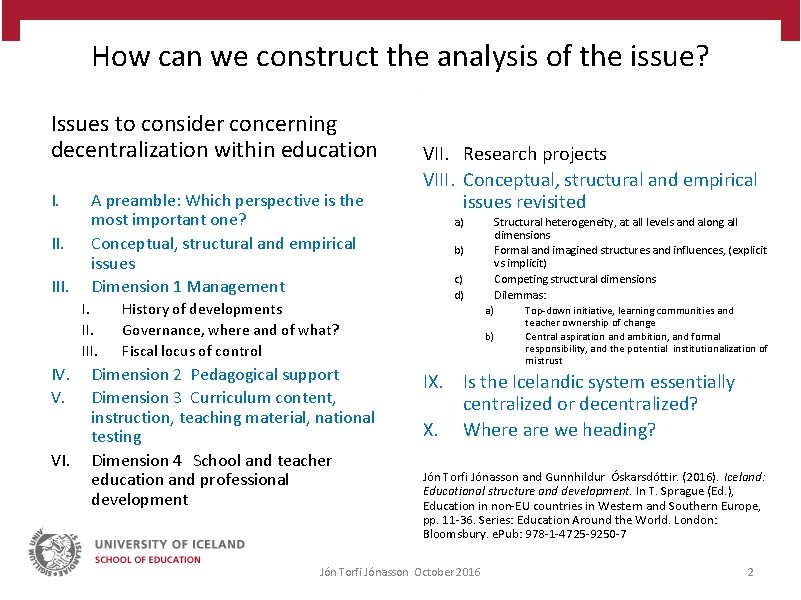
How can we construct the analysis of the issue? Issues to consider concerning decentralization within education I. III. A preamble: Which perspective is the most important one? Conceptual, structural and empirical issues Dimension 1 Management I. III. IV. V. VI. History of developments Governance, where and of what? Fiscal locus of control Dimension 2 Pedagogical support Dimension 3 Curriculum content, instruction, teaching material, national testing Dimension 4 School and teacher education and professional development VII. Research projects VIII. Conceptual, structural and empirical issues revisited a) Structural heterogeneity, at all levels and along all dimensions Formal and imagined structures and influences, (explicit vs implicit) Competing structural dimensions Dilemmas: b) c) d) a) b) Top-down initiative, learning communities and teacher ownership of change Central aspiration and ambition, and formal responsibility, and the potential institutionalization of mistrust IX. Is the Icelandic system essentially centralized or decentralized? X. Where are we heading? Jón Torfi Jónasson and Gunnhildur Óskarsdóttir. (2016). Iceland: Educational structure and development. In T. Sprague (Ed. ), Education in non-EU countries in Western and Southern Europe, pp. 11 -36. Series: Education Around the World. London: Bloomsbury. e. Pub: 978 -1 -4725 -9250 -7 Jón Torfi Jónasson October 2016 2
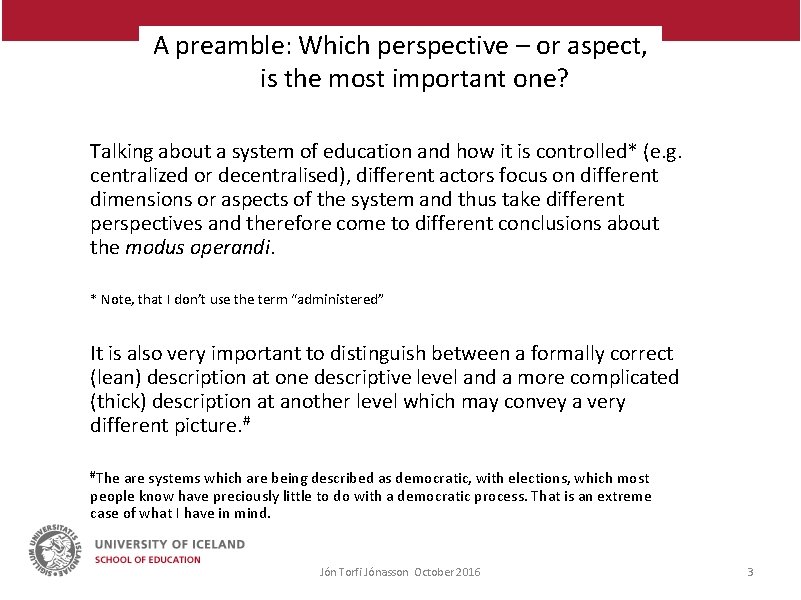
A preamble: Which perspective – or aspect, is the most important one? Talking about a system of education and how it is controlled* (e. g. centralized or decentralised), different actors focus on different dimensions or aspects of the system and thus take different perspectives and therefore come to different conclusions about the modus operandi. * Note, that I don’t use the term “administered” It is also very important to distinguish between a formally correct (lean) description at one descriptive level and a more complicated (thick) description at another level which may convey a very different picture. # #The are systems which are being described as democratic, with elections, which most people know have preciously little to do with a democratic process. That is an extreme case of what I have in mind. Jón Torfi Jónasson October 2016 3
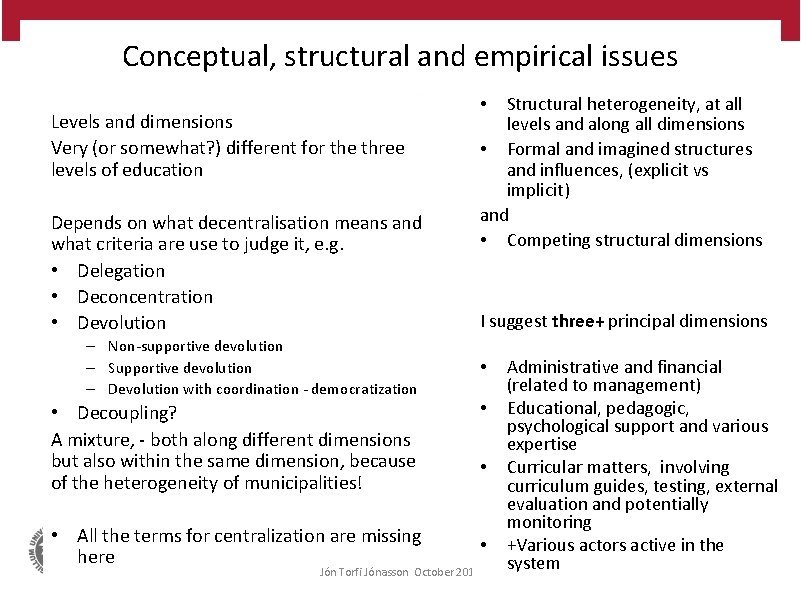
Conceptual, structural and empirical issues Levels and dimensions Very (or somewhat? ) different for the three levels of education Depends on what decentralisation means and what criteria are use to judge it, e. g. • Delegation • Deconcentration • Devolution – Non-supportive devolution – Supportive devolution – Devolution with coordination - democratization • Decoupling? A mixture, - both along different dimensions but also within the same dimension, because of the heterogeneity of municipalities! • All the terms for centralization are missing here Structural heterogeneity, at all levels and along all dimensions • Formal and imagined structures and influences, (explicit vs implicit) and • Competing structural dimensions • I suggest three+ principal dimensions • • Jón Torfi Jónasson October 2016 Administrative and financial (related to management) Educational, pedagogic, psychological support and various expertise Curricular matters, involving curriculum guides, testing, external evaluation and potentially monitoring +Various actors active in the system 4
Dimension 1: Management Jón Torfi Jónasson October 2016 5
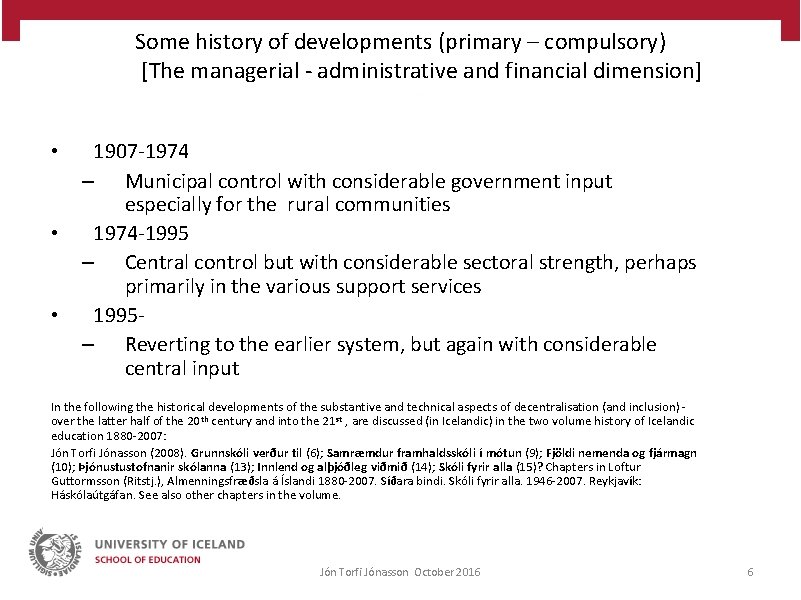
Some history of developments (primary – compulsory) [The managerial - administrative and financial dimension] • • • 1907 -1974 – Municipal control with considerable government input especially for the rural communities 1974 -1995 – Central control but with considerable sectoral strength, perhaps primarily in the various support services 1995– Reverting to the earlier system, but again with considerable central input In the following the historical developments of the substantive and technical aspects of decentralisation (and inclusion) - over the latter half of the 20 th century and into the 21 st , are discussed (in Icelandic) in the two volume history of Icelandic education 1880 -2007: Jón Torfi Jónasson (2008). Grunnskóli verður til (6); Samræmdur framhaldsskóli í mótun (9); Fjöldi nemenda og fjármagn (10); Þjónustustofnanir skólanna (13); Innlend og alþjóðleg viðmið (14); Skóli fyrir alla (15)? Chapters in Loftur Guttormsson (Ritstj. ), Almenningsfræðsla á Íslandi 1880 -2007. Síðara bindi. Skóli fyrir alla. 1946 -2007. Reykjavík: Háskólaútgáfan. See also other chapters in the volume. Jón Torfi Jónasson October 2016 6
Jón Torfi Jónasson October 2016 7
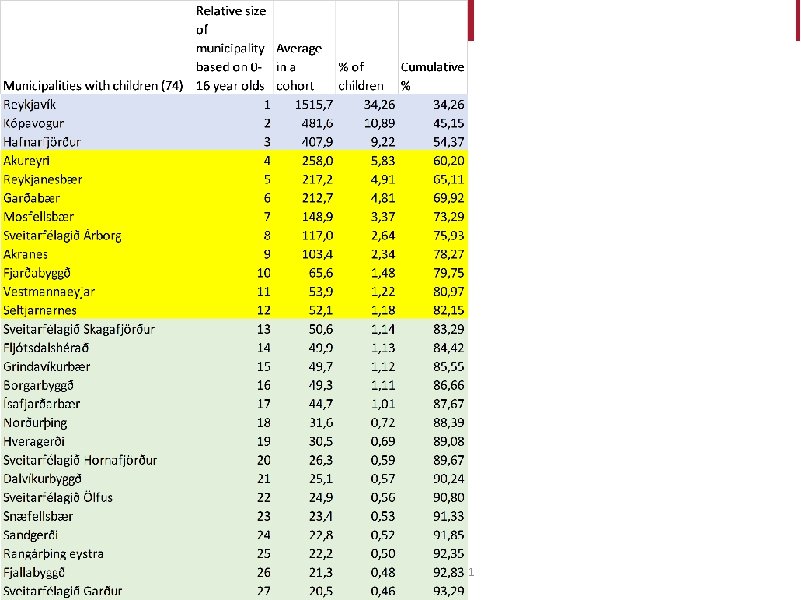
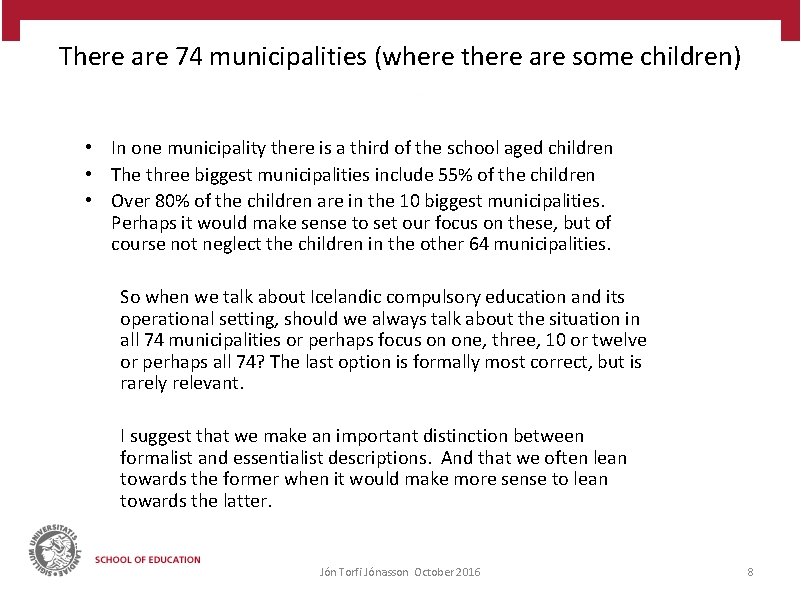
There are 74 municipalities (where there are some children) • In one municipality there is a third of the school aged children • The three biggest municipalities include 55% of the children • Over 80% of the children are in the 10 biggest municipalities. Perhaps it would make sense to set our focus on these, but of course not neglect the children in the other 64 municipalities. So when we talk about Icelandic compulsory education and its operational setting, should we always talk about the situation in all 74 municipalities or perhaps focus on one, three, 10 or twelve or perhaps all 74? The last option is formally most correct, but is rarely relevant. I suggest that we make an important distinction between formalist and essentialist descriptions. And that we often lean towards the former when it would make more sense to lean towards the latter. Jón Torfi Jónasson October 2016 8
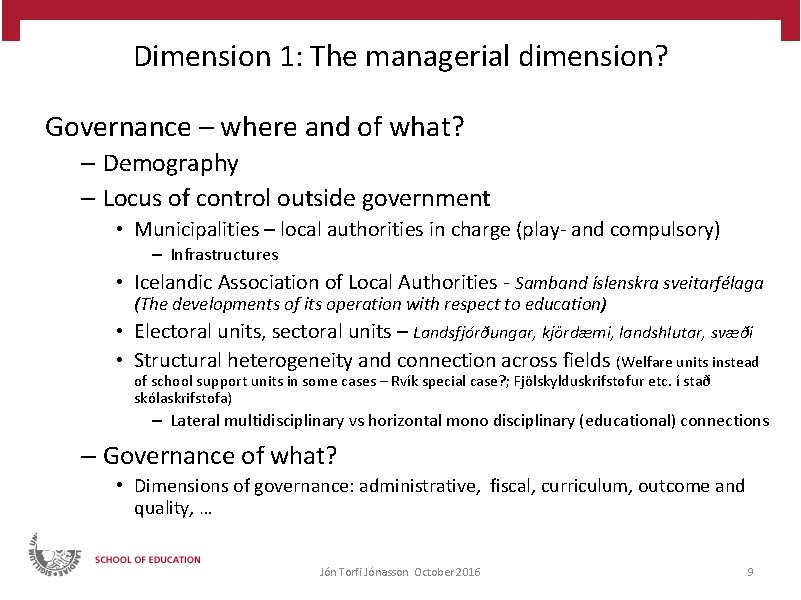
Dimension 1: The managerial dimension? Governance – where and of what? – Demography – Locus of control outside government • Municipalities – local authorities in charge (play- and compulsory) – Infrastructures • Icelandic Association of Local Authorities - Samband íslenskra sveitarfélaga (The developments of its operation with respect to education) • Electoral units, sectoral units – Landsfjórðungar, kjördæmi, landshlutar, svæði • Structural heterogeneity and connection across fields (Welfare units instead of school support units in some cases – Rvík special case? ; Fjölskylduskrifstofur etc. í stað skólaskrifstofa) – Lateral multidisciplinary vs horizontal mono disciplinary (educational) connections – Governance of what? • Dimensions of governance: administrative, fiscal, curriculum, outcome and quality, … Jón Torfi Jónasson October 2016 9
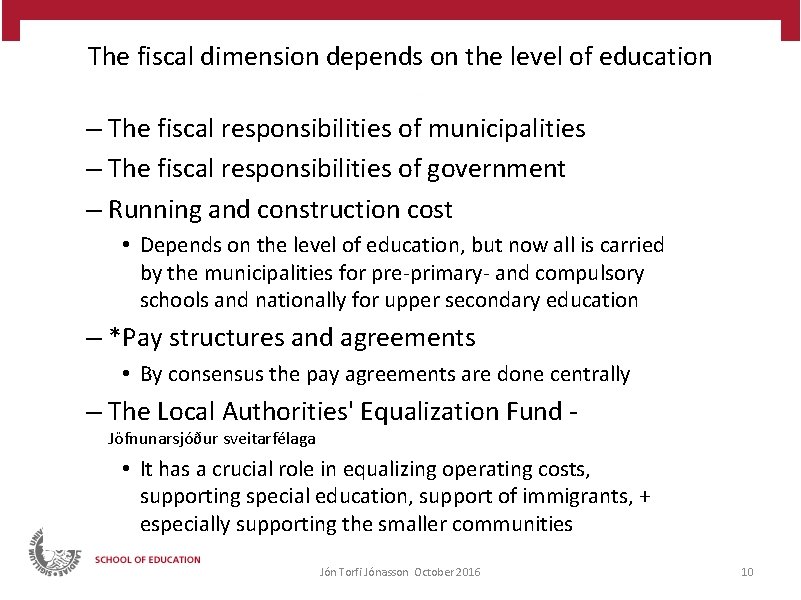
The fiscal dimension depends on the level of education – The fiscal responsibilities of municipalities – The fiscal responsibilities of government – Running and construction cost • Depends on the level of education, but now all is carried by the municipalities for pre-primary- and compulsory schools and nationally for upper secondary education – *Pay structures and agreements • By consensus the pay agreements are done centrally – The Local Authorities' Equalization Fund - Jöfnunarsjóður sveitarfélaga • It has a crucial role in equalizing operating costs, supporting special education, support of immigrants, + especially supporting the smaller communities Jón Torfi Jónasson October 2016 10
Dimension 2: Pedagogical support Jón Torfi Jónasson October 2016 11
Dimension 2: The substantive support system • A somewhat missing link in my discussion but a very important dimension, perhaps the second most important one • The educational, pedagogical, psychological, curricular support Jón Torfi Jónasson October 2016 12
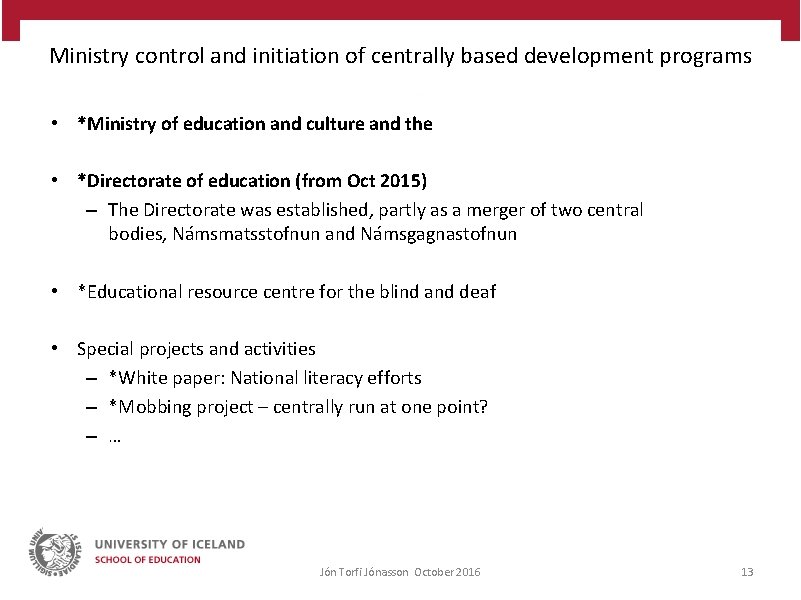
Ministry control and initiation of centrally based development programs • *Ministry of education and culture and the • *Directorate of education (from Oct 2015) – The Directorate was established, partly as a merger of two central bodies, Námsmatsstofnun and Námsgagnastofnun • *Educational resource centre for the blind and deaf • Special projects and activities – *White paper: National literacy efforts – *Mobbing project – centrally run at one point? – … Jón Torfi Jónasson October 2016 13
Dimension 3: Curricular matters Jón Torfi Jónasson October 2016 14
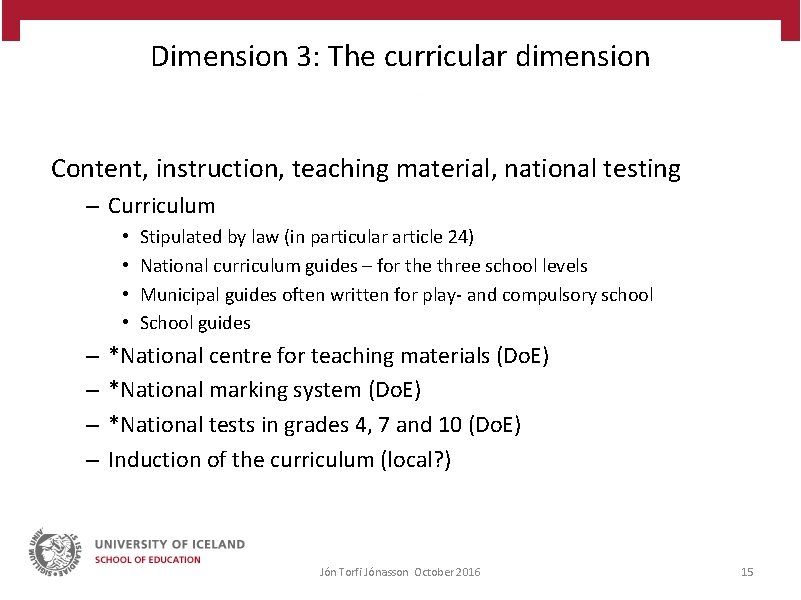
Dimension 3: The curricular dimension Content, instruction, teaching material, national testing – Curriculum • • – – Stipulated by law (in particular article 24) National curriculum guides – for the three school levels Municipal guides often written for play- and compulsory school School guides *National centre for teaching materials (Do. E) *National marking system (Do. E) *National tests in grades 4, 7 and 10 (Do. E) Induction of the curriculum (local? ) Jón Torfi Jónasson October 2016 15
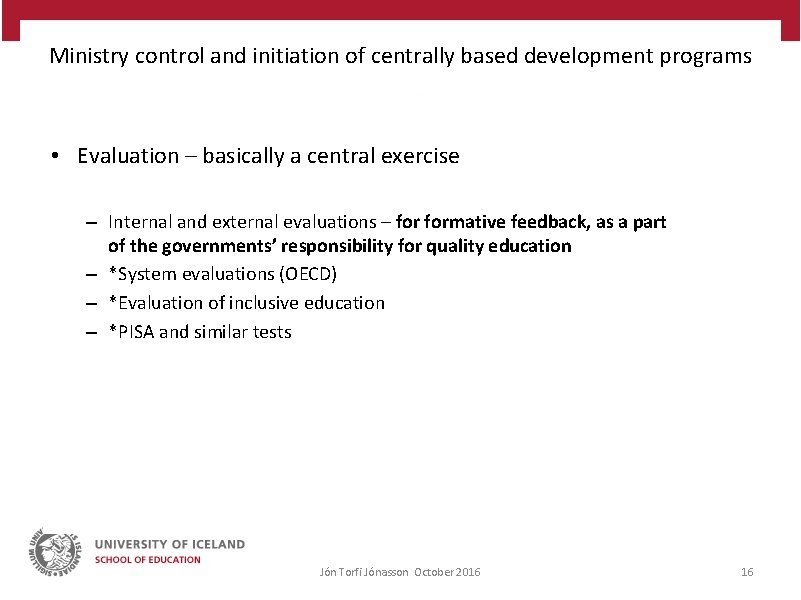
Ministry control and initiation of centrally based development programs • Evaluation – basically a central exercise – Internal and external evaluations – formative feedback, as a part of the governments’ responsibility for quality education – *System evaluations (OECD) – *Evaluation of inclusive education – *PISA and similar tests Jón Torfi Jónasson October 2016 16
Dimension 4? : Miscellaneous actors Jón Torfi Jónasson October 2016 17
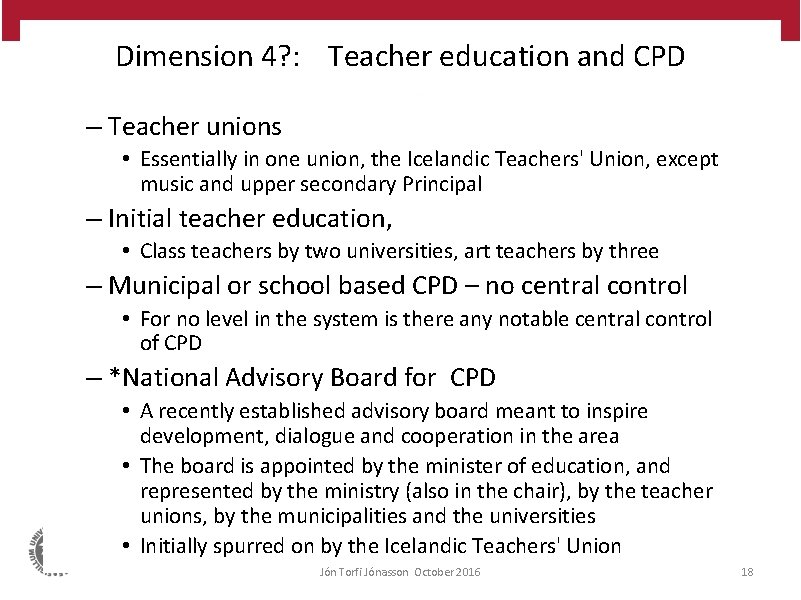
Dimension 4? : Teacher education and CPD – Teacher unions • Essentially in one union, the Icelandic Teachers' Union, except music and upper secondary Principal – Initial teacher education, • Class teachers by two universities, art teachers by three – Municipal or school based CPD – no central control • For no level in the system is there any notable central control of CPD – *National Advisory Board for CPD • A recently established advisory board meant to inspire development, dialogue and cooperation in the area • The board is appointed by the minister of education, and represented by the ministry (also in the chair), by the teacher unions, by the municipalities and the universities • Initially spurred on by the Icelandic Teachers' Union Jón Torfi Jónasson October 2016 18
Research – part of dimension 4 • Research projects – Done both on a national and a municipal and school basis Jón Torfi Jónasson October 2016 19
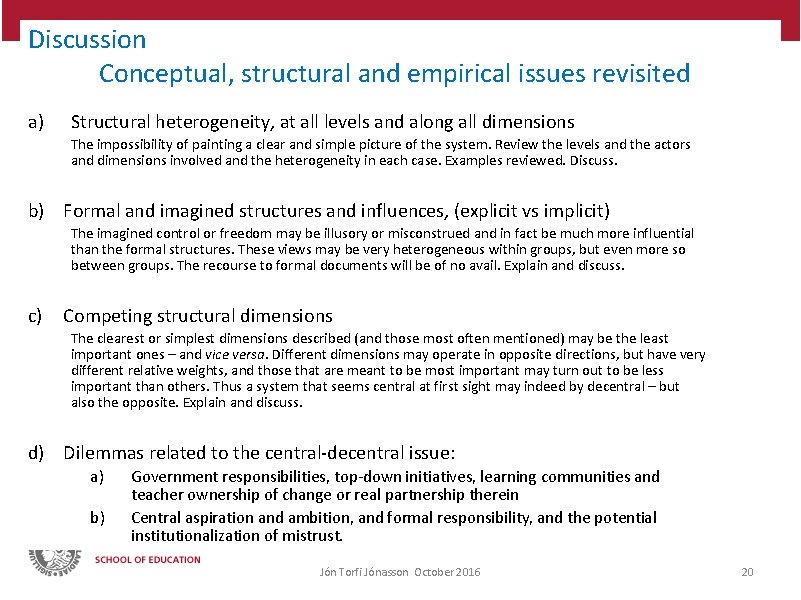
Discussion Conceptual, structural and empirical issues revisited a) Structural heterogeneity, at all levels and along all dimensions The impossibility of painting a clear and simple picture of the system. Review the levels and the actors and dimensions involved and the heterogeneity in each case. Examples reviewed. Discuss. b) Formal and imagined structures and influences, (explicit vs implicit) The imagined control or freedom may be illusory or misconstrued and in fact be much more influential than the formal structures. These views may be very heterogeneous within groups, but even more so between groups. The recourse to formal documents will be of no avail. Explain and discuss. c) Competing structural dimensions The clearest or simplest dimensions described (and those most often mentioned) may be the least important ones – and vice versa. Different dimensions may operate in opposite directions, but have very different relative weights, and those that are meant to be most important may turn out to be less important than others. Thus a system that seems central at first sight may indeed by decentral – but also the opposite. Explain and discuss. d) Dilemmas related to the central-decentral issue: a) b) Government responsibilities, top-down initiatives, learning communities and teacher ownership of change or real partnership therein Central aspiration and ambition, and formal responsibility, and the potential institutionalization of mistrust. Jón Torfi Jónasson October 2016 20
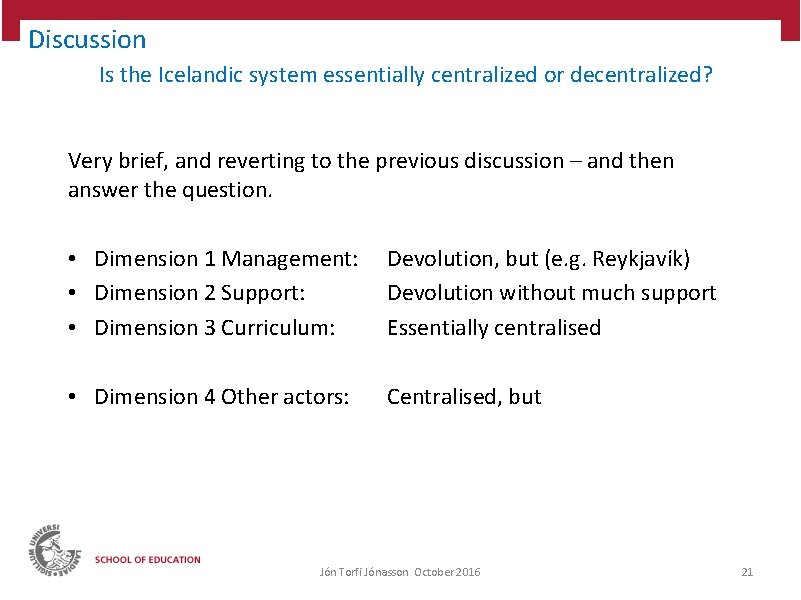
Discussion Is the Icelandic system essentially centralized or decentralized? Very brief, and reverting to the previous discussion – and then answer the question. • Dimension 1 Management: • Dimension 2 Support: • Dimension 3 Curriculum: Devolution, but (e. g. Reykjavík) Devolution without much support Essentially centralised • Dimension 4 Other actors: Centralised, but Jón Torfi Jónasson October 2016 21
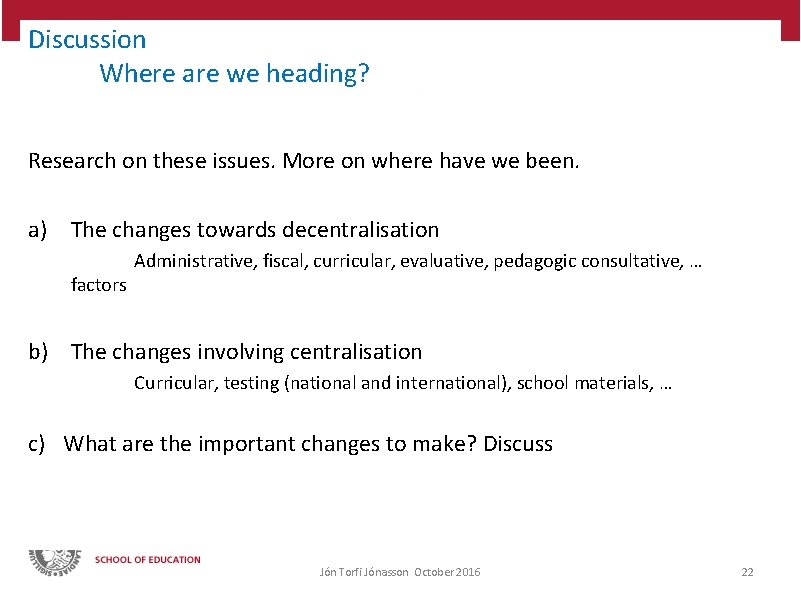
Discussion Where are we heading? Research on these issues. More on where have we been. a) The changes towards decentralisation factors Administrative, fiscal, curricular, evaluative, pedagogic consultative, … b) The changes involving centralisation Curricular, testing (national and international), school materials, … c) What are the important changes to make? Discuss Jón Torfi Jónasson October 2016 22
Research on issues related to the form of control • • • Þorsteinn Sæberg (2009). Flutningur grunnskólans til sveitarfélaganna, fjárhagsleg-, fagleg- og stjórnunarleg áhrif Kristín Hreinsdóttir (2013). „Þar brenna allir mínir eldar. “ Um áhrif sveitastjórna á grunnskólann. Hildur Ösp Gylfadóttir (2012). Þekkingarmiðlun hjá stjórnsýslu íslenskra sveitarfélaga. Áskoranir og ávinningur Börkur Hansen, Ólafur H. Jóhannsson og Steinunn Helga Lárusdóttir. (2010). Faglegt sjálfstæði grunskóla – viðhorf skólastjóra. Uppeldi og menntun, 19(1 -2), 51 -70. Börkur Hansen og Ólafur H. Jóhannsson. (2010). Allt í öllu. Hlutverk fræðslustjóra 1975 -1996. Reykjavík: Háskólaútgáfan. Amalía Björnsdóttir, Börkur Hansen and Ólafur Helgi Jóhannsson. (2008). The influence of teachers in the operation of basic schools in Iceland. Scandinavian Journal of Educational Research, 52(5), 513– 526. Börkur Hansen and Ólafur H. Jóhannsson. (2008). Issues arising from the decentralization of basic schools in Iceland. Í P. Hansson og K. Malmberg (ritstjórar) Education with a moral purpose. Educational leadership, management and governance for a sustainable future (bls. 44 -51). Uppsala Universitet. Guðmundur Ó. Ásmundsson, Börkur Hansen, Ólafur H. Jóhannsson. (2008). Stjórnskipulag grunnskóla, hugmyndir skólanefnda um völd sín og áhrif. Netla – Veftímarit um uppeldi og menntun. Grein birt 1. des. (13 bls. ). Börkur Hansen, Ólafur H. Jóhannsson, Steinunn Helga Lárusdóttir. (2008). Breytingar á hlutverki skólastjóra í grunnskólum – kröfur, mótsagnir og togstreita. Uppeldi og menntun, 17(2), 87 -104. Amalía Björnsdóttir, Börkur Hansen, Ólafur H. Jóhannsson. (2006). Mótun skólastarfs ─ Hver er hlutur kennara? ” Tímarit um menntarannsóknir (2006), 3. Félag um menntarannsóknir (bls. 12 -26). Börkur Hansen, Ólafur H. Jóhannsson, Steinunn Helga Lárusdóttir (2004) Yfirfærsla grunnskólans til sveitarfélaga – valddreifing eða miðstýring? ” Birt í Netlu í nóvember 2004. Börkur Hansen. (2004). Heimastjórnun. Áhersla í stefnumörkun um grunnskóla. Birt í Netlu í maí 2004 Jón Torfi Jónasson October 2016 23
Thank you Jón Torfi Jónasson October 2016 24