
The Federal Ministry of Education and Research Germans
- Slides: 27
The Federal Ministry of Education and Research Germans R&D System and International Cooperation Dr. Irina Ehrhardt Head of Division „Cooperation with North- and South-America“ Hannover, April 2008
Overview 1. The Federal Ministry of Education and Research 2. Funding Research 3. The Hightech Strategy 4. Internationalization Strategy 5. International Cooperation and the EU 6. Perspectives 2
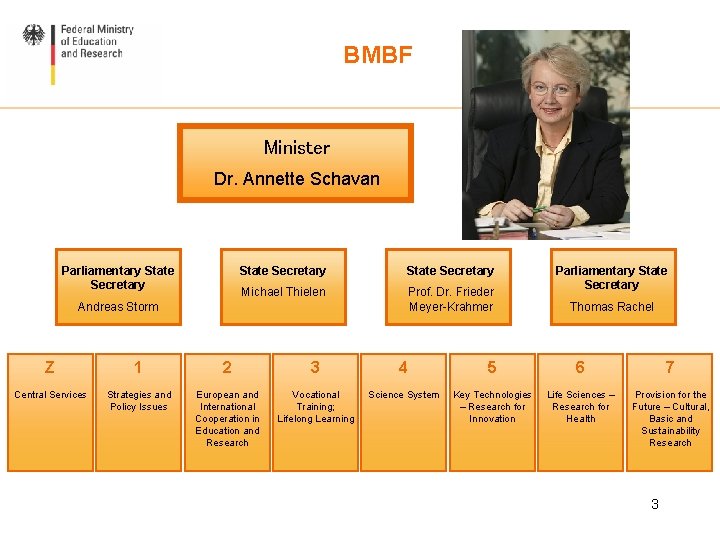
BMBF Minister Dr. Annette Schavan Parliamentary State Secretary Michael Thielen Prof. Dr. Frieder Meyer-Krahmer Andreas Storm Parliamentary State Secretary Thomas Rachel Z 1 2 3 4 5 6 7 Central Services Strategies and Policy Issues European and International Cooperation in Education and Research Vocational Training; Lifelong Learning Science System Key Technologies – Research for Innovation Life Sciences – Research for Health Provision for the Future – Cultural, Basic and Sustainability Research 3
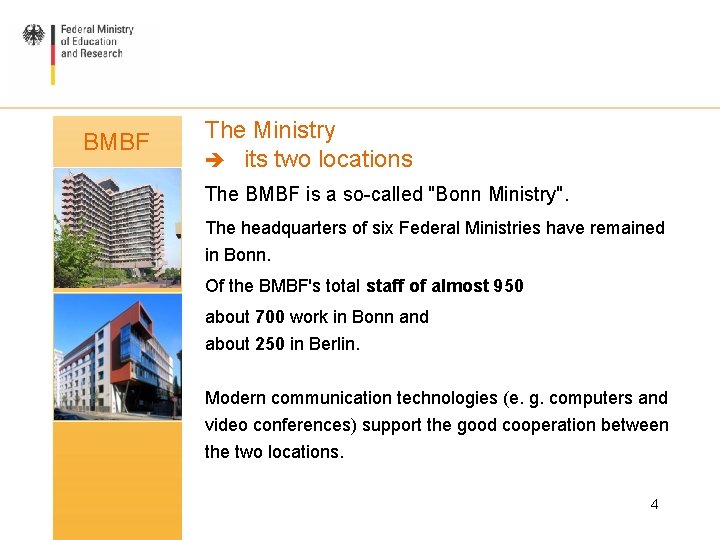
BMBF The Ministry è its two locations The BMBF is a so-called "Bonn Ministry". The headquarters of six Federal Ministries have remained in Bonn. Of the BMBF's total staff of almost 950 about 700 work in Bonn and about 250 in Berlin. Modern communication technologies (e. g. computers and video conferences) support the good cooperation between the two locations. 4
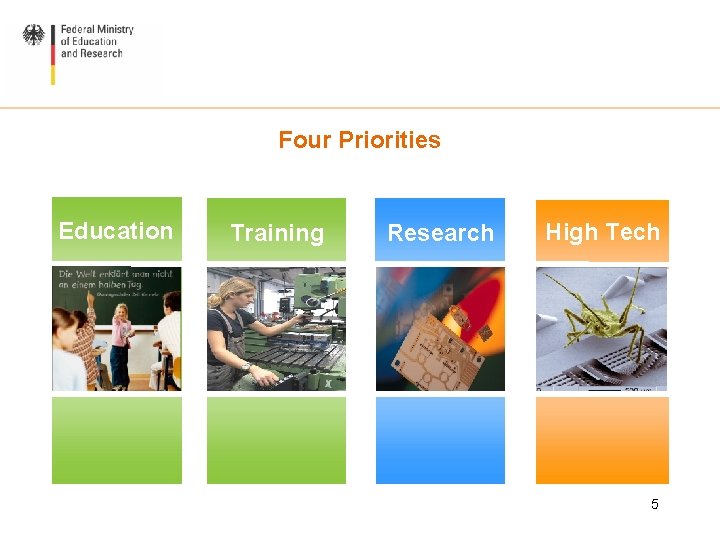
Four Priorities Education Training Research High Tech 5
Overview 1. The Federal Ministry of Education and Research 2. Funding Research 3. The Hightech Strategy 4. Internationalization Strategy 5. International Cooperation and the EU 6. Perspectives 6
Public Funding – Joint Competence § The Federal Government – especially the BMBF – is funding research in high-priority areas within special funding programs. § The State Governments (“Länder“) are funding the universities. - All universities are involved in research. § Federal and State Governments are funding the most important research oranizations together. 7
Research Basic funding for institutions Research in Germany is recognized worldwide. Science and research are the central strategic factors in international competition. Together with the Länder, the BMBF is funding the most important research organizations: è Max Planck Society (MPG) è Helmholtz Association (HGF) è Fraunhofer-Gesellschaft (Fh. G) è Leibniz Association (WGL) è Deutsche Forschungsgemeinschaft (DFG) 8
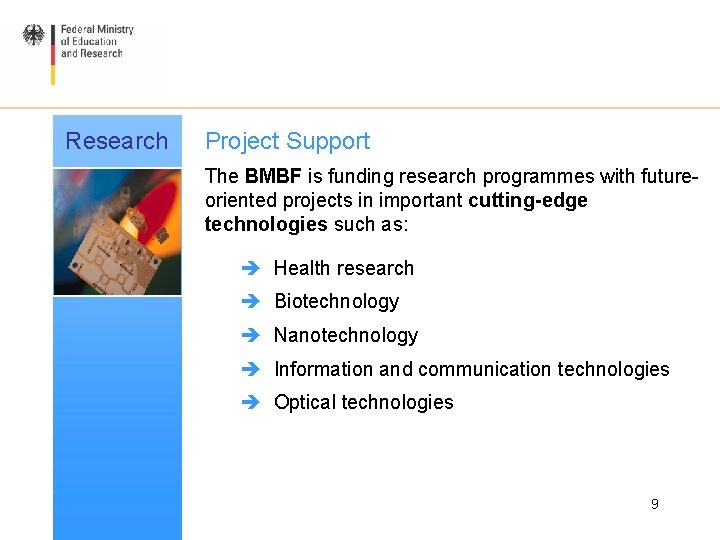
Research Project Support The BMBF is funding research programmes with futureoriented projects in important cutting-edge technologies such as: è Health research è Biotechnology è Nanotechnology è Information and communication technologies è Optical technologies 9
BMBF Haushalt: Entwicklung 1998 Budget 2007 The Federal Government is increasing its support for research, innovation and excellence in science. The budget provided for 2007 was increased by 6. 1 % up to 8. 5 billion Euro. In 2008 we expect to increase the support to 8. 9 billion Euro. Further funding was available for the expansion of allday schools and for training assistance (BAföG loans). An important focus is project funding in particularly promising areas of technology. Funding for the humanities and cultural sciences was increased by 18 % – to about 43 million Euro. Priority to Education and Research 10
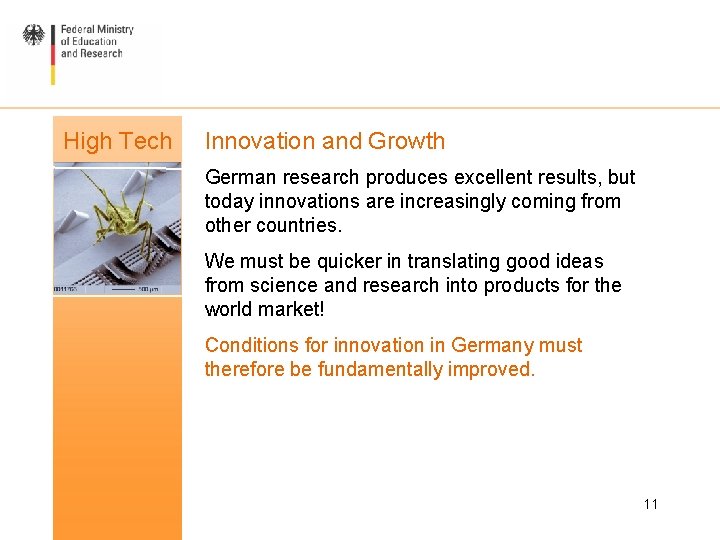
High Tech Innovation and Growth German research produces excellent results, but today innovations are increasingly coming from other countries. We must be quicker in translating good ideas from science and research into products for the world market! Conditions for innovation in Germany must therefore be fundamentally improved. 11
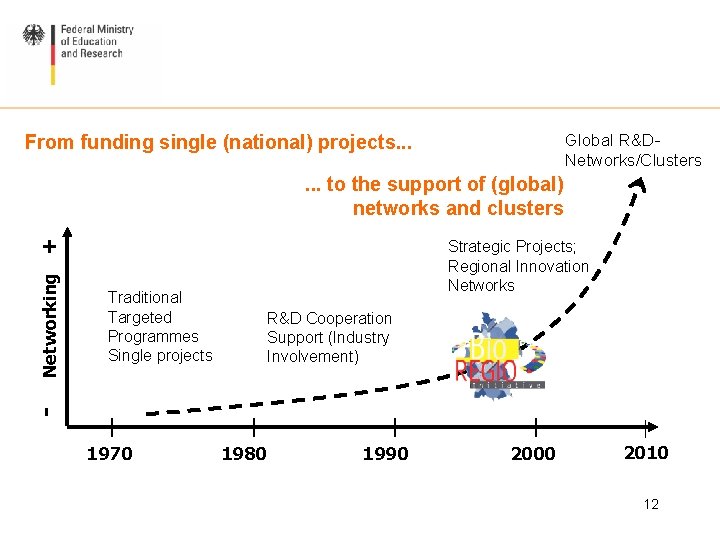
Global R&DNetworks/Clusters From funding single (national) projects. . . to the support of (global) networks and clusters Traditional Targeted Programmes Single projects Strategic Projects; Regional Innovation Networks R&D Cooperation Support (Industry Involvement) - Networking + 1970 1980 1990 2000 2010 12
How does Germany react to globalisation and the current and future challenges in R&D? § International dimension of the High-Tech Strategy (August 2006) and § Internationalisation Strategy (February 2008) 13
Overview 1. The Federal Ministry of Education and Research 2. Funding Research 3. The Hightech Strategy 4. Internationalization Strategy 5. International Cooperation and the EU 6. Perspectives 14
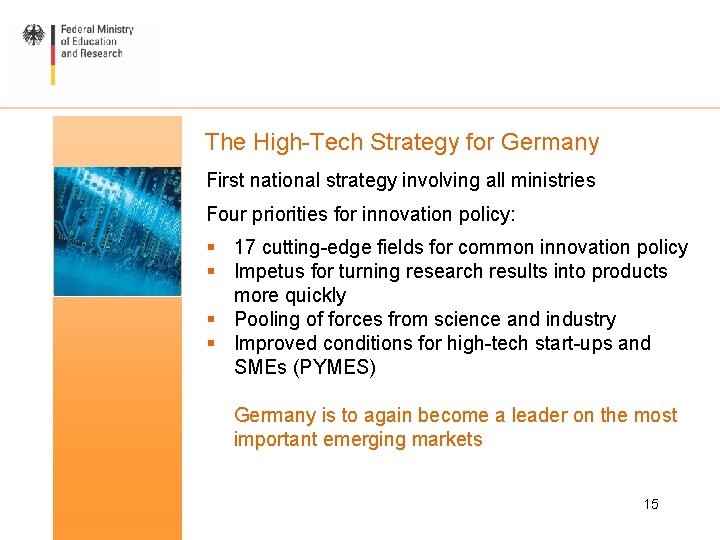
The High-Tech Strategy for Germany First national strategy involving all ministries Four priorities for innovation policy: § 17 cutting-edge fields for common innovation policy § Impetus for turning research results into products more quickly § Pooling of forces from science and industry § Improved conditions for high-tech start-ups and SMEs (PYMES) Germany is to again become a leader on the most important emerging markets 15
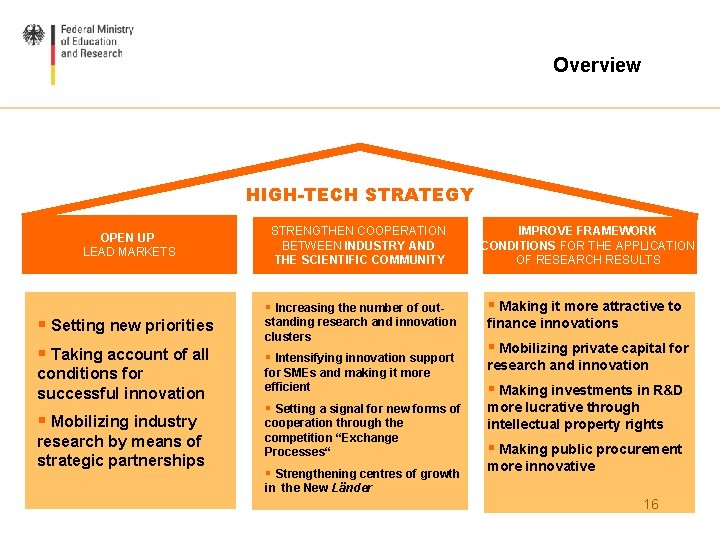
Overview HIGH-TECH STRATEGY OPEN UP LEAD MARKETS § Setting new priorities § Taking account of all conditions for successful innovation § Mobilizing industry research by means of strategic partnerships STRENGTHEN COOPERATION BETWEEN INDUSTRY AND THE SCIENTIFIC COMMUNITY § Increasing the number of outstanding research and innovation clusters § Intensifying innovation support for SMEs and making it more efficient § Setting a signal for new forms of cooperation through the competition “Exchange Processes“ § Strengthening centres of growth IMPROVE FRAMEWORK CONDITIONS FOR THE APPLICATION OF RESEARCH RESULTS § Making it more attractive to finance innovations § Mobilizing private capital for research and innovation § Making investments in R&D more lucrative through intellectual property rights § Making public procurement more innovative in the New Länder 16
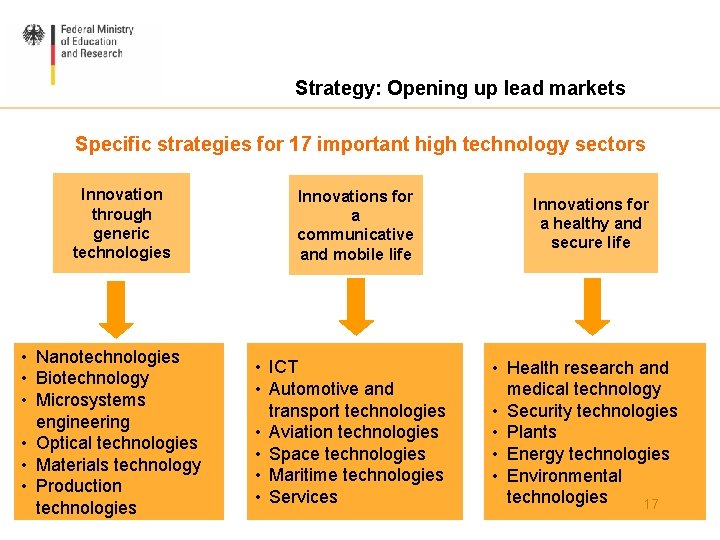
Strategy: Opening up lead markets Specific strategies for 17 important high technology sectors Innovation through generic technologies • Nanotechnologies • Biotechnology • Microsystems engineering • Optical technologies • Materials technology • Production technologies Innovations for a communicative and mobile life • ICT • Automotive and transport technologies • Aviation technologies • Space technologies • Maritime technologies • Services Innovations for a healthy and secure life • Health research and medical technology • Security technologies • Plants • Energy technologies • Environmental technologies 17
Overview 1. The Federal Ministry of Education and Research 2. Funding Research 3. The Hightech Strategy 4. Internationalization Strategy 5. International Cooperation and the EU 6. Perspectives 18
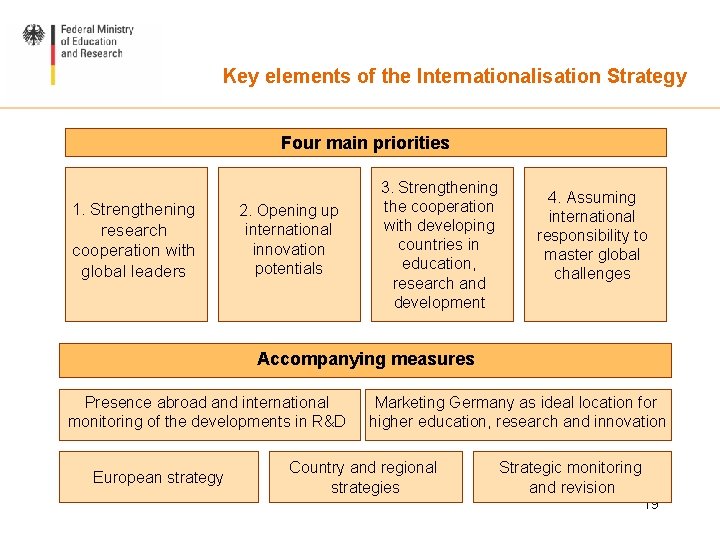
Key elements of the Internationalisation Strategy Four main priorities 1. Strengthening research cooperation with global leaders 2. Opening up international innovation potentials 3. Strengthening the cooperation with developing countries in education, research and development 4. Assuming international responsibility to master global challenges Accompanying measures Presence abroad and international monitoring of the developments in R&D European strategy Marketing Germany as ideal location for higher education, research and innovation Country and regional strategies Strategic monitoring and revision 19
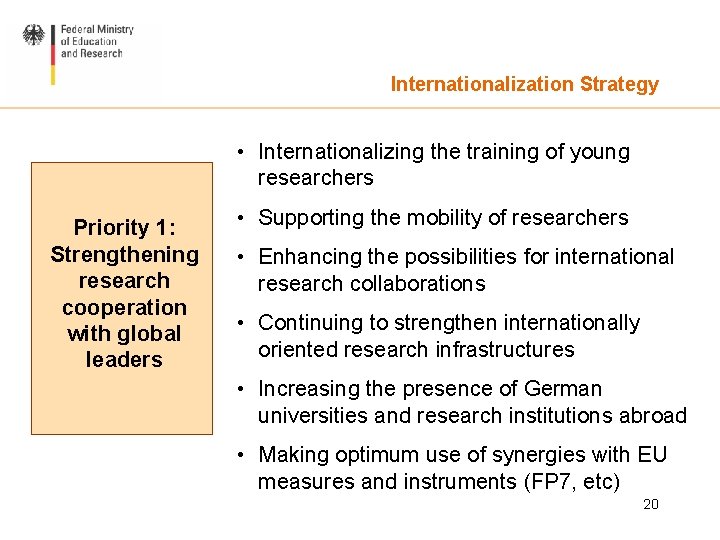
Internationalization Strategy • Internationalizing the training of young researchers Priority 1: Strengthening research cooperation with global leaders • Supporting the mobility of researchers • Enhancing the possibilities for international research collaborations • Continuing to strengthen internationally oriented research infrastructures • Increasing the presence of German universities and research institutions abroad • Making optimum use of synergies with EU measures and instruments (FP 7, etc) 20
Overview 1. The Federal Ministry of Education and Research 2. Funding Research 3. The Hightech Strategy 4. Internationalization Strategy 5. International Cooperation and the EU 6. Perspectives 21
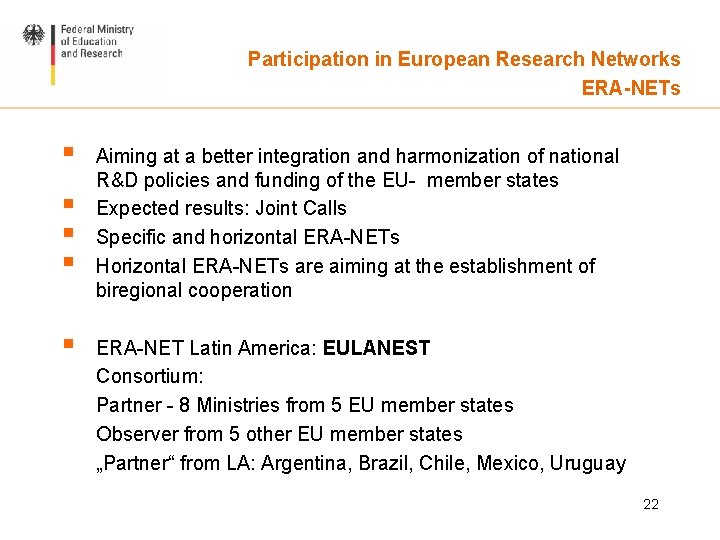
Participation in European Research Networks ERA-NETs § § § Aiming at a better integration and harmonization of national R&D policies and funding of the EU- member states Expected results: Joint Calls Specific and horizontal ERA-NETs Horizontal ERA-NETs are aiming at the establishment of biregional cooperation ERA-NET Latin America: EULANEST Consortium: Partner - 8 Ministries from 5 EU member states Observer from 5 other EU member states „Partner“ from LA: Argentina, Brazil, Chile, Mexico, Uruguay 22
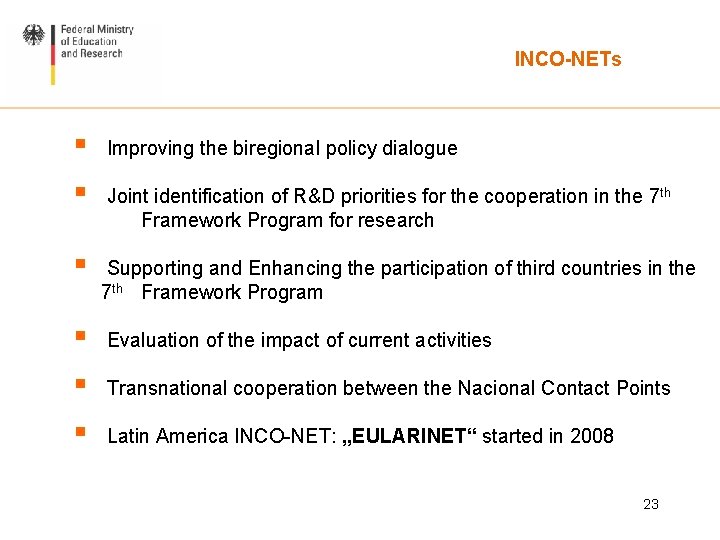
INCO-NETs § Improving the biregional policy dialogue § Joint identification of R&D priorities for the cooperation in the 7 th Framework Program for research § Supporting and Enhancing the participation of third countries in the 7 th Framework Program § Evaluation of the impact of current activities § Transnational cooperation between the Nacional Contact Points § Latin America INCO-NET: „EULARINET“ started in 2008 23
Overview 1. The Federal Ministry of Education and Research 2. Funding Research 3. The Hightech Strategy 4. Internationalization Strategy 5. International Cooperation and the EU 6. Perspectives 24
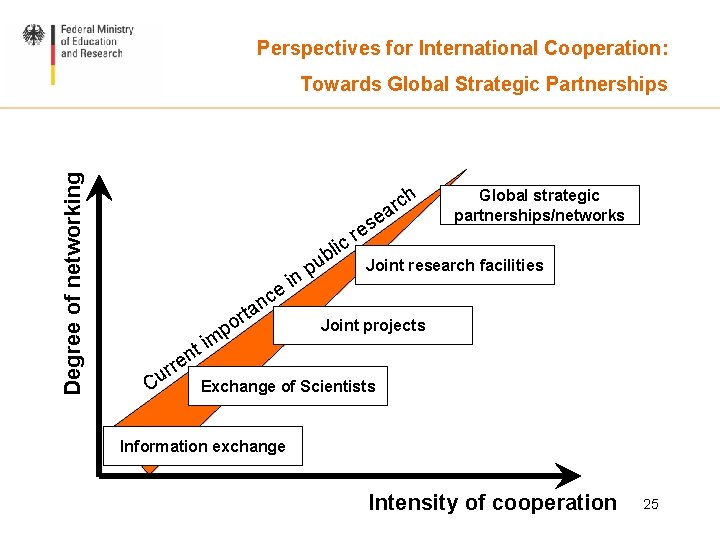
Perspectives for International Cooperation: Degree of networking Towards Global Strategic Partnerships ch r a se re c li ub p n r Cu t n e r o mp i e c n ta i Global strategic partnerships/networks Joint research facilities Joint projects r Exchange of Scientists Information exchange Intensity of cooperation 25
BMBF Visit the Ministry's Homepage www. bmbf. de 26
BMBF Thank you for your attention! I will be pleased to answer your questions. 27