meson and strange quark dynamics at RHIC YuGang



- Slides: 27
-meson and strange quark dynamics at RHIC Yu-Gang Ma Shanghai Institute of Applied Physics, Chinese Academy of Sciences International Workshop Heavy Ion Physics at LHC Also dedicate to whom died in the 5/12 Wen-Chuan Earthquake
Outline l Motivation l -meson production and s-quark at RHIC — -meson production and elliptic flow, partonic (s-quark) collectivity — W/ ratio, s-quark transverse momentum dis. — -meson spin alignment, s-quark polarization — -meson enhancement, s-quark enhancement l Summary/outlook
RHIC puzzle: large p/ Unexpected large p/ ratio in central Au+Au collisions: behavior different from elementary collisions!
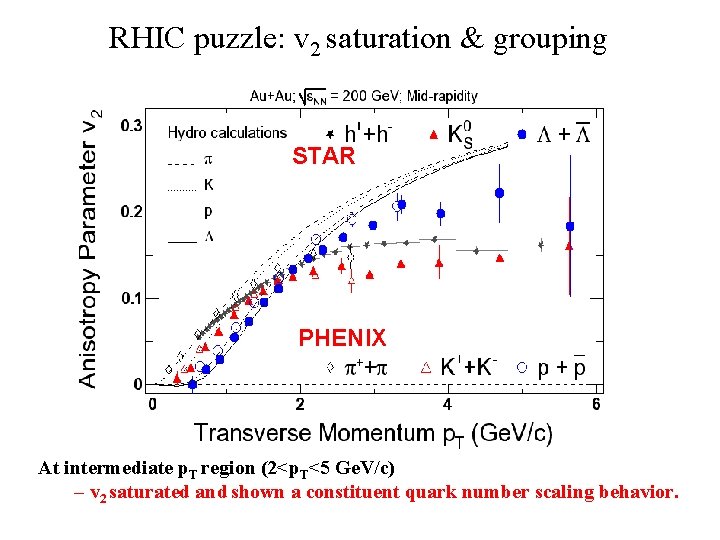
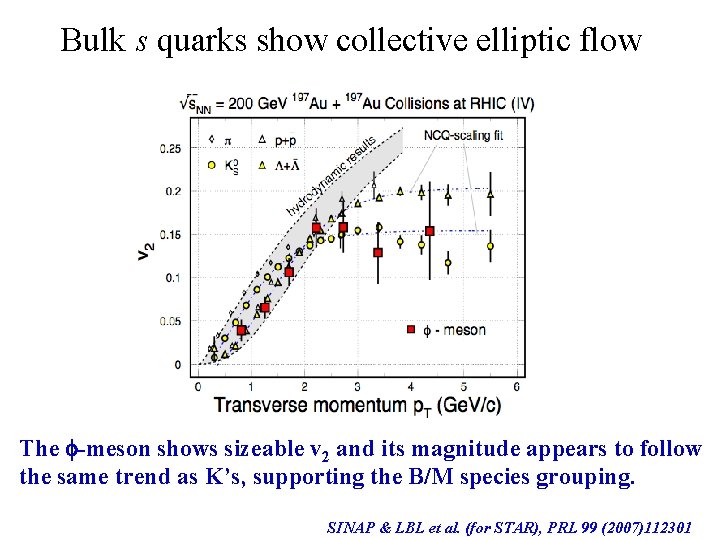
RHIC puzzle: v 2 saturation & grouping STAR PHENIX At intermediate p. T region (2<p. T<5 Ge. V/c) – v 2 saturated and shown a constituent quark number scaling behavior.
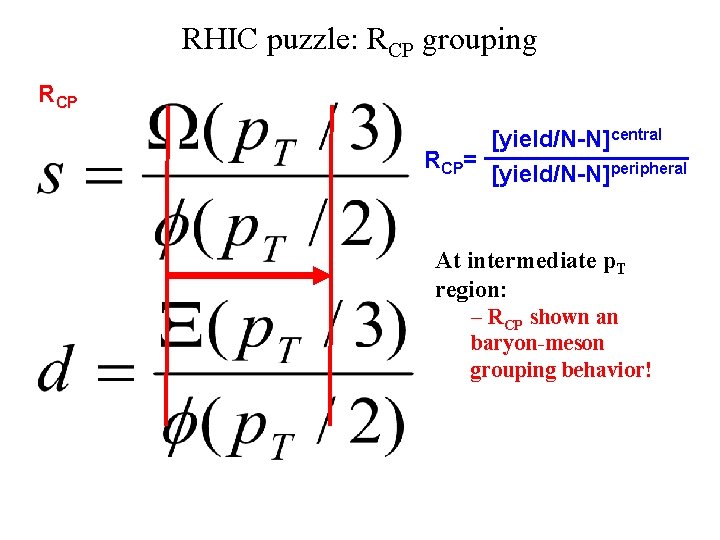
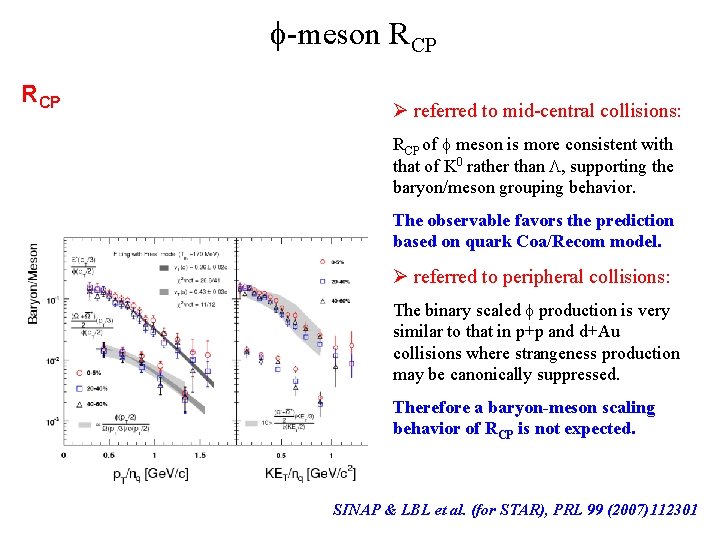
RHIC puzzle: RCP grouping RCP [yield/N-N]central RCP= [yield/N-N]peripheral At intermediate p. T region: – RCP shown an baryon-meson grouping behavior!
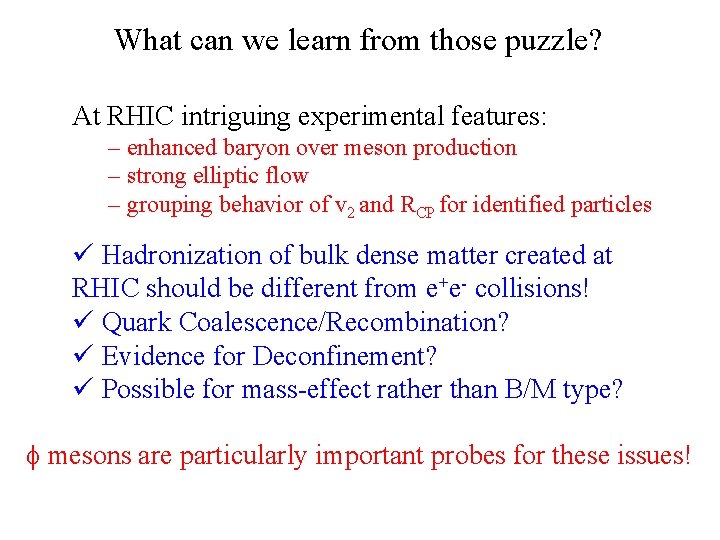
What can we learn from those puzzle? At RHIC intriguing experimental features: – enhanced baryon over meson production – strong elliptic flow – grouping behavior of v 2 and RCP for identified particles ü Hadronization of bulk dense matter created at RHIC should be different from e+e- collisions! ü Quark Coalescence/Recombination? ü Evidence for Deconfinement? ü Possible for mass-effect rather than B/M type? mesons are particularly important probes for these issues!
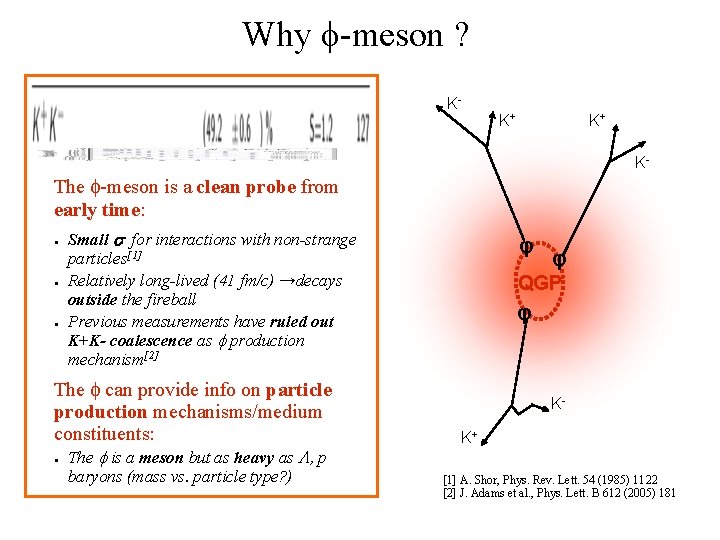
Why -meson ? K- K+ K+ K- The -meson is a clean probe from early time: ● ● ● Small s for interactions with non-strange particles[1] Relatively long-lived (41 fm/c) →decays outside the fireball Previous measurements have ruled out K+K- coalescence as f production mechanism[2] The can provide info on particle production mechanisms/medium constituents: ● The f is a meson but as heavy as L, p baryons (mass vs. particle type? ) φ φ QGP φ KK+ [1] A. Shor, Phys. Rev. Lett. 54 (1985) 1122 [2] J. Adams et al. , Phys. Lett. B 612 (2005) 181
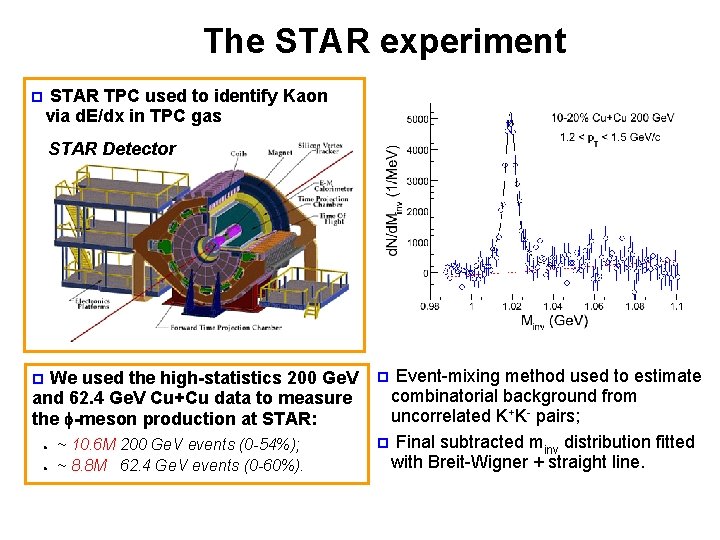
The STAR experiment STAR TPC used to identify Kaon via d. E/dx in TPC gas p STAR Detector We used the high-statistics 200 Ge. V and 62. 4 Ge. V Cu+Cu data to measure the -meson production at STAR: p ● ● ~ 10. 6 M 200 Ge. V events (0 -54%); ~ 8. 8 M 62. 4 Ge. V events (0 -60%). Event-mixing method used to estimate combinatorial background from uncorrelated K+K- pairs; p Final subtracted minv distribution fitted with Breit-Wigner + straight line. p
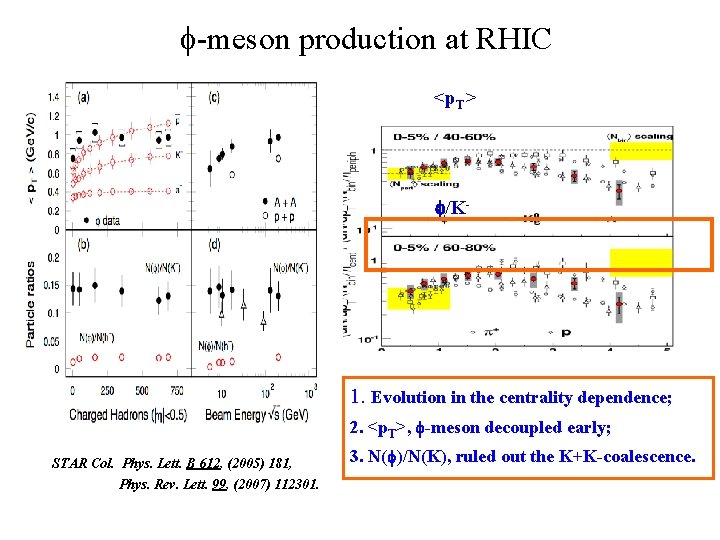
-meson production at RHIC <p. T> /K- 1. Evolution in the centrality dependence; 2. <p. T>, -meson decoupled early; STAR Col. Phys. Lett. B 612, (2005) 181, Phys. Rev. Lett. 99, (2007) 112301. 3. N( )/N(K), ruled out the K+K-coalescence.
-meson RCP Ø referred to mid-central collisions: RCP of meson is more consistent with that of K 0 rather than L, supporting the baryon/meson grouping behavior. The observable favors the prediction based on quark Coa/Recom model. Ø referred to peripheral collisions: The binary scaled production is very similar to that in p+p and d+Au collisions where strangeness production may be canonically suppressed. Therefore a baryon-meson scaling behavior of RCP is not expected. SINAP & LBL et al. (for STAR), PRL 99 (2007)112301
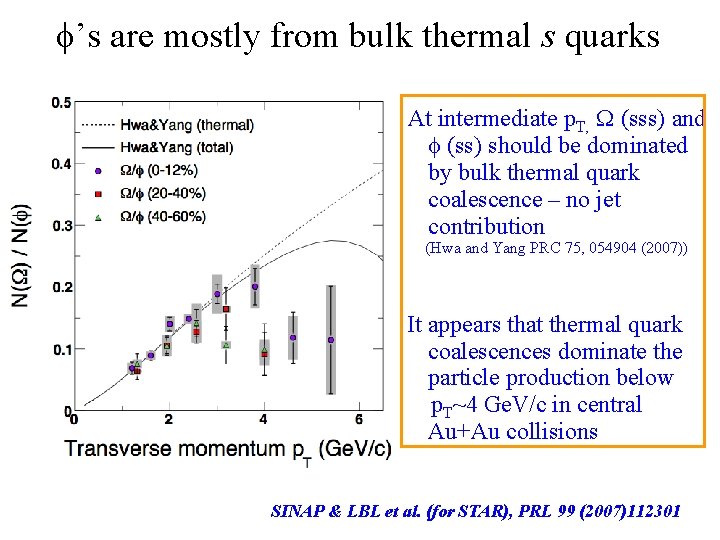
’s are mostly from bulk thermal s quarks At intermediate p. T, W (sss) and (ss) should be dominated by bulk thermal quark coalescence – no jet contribution (Hwa and Yang PRC 75, 054904 (2007)) It appears that thermal quark coalescences dominate the particle production below p. T~4 Ge. V/c in central Au+Au collisions SINAP & LBL et al. (for STAR), PRL 99 (2007)112301
Bulk s quarks show collective elliptic flow The -meson shows sizeable v 2 and its magnitude appears to follow the same trend as K’s, supporting the B/M species grouping. SINAP & LBL et al. (for STAR), PRL 99 (2007)112301
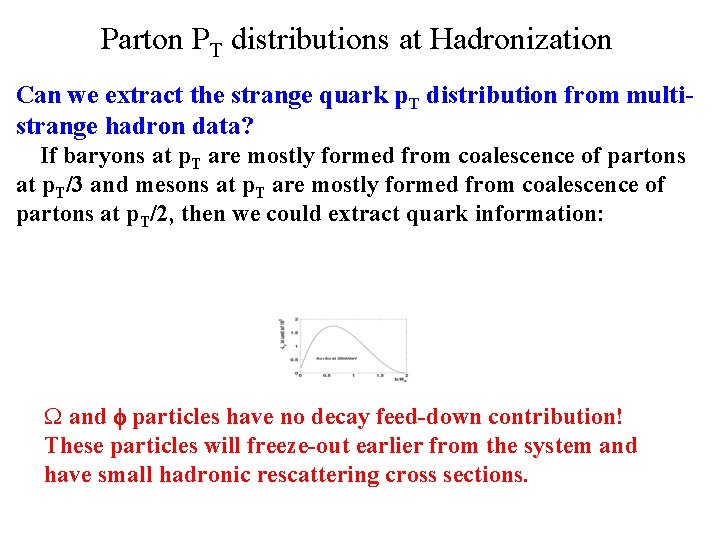
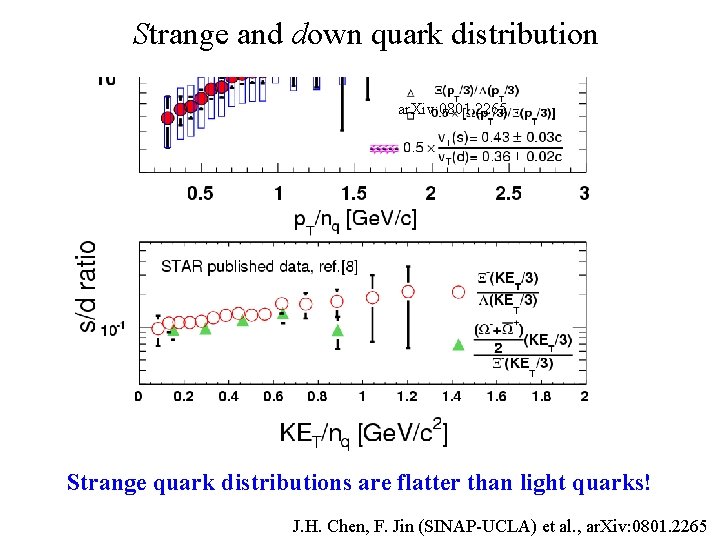
Parton PT distributions at Hadronization Can we extract the strange quark p. T distribution from multistrange hadron data? If baryons at p. T are mostly formed from coalescence of partons at p. T/3 and mesons at p. T are mostly formed from coalescence of partons at p. T/2, then we could extract quark information: W and particles have no decay feed-down contribution! These particles will freeze-out earlier from the system and have small hadronic rescattering cross sections.
Strange and down quark distribution ar. Xiv: 0801. 2265 Strange quark distributions are flatter than light quarks! J. H. Chen, F. Jin (SINAP-UCLA) et al. , ar. Xiv: 0801. 2265
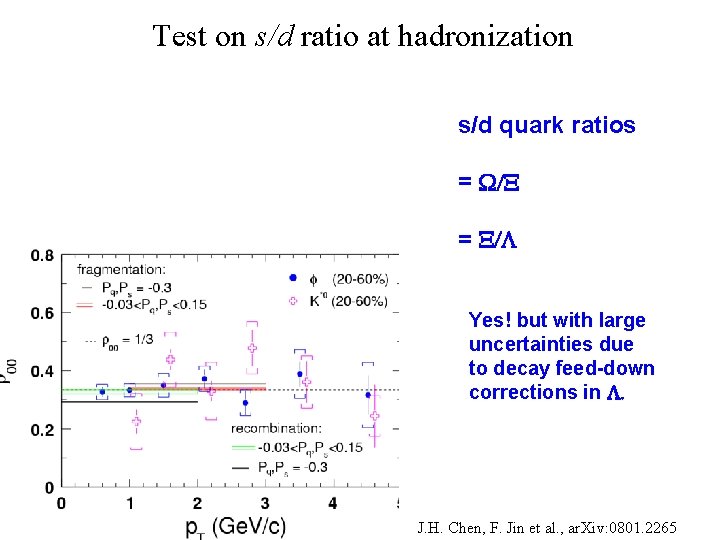
Test on s/d ratio at hadronization s/d quark ratios = W/X = X/L Yes! but with large uncertainties due to decay feed-down corrections in L. J. H. Chen, F. Jin et al. , ar. Xiv: 0801. 2265
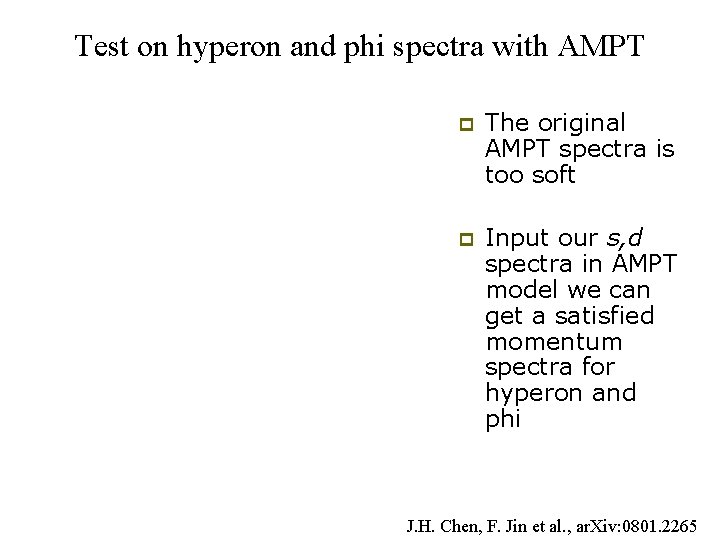
Test on hyperon and phi spectra with AMPT p The original AMPT spectra is too soft p Input our s, d spectra in AMPT model we can get a satisfied momentum spectra for hyperon and phi J. H. Chen, F. Jin et al. , ar. Xiv: 0801. 2265
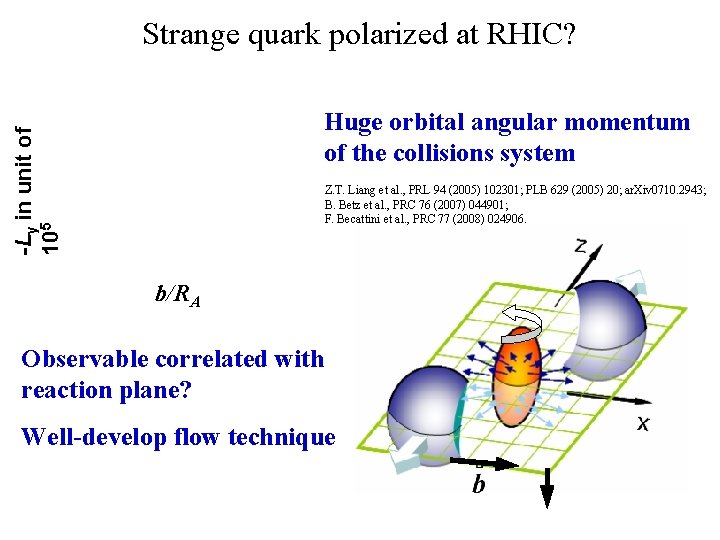
Strange quark polarized at RHIC? -Ly in unit of 105 Huge orbital angular momentum of the collisions system Z. T. Liang et al. , PRL 94 (2005) 102301; PLB 629 (2005) 20; ar. Xiv 0710. 2943; B. Betz et al. , PRC 76 (2007) 044901; F. Becattini et al. , PRC 77 (2008) 024906. b/RA Observable correlated with reaction plane? Well-develop flow technique
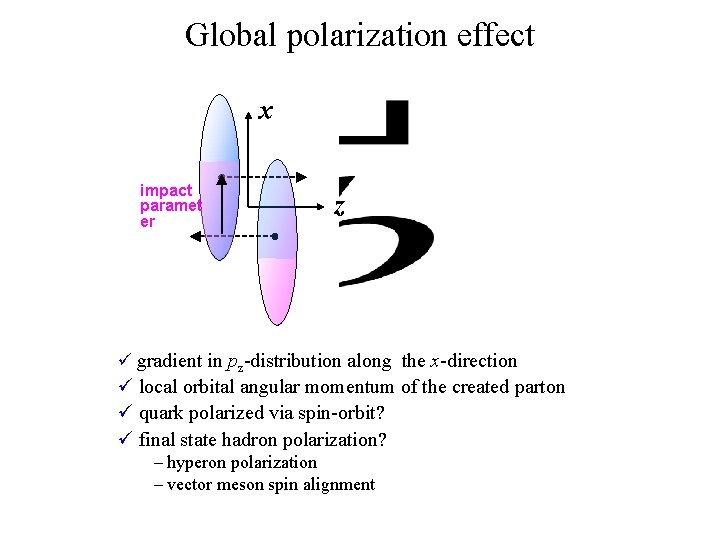
Global polarization effect x impact paramet er z ü gradient in pz-distribution along the x-direction ü local orbital angular momentum of the created parton ü quark polarized via spin-orbit? ü final state hadron polarization? – hyperon polarization – vector meson spin alignment
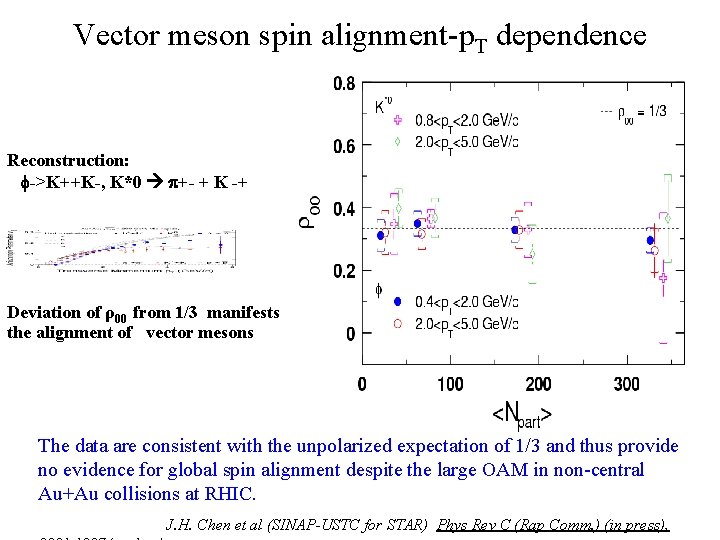
Vector meson spin alignment-p. T dependence Reconstruction: ->K++K-, K*0 +- + K -+ Deviation of ρ00 from 1/3 manifests the alignment of vector mesons The data are consistent with the unpolarized expectation of 1/3 and thus provide no evidence for global spin alignment despite the large OAM in non-central Au+Au collisions at RHIC. J. H. Chen et al (SINAP-USTC for STAR) Phys Rev C (Rap Comm. ) (in press),
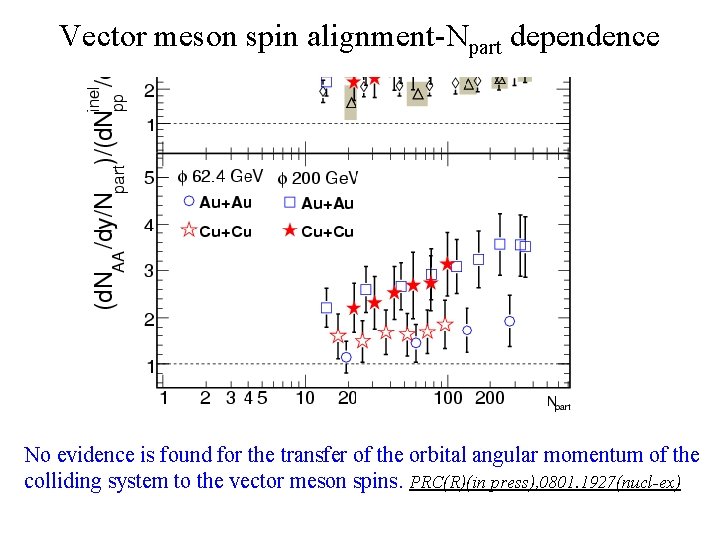
Vector meson spin alignment-Npart dependence No evidence is found for the transfer of the orbital angular momentum of the colliding system to the vector meson spins. PRC(R)(in press), 0801. 1927(nucl-ex)
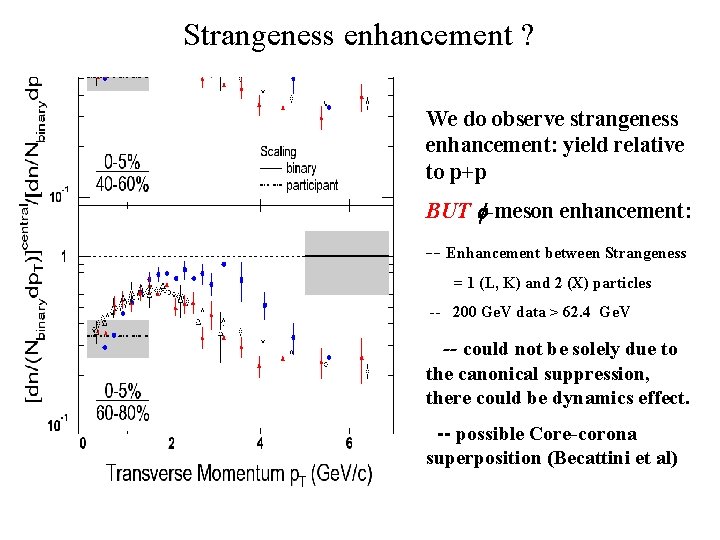
Strangeness enhancement ? We do observe strangeness enhancement: yield relative to p+p BUT -meson enhancement: -- Enhancement between Strangeness = 1 (L, K) and 2 (X) particles -- 200 Ge. V data > 62. 4 Ge. V -- could not be solely due to the canonical suppression, there could be dynamics effect. -- possible Core-corona superposition (Becattini et al)
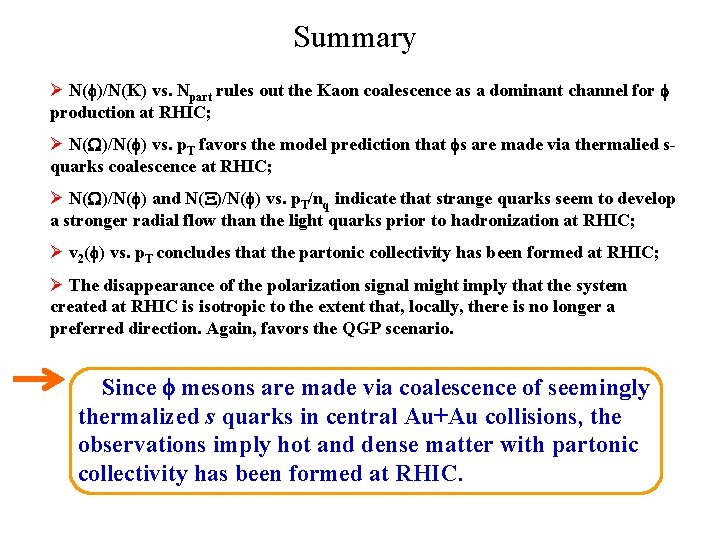
Summary Ø N( )/N(K) vs. Npart rules out the Kaon coalescence as a dominant channel for production at RHIC; Ø N(W)/N( ) vs. p. T favors the model prediction that s are made via thermalied squarks coalescence at RHIC; Ø N(W)/N( ) and N(X)/N( ) vs. p. T/nq indicate that strange quarks seem to develop a stronger radial flow than the light quarks prior to hadronization at RHIC; Ø v 2( ) vs. p. T concludes that the partonic collectivity has been formed at RHIC; Ø The disappearance of the polarization signal might imply that the system created at RHIC is isotropic to the extent that, locally, there is no longer a preferred direction. Again, favors the QGP scenario. Since mesons are made via coalescence of seemingly thermalized s quarks in central Au+Au collisions, the observations imply hot and dense matter with partonic collectivity has been formed at RHIC.
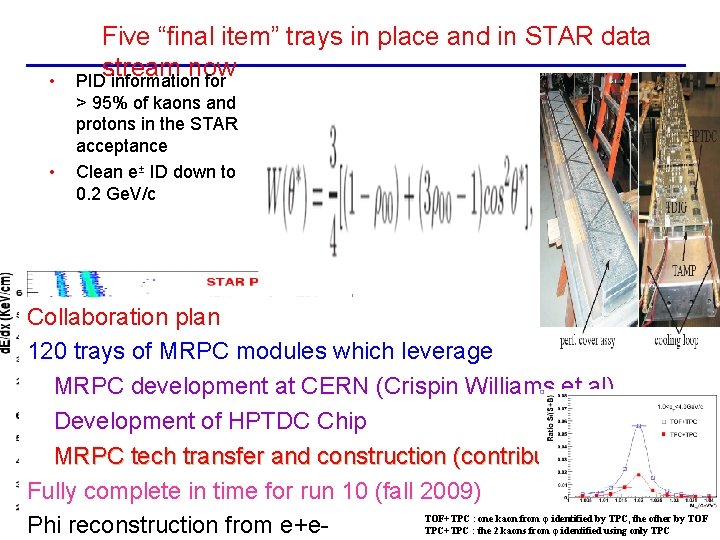
• • Five “final item” trays in place and in STAR data stream now PID information for > 95% of kaons and protons in the STAR acceptance Clean e± ID down to 0. 2 Ge. V/c Collaboration plan 120 trays of MRPC modules which leverage MRPC development at CERN (Crispin Williams et al) Development of HPTDC Chip l /K separation to 1. 6 Ge. V/c MRPC tech transfer and construction (contributed) in China – 0. 7 for TPC alone Fully complete in time for run 10 (fall 2009) l ( +K)/p to p = 3 Ge. V/c TOF+TPC : one kaon from φ identified by TPC, the other by TOF 1. 2 TPCusing alone Phi reconstruction from e+e. TPC+TPC : the 2– kaons fromfor φ identified only TPC 23
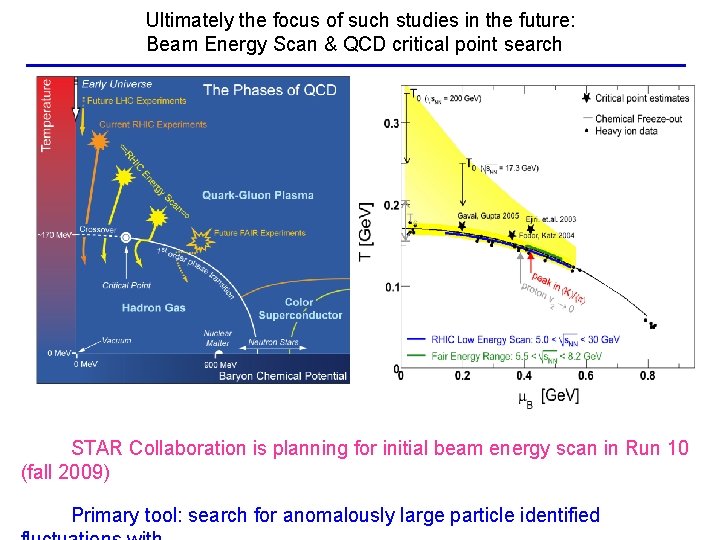
Ultimately the focus of such studies in the future: Beam Energy Scan & QCD critical point search LQCD predicts a rapid transition from a The location of the QCD Critical STAR Collaboration is planning for initial beam scan inremains Run 10 a hadron Point, if itenergyexists, (fall 2009) gas to a quark-gluon plasma. resonance matter for experiment Primary tool: search for anomalously large particle identified 24
Many Thanks for STAR collaborators, especially for Jinhui Chen, Guoliang Ma, Xiangzhou Cai, Huanzhong Huang, Nu Xu et al.
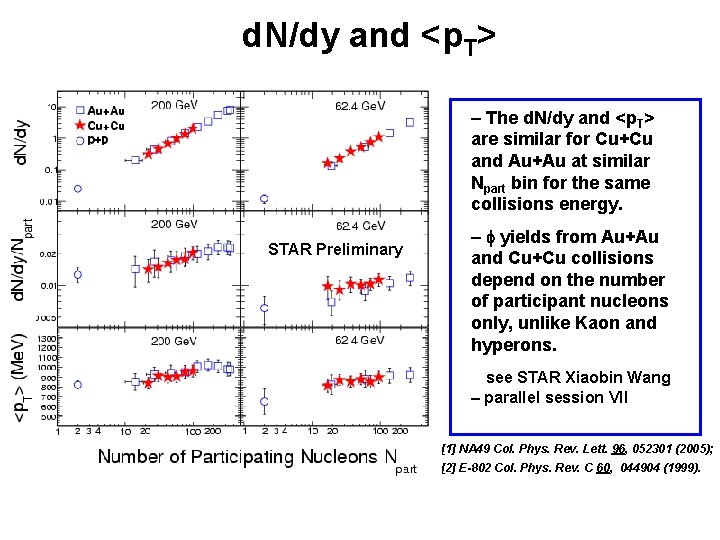
d. N/dy and <p. T> – The d. N/dy and <p. T> are similar for Cu+Cu and Au+Au at similar Npart bin for the same collisions energy. STAR Preliminary – yields from Au+Au and Cu+Cu collisions depend on the number of participant nucleons only, unlike Kaon and hyperons. see STAR Xiaobin Wang – parallel session VII [1] NA 49 Col. Phys. Rev. Lett. 96, 052301 (2005); [2] E-802 Col. Phys. Rev. C 60, 044904 (1999).
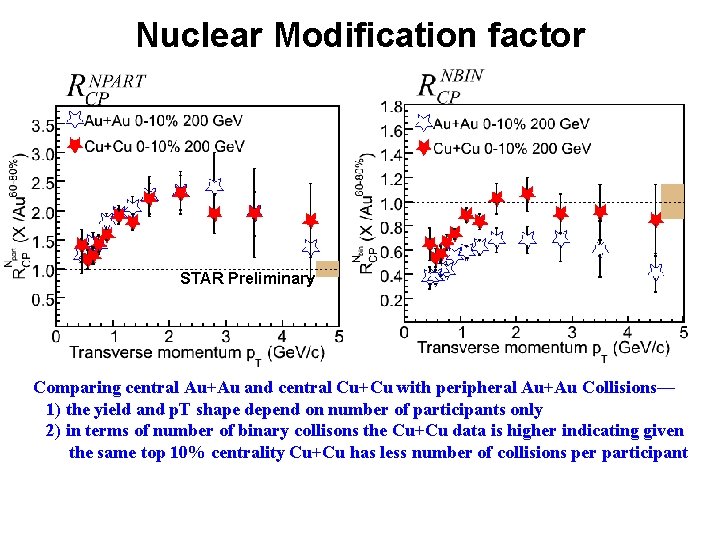
Nuclear Modification factor STAR Preliminary Comparing central Au+Au and central Cu+Cu with peripheral Au+Au Collisions— 1) the yield and p. T shape depend on number of participants only 2) in terms of number of binary collisons the Cu+Cu data is higher indicating given the same top 10% centrality Cu+Cu has less number of collisions per participant