
Recent results from the STAR experiment at RHIC


- Slides: 37
Recent results from the STAR experiment at RHIC for the STAR collaboration Lawrence Berkeley National Laboratory LBNL
Outline • STAR experiment at RHIC • Physics results from s. NN=130 Ge. V Au+Au collisions • Very preliminary results from s. NN=200 Ge. V Au+Au LBNL
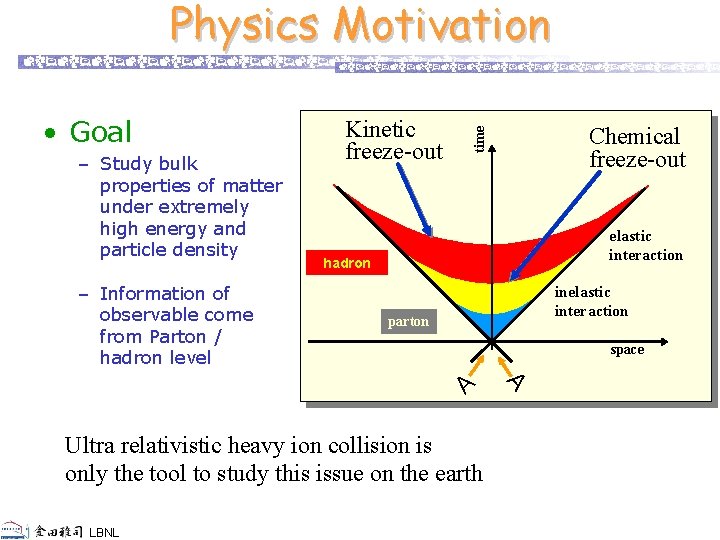
Physics Motivation – Study bulk properties of matter under extremely high energy and particle density hadron inelastic interaction parton space A Ultra relativistic heavy ion collision is only the tool to study this issue on the earth LBNL Chemical freeze-out elastic interaction A – Information of observable come from Parton / hadron level Kinetic freeze-out time • Goal
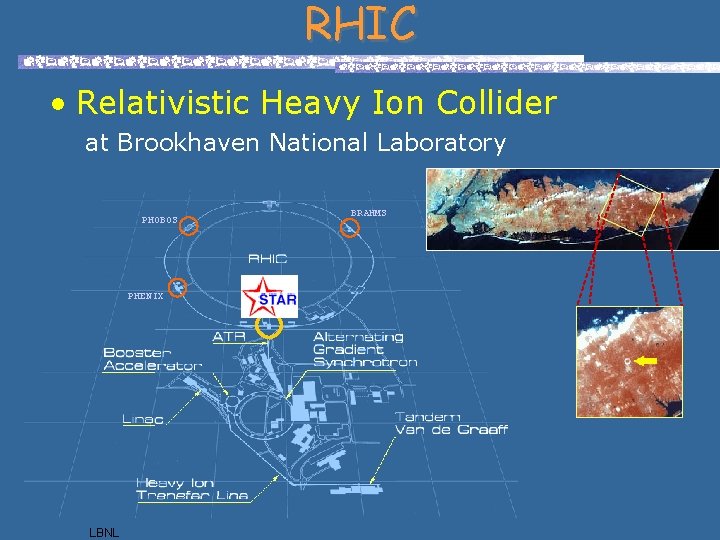
RHIC • Relativistic Heavy Ion Collider at Brookhaven National Laboratory PHOBOS PHENIX LBNL BRAHMS
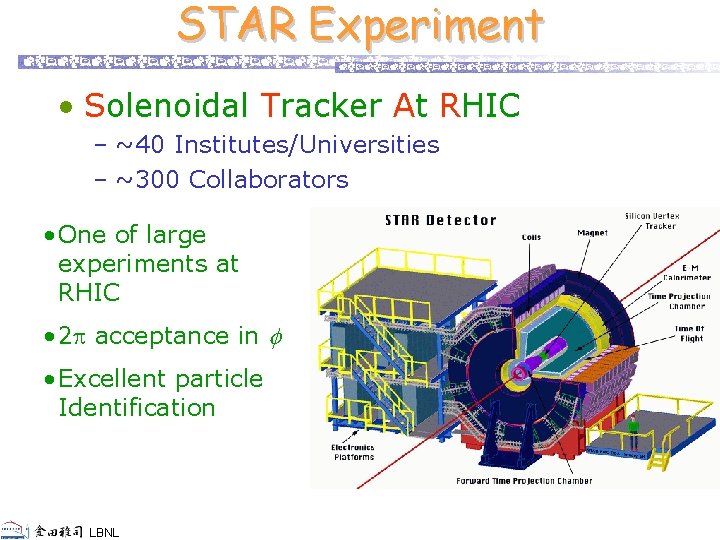
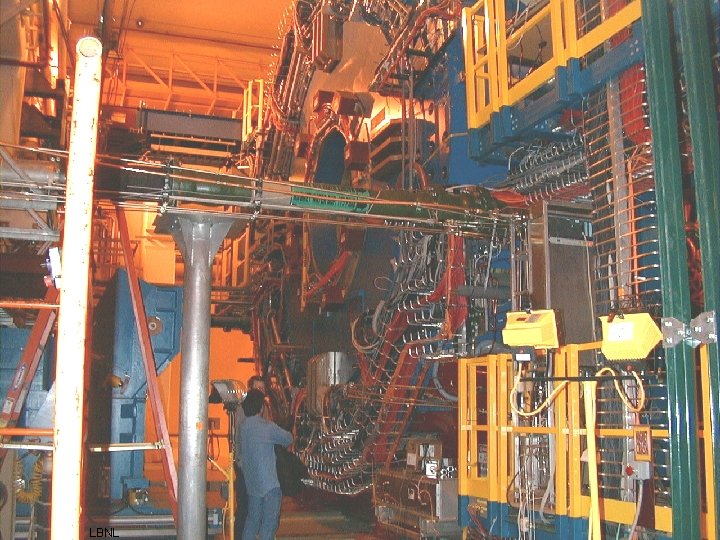
STAR Experiment • Solenoidal Tracker At RHIC – ~40 Institutes/Universities – ~300 Collaborators • One of large experiments at RHIC • 2 acceptance in f • Excellent particle Identification LBNL
LBNL
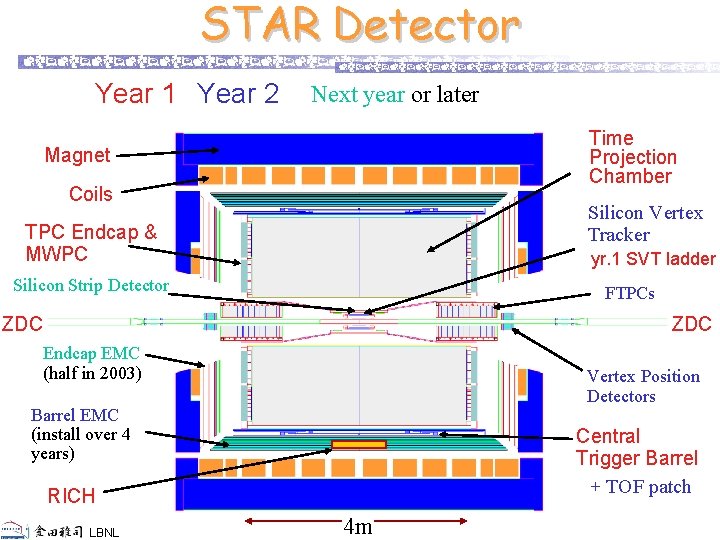
STAR Detector Year 1 Year 2 Next year or later Time Projection Chamber Magnet Coils Silicon Vertex Tracker TPC Endcap & MWPC yr. 1 SVT ladder Silicon Strip Detector FTPCs ZDC Endcap EMC (half in 2003) Vertex Position Detectors Barrel EMC (install over 4 years) Central Trigger Barrel + TOF patch RICH LBNL 4 m
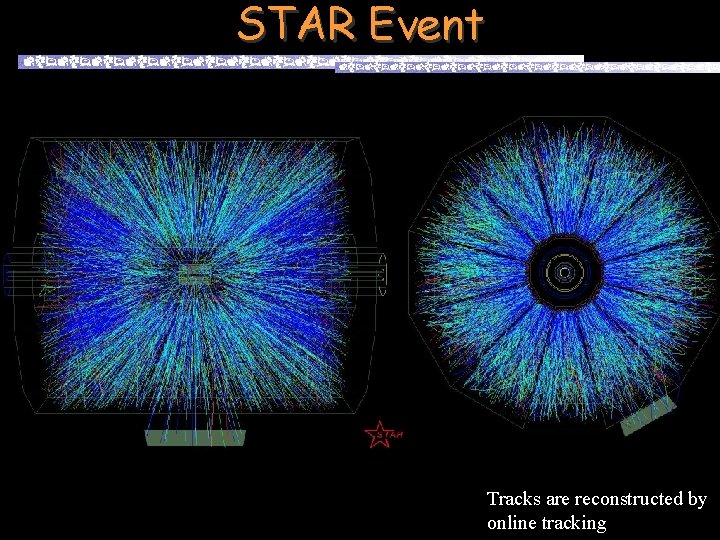
STAR Event LBNL Tracks are reconstructed by online tracking
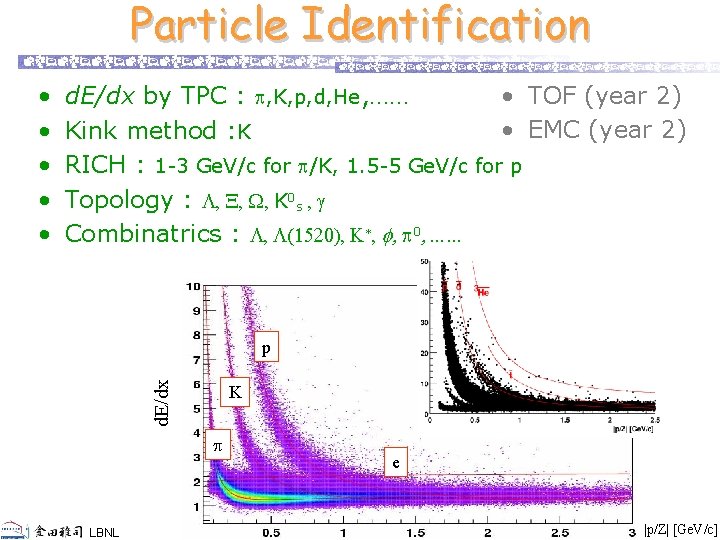
Particle Identification • TOF (year 2) d. E/dx by TPC : , K, p, d, He, …… • EMC (year 2) Kink method : K RICH : 1 -3 Ge. V/c for /K, 1. 5 -5 Ge. V/c for p Topology : , X, W, K 0 s , g Combinatrics : , (1520), K*, f, 0, …… p d. E/dx • • • K LBNL e |p/Z| [Ge. V/c]
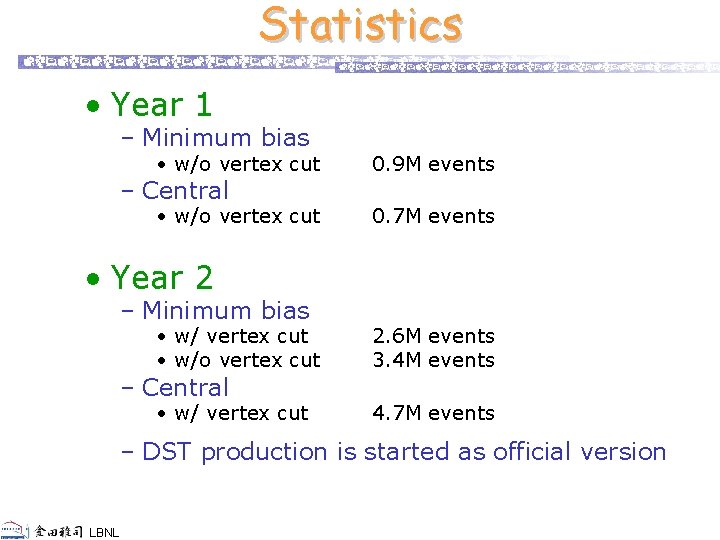
Statistics • Year 1 – Minimum bias • w/o vertex cut 0. 9 M events • w/o vertex cut 0. 7 M events – Central • Year 2 – Minimum bias • w/ vertex cut • w/o vertex cut 2. 6 M events 3. 4 M events • w/ vertex cut 4. 7 M events – Central – DST production is started as official version LBNL
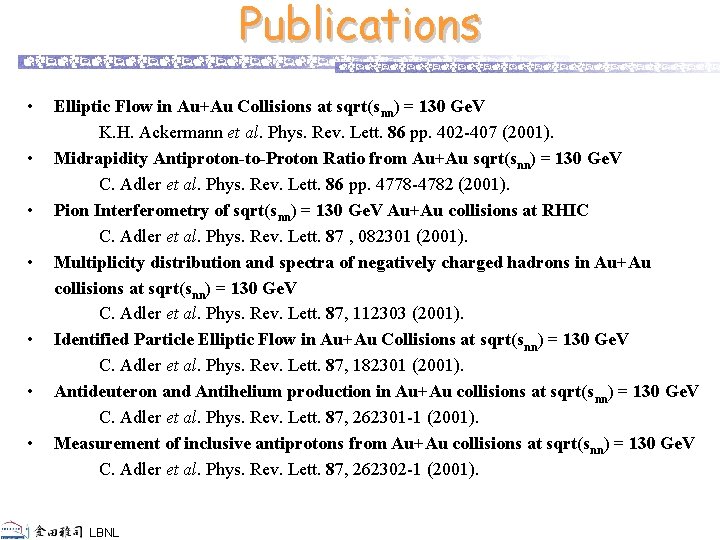
Publications • • Elliptic Flow in Au+Au Collisions at sqrt(snn) = 130 Ge. V K. H. Ackermann et al. Phys. Rev. Lett. 86 pp. 402 -407 (2001). Midrapidity Antiproton-to-Proton Ratio from Au+Au sqrt(snn) = 130 Ge. V C. Adler et al. Phys. Rev. Lett. 86 pp. 4778 -4782 (2001). Pion Interferometry of sqrt(snn) = 130 Ge. V Au+Au collisions at RHIC C. Adler et al. Phys. Rev. Lett. 87 , 082301 (2001). Multiplicity distribution and spectra of negatively charged hadrons in Au+Au collisions at sqrt(snn) = 130 Ge. V C. Adler et al. Phys. Rev. Lett. 87, 112303 (2001). Identified Particle Elliptic Flow in Au+Au Collisions at sqrt(snn) = 130 Ge. V C. Adler et al. Phys. Rev. Lett. 87, 182301 (2001). Antideuteron and Antihelium production in Au+Au collisions at sqrt(snn) = 130 Ge. V C. Adler et al. Phys. Rev. Lett. 87, 262301 -1 (2001). Measurement of inclusive antiprotons from Au+Au collisions at sqrt(snn) = 130 Ge. V C. Adler et al. Phys. Rev. Lett. 87, 262302 -1 (2001). LBNL
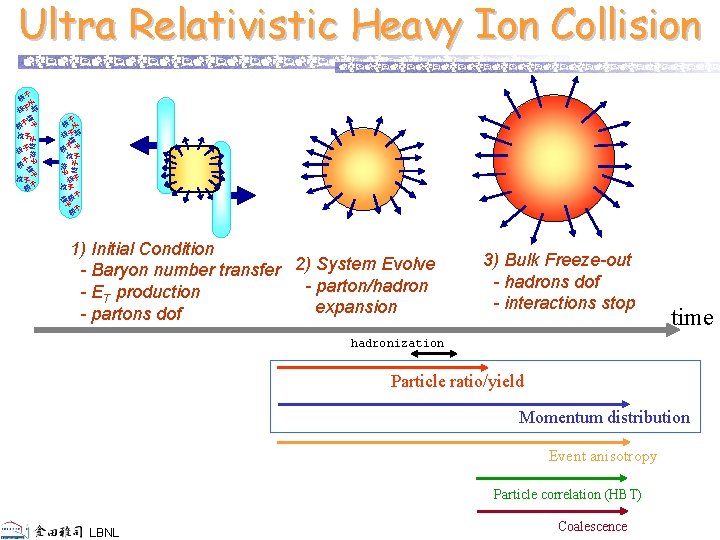
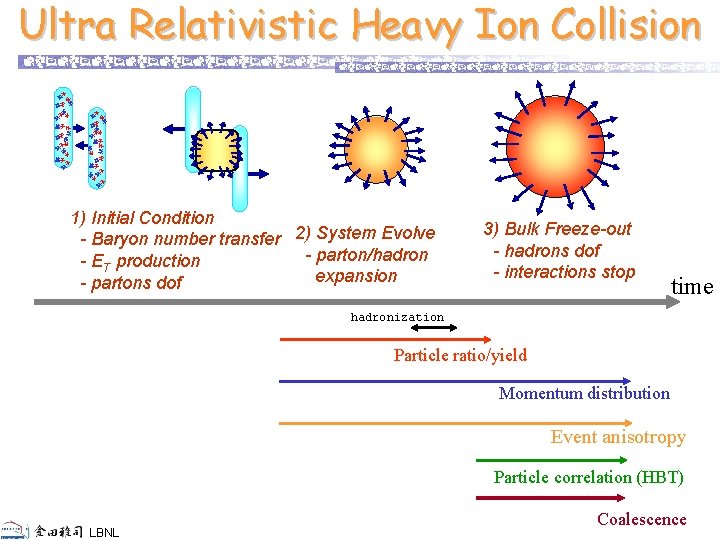
Ultra Relativistic Heavy Ion Collision 核子 子 核 核子 核子 核子 子 核 核子 子 核 核子 核子 子 核 1) Initial Condition - Baryon number transfer 2) System Evolve - parton/hadron - ET production expansion - partons dof 3) Bulk Freeze-out - hadrons dof - interactions stop time hadronization Particle ratio/yield Momentum distribution Event anisotropy Particle correlation (HBT) LBNL Coalescence
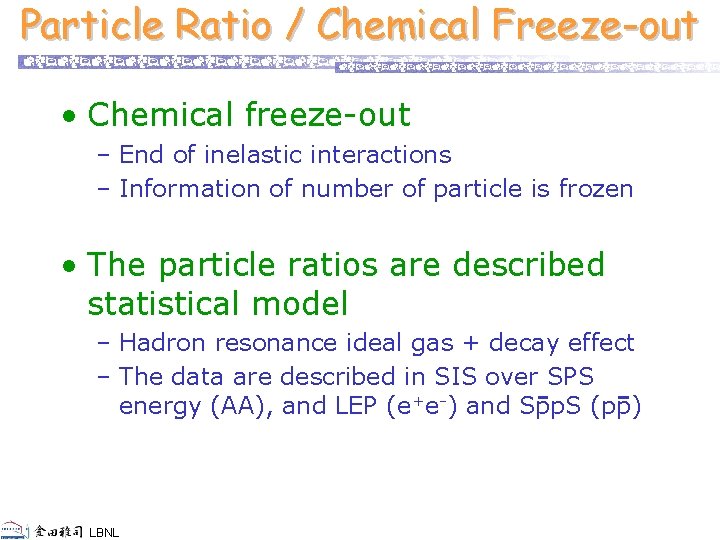
Particle Ratio / Chemical Freeze-out • Chemical freeze-out – End of inelastic interactions – Information of number of particle is frozen • The particle ratios are described statistical model – Hadron resonance ideal gas + decay effect – The data are described in SIS over SPS energy (AA), and LEP (e+e-) and Spp. S (pp) LBNL
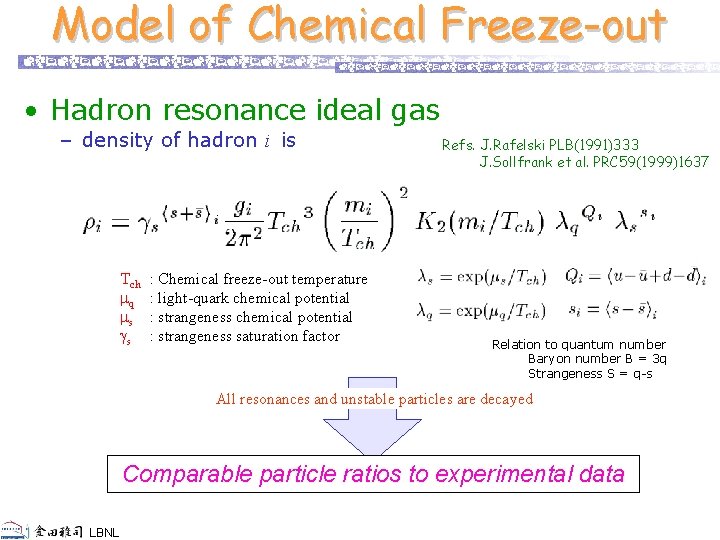
Model of Chemical Freeze-out • Hadron resonance ideal gas – density of hadron i is Tch mq ms gs : Chemical freeze-out temperature : light-quark chemical potential : strangeness saturation factor Refs. J. Rafelski PLB(1991)333 J. Sollfrank et al. PRC 59(1999)1637 Relation to quantum number Baryon number B = 3 q Strangeness S = q-s All resonances and unstable particles are decayed Comparable particle ratios to experimental data LBNL
Data vs. Model Chemical freeze-out parameters Tch = 170± 4 Me. V m. B =3 mq= 40± 4 Me. V BRAHMS PHENIX PHOBOS STAR LBNL ms = 1. 1± 2. 0 Me. V gs = 1. 09 ± 0. 06 c 2/dof = 16. 7/9 (c 2/dof = 12. 2/8 w/o X-/h-)
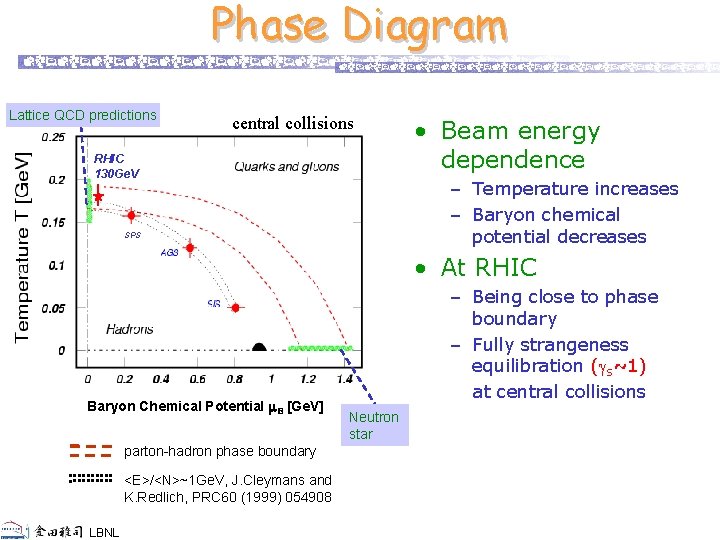
Phase Diagram Lattice QCD predictions central collisions RHIC 130 Ge. V • Beam energy dependence – Temperature increases – Baryon chemical potential decreases SPS • At RHIC Baryon Chemical Potential m. B [Ge. V] parton-hadron phase boundary <E>/<N>~1 Ge. V, J. Cleymans and K. Redlich, PRC 60 (1999) 054908 LBNL – Being close to phase boundary – Fully strangeness equilibration (gs~1) at central collisions Neutron star
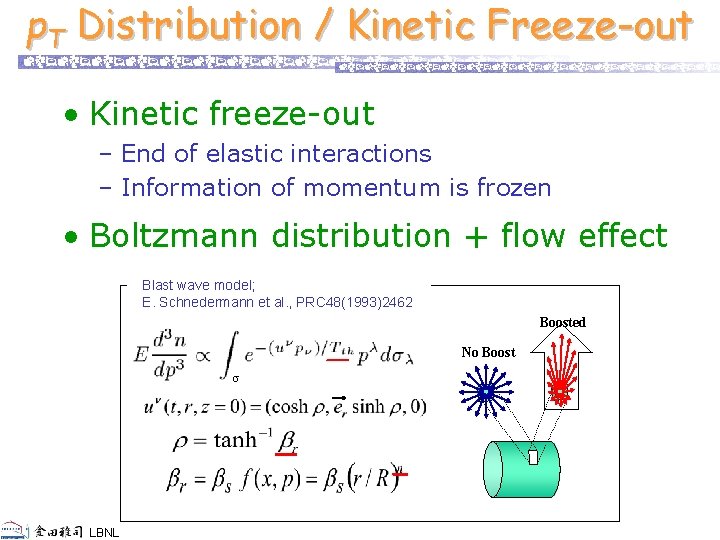
p. T Distribution / Kinetic Freeze-out • Kinetic freeze-out – End of elastic interactions – Information of momentum is frozen • Boltzmann distribution + flow effect Blast wave model; E. Schnedermann et al. , PRC 48(1993)2462 Boosted No Boost s LBNL
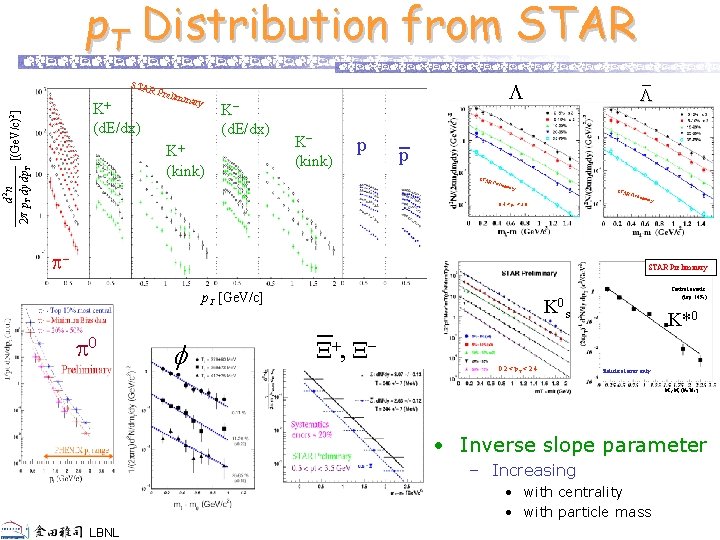
p. T Distribution from STAR d 2 n [(Ge. V/c)-2 ] 2 p p. T dy dp. T K+ Prelim inary (d. E/dx) K+ (kink) K(kink) p p STAR Prelim inary STAR 0. 4 < p. T < 3. 6 - Prelim inary STAR Preliminary p. T [Ge. V/c] 0 f Central events (top 14%) K 0 s K*0 X+ , X 0. 2 < p. T < 2. 4 Statistical error only MT-M 0 (Ge. V/c 2) • Inverse slope parameter – Increasing • with centrality • with particle mass LBNL
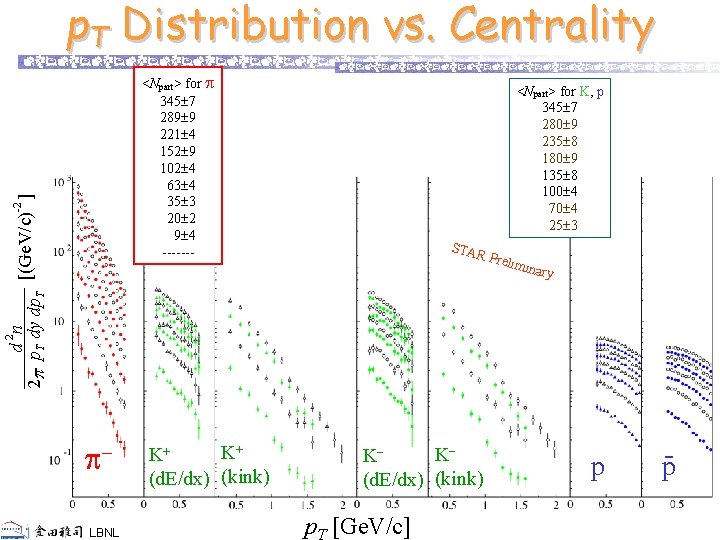
p. T Distribution vs. Centrality d 2 n [(Ge. V/c)- 2 ] 2 p p. T dy dp. T <Npart> for 345 7 289 9 221 4 152 9 102 4 63 4 35 3 20 2 9 4 ------- LBNL K+ K+ (d. E/dx) (kink) <Npart> for K, p 345 7 280 9 235 8 180 9 135 8 100 4 70 4 25 3 STAR KK(d. E/dx) (kink) p. T [Ge. V/c] Prelim inary p p
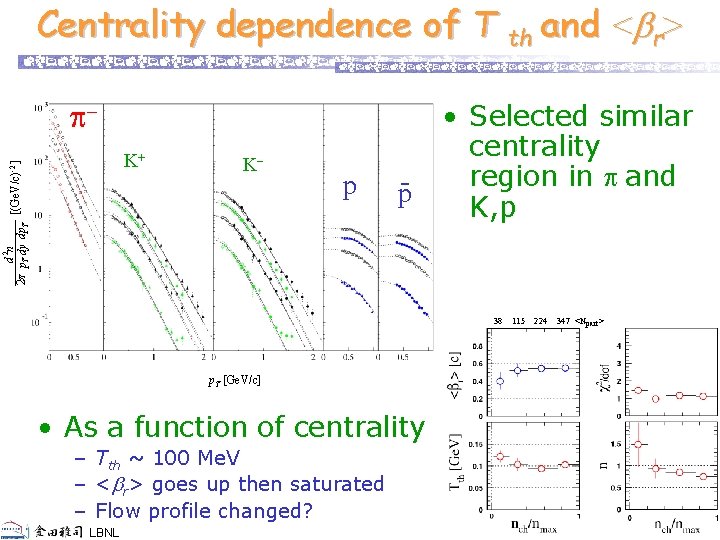
Centrality dependence of T th and < r> d 2 n -2 2 p p. T dy dp. T [(Ge. V/c) ] K+ K- p p • Selected similar centrality region in and K, p 38 p. T [Ge. V/c] • As a function of centrality – Tth ~ 100 Me. V – < r> goes up then saturated – Flow profile changed? LBNL 115 224 347 <Npart>
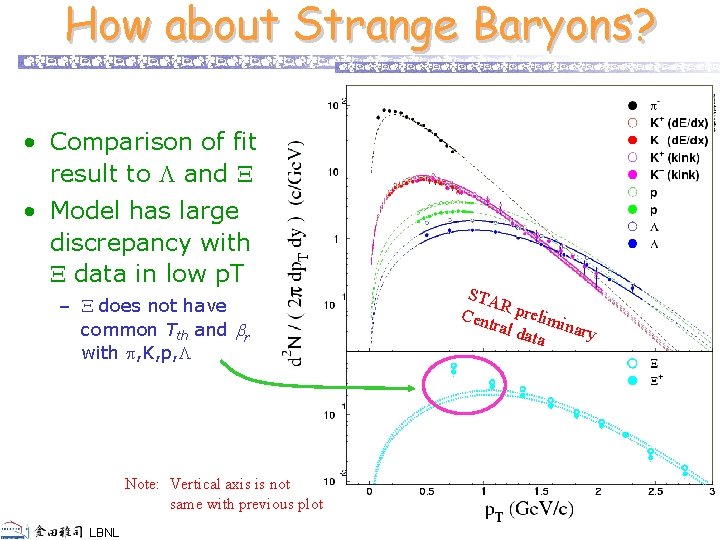
How about Strange Baryons? • Comparison of fit result to and X • Model has large discrepancy with X data in low p. T – X does not have common Tth and r with , K, p, Note: Vertical axis is not same with previous plot LBNL STA R Cent prelim inary ral d ata
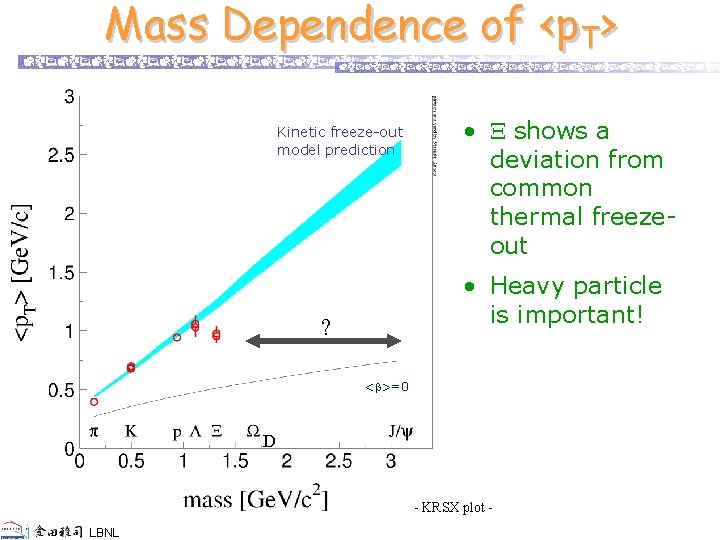
Mass Dependence of <p. T> Kinetic freeze-out model prediction • X shows a deviation from common thermal freezeout • Heavy particle is important! ? <b>=0 D - KRSX plot LBNL
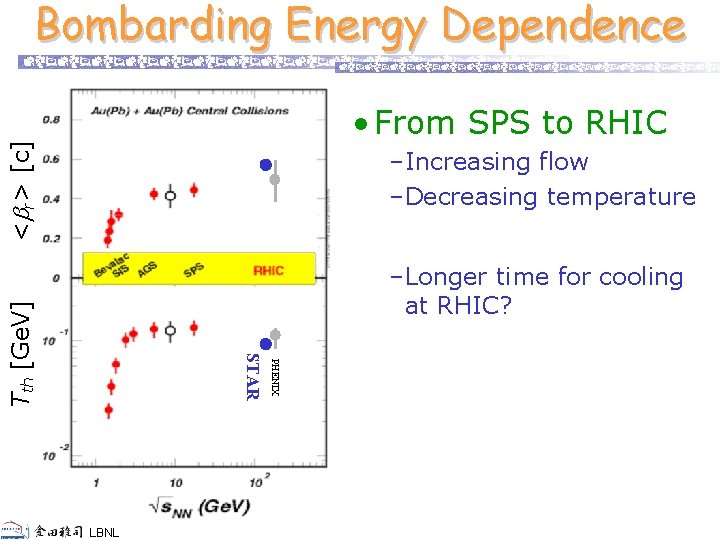
Bombarding Energy Dependence < r> [c] • From SPS to RHIC –Increasing flow –Decreasing temperature LBNL PHENIX STAR Tth [Ge. V] –Longer time for cooling at RHIC?
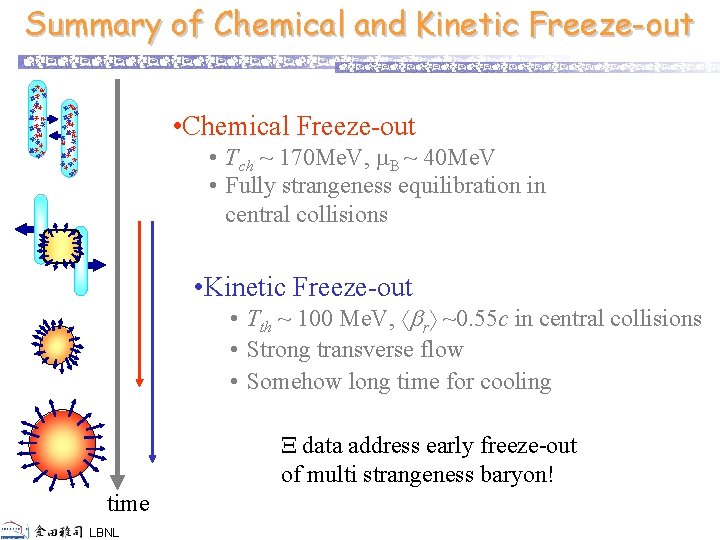
Summary of Chemical and Kinetic Freeze-out 核子 子 核 核子 • Chemical Freeze-out 子 核 核子 核子 子 核 子 核 核子 核子 核子 子 核 核子 核子 核 核子 • Tch ~ 170 Me. V, m. B ~ 40 Me. V • Fully strangeness equilibration in central collisions 子 核 核子 核子 子 核 • Kinetic Freeze-out • Tth ~ 100 Me. V, r ~0. 55 c in central collisions • Strong transverse flow • Somehow long time for cooling X data address early freeze-out of multi strangeness baryon! time LBNL
核子 核子 子 核 子 核 核子 子 子 核 核子 核子 子 核 核子 核子 Ultra Relativistic Heavy Ion Collision 子 核 核子 核子 子 核 1) Initial Condition - Baryon number transfer 2) System Evolve - parton/hadron - ET production expansion - partons dof 3) Bulk Freeze-out - hadrons dof - interactions stop time hadronization Particle ratio/yield Momentum distribution Event anisotropy Particle correlation (HBT) LBNL Coalescence
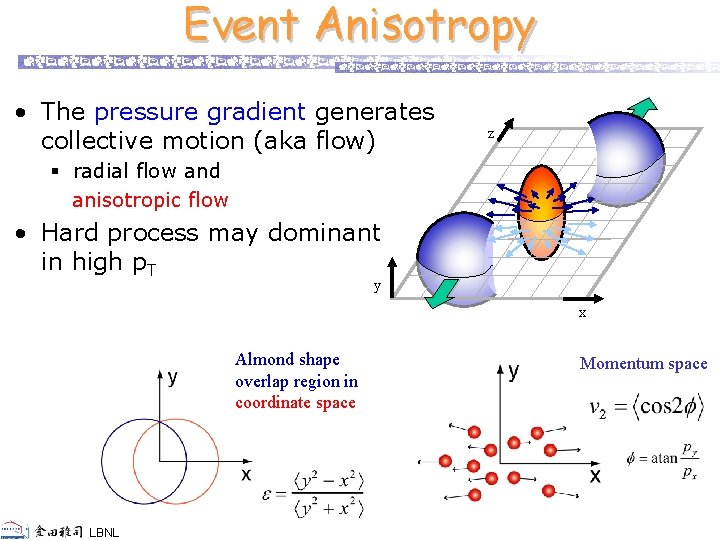
Event Anisotropy • The pressure gradient generates collective motion (aka flow) z § radial flow and anisotropic flow • Hard process may dominant in high p. T y x Almond shape overlap region in coordinate space LBNL Momentum space
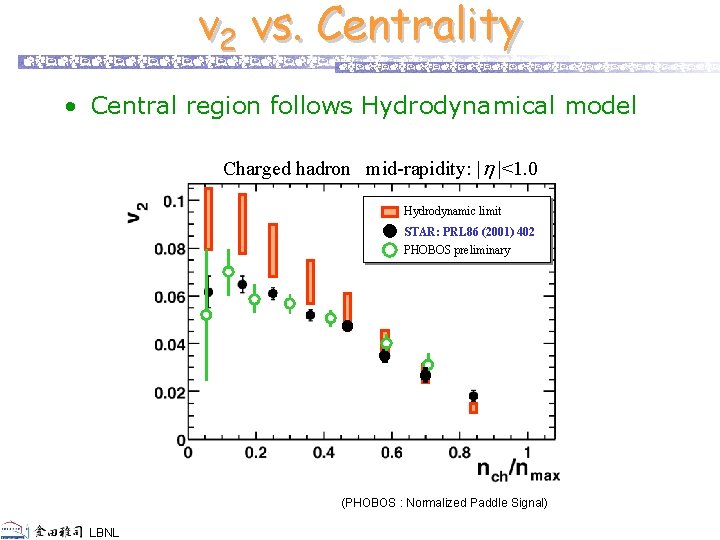
v 2 vs. Centrality • Central region follows Hydrodynamical model Charged hadron mid-rapidity: |h |<1. 0 Hydrodynamic limit STAR: PRL 86 (2001) 402 PHOBOS preliminary (PHOBOS : Normalized Paddle Signal) LBNL
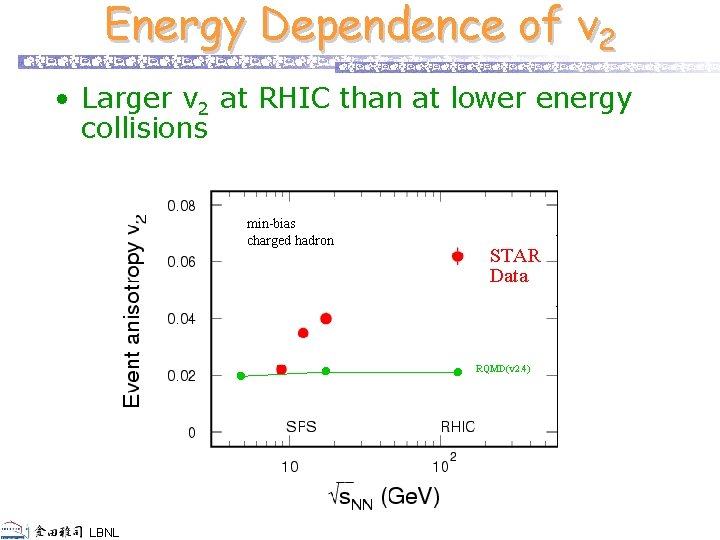
Energy Dependence of v 2 • Larger v 2 at RHIC than at lower energy collisions min-bias charged hadron STAR Data RQMD(v 2. 4) LBNL
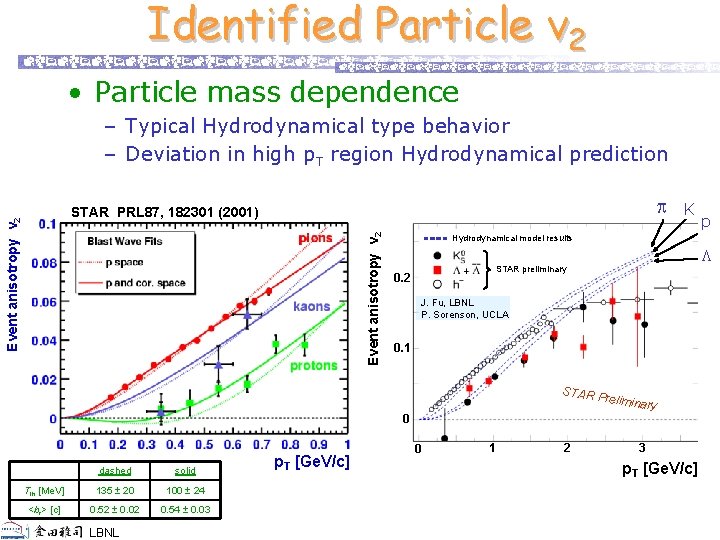
Identified Particle v 2 • Particle mass dependence – Typical Hydrodynamical type behavior – Deviation in high p. T region Hydrodynamical prediction Event anisotropy v 2 STAR PRL 87, 182301 (2001) K Hydrodynamical model results STAR preliminary 0. 2 J. Fu, LBNL P. Sorenson, UCLA 0. 1 STAR P relimina ry 0 dashed solid Tth [Me. V] 135 20 100 24 [c] 0. 52 0. 02 0. 54 0. 03 LBNL p. T [Ge. V/c] p 0 1 2 3 p. T [Ge. V/c]
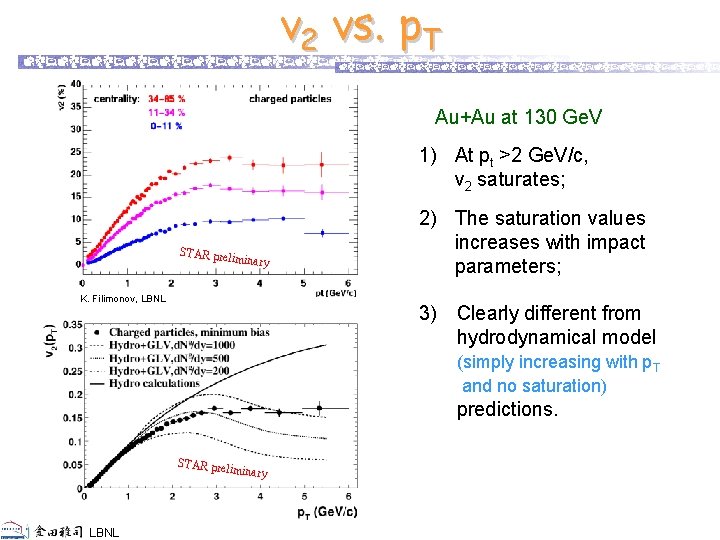
v 2 vs. p. T Au+Au at 130 Ge. V 1) At pt >2 Ge. V/c, v 2 saturates; STAR preli m inary K. Filimonov, LBNL 2) The saturation values increases with impact parameters; 3) Clearly different from hydrodynamical model (simply increasing with p. T and no saturation) predictions. STAR preli m inary LBNL
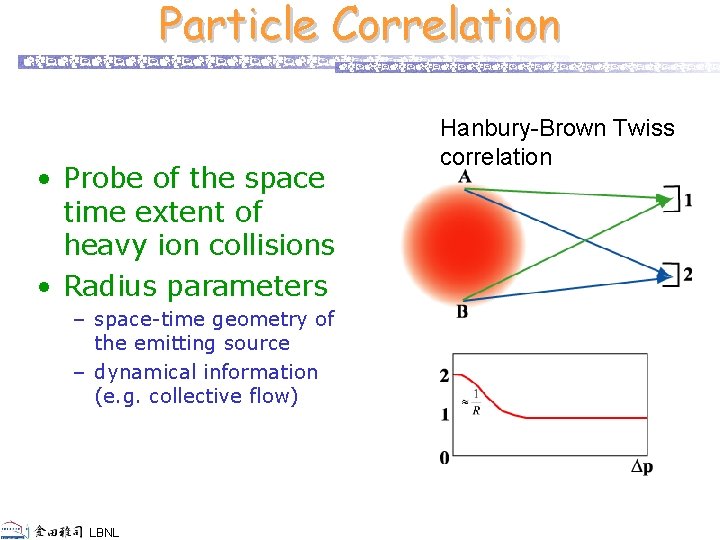
Particle Correlation • Probe of the space time extent of heavy ion collisions • Radius parameters – space-time geometry of the emitting source – dynamical information (e. g. collective flow) LBNL Hanbury-Brown Twiss correlation
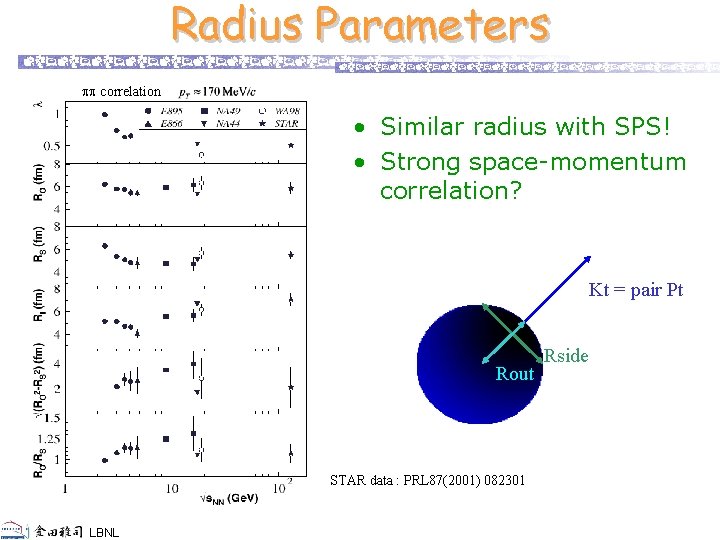
Radius Parameters correlation • Similar radius with SPS! • Strong space-momentum correlation? Kt = pair Pt Rout STAR data : PRL 87(2001) 082301 LBNL Rside
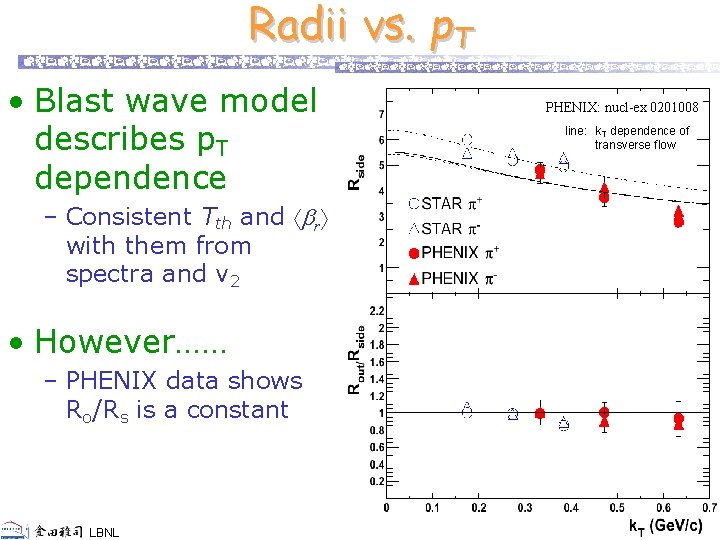
Radii vs. p. T • Blast wave model describes p. T dependence – Consistent Tth and r with them from spectra and v 2 • However…… PHENIX: nucl-ex 0201008 + + - - line: k. T dependence of transverse flow Blast wave model : Mike Lisa, ACS Chicago, 2001 STAR PRL 87(2001) 082301 model: R=13. 5 fm, t=1. 5 fm/c Tth=0. 11 Ge. V, r = 0. 5 c – PHENIX data shows Ro/Rs is a constant LBNL p. T [Ge. V/c]
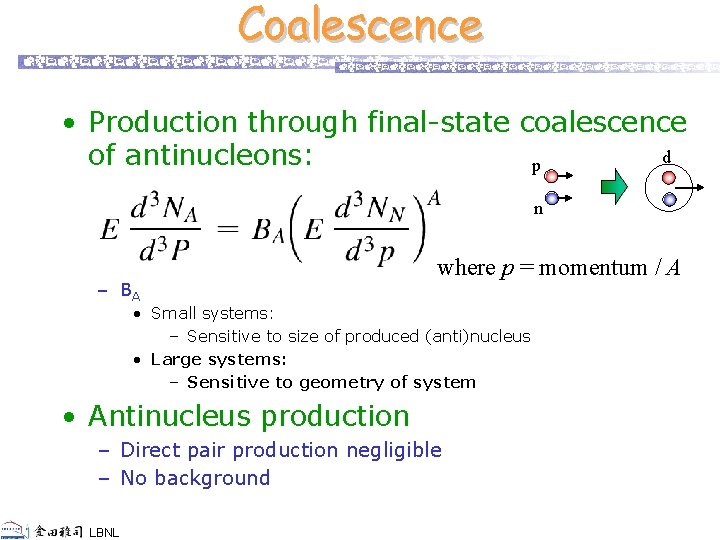
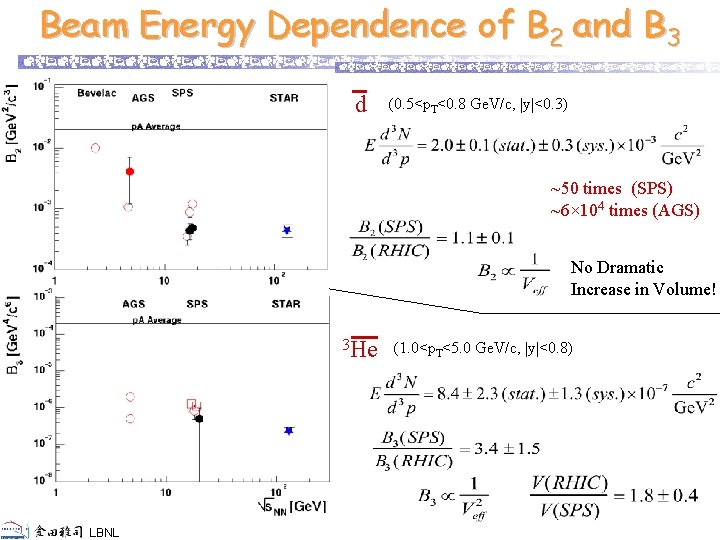
Coalescence • Production through final-state coalescence d of antinucleons: p n – BA where p = momentum / A • Small systems: – Sensitive to size of produced (anti)nucleus • Large systems: – Sensitive to geometry of system • Antinucleus production – Direct pair production negligible – No background LBNL
Beam Energy Dependence of B 2 and B 3 d (0. 5<p. T<0. 8 Ge. V/c, |y|<0. 3) ~50 times (SPS) ~6× 10⁴ times (AGS) No Dramatic Increase in Volume! 3 He (1. 0<p. T<5. 0 Ge. V/c, |y|<0. 8) LBNL
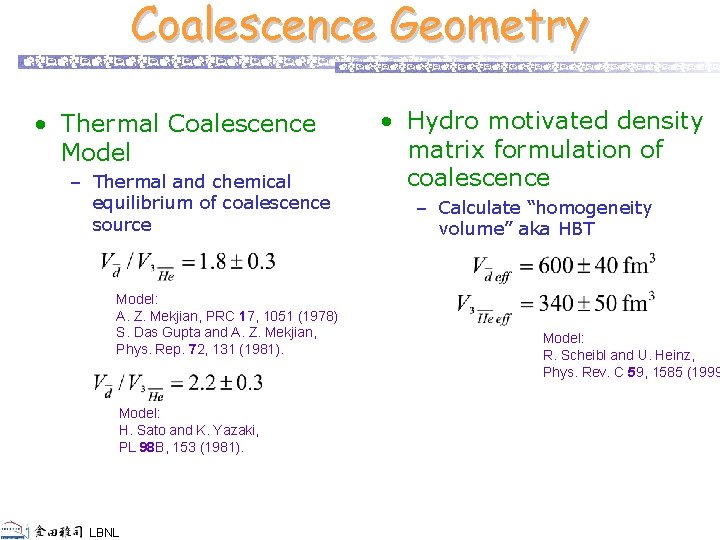
Coalescence Geometry • Thermal Coalescence Model – Thermal and chemical equilibrium of coalescence source Model: A. Z. Mekjian, PRC 17, 1051 (1978) S. Das Gupta and A. Z. Mekjian, Phys. Rep. 72, 131 (1981). Model: H. Sato and K. Yazaki, PL 98 B, 153 (1981). LBNL • Hydro motivated density matrix formulation of coalescence – Calculate “homogeneity volume” aka HBT Model: R. Scheibl and U. Heinz, Phys. Rev. C 59, 1585 (1999
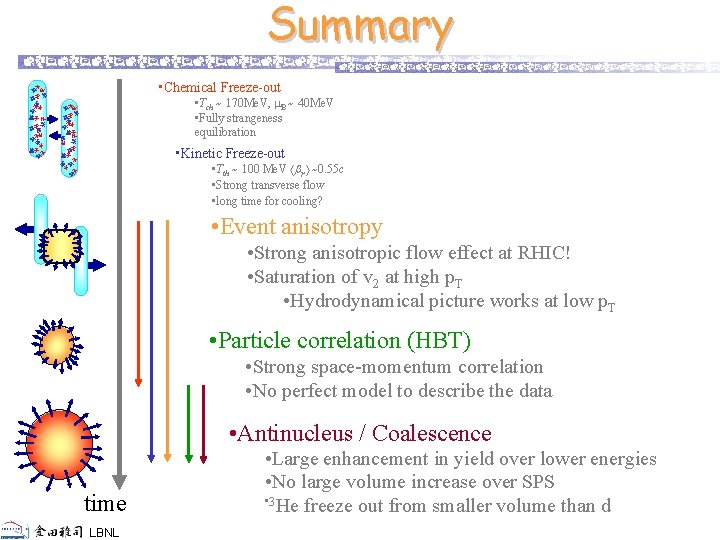
Summary • Chemical Freeze-out 核子 子 核 核子 核子 子 核 • Tch ~ 170 Me. V, m. B ~ 40 Me. V • Fully strangeness equilibration 子 核 核子 核子 核子 子 核 核子 核子 核 核子 • Kinetic Freeze-out 核子 核子 子 核 子 核 • Tth ~ 100 Me. V r ~0. 55 c • Strong transverse flow • long time for cooling? • Event anisotropy • Strong anisotropic flow effect at RHIC! • Saturation of v 2 at high p. T • Hydrodynamical picture works at low p. T • Particle correlation (HBT) • Strong space-momentum correlation • No perfect model to describe the data • Antinucleus / Coalescence time LBNL • Large enhancement in yield over lower energies • No large volume increase over SPS • 3 He freeze out from smaller volume than d