Materials Handling and Storage l 29 CFR 1910
- Slides: 54
Materials Handling and Storage l 29 CFR 1910. 176 - Handling Materials – General l 29 CFR 1910. 184 - Slings Presented by: ETTA, OSH Division, 919 -807 -2875 This presentation was created by the N. C. Department of Labor for safety and health training.
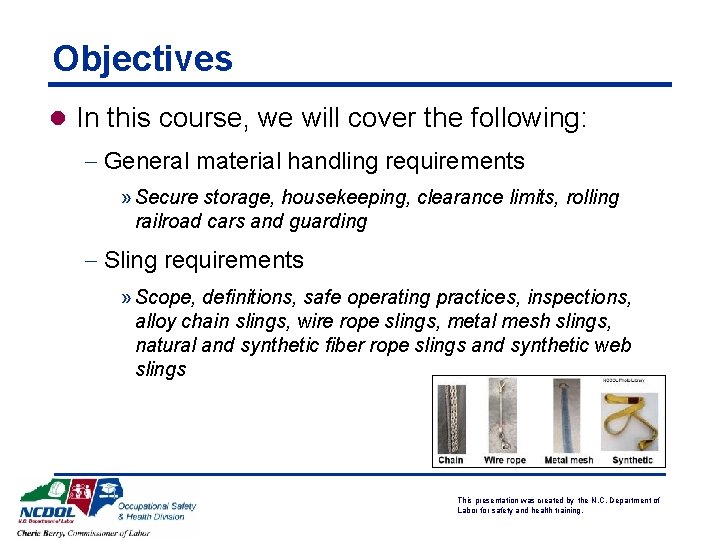
Objectives l In this course, we will cover the following: - General material handling requirements » Secure storage, housekeeping, clearance limits, rolling railroad cars and guarding - Sling requirements » Scope, definitions, safe operating practices, inspections, alloy chain slings, wire rope slings, metal mesh slings, natural and synthetic fiber rope slings and synthetic web slings This presentation was created by the N. C. Department of Labor for safety and health training.
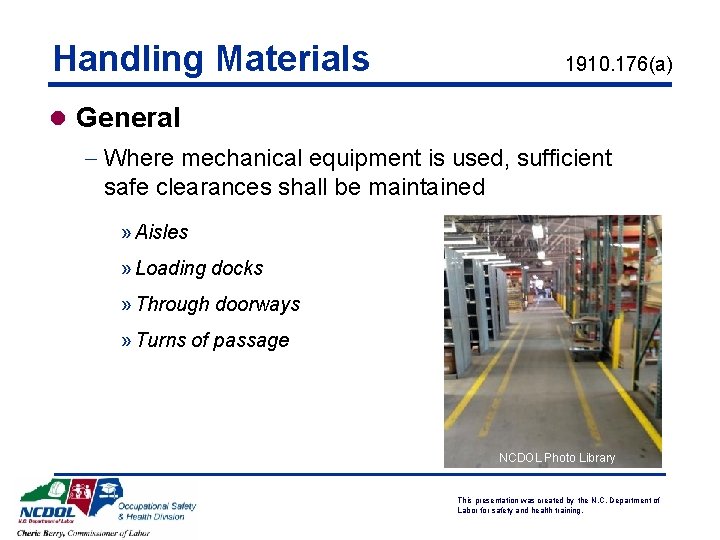
Handling Materials 1910. 176(a) l General - Where mechanical equipment is used, sufficient safe clearances shall be maintained » Aisles » Loading docks » Through doorways » Turns of passage NCDOL Photo Library This presentation was created by the N. C. Department of Labor for safety and health training.
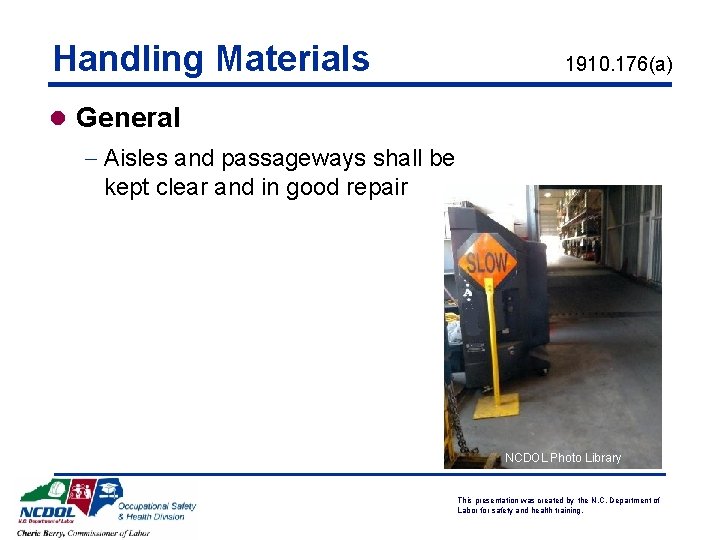
Handling Materials 1910. 176(a) l General - Aisles and passageways shall be kept clear and in good repair NCDOL Photo Library This presentation was created by the N. C. Department of Labor for safety and health training.
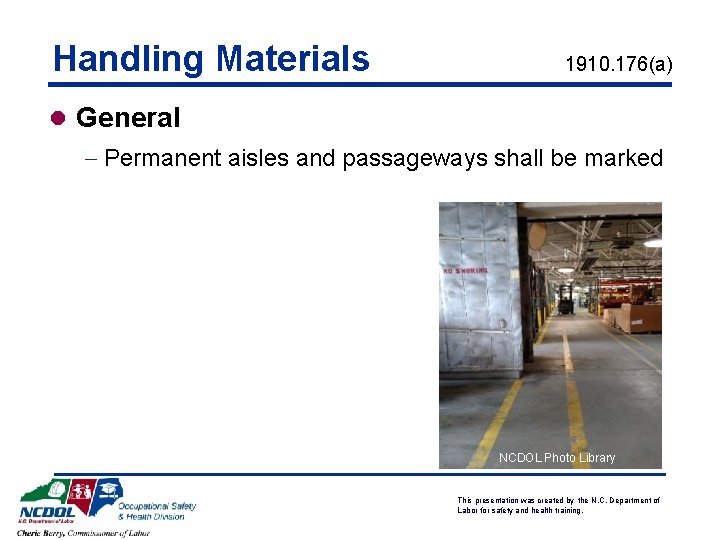
Handling Materials 1910. 176(a) l General - Permanent aisles and passageways shall be marked NCDOL Photo Library This presentation was created by the N. C. Department of Labor for safety and health training.
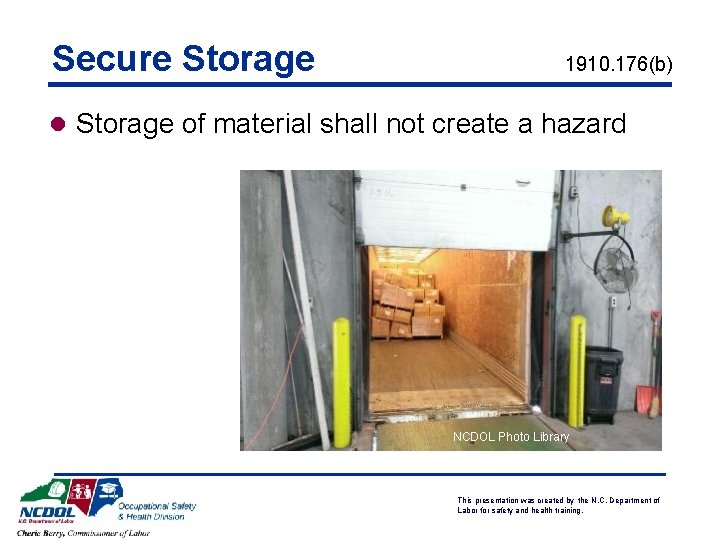
Secure Storage 1910. 176(b) l Storage of material shall not create a hazard NCDOL Photo Library This presentation was created by the N. C. Department of Labor for safety and health training.
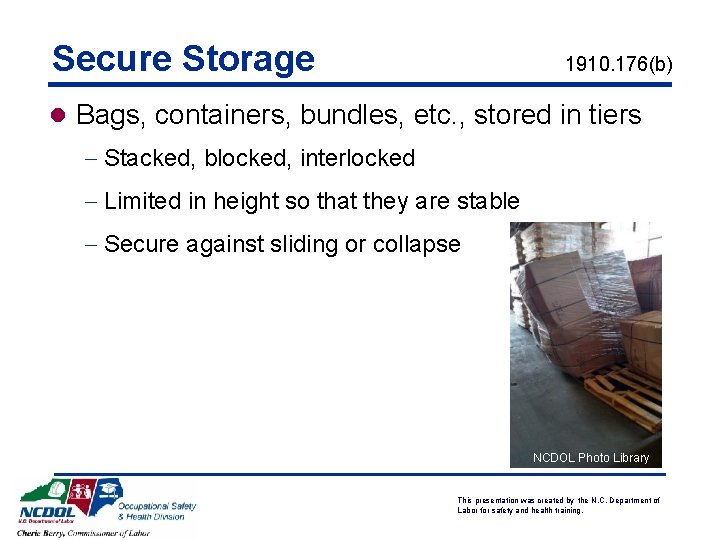
Secure Storage 1910. 176(b) l Bags, containers, bundles, etc. , stored in tiers - Stacked, blocked, interlocked - Limited in height so that they are stable - Secure against sliding or collapse NCDOL Photo Library This presentation was created by the N. C. Department of Labor for safety and health training.
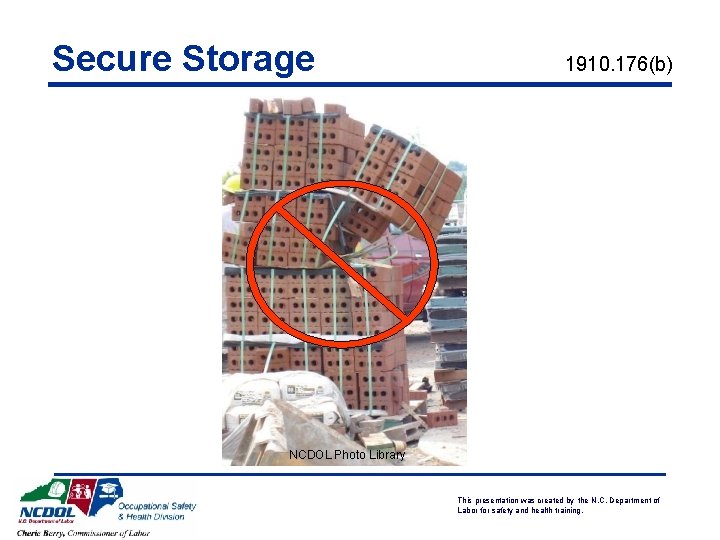
Secure Storage 1910. 176(b) NCDOL Photo Library This presentation was created by the N. C. Department of Labor for safety and health training.
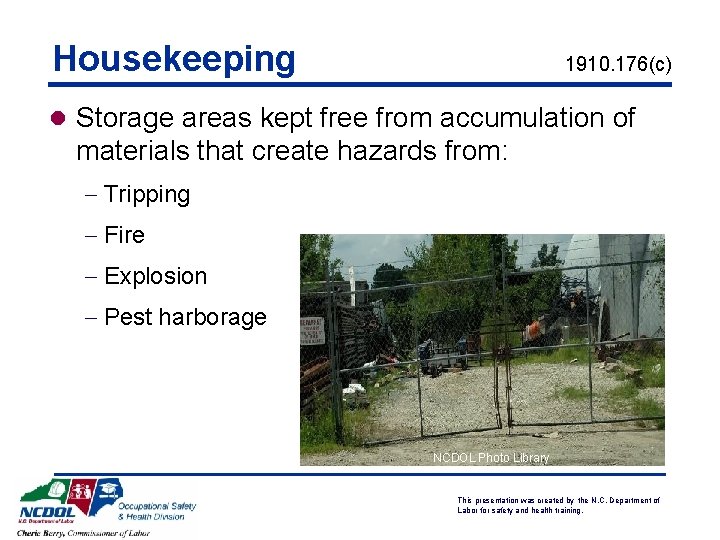
Housekeeping 1910. 176(c) l Storage areas kept free from accumulation of materials that create hazards from: - Tripping - Fire - Explosion - Pest harborage NCDOL Photo Library This presentation was created by the N. C. Department of Labor for safety and health training.
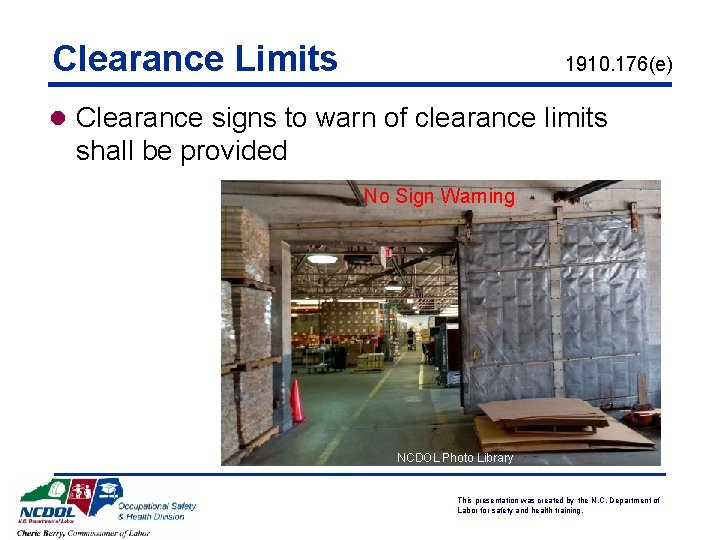
Clearance Limits 1910. 176(e) l Clearance signs to warn of clearance limits shall be provided No Sign Warning NCDOL Photo Library This presentation was created by the N. C. Department of Labor for safety and health training.
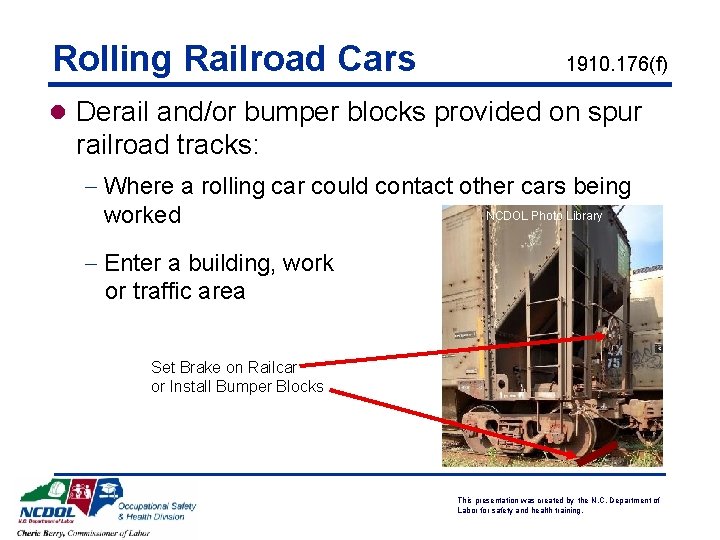
Rolling Railroad Cars 1910. 176(f) l Derail and/or bumper blocks provided on spur railroad tracks: - Where a rolling car could contact other cars being NCDOL Photo Library worked - Enter a building, work or traffic area Set Brake on Railcar or Install Bumper Blocks This presentation was created by the N. C. Department of Labor for safety and health training.
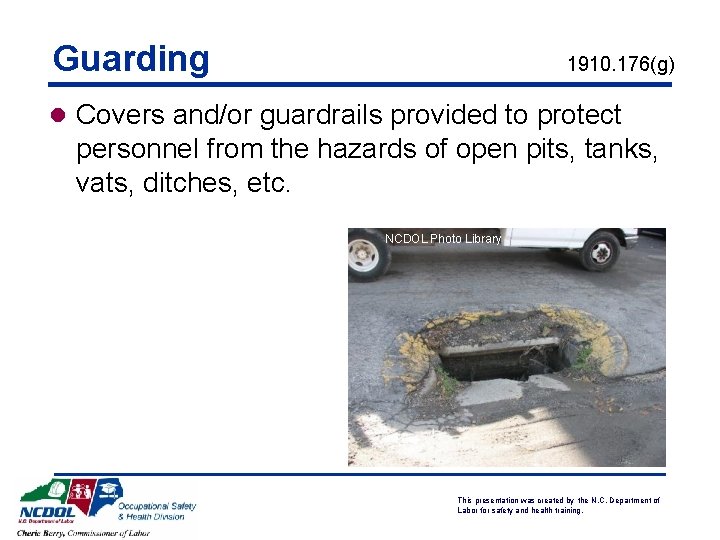
Guarding 1910. 176(g) l Covers and/or guardrails provided to protect personnel from the hazards of open pits, tanks, vats, ditches, etc. NCDOL Photo Library This presentation was created by the N. C. Department of Labor for safety and health training.
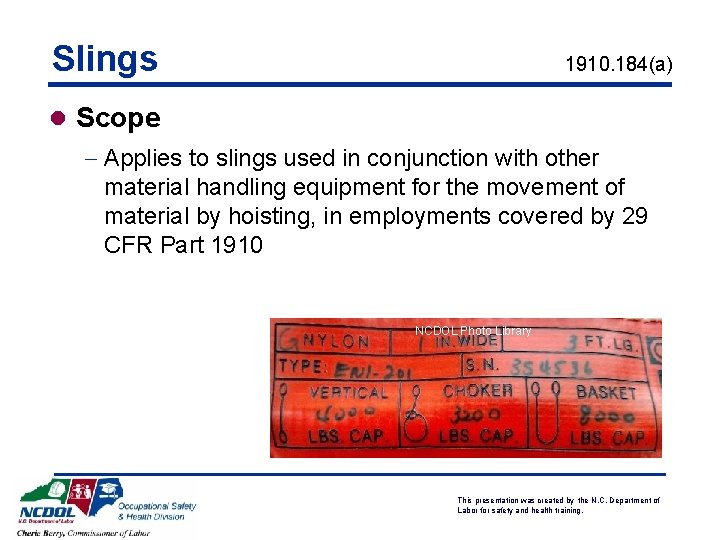
Slings 1910. 184(a) l Scope - Applies to slings used in conjunction with other material handling equipment for the movement of material by hoisting, in employments covered by 29 CFR Part 1910 NCDOL Photo Library This presentation was created by the N. C. Department of Labor for safety and health training.
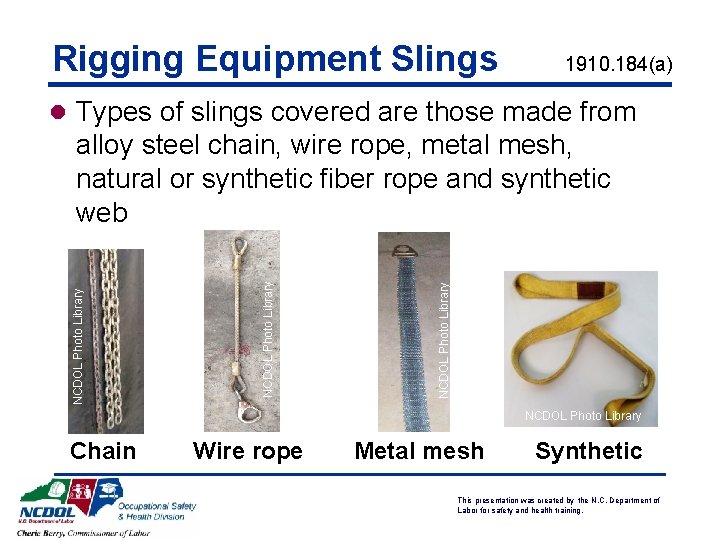
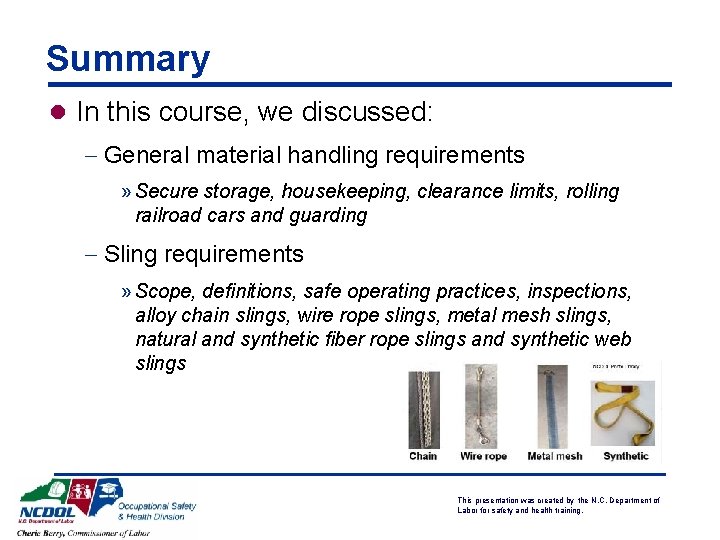
Rigging Equipment Slings 1910. 184(a) l Types of slings covered are those made from NCDOL Photo Library alloy steel chain, wire rope, metal mesh, natural or synthetic fiber rope and synthetic web NCDOL Photo Library Chain Wire rope Metal mesh Synthetic This presentation was created by the N. C. Department of Labor for safety and health training.
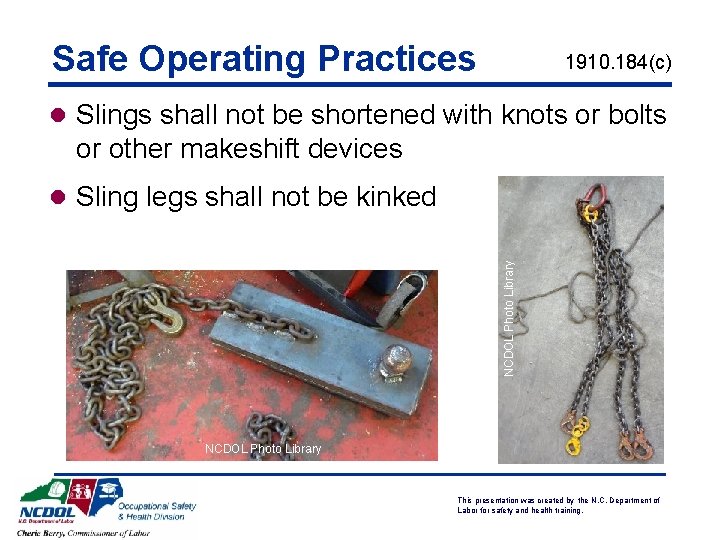
Safe Operating Practices 1910. 184(c) l Slings shall not be shortened with knots or bolts or other makeshift devices NCDOL Photo Library l Sling legs shall not be kinked NCDOL Photo Library This presentation was created by the N. C. Department of Labor for safety and health training.
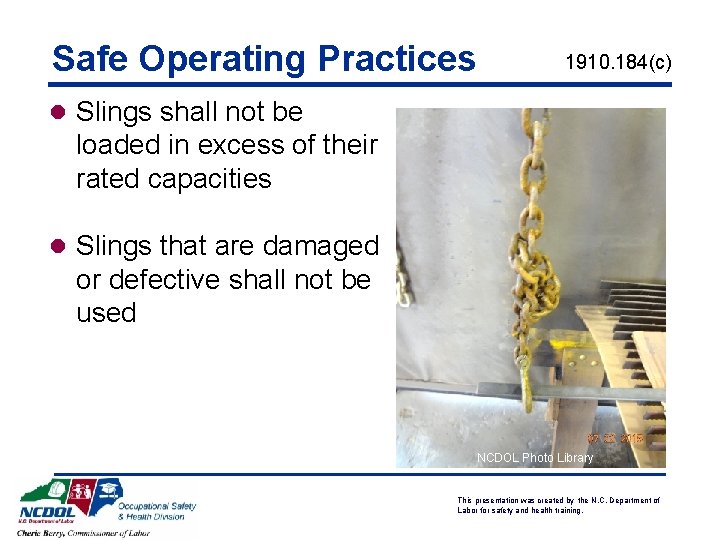
Safe Operating Practices 1910. 184(c) l Slings shall not be loaded in excess of their rated capacities l Slings that are damaged or defective shall not be used NCDOL Photo Library This presentation was created by the N. C. Department of Labor for safety and health training.
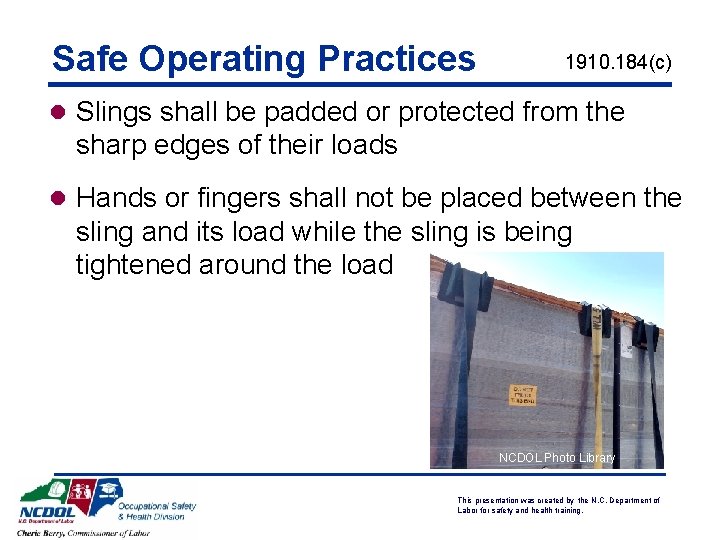
Safe Operating Practices 1910. 184(c) l Slings shall be padded or protected from the sharp edges of their loads l Hands or fingers shall not be placed between the sling and its load while the sling is being tightened around the load NCDOL Photo Library This presentation was created by the N. C. Department of Labor for safety and health training.
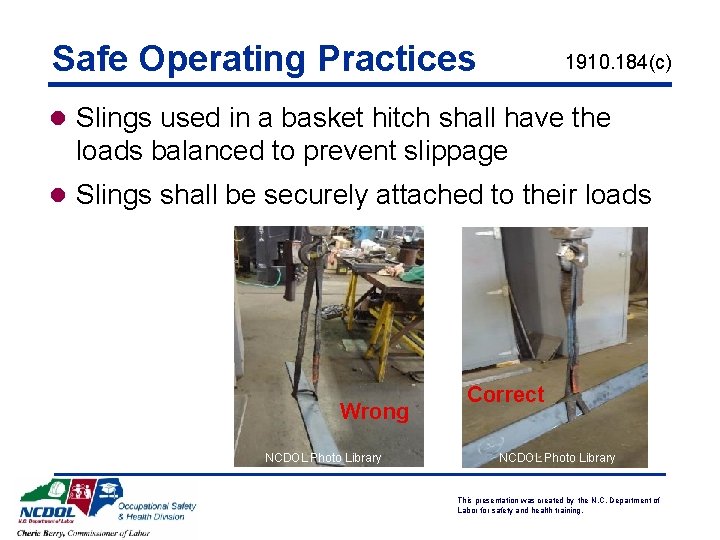
Safe Operating Practices 1910. 184(c) l Slings used in a basket hitch shall have the loads balanced to prevent slippage l Slings shall be securely attached to their loads Wrong NCDOL Photo Library Correct NCDOL Photo Library This presentation was created by the N. C. Department of Labor for safety and health training.
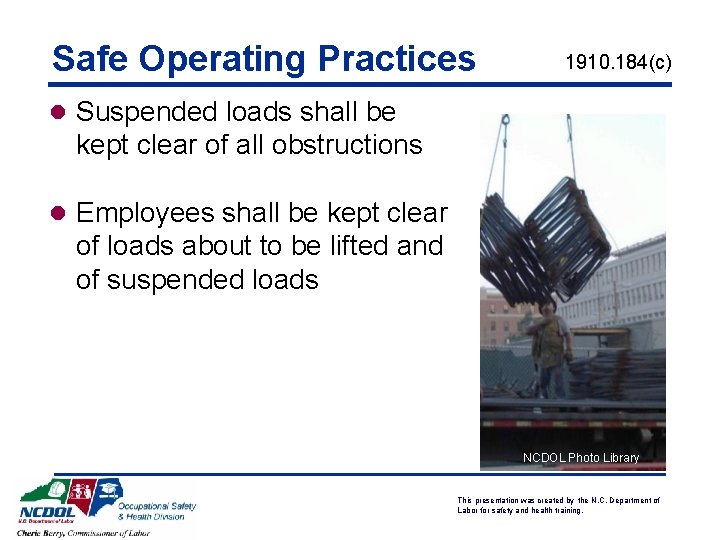
Safe Operating Practices 1910. 184(c) l Suspended loads shall be kept clear of all obstructions l Employees shall be kept clear of loads about to be lifted and of suspended loads NCDOL Photo Library This presentation was created by the N. C. Department of Labor for safety and health training.
Safe Operating Practices 1910. 184(c) l Shock loading is prohibited l A sling shall not be pulled from under a load when the load is resting on the sling l Three factors determine the magnitude of the shock load: - Weight of the object - Speed that the object is traveling before it starts to decelerate - Rate of deceleration (the stopping distance) This presentation was created by the N. C. Department of Labor for safety and health training.
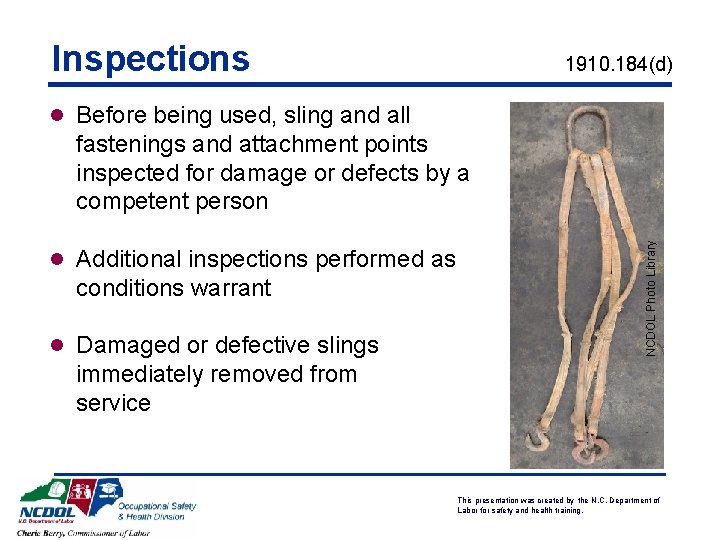
Inspections 1910. 184(d) l Before being used, sling and all l Additional inspections performed as conditions warrant l Damaged or defective slings NCDOL Photo Library fastenings and attachment points inspected for damage or defects by a competent person immediately removed from service This presentation was created by the N. C. Department of Labor for safety and health training.
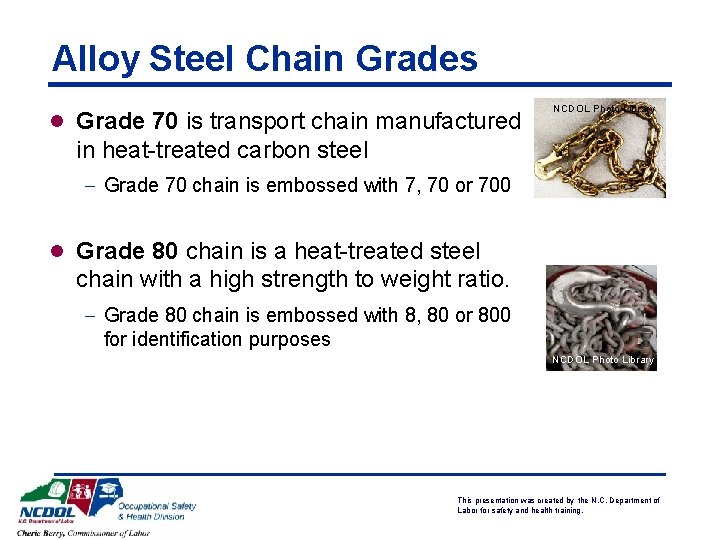
Alloy Steel Chain Grades l Grade 70 is transport chain manufactured NCDOL Photo Library in heat-treated carbon steel - Grade 70 chain is embossed with 7, 70 or 700 l Grade 80 chain is a heat-treated steel chain with a high strength to weight ratio. - Grade 80 chain is embossed with 8, 80 or 800 for identification purposes NCDOL Photo Library This presentation was created by the N. C. Department of Labor for safety and health training.
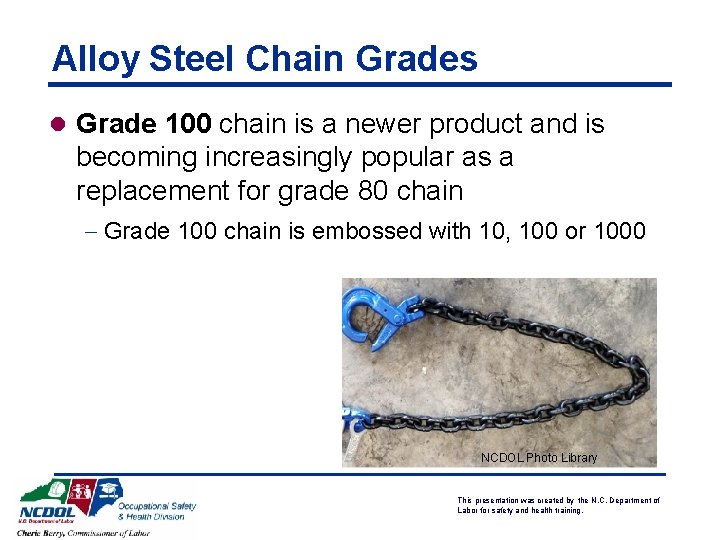
Alloy Steel Chain Grades l Grade 100 chain is a newer product and is becoming increasingly popular as a replacement for grade 80 chain - Grade 100 chain is embossed with 10, 100 or 1000 NCDOL Photo Library This presentation was created by the N. C. Department of Labor for safety and health training.
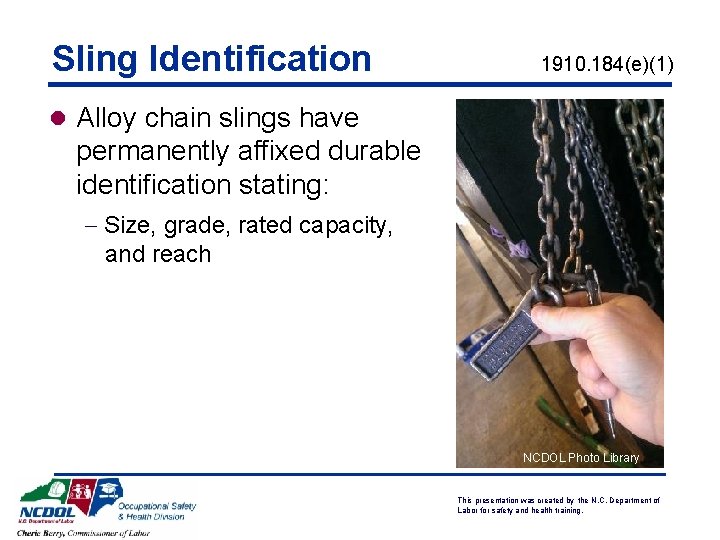
Sling Identification 1910. 184(e)(1) l Alloy chain slings have permanently affixed durable identification stating: - Size, grade, rated capacity, and reach NCDOL Photo Library This presentation was created by the N. C. Department of Labor for safety and health training.
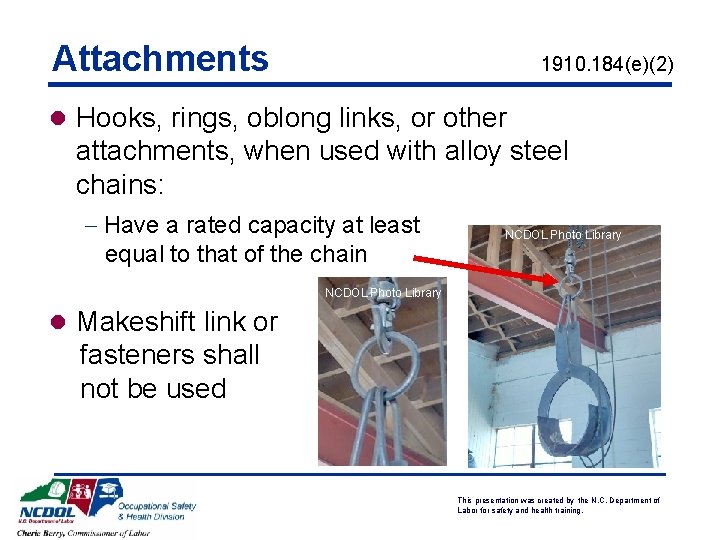
Attachments 1910. 184(e)(2) l Hooks, rings, oblong links, or other attachments, when used with alloy steel chains: - Have a rated capacity at least equal to that of the chain NCDOL Photo Library l Makeshift link or fasteners shall not be used This presentation was created by the N. C. Department of Labor for safety and health training.
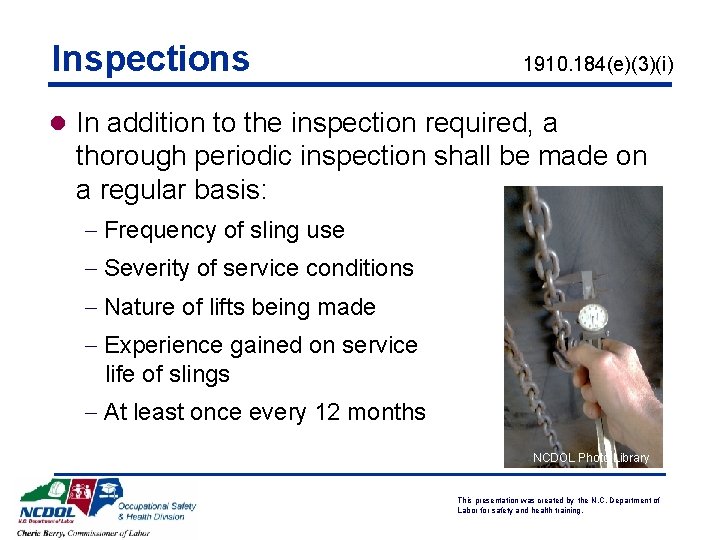
Inspections 1910. 184(e)(3)(i) l In addition to the inspection required, a thorough periodic inspection shall be made on a regular basis: - Frequency of sling use - Severity of service conditions - Nature of lifts being made - Experience gained on service life of slings - At least once every 12 months NCDOL Photo Library This presentation was created by the N. C. Department of Labor for safety and health training.
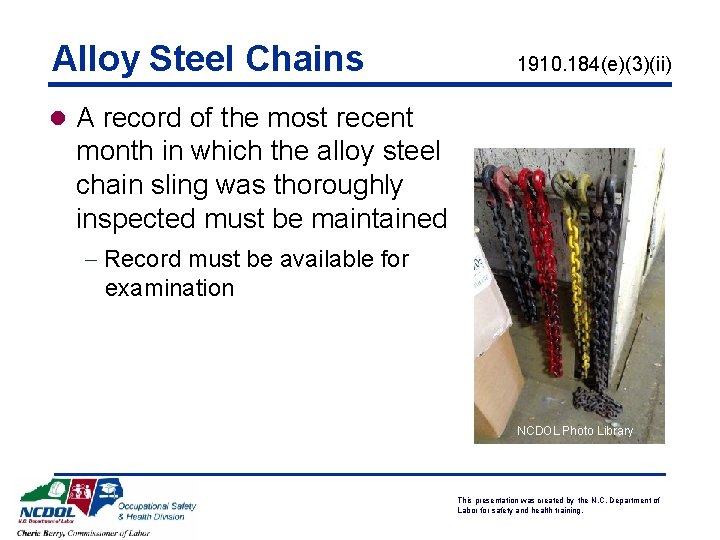
Alloy Steel Chains 1910. 184(e)(3)(ii) l A record of the most recent month in which the alloy steel chain sling was thoroughly inspected must be maintained - Record must be available for examination NCDOL Photo Library This presentation was created by the N. C. Department of Labor for safety and health training.
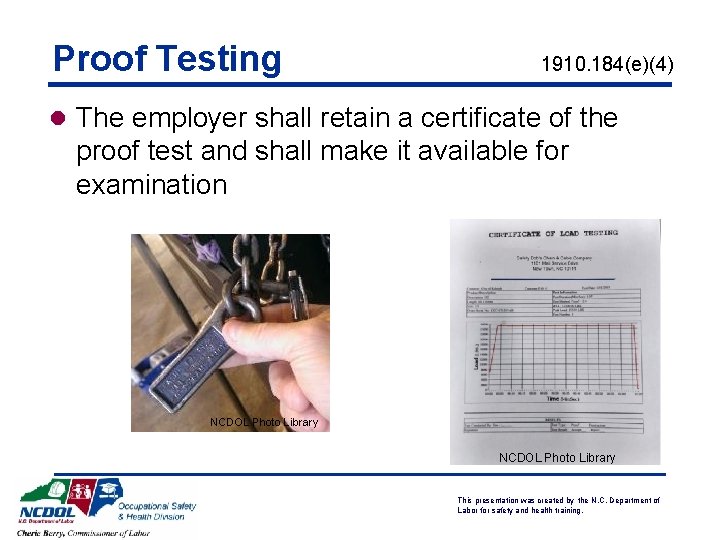
Proof Testing 1910. 184(e)(4) l The employer shall retain a certificate of the proof test and shall make it available for examination NCDOL Photo Library This presentation was created by the N. C. Department of Labor for safety and health training.
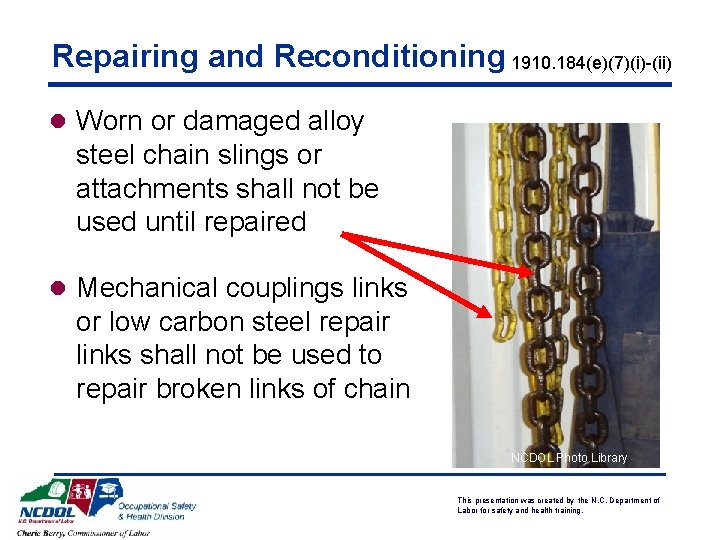
Repairing and Reconditioning 1910. 184(e)(7)(i)-(ii) l Worn or damaged alloy steel chain slings or attachments shall not be used until repaired l Mechanical couplings links or low carbon steel repair links shall not be used to repair broken links of chain NCDOL Photo Library This presentation was created by the N. C. Department of Labor for safety and health training.
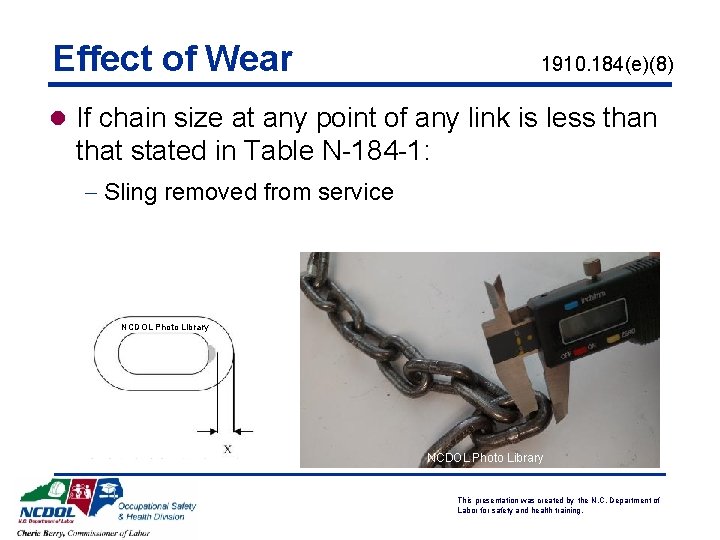
Effect of Wear 1910. 184(e)(8) l If chain size at any point of any link is less than that stated in Table N-184 -1: - Sling removed from service NCDOL Photo Library This presentation was created by the N. C. Department of Labor for safety and health training.
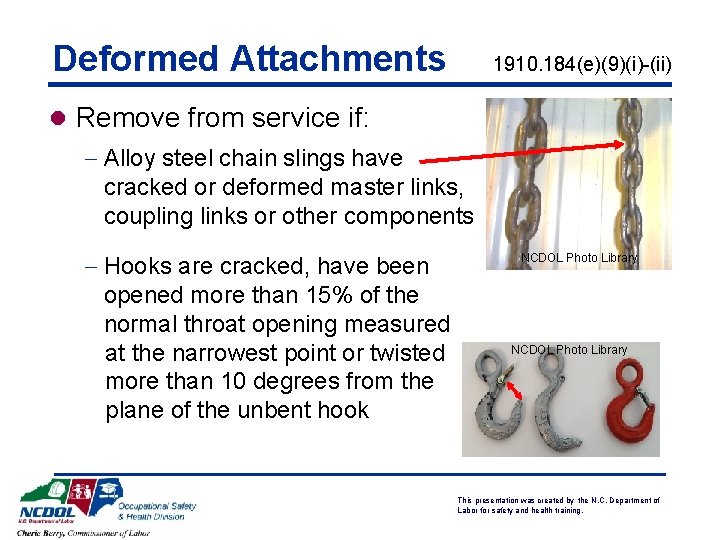
Deformed Attachments 1910. 184(e)(9)(i)-(ii) l Remove from service if: - Alloy steel chain slings have cracked or deformed master links, coupling links or other components - Hooks are cracked, have been opened more than 15% of the normal throat opening measured at the narrowest point or twisted more than 10 degrees from the plane of the unbent hook NCDOL Photo Library This presentation was created by the N. C. Department of Labor for safety and health training.
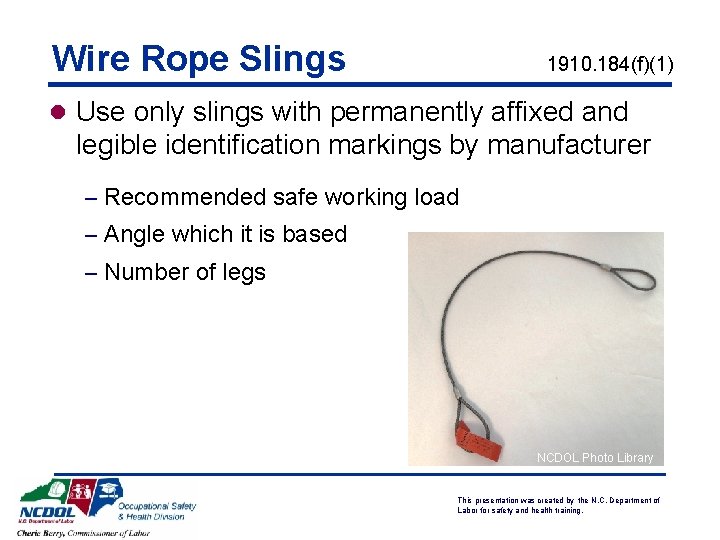
Wire Rope Slings 1910. 184(f)(1) l Use only slings with permanently affixed and legible identification markings by manufacturer – Recommended safe working load – Angle which it is based – Number of legs NCDOL Photo Library This presentation was created by the N. C. Department of Labor for safety and health training.
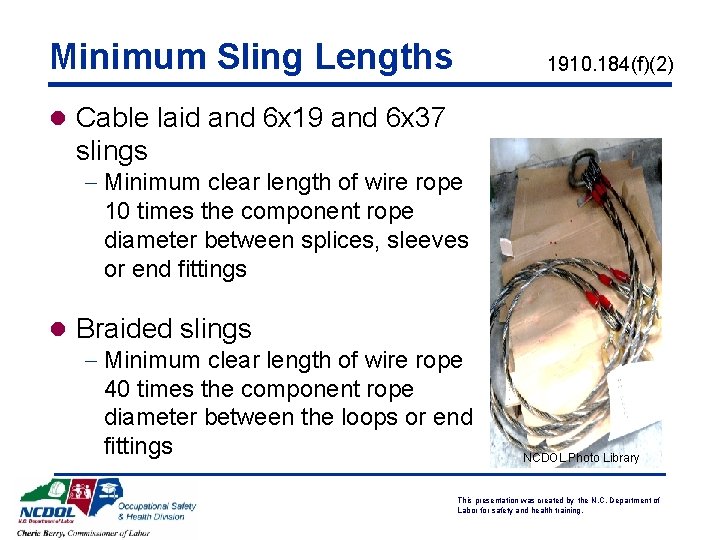
Minimum Sling Lengths 1910. 184(f)(2) l Cable laid and 6 x 19 and 6 x 37 slings - Minimum clear length of wire rope 10 times the component rope diameter between splices, sleeves or end fittings l Braided slings - Minimum clear length of wire rope 40 times the component rope diameter between the loops or end fittings NCDOL Photo Library This presentation was created by the N. C. Department of Labor for safety and health training.
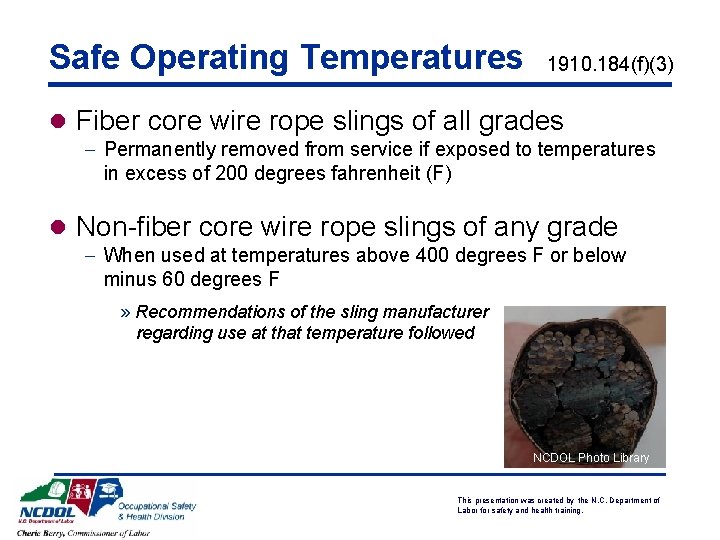
Safe Operating Temperatures 1910. 184(f)(3) l Fiber core wire rope slings of all grades - Permanently removed from service if exposed to temperatures in excess of 200 degrees fahrenheit (F) l Non-fiber core wire rope slings of any grade - When used at temperatures above 400 degrees F or below minus 60 degrees F » Recommendations of the sling manufacturer regarding use at that temperature followed NCDOL Photo Library This presentation was created by the N. C. Department of Labor for safety and health training.
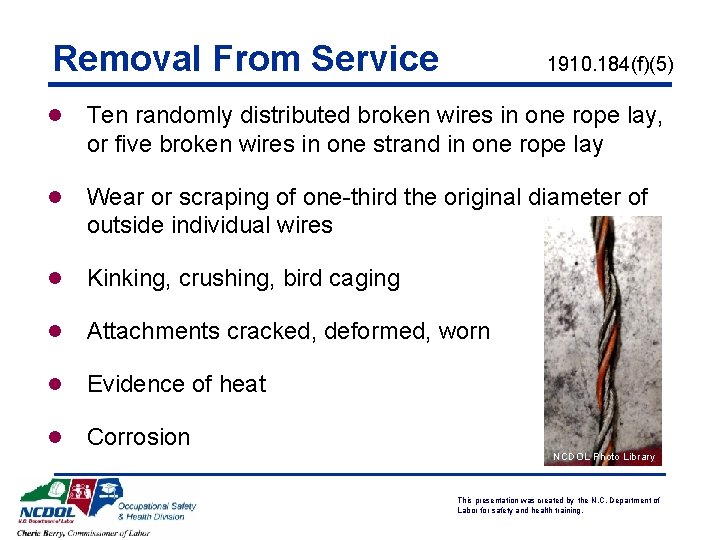
Removal From Service 1910. 184(f)(5) l Ten randomly distributed broken wires in one rope lay, or five broken wires in one strand in one rope lay l Wear or scraping of one-third the original diameter of outside individual wires l Kinking, crushing, bird caging l Attachments cracked, deformed, worn l Evidence of heat l Corrosion NCDOL Photo Library This presentation was created by the N. C. Department of Labor for safety and health training.
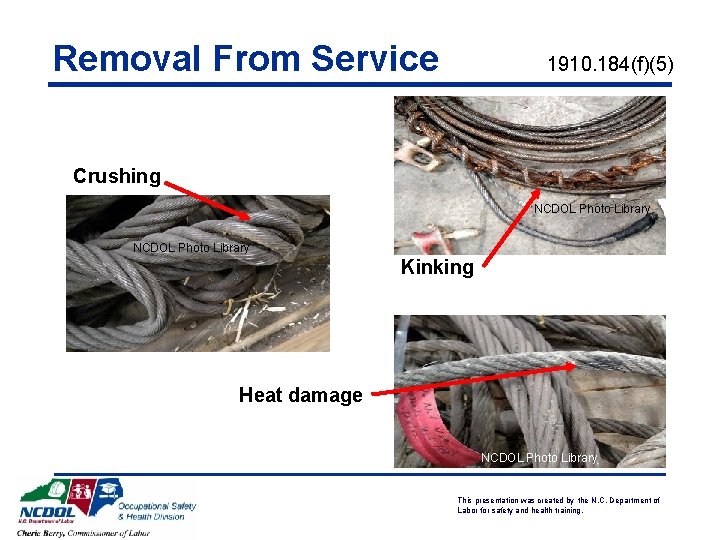
Removal From Service 1910. 184(f)(5) Crushing NCDOL Photo Library Kinking Heat damage NCDOL Photo Library This presentation was created by the N. C. Department of Labor for safety and health training.
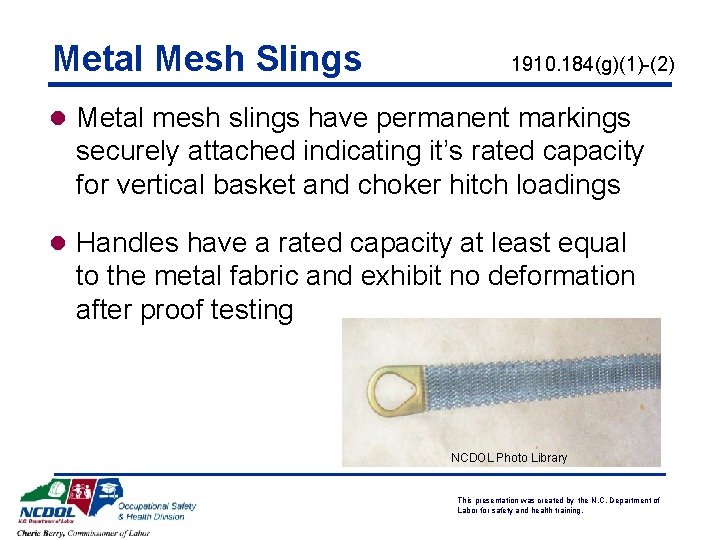
Metal Mesh Slings 1910. 184(g)(1)-(2) l Metal mesh slings have permanent markings securely attached indicating it’s rated capacity for vertical basket and choker hitch loadings l Handles have a rated capacity at least equal to the metal fabric and exhibit no deformation after proof testing NCDOL Photo Library This presentation was created by the N. C. Department of Labor for safety and health training.
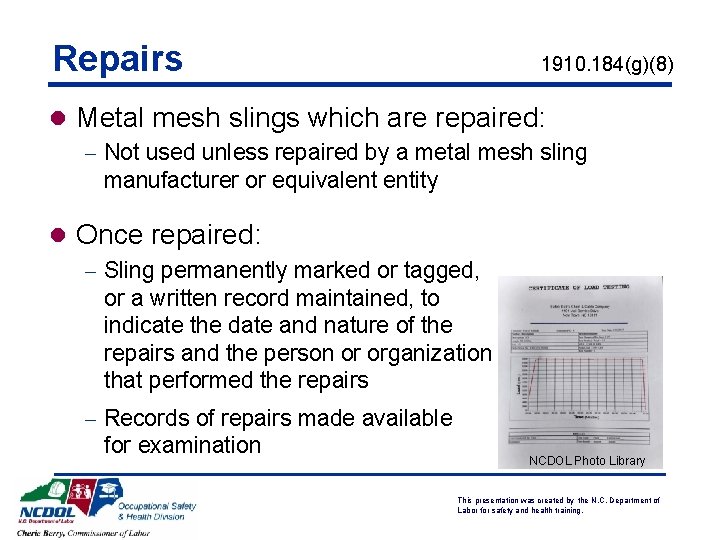
Repairs 1910. 184(g)(8) l Metal mesh slings which are repaired: - Not used unless repaired by a metal mesh sling manufacturer or equivalent entity l Once repaired: - Sling permanently marked or tagged, or a written record maintained, to indicate the date and nature of the repairs and the person or organization that performed the repairs - Records of repairs made available for examination NCDOL Photo Library This presentation was created by the N. C. Department of Labor for safety and health training.
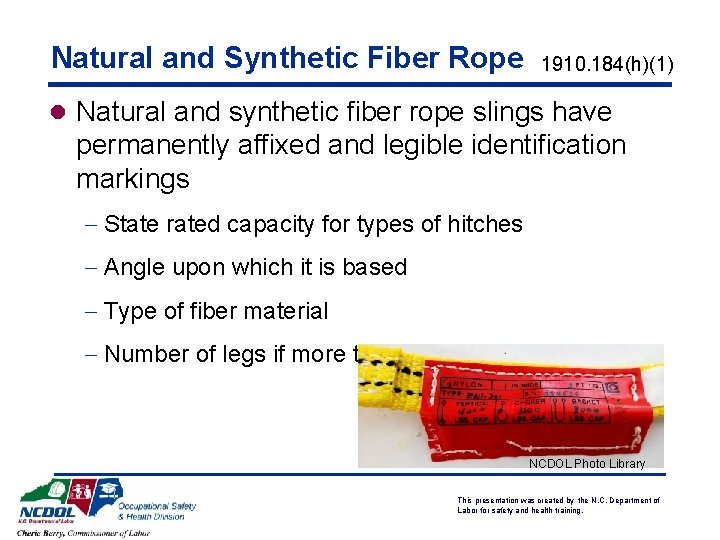
Natural and Synthetic Fiber Rope 1910. 184(h)(1) l Natural and synthetic fiber rope slings have permanently affixed and legible identification markings - State rated capacity for types of hitches - Angle upon which it is based - Type of fiber material - Number of legs if more than one NCDOL Photo Library This presentation was created by the N. C. Department of Labor for safety and health training.
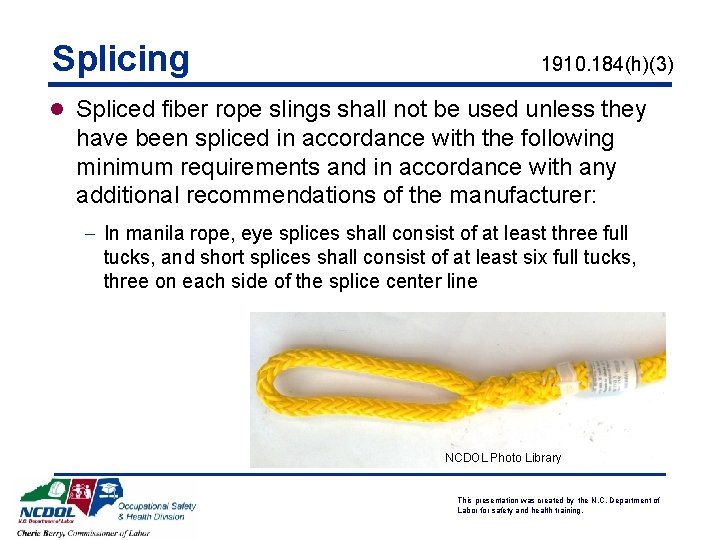
Splicing 1910. 184(h)(3) l Spliced fiber rope slings shall not be used unless they have been spliced in accordance with the following minimum requirements and in accordance with any additional recommendations of the manufacturer: - In manila rope, eye splices shall consist of at least three full tucks, and short splices shall consist of at least six full tucks, three on each side of the splice center line NCDOL Photo Library This presentation was created by the N. C. Department of Labor for safety and health training.
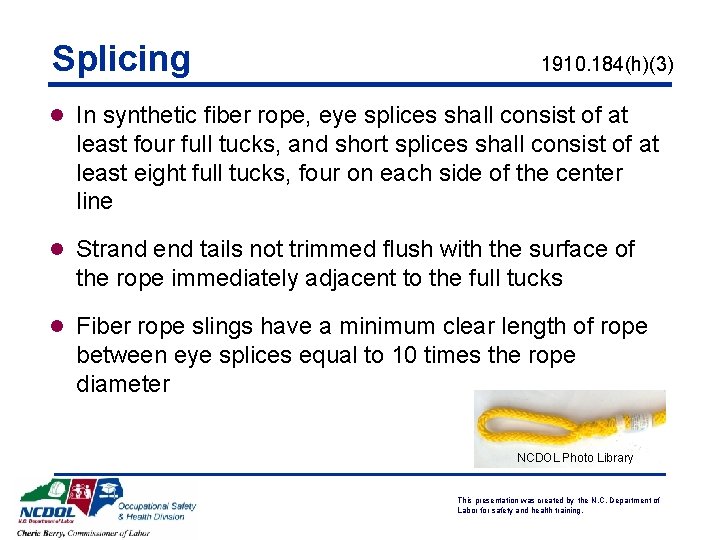
Splicing 1910. 184(h)(3) l In synthetic fiber rope, eye splices shall consist of at least four full tucks, and short splices shall consist of at least eight full tucks, four on each side of the center line l Strand end tails not trimmed flush with the surface of the rope immediately adjacent to the full tucks l Fiber rope slings have a minimum clear length of rope between eye splices equal to 10 times the rope diameter NCDOL Photo Library This presentation was created by the N. C. Department of Labor for safety and health training.
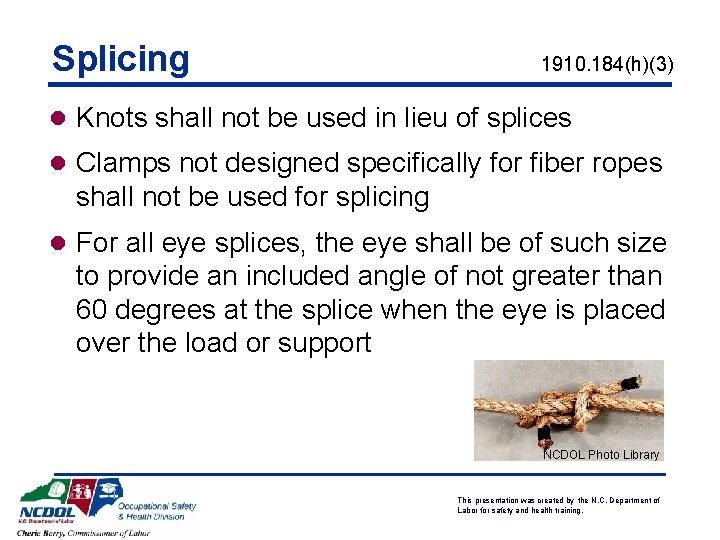
Splicing 1910. 184(h)(3) l Knots shall not be used in lieu of splices l Clamps not designed specifically for fiber ropes shall not be used for splicing l For all eye splices, the eye shall be of such size to provide an included angle of not greater than 60 degrees at the splice when the eye is placed over the load or support NCDOL Photo Library This presentation was created by the N. C. Department of Labor for safety and health training.
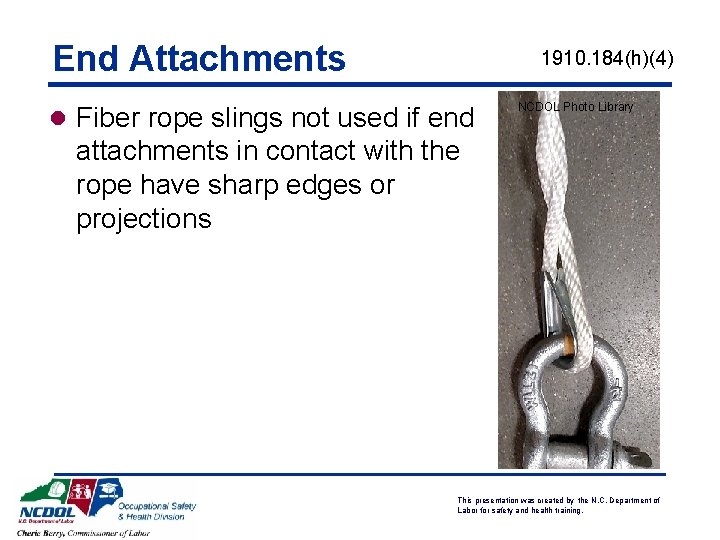
End Attachments 1910. 184(h)(4) l Fiber rope slings not used if end NCDOL Photo Library attachments in contact with the rope have sharp edges or projections This presentation was created by the N. C. Department of Labor for safety and health training.
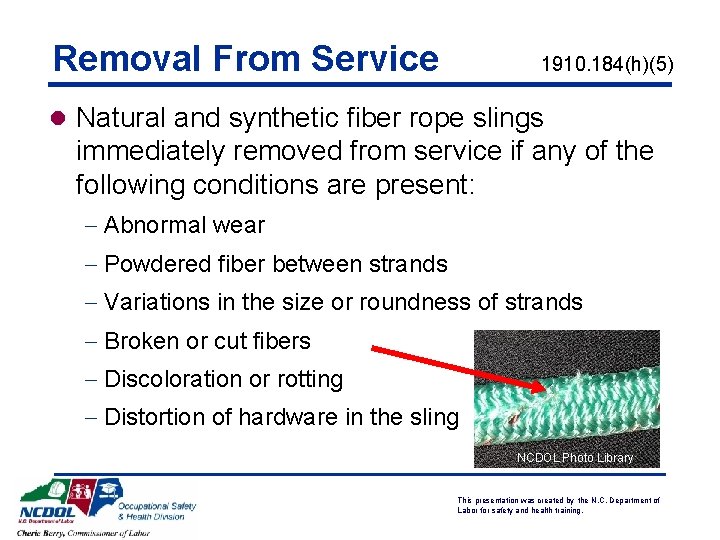
Removal From Service 1910. 184(h)(5) l Natural and synthetic fiber rope slings immediately removed from service if any of the following conditions are present: - Abnormal wear - Powdered fiber between strands - Variations in the size or roundness of strands - Broken or cut fibers - Discoloration or rotting - Distortion of hardware in the sling NCDOL Photo Library This presentation was created by the N. C. Department of Labor for safety and health training.
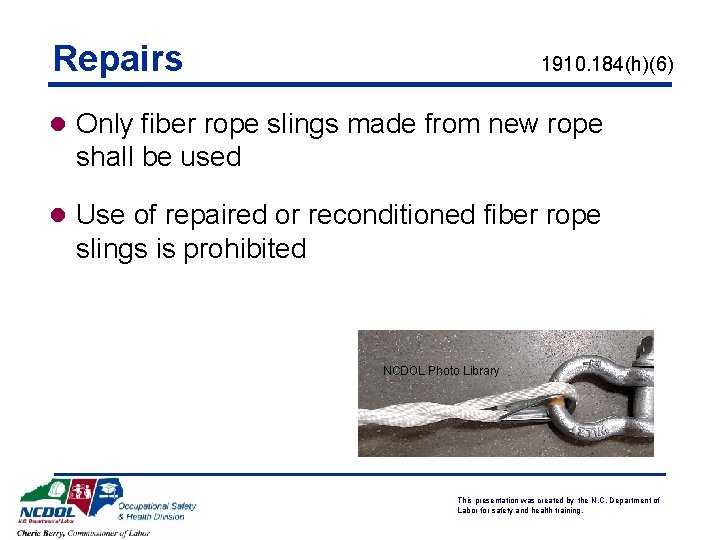
Repairs 1910. 184(h)(6) l Only fiber rope slings made from new rope shall be used l Use of repaired or reconditioned fiber rope slings is prohibited NCDOL Photo Library This presentation was created by the N. C. Department of Labor for safety and health training.
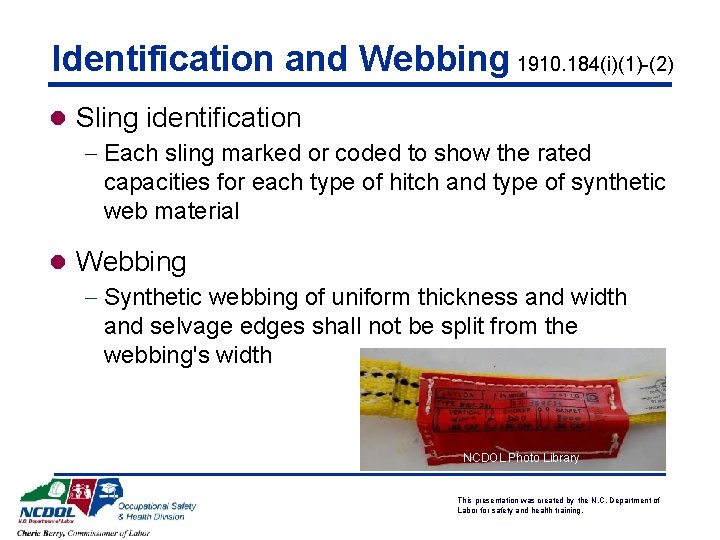
Identification and Webbing 1910. 184(i)(1)-(2) l Sling identification - Each sling marked or coded to show the rated capacities for each type of hitch and type of synthetic web material l Webbing - Synthetic webbing of uniform thickness and width and selvage edges shall not be split from the webbing's width NCDOL Photo Library This presentation was created by the N. C. Department of Labor for safety and health training.
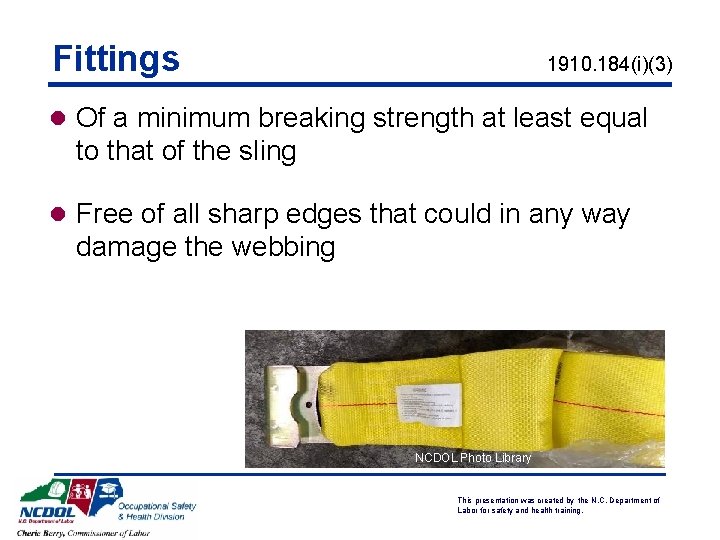
Fittings 1910. 184(i)(3) l Of a minimum breaking strength at least equal to that of the sling l Free of all sharp edges that could in any way damage the webbing NCDOL Photo Library This presentation was created by the N. C. Department of Labor for safety and health training.
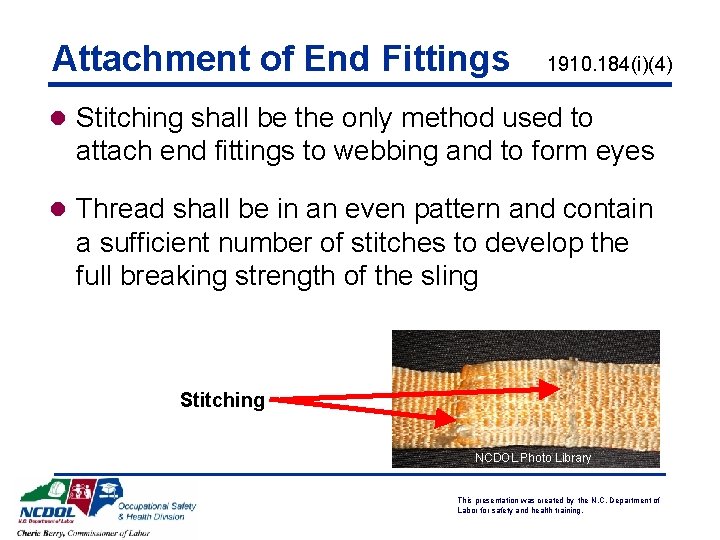
Attachment of End Fittings 1910. 184(i)(4) l Stitching shall be the only method used to attach end fittings to webbing and to form eyes l Thread shall be in an even pattern and contain a sufficient number of stitches to develop the full breaking strength of the sling Stitching NCDOL Photo Library This presentation was created by the N. C. Department of Labor for safety and health training.
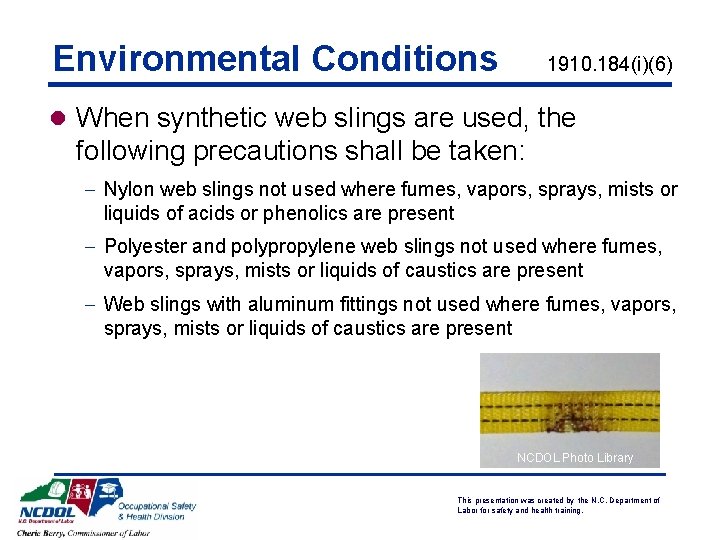
Environmental Conditions 1910. 184(i)(6) l When synthetic web slings are used, the following precautions shall be taken: - Nylon web slings not used where fumes, vapors, sprays, mists or liquids of acids or phenolics are present - Polyester and polypropylene web slings not used where fumes, vapors, sprays, mists or liquids of caustics are present - Web slings with aluminum fittings not used where fumes, vapors, sprays, mists or liquids of caustics are present NCDOL Photo Library This presentation was created by the N. C. Department of Labor for safety and health training.
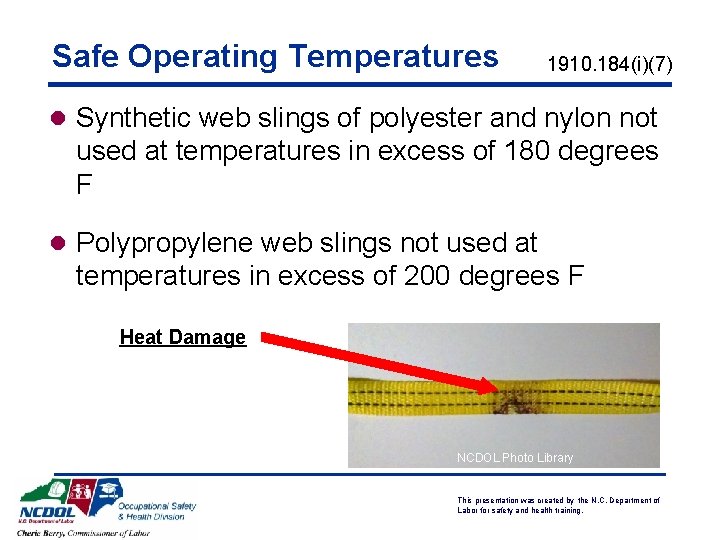
Safe Operating Temperatures 1910. 184(i)(7) l Synthetic web slings of polyester and nylon not used at temperatures in excess of 180 degrees F l Polypropylene web slings not used at temperatures in excess of 200 degrees F Heat Damage NCDOL Photo Library This presentation was created by the N. C. Department of Labor for safety and health training.
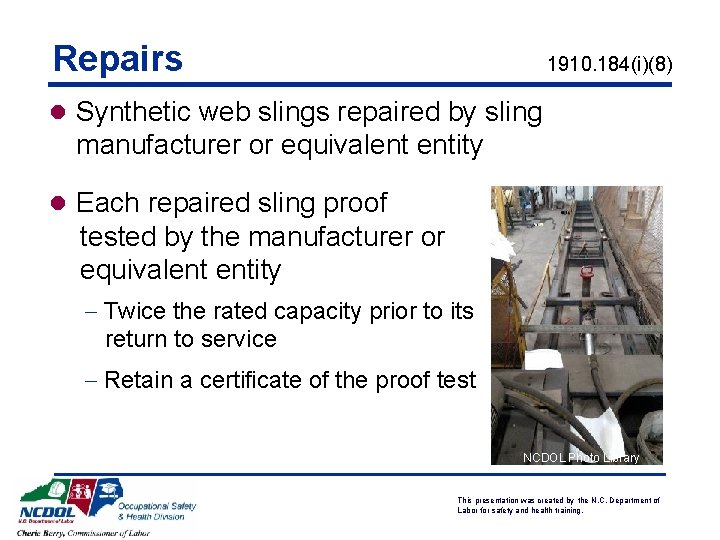
Repairs 1910. 184(i)(8) l Synthetic web slings repaired by sling manufacturer or equivalent entity l Each repaired sling proof tested by the manufacturer or equivalent entity - Twice the rated capacity prior to its return to service - Retain a certificate of the proof test NCDOL Photo Library This presentation was created by the N. C. Department of Labor for safety and health training.
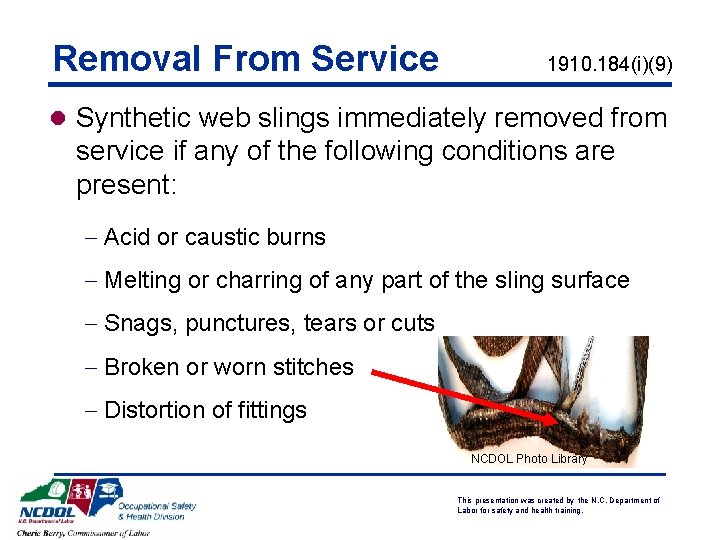
Removal From Service 1910. 184(i)(9) l Synthetic web slings immediately removed from service if any of the following conditions are present: - Acid or caustic burns - Melting or charring of any part of the sling surface - Snags, punctures, tears or cuts - Broken or worn stitches - Distortion of fittings NCDOL Photo Library This presentation was created by the N. C. Department of Labor for safety and health training.
Summary l In this course, we discussed: - General material handling requirements » Secure storage, housekeeping, clearance limits, rolling railroad cars and guarding - Sling requirements » Scope, definitions, safe operating practices, inspections, alloy chain slings, wire rope slings, metal mesh slings, natural and synthetic fiber rope slings and synthetic web slings This presentation was created by the N. C. Department of Labor for safety and health training.
Thank You For Attending! Final Questions? This presentation was created by the N. C. Department of Labor for safety and health training.