Mandated Reporter Training for School Employees State of


- Slides: 51
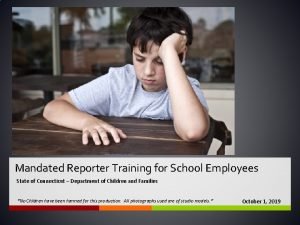
Mandated Reporter Training for School Employees State of Connecticut – Department of Children and Families *No Children have been harmed for this production. All photographs used are of studio models. * October 1, 2019
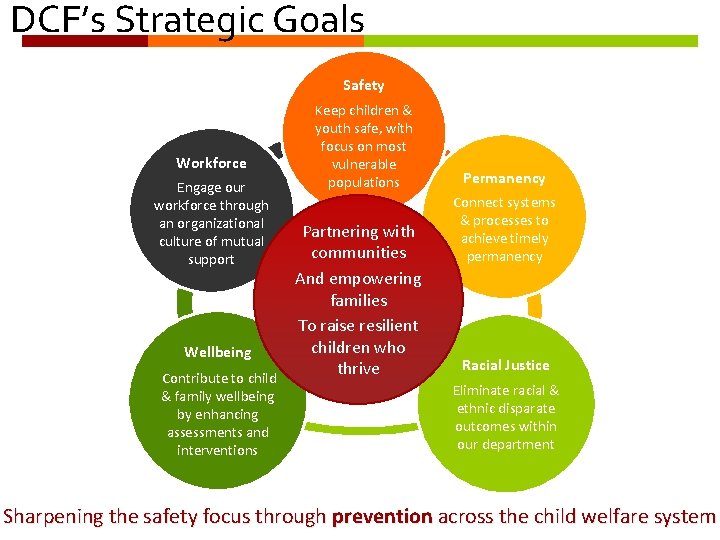
DCF’s Strategic Goals Safety Workforce Engage our workforce through an organizational culture of mutual support Keep children & youth safe, with focus on most vulnerable populations Partnering with communities And empowering families To raise resilient children who Wellbeing thrive Contribute to child & family wellbeing by enhancing assessments and interventions Permanency Connect systems & processes to achieve timely permanency Racial Justice Eliminate racial & ethnic disparate outcomes within our department Sharpening the safety focus through prevention across the child welfare system
Purpose of Mandated Reporter Training u Provide information u To keep you up to date with your roles, responsibilities and changes in the law and possible preventive measures you can take to protect yourselves as well as the children and families you serve u To hear concerns, answer questions, and develop ways to work together to better protect children October 1, 2015 October 1, 2019
Who Must Report Connecticut General Statutes (State law) identify professionals who, because their work involves regular contact with children, are mandated by law to report suspected child abuse and neglect. October 1, 2015 October 1, 2019
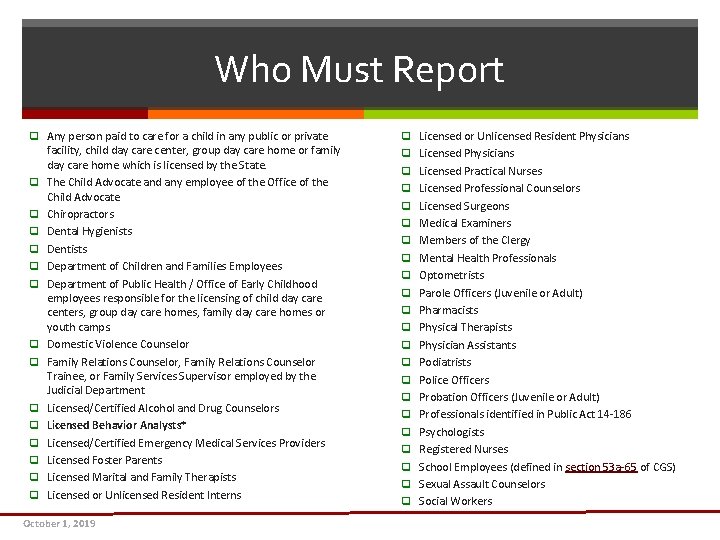
Who Must Report q Any person paid to care for a child in any public or private q q q q facility, child day care center, group day care home or family day care home which is licensed by the State. The Child Advocate and any employee of the Office of the Child Advocate Chiropractors Dental Hygienists Dentists Department of Children and Families Employees Department of Public Health / Office of Early Childhood employees responsible for the licensing of child day care centers, group day care homes, family day care homes or youth camps. Domestic Violence Counselor Family Relations Counselor, Family Relations Counselor Trainee, or Family Services Supervisor employed by the Judicial Department Licensed/Certified Alcohol and Drug Counselors Licensed Behavior Analysts* Licensed/Certified Emergency Medical Services Providers Licensed Foster Parents Licensed Marital and Family Therapists Licensed or Unlicensed Resident Interns October 1, 2019 q Licensed or Unlicensed Resident Physicians q Licensed Practical Nurses q Licensed Professional Counselors q Licensed Surgeons q Medical Examiners q Members of the Clergy q Mental Health Professionals q Optometrists q Parole Officers (Juvenile or Adult) q Pharmacists q Physical Therapists q Physician Assistants q Podiatrists q Police Officers q Probation Officers (Juvenile or Adult) q Professionals identified in Public Act 14 -186 q Psychologists q Registered Nurses q School Employees (defined in section 53 a-65 of CGS) q Sexual Assault Counselors q Social Workers
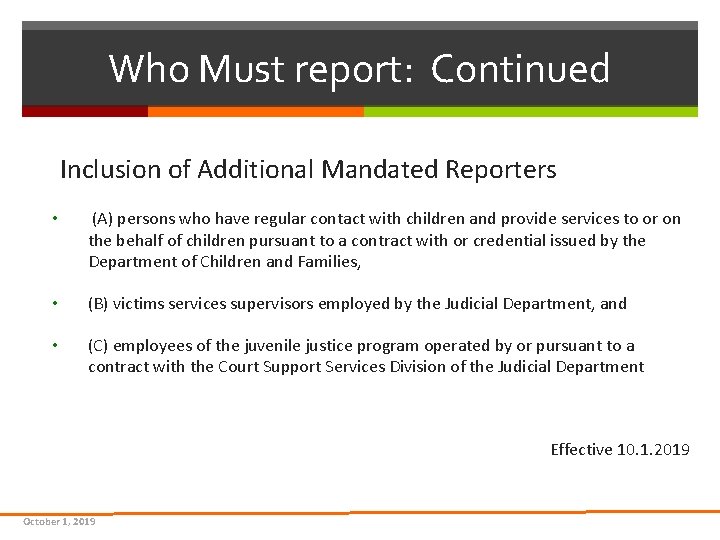
Who Must report: Continued Inclusion of Additional Mandated Reporters • (A) persons who have regular contact with children and provide services to or on the behalf of children pursuant to a contract with or credential issued by the Department of Children and Families, • (B) victims services supervisors employed by the Judicial Department, and • (C) employees of the juvenile justice program operated by or pursuant to a contract with the Court Support Services Division of the Judicial Department Effective 10. 1. 2019 October 1, 2015 October 1, 2019
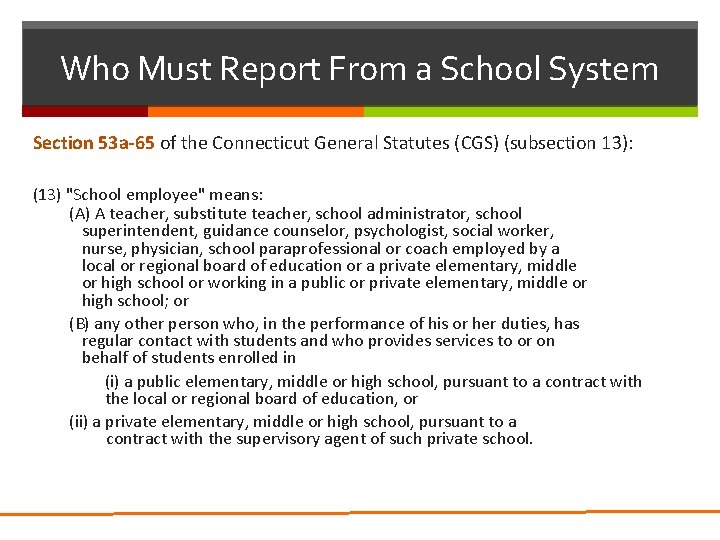
Who Must Report From a School System Section 53 a-65 of the Connecticut General Statutes (CGS) (subsection 13): (13) "School employee" means: (A) A teacher, substitute teacher, school administrator, school superintendent, guidance counselor, psychologist, social worker, nurse, physician, school paraprofessional or coach employed by a local or regional board of education or a private elementary, middle or high school or working in a public or private elementary, middle or high school; or (B) any other person who, in the performance of his or her duties, has regular contact with students and who provides services to or on behalf of students enrolled in (i) a public elementary, middle or high school, pursuant to a contract with the local or regional board of education, or (ii) a private elementary, middle or high school, pursuant to a contract with the supervisory agent of such private school. October 1, 2015
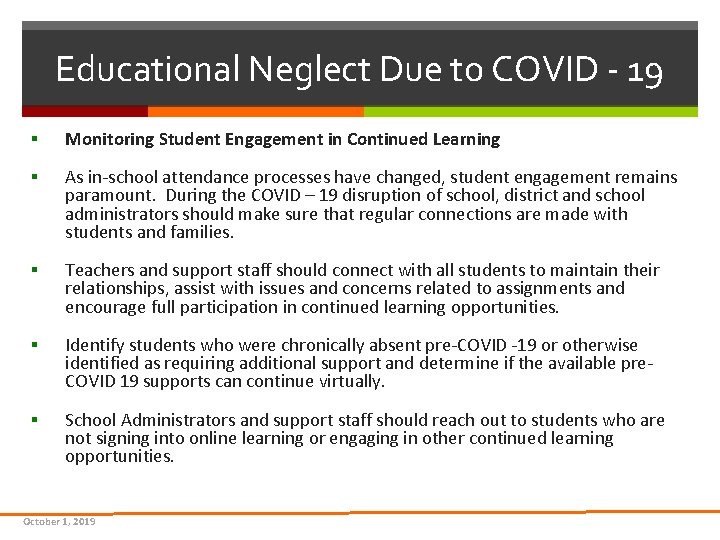
Educational Neglect Due to COVID - 19 § Monitoring Student Engagement in Continued Learning § As in-school attendance processes have changed, student engagement remains paramount. During the COVID – 19 disruption of school, district and school administrators should make sure that regular connections are made with students and families. § Teachers and support staff should connect with all students to maintain their relationships, assist with issues and concerns related to assignments and encourage full participation in continued learning opportunities. § Identify students who were chronically absent pre-COVID -19 or otherwise identified as requiring additional support and determine if the available pre. COVID 19 supports can continue virtually. § School Administrators and support staff should reach out to students who are not signing into online learning or engaging in other continued learning opportunities. October 1, 2015 October 1, 2019
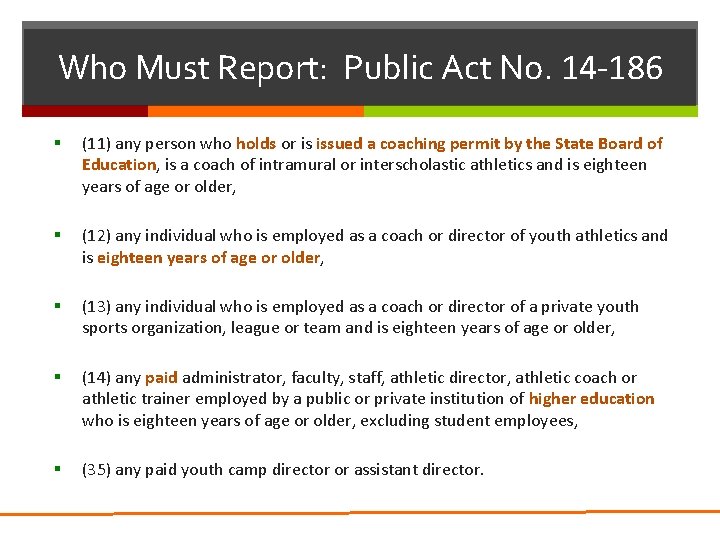
Who Must Report: Public Act No. 14 -186 § (11) any person who holds or is issued a coaching permit by the State Board of Education, is a coach of intramural or interscholastic athletics and is eighteen years of age or older, § (12) any individual who is employed as a coach or director of youth athletics and is eighteen years of age or older, § (13) any individual who is employed as a coach or director of a private youth sports organization, league or team and is eighteen years of age or older, § (14) any paid administrator, faculty, staff, athletic director, athletic coach or athletic trainer employed by a public or private institution of higher education who is eighteen years of age or older, excluding student employees, § (35) any paid youth camp director or assistant director. October 1, 2015
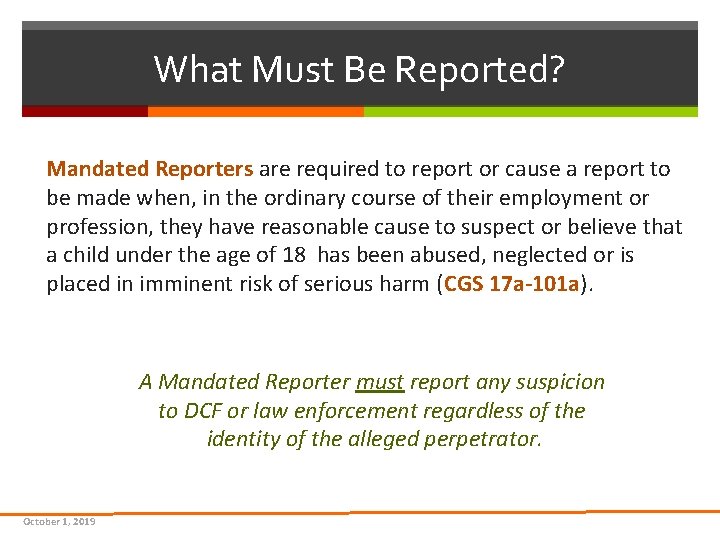
What Must Be Reported? Mandated Reporters are required to report or cause a report to be made when, in the ordinary course of their employment or profession, they have reasonable cause to suspect or believe that a child under the age of 18 has been abused, neglected or is placed in imminent risk of serious harm (CGS 17 a-101 a). A Mandated Reporter must report any suspicion to DCF or law enforcement regardless of the identity of the alleged perpetrator. October 1, 2015 October 1, 2019
What Must Be Reported? *School employees are further required to report or cause a report to be made when, in the ordinary course of their employment or profession, they have reasonable cause to suspect or believe that any person who is being educated by the technical high school system or a local or regional board of education, other than as part of an adult education program, is a victim of sexual assault and the perpetrator is a school employee. * Public Act 15 -205 - Effective 10/1/2015 October 1, 2015
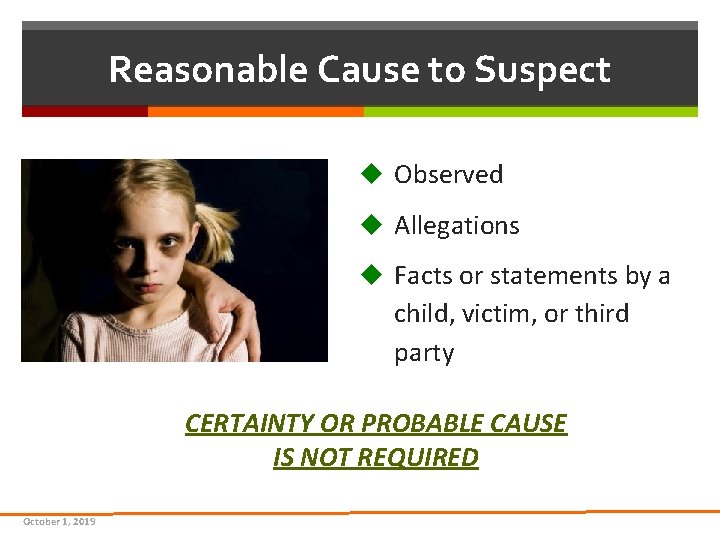
Reasonable Cause to Suspect u Observed u Allegations u Facts or statements by a child, victim, or third party CERTAINTY OR PROBABLE CAUSE IS NOT REQUIRED October 1, 2015 October 1, 2019
Definitions: Abuse Connecticut General Statutes, Section 46 b-120, defines an abused child as a child or youth less than 18 years of age who: q Has had physical injuries inflicted upon him or her other than by accidental means, or q Has injuries which are at variance with the history given of them, or q Is in a condition which is the result of maltreatment such as, but not limited to, malnutrition, sexual molestation or exploitation, deprivation of necessities, emotional maltreatment, or cruel punishment. October 1, 2015 October 1, 2019
Possible Indicators of Sexual Abuse Physical § § Chronic gastrointestinal complaints Unexplained bruises, lacerations, redness, swelling, or bleeding in the genital, vaginal, or anal areas. Complaints of genital or rectal pain Sexually transmitted disease § Child Under 13 with Venereal Disease a physician or facility must report to Careline upon the consultation, examination or treatment for venereal disease of any child not more than twelve (12) years old § Pregnancy October 1, 2015 October 1, 2019
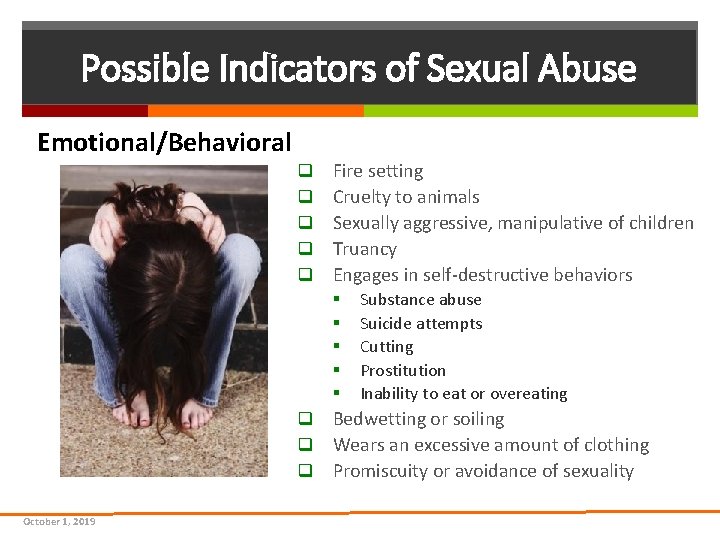
Possible Indicators of Sexual Abuse Emotional/Behavioral q q q Fire setting Cruelty to animals Sexually aggressive, manipulative of children Truancy Engages in self-destructive behaviors § § § q q q October 1, 2019 Substance abuse Suicide attempts Cutting Prostitution Inability to eat or overeating Bedwetting or soiling Wears an excessive amount of clothing Promiscuity or avoidance of sexuality October 1, 2015
Age of Consent for Sexual Activity The general age of consent in Connecticut is 16. This applies in most normal relationships. However, if any of the following apply, then the age of consent becomes 18: § Where one person is a guardian, or responsible for the general supervision, of the other. See C. G. S. § 53 a-71(a)(4). § Where one person is an athletic coach or an intensive, ongoing instructor (e. g. piano teacher) outside of a school setting, and the other is being coached or instructed. See C. G. S. § 53 a-71(9)(B). § Where one person's professional, legal, occupational or volunteer status gives him/her a role of supervision, power, or authority, over the other's participation in a program or activity, and the older person is at least 20 -years-old. See C. G. S. § 53 a-71(a)(4). October 1, 2015 October 1, 2019
Age of Consent for Sexual Activity Age of consent is irrelevant in the following; as even consensual adult sexual activity is criminalized in these relationships: § Where one person is a school employee (of the board of education, by extension excluding post-secondary schools) and the other a student. See C. G. S. § 53 a-71(a)(8) § Where one person is an athletic coach or an intensive, ongoing instructor (e. g. piano teacher) in a secondary (high school) setting and the other a student. See C. G. S. § 53 a 71(9)(A) October 1, 2015 October 1, 2019
HUMAN TRAFFICKING Commercial Sexual Exploitation of Children (CSEC). Sexual abuse of a child (under the age of 18) by another person in return for payment in money or in kind, paid to the child or to one or more third parties. CSEC includes child pornography, trafficking in children for sexual purposes, child sex tourism and child marriage when payment is exchanged. Visit DCF website for additional resources, information, and access to training: www. ct. gov/dcf October 1, 2019 Domestic Minor Sex Trafficking (DMST). Sexual abuse of a child (under the age of 18) by another person in return for payment in money or in kind, paid to one or more third parties.
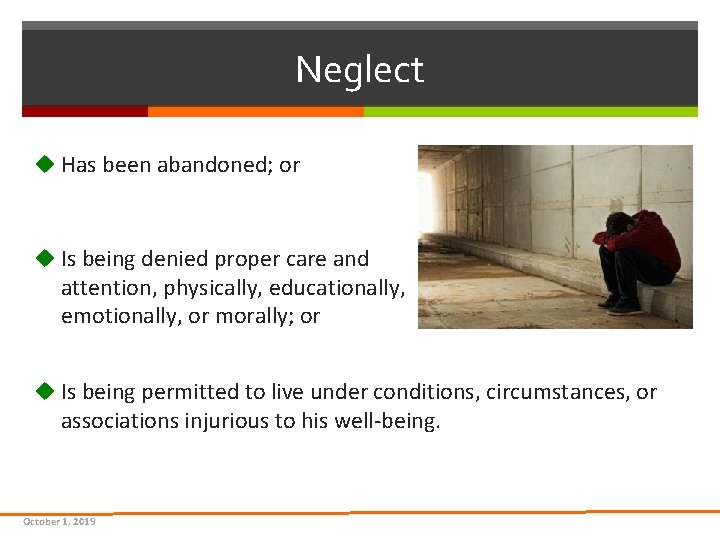
Neglect u Has been abandoned; or u Is being denied proper care and attention, physically, educationally, emotionally, or morally; or u Is being permitted to live under conditions, circumstances, or associations injurious to his well-being. October 1, 2015 October 1, 2019
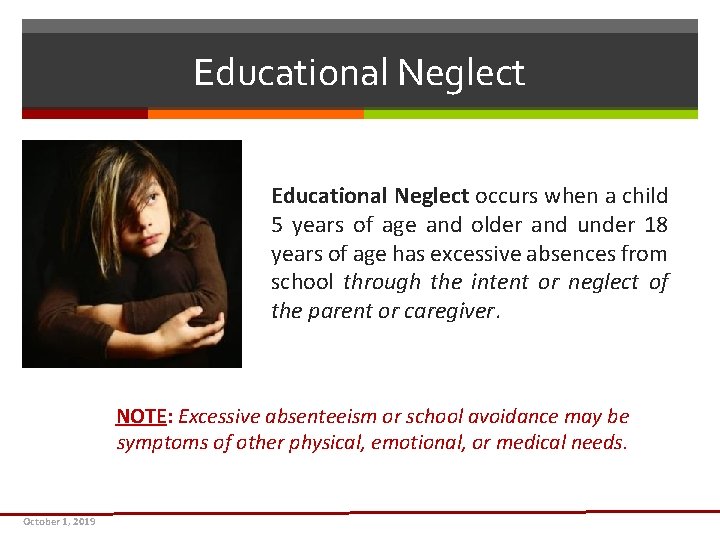
Educational Neglect occurs when a child 5 years of age and older and under 18 years of age has excessive absences from school through the intent or neglect of the parent or caregiver. NOTE: Excessive absenteeism or school avoidance may be symptoms of other physical, emotional, or medical needs. October 1, 2019
Educational Neglect Exceptions & Special Considerations • A child age 5 or 6 is not required to attend school. Educational neglect only occurs if the child is enrolled at 5 or 6 and does not attend school or receive home instruction. • For children older than 12, excessive absences through the child’s intent, despite the parents’ or caregivers efforts, is truancy. Truancy is handled through the school district. • A parent or person having control of a child 17 years of age may consent to the child’s withdrawal from school by personally appearing and signing a withdrawal form. October 1, 2015 October 1, 2019
Medical Neglect q The refusal or failure on the part of the person responsible for the child's care to seek, obtain, and/or maintain those services for necessary medical, dental, or mental health care q Withholding medically indicated treatment from disabled infants with life-threatening conditions. Note: Failure to provide the child with immunizations or routine well child care in and of itself does not constitute medical neglect. . October 1, 2015 October 1, 2019
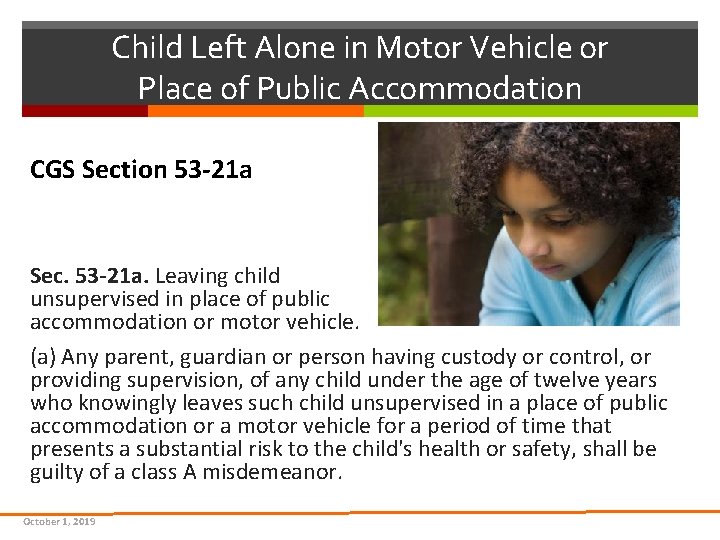
Child Left Alone in Motor Vehicle or Place of Public Accommodation CGS Section 53 -21 a Sec. 53 -21 a. Leaving child unsupervised in place of public accommodation or motor vehicle. (a) Any parent, guardian or person having custody or control, or providing supervision, of any child under the age of twelve years who knowingly leaves such child unsupervised in a place of public accommodation or a motor vehicle for a period of time that presents a substantial risk to the child's health or safety, shall be guilty of a class A misdemeanor. October 1, 2015 October 1, 2019
Whom Does DCF Investigate? The Department will investigate cases where the abuse or neglect has been inflicted by or caused by a person responsible or entrusted for a child’s health, welfare, or care; or by a person given access to a child by a person responsible. October 1, 2015 October 1, 2019
“Person Responsible” q Parent q Guardian q Foster parent q Staff personnel of child center based, family or group day care settings q Staff employees of residential child care settings and that individual responsible for a child’s health, welfare, or care and is allegedly responsible for causing or allowing the infliction of physical injury or injuries or imminent risk. October 1, 2015 October 1, 2019
“Person Entrusted” Anyone given access to child or youth by a person who is responsible for the health, welfare, or care of a child or youth for the purpose of providing education, child care, counseling, spiritual guidance, coaching, training, instruction, tutoring, or mentoring of such child or youth. October 1, 2015 October 1, 2019
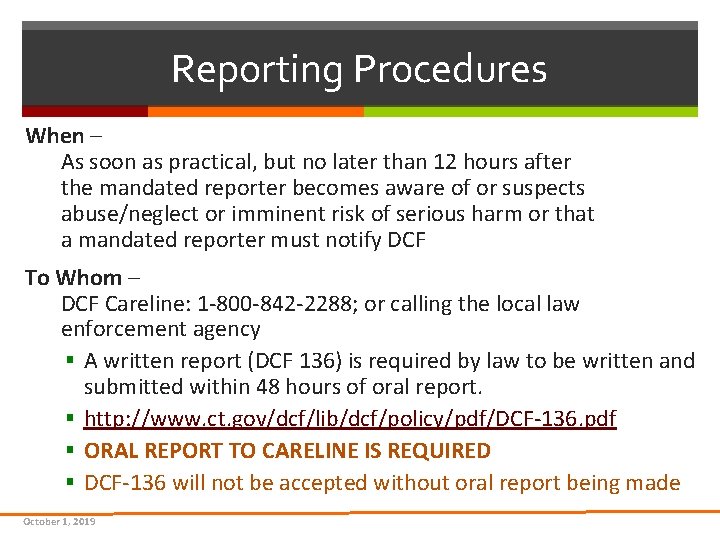
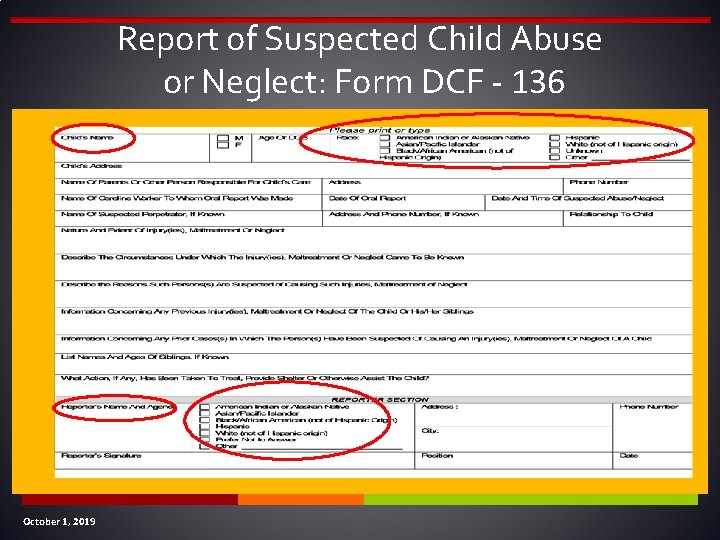
Reporting Procedures When – As soon as practical, but no later than 12 hours after the mandated reporter becomes aware of or suspects abuse/neglect or imminent risk of serious harm or that a mandated reporter must notify DCF To Whom – DCF Careline: 1 -800 -842 -2288; or calling the local law enforcement agency § A written report (DCF 136) is required by law to be written and submitted within 48 hours of oral report. § http: //www. ct. gov/dcf/lib/dcf/policy/pdf/DCF-136. pdf § ORAL REPORT TO CARELINE IS REQUIRED October 1, 2015 § DCF-136 will not be accepted without oral report being made October 1, 2019
Preliminary Investigation q A mandated reporter should not conduct his/her own investigation prior to making a report. q If abuse or neglect is suspected, a referral should be made to the DCF Careline. 1 -800 -842 -2288 October 1, 2015 October 1, 2019
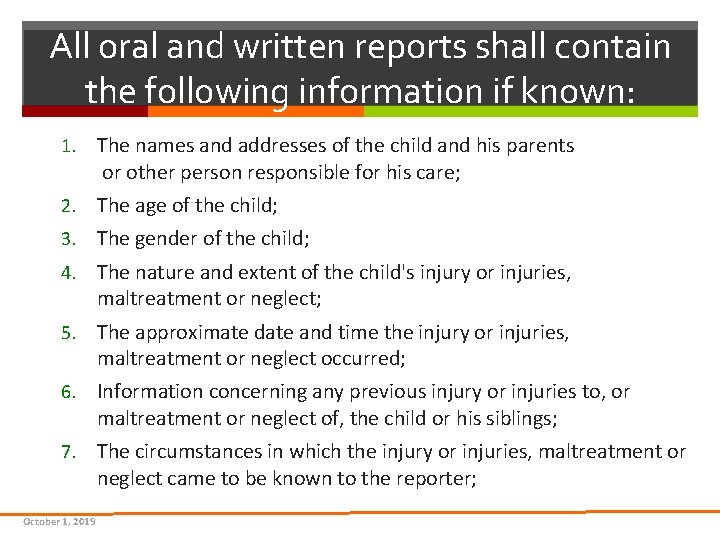
All oral and written reports shall contain the following information if known: 1. The names and addresses of the child and his parents or other person responsible for his care; 2. The age of the child; 3. The gender of the child; 4. The nature and extent of the child's injury or injuries, maltreatment or neglect; 5. The approximate date and time the injury or injuries, maltreatment or neglect occurred; 6. Information concerning any previous injury or injuries to, or maltreatment or neglect of, the child or his siblings; 7. The circumstances in which the injury or injuries, maltreatment or neglect came to be known to the reporter; October 1, 2015 October 1, 2019
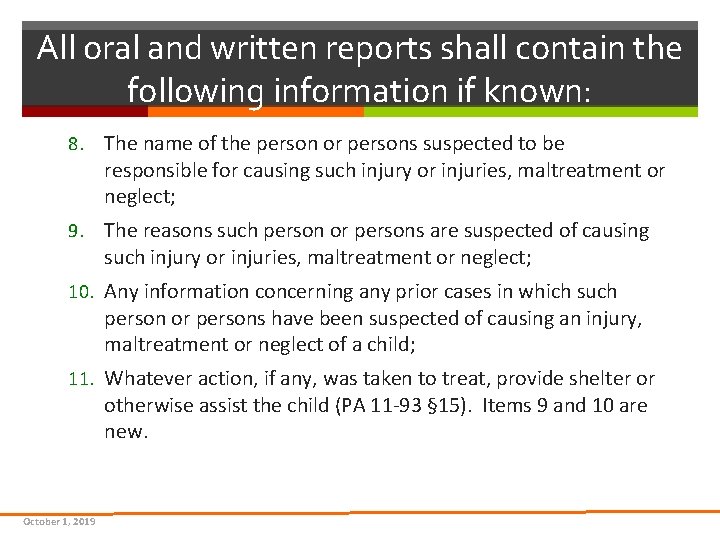
All oral and written reports shall contain the following information if known: 8. The name of the person or persons suspected to be responsible for causing such injury or injuries, maltreatment or neglect; 9. The reasons such person or persons are suspected of causing such injury or injuries, maltreatment or neglect; 10. Any information concerning any prior cases in which such person or persons have been suspected of causing an injury, maltreatment or neglect of a child; 11. Whatever action, if any, was taken to treat, provide shelter or otherwise assist the child (PA 11 -93 § 15). Items 9 and 10 are new. October 1, 2015 October 1, 2019
Report of Suspected Child Abuse or Neglect: Form DCF - 136 October 1, 2019
Careline Contact Information Child Abuse and Neglect Careline 505 Hudson Street Hartford, CT 06106 Phone: 1 -800 -842 -2288 (FAX): 860 -560 -7073 October 1, 2019
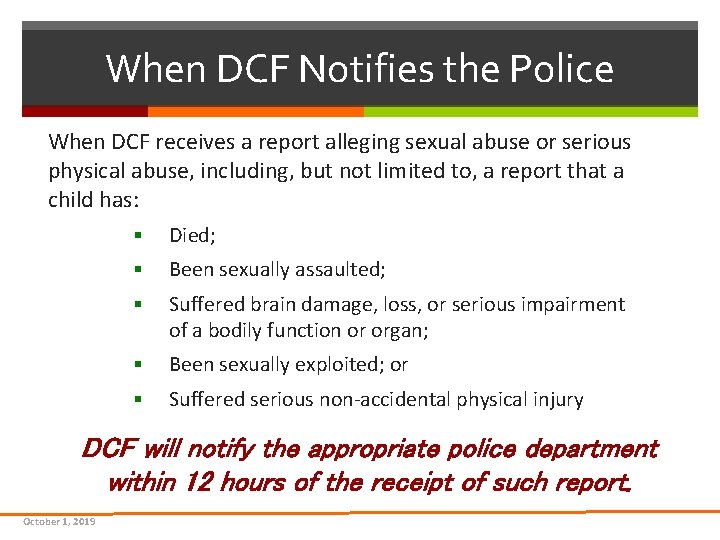
When DCF Notifies the Police When DCF receives a report alleging sexual abuse or serious physical abuse, including, but not limited to, a report that a child has: § Died; § Been sexually assaulted; § Suffered brain damage, loss, or serious impairment of a bodily function or organ; § Been sexually exploited; or § Suffered serious non-accidental physical injury DCF will notify the appropriate police department October 1, 2015 within 12 hours of the receipt of such report. October 1, 2019
Confidentiality & Anonymity October 1, 2019
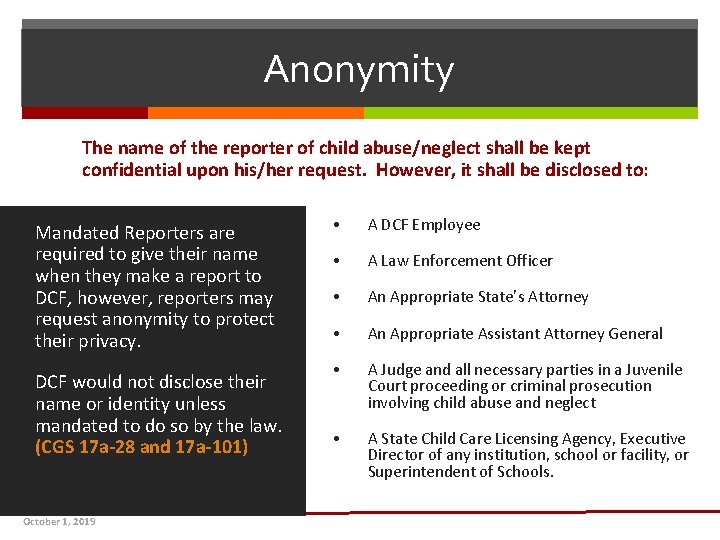
Anonymity The name of the reporter of child abuse/neglect shall be kept confidential upon his/her request. However, it shall be disclosed to: Mandated Reporters are required to give their name when they make a report to DCF, however, reporters may request anonymity to protect their privacy. DCF would not disclose their name or identity unless mandated to do so by the law. (CGS 17 a-28 and 17 a-101) October 1, 2019 • A DCF Employee • A Law Enforcement Officer • An Appropriate State’s Attorney • An Appropriate Assistant Attorney General • A Judge and all necessary parties in a Juvenile Court proceeding or criminal prosecution involving child abuse and neglect • A State Child Care Licensing Agency, Executive Director of any institution, school or facility, or Superintendent of Schools.
36 Legal Protections for Reporting & Consequences for Failing to Report October 1, 2019
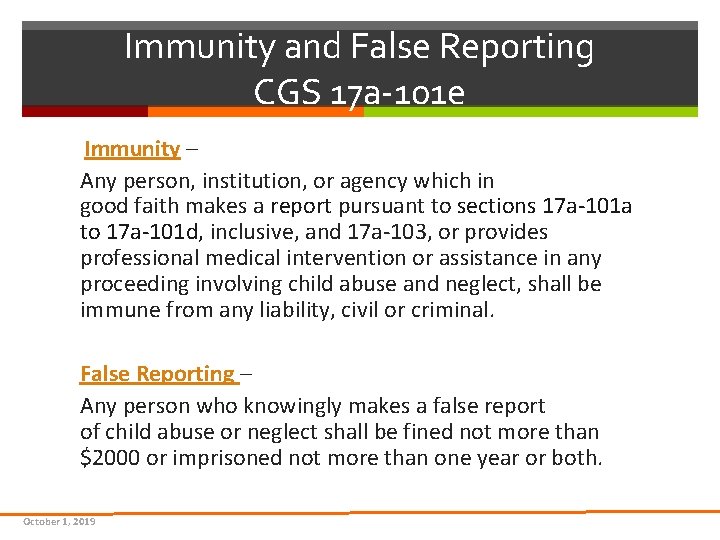
Immunity and False Reporting CGS 17 a-101 e Immunity – Any person, institution, or agency which in good faith makes a report pursuant to sections 17 a-101 a to 17 a-101 d, inclusive, and 17 a-103, or provides professional medical intervention or assistance in any proceeding involving child abuse and neglect, shall be immune from any liability, civil or criminal. False Reporting – Any person who knowingly makes a false report of child abuse or neglect shall be fined not more than $2000 or imprisoned not more than one year or both. October 1, 2015 October 1, 2019
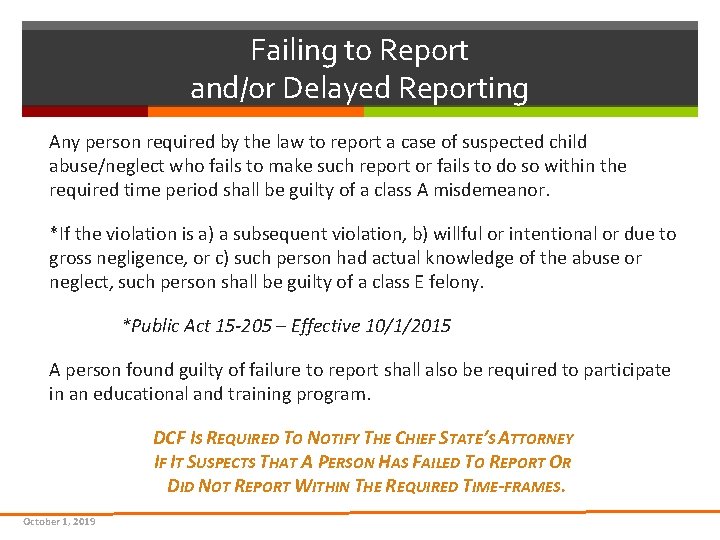
Failing to Report and/or Delayed Reporting Any person required by the law to report a case of suspected child abuse/neglect who fails to make such report or fails to do so within the required time period shall be guilty of a class A misdemeanor. *If the violation is a) a subsequent violation, b) willful or intentional or due to gross negligence, or c) such person had actual knowledge of the abuse or neglect, such person shall be guilty of a class E felony. *Public Act 15 -205 – Effective 10/1/2015 A person found guilty of failure to report shall also be required to participate in an educational and training program. DCF IS REQUIRED TO NOTIFY THE CHIEF STATE’S ATTORNEY IF IT SUSPECTS THAT A PERSON HAS FAILED TO REPORT OR DID NOT REPORT WITHIN THE REQUIRED TIME-FRAMES. October 1, 2019 October 1, 2015
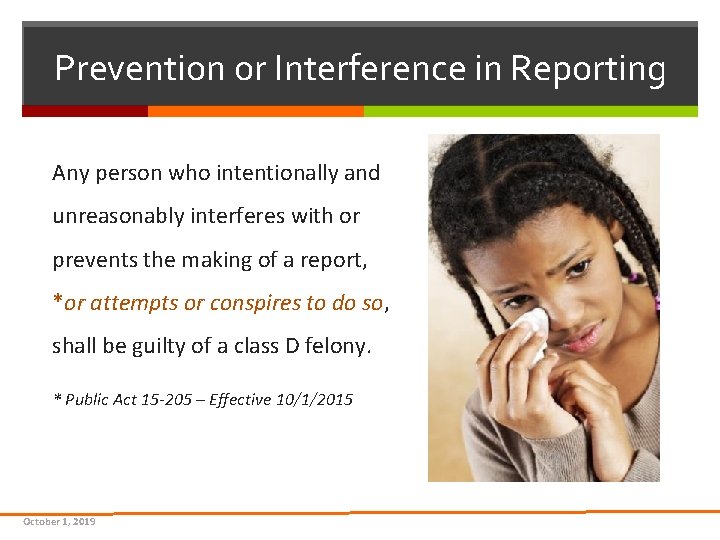
Prevention or Interference in Reporting Any person who intentionally and unreasonably interferes with or prevents the making of a report, *or attempts or conspires to do so, shall be guilty of a class D felony. * Public Act 15 -205 – Effective 10/1/2015 October 1, 2019
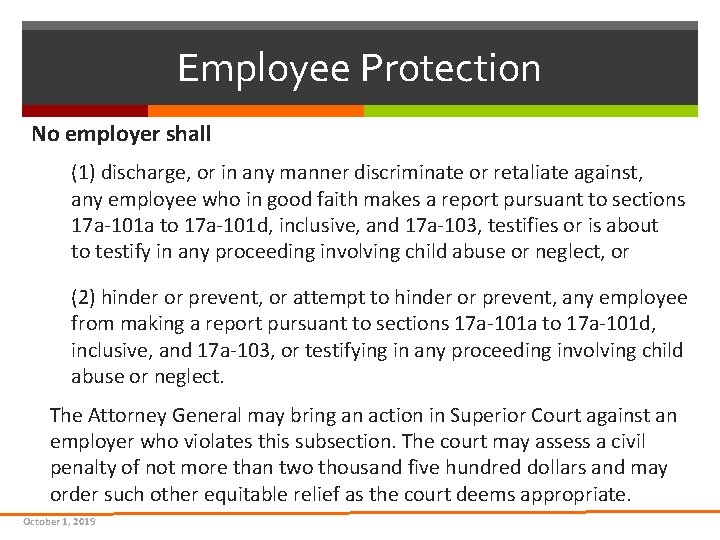
Employee Protection No employer shall (1) discharge, or in any manner discriminate or retaliate against, any employee who in good faith makes a report pursuant to sections 17 a-101 a to 17 a-101 d, inclusive, and 17 a-103, testifies or is about to testify in any proceeding involving child abuse or neglect, or (2) hinder or prevent, or attempt to hinder or prevent, any employee from making a report pursuant to sections 17 a-101 a to 17 a-101 d, inclusive, and 17 a-103, or testifying in any proceeding involving child abuse or neglect. The Attorney General may bring an action in Superior Court against an employer who violates this subsection. The court may assess a civil penalty of not more than two thousand five hundred dollars and may October 1, 2015 order such other equitable relief as the court deems appropriate. October 1, 2019
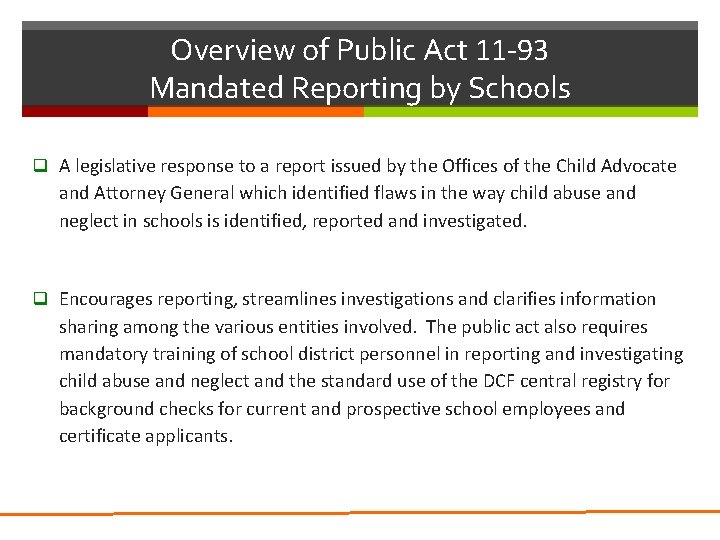
Overview of Public Act 11 -93 Mandated Reporting by Schools q A legislative response to a report issued by the Offices of the Child Advocate and Attorney General which identified flaws in the way child abuse and neglect in schools is identified, reported and investigated. q Encourages reporting, streamlines investigations and clarifies information sharing among the various entities involved. The public act also requires mandatory training of school district personnel in reporting and investigating child abuse and neglect and the standard use of the DCF central registry for background checks for current and prospective school employees and certificate applicants. October 1, 2015
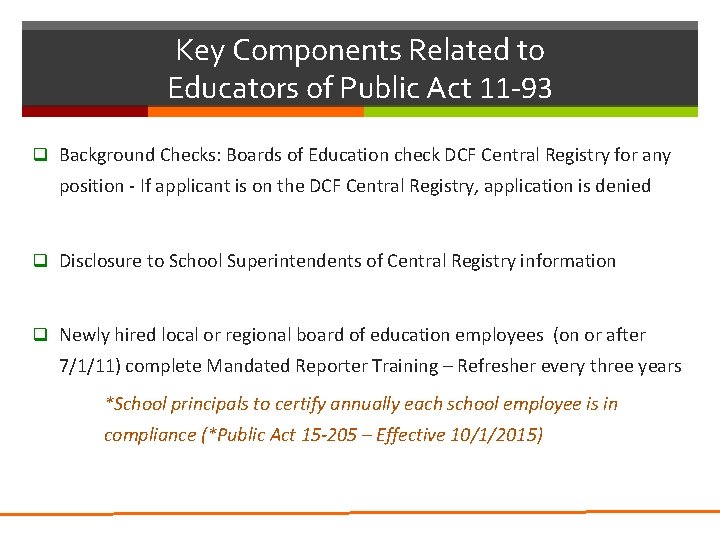
Key Components Related to Educators of Public Act 11 -93 q Background Checks: Boards of Education check DCF Central Registry for any position - If applicant is on the DCF Central Registry, application is denied q Disclosure to School Superintendents of Central Registry information q Newly hired local or regional board of education employees (on or after 7/1/11) complete Mandated Reporter Training – Refresher every three years *School principals to certify annually each school employee is in compliance (*Public Act 15 -205 – Effective 10/1/2015) October 1, 2015
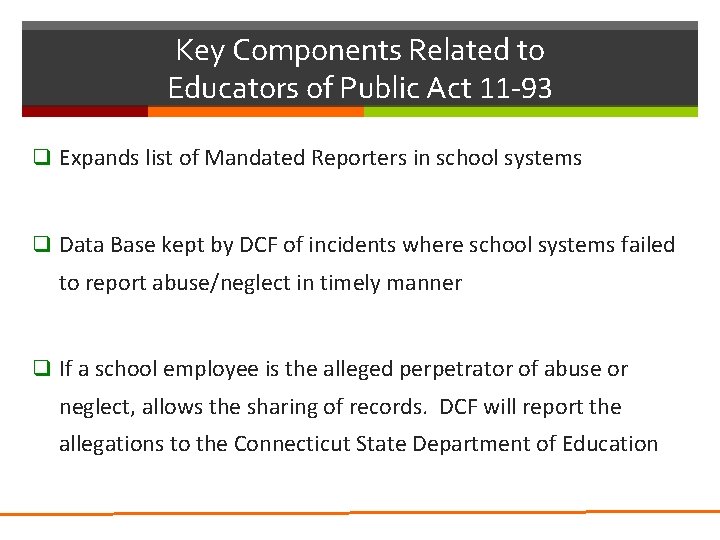
Key Components Related to Educators of Public Act 11 -93 q Expands list of Mandated Reporters in school systems q Data Base kept by DCF of incidents where school systems failed to report abuse/neglect in timely manner q If a school employee is the alleged perpetrator of abuse or neglect, allows the sharing of records. DCF will report the allegations to the Connecticut State Department of Education October 1, 2015
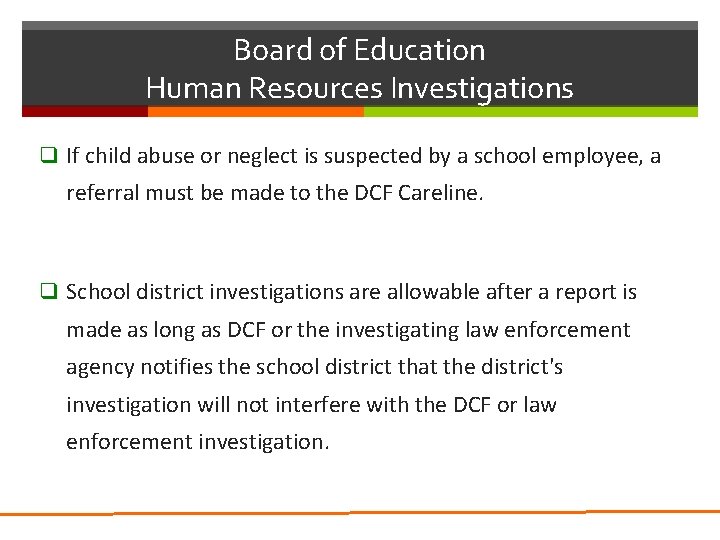
Board of Education Human Resources Investigations q If child abuse or neglect is suspected by a school employee, a referral must be made to the DCF Careline. q School district investigations are allowable after a report is made as long as DCF or the investigating law enforcement agency notifies the school district that the district's investigation will not interfere with the DCF or law enforcement investigation. October 1, 2015
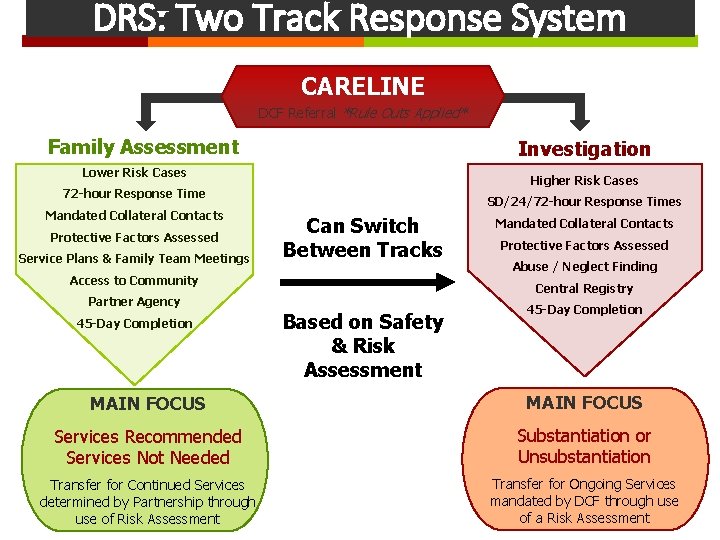
DRS: Two Track Response System CARELINE DCF Referral *Rule Outs Applied* Family Assessment Investigation Lower Risk Cases Higher Risk Cases 72 -hour Response Time Mandated Collateral Contacts Protective Factors Assessed Service Plans & Family Team Meetings SD/24/72 -hour Response Times Can Switch Between Tracks Access to Community Protective Factors Assessed Abuse / Neglect Finding Central Registry Partner Agency 45 -Day Completion Mandated Collateral Contacts Based on Safety & Risk Assessment 45 -Day Completion MAIN FOCUS Services Recommended Services Not Needed Substantiation or Unsubstantiation Transfer for Continued Services determined by Partnership through use of Risk Assessment Transfer for Ongoing Services mandated by DCF through use of a Risk Assessment
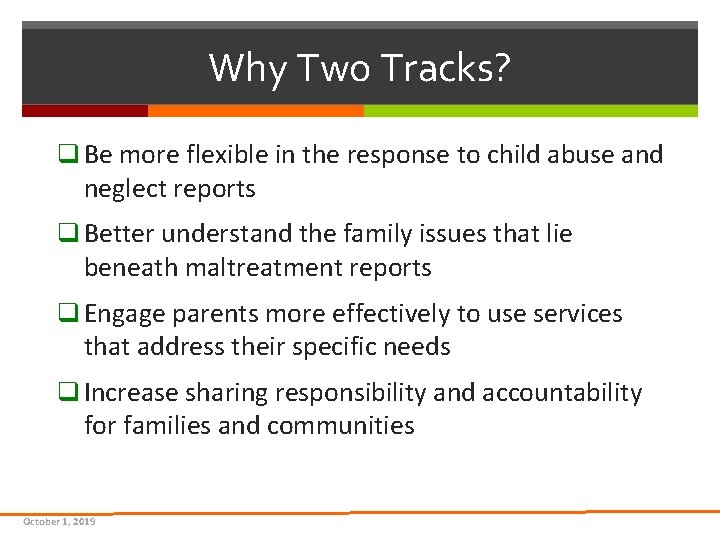
Why Two Tracks? q Be more flexible in the response to child abuse and neglect reports q Better understand the family issues that lie beneath maltreatment reports q Engage parents more effectively to use services that address their specific needs q Increase sharing responsibility and accountability for families and communities October 1, 2015 October 1, 2019
Disparate Outcomes Result From Overt & Unconscious Decisions Lower the rate of disproportionality q In CPS cases, people of color q These disparities and q The DRS approach is to begin q The first decision making point are over-represented relative to the general population. addressing these inequities and disparities as early as possible by using the assessment track to focus on service delivery to ameliorate such issues. October 1, 2019 inequities by race and culture are seen at every decision point within the DCF system. comes from assessing “reasonable suspicion”-simply ask, “Is my suspicion (or lack of) based on the race of this family? ”
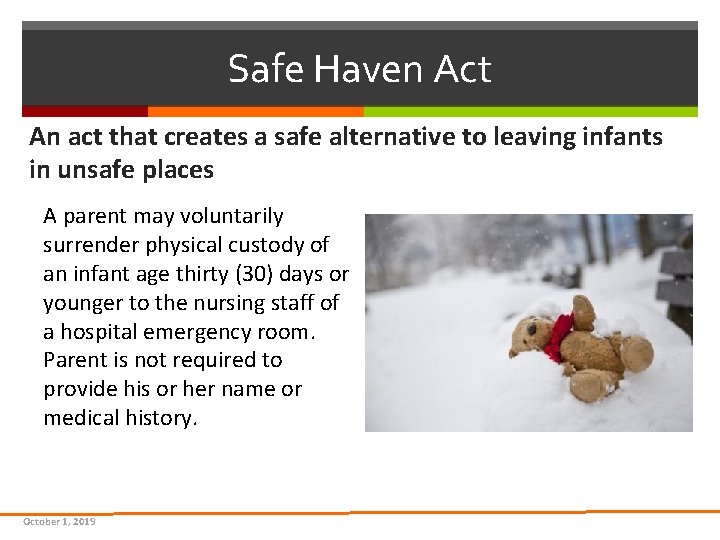
Safe Haven Act An act that creates a safe alternative to leaving infants in unsafe places A parent may voluntarily surrender physical custody of an infant age thirty (30) days or younger to the nursing staff of a hospital emergency room. Parent is not required to provide his or her name or medical history. October 1, 2015 October 1, 2019
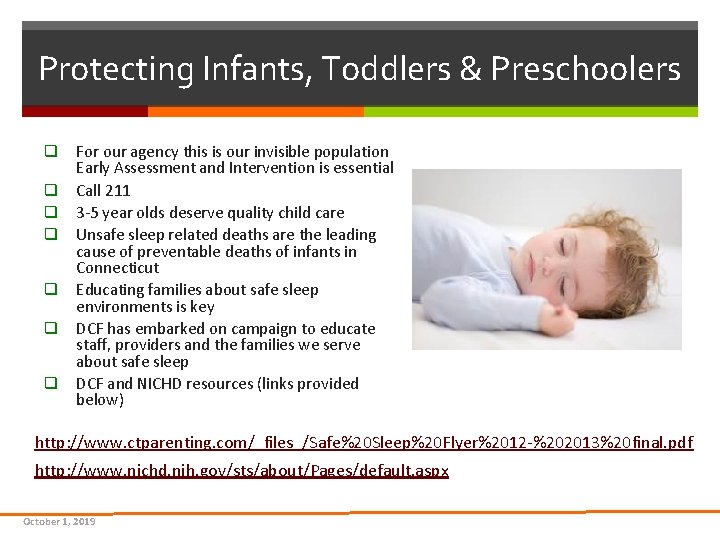
Protecting Infants, Toddlers & Preschoolers q q q q For our agency this is our invisible population Early Assessment and Intervention is essential Call 211 3 -5 year olds deserve quality child care Unsafe sleep related deaths are the leading cause of preventable deaths of infants in Connecticut Educating families about safe sleep environments is key DCF has embarked on campaign to educate staff, providers and the families we serve about safe sleep DCF and NICHD resources (links provided below) http: //www. ctparenting. com/_files_/Safe%20 Sleep%20 Flyer%2012 -%202013%20 final. pdf http: //www. nichd. nih. gov/sts/about/Pages/default. aspx October 1, 2019 October 1, 2015
DCF Strengthening Families DCF recognizes that strengthening Connecticut families requires partnership with the immediate family, the extended family, and community providers. Thank you for being part of this team. October 1, 2015 October 1, 2019
Additional Resources Still Have Questions? Please visit our website to view additional information regarding mandated reporting or to find out who to speak with from our staff. If you have any concerns of abuse or neglect, please call our Careline at 800 -842 -2288 BE A HERO, BE A FOSTER PARENT If you are interested in being a foster parent or would like information on how to become one, please call 1 -888 -KID-HERO October 1, 2019 October 1, 2015