
MBOIA September TrainingMeeting Phil Saucier Ann Freeman September
MBOIA September Training/Meeting Phil Saucier Ann Freeman September 22, 2016 Gray, Maine
AGENDA Legislative Update Case Law Update Boards of Appeal Use of Computers/HR Issues Emerging Municipal Legal Issues
Legislative Update An Act to Streamline Judicial Review of Certain Land Use Decisions (PL 2015, c. 459) • Establishes a special appeal process for “significant municipal land use decisions. ” • • • One or more buildings with a total ground area of 10, 000 SF or 40, 000 of total floor area; or Total ground area in excess of 3 acres occupied by buildings, parking lots, road, paved areas and other areas to be stripped or graded and not revegetated; or Subdivisions of 10 or more lots. Parties can request transfer to Business Court Municipality provides record on appeal (Plaintiff reimburses for cost) Parties can ask for expedited briefing schedule at Law Court
Legislative Update An Act To Amend the Shoreland Zoning Laws To Exempt Certain Walkways and Trails from Setback Requirements. ( PL 2015, c. 11) • Exempts from the normal shoreland zoning river setback requirements the construction of a walkway or trail if located over rivers located within a downtown revitalization project • • Municipality must amend shoreland zoning ordinance Cantilevered decks were previously exempted if municipality opts-in
Legislative Update An Act To Clarify Municipal Capacity of Site Location of Development and Encourage Local Development. (PL 2015, c. 28) • Municipalities that have been designated by the DEP to have capacity to conduct Site Location of Development Act regulatory review of major development proposals had already has the authority to review modifications to developments that the municipality originally permitted. • This law amended the law to allow municipalities to review modifications to developments originally permitted by the DEP.
Legislative Update An Act To Clarify That the Medical Records of Applicants for Disability Variances Submitted to Municipal Boards of Appeal Are Not Public Records. (PL 2015, c. 152) • Exempts from the definition of a public record under the Freedom of Access Act any medical records or other documents submitted to a board of appeals or a code enforcement officer that describe or verify the disability of a person seeking a disability variance
Legislative Update Municipal Authority to Manage Abandoned Mobile Homes (30 -A M. R. S. § 3106 -A) 1. Authorizes the municipality to initiate corrective actions to address property defects if the mobile home has been found by the municipal officers to be abandoned; 2. Requires notice to owner and a public hearing; 3. Authorizes the municipal officers to identify property defects to be addressed by the owners and provide those parties a 60 -day period to correct the defects; and 4. Authorizes the municipality, by means of a special tax on the property, to collect all costs associated with initiating the corrective actions
Legislative Update Municipal Authority to Abandoned Properties (30 -A M. R. S. § 3106 -B) 1. Authorizes the municipality to initiate corrective actions to address property defects if the property has been found by either a court or the municipal officers to be abandoned; 2. Requires notice to owners and a hearing; 3. Authorizes the municipal officers to identify property defects to be addressed by the owners and provide those parties a 30 -day period to correct the defects, and 4. Authorizes the municipality, by means of a special tax on the property, to collect all costs associated with initiating the corrective actions
Legislative Update An Act To Exempt Certain Agricultural Buildings from the Maine Uniform Building and Energy Code. (PL 2015, c. 126) • Requires the Technical Building Codes and Standards Board to exempt buildings used to house livestock or harvested crops from MUBEC
Case Law Update
Hartwell v. Town of Ogunquit 2015 ME 51 “Amid continuing concerns regarding the costs and delays associated with the administrative process and appeals in municipal law, we confront this challenge: the inconsistent application of mandatory provisions in local zoning ordinances. ” Addressed procedural issue in detail “in the hope of assisting towns, applicants and interested parties in their continued efforts to develop a more predictable and less expensive process. ” Findings 1. Planning Board lacked the authority to waive design review submission standards, and 2. Planning Board's failure to make sufficient and clear findings of fact necessitated remand for the board to make such findings.
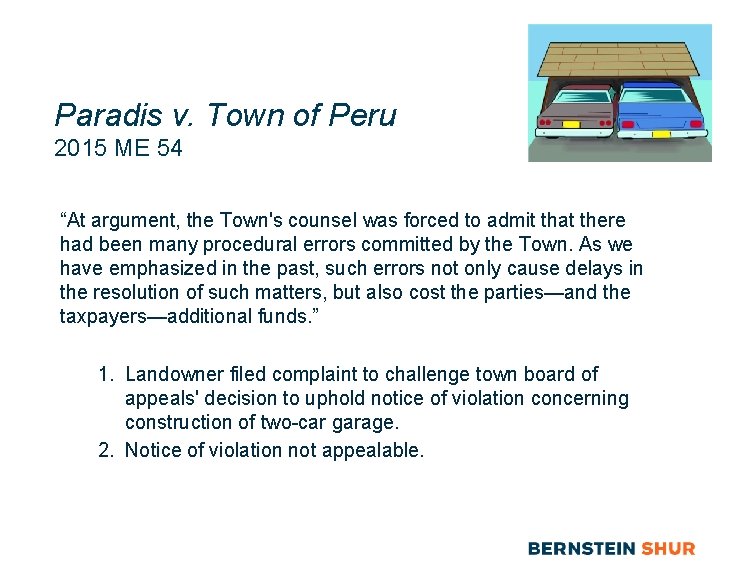
Paradis v. Town of Peru 2015 ME 54 “At argument, the Town's counsel was forced to admit that there had been many procedural errors committed by the Town. As we have emphasized in the past, such errors not only cause delays in the resolution of such matters, but also cost the parties—and the taxpayers—additional funds. ” 1. Landowner filed complaint to challenge town board of appeals' decision to uphold notice of violation concerning construction of two-car garage. 2. Notice of violation not appealable.
Bryant v. Town of Camden 2016 ME 27 “In an effort to reduce confusion, costs, and delay in municipal appeals, we today announce more clearly the need for finality in municipal decisions before a municipal entity's action may be appealed to the courts. ” ZBA approved a special exception permit conditioned on the Planning Board additionally approving the use after full site plan review. Because additional process is required by the Town's Ordinance before a final decision on the Inn's proposed changes is reached, Bryant's complaint is premature – now requires a final agency decision to “prevent piecemeal appeals from municipal decisions that do not finally dispose of a matter. ”
Day v. Town of Phippsburg 2015 ME 13 Grandfathered status of individual nonconforming beachfront lots was permanently lost when lots merged and then unlawfully divided – even if lots were ater “put back together. ”
U. S. Supreme Court Reed v. Town of Gilbert Sign Regulations must be content neutral If not content neutral, reviewed by the courts with strict scrutiny (1) has a compelling interest in regulating the speech and (2) has created a regulation that is narrowly tailored to that interest • The rigid, “literal” test for content-neutrality: If you “need to read” the sign in order to apply the sign law, the sign law is contentbased. • The more pragmatic test for content-neutrality: so long as you can justify the sign law without reference to the sign’s content, and did not adopt the law because of disagreement with the message it conveys, it’s content neutral.
Post-Reed Sign Regulation State billboard law amended this year to comply with Reed; repealed temporary sign provisions because they had political signs different from others. Now any temporary sign can only be 6 weeks in the right of way in a calendar year, not within 30 feet of another temporary sign with same message or exceed 4 feet by 8 feet; must label sign with name/address and timeframe to be in right of way. Municipalities may not: • Distinguish between types of temporary signs (political or ideological) in terms of where or when they can be displayed • Define signs by reference to the content of the message displayed or who is displaying the message (such as political signs, event signs, church bulletins or holiday lights.
Issues Related to Boards of Appeal Variances Conflicts of Interest FOAA
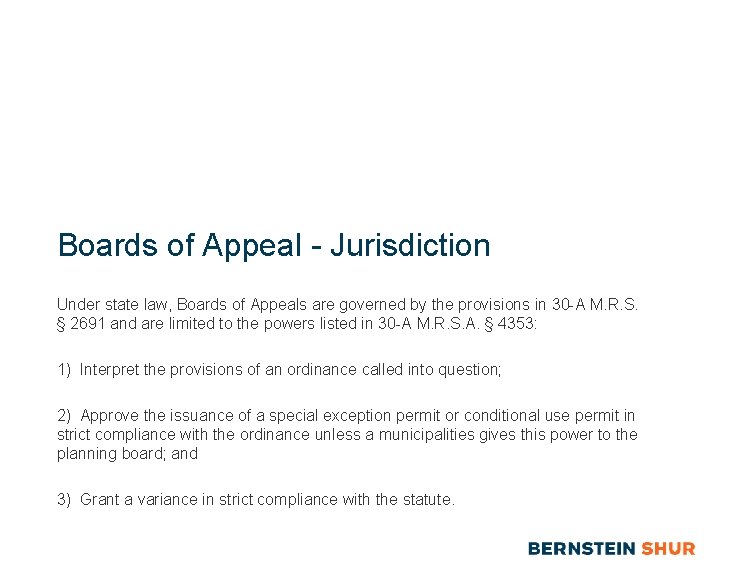
Boards of Appeal - Jurisdiction Under state law, Boards of Appeals are governed by the provisions in 30 -A M. R. S. § 2691 and are limited to the powers listed in 30 -A M. R. S. A. § 4353: 1) Interpret the provisions of an ordinance called into question; 2) Approve the issuance of a special exception permit or conditional use permit in strict compliance with the ordinance unless a municipalities gives this power to the planning board; and 3) Grant a variance in strict compliance with the statute.
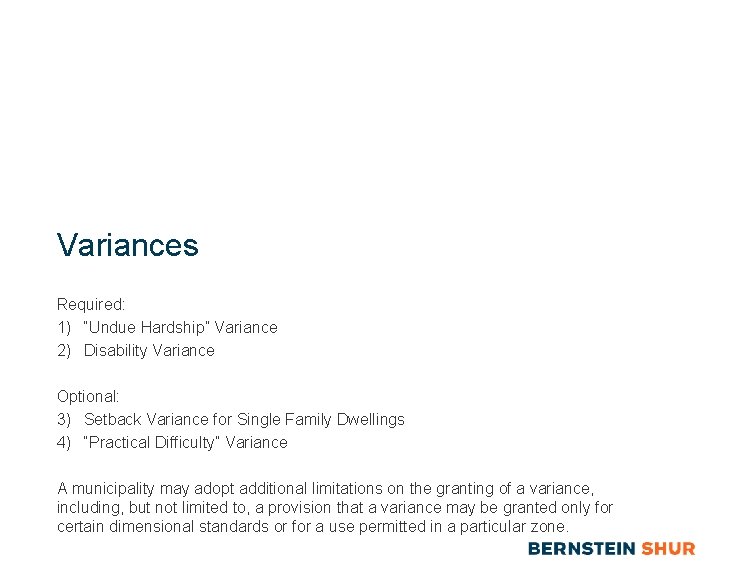
Variances Required: 1) “Undue Hardship” Variance 2) Disability Variance Optional: 3) Setback Variance for Single Family Dwellings 4) “Practical Difficulty” Variance A municipality may adopt additional limitations on the granting of a variance, including, but not limited to, a provision that a variance may be granted only for certain dimensional standards or for a use permitted in a particular zone.
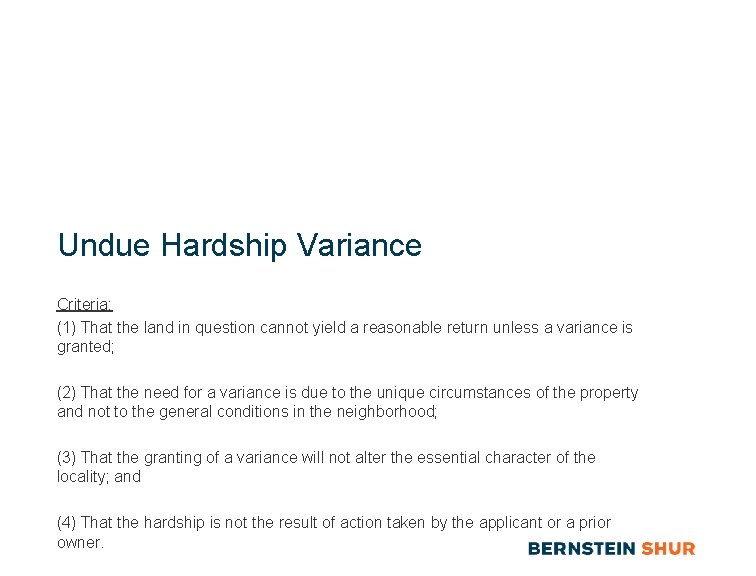
Undue Hardship Variance Criteria: (1) That the land in question cannot yield a reasonable return unless a variance is granted; (2) That the need for a variance is due to the unique circumstances of the property and not to the general conditions in the neighborhood; (3) That the granting of a variance will not alter the essential character of the locality; and (4) That the hardship is not the result of action taken by the applicant or a prior owner.
Disability Variance For the purpose of making a dwelling accessible to person who resides in or regularly uses the dwelling. - May adopt an ordinance giving this authority to the CEO Optional – may adopt an ordinance allowing a disability variance for the construction of a place of storage and parking for a noncommercial vehicle owned by a resident of the dwelling with a permanent disability and no other purpose. The width and length of the structure may not be larger than 2 times the width and length of the noncommercial vehicle.
Practical Difficulty Variance 1. The need for a variance is due to the unique circumstances of the property and not to the general condition of the neighborhood; 2. The granting of a variance will not produce an undesirable change in the character of the neighborhood and will not have an unreasonably detrimental effect on either the use or fair market value of abutting properties; 3. The practical difficulty is not the result of action taken by the applicant or a prior owner; 4. No other feasible alternative to a variance is available; 5. The granting of a variance will not unreasonably adversely affect the natural environment; and 6. The property is not located, in whole or in part, within a shoreland area
Conflicts – Integrity of the Governmental Process • • • Financial Conflicts of Interest Incompatibility of Office Prohibited Appointments or Employment Relationships Predisposition or Bias
Financial Conflicts of Interest Common Law “whether the town official by reason of his [her] interest, is placed in a situation of temptation to serve his own personal pecuniary interest to the prejudice of the interests of those for whom the law authorized and required him to act. . . ”
Financial Conflicts of Interest Statutory Law 30 -A M. R. S. A. § 2605 sets out black letter standards when it will be presumed that the official or deciding party is “self-interested” in connection with the performance of governmental actions or decision making.
Statutory Test – 10% Rule Section 2605 defines as a conflict situation: (1) when the official is an “officer, director, partner, associate or stockholder of a private corporation, business or other economic entity” which is the subject of the issue before the body; and (2) the individual is “directly or indirectly the owner of at least 10% of the stock of the private corporation or owns at least 10% interest in the business or other economic entity. ”
Indirect Pecuniary Interest Not a lot of guidance on the threshold for indirect pecuniary interests that triggers disqualification. The Maine Law Court has directed that the determination of whether a particular interest is sufficient to disqualify an individual must be made on a case-by-case basis.
Avoid Appearance of a Conflict of Interest Safeguard the integrity of the proceedings. Do you think that in light of the points raised, circumstances and situation that you can participate in these proceedings without any bias, predisposition or letting your relationship impact your participation or decision? and Will you conduct yourself and base your decision in the proceedings based solely on the record of the proceedings and based on your best judgment on applying the applicable and relevant standards?
Handling Conflicts Disclose, Discuss and Vote.
Consequence – Action Could be Voidable if Challenged • Voting • Contracts
Incompatibility of Offices Statutory Prohibitions : - Town manager may not serve as town moderator, selectman, assessor or school committee member - Tax collector or treasurer may not serve as selectman or assessor - Municipal officer (or spouse) may not serve on board of appeals - Etc…. Common law - Municipal officers and code enforcement officers, road commission, school committee member, municipal clerk, election warden, etc…
Bias Based on Relationships • Quasi-judicial Functions • Consanguinity or Affinity Within the 6 th Degree = Bias
Bias Based on Predisposition • • • Quasi-Judicial Functions Can you make an impartial decision? Is there an appearance of bias? Burden of Proof is on the applicant Research Conducted by Board Members
Freedom of Access Act Declaration of Intent “…public proceedings exist to aid in the conduct of the people's business. It is the intent of the Legislature that their actions be taken openly and that the records of their actions be open to public inspection and their deliberations be conducted openly…. ” The law “shall be liberally construed and applied to promote its underlying purposes and policies…. ” 1 M. R. S. § 401 34
What does the law cover? Public meetings/proceedings Public records 35
Public Meetings/Proceedings What are public proceedings? Who is covered by FOAA? • The transactions of any functions affecting any or all citizens of the State by any of the following: • The Legislature of Maine and its committees and subcommittees; • Any board or commission of any state agency or authority …. ; • Any board, commission, agency or authority of any county, municipality, school district or any regional or other political or administrative subdivision; • The full membership meetings of [MMA]…; 36
Open Meeting Requirement Proceedings open to public. Except as otherwise provided by statute all public proceedings must be open to the public and any person must be permitted to attend a public proceeding. 37
Notice of Public Meetings - § 406 • Public notice shall be given for all public proceedings … if these proceedings are a meeting of a body or agency consisting of 3 or more persons. • Notice shall be given in ample time to allow public attendance and shall be disseminated in a manner reasonably calculated to notify the general public in the jurisdiction served by the body or agency concerned. • In the event of an emergency meeting, local representatives of the media shall be notified of the meeting, whenever practical, the notification to include time and location, by the same or faster means used to notify the members of the agency conducting the public proceeding. 38
Communications Outside a Public Meeting § 401: FOAA “does not prohibit communications outside of public proceedings between members of a public body unless those communications are used to defeat the purposes of” FOAA Telephone and electronic communications are subject to FOAA Including personal and official email accounts, Facebook, Twitter, etc… Phone, e-mail, electronic communications can be used for communications on non-substantive issues (set meeting date for example), but not to deliberate or discuss substantive matters among board members. Common violations: polling members by telephone to vote on or discuss an application; chance meeting at grocery store or private party where matter is discussed, making decisions in a closed door meeting when not authorized, and conducting discussions about official business by email. 39
Public Right to Attend and Record § 404 In order to facilitate the public policy so declared by the Legislature of opening the public's business to public scrutiny, all persons shall be entitled to attend public proceedings and to make written, taped or filmed records of the proceedings, or to live broadcast the same, provided the writing, taping, filming or broadcasting does not interfere with the orderly conduct of proceedings. The body or agency holding the public proceedings may make reasonable rules and regulations governing these activities, so long as these rules or regulations do not defeat the purpose of this subchapter. 40
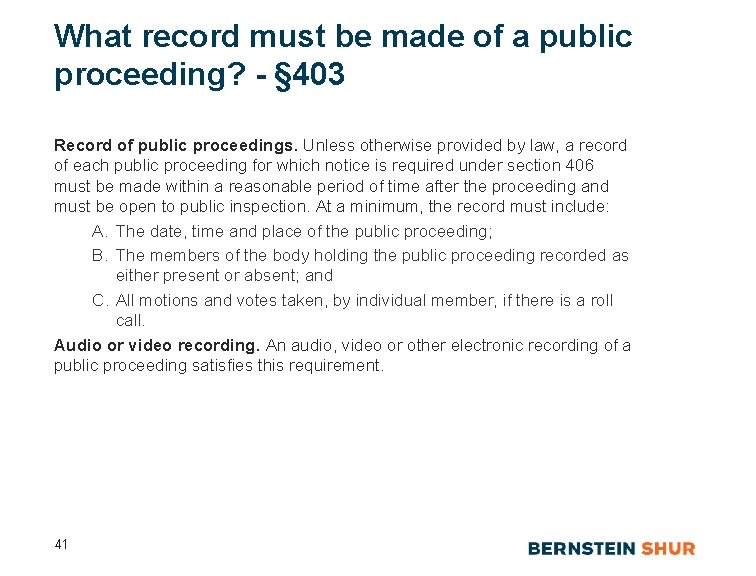
What record must be made of a public proceeding? - § 403 Record of public proceedings. Unless otherwise provided by law, a record of each public proceeding for which notice is required under section 406 must be made within a reasonable period of time after the proceeding and must be open to public inspection. At a minimum, the record must include: A. The date, time and place of the public proceeding; B. The members of the body holding the public proceeding recorded as either present or absent; and C. All motions and votes taken, by individual member, if there is a roll call. Audio or video recording. An audio, video or other electronic recording of a public proceeding satisfies this requirement. 41
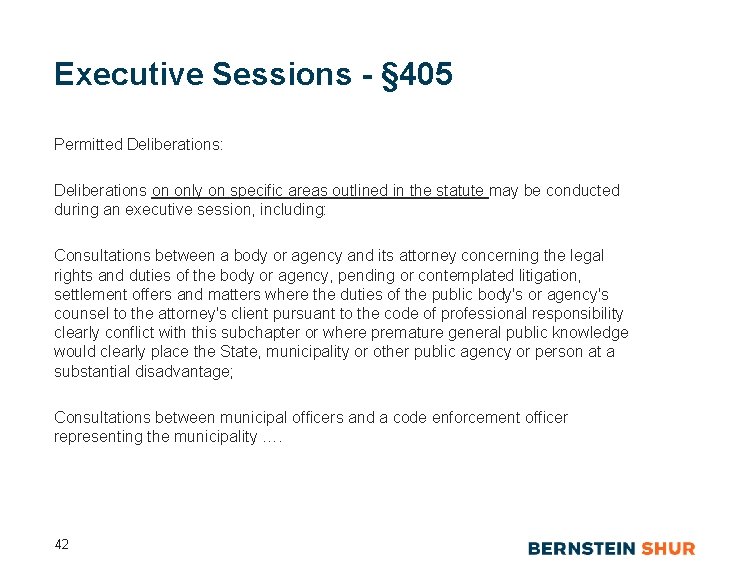
Executive Sessions - § 405 Permitted Deliberations: Deliberations on only on specific areas outlined in the statute may be conducted during an executive session, including: Consultations between a body or agency and its attorney concerning the legal rights and duties of the body or agency, pending or contemplated litigation, settlement offers and matters where the duties of the public body's or agency's counsel to the attorney's client pursuant to the code of professional responsibility clearly conflict with this subchapter or where premature general public knowledge would clearly place the State, municipality or other public agency or person at a substantial disadvantage; Consultations between municipal officers and a code enforcement officer representing the municipality …. 42
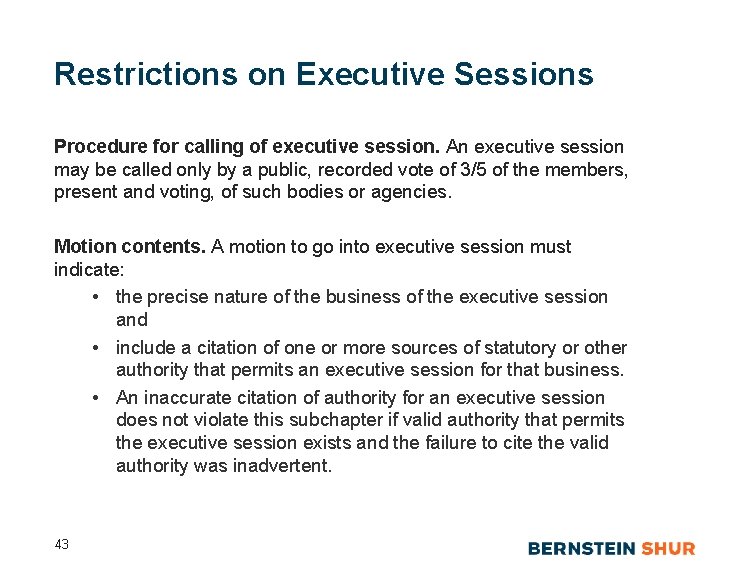
Restrictions on Executive Sessions Procedure for calling of executive session. An executive session may be called only by a public, recorded vote of 3/5 of the members, present and voting, of such bodies or agencies. Motion contents. A motion to go into executive session must indicate: • the precise nature of the business of the executive session and • include a citation of one or more sources of statutory or other authority that permits an executive session for that business. • An inaccurate citation of authority for an executive session does not violate this subchapter if valid authority that permits the executive session exists and the failure to cite the valid authority was inadvertent. 43
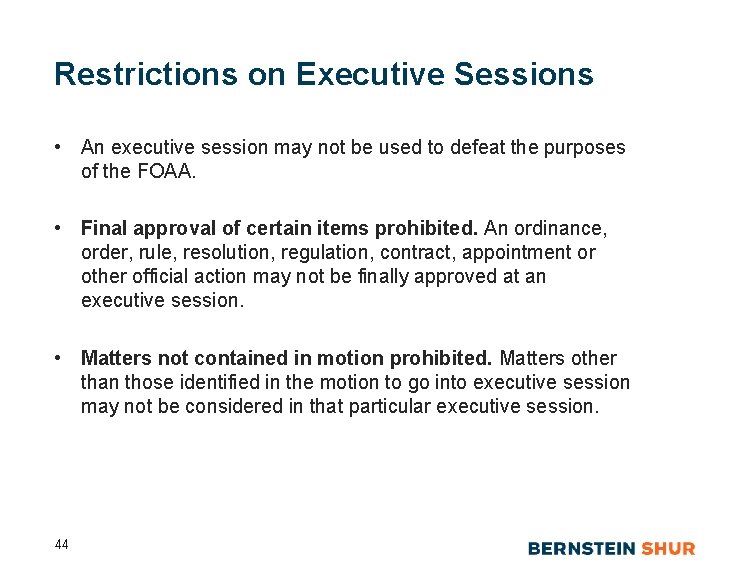
Restrictions on Executive Sessions • An executive session may not be used to defeat the purposes of the FOAA. • Final approval of certain items prohibited. An ordinance, order, rule, resolution, regulation, contract, appointment or other official action may not be finally approved at an executive session. • Matters not contained in motion prohibited. Matters other than those identified in the motion to go into executive session may not be considered in that particular executive session. 44
Written Decisions - § 407 FOAA requires a written decision that explains the basis for a decision for conditional approvals or denials. The Board of Appeals statute further requires that all Board decisions include a statement of findings and conclusions, as well as the reasons or basis for the findings and conclusions, upon all the material issues of fact, law or discretion presented and the appropriate order, relief or denial of relief. 30 -A M. R. S. § 2691(3)(E). Purposes for written findings of fact and conclusions of law: 1. Practical purpose- ensures that the Board has considered each review criteria and there is sufficient evidence in the record to support a finding on each; 2. Provide detailed reasons for the Board’s decision to applicant and interested parties to judge whether or not they agree with the decision and to decide whethere are sufficient grounds for appeal; and 3. Provide a clear record for the Superior Court in the event a decision is appealed. 45
Violations Any person may appeal to Superior Court Burden on agency or public body If illegal meeting, action of board will null and void • If any body or agency approves any ordinances, orders, rules, resolutions, regulations, contracts, appointments or other official action in an executive session, this action is illegal and penalties may apply Officials subject to penalties and attorneys fees A willful, intentional or knowing violation of FOAA is subject to a civil penalty of not more than $500 46
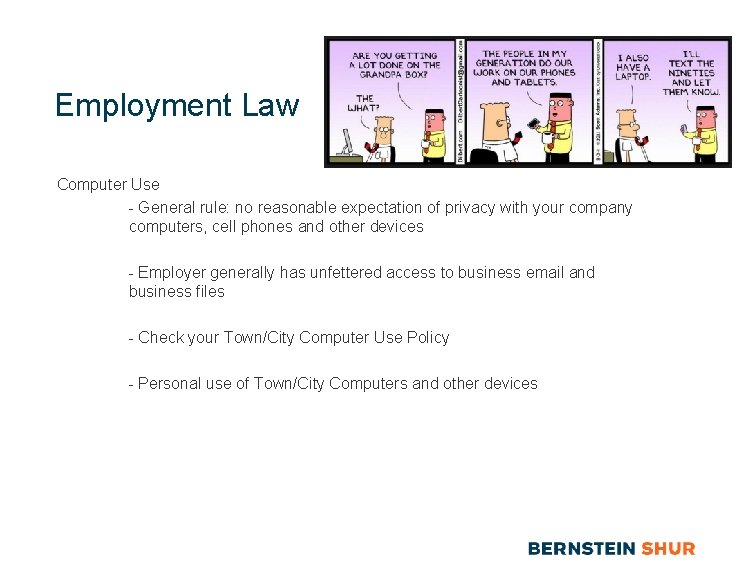
Employment Law Computer Use - General rule: no reasonable expectation of privacy with your company computers, cell phones and other devices - Employer generally has unfettered access to business email and business files - Check your Town/City Computer Use Policy - Personal use of Town/City Computers and other devices
Emerging Municipal Law Issues
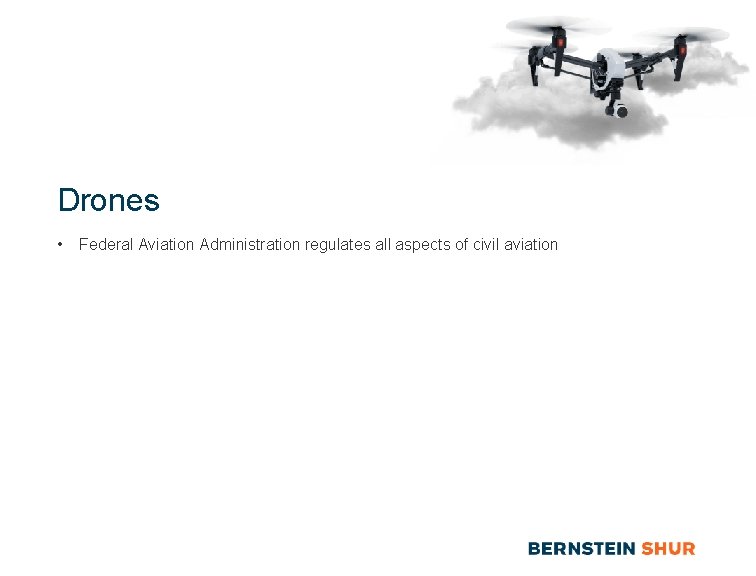
Drones • Federal Aviation Administration regulates all aspects of civil aviation
State and Local Drone Regulations • 20 states have passed laws • Increasing number of municipalities have passed regulations • Federal Pre-emption? • Governmental Use of Drones
State Drone Laws Deal with various issues related to drones: • • • Prohibition of voyeurism Restrictions on paparazzi Prohibiting the use of drones for hunting, fishing or trapping Regulating drones used for agricultural purpose Restricting the use of drones by law enforcement agencies
State Examples Maine The bipartisan law, PL 2015, Ch. 307, prohibits law enforcement agencies from using a weaponized drone, and from using a drone in a criminal investigation without a warrant, with certain exceptions. The law also addresses privacy and free speech matters by prohibiting law enforcement from using a drone to conduct surveillance of private citizens peacefully exercising their rights of free speech and assembly.
State Examples New Hampshire Harassment of hunters – prohibits the use of a drone to disturb wild animals with intent to prevent their lawful taking and also prohibiting the surveillance of an individual who is lawfully hunting, fishing or trapping. The state’s Fish and Game Department through rule also has banned the use of drones, smart rifles and live-action cameras for hunting.
Municipal Regulations • Pittsburgh - banned the use of drones above, within or in the vicinity of a public park • Chatham Township, New Jersey - prohibits the use of drones launched from, landing on, or flying above government or public buildings, property, or parks (except by certain governmental agencies) • Los Angeles – prohibits drones from being flown more than 400 feet above the ground, within five miles of an airport without permission or within 25 feet of another person, with a punishment for violators of up to $1, 000 and six months in jail • St. Bonifacius, Minnesota - banned the uses of drones altogether from flying within the airspace of the city, except by a governmental agency with a warrant
Municipal Regulations • Northampton, Massachusetts - affirmed that landowners subject to state laws and local ordinances have exclusive control of the immediate reaches of the airspace and that no drone aircraft shall have the public right of transit through this private property • Iowa City, Iowa - prohibited the use of a drone for traffic enforcement unless an officer is on the scene, witnesses the event, and personally hands over the ticket to the alleged violator at the time and location of the violation
FAA Guidance State and Local Regulation of Unmanned Aircraft Systems (USAS) Fact Sheet - issued on December 17, 2015 by the FAA’s Office of General Counsel • Acknowledged the increasing interest at the state and local level of drone regulation • Expressed concerns about the possible impact of such laws on drone operations across the country. • Noted that there are substantial air safety issues raised when state or local governments regulate drones, potentially leading to fractionalized control of the navigable airspace. • Expressed concern that a resulting “patchwork quilt” of regulations could impact safety and air traffic flow.
Likely Prohibited State and Local Regulations where consultation with the FAA is recommended: • Restrictions on drone flight altitude or flight paths • Operational bans • Any regulation of the navigable airspace such as banning a drone within a municipality’s airspace or within certain distances of landmarks • Aviation safety requirements related to equipment, training or geo-fencing
Likely Permitted State and Local Regulations within the traditional state and local governmental authority of land use, zoning, privacy, trespass, and law enforcement operations regulations, including: • Requiring search warrants for police surveillance • Prohibition on using drones for voyeurism • Laws that prohibit the harassment and surveillance of individuals who are hunting and fishing and also prohibiting the use of a drone for hunting and fishing • Prohibitions on attaching firearms or similar weapons to drones
Local Governmental Use of Drones • Crime, accident, and fire scene investigation and documentation • Search and rescue operations • Law enforcement surveillance and live imaging in hostile situations • Firefighting • Monitoring and inspecting infrastructure • Aerial photography, filming of events • Property inspections and appraisals
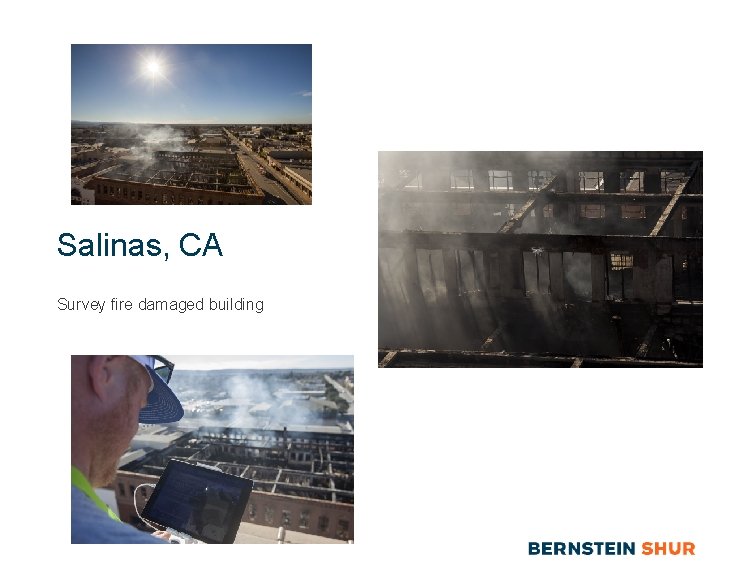
Salinas, CA Survey fire damaged building
Maine Mandatory Reporter Law 22 MRSA Chapter 1071 • Training – all mandatory reporters must complete at least once every four years a DHHS approved training program (PL 2015, c. 407) • Child and Family Services – Maine Department of Health and Human Services • http: //www. maine. gov/dhhs/ocfs/mandated-reporters. shtml
Maine Mandatory Reporter Law A mandated reporter is someone who is legally required to report suspected abuse or neglect of a child. Someone is mandated to file a report of suspected abuse or neglect of a child when: • Your occupation is included in the law (CEOs are included) • You become aware of the suspected abuse or neglect while you are acting in a professional capacity. • You have a reasonable cause to suspect that a child has been or is likely to be abused or neglected or that suspicious child death has occurred.
Maine Mandatory Reporter Law Required report of residence with non-family: • A report shall be made to the department if the person knows or has reasonable cause to suspect that a child is not living with the child’s family: • Report must be made immediately if there is reason to suspect that a child has been living with someone other than the child’s family for more than 6 months. • If there is reason to suspect that a child has been living with someone other than the child’s family for more than 12 months pursuant to a power of attorney or other non-judicial authorization (this means that there has been no legal transfer of custody/guardianship of the child).
Maine Mandatory Reporter Law Permissive reporting of animal cruelty, abuse or neglect: • A mandatory report may report a reasonable suspicion of animal cruelty, abuse or neglect to the local animal control officer or to the animal welfare program of the Department of Agriculture, Conservation and Forestry
Maine Mandatory Reporter Law Penalty for violations - “A person who knowingly violates a provision of this chapter commits a civil violation for which a forfeiture of not more than $500 may be adjudged. ”
Maine Medical Marijuana Act Local regulation of Marijuana Production Facilities Marijuana Legalization Act (Question 1) Would permit the cultivation, manufacture, distribution, sale and testing of retail marijuana and retail marijuana products Retail marijuana stores Retail marijuana social clubs Retail marijuana cultivation facilities Retail marijuana products manufacturing facilities Retail marijuana testing facility
Marijuana Legalization Act Municipal Decisions • Licensing • Land use regulations - location and operation • Allow marijuana retail establishments?
Questions? • • • 80 K Procedure After the Fact Permits Illegal Subdivisions and Lot Divisions
Thank you. Municipal and Governmental Services Practice Group Philip Saucier psaucier@bernsteinshur. com Ann Freeman afreeman@bernsteinshur. com
- Slides: 69