
Mandated Reporting suspected occurrences of abuse neglect and
Mandated Reporting suspected occurrences of abuse, neglect, and mistreatment of individuals with developmental disabilities Massachusetts Department of Developmental Services
Protecting a vulnerable group Individuals with developmental disabilities (D. D. ) are susceptible to being abused. • 5, 000 crimes are committed against folks with D. D. each year in the U. S. (Petersilia - When Justice Sleeps: Violence and Abuse Against the Developmentally Disabled; 2000) • Adults with developmental disabilities are at risk of being physically or sexually assaulted at rates four to ten times greater than other adults. (Sobsey - Violence and Abuse in the Lives of People with Disabilities; 1994) • Only 3% of sexual abuse cases involving victims who have developmental disabilities will be reported. (Valenti-Hein and Schwartz – the sexual abuse interview for those with D. D. ; 1995) • 33% of abusers are friends or acquaintances, 33% are natural or foster family members, and 25% are caregivers or service providers. (Sobsey, -Sexual Offenses and Disabled Victims; 1994)
Why does this happen so often? • Some individuals may not be able to defend themselves against abuse, neglect and mistreatment. • Many cannot speak up to report that they have been abused, neglected or mistreated. Even when they do make reports, they are not always believed. • An abusive person is usually someone the victim knows and trusts – someone with control and influence over the person with a disability. • Persons with disabilities are often taught to be compliant and encouraged not to question authority figures/caregivers.
Your responsibility to report • As a caregiver or provider, it is your job to support individuals to be safe and healthy. • As a human being, you have a moral and ethical responsibility to protect a vulnerable person who is being abused, mistreated or neglected. • As an employee of DDS or a Provider agency, you are a mandated reporter and you have a legal responsibility to report. Failure to report may be punished by a fine of up to $1, 000. Caregivers can be staff or family members. A caregiver is any agency or individual responsible for the health and welfare of a person with a disability by providing for or directly providing assistance in meeting daily living needs. A Provider is an individual, agency or other legal entity with day to day responsibility for the operation of services or supports or facilities regulated by the DDS. A provider may be a DDS employee or a contact-vendor employee.
What to report • Any incident, condition, or occurrence where there’s a reasonable cause to believe that an individual has been abused, harmed, exposed to risk, or been subjected to mistreatment due to the actions, the inaction or the negligence of a caregiver or provider. This belief is triggered by a presentation of facts either directly observed or obtained from reliable sources that creates a reasonable cause to believe that abuse, neglect, or mistreatment exists. • Deaths – DDS staff and contracted vendors are also required to report to the DPPC all cases in which an individual with a disability has died, regardless of whether or not abuse or neglect is suspected. This is because DPPC is required by the Commonwealth to maintain a record of the deaths of all individuals who are served by DDS.
A reasonable cause to believe • A reasonable cause to believe is a standard that is less than “probable cause”, but more than an non-specific suspicion, “hunch”, or gut feeling. • Facts that could provide a reasonable person with cause to believe that abuse, neglect or mistreatment exists could include: ü You witnessed abuse, neglect, or mistreatment ü Someone reported it to you ü You observed an injury to an individual ü There are changes in the mood or behavior of the individual ü Other evidence, such as records, documents, photos, etc.
Considering the information Consider all of the information available to you. This may include, but would not be limited to: • • • The location, nature and extent of an injury, if any; • Any information other staff or other persons may have regarding the circumstances. Physical location where the injury occurred; Any information the individual may be able to offer; Changes in the behavior/mood of the individual; Specialized support needs such as one to one supervision, special dietary restrictions, or guidelines or the use of a gait belt that were not provided in the incident under consideration; and
Deciding whether to report • After considering all of the information known to you, ask yourself: Is it reasonable of me to believe that abuse, mistreatment, or another reportable condition may have occurred? Does it make sense? • • If you cannot decide, make the report. • It is better to err on the side of reporting. Reports can be made by provider or DDS area office staff, including Service Coordinators
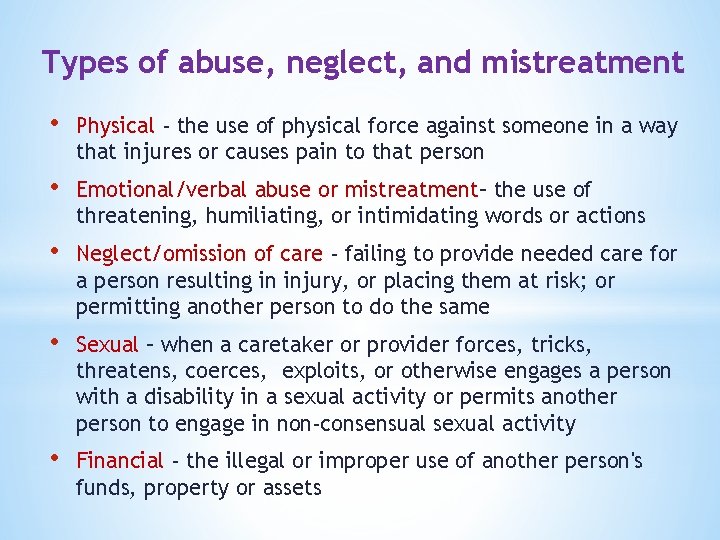
Types of abuse, neglect, and mistreatment • Physical - the use of physical force against someone in a way that injures or causes pain to that person • Emotional/verbal abuse or mistreatment– the use of threatening, humiliating, or intimidating words or actions • Neglect/omission of care - failing to provide needed care for a person resulting in injury, or placing them at risk; or permitting another person to do the same • Sexual – when a caretaker or provider forces, tricks, threatens, coerces, exploits, or otherwise engages a person with a disability in a sexual activity or permits another person to engage in non-consensual sexual activity • Financial - the illegal or improper use of another person's funds, property or assets

An example - Tom is having a difficult morning at his day program. He seems to be on edge. When lunch time comes, Tom goes outside. He says he wants to take a walk to relax. After a half hour, staff realize that he has not returned. They begin to search for him, when a police car pulls up to the program with Tom. They said that they found him wandering the streets, lost.
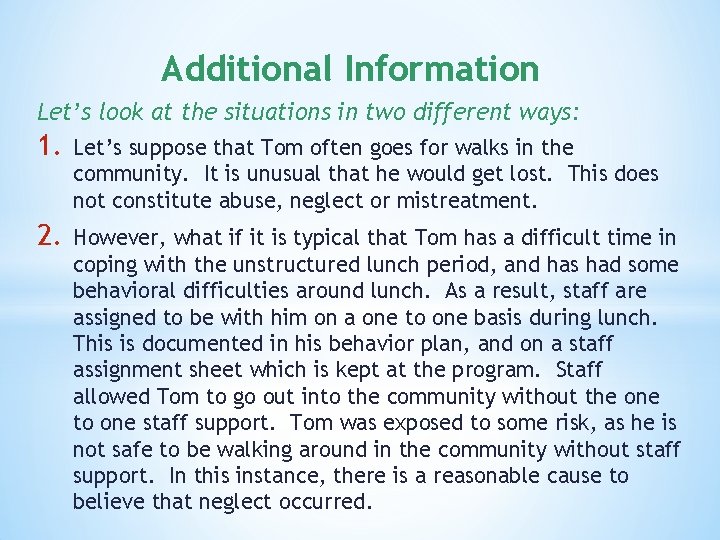
Additional Information Let’s look at the situations in two different ways: 1. Let’s suppose that Tom often goes for walks in the community. It is unusual that he would get lost. This does not constitute abuse, neglect or mistreatment. 2. However, what if it is typical that Tom has a difficult time in coping with the unstructured lunch period, and has had some behavioral difficulties around lunch. As a result, staff are assigned to be with him on a one to one basis during lunch. This is documented in his behavior plan, and on a staff assignment sheet which is kept at the program. Staff allowed Tom to go out into the community without the one to one staff support. Tom was exposed to some risk, as he is not safe to be walking around in the community without staff support. In this instance, there is a reasonable cause to believe that neglect occurred.
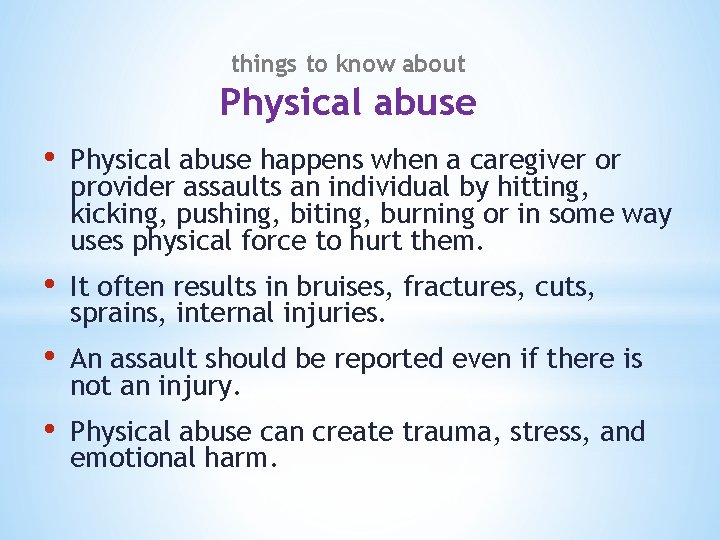
things to know about Physical abuse • Physical abuse happens when a caregiver or provider assaults an individual by hitting, kicking, pushing, biting, burning or in some way uses physical force to hurt them. • It often results in bruises, fractures, cuts, sprains, internal injuries. • An assault should be reported even if there is not an injury. • Physical abuse can create trauma, stress, and emotional harm.
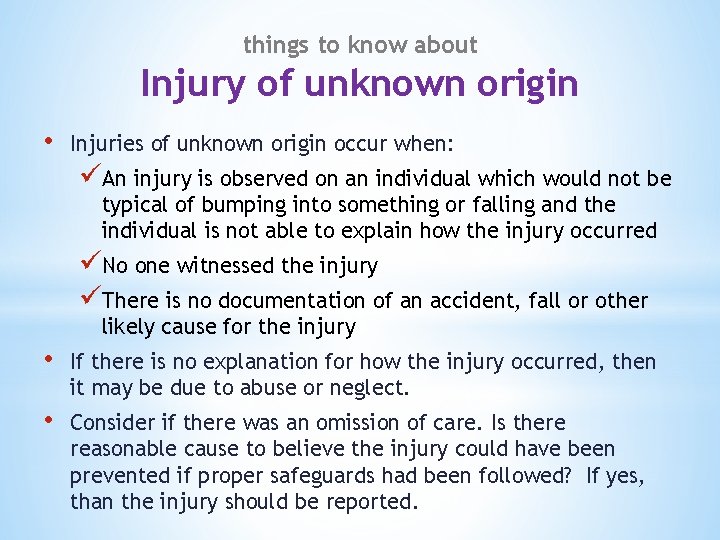
things to know about Injury of unknown origin • Injuries of unknown origin occur when: üAn injury is observed on an individual which would not be typical of bumping into something or falling and the individual is not able to explain how the injury occurred üNo one witnessed the injury üThere is no documentation of an accident, fall or other likely cause for the injury • If there is no explanation for how the injury occurred, then it may be due to abuse or neglect. • Consider if there was an omission of care. Is there reasonable cause to believe the injury could have been prevented if proper safeguards had been followed? If yes, than the injury should be reported.
ask yourself… Is the injury reportable? It can be challenging to apply the reasonable cause to believe standard to an injury of unknown origin. Consider the following: • The severity of the injury • The location of the injury on the body – is it in a place that is likely to happen as a result of a fall, or bumping into something? • The type of injury – are there patterns of bruises or other indications that it was caused by another person? • Are there changes in the mood and behavior of the person that could indicate that they have been abused? • Is there documentation or are there witnesses which can explain how the injury occurred in an accidental manner? This information could help you weigh the evidence in deciding whether to report. When in doubt, report!
An example - Bernie Staff are assisting an individual, Bernie in the shower and notice that he has a long thin bruise in the middle of his back. Bernie is not able to communicate how this injury occurred. Staff asks his coworkers if they know how Bernie could have gotten the bruise, and nobody knows. Staff review the log books at the home and there is no mention of any injury. Staff then call the day program to inquire about the injury, but they don’t know about it either. Bernie does not have any history of frequent falls or of self injurious behavior.
Is this abuse? • • This could be an instance of physical abuse. • Such circumstances could provide reasonable cause to believe that Bernie was assaulted. Erring on the side of reporting, this injury should be reported. The bruise is evidence that something happened to Bernie. It occurred in a place that is not typical of a fall or bumping into something. It is an injury of unknown origin and the possibility does exist that Bernie was assaulted.
What about Peer to peer violence? • Abuse, neglect and mistreatment must be reported when they are perpetrated by a caregiver or provider. • Peer to peer violence, which does not involve omission by a caregiver, does not meet that standard. • However, there may be instances when a caregiver or provider is negligent in their support and attention to the individuals. This “omission of care” may have led to the peer to peer violence. • In this instance, the incident must be reported.

An example – Gail and Paula One staff is transporting two individuals, Gail and Paula in a van to go out for coffee. They have been arguing with each other all day. Paula has a history of assaultive behavior. On the way to the coffee shop, the staff stops at a convenience store to buy lottery tickets for themselves, leaving the individuals in the van. Paula punches Gail in the nose.
Is this omission of care? • This is an example of Omission of Care – the individual was injured as a result of staff negligence. The omission of care occurred because the staff should have known that there was a significant risk of an assault, given Paula’s history of assault and the arguing that was occurring between Paula and Gail. • There is not an omission of care in every instance of peer to peer violence. In this example, staff knew that there was a risk of assault if the individuals were unattended. Staff decided to pursue a personal errand in neglect of their duties which exposed the individuals to risk.
things to know about Emotional/verbal abuse or mistreatment Emotional abuse may be verbal or non-verbal, when a caregiver or provider uses words or actions/gestures to threaten, humiliate or intimidate an individual. It may be difficult to judge whether an interaction is abusive. Some indications that the threshold for verbal/emotional abuse has been reached could include: ü Name calling – insulting the individual with derogatory terms, swearing at them ü Screaming/yelling – displaying anger, rage, raising their voice at the individual ü Intimidating – using words or gestures to frighten the individual ü Threatening the individual with harm, punishment or humiliation If the Individual is visibly upset after being called names, yelled at, intimidated, or threatened by staff or caretaker, it is probably emotional abuse.
An example - Janet An individual, Janet, is angry because her shared living provider, Kristen will not take her shopping on a Saturday morning. Janet tells Kristen that she is going to call her guardian and say that Kristen is abusing her. Kristen tells Janet, “If you are going to lie about me, I am not going to allow you to use the phone. I am going to break every phone in the house and you wont be able to tell anyone about anything. ” Janet starts to cry and goes into her room.
Is this mistreatment? This is verbal/emotional mistreatment, even though Janet has not been injured, or even exposed to risk. Kristen is threatening Janet and is intimidating her. Janet’s claim that she was going to call her guardian and get Kristen in trouble does not justify this mistreatment.
things to know about Neglect/omission of care Neglect or Omission of Care – A caregiver or provider fails to provide the support services that are required, which results in an injury, a risk, or in mistreatment. Examples include: • A lack of proper supervision leads to peer violence • Not following through on medical protocols leads to or exposes an individual to the risk of injury or illness • An individual who requires close supervision suffers a preventable fall or otherwise injures themselves due to inattentiveness of staff • Individual is improperly dressed for weather conditions • Individual not provided with sufficient healthy food and drinks • Individual medical support devices not properly maintained

An example - Rich An individual at a community residence, Rich has a doctor’s order for a ground diet. It has been agreed to by the guardian. Rich wants to have a snack. Staff have seen him eat whole food (which has not been ground) on another occasion. They decide it is OK to give him a cookie and then go into the office to do paperwork. Rich begins to choke. He does manage to clear his airway with the assistance of staff.
Is this omission of care? This is an example of Omission of Care – the individual was exposed to injury as a result of staff negligence. They did not follow the doctor’s order. If there had not been an order for a ground diet, this would not be considered to be an omission of care.
some indicators of Sexual abuse Individuals may be reluctant to report being the victim of sexual abuse. Here are some indications that sexual abuse may have occurred: • • Physical evidence such as torn or stained clothing Injury to the individual such as vaginal, rectal bleeding, bruises on the genital area or inner thigh • • • Itching, swelling or pain in the genital or rectal area Incontinence which is not typical for the individual Changes in the behavior or mood of the individual including: becoming fearful and withdrawn, acting in a sexually provocative way, or being angry, crying, being more emotionally volatile than is usual
After reporting sexual abuse There are special considerations when sexual abuse is suspected. It is important to preserve evidence which may be essential for an investigation. • Do not bathe victim of an alleged sexual assault or rape until they have been medically assessed. • Do not change the clothes of an alleged victim of a sexual assault or rape. • Do not wash the bed linens or clothing of an alleged victim of a sexual assault or rape. • Do not clean the location of an alleged sexual assault or rape. The investigator will provide direction. They will likely want the alleged victim to be assessed at an emergency room, preferably one that has a sexual assault nurse examiner (S. A. N. E. ), and will want to examine clothing and other evidence. We have included a list of designated S. A. N. E. sites at the end of this Power. Point for reference.
An example - Pat An individual, Pat, has a history of telling stories about people which are not true. She may be angry with someone and will tell a story with the intent to get them into trouble. One day she asks to speak to the program manager at her day program. She appears to be upset, and is crying while she is talking. That is not usual for her. She has been keeping to herself all day, which is very unusual. Pat says that a staff at her group home came into her bedroom at night and put his hands on her breasts. He told her not to tell anybody or she would get into trouble because nobody would believe her anyway.
Is this reportable? Even though Pat can be an unreliable reporter at times, staff can’t completely disregard everything that she says. Pat appeared to be genuinely upset, so there is a reasonable cause to believe that something may have happened, and it should be reported.
about Financial abuse or exploitation The mismanagement, misappropriation, improper use, waste, fraudulent taking or taking without authorization or consent of personal funds or goods. Some examples are: • A caregiver or provider takes an individual’s money • A caregiver or provider uses an individual’s money to pay for their own expenses • A caregiver or provider persuades an individual to give them money, to give them possessions, or to buy them something
some Indicators of financial abuse • Individual seems to be missing funds, money cannot be located or accounted for • Individual expresses concern that he/she does not have enough money for basic needs • Individual appears to be pressured into making transactions or purchases by caregivers, providers or others • The individual’s financial records have major discrepancies
Financial records A review of financial records and receipts could reveal financial exploitation. This information could provide reasonable cause to believe that financial exploitation has occurred and should be reported: • A count of the actual cash that an individual has does not match up with what the records would indicate they should have • There are receipts for items that the individual does not seem to possess • There are bank account withdrawals with no indication of what happened to the money Discrepancies in financial records could be exploitation or just poor record keeping. Falsification of records would be a strong indication of exploitation.
An example - Ed A staff member at a community residence is reviewing the financial records of one of the people who live in the home, Ed. She was surprised to see a receipt for children’s clothing in the amount of $150. It was entered by her coworker, Carol. When Carol was asked about this, she said that Ed had insisted on buying birthday gifts for her children.
Is this financial exploitation? Let’s look at two situations: 1. When questioned, Ed didn’t know anything about it. • 2. This is financial exploitation. Carol used Ed’s money for her own benefit. When questioned, Ed said that Carol asked him to buy the gifts. • This is financial exploitation as well. Since Carol is a staff member, she cannot ask Ed to spend his money on her children. This would be considered to be coercion, as Ed may feel pressured to go along with what staff want him to do.
Reluctant reporters Sometimes mandated reporters are hesitant to report instances of abuse, neglect or mistreatment. • It can be difficult to report on a coworker or supervisor. These are people who you know and like and who you work with every day. “I cannot believe that they would do a thing like that. There must be some mistake” ü People are complicated, with good and bad qualities. ü You cannot know for certain what others are capable of doing. ü Sometimes good people make mistakes and do the wrong thing.
Reluctant reporters “I Don’t want to get my co-worker/supervisor in trouble” • They are responsible for their own behavior and for the consequences of that behavior. “I am not certain that this rises to the threshold of abuse/neglect” • Maybe it does and maybe it doesn’t. If you are having difficulty in determining whether facts known to you provide a reasonable cause to believe a reportable condition exists, report the incident to DPPC and let the investigator determine that. “The culture of my workplace seems to permit this behavior; we don’t talk to outsiders, what happens in Vegas…” • That “culture of secrecy” cannot apply to covering up the abuse or mistreatment of vulnerable individuals. Don’t be wrongly influenced by others when you know what the right thing is.
Reluctant reporters “My boss won’t be happy if I report this, I am afraid I will get into trouble” • • You are protected from retaliation by the law Chapter 19 C, section 11 states - No person shall discharge or cause to be discharged or otherwise discipline or in any manner discriminate against or thereafter take any other retaliatory action against any employee, client or other person for filing a report with the Disabled Persons Protection Commission
When an individual discloses abuse • Do stay calm and remain non-judgmental. Put your own feelings aside. • Do be supportive, assure the individual that he/she did the right thing by reporting. • Do ensure the individual’s safety. Ensure the alleged abuser(s) does not have access to the alleged victim. • • • Do explain the requirement to immediately report to DPPC. Do ask the individual if they would like to make the call to DPPC. Do gather the essential information by asking questions about ü what happened ü where and when it happened ü who is the alleged abuser, who else was present (if anyone) • Do prevent loss or destruction of known evidence.
When an individual discloses abuse • • • Don’t agree to keep the information secret. Don’t interpret or edit the information. Don’t conduct an investigation. Don’t interrogate the alleged abuser/suspect. Don’t touch physical evidence. Don’t bathe, change clothes, or bedlinens of an alleged victim of sexual abuse or rape until they have been medically assessed.
How to make the report • Call the Disabled Persons Protection Commission (DPPC) at 1 -800 -426 -9009. • In case of emergency call 911 first and then call DPPC. • The DPPC has a 24 hour hotline, you can call them at any time.
Next Steps • If the individual is at risk of being abused again, contact someone in your agency who can provide for their immediate safety while the investigation is ongoing. • Your agency may want to conduct their own internal review of the allegation in order to determine what they need to do in order to insure the health and safety of all of the individuals in the program are protected.
What you will be asked by DPPC When you place the call to DPPC, you will be asked some questions: • name and contact information of the reporter, alleged victim, alleged abuser (if known) • information about the victim such as date of birth, sex, guardian name and address • description of alleged abuse and resulting injuries • name of any witnesses • description of current status of the alleged victim, including level of risk You should make the call to the DPPC even if you don’t know all of the answers.
What happens next? • DPPC will perform a risk assessment to determine whether protective services are warranted. • Protective services are immediate interventions to protect the victim from further abuse. • The State police detective unit at the DPPC will also review the case. Law Enforcement will get involved if a crime is suspected. • • DPPC may conduct the investigation themselves. • Some cases are referred to the DDS Regional Director or Designee for administrative review. The DPPC may assign to the case to the Department of Developmental Services (DDS) investigations unit.
The investigation After insuring that everyone is safe from further abuse or mistreatment, DPPC or DDS staff will conduct an investigation or an administrative review. • They will talk to the alleged victim, perpetrator and any witnesses. • They will examine any evidence, including records, policies, and other relevant documents. • Upon completion of the investigation, they will issue a written report with a conclusion that the allegations were either substantiated or unsubstantiated. • Regardless of the conclusions, the report may make recommendations for corrective actions to prevent future incidents, injuries, or mistreatment.
Conclusion • Individuals with developmental disabilities are vulnerable to being abused, neglected or mistreated. • • Caregivers or providers are often the perpetrators of abuse. • The threshold for reporting is “reasonable cause to believe”. You don’t have to be certain. • If you have a reasonable cause to believe that abuse, neglect or mistreatment has occurred call the DPPC at -800 -426 -9009 • • Always call 911 in an emergency. Staff may have reasons why they are reluctant to report, but they have a moral, ethical and legal responsibility to report abuse. Your responsibility is to make the call. The investigators will do the rest. 1
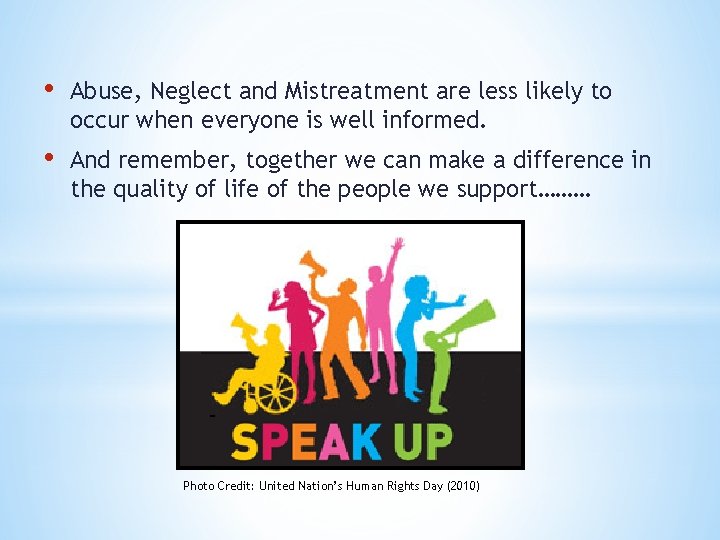
• Abuse, Neglect and Mistreatment are less likely to occur when everyone is well informed. • And remember, together we can make a difference in the quality of life of the people we support……… Photo Credit: United Nation’s Human Rights Day (2010)
Designated S. A. N. E Sites (sexual assault nurse examiner) Metro Boston Region • • Boston – Boston Medical Center Boston – Beth Israel Deaconess Medical Center Boston – Brigham and Women’s Hospital Boston – Children’s Hospital Boston – Mass General Hospital Cambridge – Cambridge Hospital Framingham – Metro West Medical Center Newton – Newton Wellesley Hospital
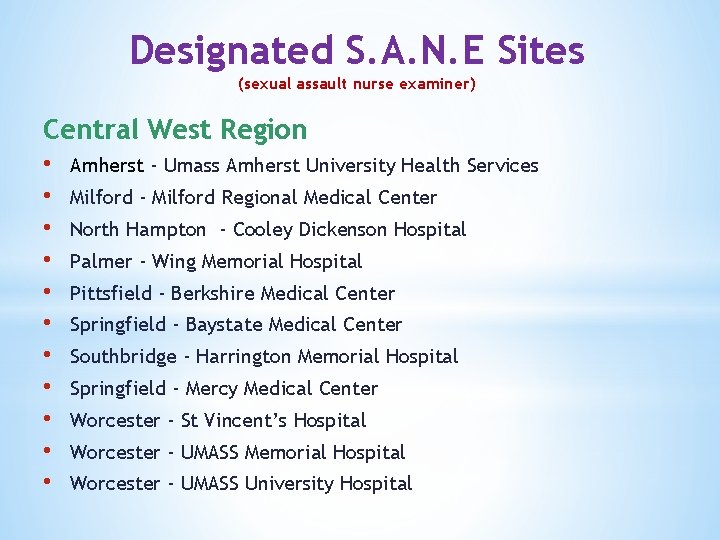
Designated S. A. N. E Sites (sexual assault nurse examiner) Central West Region • • • Amherst - Umass Amherst University Health Services Milford - Milford Regional Medical Center North Hampton - Cooley Dickenson Hospital Palmer - Wing Memorial Hospital Pittsfield - Berkshire Medical Center Springfield - Baystate Medical Center Southbridge - Harrington Memorial Hospital Springfield - Mercy Medical Center Worcester - St Vincent’s Hospital Worcester - UMASS Memorial Hospital Worcester - UMASS University Hospital
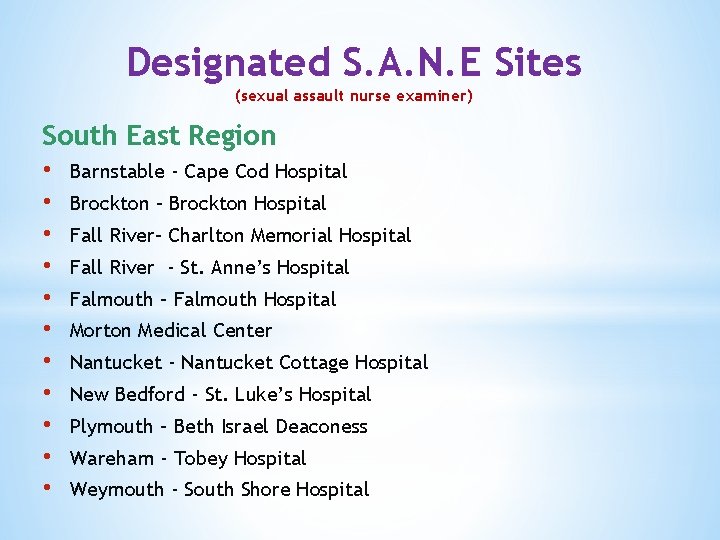
Designated S. A. N. E Sites (sexual assault nurse examiner) South East Region • • • Barnstable - Cape Cod Hospital Brockton – Brockton Hospital Fall River– Charlton Memorial Hospital Fall River - St. Anne’s Hospital Falmouth – Falmouth Hospital Morton Medical Center Nantucket - Nantucket Cottage Hospital New Bedford - St. Luke’s Hospital Plymouth – Beth Israel Deaconess Wareham - Tobey Hospital Weymouth - South Shore Hospital
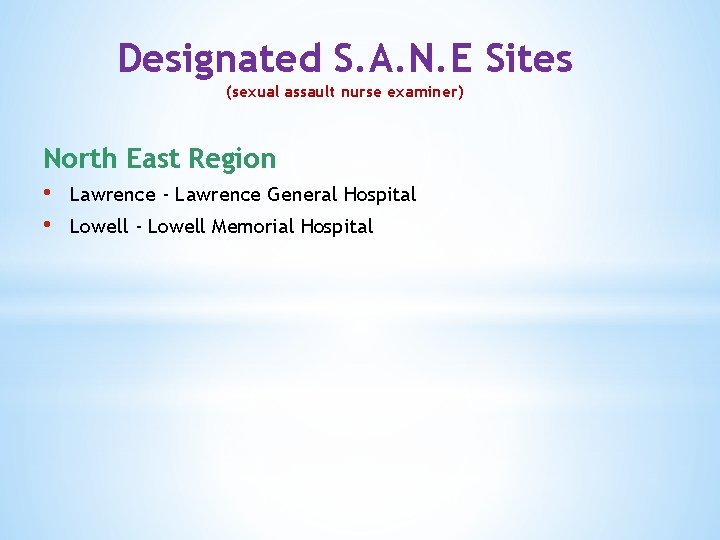
Designated S. A. N. E Sites (sexual assault nurse examiner) North East Region • • Lawrence - Lawrence General Hospital Lowell - Lowell Memorial Hospital
- Slides: 50