MACSSE 474 Theory of Computation FSM Intro Trying

- Slides: 35
MA/CSSE 474 Theory of Computation FSM Intro
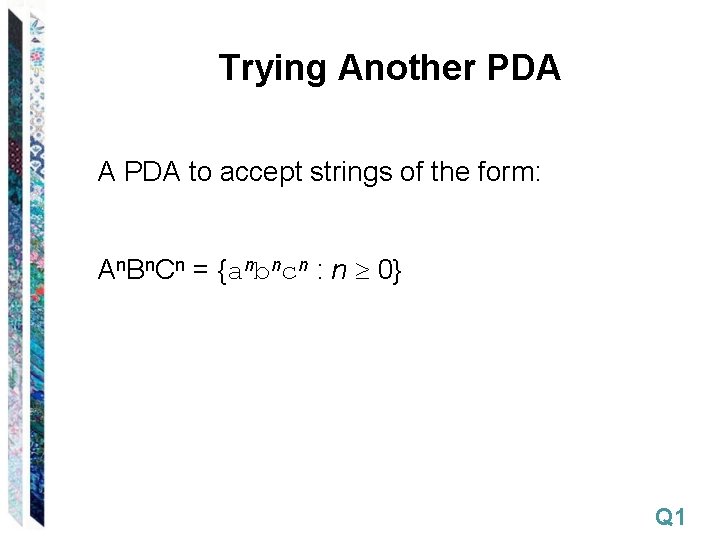
Trying Another PDA A PDA to accept strings of the form: An. Bn. Cn = {anbncn : n 0} Q 1
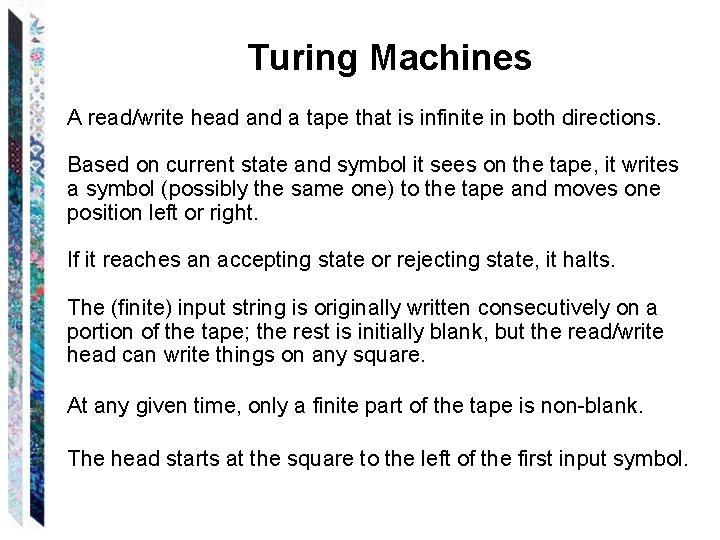
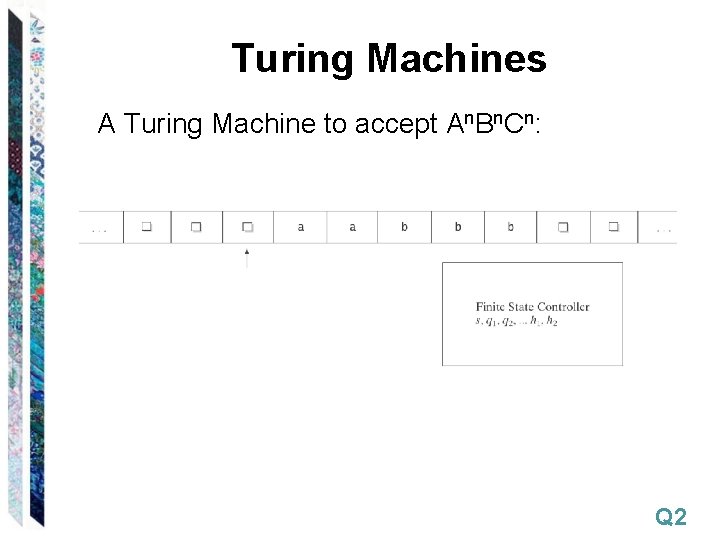
Turing Machines A read/write head and a tape that is infinite in both directions. Based on current state and symbol it sees on the tape, it writes a symbol (possibly the same one) to the tape and moves one position left or right. If it reaches an accepting state or rejecting state, it halts. The (finite) input string is originally written consecutively on a portion of the tape; the rest is initially blank, but the read/write head can write things on any square. At any given time, only a finite part of the tape is non-blank. The head starts at the square to the left of the first input symbol.
Turing Machines A Turing Machine to accept An. Bn. Cn: Q 2
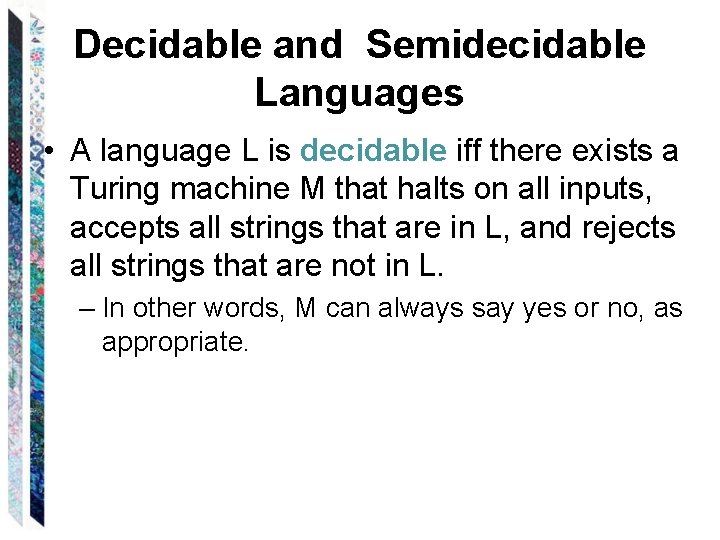
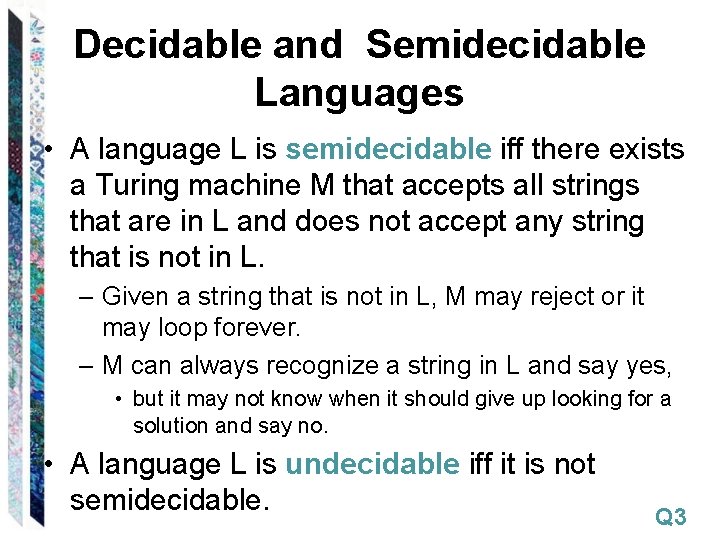
Decidable and Semidecidable Languages • A language L is decidable iff there exists a Turing machine M that halts on all inputs, accepts all strings that are in L, and rejects all strings that are not in L. – In other words, M can always say yes or no, as appropriate.
Decidable and Semidecidable Languages • A language L is semidecidable iff there exists a Turing machine M that accepts all strings that are in L and does not accept any string that is not in L. – Given a string that is not in L, M may reject or it may loop forever. – M can always recognize a string in L and say yes, • but it may not know when it should give up looking for a solution and say no. • A language L is undecidable iff it is not semidecidable. Q 3
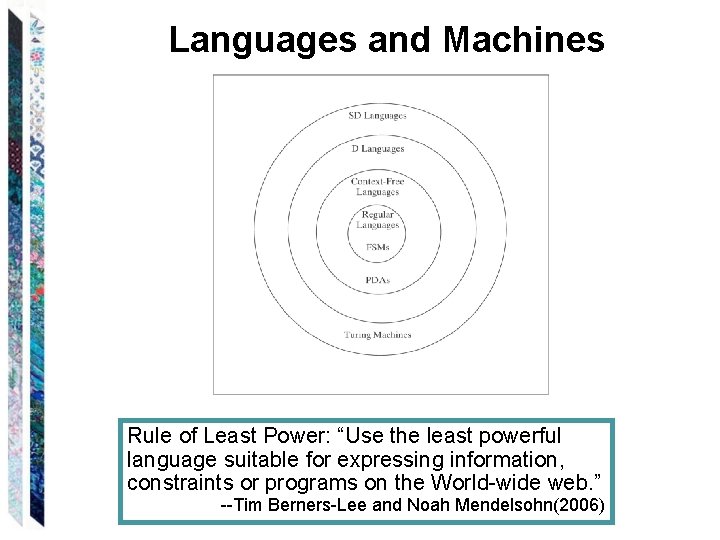
Languages and Machines Rule of Least Power: “Use the least powerful language suitable for expressing information, constraints or programs on the World-wide web. ” --Tim Berners-Lee and Noah Mendelsohn(2006)
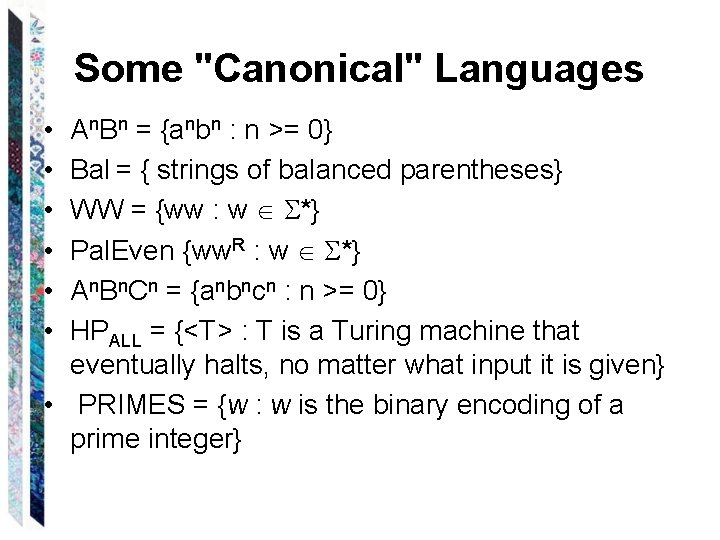
Some "Canonical" Languages • • • An. Bn = {anbn : n >= 0} Bal = { strings of balanced parentheses} WW = {ww : w *} Pal. Even {ww. R : w *} An. Bn. Cn = {anbncn : n >= 0} HPALL = {<T> : T is a Turing machine that eventually halts, no matter what input it is given} • PRIMES = {w : w is the binary encoding of a prime integer}
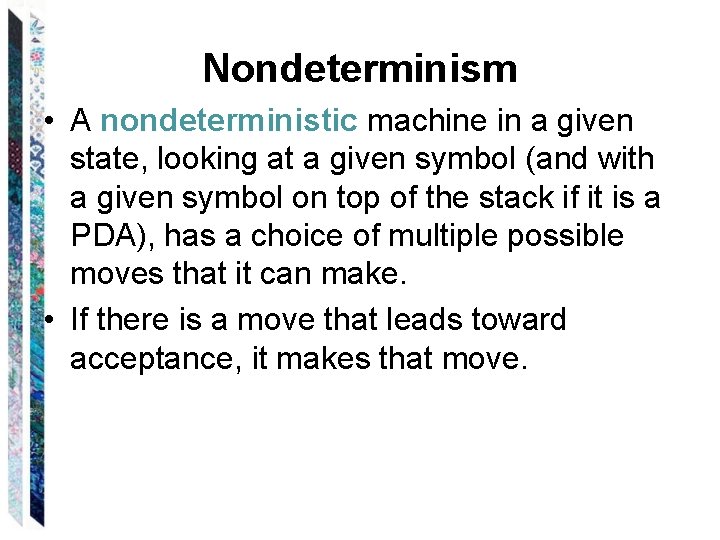
Nondeterminism • A nondeterministic machine in a given state, looking at a given symbol (and with a given symbol on top of the stack if it is a PDA), has a choice of multiple possible moves that it can make. • If there is a move that leads toward acceptance, it makes that move.
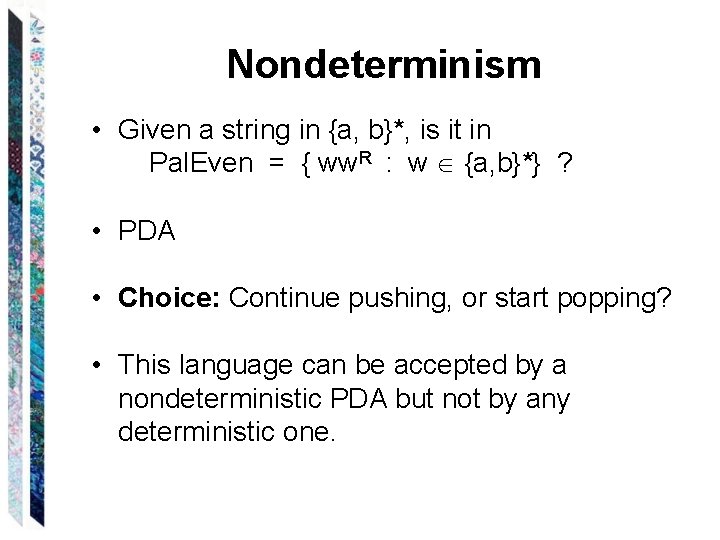
Nondeterminism • Given a string in {a, b}*, is it in Pal. Even = { ww. R : w {a, b}*} ? • PDA • Choice: Continue pushing, or start popping? • This language can be accepted by a nondeterministic PDA but not by any deterministic one.
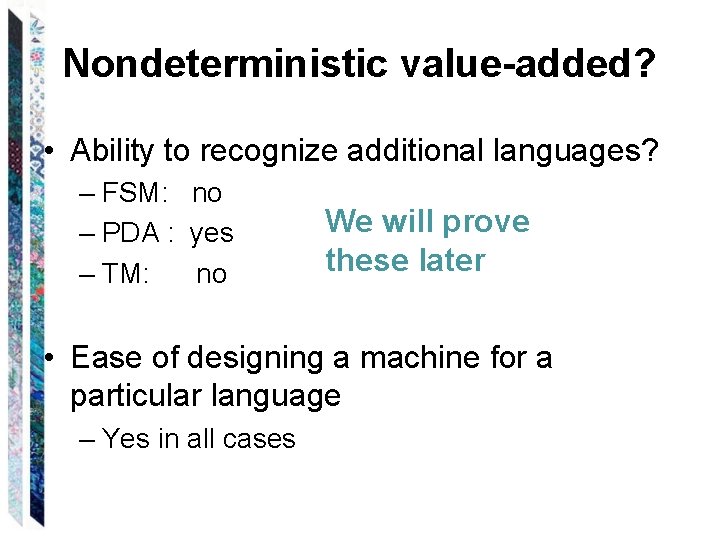
Nondeterministic value-added? • Ability to recognize additional languages? – FSM: no – PDA : yes – TM: no We will prove these later • Ease of designing a machine for a particular language – Yes in all cases
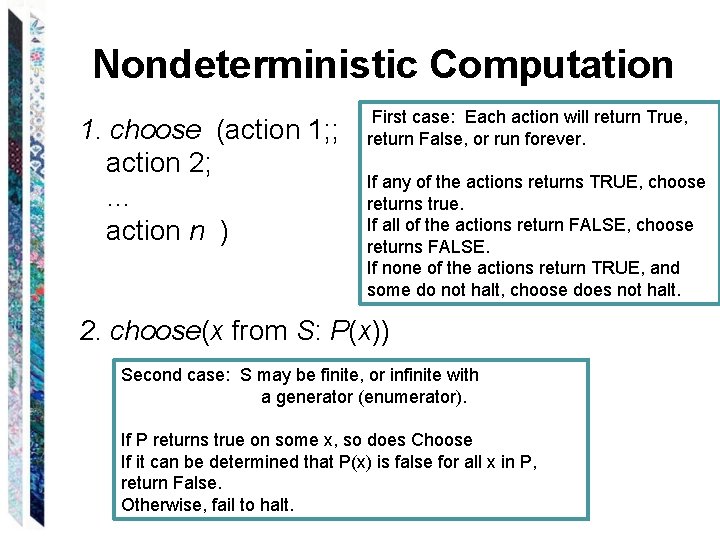
Nondeterministic Computation 1. choose (action 1; ; action 2; … action n ) First case: Each action will return True, return False, or run forever. If any of the actions returns TRUE, choose returns true. If all of the actions return FALSE, choose returns FALSE. If none of the actions return TRUE, and some do not halt, choose does not halt. 2. choose(x from S: P(x)) Second case: S may be finite, or infinite with a generator (enumerator). If P returns true on some x, so does Choose If it can be determined that P(x) is false for all x in P, return False. Otherwise, fail to halt.
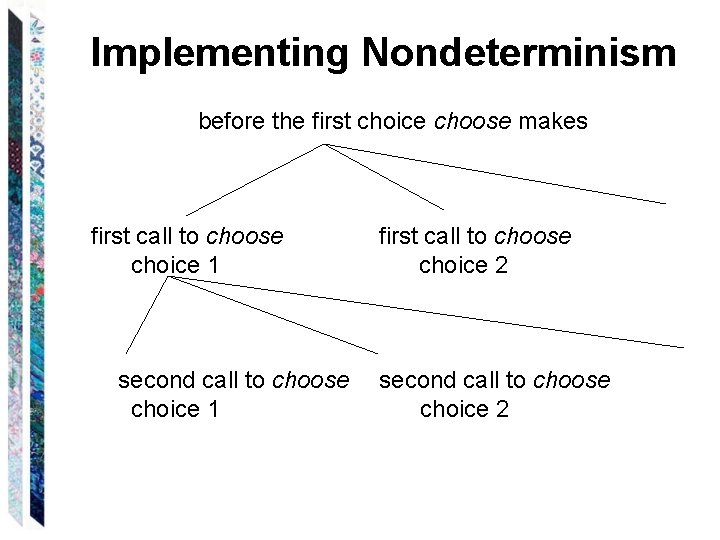
Implementing Nondeterminism before the first choice choose makes first call to choose choice 1 second call to choose choice 1 first call to choose choice 2 second call to choose choice 2
Sample Decision Problems Example: Given two strings s and t, does s occur anywhere as a substring of t? It's easy to see that this is decidable. Q 4
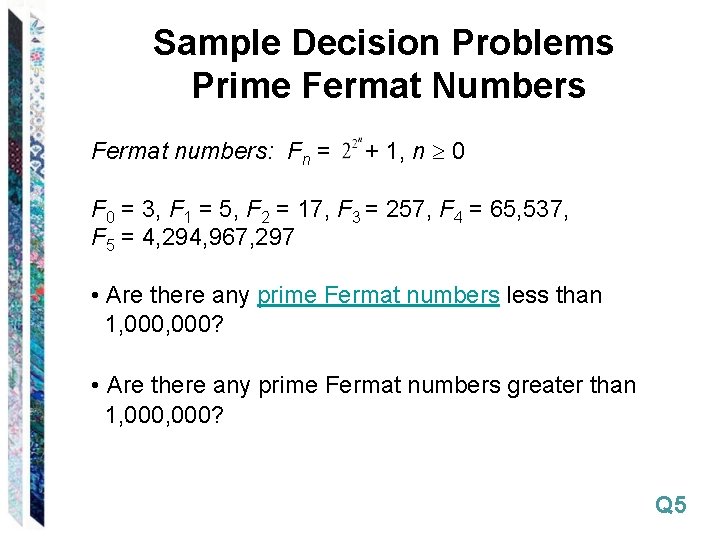
Sample Decision Problems Prime Fermat Numbers Fermat numbers: Fn = + 1, n 0 F 0 = 3, F 1 = 5, F 2 = 17, F 3 = 257, F 4 = 65, 537, F 5 = 4, 294, 967, 297 • Are there any prime Fermat numbers less than 1, 000? • Are there any prime Fermat numbers greater than 1, 000? Q 5
Sample Decision Problems Given a Java program P, is there some input string on which P halts? Given a Java program P, and a value v, is v the shortest input string on which P halts?
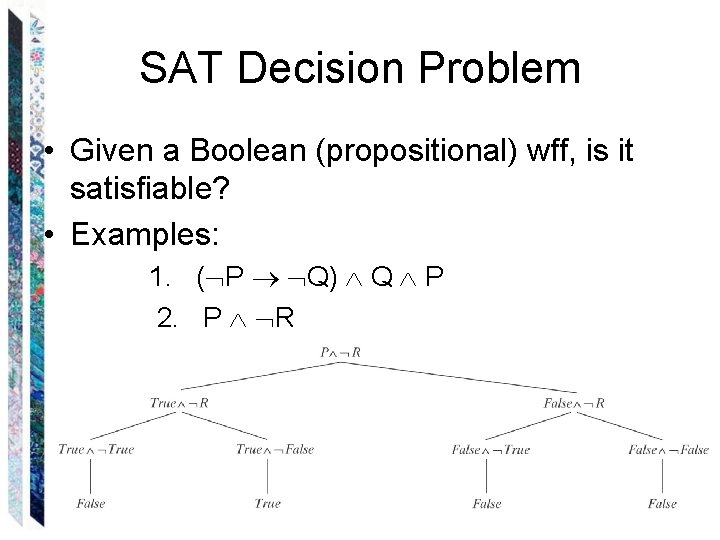
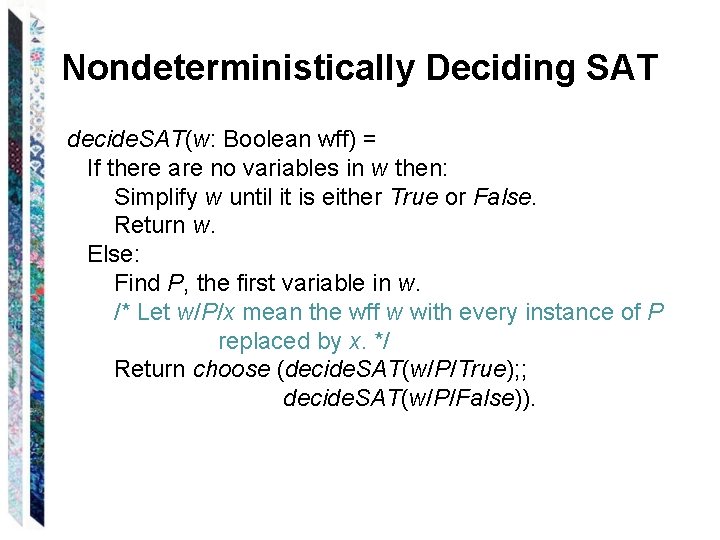
SAT Decision Problem • Given a Boolean (propositional) wff, is it satisfiable? • Examples: 1. ( P Q) Q P 2. P R
Nondeterministically Deciding SAT decide. SAT(w: Boolean wff) = If there are no variables in w then: Simplify w until it is either True or False. Return w. Else: Find P, the first variable in w. /* Let w/P/x mean the wff w with every instance of P replaced by x. */ Return choose (decide. SAT(w/P/True); ; decide. SAT(w/P/False)).
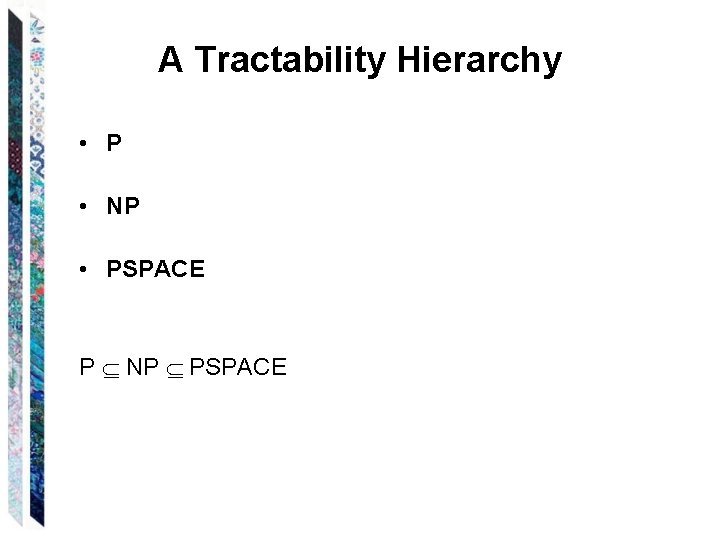
A Tractability Hierarchy • P • NP • PSPACE P NP PSPACE
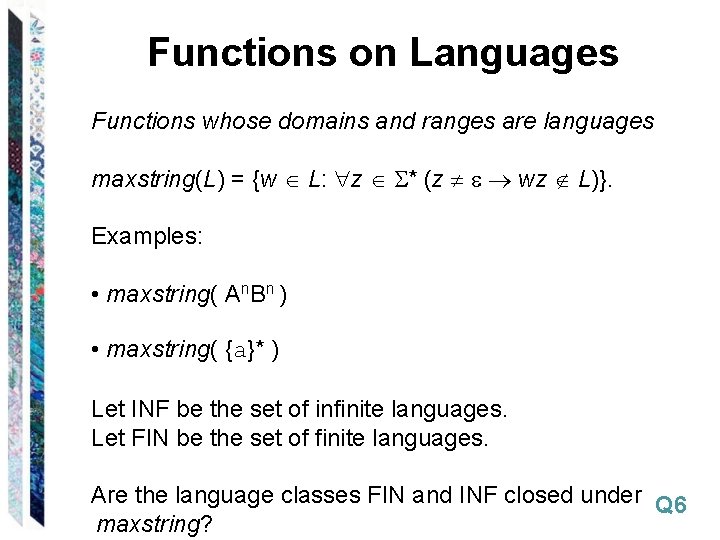
Functions on Languages Functions whose domains and ranges are languages maxstring(L) = {w L: z * (z wz L)}. Examples: • maxstring( An. Bn ) • maxstring( {a}* ) Let INF be the set of infinite languages. Let FIN be the set of finite languages. Are the language classes FIN and INF closed under Q 6 maxstring?
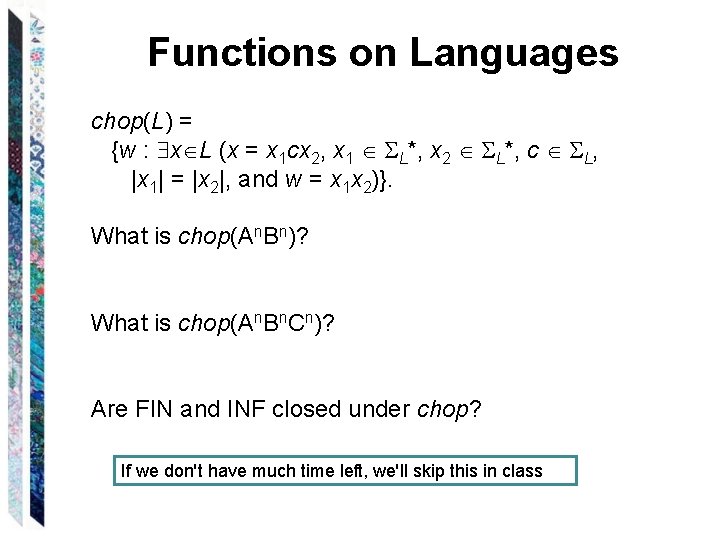
Functions on Languages chop(L) = {w : x L (x = x 1 cx 2, x 1 L*, x 2 L*, c L, |x 1| = |x 2|, and w = x 1 x 2)}. What is chop(An. Bn)? What is chop(An. Bn. Cn)? Are FIN and INF closed under chop? If we don't have much time left, we'll skip this in class
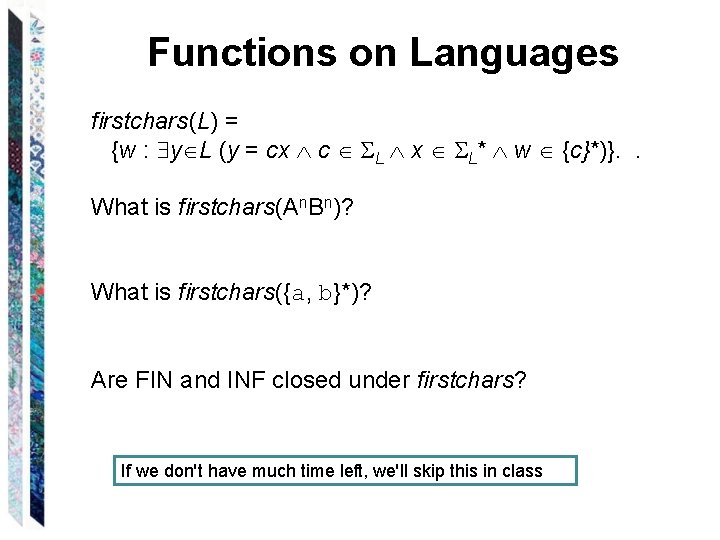
Functions on Languages firstchars(L) = {w : y L (y = cx c L x L* w {c}*)}. . What is firstchars(An. Bn)? What is firstchars({a, b}*)? Are FIN and INF closed under firstchars? If we don't have much time left, we'll skip this in class
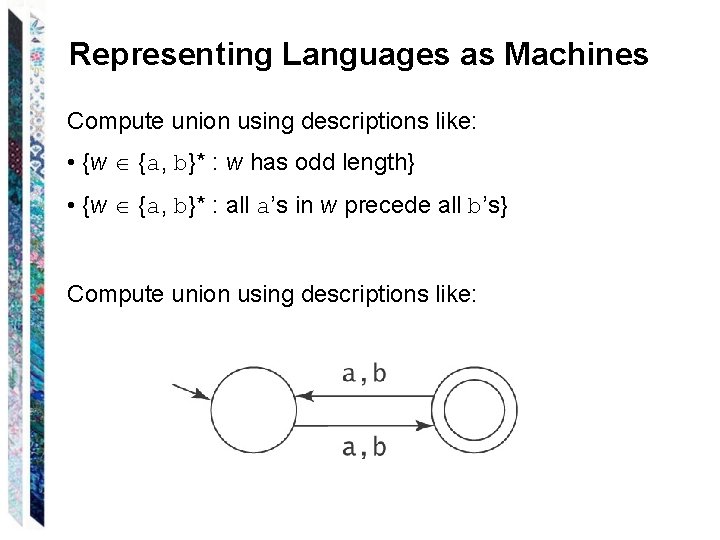
Representing Languages as Machines Compute union using descriptions like: • {w {a, b}* : w has odd length} • {w {a, b}* : all a’s in w precede all b’s} Compute union using descriptions like:
Finite State Machine Intro
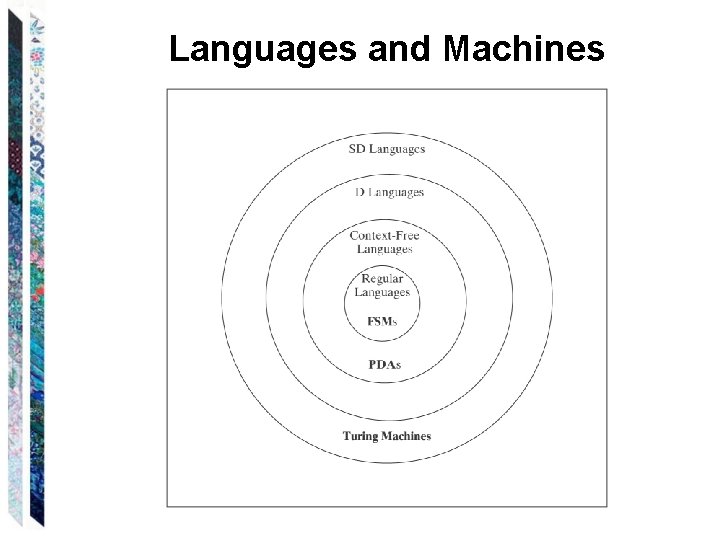
Languages and Machines
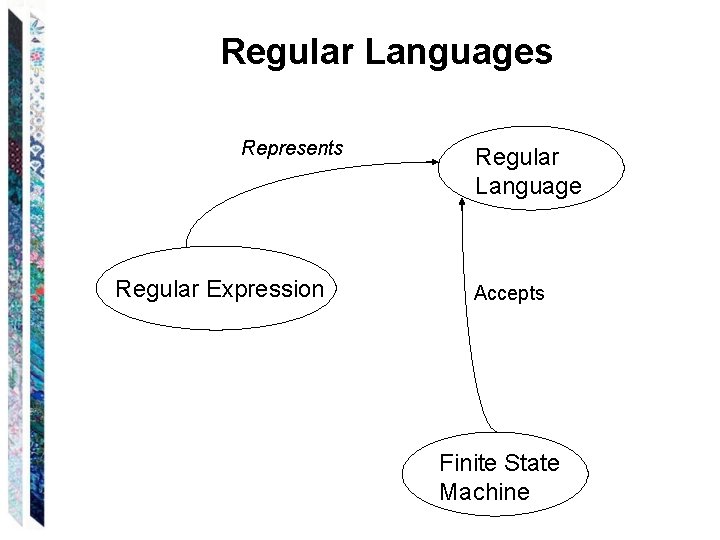
Regular Languages Represents Regular Expression Regular Language Accepts Finite State Machine
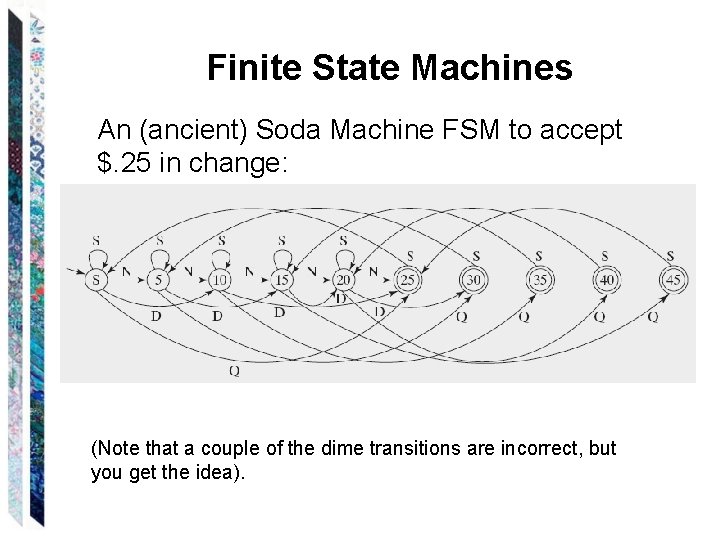
Finite State Machines An (ancient) Soda Machine FSM to accept $. 25 in change: (Note that a couple of the dime transitions are incorrect, but you get the idea).
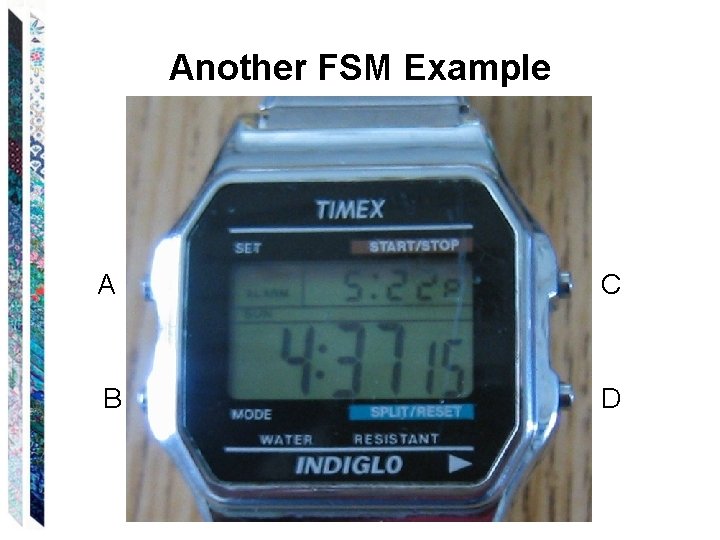
Another FSM Example A C B D
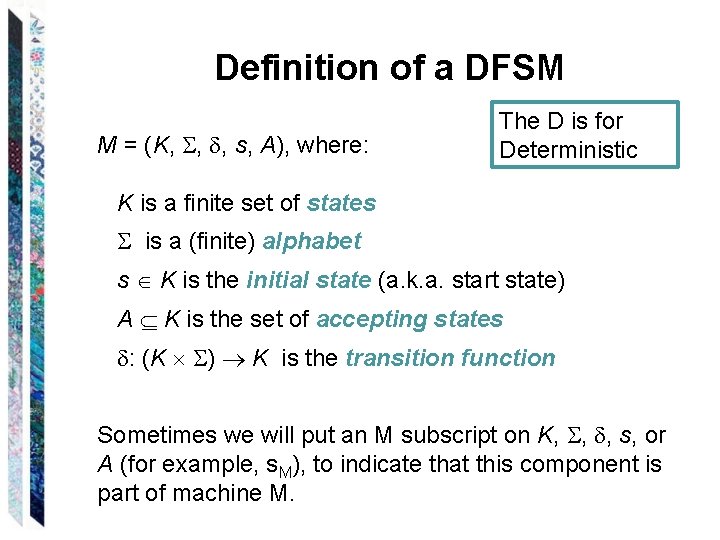
Definition of a DFSM M = (K, , , s, A), where: The D is for Deterministic K is a finite set of states is a (finite) alphabet s K is the initial state (a. k. a. start state) A K is the set of accepting states : (K ) K is the transition function Sometimes we will put an M subscript on K, , , s, or A (for example, s. M), to indicate that this component is part of machine M.
Acceptance by a DFSM Informally, M accepts a string w iff M winds up in some element of A after it has finished reading w. The language accepted by M, denoted L(M), is the set of all strings accepted by M. But we need more formal notations if we want to prove things about machines and languages.
Configurations of a DFSM A configuration of a DFSM M is an element of: K * It captures the two things that affect M’s future behavior: • its current state • the remaining input to be read. The initial configuration of a DFSM M, on input w, is: (s. M, w)
The "Yields" Relations The yields-in-one-step relation: |-M : (q, w) |-M (q', w') iff • w = a w' for some symbol a , and • (q, a) = q' The yields-in-zero-or-more-steps relation: |-M* |-M * is the reflexive, transitive closure of |-M. Q 7
Computations Using FSMs A computation by M is a finite sequence of configurations C 0, C 1, …, Cn for some n 0 such that: • C 0 is an initial configuration, • Cn is of the form (q, ), for some state q KM, • i {0, 1, …, n-1} (Ci |-M Ci+1)
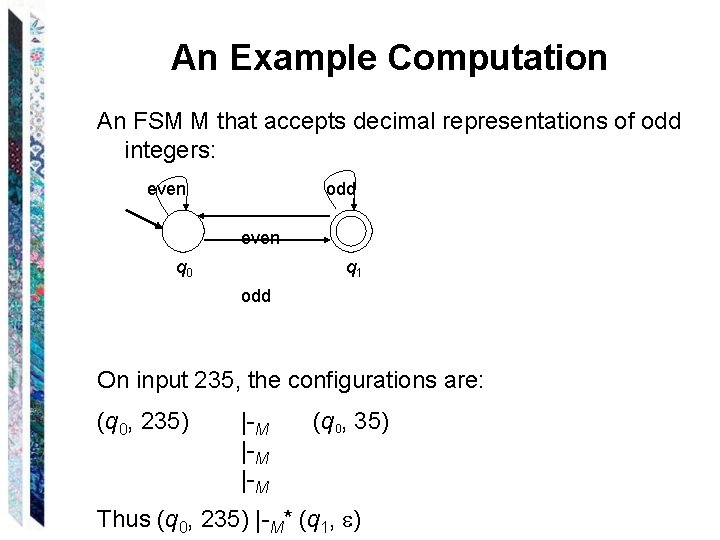
An Example Computation An FSM M that accepts decimal representations of odd integers: even odd even q 0 q 1 odd On input 235, the configurations are: (q 0, 235) |-M |-M (q 0, 35) Thus (q 0, 235) |-M* (q 1, )
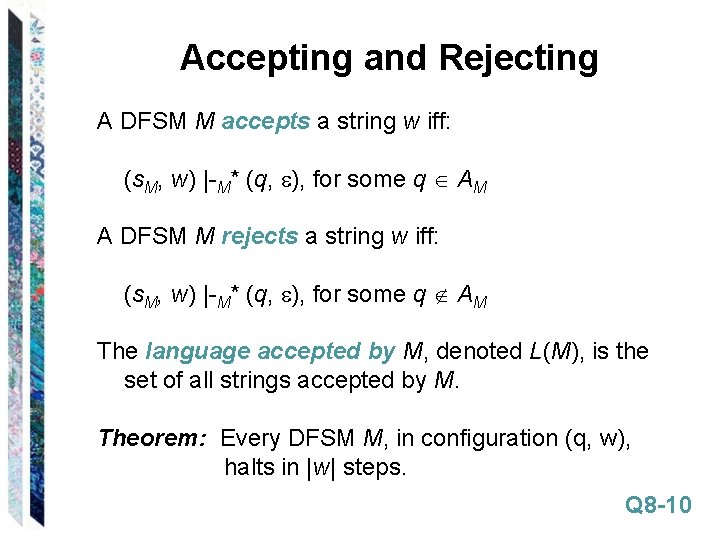
Accepting and Rejecting A DFSM M accepts a string w iff: (s. M, w) |-M* (q, ), for some q AM A DFSM M rejects a string w iff: (s. M, w) |-M* (q, ), for some q AM The language accepted by M, denoted L(M), is the set of all strings accepted by M. Theorem: Every DFSM M, in configuration (q, w), halts in |w| steps. Q 8 -10