Lyndal Greenslade Griffith University SOCIAL WORK ACTIVISM Resistance





- Slides: 66
Lyndal Greenslade Griffith University SOCIAL WORK ACTIVISM: Resistance from the frontier
Social Work Activism Resistance from the Frontier Lyndal Greenslade Ph. D Candidate School of Human Services and Social Work Griffith University
Why this topic? Professional Reflections § Social workers are committed to social justice activism § Social workers are experiencing difficulties practicing social justice Activism within contemporary welfare organisations § Social workers report feelings of distress when they are unable to pursue social justice Activism for their clients
Activism in social work: A proud history “Action indeed is the sole medium of expression for ethics” - Jane Addams
Activism in social work ethical documents § Activism is enshrined in the Codes of Ethics of member countries of the IFSW § The Codes of Ethics use proactive language: “Act to change” “promote” “challenging injustice” “engaging in action”
Social Work - A unique perspective § In comparison with the Codes of Ethics of five professions in the Allied Health field in Australia, social work is unique in its focus on the active pursuit of social justice § Further, many Codes of Ethics and Practice Standards state that they take precedence over employers’ policies and procedures
Why research social work Activism? § Limited amount of research exploring Activism § What does exist conceptualises Activism as a form of macro practice (eg: engaging in critical discussions, advocating for client groups, collaborating with others and joining existing issue groups) § Call for more research into Activism to explore possible incongruence between professional and organisational demands Chui & Gray, 2004; Andrews & Reisch, 2002; Gray et al, 2002; Abramovitz, 1998; Dietz Domanski, 1998; Pritchard, 1998; De Maria, 1993; Healy, 1993; Wagner, 1989; Reeser &Epstein, 1987; Hearn, 1982; Evans, 1975.
Activism in practice: why is it so hard? Incongruence between social work professional values and contemporary welfare ideologies, which have seen: § a dominance of technical practice models and an accompanying loss of structural, activist approaches § a concealing of activist activities, for fear of reprisal should more open forms of radical practice be attempted Andrew & Reisch, 2002; Wagner, 1989
Organisational-Professional Conflict § Research informs that conflict between the social work professional Code of Ethics and Organisational policy and procedure is wide spread § Research reports that such conflict is more prevalent in statutory workplace settings Aronson & Smith, 2009; Mc. Donald & Chenoweth, 2009; Collins, 2008; Ferguson & Lavalette, 2006; Mc. Auliffe, 2005; Jordan, 2004; Lonne et al, 2004; Hough, 2003; Jones, 2001; Postle, 2001; Fook et al, 2000; Bell, 1999; Balloch et al, 1998; Banks, 1998; Dominelli & Hoogvelt, 1996 Reeser, 1996; Jones & Novak, 1993.
Voices from the Field I think that I did at one time actually believe that I could change the world. Now I do the best in my sphere of influence and hope that how I treat others will make a difference in how they treat others. Andrews & Reisch, 2002, p. 21 For the people from 1999 on, it's the only system they know. So we talk in the field about the new generation of social workers - like '99 to now - being real compliance technicians not social workers, right? Aronson and Smith's, 2009, p. 6
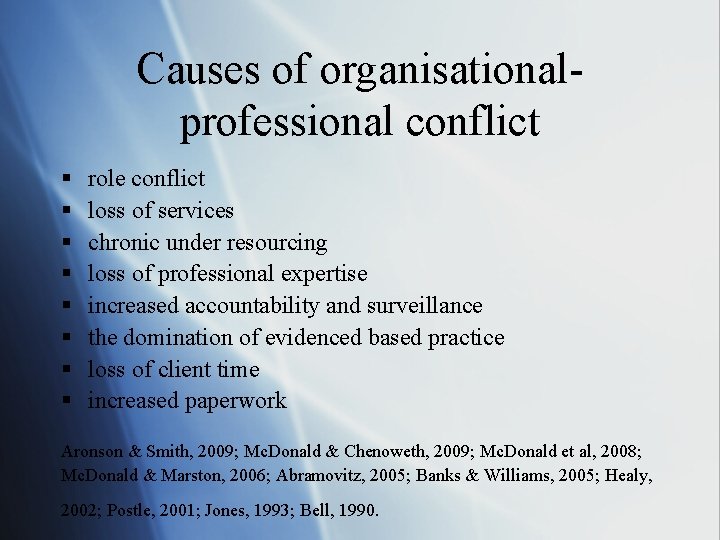
Causes of organisationalprofessional conflict § § § § role conflict loss of services chronic under resourcing loss of professional expertise increased accountability and surveillance the domination of evidenced based practice loss of client time increased paperwork Aronson & Smith, 2009; Mc. Donald & Chenoweth, 2009; Mc. Donald et al, 2008; Mc. Donald & Marston, 2006; Abramovitz, 2005; Banks & Williams, 2005; Healy, 2002; Postle, 2001; Jones, 1993; Bell, 1990.
Ethical Dilemmas on the rise § Findings from several studies attested to the rise in ethical dilemmas, as social workers attempt to implement their professional values in environments that are incongruent with these values and increasingly hostile Aronson & Smith, 2009; Mc. Donald & Chenoweth, 2009; Mc. Donald et al, 2008; Mc. Donald & Marston, 2006; Abramovitz, 2005; Banks & Williams, 2005; Healy, 2002; Postle, 2001; Jones, 1993; Bell, 1990.
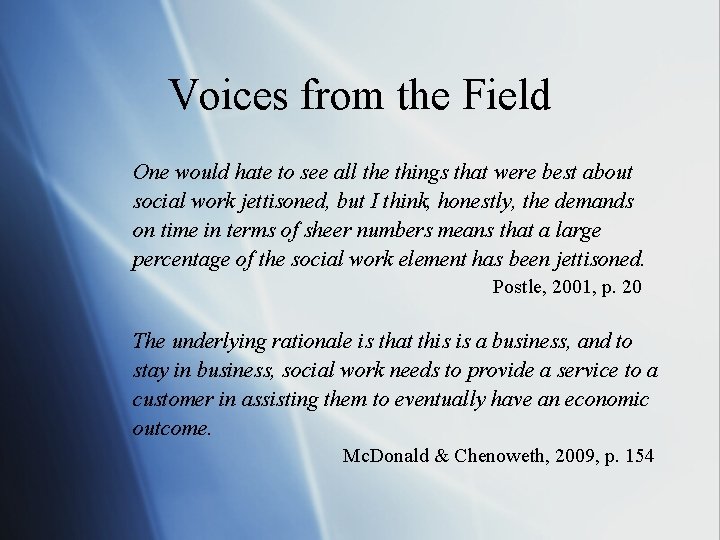
Voices from the Field One would hate to see all the things that were best about social work jettisoned, but I think, honestly, the demands on time in terms of sheer numbers means that a large percentage of the social work element has been jettisoned. Postle, 2001, p. 20 The underlying rationale is that this is a business, and to stay in business, social work needs to provide a service to a customer in assisting them to eventually have an economic outcome. Mc. Donald & Chenoweth, 2009, p. 154
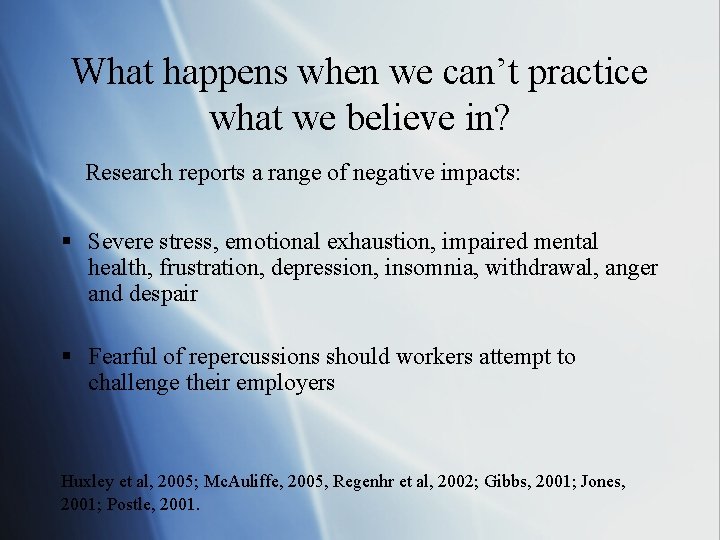
What happens when we can’t practice what we believe in? Research reports a range of negative impacts: § Severe stress, emotional exhaustion, impaired mental health, frustration, depression, insomnia, withdrawal, anger and despair § Fearful of repercussions should workers attempt to challenge their employers Huxley et al, 2005; Mc. Auliffe, 2005, Regenhr et al, 2002; Gibbs, 2001; Jones, 2001; Postle, 2001.
Voices from the Field Social work agencies need to remember just how stressful social work can be and, when an employee shows clear signs of stress, the question should not be: 'What is the weakness in this employee? ', but what is the weakness in this organization that allows this to happen? Thompson et al, 1996, p. 663
What do we do? Research reports a range of responses to organisational professional conflict: § § Staying and ‘coping’ Breaking down and leaving Whistle blowing A new field of research identifies a different approach RESISTANCE Aronson & Smith, 2009; Mc. Donald & Chenoweth, 2009; Abramovitz, 2005; Huxley et al, 2005; Mc. Auliffe, 2005; Pockett, 2002; Baines, 2001; Gibbs, 2001; Jones, 2001; Postle, 2001; Drake & Yadama, 1996
Covert Activism § A small number of studies identify covert activist strategies employed by social workers to resist organisational policy and procedure which is incongruent with our professional ethics § These strategies are covert due to the fear of reprisal and the belief that overt Activism will not work Aronson & Smith, 2009; Mc. Donald & Chenoweth, 2009; Abramovitz, 2005; Huxley et al, 2005; Mc. Auliffe, 2005; Pockett, 2002; Baines, 2001; Gibbs, 2001; Jones, 2001; Postle, 2001; Drake & Yadama, 1996
Borrowing from sociology: Workplace resistance • Major field of study in sociology • Minor field of study in nursing and human resource management • Birth of ‘covert’, ‘everyday’ and ‘informal’ resistance in the 1980’s/90’s • Minimal use of the concept in social work research Hollander & Einwohner, 2004; Peter, 2004; Fleming & Sewell, 2002; Prasad & Prasad, 2000.
Covert workplace resistance in social work practice Micro activities to advance the needs of the client: § acting in opposition to organisational directives § looking the other way when client's did not comply with directives § ‘creatively’ filling out forms and over stating a client problem to promote their access to services § being 'flexible' with rules and laws § case by case 'rule bending' § No studies explore the experience of utilising covert workplace resistance for social workers Aronson & Smith, 2009; Mc. Donald & Chenoweth, 2009; Abramovitz, 2005; Baines, 2001
Voices from the Field I’ve decided to stick with the job for a while to see how it all pans out. I’ve no intention of keeping my mouth shut! Mc. Donald & Chenoweth, 2009, p. 157 We become very creative in our efforts to gain services. We don’t lie, we just creatively manage to try to get our folks what they need. Abramovitz, 2005, p. 182 We may be doing some things that violate the rules or the law. It happens. Believe me it happens. We put ourselves on the line. Whatever it takes. Abramovitz, 2005, p. 182
The time is ripe § Resurgence of interest in Radical practice § Our professional values are radical and revolutionary in contemporary welfare ideologies § ‘macro’ radical activist strategies may be less appropriate/successful in contemporary settings Is covert workplace resistance a form of contemporary Radical practice?
The Research study Theoretical Perspectives: • Critical Theory Methodology: • Qualitative, feminist research • Critical Reflective practice Methods: • Semi-structured narrative interviews (Email Facilitated Reflective Dialogue) • Manual theme analysis and interpretation • Critical analysis and recommendations
Participant criteria and Recruitment § Qualified social workers with eligibility for AASW membership § Current or recent past (2 years) employees of a statutory welfare organisation § State Child Protection Services § State Corrections Services § State Mental Health Services § State Hospital Services § Federal Income Service (Centrelink) § Recruited through advertisements in key social work publications, informal networks and online social networking sites
The research questions § How do social work practitioners utilising covert resistant strategies within statutory welfare organisations define their professional identity? § How do social work practitioners utilise covert resistant strategies within statutory welfare organisations to challenge organisationalprofessional conflict? § What is the experience of utilising covert resistant strategies within statutory welfare organisations for social work practitioners?
Research outcomes § Insight into the behaviours and experiences of social workers working in contemporary statutory organisations § Insight into potential incongruence between professional and organisational demands § Identify potential strategies for reducing incongruence between professional and organisational demands § Inform discussion on the relevance of activist practice methods in challenging contemporary welfare practice and the role of Social Workers as agents of change
A final thought …. “Tactics mean doing what you can with what you have” Saul Alinsky
Interested in participating? l. greenslade@griffith. edu. au
Deborah Sauvage Griffith University GRAPPLING WITH ETHICS & EVIDENCE WITHIN A SEMI-REGULATED INDUSTRY Reported and un-reported complaints about problematic or unethical practice
Research Symposium: Social Work Ph. D Research Grappling with ethics and evidence within a semi-regulated industry: Reported and un-reported complaints about problematic or unethical practice Deborah Sauvage Griffith University School of Human Services and Social Work Friday 6 th November 2009
Trust and integrity in helping professions • “There is a long-standing tradition dating back as least as far as the Hippocratic Oath, that the integrity and trustworthiness of the practitioner is assured by the profession and can be assumed by the consumer/client” (Gabriel, 2005, p. 73)
The problem • There is historical evidence of reported cases of impaired practice and harm • an unknown rate of unreported harm • Psychological services are often provided in power-laden, unwitnessed interactions • Creates significant difficulty in establishing factual evidence • A compassionate, humane system of regulation is needed for such a complex industry
A taboo topic • Taboo topics such as “professional misconduct”, “incompetence”, “unethical practice”, and “sexual exploitation” can provoke many strong reactions • These can include shock, anger, denial, numbness, minimisation, dissociation, blame, stereotyping, vigilante responses, anxiety, confusion, distress, sadness, despair, and many others…
Cases of Harm • 100+ years of discourse about harm and complaints e. g • - 1906 Sabina Speilrein’s diary (client) • - 1999 “John Brown” (practitioner) • 2009 Tribunal Transcripts UK Social Workers • Acute impacts on health of clients and practitioners, including suicides. (evidenced by published cases and research eg. Nachmani & Somer, 2007, Gabriel, 2005, Disch & Avery, 2001, Pope & Vasquez, 1998, Pope and Vetter 1991, Luepker, 1989, Schoener et al, 1989; Quadrio, 1994, Dawson, 1994 ; Boeckenhauer et al 1998 ; Middleton, 2004, Callinan et al, 2000, 2001; Celenza 2008, Celenza & Gabbard, 2007, Brown, 1999, Hedges, 1999 )
Solutions? • Is licencing and regulation part of the solution? • If so, what model of regulation should we use in Australia? • We need to ask those who have been involved
The research problem • Natural justice, or “the right to be given a fair hearing and the opportunity to present one’s case…and a decision by an unbiased decision maker” (AASW 1999, p 28) is not assured for all in a semi-regulated industry.
The research problem (con’t) • Only those using the occupation title ‘psychologist’, or ‘psychiatric nurse’ are required to be registered, and subject to formal complaint avenues. • Occupation titles of ‘counsellor’, ‘psychotherapist’, ‘social worker’, ‘case worker’ and ‘welfare worker’ etc are not subject to statutory licensing or registration.
The research problem (con’t) • Practitioners can get an ABN to register as a business in private practice, even without having to provide proof of qualification or ‘blue card’. (Australian Government, 2009). • Even if complaints about fair trading by those in private business are made, these are only actionable within the jurisdiction of legislation governing registered health professionals. • (see www. fairtrading. qld. gov. au)
What does overseas research tell us? • In the US, half of respondents to a national survey of psychologists in 1991 reported they had assessed or treated at least one patient who reported sexual involvement with a previous therapist (Pope Sonne & Holroyd, 1993). • In the US, half of the respondents to a survey about social workers in private practice in 2004 reported treating clients who had sexual involvement with a previous therapist (Hutchinson-Mittendorf & Schroeder, 2004).
What does overseas research tell us? (con’t) • When sexual involvement occurs within a therapeutic relationship it results in reported harm in 80 -95% of cases (Pope Sonne & Holroyd, 1993). • Harm so serious that it resulted in suicides, multiple attempted suicides, hospitalizations, and 80% did not recover from the effects of the sexual involvement despite subsequent treatment (Pope & Vetter, 1991). • Despite the seriousness of harm, complaints were only lodged in 12 -15% of cases (Pope & Vetter, 1991, Hutchinson-Mittendorf & Schroeder, 2004). • An analysis of 894 complaints to the NASW in the US found that over a third of complaints made to the NASW were not accepted for adjudication, some of these due to what appeared to the author to be prejudging of cases without hearing (Strom-Gottfried, 2003).
What does Australian research tell us? Paucity of research indicates there is much that we do not know about: - • the number of unregulated providers, their training and their activities • the prevalence of harm or problematic outcomes • The level of knowledge of ethical practice standards and commitment to ethical codes • The rate of complaint within small and large government and non-government organisations and regarding those in private practice • The manner of response to complaints • Feedback from consumers about services and manner of response to complaints
What does Australian research tell us? (con’t) • Workforce mapping research with a 9% return rate (577 replies) out of a population of 6000 counsellors and psychotherapists who held voluntary membership of professional associations, indicated that a quarter of these counsellors reported that they do not follow an ethical code, and only 40 % of these counsellors were university trained (Schofield 2008 b, Pelling, 2005). • 3% of surveyed advertised counselling Psychologists reported that although they are members of the Australian Psychological Society, they do not follow an ethical code (Pelling, 2007, p. 213). • Quadrio (1994, p. 189) published case studies about sexual abuse by therapists, and reported serious concerns about “closed ranks, collusions, and conspiracies of silence” in complaint procedures.
How will this research project add to the literature? • “One important group which was not formally consulted about the models of self-regulation was the consumer group” (Schofield 2008, p. 96). • There is a current agenda regarding regulation (Council of Australian Governments, 2006, 2009, Schofield, 2008, Cumming, 2008). • For the first time in Australia, a research project can contribute recommendations about regulation and complaint management systems based on input by those involved in decision-making and those whose lives have been affected.
Who should be asked for further data to address gaps in previous research? 1. Complainants 2. Respondents 3. Third parties - includes subsequent therapists whose client told them of a past problematic experience with a counsellor, as well as members of relevant organizations eg. ethics officers, ethics panel members, investigators, policy makers, legislators.
What should be asked? - Research questions 1. How do complainants, respondents and third parties describe, reflect on and understand their past experience of a decision making process regarding complaints? 2. What do the perspectives and experiences of complainants, respondents and third parties indicate about dynamics of structural and relational power associated with complaints? 3. What specific changes need to be made by the industry to effectively address the needs of various parties involved in complaints?
Conduct of the study • No known finite population, purposive, snowball methods will be used to recruit up to 30 (7 -10 from each of the three groups) • In-depth semi-structured qualitative interviews • face-to-face and email facilitated reflective dialogue (Mc. Auliffe, 2003, Mc. Coyd, 2006) • personal narratives and reflections in hindsight about the experience of decision making processes
Limitations • Small sample – results not generalisable • Data saturation unlikely with three sub- groups • Self-report of retrospective reflections are highly subjective and subject to inaccuracy
Ethical protocols • No identifying information required from participants apart from name (required for the consent form) • The identity of others involved in complaints is not to be stated by participants • No identifying information in transcripts or findings • No details about potentially identifiable incidents, professions, organisation, location, or timeframes • Broad Australia-wide sample population
Preliminary findings - #1 an unreported complaint • About an unregulated professional – counselling role • Described by complainant as “creepy”; “having very close intense relationships with young men (clients)”; “giving moral advice”; “patronising”; “would divulge things to me about clients that just weren’t appropriate”; told client “god would solve her problems”; “grooming behaviours”; ”strong gut instinct” ; “interrogating them in front of others…asserting power of what he knew about them every time instead of just saying hi”; ”coming out of session with arm around clients back”; “moral guardian”, judging female clients’ sexual behaviour and giving inappropriate relationship advice; failing to intervene in serious situations appropriately; “extremely high opinion of himself”.
Preliminary Findings - #1 an unreported complaint • “I had no idea whethere was any sort of ethical review or whether his performance management crossed over lines of ethics or behaviour or procedures. I had no idea whether the (organisation) really gave a damn. Like really, because they clearly didn’t give a damn about certain other things at the time. There whole piles of other issues going on” • “privacy” of unwitnessed, unsupervised sessions a barrier to these matters being dealt with. • Need an external body, to oversee patterns in “hearsay” complaints in absence of client report
Preliminary findings - #1 an unreported complaint • No formal complaint reported but verbal “blacklisting” of the practitioner due to many informal reports from clients. • another worker made complaint; practitioner made a countercomplaint, observed by others as a threat to all. • “I don’t know what procedural method she would have had to deal with him because he was one of those people who would almost have you in court the next day if you said something negatively about him. ” • “the way I felt about it, (was) conflicted most of the time, not able to really seriously voice my true opinion ever, genuinely, and the problem was that I had not much evidence, really, apart from my feelings, and some reports, about this person”. • could not directly ask clients to complain, fear of implications
Preliminary findings - #2 a reported complaint • About an unregulated professional – casework role • Described by complainant as about “almost criminally negligent practice”, “systemic abuse” of clients, associated with “character failings”, as well as imposition of damaging beliefs of practitioner • Complaint made complainant in exit interview • Was validated and acted on promptly • Practitioner removed from that role, given other duties • Complainant had safe person to talk through the issues with away from work
Preliminary findings - #2 a reported complaint • Stressed need for “validation of concerns” without “vigilante” response against respondent • Need for clear knowledge of practice standards and how to supervise these • “acres of red tape”, “naming and shaming” not needed in complaint management; Need a “relational response” in order to maximise “conditions for growth” • Proposed a “pink card” licencing system to be required for all “helping and caring roles” in Australia, similar to blue card, so background checks can occur
Questions and comments Interested in the project? Deborah Sauvage d. sauvage@griffith. edu. au (07) 33821201
Dr Judith Anne Merari -Lyons Queensland Health AN EXPLORATION OF HYPNOSIS IN THE AUSTRALIAN CONTEXT
AN EXPLORATION OF HYPNOSIS IN THE AUSTRALIAN CONTEXT JUDITH ANNE MERARI-LYONS (Ph. D) The thesis comments on hypnosis within the Australian Context • Definition • Research question • Hypothesis • Research objectives • Target population • Methodology • Definitions • Findings • Relevance to Social Work
Definition of Hypnosis 1: Hypnosis is a natural, altered state of consciousness. The state of hypnosis is distinctly different from a person’s normal state of consciousness. 2: Each person is unique and therefore their response to the hypnotic Trance State will also be unique (Erickson, 1985 & Yappko, 1995)
Research Question In a therapeutic context Is Hypnosis well utlized as an intervention tool in Australia?
Hypothesis Hypnosis is well utilized Or Hypnosis is not well utlized
Research Objectives 1: To explore if religion and myth influence the use of hypnosis in Australia 2: To explore what theoretical frameworks guide practice in Australia 3: To understand how hypnosis is utlized in Australia 4: To explore and define any barriers to the use of hypnosis in Australia 5: To understand what the real or perceived differences are between lay and professional practitioners
Target Population 1: Lay population 2: Legal professionals and police 3: Medical professionals, allied health professionals (i. e. , psychologists, social workers, occupational therapists) working in drug and alcohol, mental health, nursing professionals working in the above fields as well in general care, private hypnotherapists and psychotherapists.
Defining Hypnosis/Myths and Facts To tease out the myths and facts a questionnaire containing 7 key questions was devised after an extensive analysis of the literature. They are: 1: What myths and legends, if any, are you aware of about hypnosis practice in Australia? 2: In your opinion does religion influence who uses hypnosis in Australia? 3: From your experience what are the prevailing theories influencing hypnosis practice in Australia? 4: In your view what are the main uses of hypnosis? 5: Do you consider hypnosis to be under-utilized in the Australian clinical practice arena? If yes please explain why in your view? 6: What are the barriers, if any, to utlizing hypnosis as a best practice in the Australian context.
Social context of the Study The history of hypnosis Regulation of the industry including counsellors & psychotherapists The Introduction of Medicare rebates for people accessing a mental health plan via their GP to see registered professionals working privately within allied health ie Social Workers and Psychologists/ Occupational Therapists.
Methodology Literature review Impressions & Informal discussions Review of the Australian and State Regulation Research Design & Data Collection: Ethics and interviews Problems encountered Open ended Questionnaires Definition of hypnosis
Findings Overall: The lay population was consistently influenced by religion. The lay population were not interested, or concerned if they have any factual knowledge about hypnosis – blind faith factor. The legal profession and the police ( the most responsive group of participants) highlighted a healthy skepticism , pragmatic approach due to fear of contamination of evidence – but they were the participants most likely to support and engage a hypnotherapist for clients. The theories in general about hypnosis were not well known by any participants All participants had a sound knowledge of what hypnosis can be used for The legal profession were the strongest voice in supporting registered practitioners with tertiary qualifications to work with clients. Where as the lay population did not mind either way. The health professionals across the country showed the most interest in participating but were frequently stopped by management from participating. Practicing psychotherapist & Hypnotehrapists did not participate Erickson is the most well known theorist
Findings The overall findings indicate that the health practitioners who did participate focused on the uses of hypnosis for stop smoking; weight; stress reduction; mental health issues such as phobias and anxiety. All participants thought hypnosis is under utlized in Australia The barriers were noted as lack of empirical evidence/ evidenced based studies, the dominance of the medical model, rules of evidence, qualifications and training All participants had tried or were fascinated by hypnosis at some point in their life. Those who had tried it found it successful and those who were fascinated were planning to attend a session in the future.
Relevance for Social Work Why not? Working with trauma/ prisoners Relaxation techniques- stress reduction techniques which derive from hypnosis Private Practice- Clinical Social Work Brief interventions Further research – i. e. evidence based Hypnosis is one tool in the tool kit of many and requires a sound psychosocial and bio psychosocial assessment Caution - use as a tool in mental health patients if a psychiatrist agrees and is supportive and a thorough assessment has been done, and the practitioner has training in the use of hypnosis