
Applicant Faking Behavior Dr Richard Griffith Director IO
Applicant Faking Behavior Dr. Richard Griffith, Director I/O Psychology Florida Tech Industrial Organizational Psychology 150 W. University Blvd. Melbourne, FL. 32901 (321) 674 -8104
Personality Tests 1. I like using my imagination. 2. It is best to work step-by-step until the task is complete. 3. I enjoy working in teams. 4. Paying attention to minute details of work is important. 5. Working with data and figures is exciting. 6. A loose work structure without deadlines irritates me. 7. I never have read a dirty book or magazines 1 2 3 4 5 1 2 3 4 5
Personality Traits • Personality traits are defined as “pervasive consistencies in thoughts, feelings, and behaviors, ” (Costa and Mc. Crae, 1992). • Development of personality traits began with the “lexical hypothesis. ” • Galton used the dictionary to estimate the number of descriptive terms that could be used to describe individual differences • 18, 000 adjectives
Big Five • Wide acceptance of the five-factor model, or the “Big Five” (Costa, 1996). • Model assumes that five broad factors account for most of the common variance in virtually all personality traits. • Some debate about the number of factors still exists • Conscientiousness has overall received the greatest attention from personnel researchers.
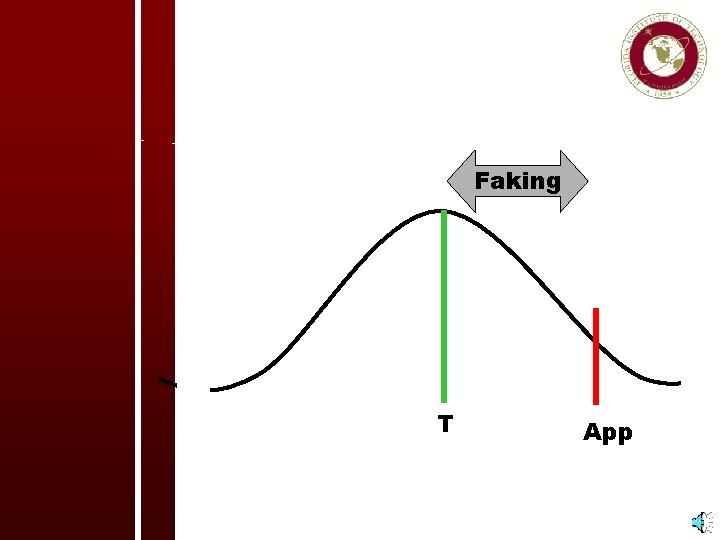
Faking T App
• Many factors may contribute to the elevation of applicant scores – – – Situational variance Cognitive biases Ability Integrity Motivation Faking related constructs
• • • Doesn’t make sense to lump “fakers” into a stereotyped category Faking behavior is dynamic May demonstrate considerable individual differences – – – Amount individuals “fake” Why their applicant scores are elevated Subsequent performance!!!
The Study Method • Within Subjects design • Over 1000 participants • Students apply for consulting “position” – Deception was used to simulate an applicant environment • Complete NEO-FFI & WPT • Students then asked to respond honestly to measures – – – NEO-FFI Integrity Locus of Control BIDR SCS – past, present, future FOR
The Study • This study utilized deception • Deception can be used in psychology experiments if it does not harm the subject, and data can not be collected another way. • Getting honest baseline results with real applicants may not be possible because they will still be cautious out of fear that their employer may see the results • Study reviewed by IRB
Results • People do in fact fake (roughly 30 %) • Difference found between Honest (baseline) and Applicant scores • How large are these differences?
Cognitive Biases • Significant difference was found between the future, present, and past scores • (F = 16. 431; p<. 001) Measure Min Max Mean SD Past SCS 4. 00 6. 00 5. 34 . 65 Present SCS 4. 00 7. 00 5. 59 . 67 Future SCS 4. 00 7. 00 5. 88 . 58 * Total score differences 106 < 112 < 117
Integrity • Hypotheses were supported • Correlations ranged from. 20 (N) to -. 31 (C) • At least some of the variance in faking behavior is related to an individuals integrity • Liars are liars • Makes the effects of applicant faking even more problematic if employees engage in counter productive behaviors
Locus of Control • Hypotheses supported • Applicants with an external locus of control have higher amounts of applicant faking • Correlations ranged from -. 27 (N) to. 29 (C) • LOC related to academic dishonesty. – (Coleman and Mahaffey, 2000; Leming, 1980)
Ability, SDE, & IM • In the both conditions cognitive ability was not significantly correlated with the amount of applicant faking • Neither SDE or IM was positively correlated with faking
New Studies • Examining the influence of relative external need on the prediction of faking • Faking & Gender • Is faking just cheating? Academic Dishonesty
New Studies • Situational determinants of faking • Job conditions • Selection ratio • Type of job – Can assess whether job knowledge helps faking
Thank you! • I would like to thank you for participating in our research study • Your participation has helped graduate students to complete their theses and dissertations • The knowledge we have gained here will allow us to improve personality measures and help organizations make better decisions when hiring employees
- Slides: 17