
Colon Cancer Screening in Barbados P Sahle Griffith
Colon Cancer Screening in Barbados P. Sahle Griffith MBBS, MRCS, DM, FCCS Medical Director, Surgical Solutions Inc. , Barbados Minimally Invasive Surgery Consultant, QEH, Barbados Associate Lecturer, UWI (Cave Hill)
Disclosures None
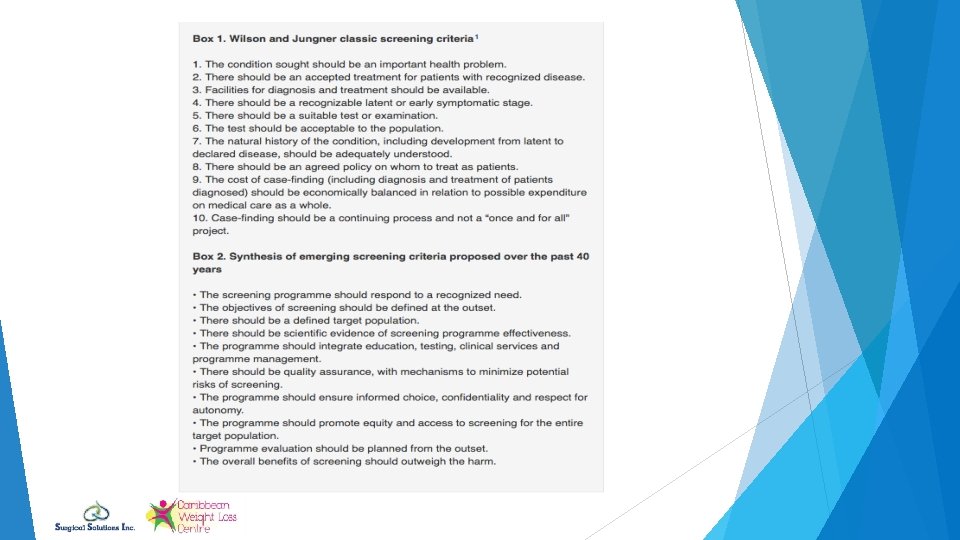
What is Screening? A strategy used in a population to identify the possible presence of an as-yet-undiagnosed disease in individuals without signs or symptoms.
We are no longer screening when…. . There is bleeding In a study designed to determine whether a complaint of visible rectal bleeding that is elicited by a screening review of systems merits investigation and to assess the accuracy of a defined protocol to evaluate bleeding. 297 patients identified, 201 scoped 19. 5% of these patients had either polyps or Colorectal Ca Helfand M, Marton KI, Zimmer-Gembeck MJ. History of visible rectal bleeding in a primary care population. Initial assessment and 10 -year follow-up. JAMA. 1997 Jan 1; 277(1): 44 -8.
A study of 145 patients ages 40 and older who had rectal bleeding of less than six months duration found that 11 of the 63 patients who the primary care provider had predicted an anal source of pathology had a colonic or rectal source Conclusion All patients aged over 40 who present with recent rectal bleeding should be referred for full colonic investigation. Goulston KJ, Cook I, Dent OF. How important is rectal bleeding in the diagnosis of bowel cancer and polyps? Lancet. 1986 Aug 2; 2(8501): 261 -5.
We are no longer screening when…. . There is chronic abdominal pain All patients >50 years old with abdominal pain should have a GI tract endoscopy. BMJ Best Practice Guidelines. Last updated Feb 06, 2017
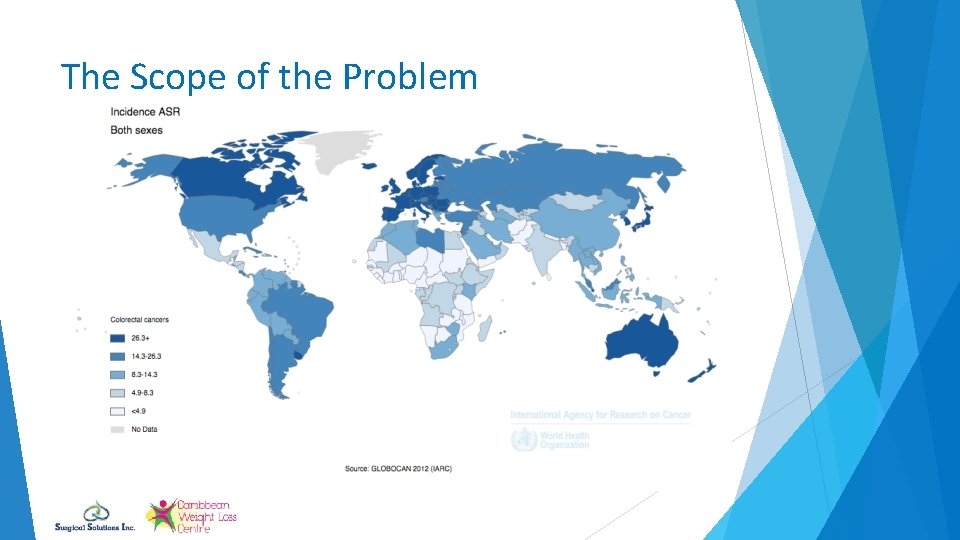
The Scope of the Problem
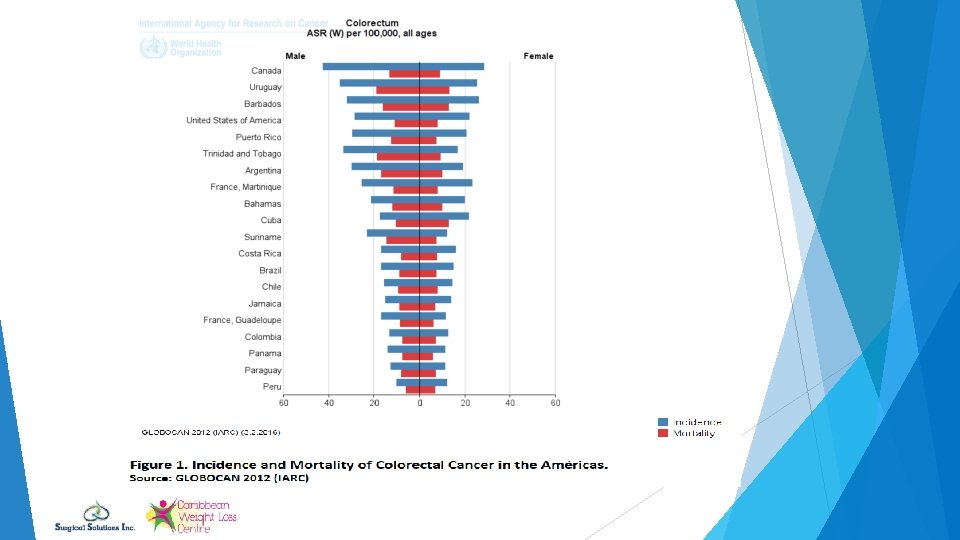
The Scope of the Problem Colorectal cancer is the third leading cause of cancer incidence and mortality in the Americas in both men and women. The highest colorectal cancer incidence rates are observed in Canada (35. 15), Uruguay (29. 48) and Barbados (28. 39) Barbados (14. 11) and Uruguay (15. 65) are the countries with the highest mortality rates Cancer in Barbados 2008: Annual Report of the BNR-Cancer ASR Incidence Colon (30. 8), ASR Incidence Rectum (8. 9) ASMR Colorectal (16. 0) Fact-sheet: Colorectal Cancer in the Americas, 2014 GLOBOCAN 2012 (IARC) Cancer in Barbados 2008: Annual Report of the BNR-Cancer
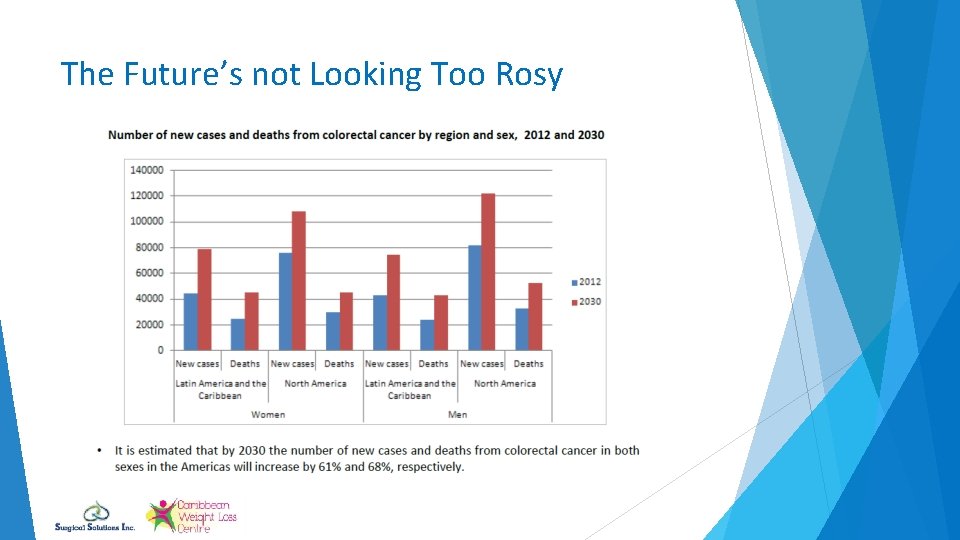
The Future’s not Looking Too Rosy
Screening to the rescue? ? Colorectal cancer screening can reduce mortality, by an estimated 2068% Hewitson P GP, Irwig L, Towler B, Watson E. Screening for colorectal cancer using the faecal occult blood test, Hemoccult (Review). The Cochrane Library (1), 2007. Holme Ø BM, Fretheim A, Odgaard-Jensen J, Hoff G. Flexible sigmoidoscopy versus faecal occult blood testing for colorectal cancer screening in asymptomatic individuals (Review). The Cochrane Library (9), 2013.
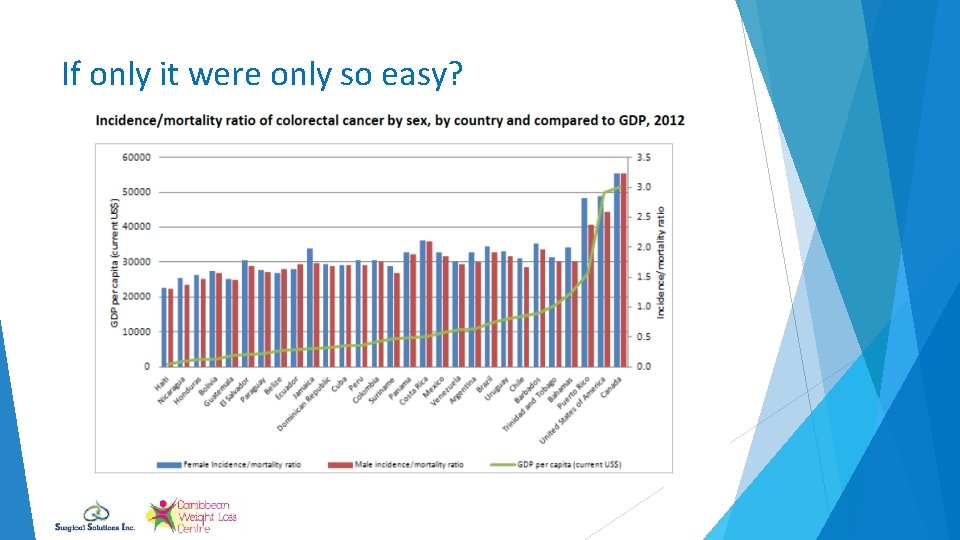
If only it were only so easy?
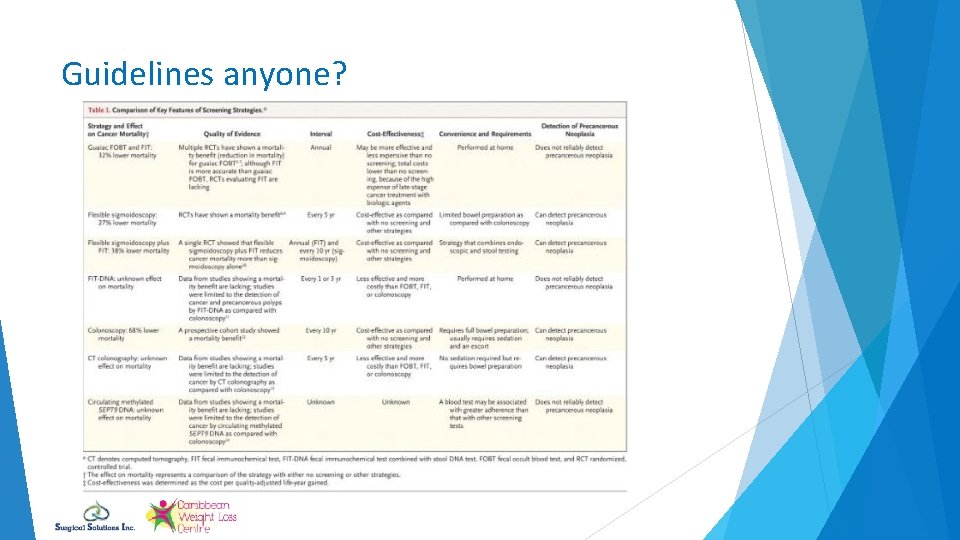
Guidelines anyone?
Typical Guidelines Begin colon cancer screening at age 50 for average risk individuals (ACG recommends beginning at age 45 in African Americans) Suspending screening at age 75 Intervals dependent on screening modality used Agrawal S, Bhupinderjit A, Bhutani MS et al. Colorectal cancer in African Americans. Am J Gastroenterol 2005; 100: 515– 523; discussion 514. Final Update Summary: Colorectal Cancer: Screening. U. S. Preventive Services Task Force. July 2015. https: //www. uspreventiveservicestaskforce. org/Page/Document/Update. Summary. Final/colorectal-cancer-screening American Cancer Society Recommendations for Colorectal Cancer Early Detection. Revised March 1, 2017
Are there regional guidelines? Twelve countries in PAHO report having national guidelines In the non-Latin Caribbean countries, organized CRC screening is uncommon Barbados reports having opportunistic screening with no idea of screening coverage Colorectal Cancer Screening in the Americas: Situation and Challenges
Many Rivers to cross Limited locations for CRC screening Out of pocket expenses for tests Lack of Public awareness Aversion to screening modalities Need to demonstrate cost effectiveness
Counting the costs (High resource setting) Screening for colorectal cancer appears cost-effective compared with no screening, but a single optimal strategy cannot be determined from the currently available data. All studies found that colorectal cancer screening was costeffective or even cost-saving compared with no screening. There was agreement among studies that the newly developed screening tests of stool DNA testing, computed tomographic colonography, and capsule endoscopy were not yet cost-effective compared with the established screening options. Lansdorp-Vogelaar I 1, Knudsen AB, Brenner H. Cost-effectiveness of colorectal cancer screening. Epidemiol Rev. 2011; 33: 88 -100. doi: 10. 1093/epirev/mxr 004. Epub 2011 Jun 1. Pignone M 1, Saha S, Hoerger T. Cost-effectiveness analyses of colorectal cancer screening: a systematic review for the U. S. Preventive Services Task Force. Ann Intern Med; 137(2): 96 -104, 2002.
Counting the cost (LMIC’s) In colorectal cancer, increasing treatment coverage is highly cost effective (screening through colonoscopy is cost effective in the African sub-region) Colombian study compared six different screening strategies and concluded that only one of them (FOBT every 2 years) was cost-effective for the country In Argentina a fecal occult blood test, every year, was considered the most cost effective strategy. Ginsberg GM, Lauer JA, Zelle S, Baeten S, Baltussen R. Cost effectiveness of strategies to combat breast, cervical, and colorectal cancer in sub-Saharan Africa and South East Asia: mathematical modelling study. BMJ; 344: e 614, 2012. Pinzon Florez CE, Roselli D, Gamboa Garay OA. Análisis de Costo-Efectividad de las Estrategias de Tamización de Cáncer Colorrectal en Colombia. Value in Health Regional Issues; 190 -200, 2012.
WHO/PAHO Consensus for LAC CRC screening programs need to become a higher public health priority and investments in developing quality programs are urgently needed.
Possible Recommendations Patient education/awareness campaign Physician education Accept colonoscopy is the gold standard but as a screening tool cannot be nationally applied Yearly FOBT (Note there has been no mention of DCBE) ages 50 -75 Capacity build out to facilitate increased colonoscopies Interval Review of program re: cost effectiveness and possible benefits of emerging technologies

Thank You
- Slides: 23