
Lyndal Greenslade Griffith University SOCIAL WORK ACTIVISM Resistance

- Slides: 27
Lyndal Greenslade Griffith University SOCIAL WORK ACTIVISM: Resistance from the frontier
Social Work Activism Resistance from the Frontier Lyndal Greenslade Ph. D Candidate School of Human Services and Social Work Griffith University
Why this topic? Professional Reflections § Social workers are committed to social justice activism § Social workers are experiencing difficulties practicing social justice Activism within contemporary welfare organisations § Social workers report feelings of distress when they are unable to pursue social justice Activism for their clients
Activism in social work: A proud history “Action indeed is the sole medium of expression for ethics” - Jane Addams
Activism in social work ethical documents § Activism is enshrined in the Codes of Ethics of member countries of the IFSW § The Codes of Ethics use proactive language: “Act to change” “promote” “challenging injustice” “engaging in action”
Social Work - A unique perspective § In comparison with the Codes of Ethics of five professions in the Allied Health field in Australia, social work is unique in its focus on the active pursuit of social justice § Further, many Codes of Ethics and Practice Standards state that they take precedence over employers’ policies and procedures
Why research social work Activism? § Limited amount of research exploring Activism § What does exist conceptualises Activism as a form of macro practice (eg: engaging in critical discussions, advocating for client groups, collaborating with others and joining existing issue groups) § Call for more research into Activism to explore possible incongruence between professional and organisational demands Chui & Gray, 2004; Andrews & Reisch, 2002; Gray et al, 2002; Abramovitz, 1998; Dietz Domanski, 1998; Pritchard, 1998; De Maria, 1993; Healy, 1993; Wagner, 1989; Reeser &Epstein, 1987; Hearn, 1982; Evans, 1975.
Activism in practice: why is it so hard? Incongruence between social work professional values and contemporary welfare ideologies, which have seen: § a dominance of technical practice models and an accompanying loss of structural, activist approaches § a concealing of activist activities, for fear of reprisal should more open forms of radical practice be attempted Andrew & Reisch, 2002; Wagner, 1989
Organisational-Professional Conflict § Research informs that conflict between the social work professional Code of Ethics and Organisational policy and procedure is wide spread § Research reports that such conflict is more prevalent in statutory workplace settings Aronson & Smith, 2009; Mc. Donald & Chenoweth, 2009; Collins, 2008; Ferguson & Lavalette, 2006; Mc. Auliffe, 2005; Jordan, 2004; Lonne et al, 2004; Hough, 2003; Jones, 2001; Postle, 2001; Fook et al, 2000; Bell, 1999; Balloch et al, 1998; Banks, 1998; Dominelli & Hoogvelt, 1996 Reeser, 1996; Jones & Novak, 1993.
Voices from the Field I think that I did at one time actually believe that I could change the world. Now I do the best in my sphere of influence and hope that how I treat others will make a difference in how they treat others. Andrews & Reisch, 2002, p. 21 For the people from 1999 on, it's the only system they know. So we talk in the field about the new generation of social workers - like '99 to now - being real compliance technicians not social workers, right? Aronson and Smith's, 2009, p. 6
Causes of organisationalprofessional conflict § § § § role conflict loss of services chronic under resourcing loss of professional expertise increased accountability and surveillance the domination of evidenced based practice loss of client time increased paperwork Aronson & Smith, 2009; Mc. Donald & Chenoweth, 2009; Mc. Donald et al, 2008; Mc. Donald & Marston, 2006; Abramovitz, 2005; Banks & Williams, 2005; Healy, 2002; Postle, 2001; Jones, 1993; Bell, 1990.
Ethical Dilemmas on the rise § Findings from several studies attested to the rise in ethical dilemmas, as social workers attempt to implement their professional values in environments that are incongruent with these values and increasingly hostile Aronson & Smith, 2009; Mc. Donald & Chenoweth, 2009; Mc. Donald et al, 2008; Mc. Donald & Marston, 2006; Abramovitz, 2005; Banks & Williams, 2005; Healy, 2002; Postle, 2001; Jones, 1993; Bell, 1990.
Voices from the Field One would hate to see all the things that were best about social work jettisoned, but I think, honestly, the demands on time in terms of sheer numbers means that a large percentage of the social work element has been jettisoned. Postle, 2001, p. 20 The underlying rationale is that this is a business, and to stay in business, social work needs to provide a service to a customer in assisting them to eventually have an economic outcome. Mc. Donald & Chenoweth, 2009, p. 154
What happens when we can’t practice what we believe in? Research reports a range of negative impacts: § Severe stress, emotional exhaustion, impaired mental health, frustration, depression, insomnia, withdrawal, anger and despair § Fearful of repercussions should workers attempt to challenge their employers Huxley et al, 2005; Mc. Auliffe, 2005, Regenhr et al, 2002; Gibbs, 2001; Jones, 2001; Postle, 2001.
Voices from the Field Social work agencies need to remember just how stressful social work can be and, when an employee shows clear signs of stress, the question should not be: 'What is the weakness in this employee? ', but what is the weakness in this organization that allows this to happen? Thompson et al, 1996, p. 663
What do we do? Research reports a range of responses to organisational professional conflict: § § Staying and ‘coping’ Breaking down and leaving Whistle blowing A new field of research identifies a different approach RESISTANCE Aronson & Smith, 2009; Mc. Donald & Chenoweth, 2009; Abramovitz, 2005; Huxley et al, 2005; Mc. Auliffe, 2005; Pockett, 2002; Baines, 2001; Gibbs, 2001; Jones, 2001; Postle, 2001; Drake & Yadama, 1996
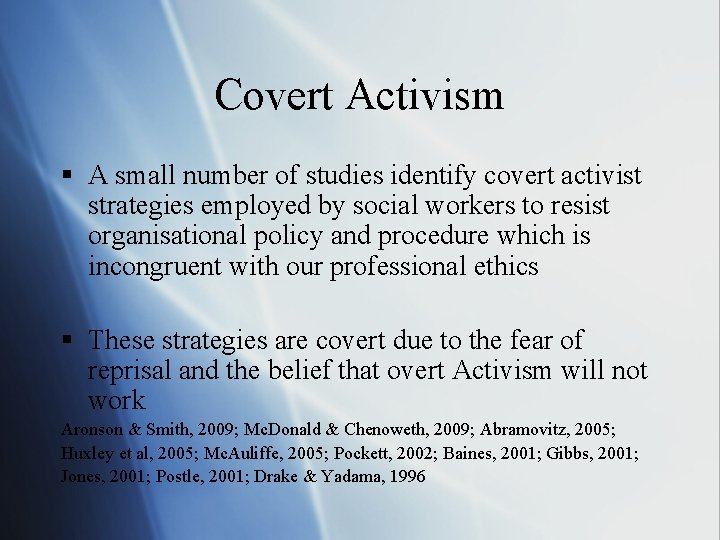
Covert Activism § A small number of studies identify covert activist strategies employed by social workers to resist organisational policy and procedure which is incongruent with our professional ethics § These strategies are covert due to the fear of reprisal and the belief that overt Activism will not work Aronson & Smith, 2009; Mc. Donald & Chenoweth, 2009; Abramovitz, 2005; Huxley et al, 2005; Mc. Auliffe, 2005; Pockett, 2002; Baines, 2001; Gibbs, 2001; Jones, 2001; Postle, 2001; Drake & Yadama, 1996
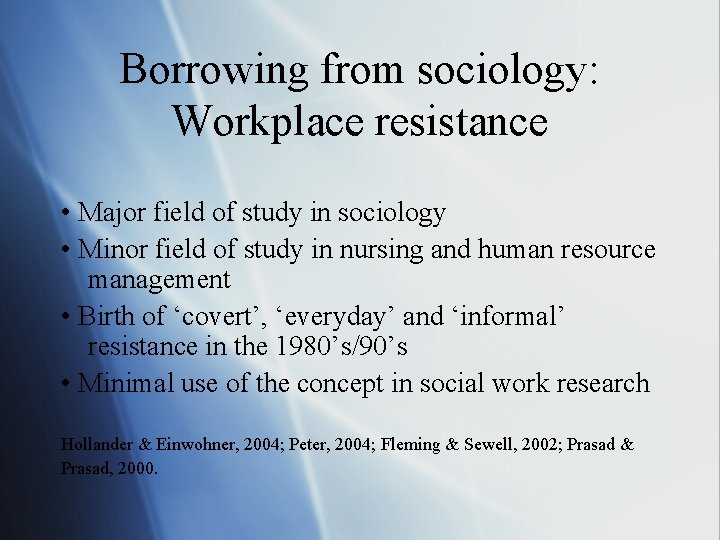
Borrowing from sociology: Workplace resistance • Major field of study in sociology • Minor field of study in nursing and human resource management • Birth of ‘covert’, ‘everyday’ and ‘informal’ resistance in the 1980’s/90’s • Minimal use of the concept in social work research Hollander & Einwohner, 2004; Peter, 2004; Fleming & Sewell, 2002; Prasad & Prasad, 2000.
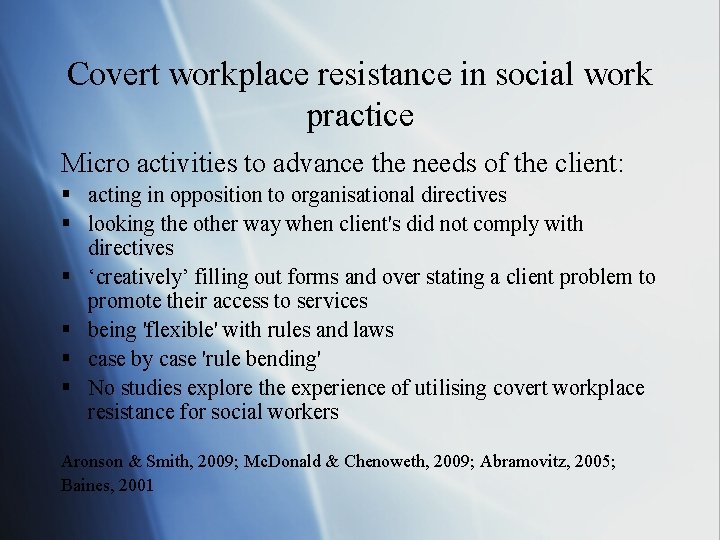
Covert workplace resistance in social work practice Micro activities to advance the needs of the client: § acting in opposition to organisational directives § looking the other way when client's did not comply with directives § ‘creatively’ filling out forms and over stating a client problem to promote their access to services § being 'flexible' with rules and laws § case by case 'rule bending' § No studies explore the experience of utilising covert workplace resistance for social workers Aronson & Smith, 2009; Mc. Donald & Chenoweth, 2009; Abramovitz, 2005; Baines, 2001
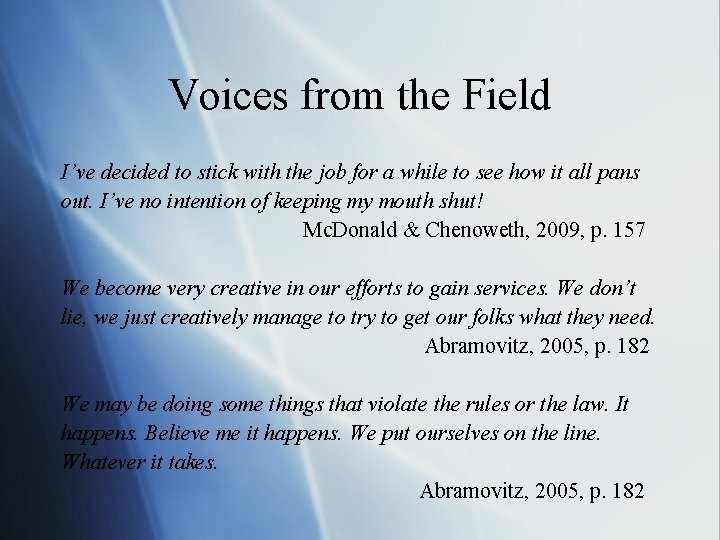
Voices from the Field I’ve decided to stick with the job for a while to see how it all pans out. I’ve no intention of keeping my mouth shut! Mc. Donald & Chenoweth, 2009, p. 157 We become very creative in our efforts to gain services. We don’t lie, we just creatively manage to try to get our folks what they need. Abramovitz, 2005, p. 182 We may be doing some things that violate the rules or the law. It happens. Believe me it happens. We put ourselves on the line. Whatever it takes. Abramovitz, 2005, p. 182
The time is ripe § Resurgence of interest in Radical practice § Our professional values are radical and revolutionary in contemporary welfare ideologies § ‘macro’ radical activist strategies may be less appropriate/successful in contemporary settings Is covert workplace resistance a form of contemporary Radical practice?
The Research study Theoretical Perspectives: • Critical Theory Methodology: • Qualitative, feminist research • Critical Reflective practice Methods: • Semi-structured narrative interviews (Email Facilitated Reflective Dialogue) • Manual theme analysis and interpretation • Critical analysis and recommendations
Participant criteria and Recruitment § Qualified social workers with eligibility for AASW membership § Current or recent past (2 years) employees of a statutory welfare organisation § State Child Protection Services § State Corrections Services § State Mental Health Services § State Hospital Services § Federal Income Service (Centrelink) § Recruited through advertisements in key social work publications, informal networks and online social networking sites
The research questions § How do social work practitioners utilising covert resistant strategies within statutory welfare organisations define their professional identity? § How do social work practitioners utilise covert resistant strategies within statutory welfare organisations to challenge organisationalprofessional conflict? § What is the experience of utilising covert resistant strategies within statutory welfare organisations for social work practitioners?
Research outcomes § Insight into the behaviours and experiences of social workers working in contemporary statutory organisations § Insight into potential incongruence between professional and organisational demands § Identify potential strategies for reducing incongruence between professional and organisational demands § Inform discussion on the relevance of activist practice methods in challenging contemporary welfare practice and the role of Social Workers as agents of change
A final thought …. “Tactics mean doing what you can with what you have” Saul Alinsky
Interested in participating? l. greenslade@griffith. edu. au