Ludwik Adamowicz and Michele Pavanello Department of Chemistry












- Slides: 26
Ludwik Adamowicz and Michele Pavanello, Department of Chemistry and Biochemistry February 9 th, 2012
UA SUPERCOMPUTERS Shared Memory - SGI Altix 4700 Marin - Interactive Front End, Altix 4700, 100 core Itanium 2, 160 GB memory Bora - Batch System, Altix 4700, 512 -core Itanium 2, 1024 GB memory Cluster - SGI Altix ICE 8200 Ice - Interactive Front End, 3 "round-robin" login nodes cluster 1392 -core, quad-core Xeon (Harpertown), 2 GB memory/core New Cluster - SGI Altix ICE 8400 2112 -core, 6 -core INTEL Xeon Soon To Be Installed SGI Altix UV IBM: Data. Plex HTC
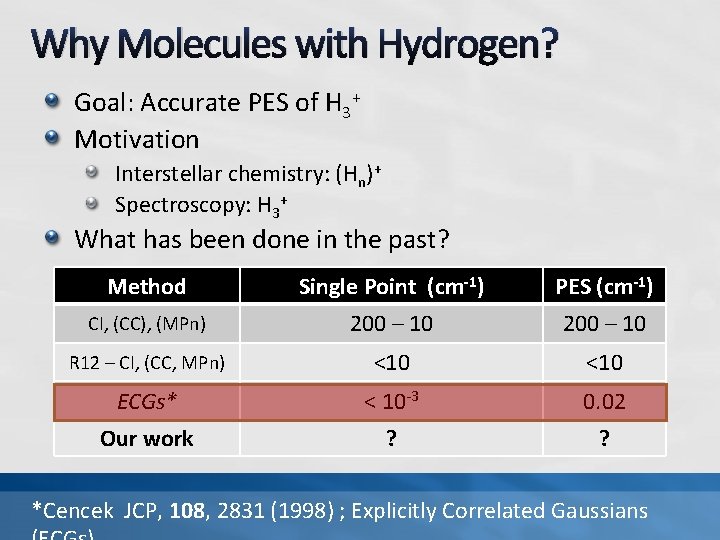
Why Molecules with Hydrogen? Goal: Accurate PES of H 3+ Motivation Interstellar chemistry: (Hn)+ Spectroscopy: H 3+ What has been done in the past? Method Single Point (cm-1) PES (cm-1) CI, (CC), (MPn) 200 – 10 R 12 – CI, (CC, MPn) <10 ECGs* < 10 -3 0. 02 Our work ? ? *Cencek JCP, 108, 2831 (1998) ; Explicitly Correlated Gaussians
What are ECGs? Expansion in terms of basis functions The basis set is made of explicitly correlated Gaussians with floating centers Atoms Molecules The case of H 3+ linear and non-linear parameters
The cusp condition 1. Electron-Nucleous cusp 2. Electron-Electron cusp Kato’s condition* Cusp function: *T. Kato (1957) The derivative of Ψ in this point counts!
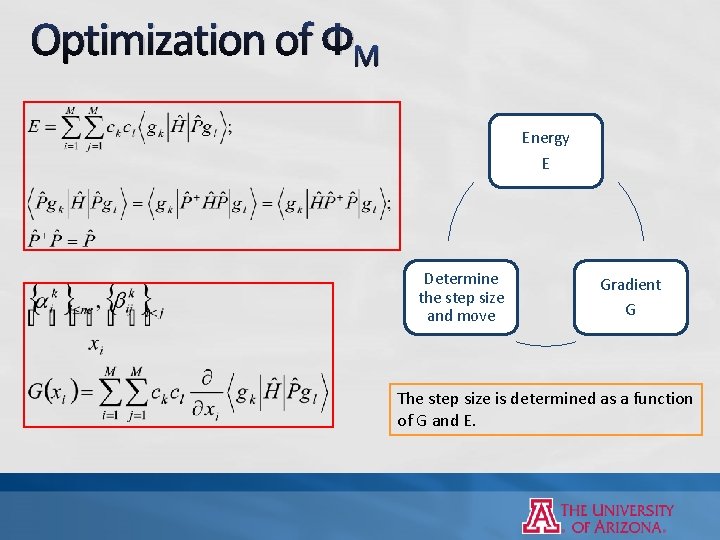
Optimization of ФM Energy E Determine the step size and move Gradient G The step size is determined as a function of G and E.
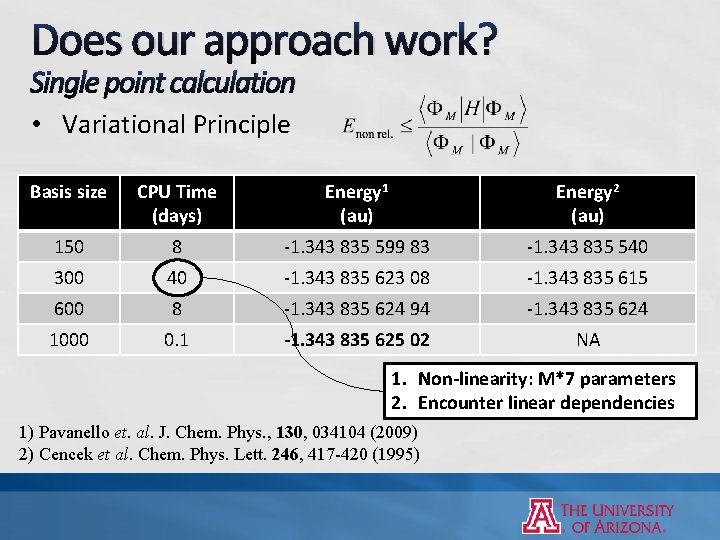
Does our approach work? Single point calculation • Variational Principle Basis size CPU Time (days) Energy 1 (au) Energy 2 (au) 150 8 -1. 343 835 599 83 -1. 343 835 540 300 40 -1. 343 835 623 08 -1. 343 835 615 600 8 -1. 343 835 624 94 -1. 343 835 624 1000 0. 1 -1. 343 835 625 02 NA 1. Non-linearity: M*7 parameters 2. Encounter linear dependencies 1) Pavanello et. al. J. Chem. Phys. , 130, 034104 (2009) 2) Cencek et al. Chem. Phys. Lett. 246, 417 -420 (1995)
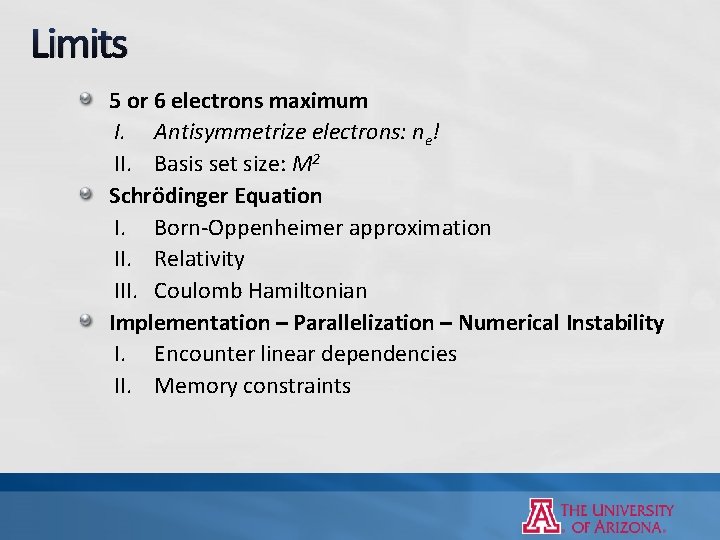
Limits 5 or 6 electrons maximum I. Antisymmetrize electrons: ne! II. Basis set size: M 2 Schrödinger Equation I. Born-Oppenheimer approximation II. Relativity III. Coulomb Hamiltonian Implementation – Parallelization – Numerical Instability I. Encounter linear dependencies II. Memory constraints
What if we move the geometry? Can we carry out PES calculations? 1. Re-optimize from scratch the basis set for each PES grid point. a. Takes a long time to optimize the basis set b. Hundreds, sometimes thousands of geometries need to be considered 2. Guess the basis set from nearby geometries a. How? b. Is it precise? c. Is the precision maintained for each grid point? We need a benchmark!
Test of the spring method Benchmark PES of H 3+ Generated a 377 -point PES The wavefunction at a certain geometry was generated from one of a nearby geometry The spring model M=900 6300 parameters Convergence dictated by the value of the analytical gradient ( GTG < 10 -11 a. u. ) and not of the energy Pavanello et al. J. Chem. Phys. 130, 001033 (2009)
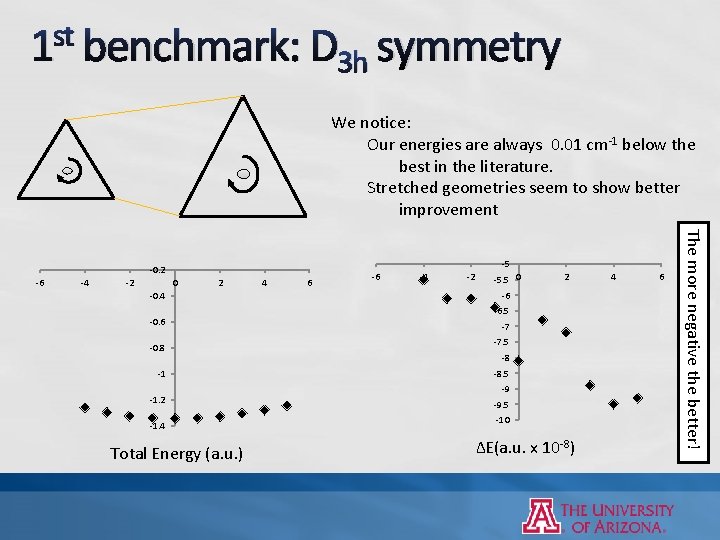
st 1 benchmark: D 3 h symmetry We notice: Our energies are always 0. 01 cm-1 below the best in the literature. Stretched geometries seem to show better improvement -6 -4 -2 0 2 -0. 4 -0. 6 -0. 8 4 6 -6 -4 -2 -5. 5 0 -6 -6. 5 -7 -7. 5 -8 -1 -8. 5 -1. 2 -9. 5 -1. 4 Total Energy (a. u. ) 2 -9 -10 ΔE(a. u. x 10 -8) 4 6 The more negative the better! -5 -0. 2
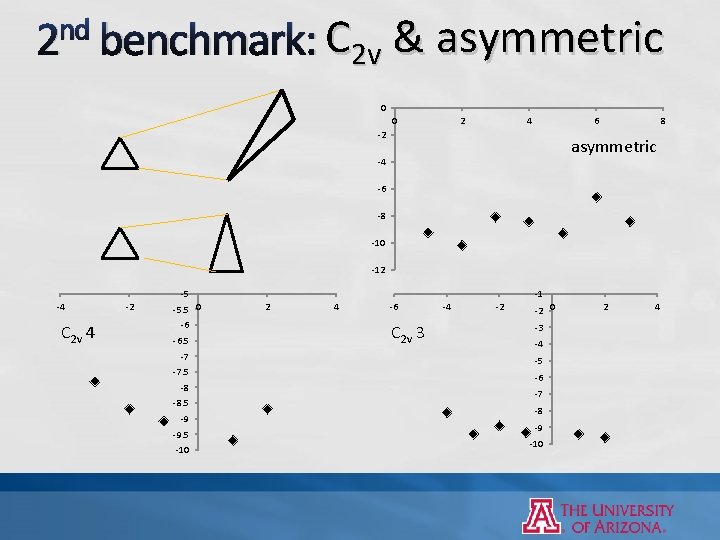
nd 2 benchmark: C 2 v & asymmetric 0 0 2 4 6 -2 8 asymmetric -4 -6 -8 -10 -12 -5 -4 C 2 v 4 -2 -5. 5 0 -6 -6. 5 -7 -7. 5 -8 -8. 5 -9 -9. 5 -10 -1 2 4 -6 C 2 v 3 -4 -2 -2 0 -3 -4 -5 -6 -7 -8 -9 -10 2 4
+ The challenge: a complete PES of H 3 R 1 3 R 23 toward sub 0. 01 cm-1 accuracy 0. 4 Total Energy (a. u. ) 0. 2 ρ (a. u. ) 0 0 2 4 6 8 10 12 R 12 -0. 4 1 E 1 -0. 6 -0. 8 -1 -1. 2 1 1 A 1 -1. 4 -1. 6 Alijah at al. used MR-CI with cc-p. V 5 Z Viegas, Alijah and Varandas, JCP (2007) Johnson, JCP (1980) Whitten and Smith (1968)
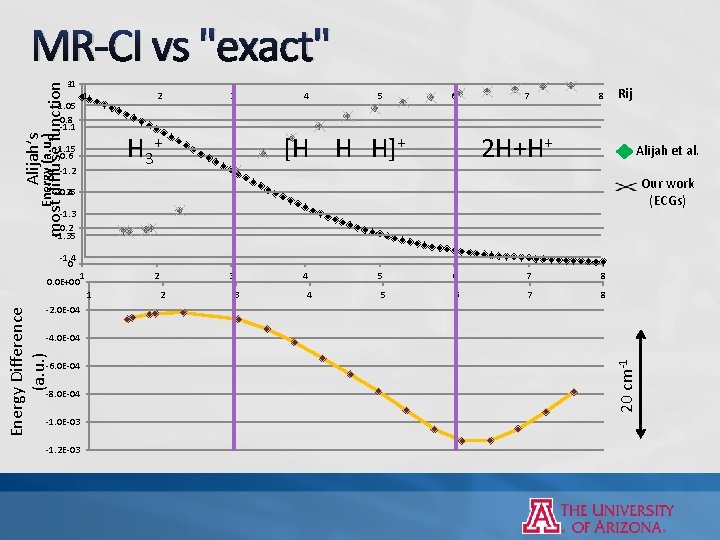
Alijah’s most diffuse function MR-CI vs "exact" 1 -1 Energy (a. u. ) -1. 05 0. 8 -1. 1 1 2 3 H 3 + -1. 15 0. 6 -1. 2 4 5 6 [H H H]+ 7 8 2 H+H+ Rij Alijah et al. Our work (ECGs) 0. 4 -1. 25 -1. 3 0. 2 -1. 35 -1. 4 0 0. 0 E+00 1 2 1 3 2 3 4 4 5 5 6 7 8 Energy Difference (a. u. ) -2. 0 E-04 -6. 0 E-04 -8. 0 E-04 -1. 0 E-03 -1. 2 E-03 20 cm-1 -4. 0 E-04
Vibrational Wave function Plots
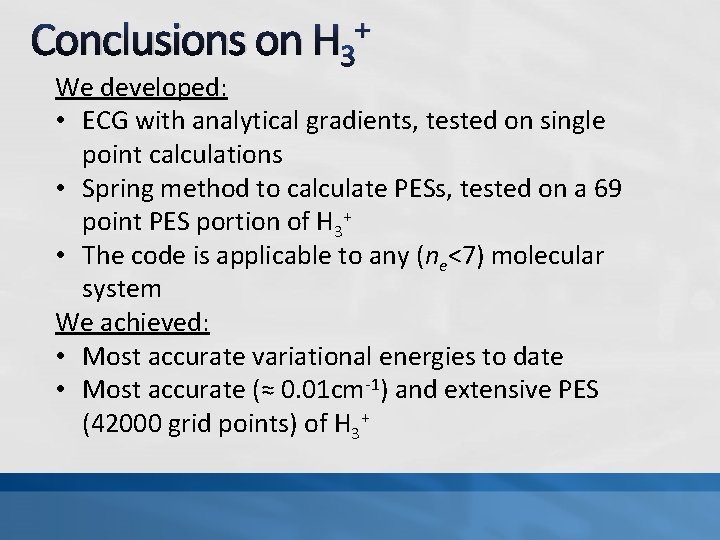
+ Conclusions on H 3 We developed: • ECG with analytical gradients, tested on single point calculations • Spring method to calculate PESs, tested on a 69 point PES portion of H 3+ • The code is applicable to any (ne<7) molecular system We achieved: • Most accurate variational energies to date • Most accurate (≈ 0. 01 cm-1) and extensive PES (42000 grid points) of H 3+
+ Conclusions on H 3 To be developed: • Leading relativistic corrections • Non-adiabatic corrections • Leading QED corrections
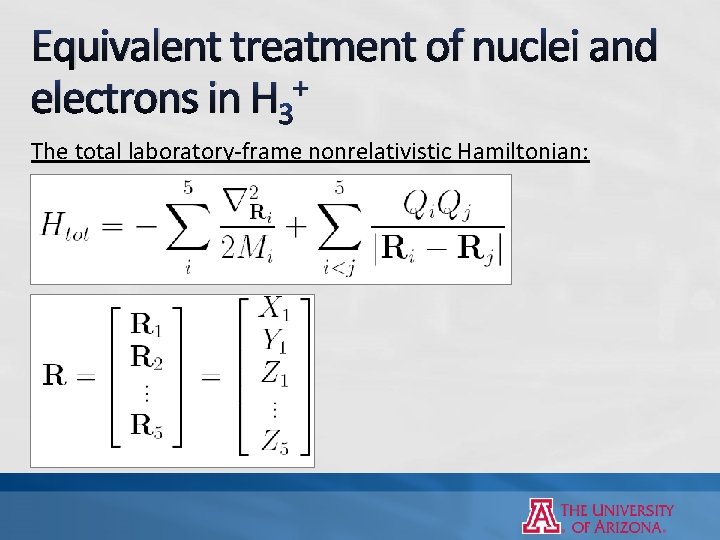
Equivalent treatment of nuclei and + electrons in H 3 The total laboratory-frame nonrelativistic Hamiltonian:
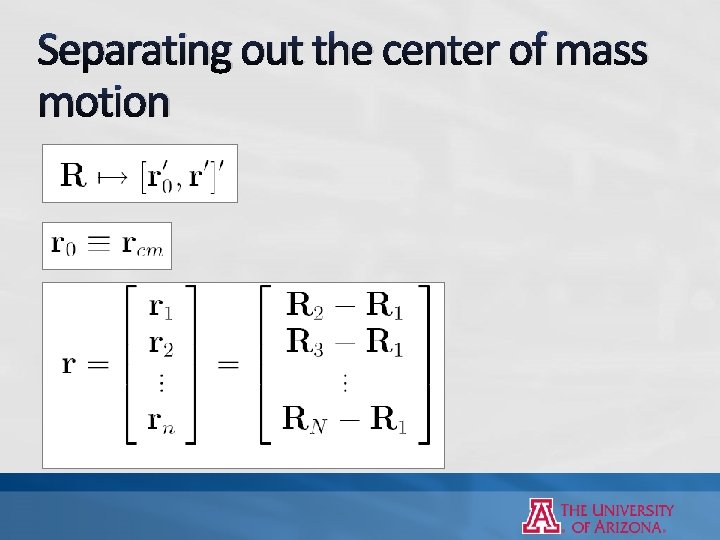
Separating out the center of mass motion
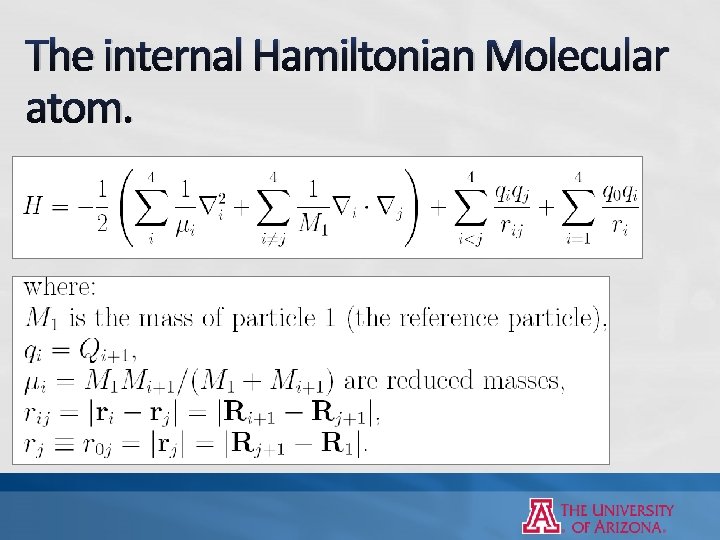
The internal Hamiltonian Molecular atom.
Explicitly Correlated Gaussian Functions + for non-BO calculations of H 3 diatomics H 3 + or
Expectation values of the ground state non-BO energies, virial coefficients (η) , and internuclear distances for some isotopologues of H 3+. All values are calculated for an optimized 50 term explicitly correlated Gaussian basis set and are in atomic units.
Acknowledgements Pawel Kozlowski Mauricio Cafiero Michele Pavanello Coworkers: Donald Kinghorn Sergiy Bubin Wei-Cheng Tung Collaborators: Alexander Alijah Irina I. Mizus Jonathan Tennyson Attila Császár Annemieke Petrignani Nikolai Zobov Oleg Polyansky Tamás Szidarovzsky Max Berg Andreas Wolf Support: NSF