Low Energy Electromagnetic Physics http www ge infn
- Slides: 34
Low Energy Electromagnetic Physics http: //www. ge. infn. it/geant 4/low. E Maria Grazia Pia INFN Genova on behalf of Geant 4 Low Energy Electromagnetic Working Group Monte Carlo 2005 Chattanooga, 18 -21 April 2005 Maria Grazia Pia, INFN Genova
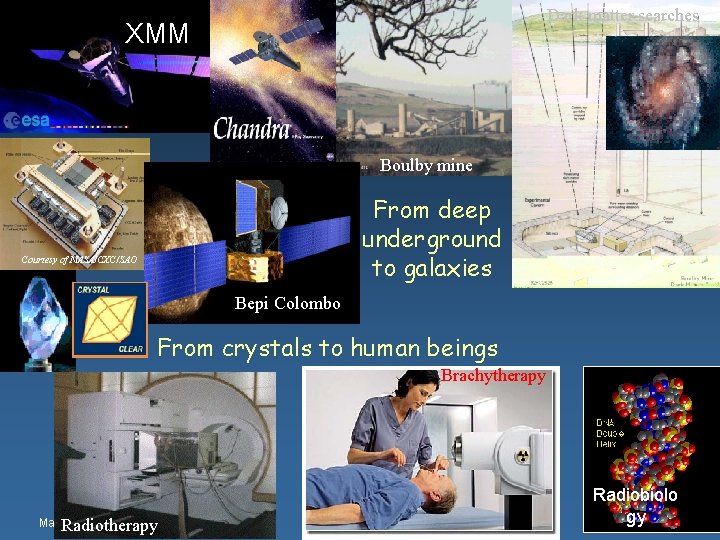
Dark matter searches XMM Boulby mine From deep underground to galaxies Courtesy of NASA/CXC/SAO Bepi Colombo From crystals to human beings Brachytherapy Maria Grazia Pia, INFN Genova Radiotherapy Radiobiolo gy
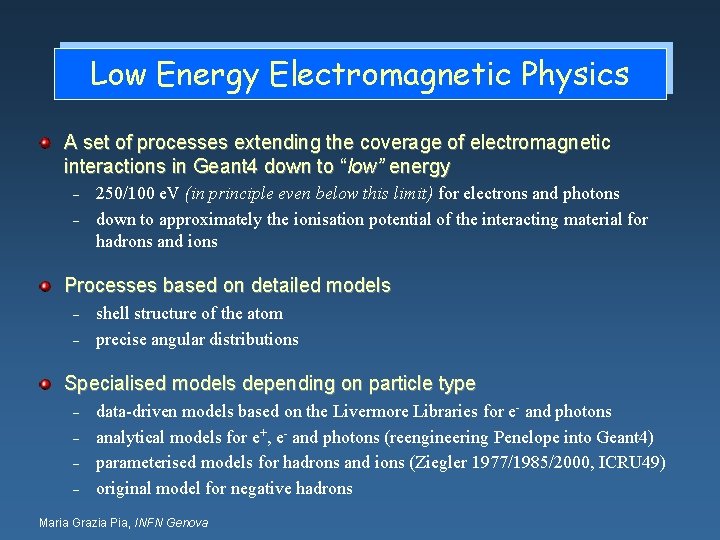
Low Energy Electromagnetic Physics A set of processes extending the coverage of electromagnetic interactions in Geant 4 down to “low” energy – – 250/100 e. V (in principle even below this limit) for electrons and photons down to approximately the ionisation potential of the interacting material for hadrons and ions Processes based on detailed models – – shell structure of the atom precise angular distributions Specialised models depending on particle type – – data driven models based on the Livermore Libraries for e and photons analytical models for e+, e and photons (reengineering Penelope into Geant 4) parameterised models for hadrons and ions (Ziegler 1977/1985/2000, ICRU 49) original model for negative hadrons Maria Grazia Pia, INFN Genova
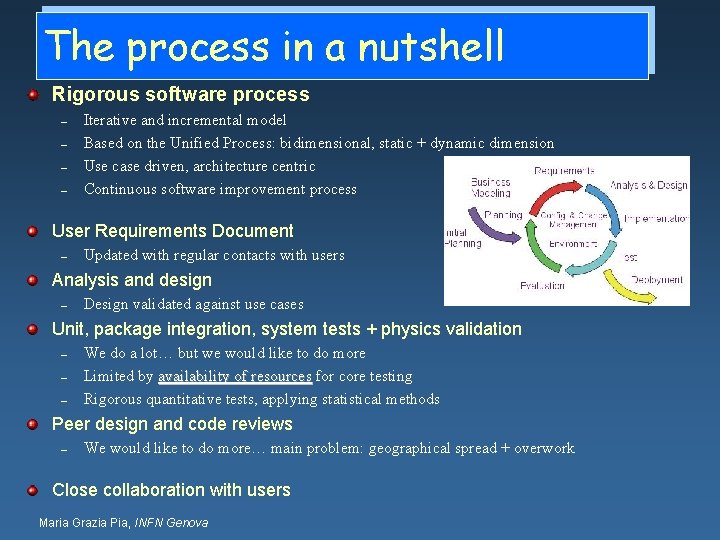
The process in a nutshell Rigorous software process – – Iterative and incremental model Based on the Unified Process: bidimensional, static + dynamic dimension Use case driven, architecture centric Continuous software improvement process User Requirements Document – Updated with regular contacts with users Analysis and design – Design validated against use cases Unit, package integration, system tests + physics validation – – – We do a lot… but we would like to do more Limited by availability of resources for core testing Rigorous quantitative tests, applying statistical methods Peer design and code reviews – We would like to do more… main problem: geographical spread + overwork Close collaboration with users Maria Grazia Pia, INFN Genova
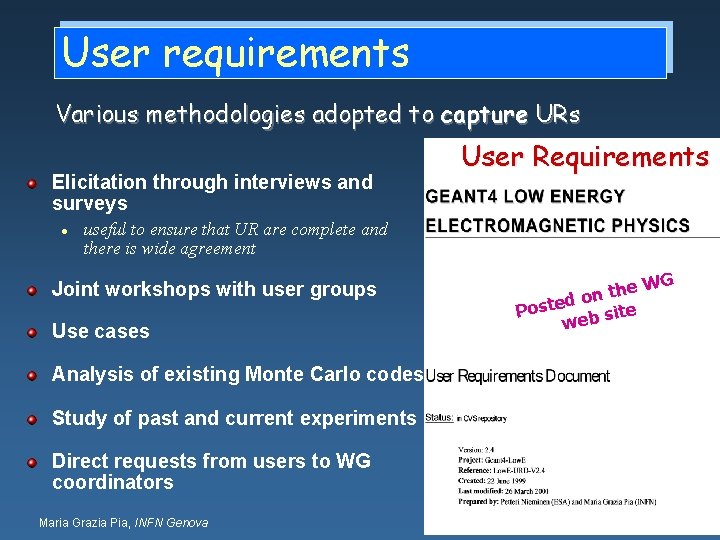
User requirements Various methodologies adopted to capture URs Elicitation through interviews and surveys l User Requirements useful to ensure that UR are complete and there is wide agreement Joint workshops with user groups Use cases Analysis of existing Monte Carlo codes Study of past and current experiments Direct requests from users to WG coordinators Maria Grazia Pia, INFN Genova WG e h t d on e t s o P site web
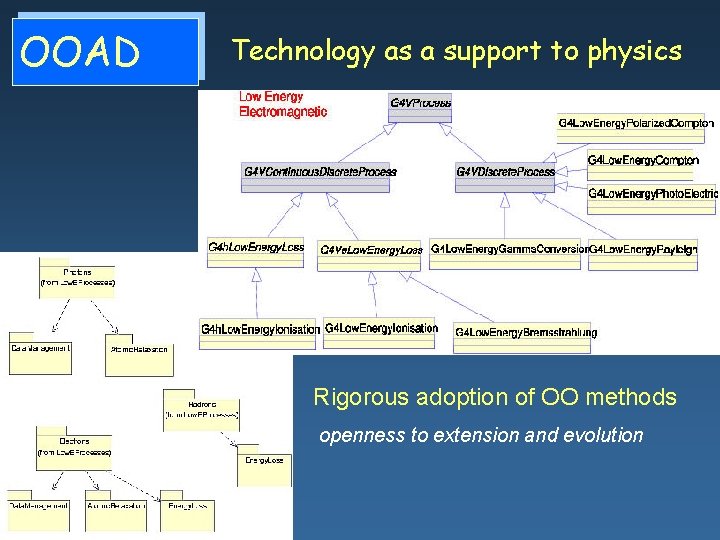
OOAD Technology as a support to physics Rigorous adoption of OO methods openness to extension and evolution Maria Grazia Pia, INFN Genova
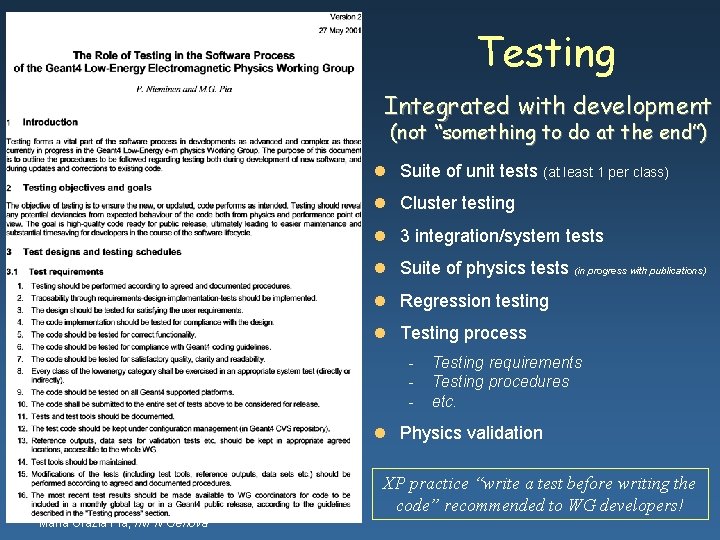
Testing Integrated with development (not “something to do at the end”) l Suite of unit tests (at least 1 per class) l Cluster testing l 3 integration/system tests l Suite of physics tests (in progress with publications) l Regression testing l Testing process Testing requirements Testing procedures etc. l Physics validation XP practice “write a test before writing the code” recommended to WG developers! Maria Grazia Pia, INFN Genova
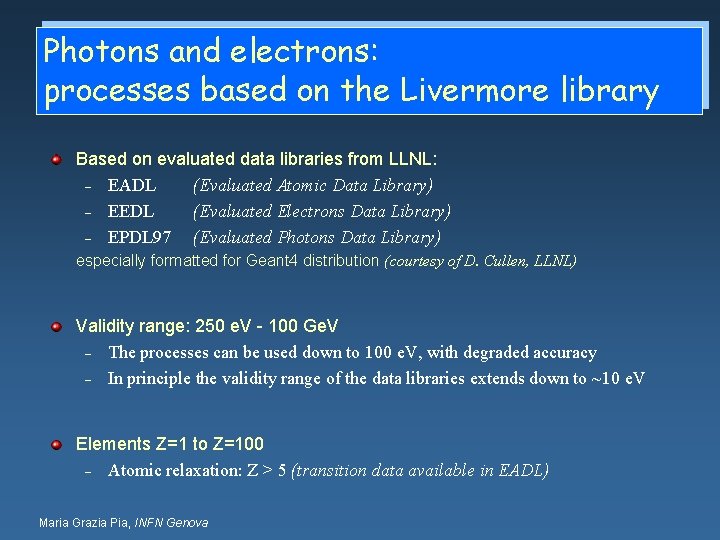
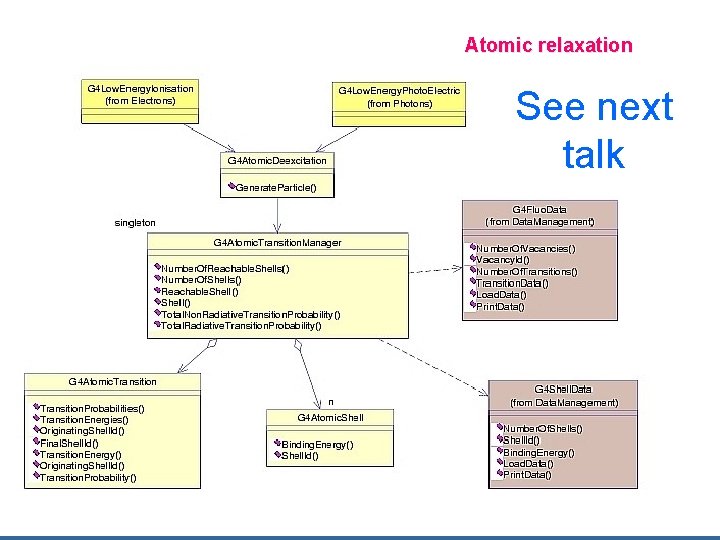
Photons and electrons: processes based on the Livermore library Based on evaluated data libraries from LLNL: – EADL (Evaluated Atomic Data Library) – EEDL (Evaluated Electrons Data Library) – EPDL 97 (Evaluated Photons Data Library) especially formatted for Geant 4 distribution (courtesy of D. Cullen, LLNL) Validity range: 250 e. V 100 Ge. V – The processes can be used down to 100 e. V, with degraded accuracy – In principle the validity range of the data libraries extends down to ~10 e. V Elements Z=1 to Z=100 – Atomic relaxation: Z > 5 (transition data available in EADL) Maria Grazia Pia, INFN Genova
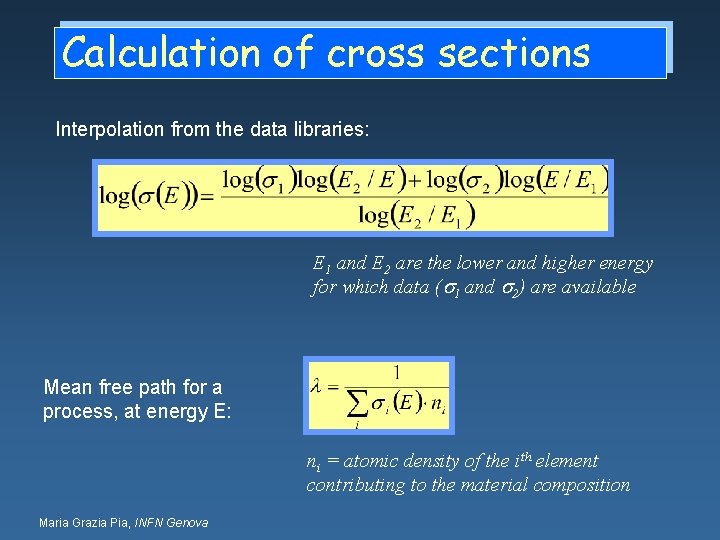
Calculation of cross sections Interpolation from the data libraries: E 1 and E 2 are the lower and higher energy for which data (s 1 and s 2) are available Mean free path for a process, at energy E: ni = atomic density of the ith element contributing to the material composition Maria Grazia Pia, INFN Genova
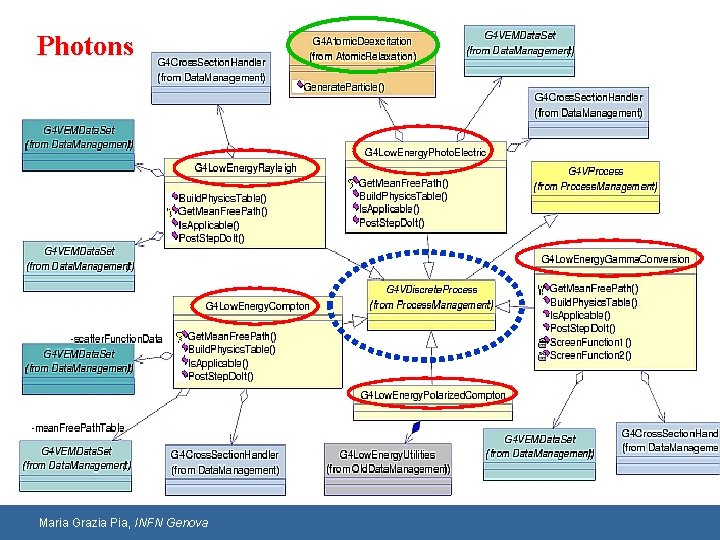
Photons Maria Grazia Pia, INFN Genova
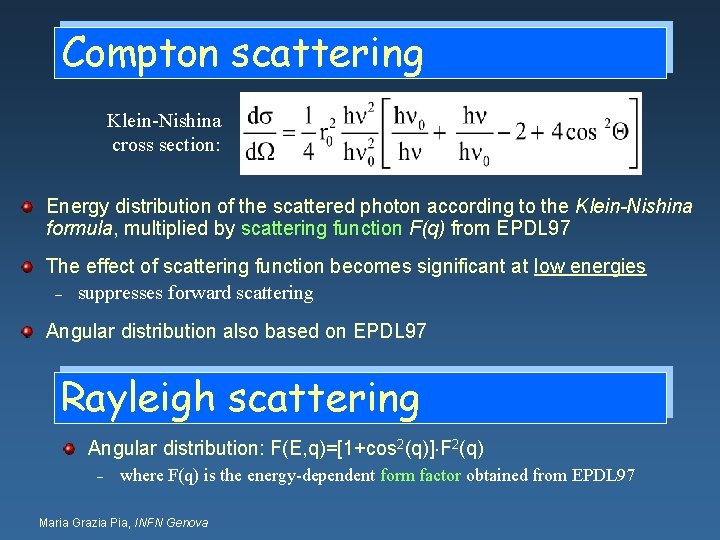
Compton scattering Klein Nishina cross section: Energy distribution of the scattered photon according to the Klein-Nishina formula, multiplied by scattering function F(q) from EPDL 97 The effect of scattering function becomes significant at low energies – suppresses forward scattering Angular distribution also based on EPDL 97 Rayleigh scattering Angular distribution: F(E, q)=[1+cos 2(q)] F 2(q) – where F(q) is the energy dependent form factor obtained from EPDL 97 Maria Grazia Pia, INFN Genova
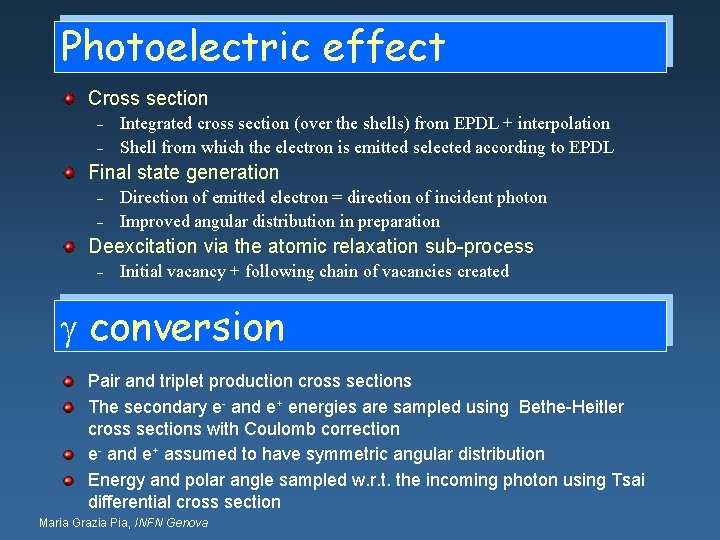
Photoelectric effect Cross section – – Integrated cross section (over the shells) from EPDL + interpolation Shell from which the electron is emitted selected according to EPDL Final state generation – – Direction of emitted electron = direction of incident photon Improved angular distribution in preparation Deexcitation via the atomic relaxation sub process – Initial vacancy + following chain of vacancies created g conversion Pair and triplet production cross sections The secondary e and e+ energies are sampled using Bethe Heitler cross sections with Coulomb correction e and e+ assumed to have symmetric angular distribution Energy and polar angle sampled w. r. t. the incoming photon using Tsai differential cross section Maria Grazia Pia, INFN Genova
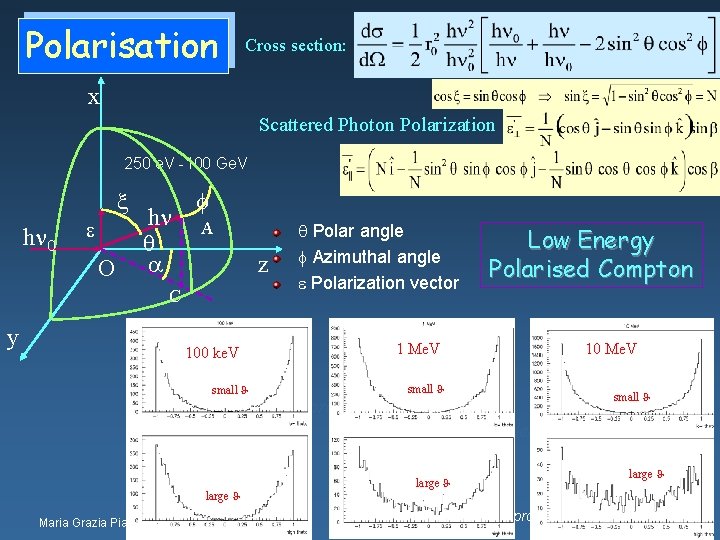
Polarisation Cross section: x Scattered Photon Polarization 250 e. V 100 Ge. V x hn 0 O hn a A z C y 100 ke. V small large Maria Grazia Pia, INFN Genova Polar angle Azimuthal angle Polarization vector 1 Me. V small More details: talk on large Low Energy Polarised Compton 10 Me. V small Geant 4 Low Energy Electromagnetic Physics large Other polarised processes under development
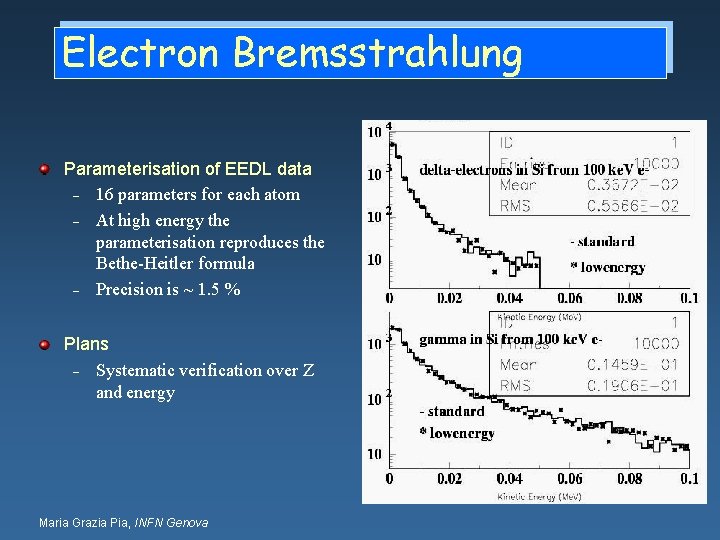
Electron Bremsstrahlung Parameterisation of EEDL data – 16 parameters for each atom – At high energy the parameterisation reproduces the Bethe Heitler formula – Precision is ~ 1. 5 % Plans – Systematic verification over Z and energy Maria Grazia Pia, INFN Genova
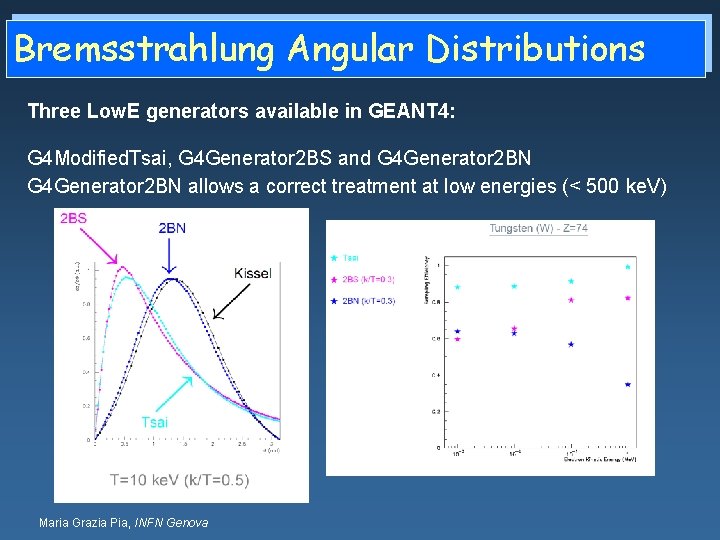
Bremsstrahlung Angular Distributions Three Low. E generators available in GEANT 4: G 4 Modified. Tsai, G 4 Generator 2 BS and G 4 Generator 2 BN allows a correct treatment at low energies (< 500 ke. V) Maria Grazia Pia, INFN Genova
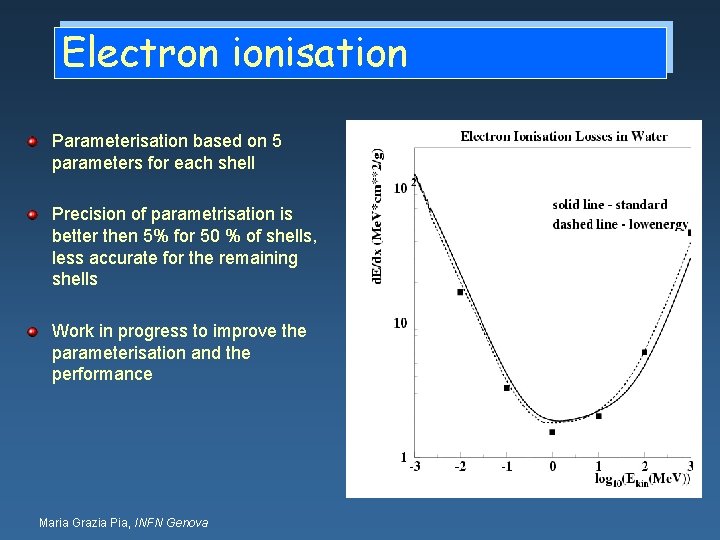
Electron ionisation Parameterisation based on 5 parameters for each shell Precision of parametrisation is better then 5% for 50 % of shells, less accurate for the remaining shells Work in progress to improve the parameterisation and the performance Maria Grazia Pia, INFN Genova
Processes à la Penelope The whole physics content of the Penelope Monte Carlo code has been re engineered into Geant 4 (except for multiple scattering) – processes for photons: release 5. 2, for electrons: release 6. 0 Physics models by F. Salvat et al. Power of the OO technology: – – – extending the software system is easy all processes obey to the same abstract interfaces using new implementations in application code is simple Profit of Geant 4 advanced geometry modeling, interactive facilities etc. – same physics as original Penelope Maria Grazia Pia, INFN Genova
Hadrons and ions Variety of models, depending on – – – energy range particle type charge Composition of models across the energy range, with different approaches – – analytical based on data reviews + parameterisations Specialised models for fluctuations Open to extension and evolution Maria Grazia Pia, INFN Genova
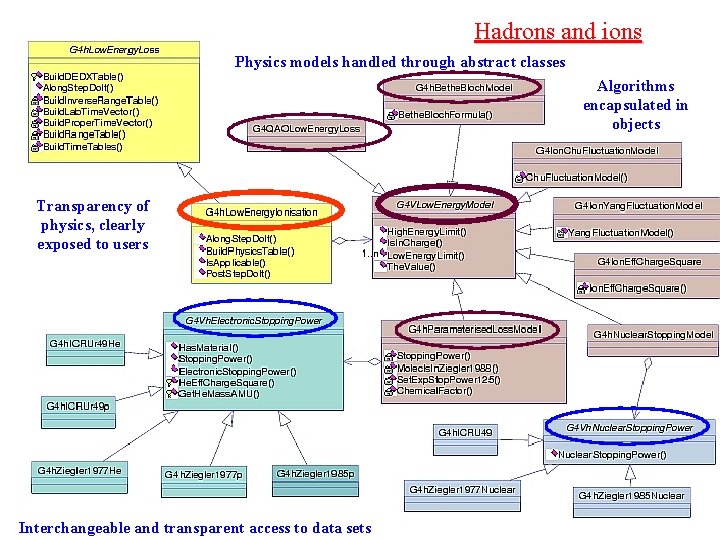
Hadrons and ions Physics models handled through abstract classes Algorithms encapsulated in objects Transparency of physics, clearly exposed to users Maria Grazia Pia, and INFN transparent Genova Interchangeable access to data sets
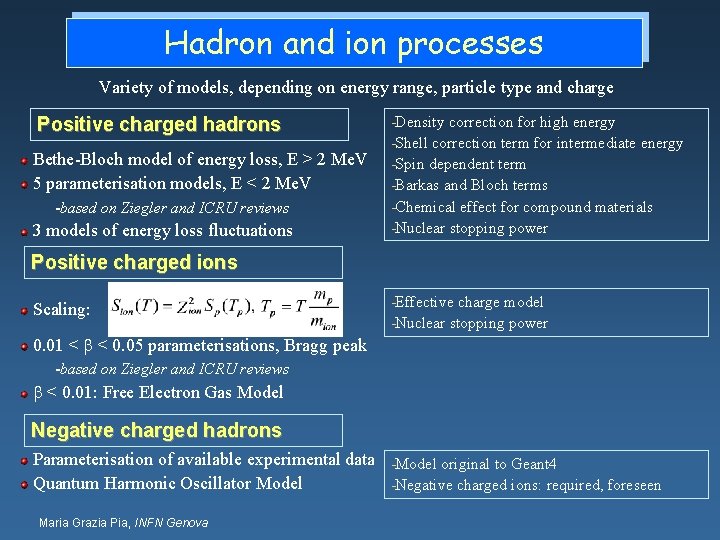
Hadron and ion processes Variety of models, depending on energy range, particle type and charge Positive charged hadrons Bethe Bloch model of energy loss, E > 2 Me. V 5 parameterisation models, E < 2 Me. V based on Ziegler and ICRU reviews 3 models of energy loss fluctuations Density correction for high energy Shell correction term for intermediate energy Spin dependent term Barkas and Bloch terms Chemical effect for compound materials Nuclear stopping power Positive charged ions Scaling: Effective charge model Nuclear stopping power 0. 01 < < 0. 05 parameterisations, Bragg peak based on Ziegler and ICRU reviews < 0. 01: Free Electron Gas Model Negative charged hadrons Parameterisation of available experimental data Model original to Geant 4 Quantum Harmonic Oscillator Model Negative charged ions: required, foreseen Maria Grazia Pia, INFN Genova
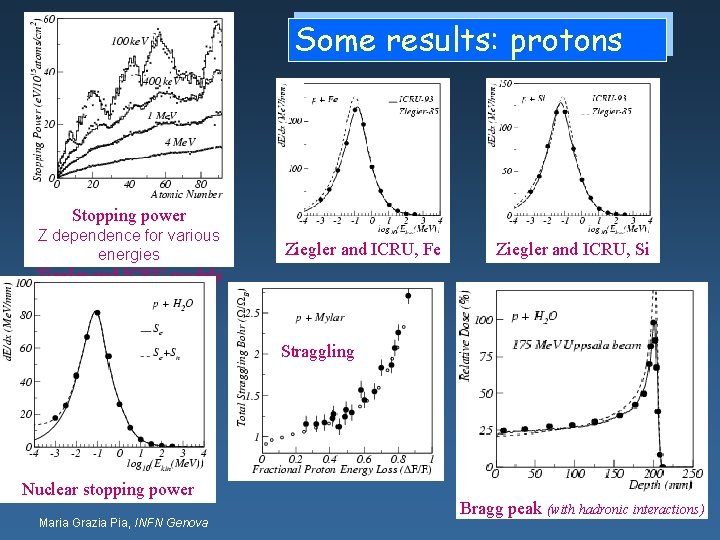
Some results: protons Stopping power Z dependence for various energies Ziegler and ICRU, Fe Ziegler and ICRU, Si Ziegler and ICRU models Straggling Nuclear stopping power Maria Grazia Pia, INFN Genova Bragg peak (with hadronic interactions)
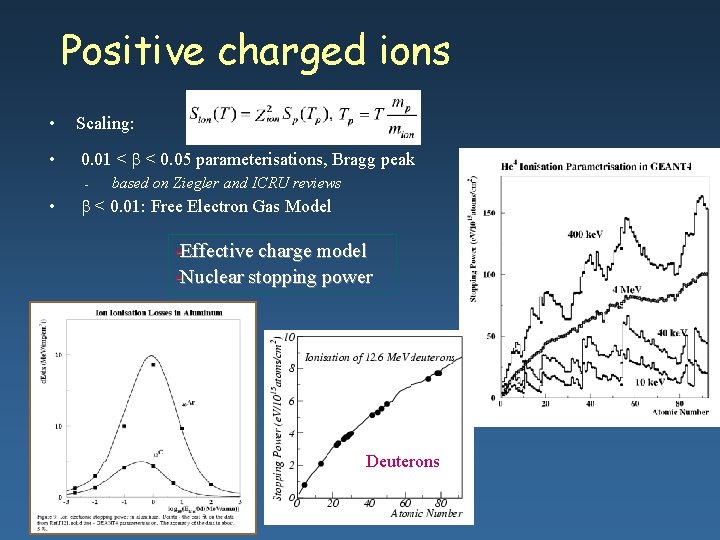
Positive charged ions • Scaling: • 0. 01 < < 0. 05 parameterisations, Bragg peak • based on Ziegler and ICRU reviews < 0. 01: Free Electron Gas Model Effective charge model Nuclear stopping power Deuterons Maria Grazia Pia, INFN Genova
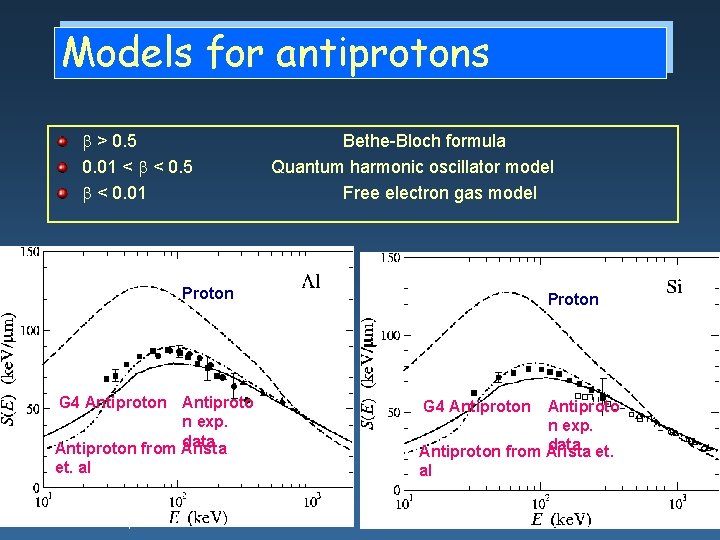
Models for antiprotons > 0. 5 0. 01 < < 0. 5 < 0. 01 Bethe Bloch formula Quantum harmonic oscillator model Free electron gas model Proton G 4 Antiproton Antiproto n exp. data Antiproton from Arista et. al Maria Grazia Pia, INFN Genova Proton G 4 Antiproton Antiproto n exp. data et. Antiproton from Arista al
Atomic relaxation See next talk Maria Grazia Pia, INFN Genova
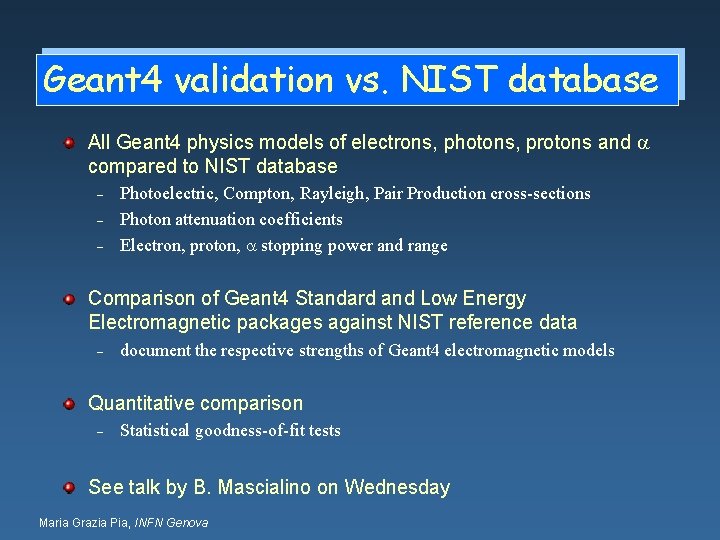
Geant 4 validation vs. NIST database All Geant 4 physics models of electrons, photons, protons and a compared to NIST database – – – Photoelectric, Compton, Rayleigh, Pair Production cross sections Photon attenuation coefficients Electron, proton, a stopping power and range Comparison of Geant 4 Standard and Low Energy Electromagnetic packages against NIST reference data – document the respective strengths of Geant 4 electromagnetic models Quantitative comparison – Statistical goodness of fit tests See talk by B. Mascialino on Wednesday Maria Grazia Pia, INFN Genova
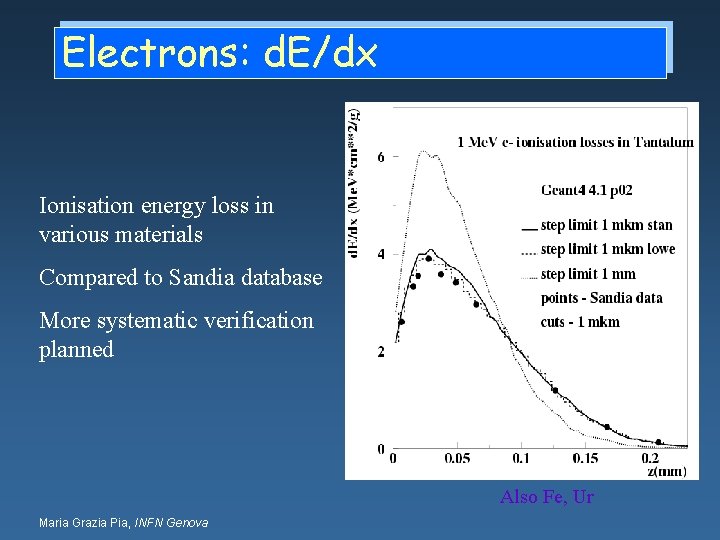
Electrons: d. E/dx Ionisation energy loss in various materials Compared to Sandia database More systematic verification planned Also Fe, Ur Maria Grazia Pia, INFN Genova
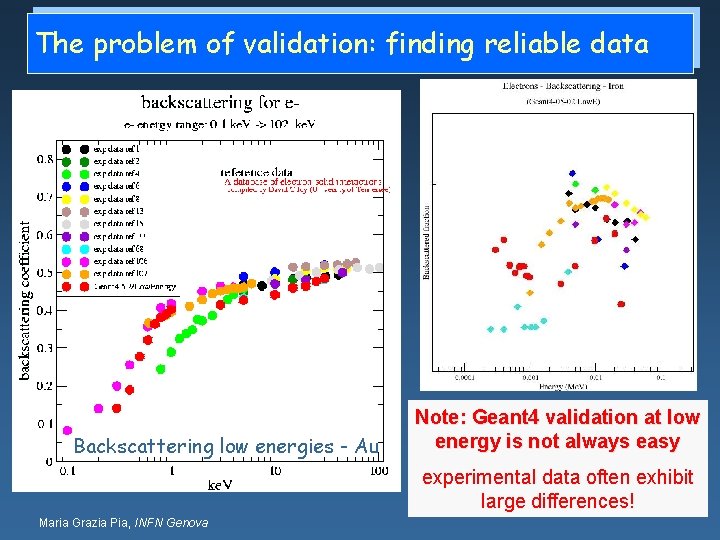
The problem of validation: finding reliable data Backscattering low energies - Au Note: Geant 4 validation at low energy is not always easy experimental data often exhibit large differences! Maria Grazia Pia, INFN Genova
Applications A small sample in the next slides – various talks at this conference concerning Geant 4 Low Energy Electromagnetic applications Many valuable contributions to the validation of Low. E physics from users all over the world – excellent relationship with our user community Maria Grazia Pia, INFN Genova
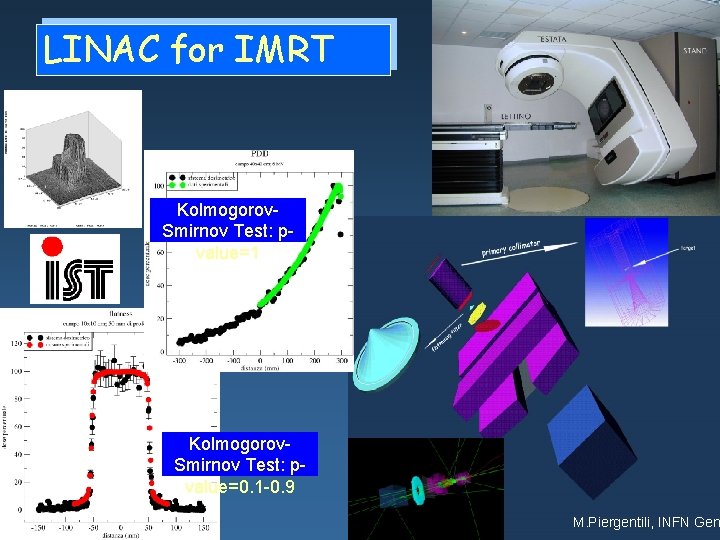
LINAC for IMRT Kolmogorov Smirnov Test: p value=1 Kolmogorov Smirnov Test: p value=0. 1 0. 9 Maria Grazia Pia, INFN Genova M. Piergentili, INFN Gen
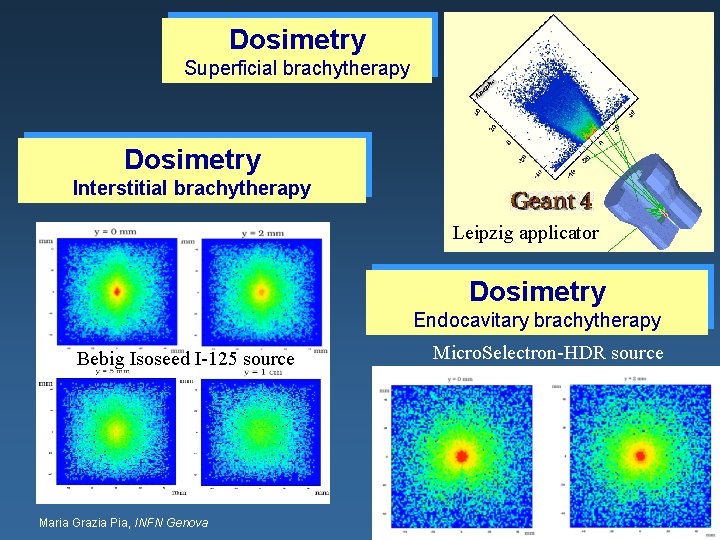
Dosimetry Superficial brachytherapy Dosimetry Interstitial brachytherapy Leipzig applicator Dosimetry Endocavitary brachytherapy Bebig Isoseed I 125 source Maria Grazia Pia, INFN Genova Micro. Selectron HDR source
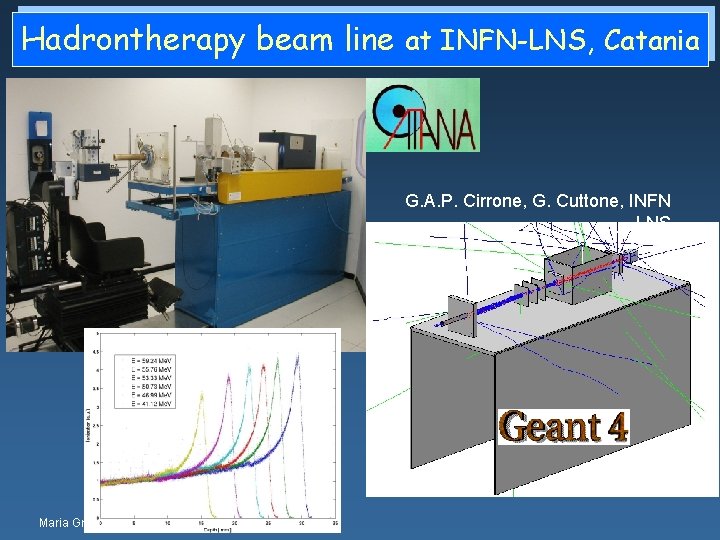
Hadrontherapy beam line at INFN-LNS, Catania G. A. P. Cirrone, G. Cuttone, INFN LNS Maria Grazia Pia, INFN Genova
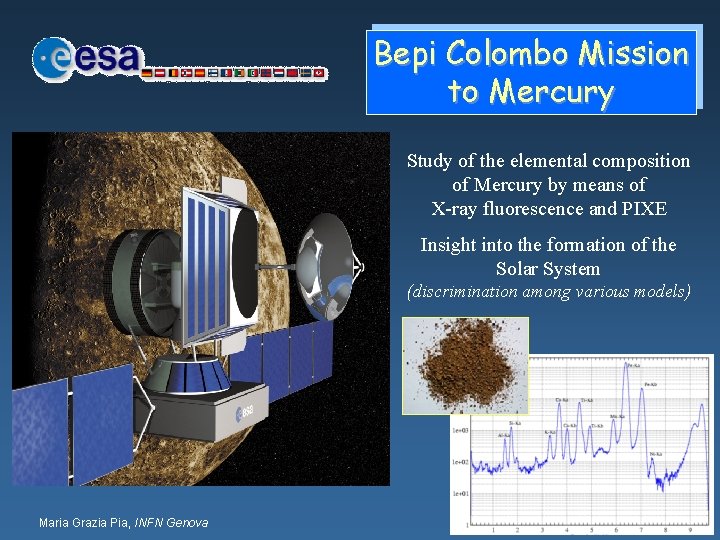
Bepi Colombo Mission to Mercury Study of the elemental composition of Mercury by means of X ray fluorescence and PIXE Insight into the formation of the Solar System (discrimination among various models) Maria Grazia Pia, INFN Genova
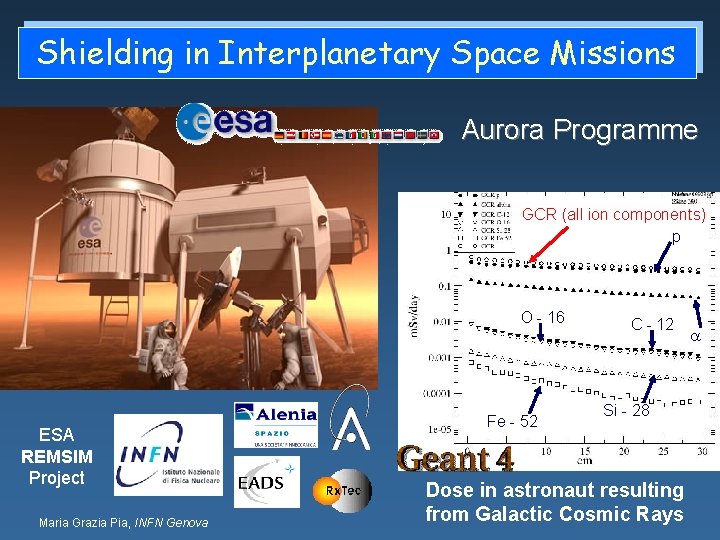
Shielding in Interplanetary Space Missions Aurora Programme GCR (all ion components) p O 16 ESA REMSIM Project Maria Grazia Pia, INFN Genova Fe 52 C 12 Si 28 Dose in astronaut resulting from Galactic Cosmic Rays a
Conclusions New physics domain in HEP simulation Wide interest in the user community A wealth of physics models A rigorous approach to software engineering Significant results from an extensive validation programme A variety of applications in diverse domains Maria Grazia Pia, INFN Genova