LLM Advanced Commercial Property Law 2009 REPAIR AND



















- Slides: 60
LLM Advanced Commercial Property Law 2009 REPAIR AND DISREPAIR OF COMMERCIAL PROPERTY Siân Lee
Course outline • Workbook • Cases/articles • Blackboard (e-Learning Portal)
Introduction • Repairing obligations as between landlord and tenant in a commercial lease • Some selected topics: – 1 - Overview – 2 – Key concepts and case analysis – 3 – Drafting issues – 4 – Landlord’s remedies
Repairing Covenants: Overview • • Implied obligations Tenant’s covenant Design/Construction defects Amendments to draft covenant Access by landlord Landlord’s covenant to repair Ancillary covenants Remedies
Key concepts • Repair – Dictionary definition? • Disrepair • Renewal • Defect – Inherent defect • Improvement
Concepts and cases • Little statutory guidance – Case-based reasoning • Look for judicial distinctions between concepts – Trace themes through cases, rather than expect each issue to dealt with by a particular case • • “Fact and degree” arguments Examples: facts Examples: drafting Look at some cases/themes: – Standard of repair – Repair vs renewal
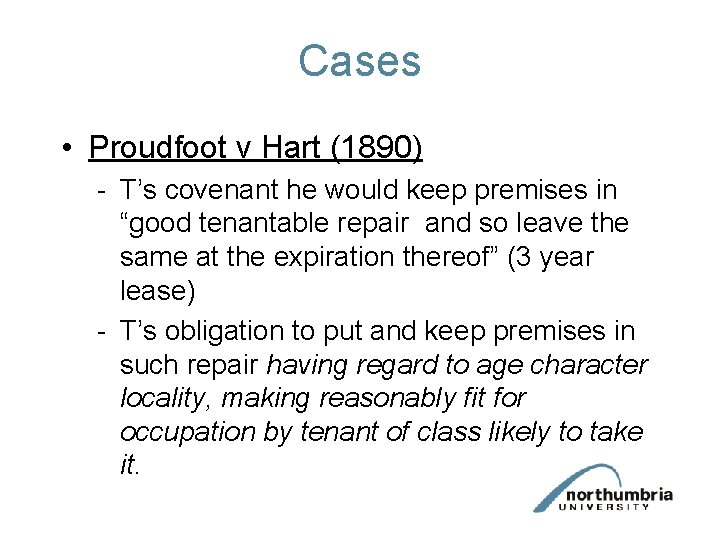
Cases • Proudfoot v Hart (1890) - T’s covenant he would keep premises in “good tenantable repair and so leave the same at the expiration thereof” (3 year lease) - T’s obligation to put and keep premises in such repair having regard to age character locality, making reasonably fit for occupation by tenant of class likely to take it.
Cases • Lister v Lane and Nesham (1893) - T’s covenant “…well, sufficiently, substantially repair uphold maintain…” - House was +100 years old. Walls bulged due to timber in foundations decaying – resting on boggy soil - Surveyor – not economic to repair without demolition/rebuilding, but this might have been done during term - Held: T not liable, since caused by time/elements on defective construction
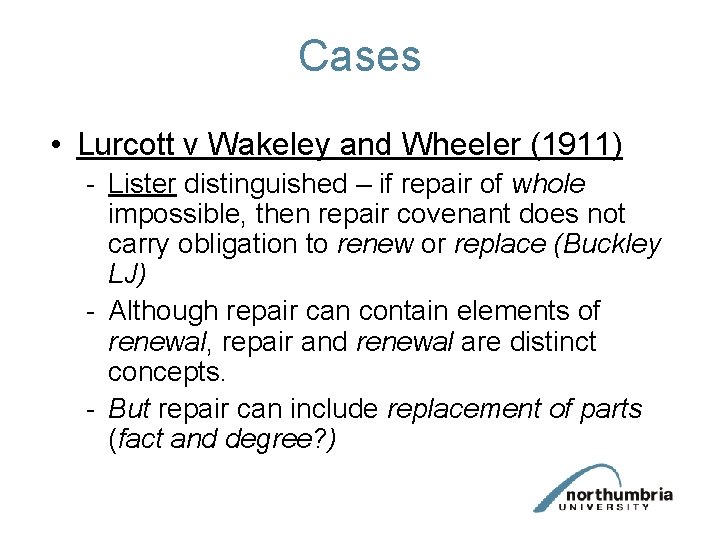
Cases • Lurcott v Wakeley and Wheeler (1911) - Lister distinguished – if repair of whole impossible, then repair covenant does not carry obligation to renew or replace (Buckley LJ) - Although repair can contain elements of renewal, repair and renewal are distinct concepts. - But repair can include replacement of parts (fact and degree? )
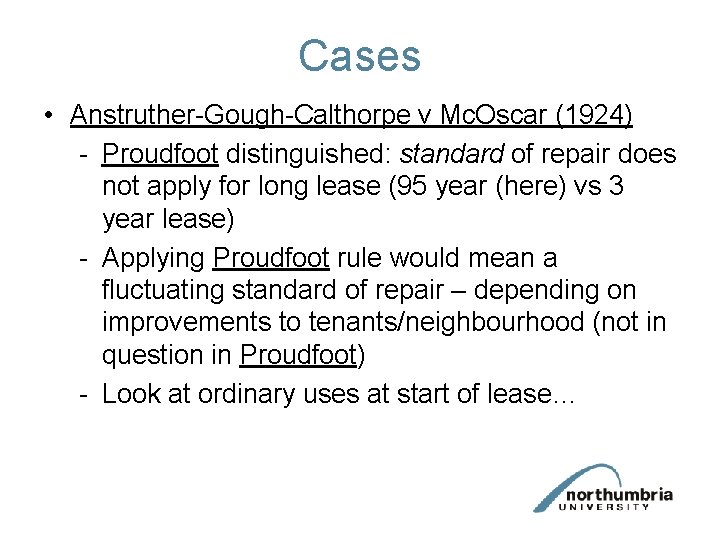
Cases • Anstruther-Gough-Calthorpe v Mc. Oscar (1924) - Proudfoot distinguished: standard of repair does not apply for long lease (95 year (here) vs 3 year lease) - Applying Proudfoot rule would mean a fluctuating standard of repair – depending on improvements to tenants/neighbourhood (not in question in Proudfoot) - Look at ordinary uses at start of lease…
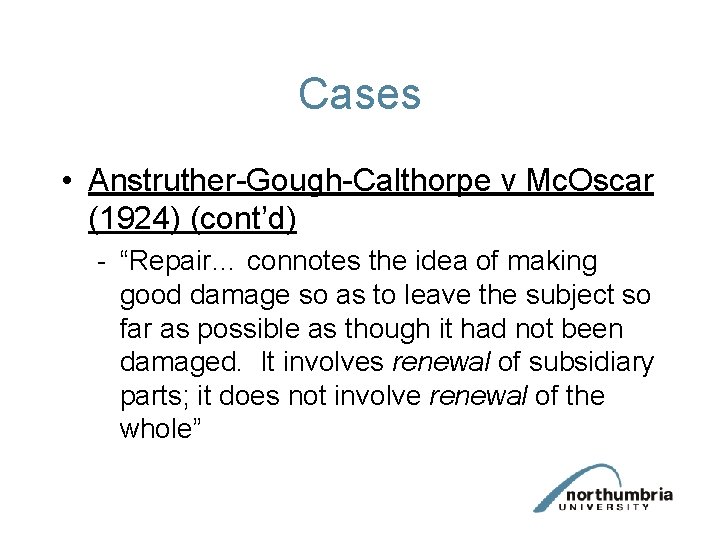
Cases • Anstruther-Gough-Calthorpe v Mc. Oscar (1924) (cont’d) - “Repair… connotes the idea of making good damage so as to leave the subject so far as possible as though it had not been damaged. It involves renewal of subsidiary parts; it does not involve renewal of the whole”
Cases • Mc. Dougall v Easington BC (1989) – Fundamental flaw in design/build remedied by removal of front and rear, roof, windows, doors, interior fittings – T’s appealed first instance decision that works did not qualify as (L’s) repairs. Held: not repairs. – No attempt to reconcile whole body of authority with single statement of principle
Cases • Mc. Dougall v Easington BC (1989) (cont’d) – Three tests for renewal vs repair (apply separately or concurrently as case demands; take into account nature of premises, condition at start, terms of lease): • 1. alteration of substantially whole or a subsidiary part? • 2. whether wholly different character of building produced or not? • 3. ratio of costs to previous value, and effect on value/lifespan of building?
Cases • Mc. Dougall v Easington BC (1989) (cont’d) – Here the works gave “building a new life in a different form” – so not simply repairs • Comment – An extreme case upon which to base tests? – How useful are the tests (when to apply – separate, concurrent? ) – Do terms of tests give rise to more problems – substantial, subsidiary, character?
Cases/concepts • Looked at themes of – Standard of repair – Renewal vs repair • Look at some leading repair cases, which give rise to some surprising principles: – Ravenseft v Davstone (inherent defects can fall under repairing covenant) – Post Office v Aquarius (basement flooded but property not out of repair)
Ravenseft v Davstone • [1979] 1 All ER 929 • Facts: – 16 storey block of maisonettes erected 1958 -1960 – looked like a “set of pigeon holes” – reinforced concrete frame with stone claddings; not practice at time to use expansion joints (but stone cladding and concrete frame have different coefficients of expansion); also stones not properly tied in – part of cladding bowed away from frame
Ravenseft v Davstone – In 1973 some of cladding was observed to be loose and danger of falling – Plaintiff landlord took responsibility for remedial works (defendant tenant disputed liability but assisted with inspection of works) – (By 1973 it had become standard practice to include expansion joints in construction of buildings like this)
Ravenseft v Davstone – Tenant’s repairing covenant was lengthy and tried to cover all eventualities (see case) • Tenant’s argument: – the doctrine of inherent defect applies to tenant’s covenants of repair – – i. e. where disrepair arises from an inherent defect of the demised premises, the result of the defect cannot fall within the tenant’s obligation to repair • Plaintiff: no such doctrine; just ask if works fall within “repair”
Ravenseft v Davstone • Judge’s reasoning: – no need to reconsider Proudfoot, since not about standard of repair – here concerned with what falls under “repair” – Note Lister v lane (Lord Esher) – however large words of covenant it is not a covenant to give back a different thing
Ravenseft v Davstone • Judge’s reasoning: – Reviewed (old) authorities - e. g. Sotheby v Grundy – question is one of degree for result of inherent defect - partial collapse brings within covenant, total collapse falls outside – Concluded that cases do not support the doctrine that disrepair caused by inherent defect gives tenant complete defence; instead it is a matter of degree… – Comes back to Lister v Lane: whether repair or giving back wholly different thing
Ravenseft v Davstone • Judge’s reasoning: – To assist use ratio of cost of works to value of whole premises (see criterion in Mc. Dougall) – Cost of works £ 55 K; £ 50 K for refixing stones and £ 5 K for inserting joints; value of building £ 3 m. • Held – tenant liable for full cost of works
See also (inherent defects) • Stent v Monmouth (1985) • Creska v Hammersmith & Fulham LBC (1998) • Quick v Taff-Ely (1985) …. . disrepair
Post Office v Aquarius • [1987] 1 All ER 1055 • Facts – “highly unusual” – New office building let in 1969 – Defect in structure of basement due to use of porous concrete and defective construction joints; 1979 -1984 water table rose and basement flooded – 1984 water table subsided again; basement dry; no damage caused by the defect
Post Office v Aquarius • T’s repairing covenant in fairly standard form • First instance: three schemes of treatment considered; waterproofing substantial structural addition; cost twice annual rent (15% value) – not repairs
Post Office v Aquarius • L’s appeal that (a) works did not produce wholly different thing (b) substantial additions/alterations/improvements can be repairs if only reasonable way to remedy • Ravenseft referred to: repair can require remedying inherent defect in a building (matter of degree) • Quick v Taff-Ely referred to: disrepair related to physical condition not lack of amenity
Post Office v Aquarius • Ralph Gibson LJ: when water entered damage could have been done; this would be disrepair; no such damage proved; since no disrepair, no liability arisen under tenant’s covenant – Proudfoot does not hold T liable merely to improve so as to remove defect • Slade LJ: clear words are needed to impose obligation on tenants to remedy defects in original construction, before they have caused any damage • Landlord’s appeal dismissed
Click on this slide to see The diagram of case analysis (the Word document will open in a new window)
Drafting • Amendments – commercial lease, repairing covenant, e. g. “Repair and cleaning To put and keep the Property in repair and keep clean neat and tidy”
Drafting • Landlord’s amendments? • Tenant’s amendments? • Further instructions?
Drafting Issues Anatomy of a lease Parties Definitions/Interpretation Demise/Rent Tenant’s covenants e. g. Repair, User, Alienation, Insurance, Alterations, Signage Landlord’s covenants Provisos e. g. Forfeiture Schedules e. g. Rent Review, Service Charge
Drafting Issues • Which clauses interact with the tenant’s repairing covenant (and why)? – ………….
Drafting Issues • “Demised Premises” – Lease of whole – Improvements and additions? – Lease of part (internal demise) • e. g. Top floor/ground floor obligations
Drafting Issues • “Demised Premises” – Building up definition of “internal envelope” (e. g. for retail unit): – ……………. • HM Land Registry/plans
Drafting Issues • Sample tenant’s repairing covenant: “To keep the Demised Premises in good and substantial repair” • Tenant’s amendments? (Click on the slide to view the Word document, which will open in a new window)
Styles of drafting What impact does style of drafting have on repairing obligations? • See the covenant in Post Office v Aquarius Properties Ltd [1987] All ER 1055 – Impact of other terms not considered?
Styles of drafting • See Norwich Union v BRB [1987] 2 EGLR 137 – Hoffman refers to ‘torrential drafting’ (numerous words have same effect) • See Credit Suisse v Beegas Nominees [1994] 5 All ER 803 – ‘fairly torrential’ – not in good condition whether or not out of repair
Styles of drafting • See Welsh v Greenwich [2000] 3 EGLR 41 – Sparse drafting but “condition” had separate effect, adding to “repair” – Social landlord?
Click on this slide to see The diagram of case analysis (the Word document will open in a new window)
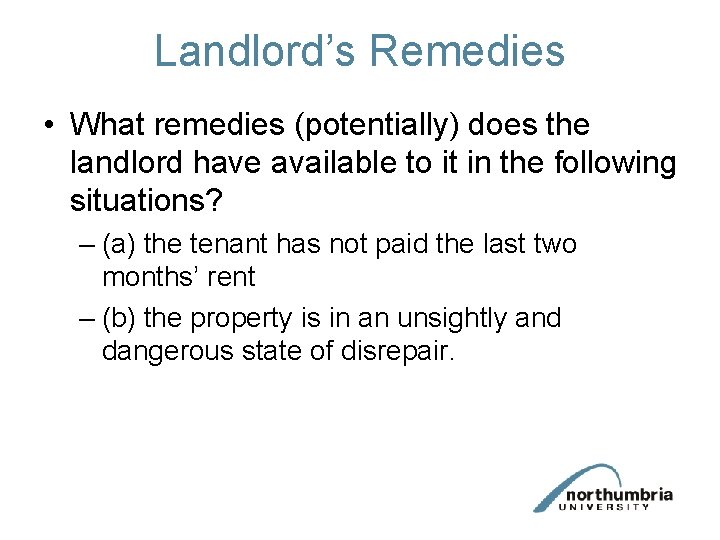
Landlord’s Remedies • What remedies (potentially) does the landlord have available to it in the following situations? – (a) the tenant has not paid the last two months’ rent – (b) the property is in an unsightly and dangerous state of disrepair.
Landlord’s Remedies • Consider non-payment of rent – Rent deposit? – Guarantor/former tenant? – Landlord and Tenant Act 1954? • S 30(1), ground (b) – Action
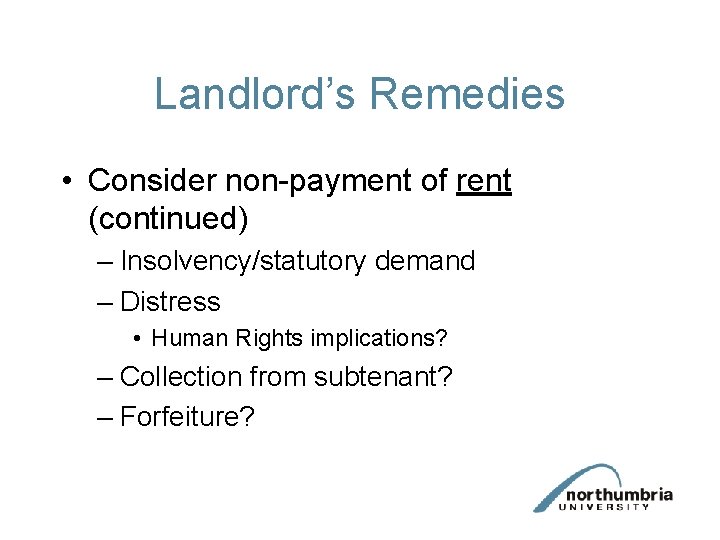
Landlord’s Remedies • Consider non-payment of rent (continued) – Insolvency/statutory demand – Distress • Human Rights implications? – Collection from subtenant? – Forfeiture?
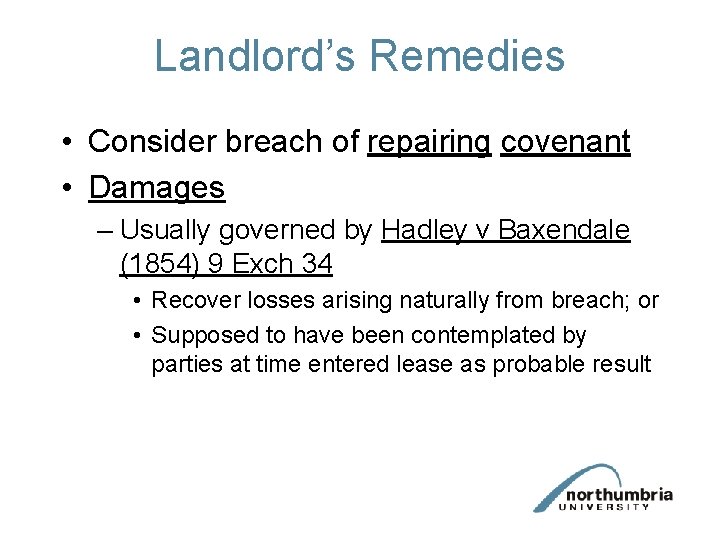
Landlord’s Remedies • Consider breach of repairing covenant • Damages – Usually governed by Hadley v Baxendale (1854) 9 Exch 34 • Recover losses arising naturally from breach; or • Supposed to have been contemplated by parties at time entered lease as probable result
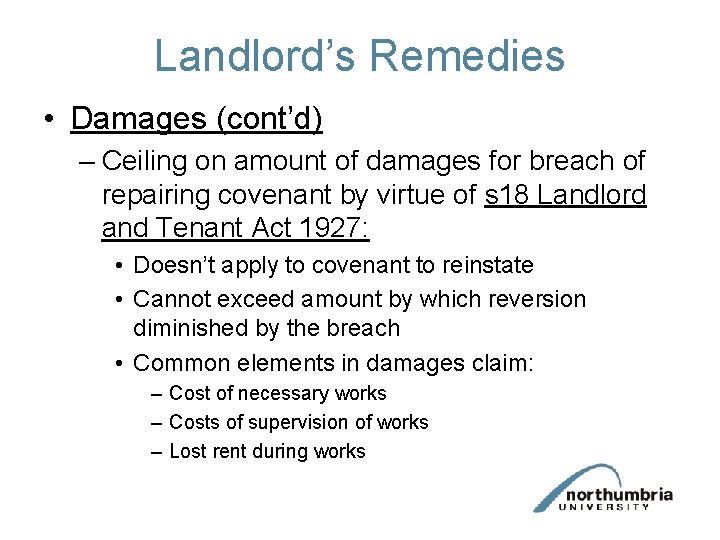
Landlord’s Remedies • Damages (cont’d) – Ceiling on amount of damages for breach of repairing covenant by virtue of s 18 Landlord and Tenant Act 1927: • Doesn’t apply to covenant to reinstate • Cannot exceed amount by which reversion diminished by the breach • Common elements in damages claim: – Cost of necessary works – Costs of supervision of works – Lost rent during works
Landlord’s Remedies • Damages (cont’d) – Ceiling on amount of damages for breach of repairing covenant by virtue of s 18 Landlord and Tenant Act 1927 (Cont’d): • If during term, reduction in reversion value a function of unexpired lease (longer the remainder the less the reduction in value of reversion) • If proceedings at end, court may accept cost of repairs as measure of damages (subject to s 18)
Landlord’s Remedies • Damages (cont’d) • Ceiling on amount of damages for breach of repairing covenant, relevant factors: – Basis of valuation • E. g. 5 storey 1970’s office block in satellite town to city. In disrepair at end of lease. On what bases may it be valued? • • ………………… (see Ultraworth case – next slide)
Landlord’s Remedies • Damages (cont’d) – See Ultraworth Ltd v General Accident Fire & Life [2002] 2 EGLR 254 • valuation bases – Section 18 (1) also provides that no damages available for failure to repair if premises to be pulled down shortly after termination (or works would make repairs valueless)
Landlord’s Remedies • Damages (cont’d) – Is it straightforward to sue for damages on breach of repair? – Leasehold Property (Repairs) Act 1938, s 1 • If lease granted for 7+ years with 3+ years to run, then • Must serve notice under s 146 LPA 1925 and • Tenant has right to serve 28 day counternotice, then leave of court needed by Landlord (see forfeiture)
Landlord’s Remedies • • Forfeiture Meaning? Not an implied right Commercial considerations? – ………………
Landlord’s Remedies Forfeiture (cont’d) • Generally s 146 notice to be served for any breach • Notice contains: - Identity of tenant, premises, covenant, breach, compensation - Options/action depending on whether remediable/irremediable
Landlord’s Remedies Forfeiture ( cont’d) • Irremediable breaches – …………… – ……………
Landlord’s Remedies Forfeiture ( cont’d) • Remediable breaches – ……………. . repair – ……………. . Breach of user? ? /keep open – ……………. . Commission of nuisance – ……………. non-payment of sums due
Landlord’s Remedies Forfeiture ( cont’d) • Waiver of breach – can be implied from conduct – once and for all (irremediable? ) breaches can be waived • Lose right to forfeit – Continuing (remediable? ) breaches – each day constitute continuation of breach • Fresh s 146 notice needed
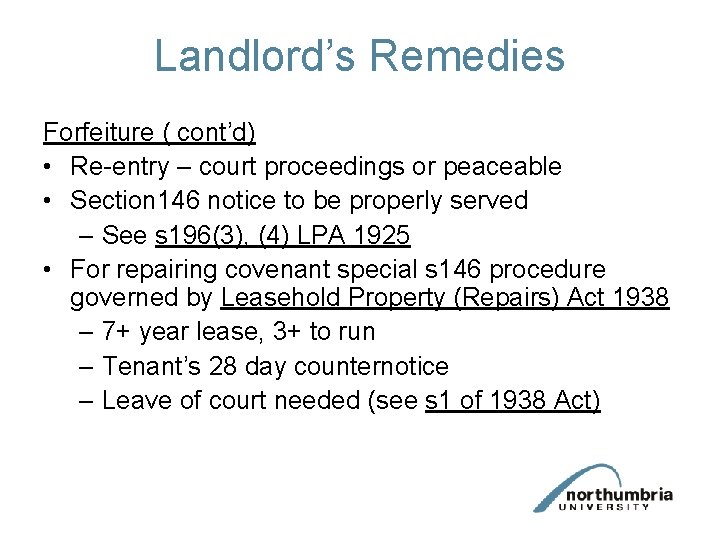
Landlord’s Remedies Forfeiture ( cont’d) • Re-entry – court proceedings or peaceable • Section 146 notice to be properly served – See s 196(3), (4) LPA 1925 • For repairing covenant special s 146 procedure governed by Leasehold Property (Repairs) Act 1938 – 7+ year lease, 3+ to run – Tenant’s 28 day counternotice – Leave of court needed (see s 1 of 1938 Act)
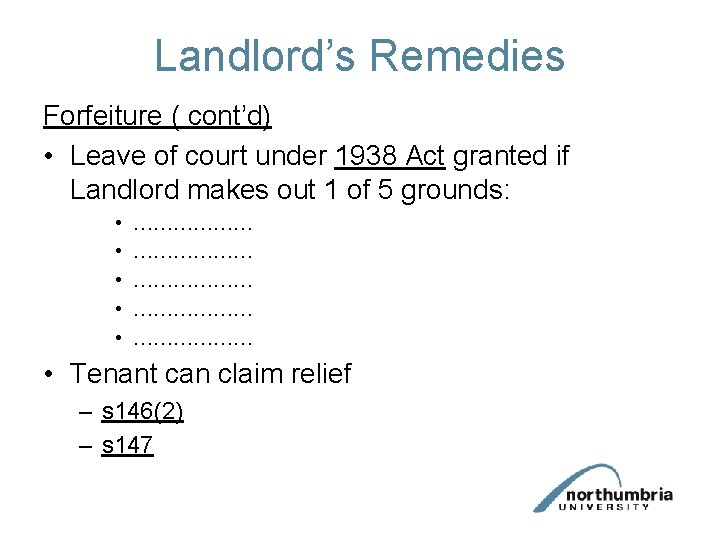
Landlord’s Remedies Forfeiture ( cont’d) • Leave of court under 1938 Act granted if Landlord makes out 1 of 5 grounds: • • • ……………… ……………… • Tenant can claim relief – s 146(2) – s 147
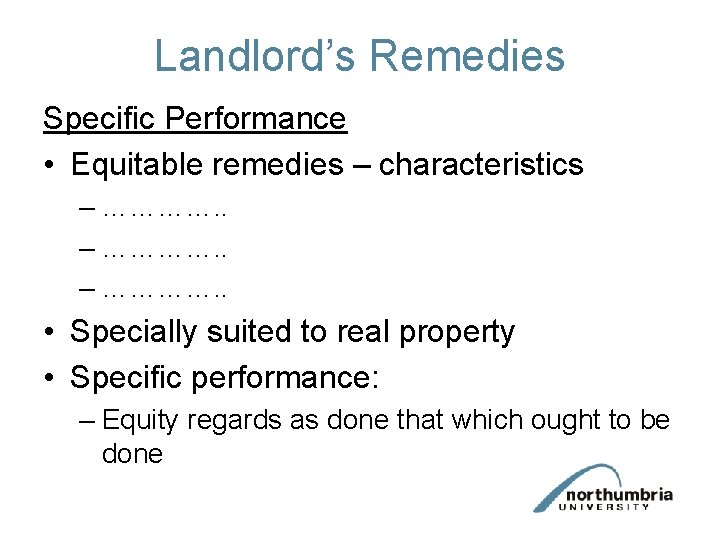
Landlord’s Remedies Specific Performance • Equitable remedies – characteristics – …………. . • Specially suited to real property • Specific performance: – Equity regards as done that which ought to be done
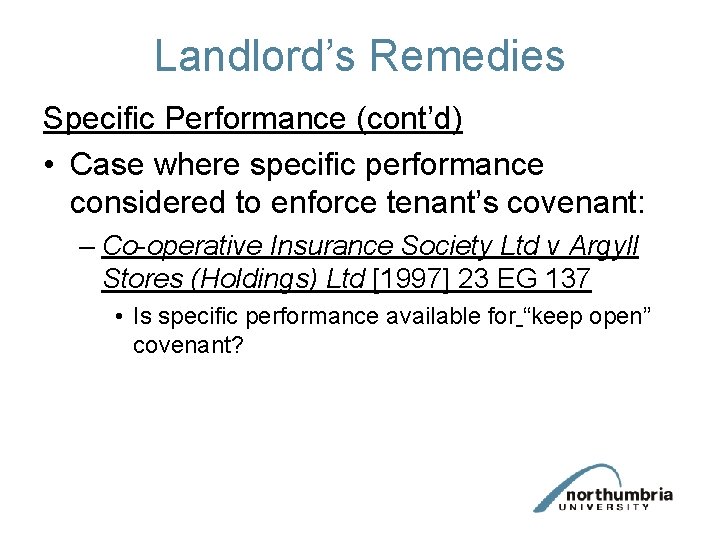
Landlord’s Remedies Specific Performance (cont’d) • Case where specific performance considered to enforce tenant’s covenant: – Co-operative Insurance Society Ltd v Argyll Stores (Holdings) Ltd [1997] 23 EG 137 • Is specific performance available for “keep open” covenant?
Landlord’s Remedies Specific Performance (cont’d) • Compare Argyll Stores case with case about repairing covenant: – Rainbow Estates Ltd v Tokenhold [1999] Ch 64 • How do the courts’ reasoning compare?
Landlord’s Remedies “Self-help” • See case of Jervis v Harris [1996] 1 EGLR 78 • How does this address problems with: – Damages – Forfeiture – Specific performance
Overview & Close