Leveraging CMM and Six Sigma Francesca Pratt March
- Slides: 29
Leveraging CMM and Six Sigma Francesca Pratt March 11, 2003 lu So t en ym tio Pa ns SEPG
lu So t en ym tio Pa Objectives ns SEPG n Describe the importance for aligning the CMM and Six Sigma for First Data n Provide a basic understanding of how the CMM and Six Sigma support each other n Provide examples of how a First Data’s IT organization is integrating the initiatives March 11, 2003 2
tio lu So t en ym n Pa Background ns SEPG Payment Solutions (IT) introduced its CMM Initiative in 1999 – – Focus was to merge the multiple cultures and processes from several IT organizations that were acquired into one organization To be able to determine capability of the organization to meet the business needs Achieved Level 2 in October 2001 Next formal assessment scheduled for September 2003 for Level 3 March 11, 2003 3
tio lu So t en ym n Pa Background ns SEPG First Data introduced the Six Sigma Initiative in 2000 to build a premiere organization – – – Measurement is its foundation that determines the success and focus for the organization Focus on Customer Values (Voice of the Customer) and how to deliver Work to ensure value is delivered when needed and continuously improve our ability to do so March 11, 2003 4
tio lu So t en ym n Pa Background ns SEPG To be successful with the CMM Initiative the following needed to be addressed: – – Need to market the CMM at the corporate level to address the perception of conflicting initiatives Need for strong Senior Management to fight off and maintain the CMM Initiative March 11, 2003 5
tio lu So t en ym n Pa CMM vs. Six Sigma ns SEPG CMM is: – – A common-sense application of process management and quality improvement concepts to software development and maintenance A community-developed guide A model for organizational improvement The underlying structure for reliable and consistent CMM-based appraisal methods March 11, 2003 6
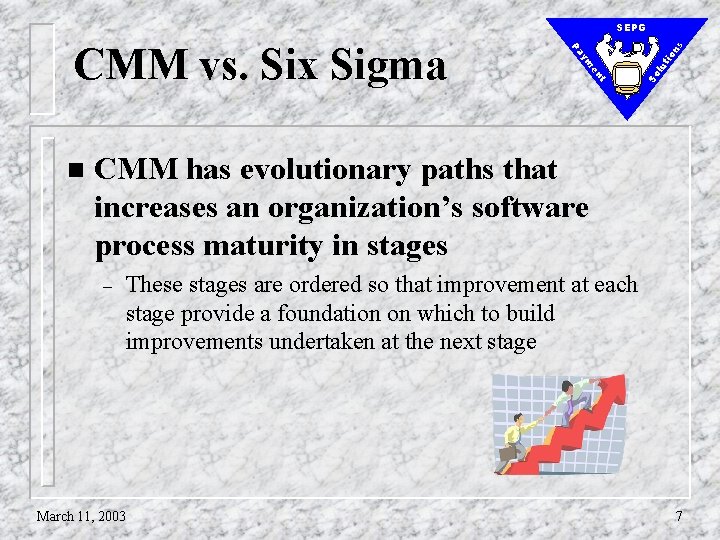
tio lu So t en ym n Pa CMM vs. Six Sigma ns SEPG CMM has evolutionary paths that increases an organization’s software process maturity in stages – These stages are ordered so that improvement at each stage provide a foundation on which to build improvements undertaken at the next stage March 11, 2003 7
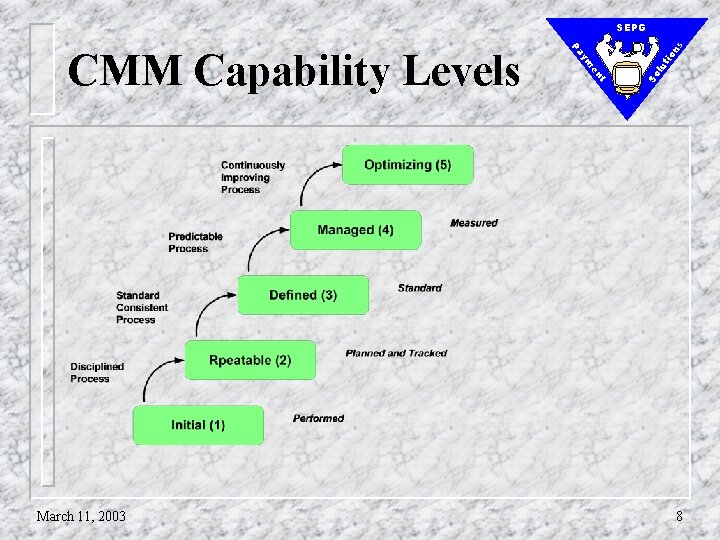
tio lu So t en ym March 11, 2003 Pa CMM Capability Levels ns SEPG 8
tio lu So t en ym n Pa CMM vs. Six Sigma ns SEPG Six Sigma is: – – A business process that allows companies to drastically improve their bottom line by designing and monitoring everyday business activities in ways that minimize waste and resources while increasing customer satisfaction It provides specific methods to re-create the process so that defects and errors never arise in the first place March 11, 2003 9
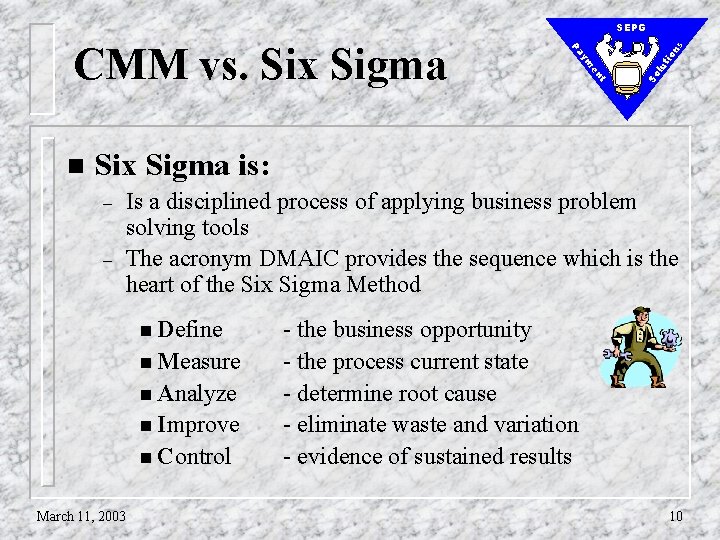
tio lu So t en ym n Pa CMM vs. Six Sigma ns SEPG Six Sigma is: – – Is a disciplined process of applying business problem solving tools The acronym DMAIC provides the sequence which is the heart of the Six Sigma Method n Define n Measure n Analyze n Improve n Control March 11, 2003 - the business opportunity - the process current state - determine root cause - eliminate waste and variation - evidence of sustained results 10
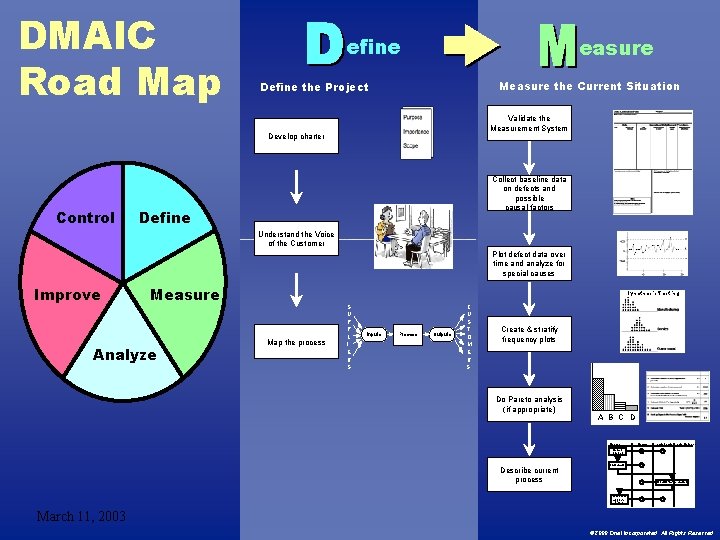
DMAIC Road Map efine easure Measure the Current Situation Define the Project Validate the Measurement System Develop charter Control Collect baseline data on defects and possible causal factors Define Understand the Voice of the Customer Plot defect data over time and analyze for special causes Improve Measure Analyze Hypothesis Testing Map the process S U P P L I E R S Inputs Process Outputs C U S T O M E R S Create & stratify frequency plots Do Pareto analysis (if appropriate) A B C D Sponsor Coach Team Leader Team Members Select project Describe current process Draft charter Discuss/revise charter Review & approve charter March 11, 2003 © 2000 Oriel Incorporated. All Rights Reserved.
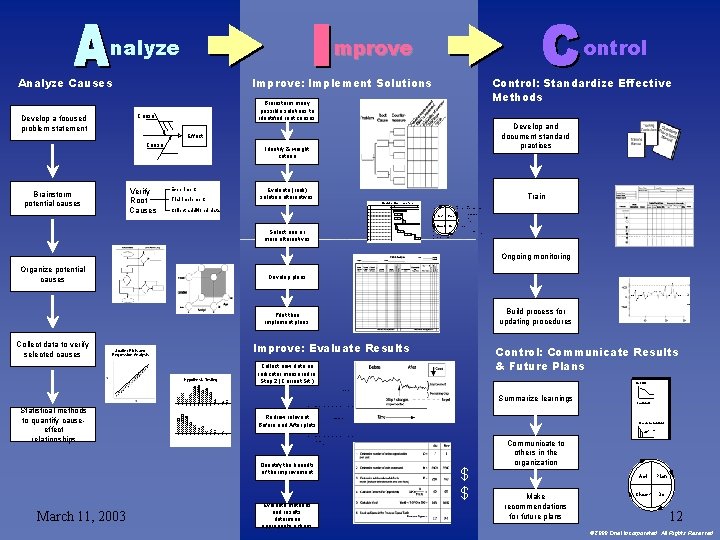
Verify Root Causes Identify & weight criteria Experiment Trial implement tio Develop and document standard practices Effect Brainstorm potential causes lu t Control: Standardize Effective Methods Brainstorm many possible solutions to identified root causes Cause So en Improve: Implement Solutions Cause Develop a focused problem statement ym Analyze Causes ontrol ns mprove Pa nalyze SEPG Evaluate (rank) solution alternatives Train Reduce Call Transfers MAY ID Task Name Collect additional data 5/31 JUNE 6/7 6/14 6/21 6/28 1 Update extension lists 2 3 4 Act Plan Dept supv. update job responsibility lists Calvin, Max, Sheryl Update names and extension numbers Maria Mark responsibilities on phone ext. list Maria 5 Revise auto-attendant 6 Select one or more alternatives Check Assemble team Do 7 Examine data 8 Decide what options should be given 9 Pilot and test new language Calvin Team, TBD Ongoing monitoring Organize potential causes Develop plans Build process for updating procedures Pilot then implement plans Collect data to verify selected causes Improve: Evaluate Results Scatter Plots and Regression Analysis Hypothesis Testing Control: Communicate Results & Future Plans Collect new data on indicator measured in Step 2 (Current Sit. ) Results Made the Sale Summarize learnings Statistical methods to quantify causeeffect relationships 5 10 15 20 30 3 5 40 45 50 55 60 >60 Learnings • • Redraw relevant Before and After plots • Did Not Make the Sale Recommendations next 5 10 15 20 25 30 3 5 40 45 50 55 60 >60 Time With Customer (in minutes) Quantify the benefits of the improvement March 11, 2003 25 Evaluate methods and results; determine appropriate actions $ $ Communicate to others in the organization Make recommendations for future plans Act Plan Check Do 12 © 2000 Oriel Incorporated. All Rights Reserved.
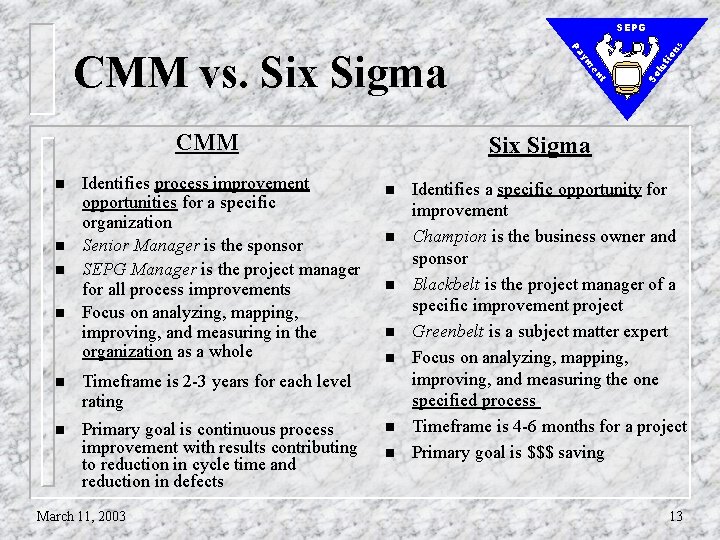
n n n Timeframe is 2 -3 years for each level rating n Primary goal is continuous process improvement with results contributing to reduction in cycle time and reduction in defects March 11, 2003 tio lu So t n Identifies process improvement opportunities for a specific organization Senior Manager is the sponsor SEPG Manager is the project manager for all process improvements Focus on analyzing, mapping, improving, and measuring in the organization as a whole en n ym CMM Pa CMM vs. Six Sigma ns SEPG Six Sigma n n n n Identifies a specific opportunity for improvement Champion is the business owner and sponsor Blackbelt is the project manager of a specific improvement project Greenbelt is a subject matter expert Focus on analyzing, mapping, improving, and measuring the one specified process Timeframe is 4 -6 months for a project Primary goal is $$$ saving 13
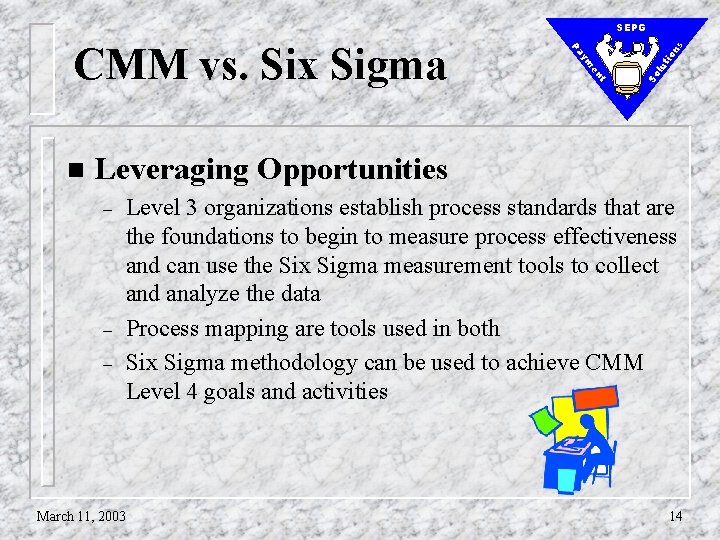
tio lu So t en ym n Pa CMM vs. Six Sigma ns SEPG Leveraging Opportunities – – – Level 3 organizations establish process standards that are the foundations to begin to measure process effectiveness and can use the Six Sigma measurement tools to collect and analyze the data Process mapping are tools used in both Six Sigma methodology can be used to achieve CMM Level 4 goals and activities March 11, 2003 14
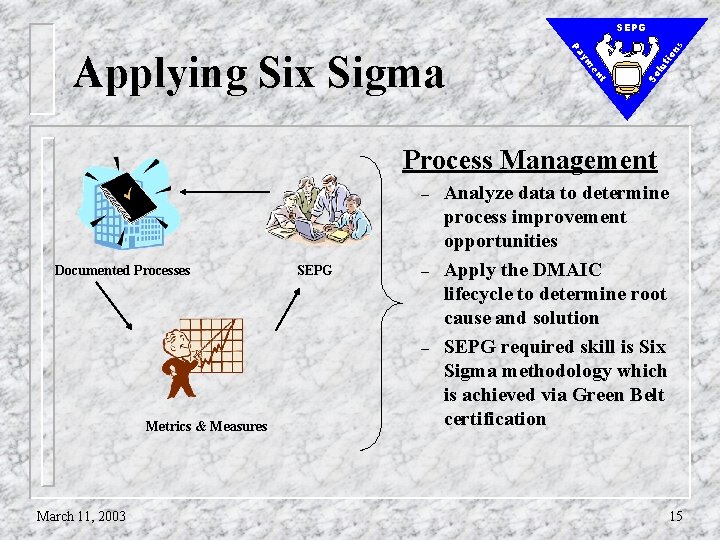
lu So t en ym tio Pa Applying Six Sigma ns SEPG Process Management – Documented Processes SEPG – – Metrics & Measures March 11, 2003 Analyze data to determine process improvement opportunities Apply the DMAIC lifecycle to determine root cause and solution SEPG required skill is Six Sigma methodology which is achieved via Green Belt certification 15
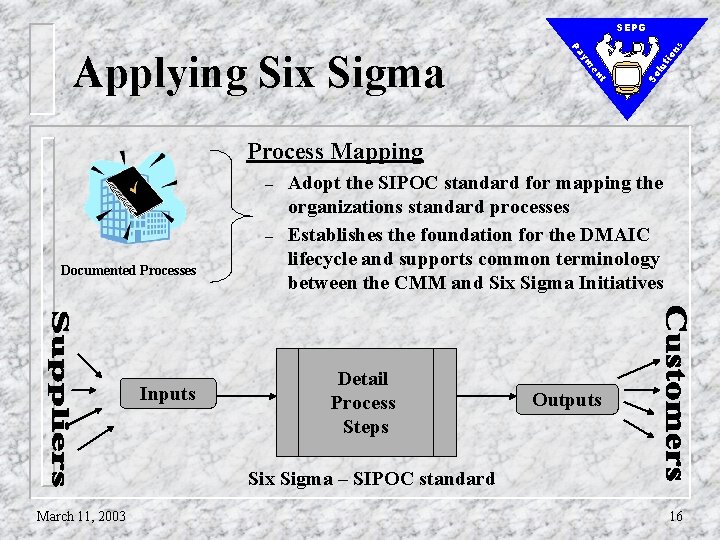
lu So t en ym tio Pa Applying Six Sigma ns SEPG Process Mapping – – Documented Processes Inputs Adopt the SIPOC standard for mapping the organizations standard processes Establishes the foundation for the DMAIC lifecycle and supports common terminology between the CMM and Six Sigma Initiatives Detail Process Steps Outputs Six Sigma – SIPOC standard March 11, 2003 16
tio lu So t en ym n Pa Applying Six Sigma ns SEPG Leverage Six Sigma Methodology to align to the corporate initiative and achieve Level 4 (without even trying) – – At Level 3, measurements have been defined and collected systematically At Level 4, decisions are made based on data collected n n March 11, 2003 Common measurement Data analysis 17
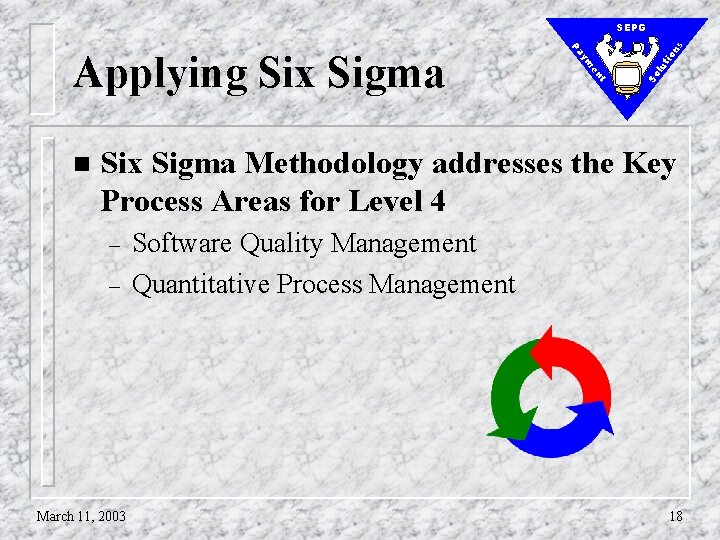
tio lu So t en ym n Pa Applying Six Sigma ns SEPG Six Sigma Methodology addresses the Key Process Areas for Level 4 – – March 11, 2003 Software Quality Management Quantitative Process Management 18
lu So t en n ym Applying Six Sigma tio Pa ns SEPG Quantitative Process Management KPA – – Purpose is to control the process performance of the software project quantitatively Involves: establishing goals for process performance n measuring the performance of the project n analyzing these measurements n making adjustments to maintain process performance within acceptable limits n March 11, 2003 19
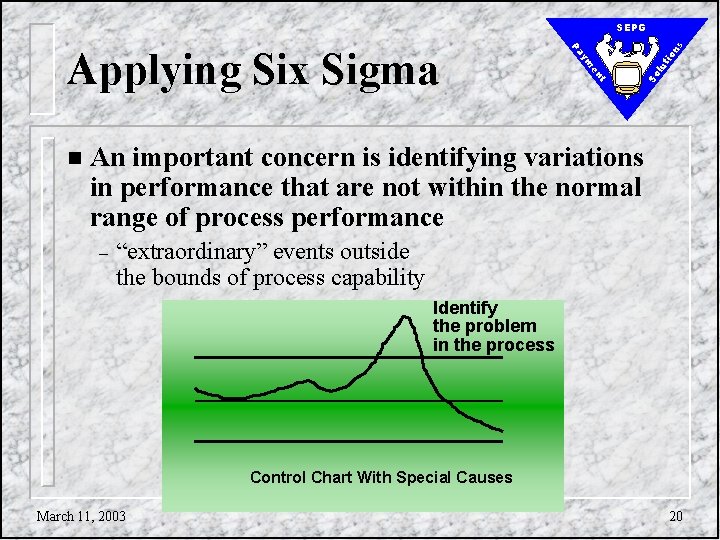
lu So t en ym tio Pa Applying Six Sigma ns SEPG n An important concern is identifying variations in performance that are not within the normal range of process performance – “extraordinary” events outside the bounds of process capability Identify the problem in the process Control Chart With Special Causes March 11, 2003 20
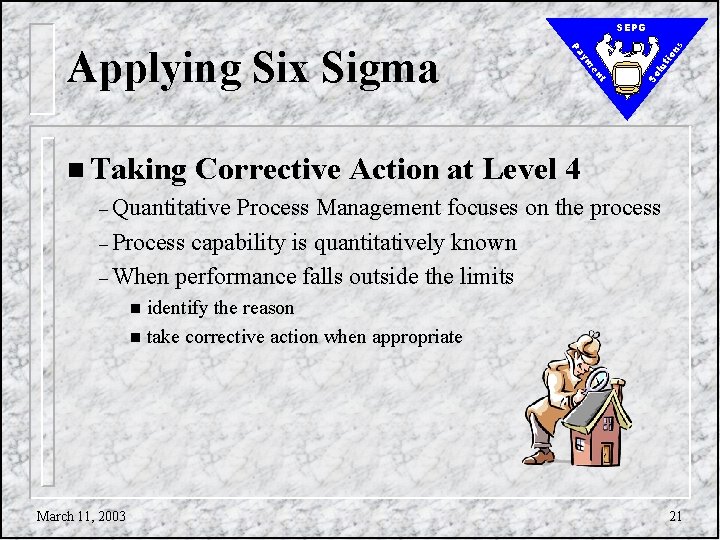
lu So t en ym tio Pa Applying Six Sigma ns SEPG n Taking Corrective Action at Level 4 – Quantitative Process Management focuses on the process – Process capability is quantitatively known – When performance falls outside the limits identify the reason n take corrective action when appropriate n March 11, 2003 21
lu So t en ym tio Pa Applying Six Sigma ns SEPG n The Meaning of Quantitative Control – Quantitative Control in the CMM implies any quantitative or statistically based technique – The words “statistical” and “quantitative” imply data – Data reflect facts – Fact-based management results in objective decisions March 11, 2003 22
lu So t en ym tio Pa Applying Six Sigma ns SEPG n Basic Statistics – Quantitative, or statistical, techniques need not be sophisticated to be useful – Pareto analysis, for example, is fairly simple – Quantitative techniques do require measurable data n consistent data collection n defined, comparable measurements n March 11, 2003 23
tio lu So t en ym n Pa Applying Six Sigma ns SEPG Software Quality Management KPA – – Purpose is to develop a quantitative understanding of the quality of the project’s software products and achieve specific quality goals Involves defining quality goals for the software products n establishing plans to achieve these goals n monitoring and adjusting software plans, software work products, activities, and quality goals to satisfy the needs and desires of customer and end-user n March 11, 2003 24
tio lu So t en ym n Pa Applying Six Sigma ns SEPG Building High-Quality Products – Software Quality Management focuses on the product – Measurable quality goals for the product are defined – The product is “ready” when the goals are achieved March 11, 2003 25
tio lu So t en ym n Pa Applying Six Sigma ns SEPG Quality Evolves – – At Level 2, the focus of quality is “conformance to requirements” By Level 4, there is an emphasis on understanding the needs of the customer – end users – organization (supplier) – – – Ultimately, the customer determines what quality is or is not Total Quality Management revolves around customer satisfaction March 11, 2003 26
tio lu So t en ym n Pa Applying Six Sigma ns SEPG Other areas that are being addressed: – – Developed a standard SDLC to support the Six Sigma Methodology when the solution involves technology Leveraging the “Voice of the Customer” methods to improve the current requirements process March 11, 2003 27
lu So t en ym tio Pa Summary ns SEPG CMM and Six Sigma are not conflicting methodologies n CMM Level 3 provides the foundation for integrating Six Sigma in an efficient manner n Using the Six Sigma methodology supports CMM Level 4 n March 11, 2003 28
lu So t en ym tio Pa Questions ? ? ns SEPG francesca. pratt@firstdata. com March 11, 2003 29