
Process Management Lean Six Sigma Team Member Copyright
Process Management Lean Six Sigma Team Member Copyright Open. Source. Six. Sigma. com
Process Management Vocabulary A Process is a logical, related, sequential (connected) set of activities and tasks that takes an input from a “supplier”, adds value to it, and produces an output that goes to a “customer”. A Major Process is a process that usually involves more than one function within the organizational structure, and its operation has a significant impact on the way the organization functions. When a major process is to complex to be flowcharted at the activity level, it is often divided into sub-processes. A Sub-Process is a portion of a major process that accomplishes a specific objective in support of the major process. Activities are things that go on within a process or sub-process. They are usually performed by a single unit (a person, a machine or a department). An activity is usually documented in an instruction. Tasks are the individual elements and/or subsets of an activity. Normally, tasks relates to how someone or some machine performs a specific assignment. Lean Six Sigma Team Member Copyright Open. Source. Six. Sigma. com
Process Management Vocabulary A Supplier is an entity, person or another process that provides an input into the process under consideration. A Customer is any entity, person or another process that receives an output from the process under consideration. Product/Service Business Processes are directly involved in producing the delivered product or service such as manufacturing a boat or processing a check in a bank. Administrative Business Processes (also called enabling processes) are all of the support processes such as order processing, accounts payable and hiring processes. A Key Process is defined as a process that is important to the success of the business or the customer and/or is in need of immediate improvement to alleviate a business problem. Lean Six Sigma Team Member Copyright Open. Source. Six. Sigma. com
Process Management Vocabulary A Process Management System is an approach used by managers and workgroups to ensure that the outputs of their work efforts are: 1. Predictable (stable). 2. Meeting customer requirements (capable). 3. Are performed quickly and at low cost (efficient). 4. Aligned and optimized to deliver correct results/value to a customer (effective). 5. Capable of quickly changing to meet market and customer demands (adaptable). It is a structured approach to aligning and optimizing how business processes work together to repeatedly and consistently deliver results/value to a customer. A Process Owner is a person who manages the process end-to-end to ensure optimal overall performance, someone who coordinates functional/cross-functional activities at all levels of a work process, a person who has the responsibility to approve changes in the process and a person who sponsors improvement efforts (teams). A Process Member is an individual who is a key contributor or supporter for the successful completion of the deliverables from the process. Lean Six Sigma Team Member Copyright Open. Source. Six. Sigma. com
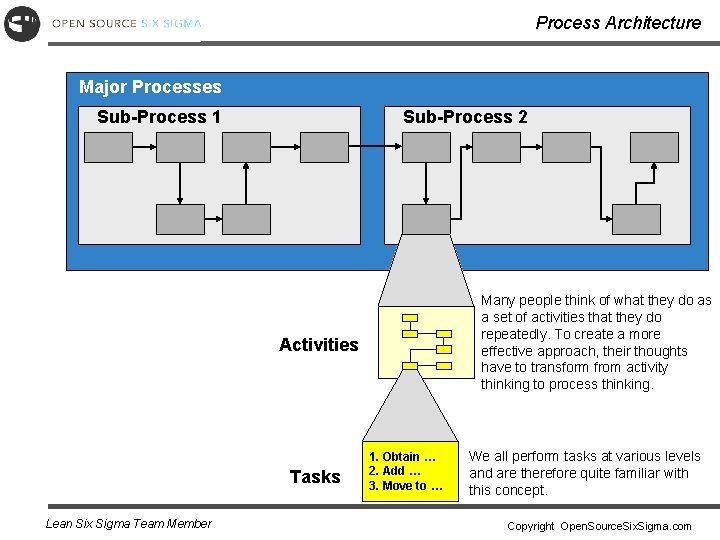
Process Architecture Major Processes Sub-Process 1 Sub-Process 2 Many people think of what they do as a set of activities that they do repeatedly. To create a more effective approach, their thoughts have to transform from activity thinking to process thinking. Activities Tasks Lean Six Sigma Team Member 1. Obtain … 2. Add … 3. Move to … We all perform tasks at various levels and are therefore quite familiar with this concept. Copyright Open. Source. Six. Sigma. com

Fundamental Relationship of Cause and Effect Y • • • is equal to a function of Y Dependent A Process Output The Effect It is a Symptom Can Only be Monitored This is the “Blending” or the way in which the process combines the inputs together with various process activities. (X) • • X 1. . . Xn Independent A Process Input The Cause of a Problem • What Needs to be Controlled The performance of an output or a characteristic we are interested in is a function of the process inputs, called (X’s) and the manner in which the process combines them to provide the resultant output (Y). Written as Y = f(X). Lean Six Sigma Team Member Copyright Open. Source. Six. Sigma. com
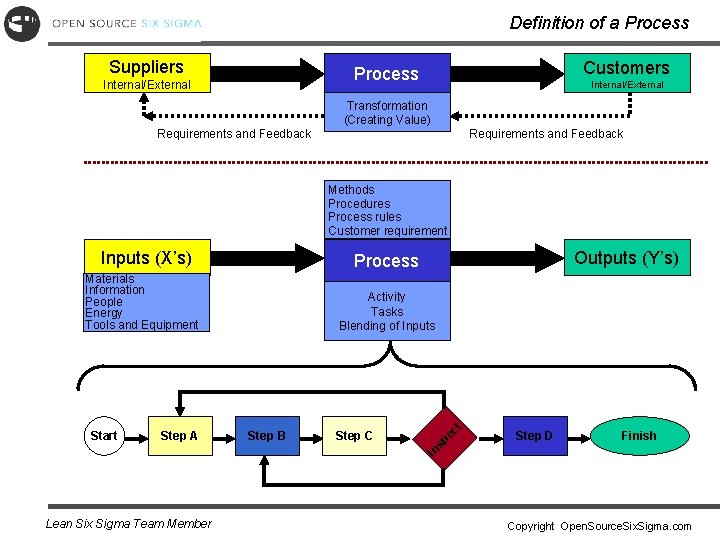
Definition of a Process Suppliers Customers Process Internal/External Transformation (Creating Value) Requirements and Feedback Methods Procedures Process rules Customer requirement Inputs (X’s) Materials Information People Energy Tools and Equipment Step B Step C sp ec t Step A Activity Tasks Blending of Inputs Step D Finish In Start Outputs (Y’s) Process Lean Six Sigma Team Member Copyright Open. Source. Six. Sigma. com
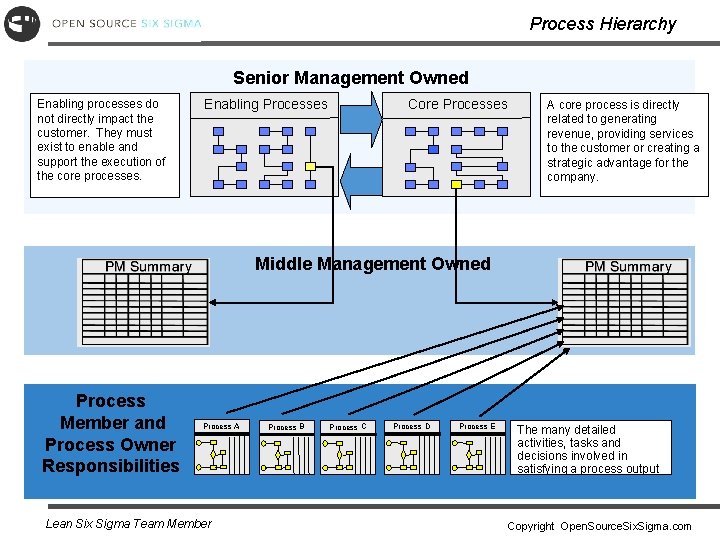
Process Hierarchy Senior Management Owned Enabling processes do not directly impact the customer. They must exist to enable and support the execution of the core processes. Enabling Processes Core Processes A core process is directly related to generating revenue, providing services to the customer or creating a strategic advantage for the company. Middle Management Owned Process Member and Process Owner Responsibilities Process A Lean Six Sigma Team Member Process B Process C Process D Process E The many detailed activities, tasks and decisions involved in satisfying a process output Copyright Open. Source. Six. Sigma. com
Process Management Summary Process Management provides a systematic approach and knowledge about the true workflow while helping prioritize improvement efforts. Benefits: 1. Creates indicators to help manage objectively 2. Focuses on the needs of the customer, the process and the business 3. Provides a structure for the continuous monitoring of an organization’s capability to meet customer requirements 4. Establishes work improvement priorities 5. Provides a common language within and across departments 6. Links together all process activities so the team can better understand perform the necessary work 7. Maintains the gains achieved by problem-solving teams and process redesign teams Lean Six Sigma Team Member Copyright Open. Source. Six. Sigma. com
Business Example Exercise The purpose of this exercise is to identify what we deem as important from our perspective in a business situation and then see how that can be transformed using six sigma’s cause and effect thinking. Read the following background for the exercise: The exercise is about the operation of a movie theatre. First, take the perspective of an owner, read the owner scenario and perform the steps below. Owner Scenario 1. You have invested $14 million in a very successful cinema with many employees. 2. You have been presented another viable business opportunity overseas and you will be out of the country for three consecutive months diligently working this new deal. 3. In order to assure the success of your cinema business and to maintain a continuous income stream, you have asked your staff to fax you a weekly report each Monday morning to your overseas office. What information (measures) would you like to see in that fax? Task 1: Brainstorm as many things as you can think of that you would want included on the fax, try to complete this in 10 minutes or less. Task 2: Write these items in a well organized fashion. Task 3: When finished, proceed to the Customer Scenario. Lean Six Sigma Team Member Copyright Open. Source. Six. Sigma. com
Business Example Exercise Customer Scenario You and a number of your friends have decided to go to a movie as a group. The movie that you would like to see is playing in three different cinemas in your neighborhood. You must decide which theatre you will choose based upon some criteria. The following items in this exercise are common to all three theatres and therefore are not part of your decision criteria. • They are all about the same travel time from your home and the routes are similar. • Each theatre charges the same amount for the movie. • Parking facilities and neighborhood security are the same. • The movie is showing at the same times in each theatre. • The general seating, screen size, sound systems and clientele are the same. Task 1: Brainstorm as many things as you can think of that you would use as a criteria, excluding the items above, to decide to which theatre you would go. Task 3: Write these items in a well organized fashion. Task 4: When finished proceed to the next slide. Lean Six Sigma Team Member Copyright Open. Source. Six. Sigma. com

The X’s (Drivers) & the Y’s (Results) The X’s Customer Perspective (Movie Goers) The Y’s Supplier Perspective (Owners) è Good Popcorn è Ticket Sales è No Sticky Floors è Concession Sales è Clean Restrooms è Labor/Work Force Costs è Short Lines è Profit Reports è Pleasant, Courteous Employees è Other. . . Voice of the Customer “Inputs to the Business” Lean Six Sigma Team Member Voice of the Business “Outputs of the Business” Copyright Open. Source. Six. Sigma. com
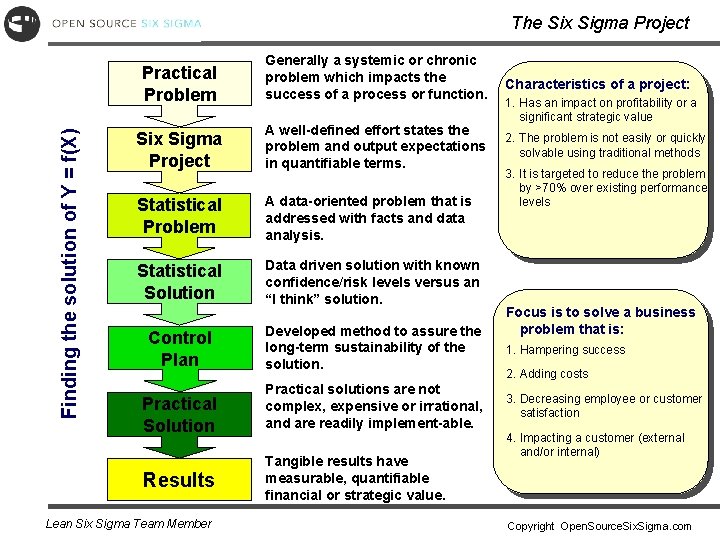
Finding the solution of Y = f(X) The Six Sigma Project Practical Problem Generally a systemic or chronic problem which impacts the success of a process or function. Six Sigma Project A well-defined effort states the problem and output expectations in quantifiable terms. Statistical Problem A data-oriented problem that is addressed with facts and data analysis. Statistical Solution Data driven solution with known confidence/risk levels versus an “I think” solution. Control Plan Developed method to assure the long-term sustainability of the solution. Practical Solution Practical solutions are not complex, expensive or irrational, and are readily implement-able. Results Lean Six Sigma Team Member Tangible results have measurable, quantifiable financial or strategic value. Characteristics of a project: 1. Has an impact on profitability or a significant strategic value 2. The problem is not easily or quickly solvable using traditional methods 3. It is targeted to reduce the problem by >70% over existing performance levels Focus is to solve a business problem that is: 1. Hampering success 2. Adding costs 3. Decreasing employee or customer satisfaction 4. Impacting a customer (external and/or internal) Copyright Open. Source. Six. Sigma. com

Six Sigma Roles Six Sigma provides a structure of skill levels and knowledge for all members of the organization. Executive Deployment Leader Champions Master Black Belts Each group has well defined roles and responsibilities and linkages of communication. Black Belts Green Belts Yellow Belts All Employees Lean Six Sigma Team Member Effect: Individuals are focused on and capable of meeting the needs of the business & customer. Copyright Open. Source. Six. Sigma. com
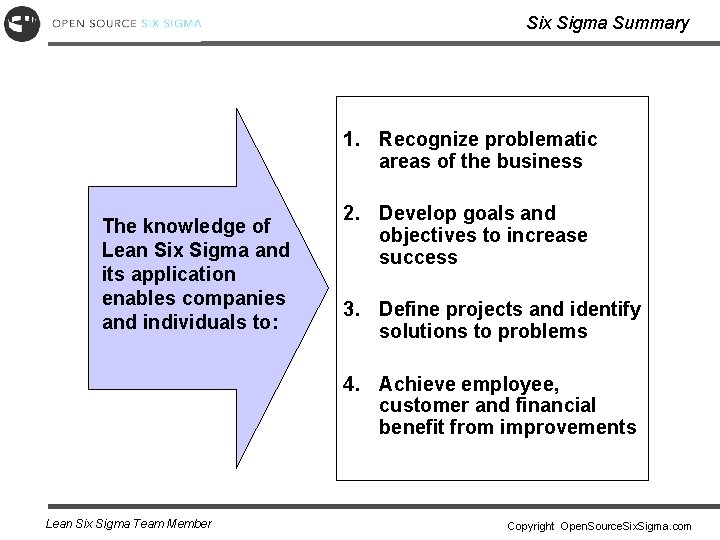
Six Sigma Summary 1. Recognize problematic areas of the business The knowledge of Lean Six Sigma and its application enables companies and individuals to: 2. Develop goals and objectives to increase success 3. Define projects and identify solutions to problems 4. Achieve employee, customer and financial benefit from improvements Lean Six Sigma Team Member Copyright Open. Source. Six. Sigma. com
- Slides: 15