Lecture V Distance Indicators in Cosmology Physics 8803
- Slides: 40
Lecture V: Distance Indicators in Cosmology Physics 8803 February 6, 2019 1
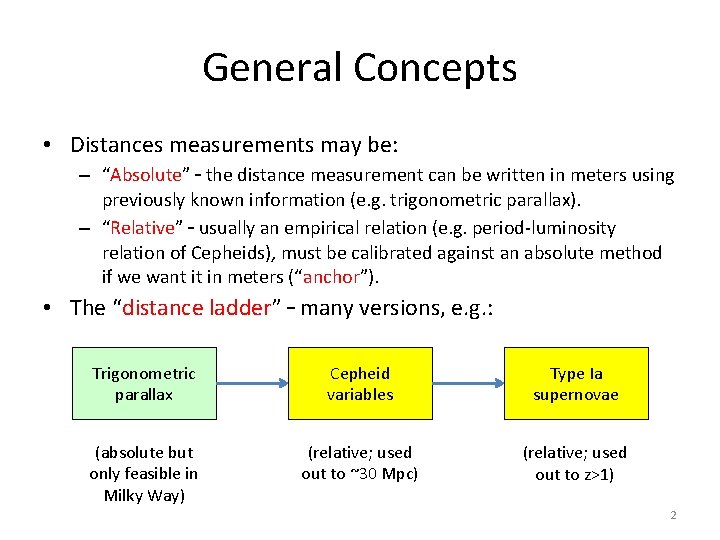
General Concepts • Distances measurements may be: – “Absolute” – the distance measurement can be written in meters using previously known information (e. g. trigonometric parallax). – “Relative” – usually an empirical relation (e. g. period-luminosity relation of Cepheids), must be calibrated against an absolute method if we want it in meters (“anchor”). • The “distance ladder” – many versions, e. g. : Trigonometric parallax Cepheid variables Type Ia supernovae (absolute but only feasible in Milky Way) (relative; used out to ~30 Mpc) (relative; used out to z>1) 2
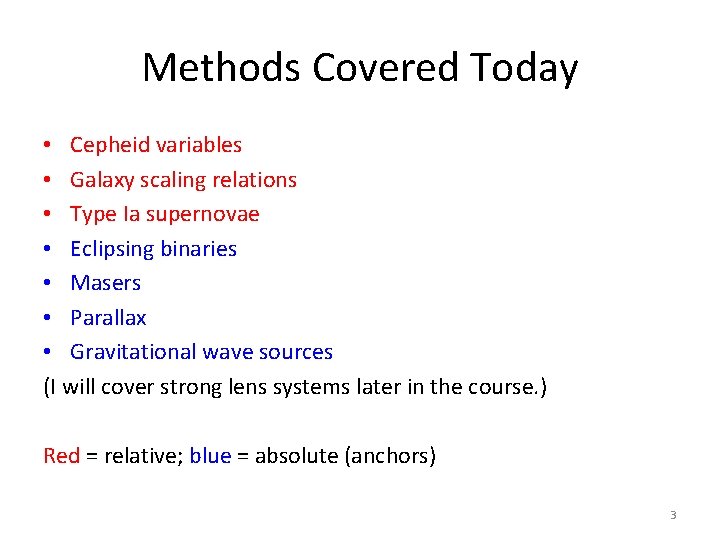
Methods Covered Today • Cepheid variables • Galaxy scaling relations • Type Ia supernovae • Eclipsing binaries • Masers • Parallax • Gravitational wave sources (I will cover strong lens systems later in the course. ) Red = relative; blue = absolute (anchors) 3
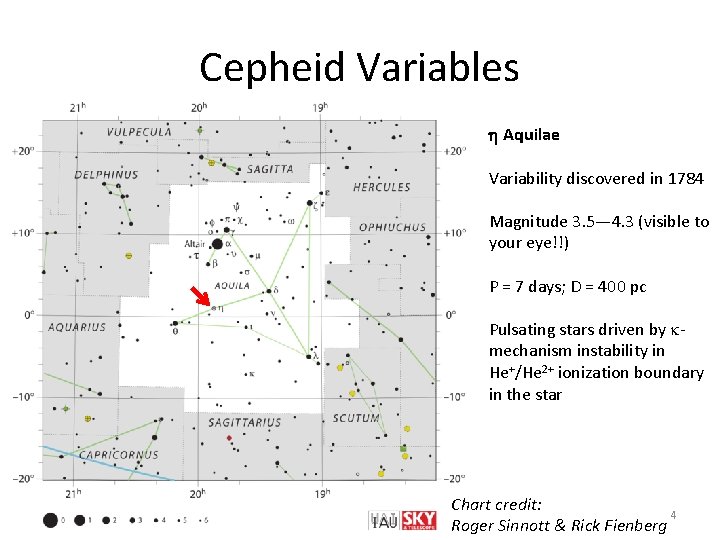
Cepheid Variables h Aquilae Variability discovered in 1784 Magnitude 3. 5— 4. 3 (visible to your eye!!) P = 7 days; D = 400 pc Pulsating stars driven by kmechanism instability in He+/He 2+ ionization boundary in the star Chart credit: 4 Roger Sinnott & Rick Fienberg
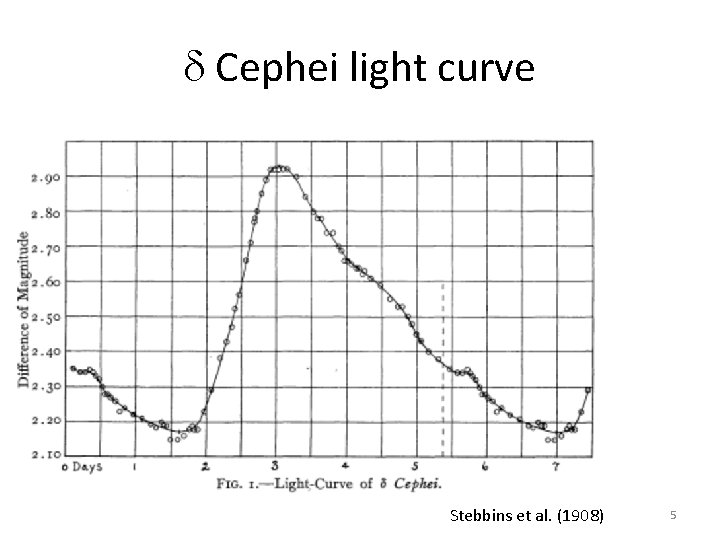
d Cephei light curve Stebbins et al. (1908) 5
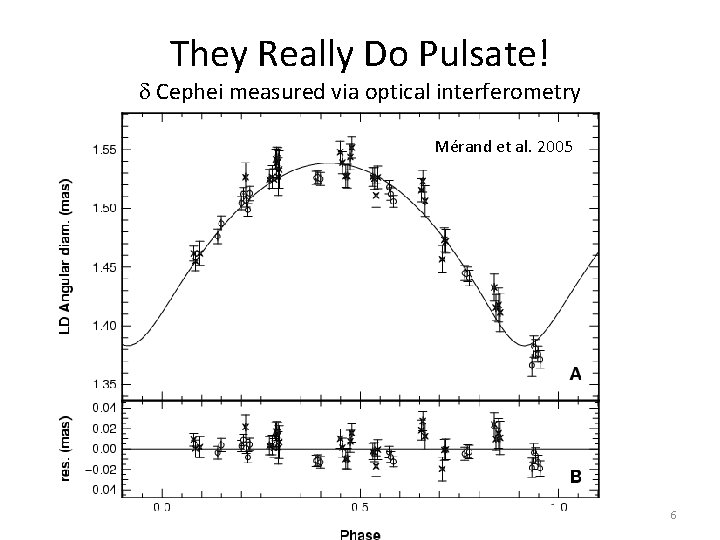
They Really Do Pulsate! d Cephei measured via optical interferometry Mérand et al. 2005 6
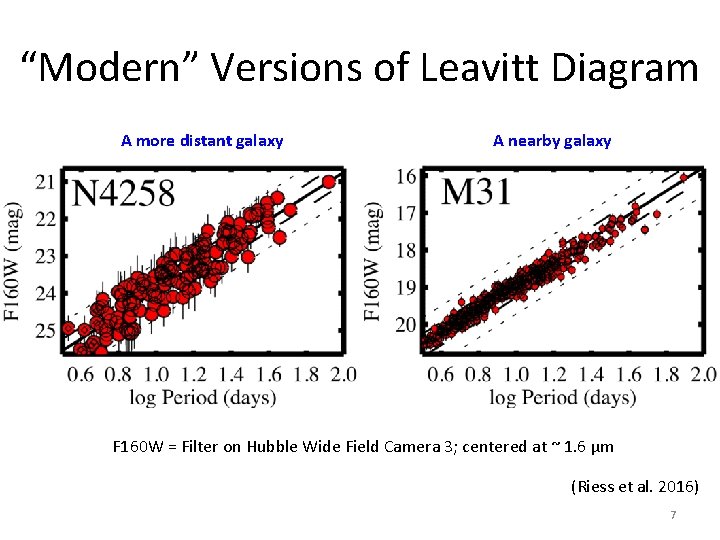
“Modern” Versions of Leavitt Diagram A more distant galaxy A nearby galaxy F 160 W = Filter on Hubble Wide Field Camera 3; centered at ~ 1. 6 µm (Riess et al. 2016) 7
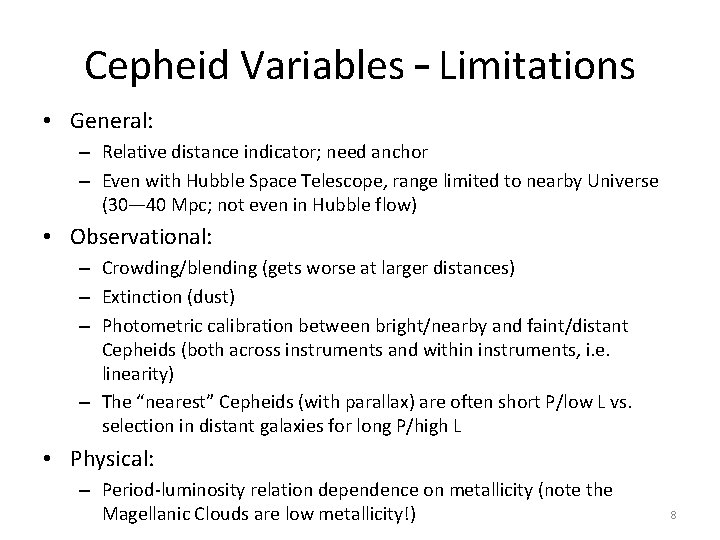
Cepheid Variables – Limitations • General: – Relative distance indicator; need anchor – Even with Hubble Space Telescope, range limited to nearby Universe (30— 40 Mpc; not even in Hubble flow) • Observational: – Crowding/blending (gets worse at larger distances) – Extinction (dust) – Photometric calibration between bright/nearby and faint/distant Cepheids (both across instruments and within instruments, i. e. linearity) – The “nearest” Cepheids (with parallax) are often short P/low L vs. selection in distant galaxies for long P/high L • Physical: – Period-luminosity relation dependence on metallicity (note the Magellanic Clouds are low metallicity!) 8
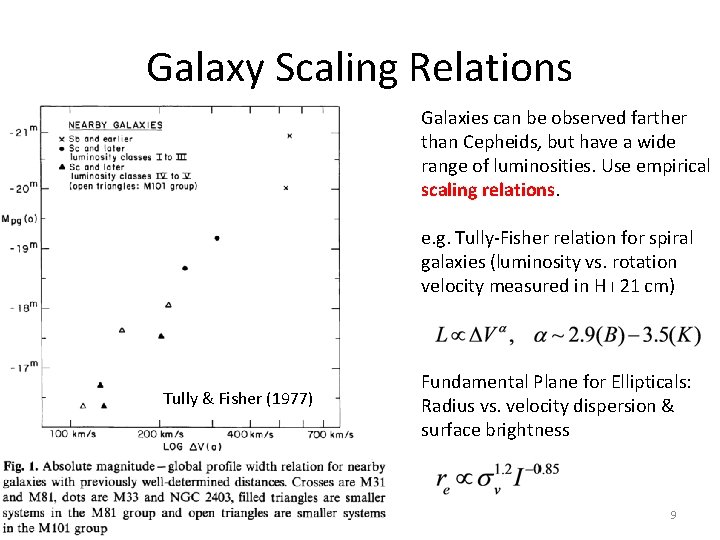
Galaxy Scaling Relations Galaxies can be observed farther than Cepheids, but have a wide range of luminosities. Use empirical scaling relations. e. g. Tully-Fisher relation for spiral galaxies (luminosity vs. rotation velocity measured in H I 21 cm) Tully & Fisher (1977) Fundamental Plane for Ellipticals: Radius vs. velocity dispersion & surface brightness 9
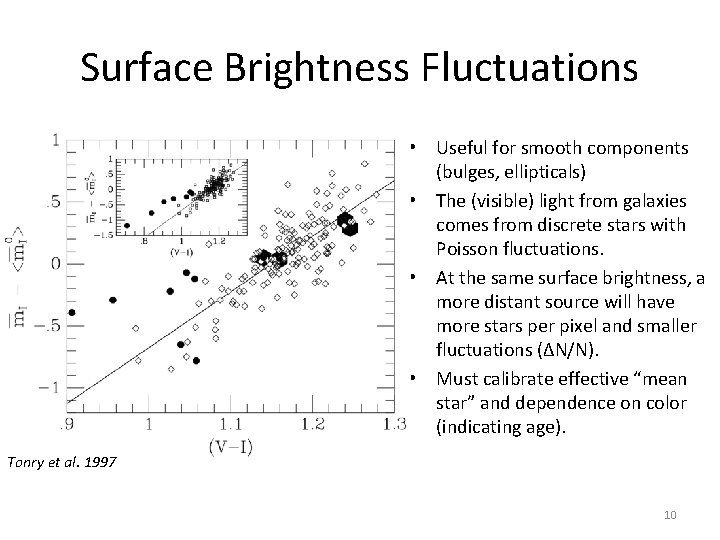
Surface Brightness Fluctuations • Useful for smooth components (bulges, ellipticals) • The (visible) light from galaxies comes from discrete stars with Poisson fluctuations. • At the same surface brightness, a more distant source will have more stars per pixel and smaller fluctuations (∆N/N). • Must calibrate effective “mean star” and dependence on color (indicating age). Tonry et al. 1997 10
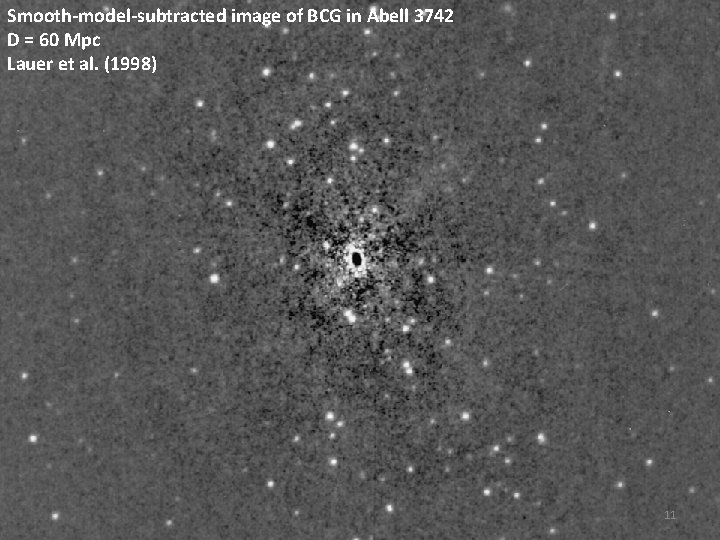
Smooth-model-subtracted image of BCG in Abell 3742 D = 60 Mpc Lauer et al. (1998) 11
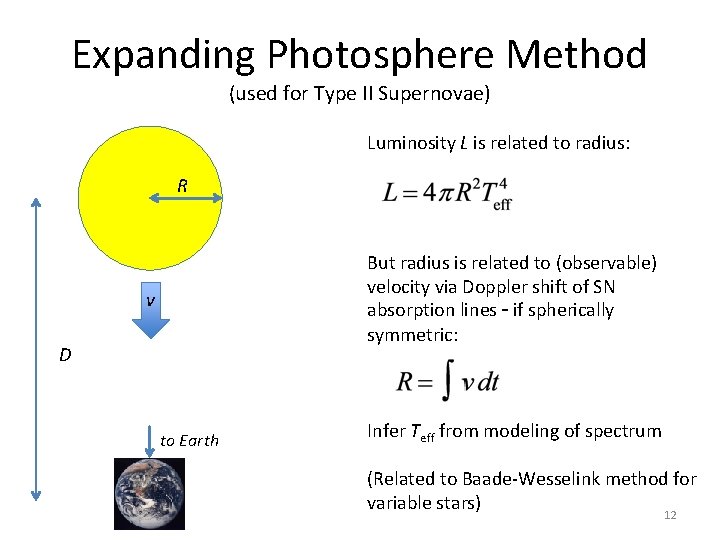
Expanding Photosphere Method (used for Type II Supernovae) Luminosity L is related to radius: R But radius is related to (observable) velocity via Doppler shift of SN absorption lines – if spherically symmetric: v D to Earth Infer Teff from modeling of spectrum (Related to Baade-Wesselink method for variable stars) 12
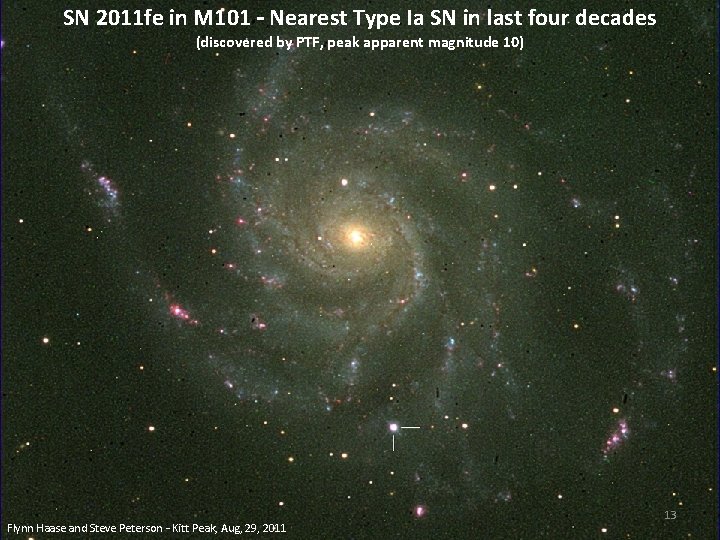
SN 2011 fe in M 101 – Nearest Type Ia SN in last four decades (discovered by PTF, peak apparent magnitude 10) Flynn Haase and Steve Peterson – Kitt Peak, Aug, 29, 2011 13
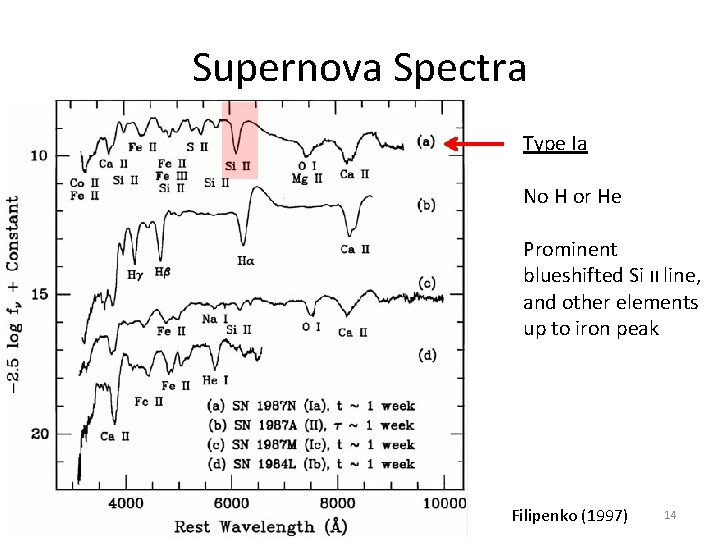
Supernova Spectra Type Ia No H or He Prominent blueshifted Si II line, and other elements up to iron peak Filipenko (1997) 14
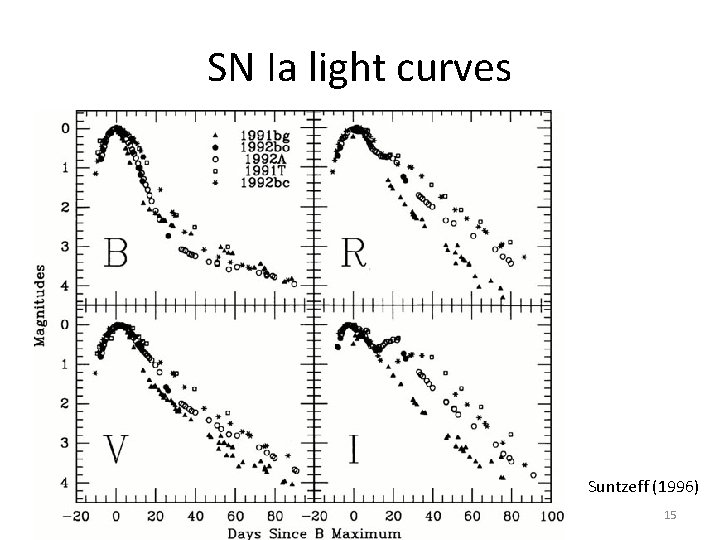
SN Ia light curves Suntzeff (1996) 15
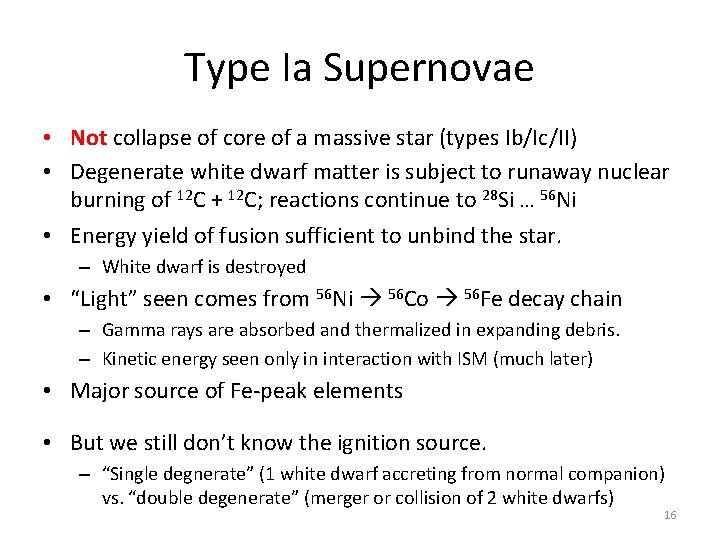
Type Ia Supernovae • Not collapse of core of a massive star (types Ib/Ic/II) • Degenerate white dwarf matter is subject to runaway nuclear burning of 12 C + 12 C; reactions continue to 28 Si … 56 Ni • Energy yield of fusion sufficient to unbind the star. – White dwarf is destroyed • “Light” seen comes from 56 Ni 56 Co 56 Fe decay chain – Gamma rays are absorbed and thermalized in expanding debris. – Kinetic energy seen only in interaction with ISM (much later) • Major source of Fe-peak elements • But we still don’t know the ignition source. – “Single degnerate” (1 white dwarf accreting from normal companion) vs. “double degenerate” (merger or collision of 2 white dwarfs) 16
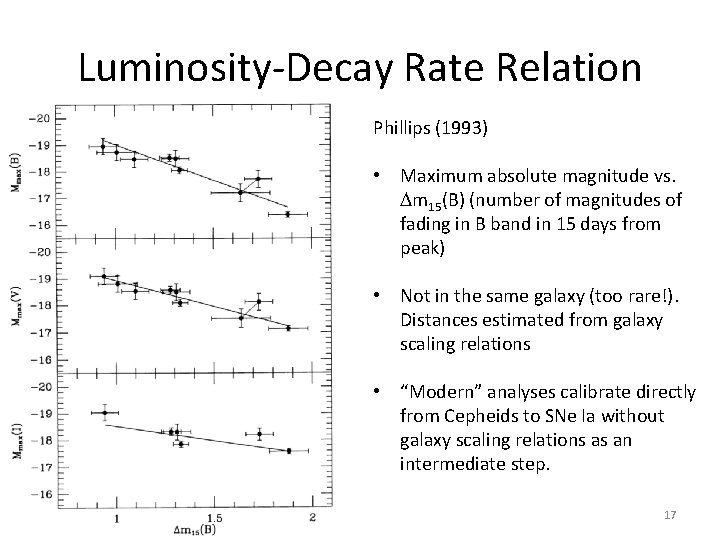
Luminosity-Decay Rate Relation Phillips (1993) • Maximum absolute magnitude vs. Dm 15(B) (number of magnitudes of fading in B band in 15 days from peak) • Not in the same galaxy (too rare!). Distances estimated from galaxy scaling relations • “Modern” analyses calibrate directly from Cepheids to SNe Ia without galaxy scaling relations as an intermediate step. 17
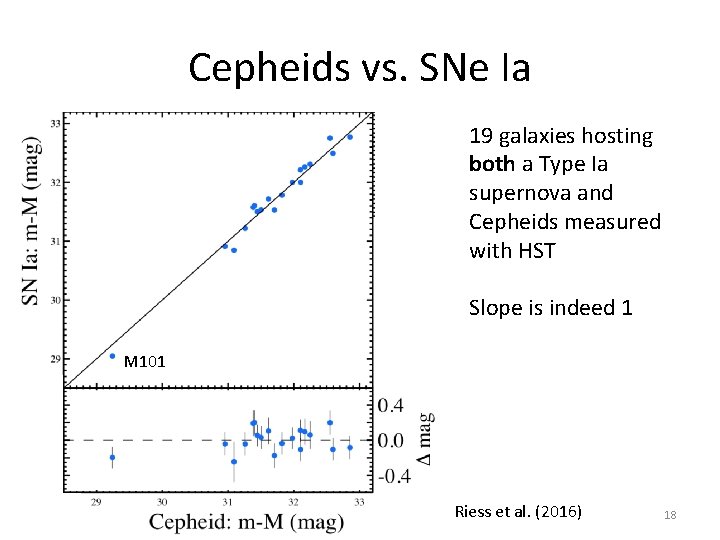
Cepheids vs. SNe Ia 19 galaxies hosting both a Type Ia supernova and Cepheids measured with HST Slope is indeed 1 M 101 Riess et al. (2016) 18
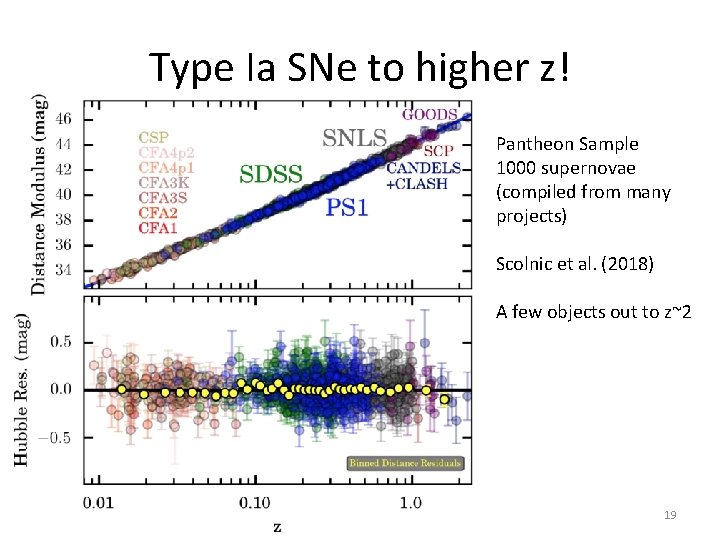
Type Ia SNe to higher z! Pantheon Sample 1000 supernovae (compiled from many projects) Scolnic et al. (2018) A few objects out to z~2 19
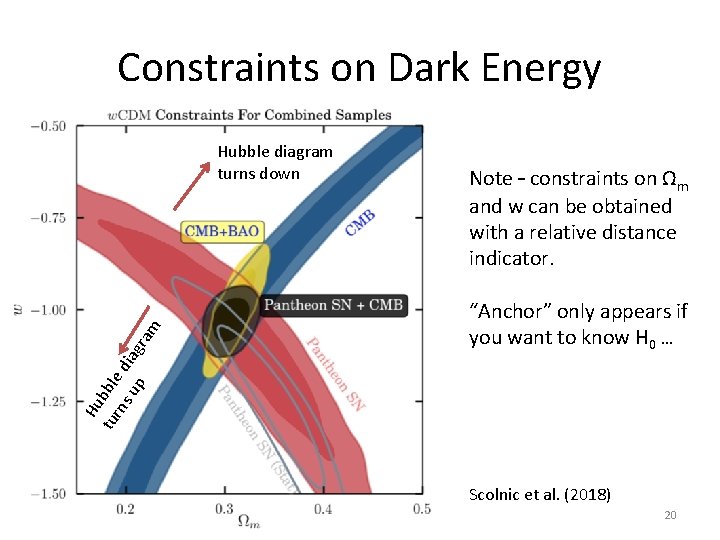
Constraints on Dark Energy Hu tu bble rn s u dia gra p m Hubble diagram turns down Note – constraints on Ωm and w can be obtained with a relative distance indicator. “Anchor” only appears if you want to know H 0 … Scolnic et al. (2018) 20
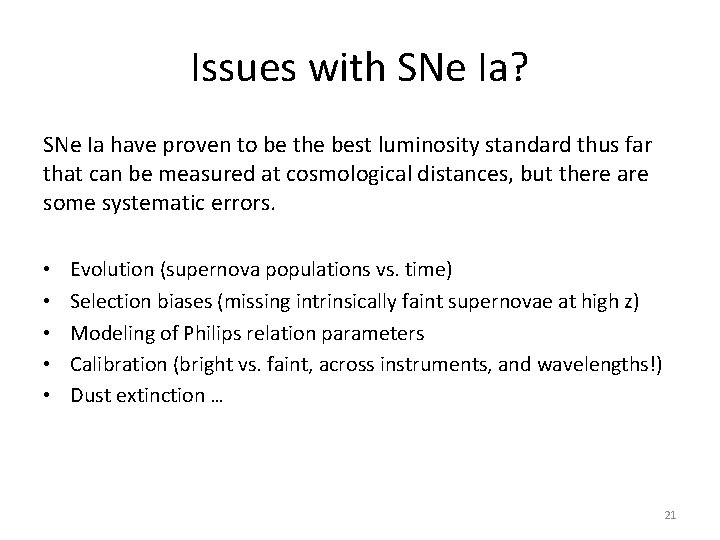
Issues with SNe Ia? SNe Ia have proven to be the best luminosity standard thus far that can be measured at cosmological distances, but there are some systematic errors. • • • Evolution (supernova populations vs. time) Selection biases (missing intrinsically faint supernovae at high z) Modeling of Philips relation parameters Calibration (bright vs. faint, across instruments, and wavelengths!) Dust extinction … 21
Distance “Anchors” • Historically, wanted to know H 0 • Can only do this with an absolute distance measurement that calibrates the Cepheid distance scale. • Usually based on fortuitous circumstances that allow measurement of distance to one object. 22
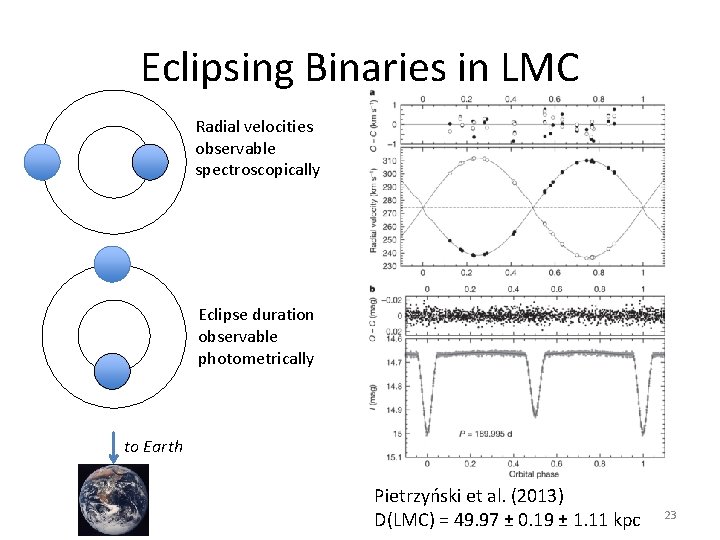
Eclipsing Binaries in LMC Radial velocities observable spectroscopically Eclipse duration observable photometrically to Earth Pietrzyński et al. (2013) D(LMC) = 49. 97 ± 0. 19 ± 1. 11 kpc 23
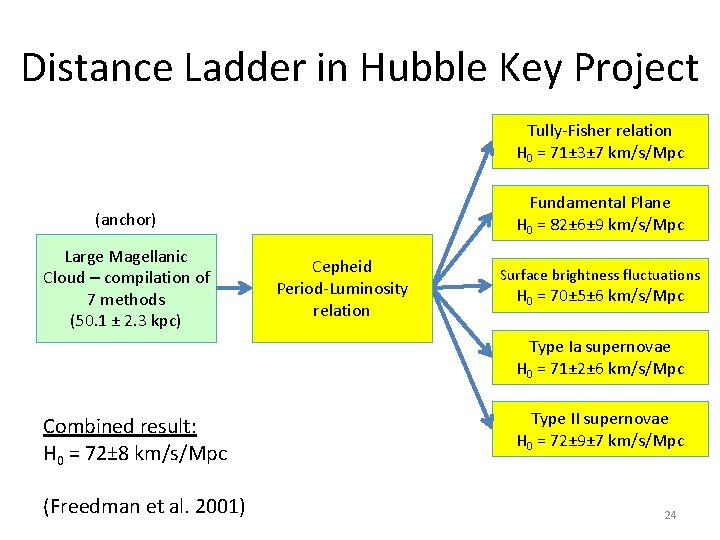
Distance Ladder in Hubble Key Project Tully-Fisher relation H 0 = 71± 3± 7 km/s/Mpc Fundamental Plane H 0 = 82± 6± 9 km/s/Mpc (anchor) Large Magellanic Cloud – compilation of 7 methods (50. 1 ± 2. 3 kpc) Cepheid Period-Luminosity relation Surface brightness fluctuations H 0 = 70± 5± 6 km/s/Mpc Type Ia supernovae H 0 = 71± 2± 6 km/s/Mpc Combined result: H 0 = 72± 8 km/s/Mpc (Freedman et al. 2001) Type II supernovae H 0 = 72± 9± 7 km/s/Mpc 24
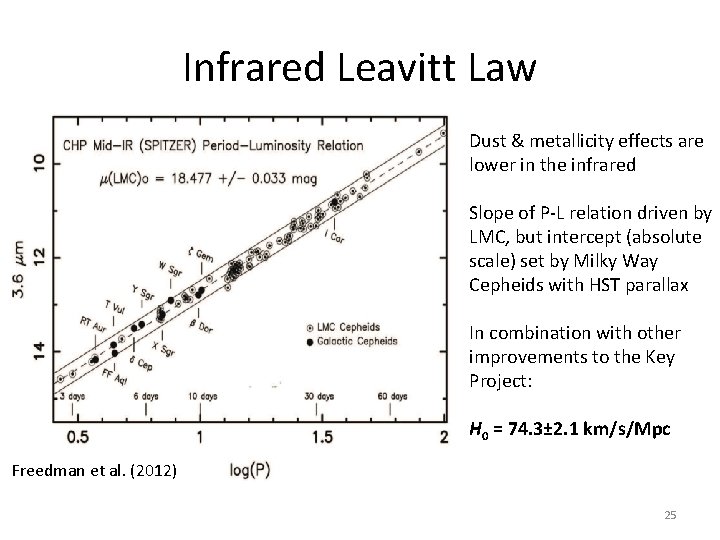
Infrared Leavitt Law Dust & metallicity effects are lower in the infrared Slope of P-L relation driven by LMC, but intercept (absolute scale) set by Milky Way Cepheids with HST parallax In combination with other improvements to the Key Project: H 0 = 74. 3± 2. 1 km/s/Mpc Freedman et al. (2012) 25
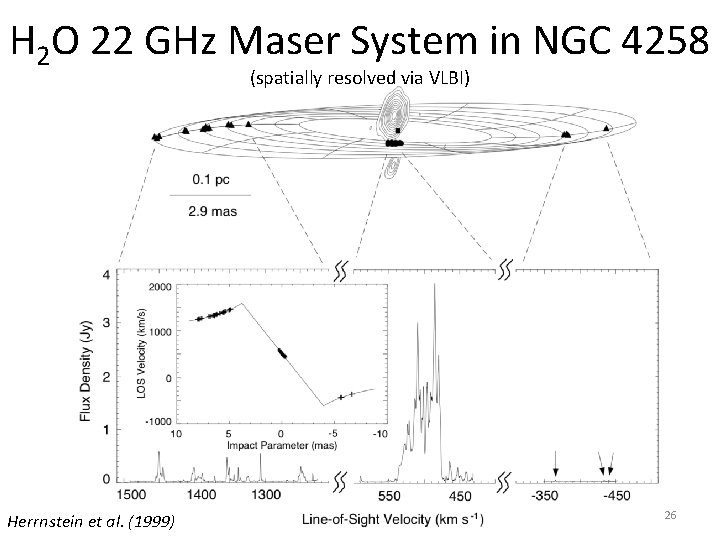
H 2 O 22 GHz Maser System in NGC 4258 (spatially resolved via VLBI) Herrnstein et al. (1999) 26
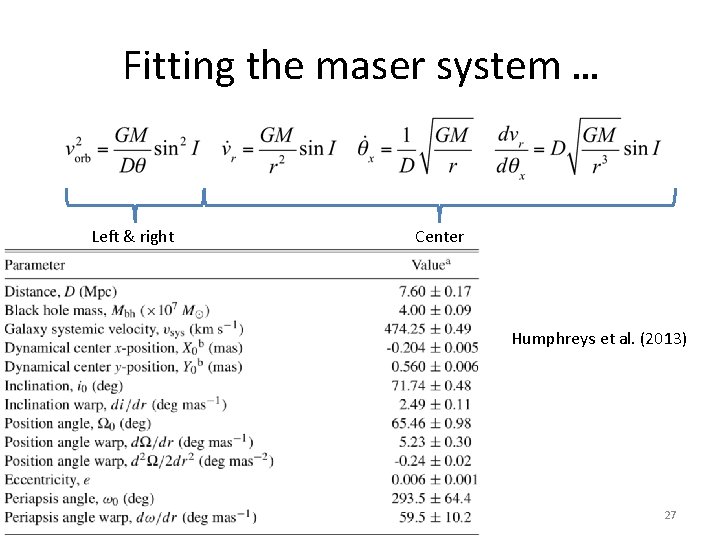
Fitting the maser system … Left & right Center Humphreys et al. (2013) 27
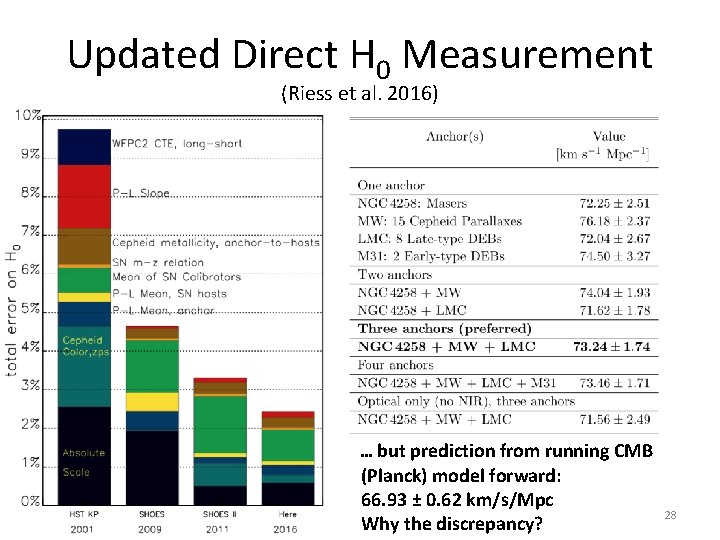
Updated Direct H 0 Measurement (Riess et al. 2016) … but prediction from running CMB (Planck) model forward: 66. 93 ± 0. 62 km/s/Mpc Why the discrepancy? 28
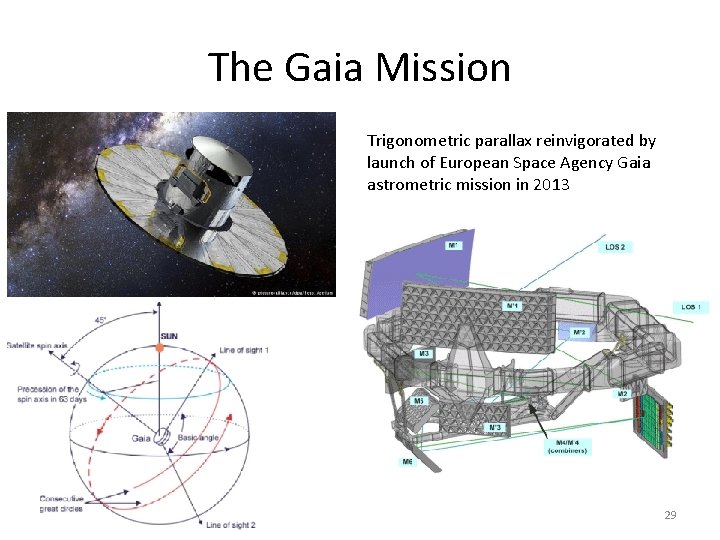
The Gaia Mission Trigonometric parallax reinvigorated by launch of European Space Agency Gaia astrometric mission in 2013 29
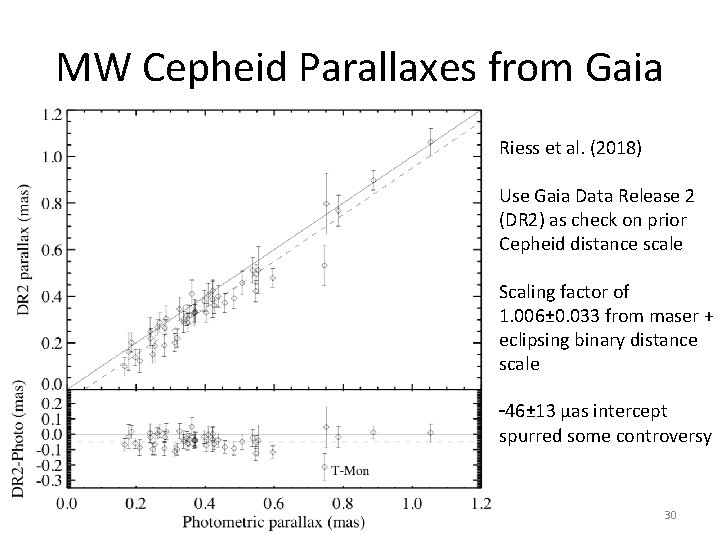
MW Cepheid Parallaxes from Gaia Riess et al. (2018) Use Gaia Data Release 2 (DR 2) as check on prior Cepheid distance scale Scaling factor of 1. 006± 0. 033 from maser + eclipsing binary distance scale – 46± 13 µas intercept spurred some controversy 30
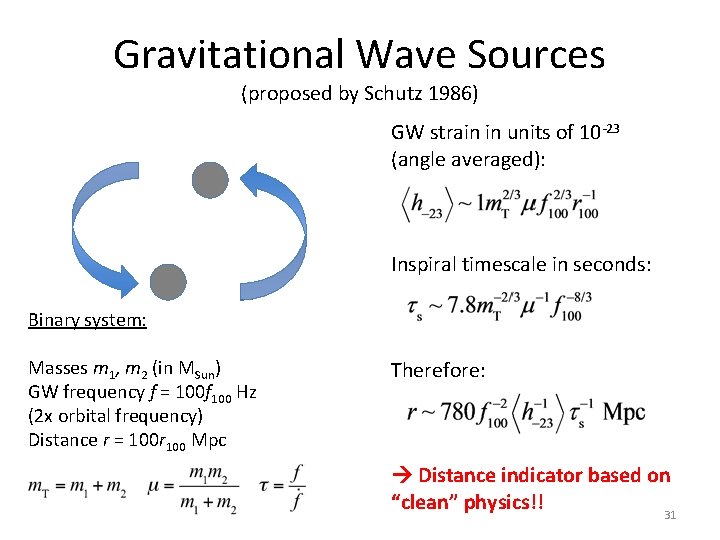
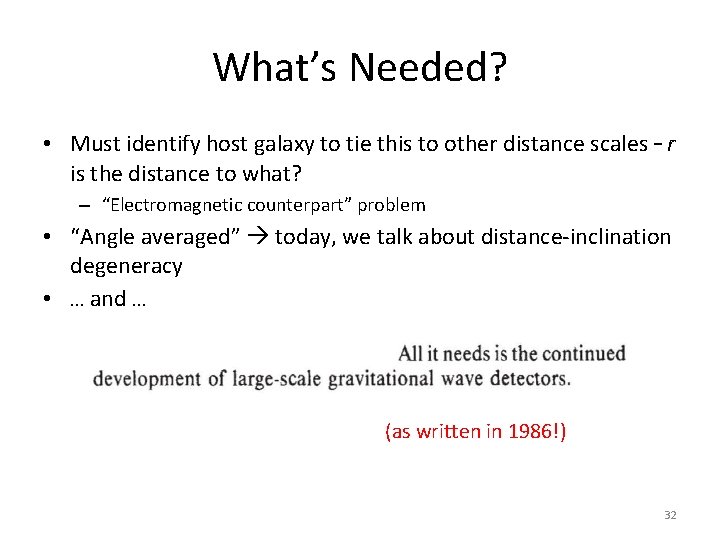
Gravitational Wave Sources (proposed by Schutz 1986) GW strain in units of 10 -23 (angle averaged): Inspiral timescale in seconds: Binary system: Masses m 1, m 2 (in MSun) GW frequency f = 100 f 100 Hz (2 x orbital frequency) Distance r = 100 r 100 Mpc Therefore: Distance indicator based on “clean” physics!! 31
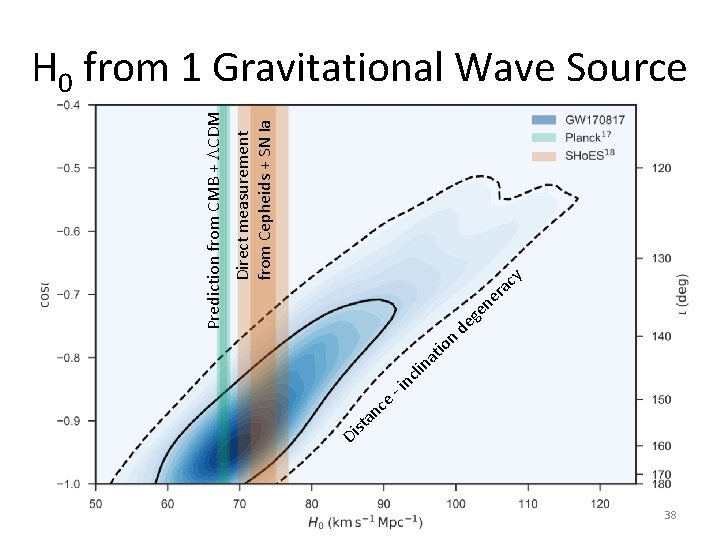
What’s Needed? • Must identify host galaxy to tie this to other distance scales – r is the distance to what? – “Electromagnetic counterpart” problem • “Angle averaged” today, we talk about distance-inclination degeneracy • … and … (as written in 1986!) 32
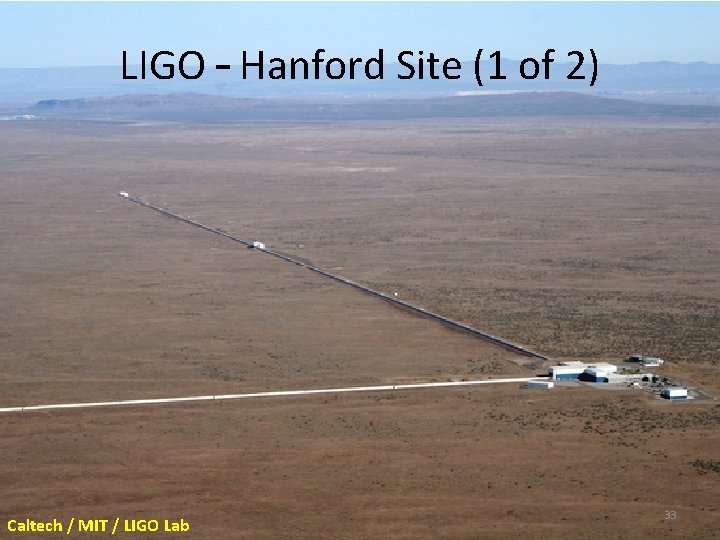
LIGO – Hanford Site (1 of 2) Caltech / MIT / LIGO Lab 33
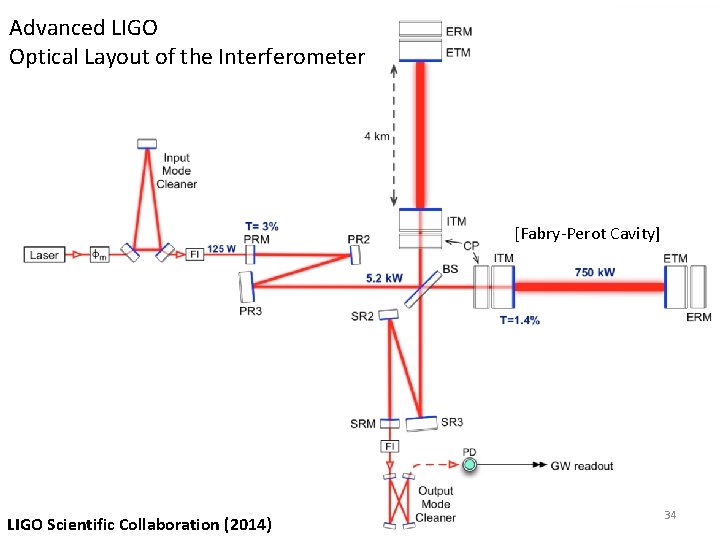
Advanced LIGO Optical Layout of the Interferometer [Fabry-Perot Cavity] LIGO Scientific Collaboration (2014) 34
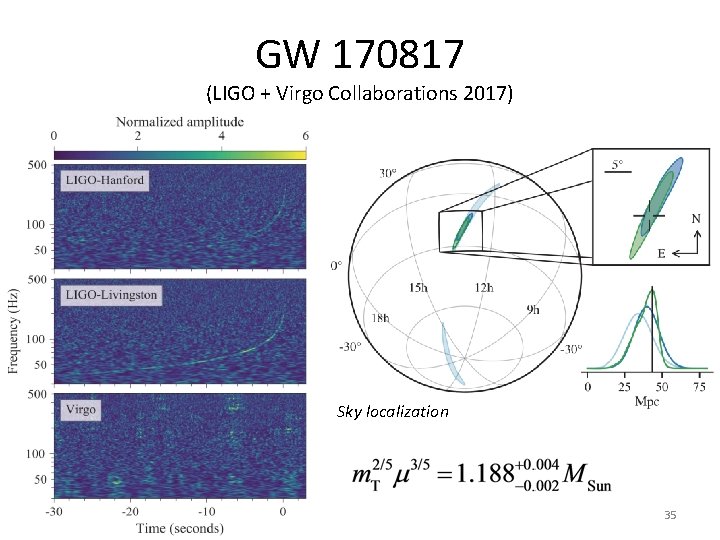
GW 170817 (LIGO + Virgo Collaborations 2017) Sky localization 35
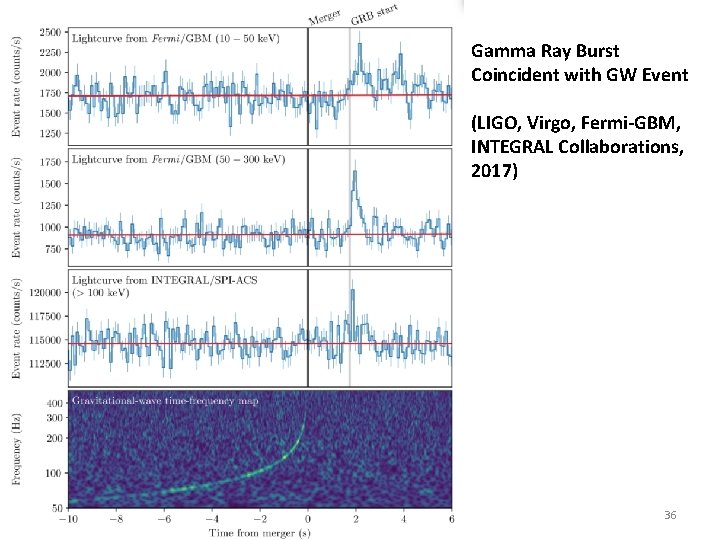
Gamma Ray Burst Coincident with GW Event (LIGO, Virgo, Fermi-GBM, INTEGRAL Collaborations, 2017) 36
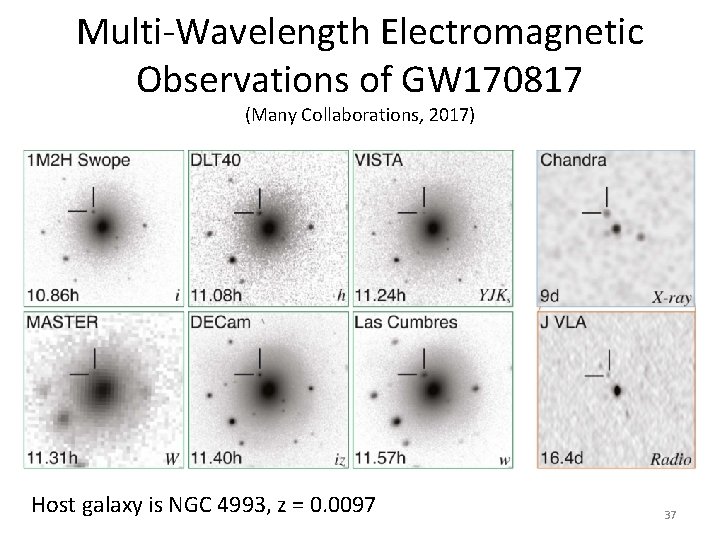
Multi-Wavelength Electromagnetic Observations of GW 170817 (Many Collaborations, 2017) Host galaxy is NGC 4993, z = 0. 0097 37
Direct measurement from Cepheids + SN Ia Prediction from CMB + LCDM H 0 from 1 Gravitational Wave Source y ac r e en n e nc – io at g de n cli n i a st Di 38
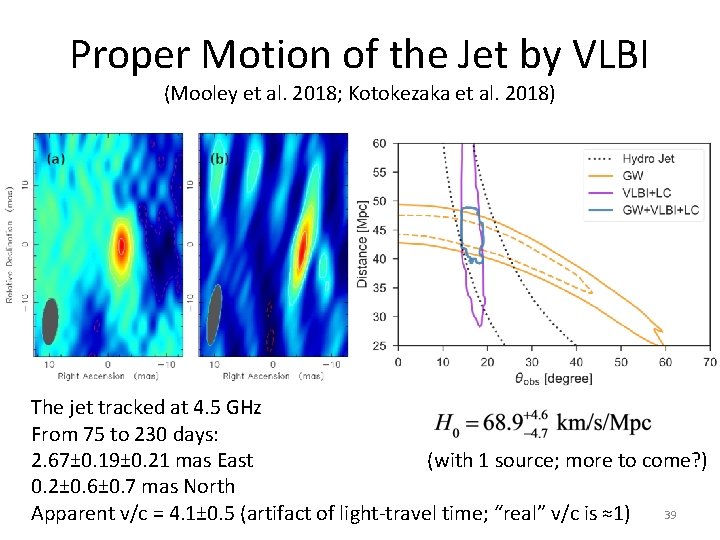
Proper Motion of the Jet by VLBI (Mooley et al. 2018; Kotokezaka et al. 2018) The jet tracked at 4. 5 GHz From 75 to 230 days: 2. 67± 0. 19± 0. 21 mas East (with 1 source; more to come? ) 0. 2± 0. 6± 0. 7 mas North 39 Apparent v/c = 4. 1± 0. 5 (artifact of light-travel time; “real” v/c is ≈1)
Extragalactic Distance Scale – Summary • Lots of history, many methods • But modern developments are coming from many wavebands and techniques – Gamma rays through radio, as well as non-electromagnetic messengers – Lots of clever physics ideas – But precision is key! • Big outstanding issue today is conflict between direct H 0 measurement and prediction from CMB • Much more to come! 40