LECTURE 12 Stereotyping Prejudice Discrimination and Course Wrapup
- Slides: 75
LECTURE 12 Stereotyping, Prejudice, Discrimination and Course Wrap-up § Administration § Categorization and Social Identity Processes § Types of Intergroup Biases and their Relationships § Stereotyping, Prejudice, Discrimination § Video: True Colors § Final Exam § Course Evaluations § Learning More about Research in Social Psychology § Volunteering, Independent Studies, Honour’s Theses, Graduate School
Dot Estimation Task
According to Realistic Conflict Theory (and results from the Robber’s Cave experiments) To create bias (discrimination/prejudice) you need: a) intergroup interaction b) scarce resources c) intergroup conflict (competition)
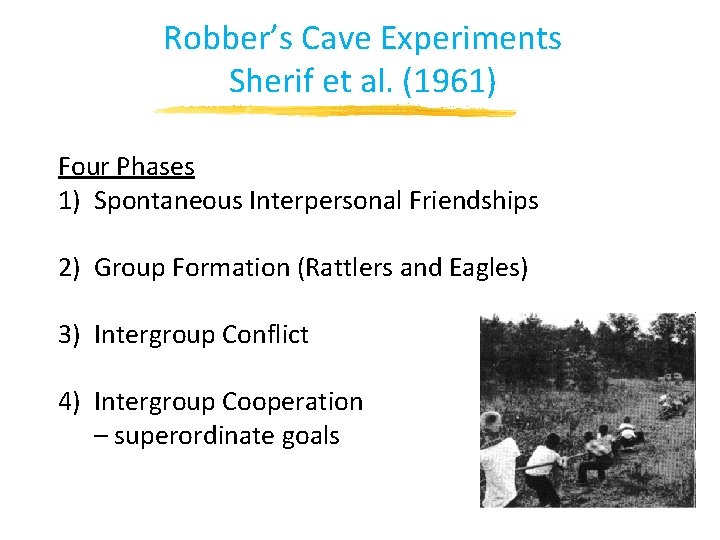
Robber’s Cave Experiments Sherif et al. (1961) Four Phases 1) Spontaneous Interpersonal Friendships 2) Group Formation (Rattlers and Eagles) 3) Intergroup Conflict 4) Intergroup Cooperation – superordinate goals
According to Realistic Conflict Theory (and results from the Robber’s Cave experiments) To create bias (discrimination/prejudice) you need: a) intergroup interaction b) scarce resources c) intergroup conflict (competition)
According to Social Identity Theory (and results from the minimal group experiments) To create discrimination/prejudice you only need: a) categorization into 2 groups (Robber’s Cave) The Importance of Being Positive and Distinct.
Minimal Group Paradigm Tajfel & Turner (1979) ■ The procedure. ■ The importance of being positive and distinct.
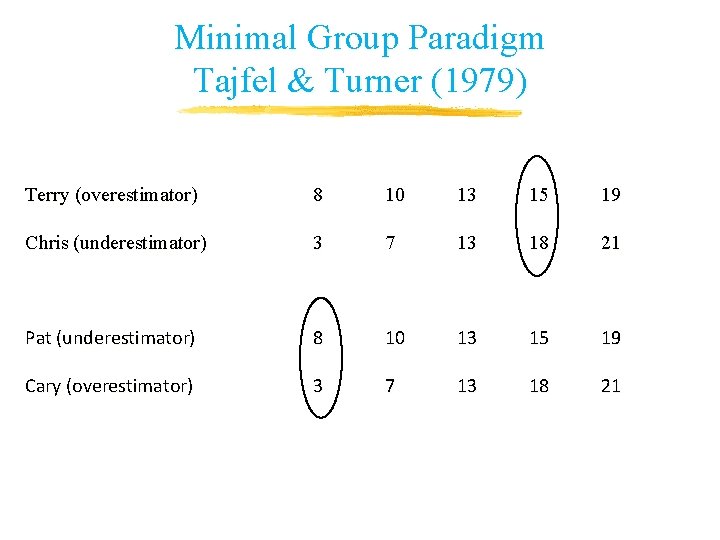
Minimal Group Paradigm Tajfel & Turner (1979) Terry (overestimator) 8 10 13 15 19 Chris (underestimator) 3 7 13 18 21 Pat (underestimator) 8 10 13 15 19 Cary (overestimator) 3 7 13 18 21
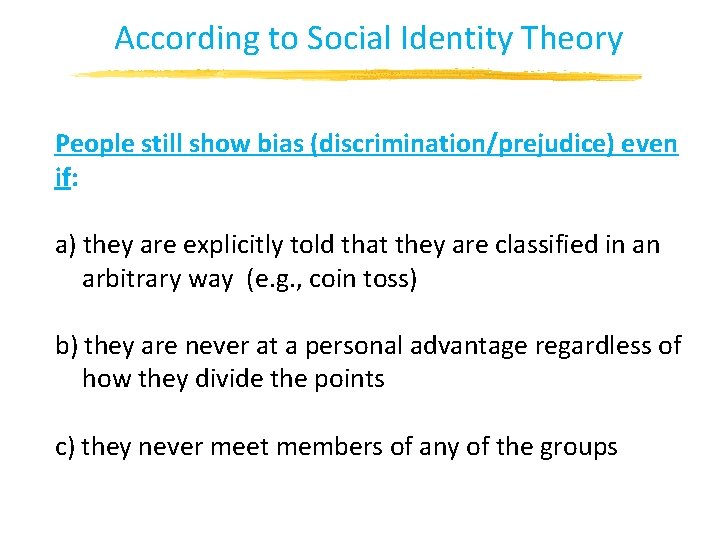
According to Social Identity Theory People still show bias (discrimination/prejudice) even if: a) they are explicitly told that they are classified in an arbitrary way (e. g. , coin toss) b) they are never at a personal advantage regardless of how they divide the points c) they never meet members of any of the groups
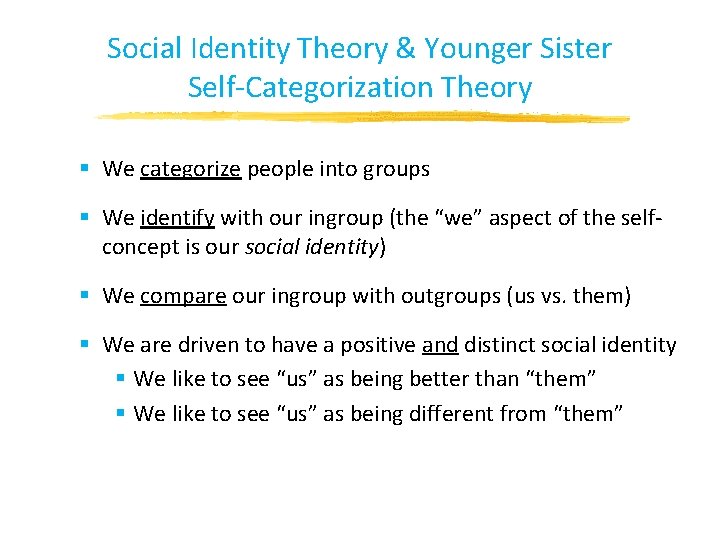
Social Identity Theory & Younger Sister Self-Categorization Theory § We categorize people into groups § We identify with our ingroup (the “we” aspect of the selfconcept is our social identity) § We compare our ingroup with outgroups (us vs. them) § We are driven to have a positive and distinct social identity § We like to see “us” as being better than “them” § We like to see “us” as being different from “them”
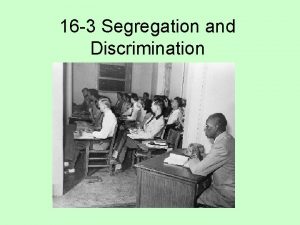
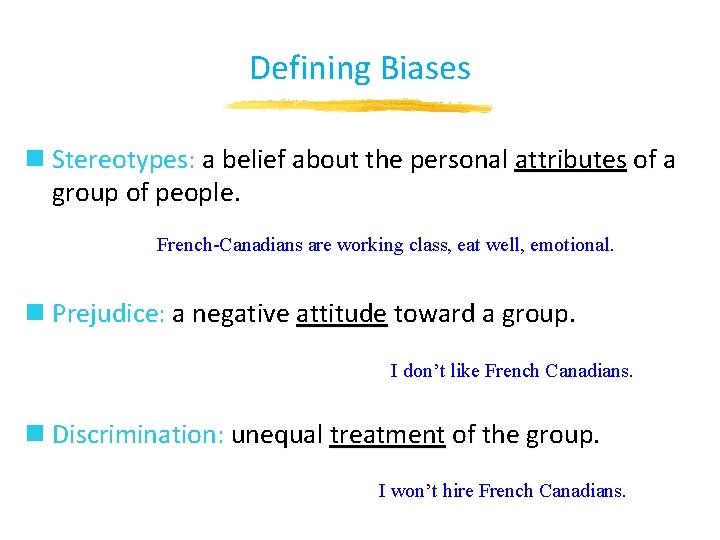
Defining Biases n Stereotypes: a belief about the personal attributes of a group of people. French-Canadians are working class, eat well, emotional. n Prejudice: a negative attitude toward a group. I don’t like French Canadians. n Discrimination: unequal treatment of the group. I won’t hire French Canadians.
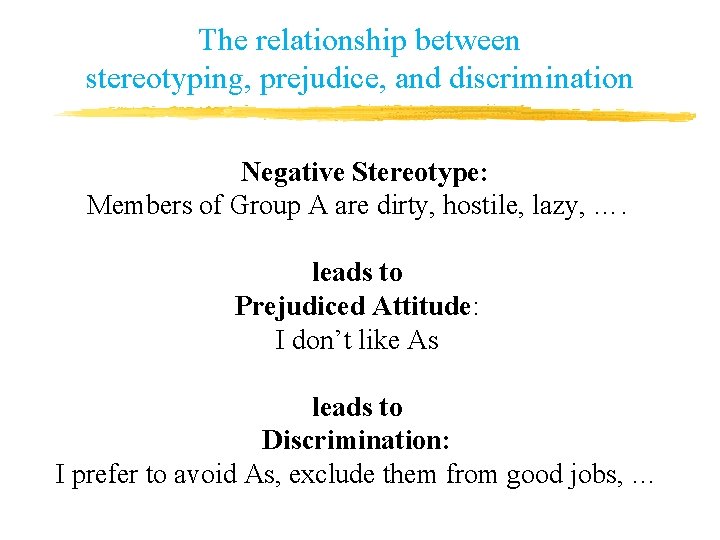
The relationship between stereotyping, prejudice, and discrimination Negative Stereotype: Members of Group A are dirty, hostile, lazy, …. leads to Prejudiced Attitude: I don’t like As leads to Discrimination: I prefer to avoid As, exclude them from good jobs, …
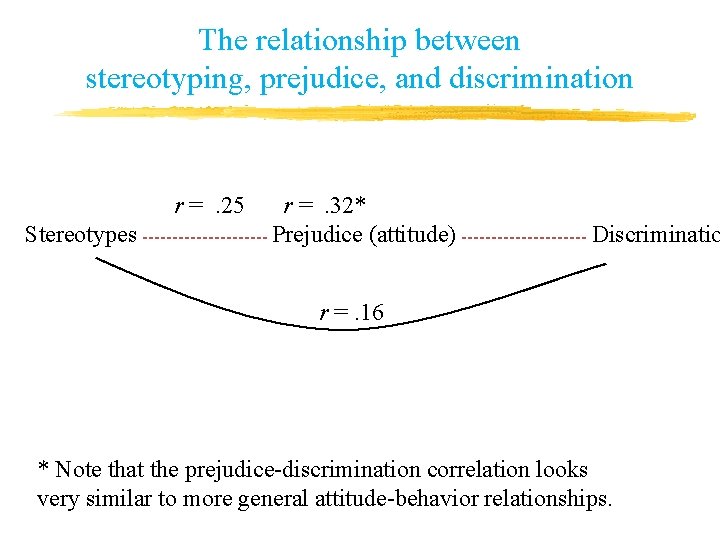
The relationship between stereotyping, prejudice, and discrimination r =. 25 r =. 32* Stereotypes ----------- Prejudice (attitude) ----------- Discriminatio r =. 16 * Note that the prejudice-discrimination correlation looks very similar to more general attitude-behavior relationships.
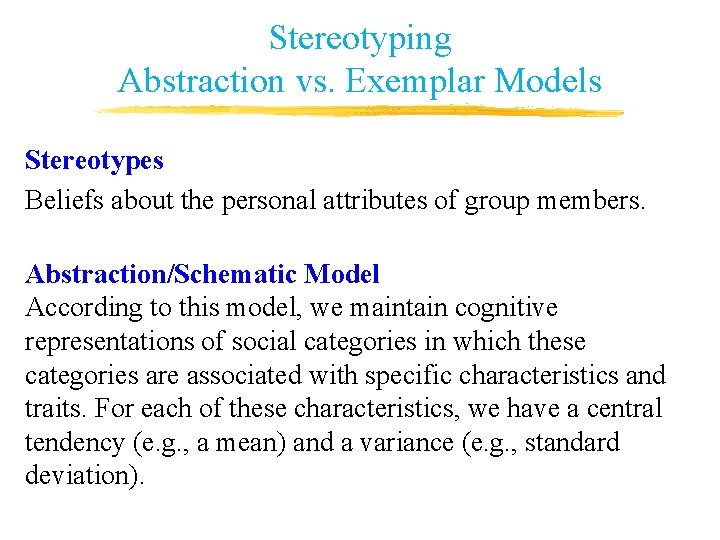
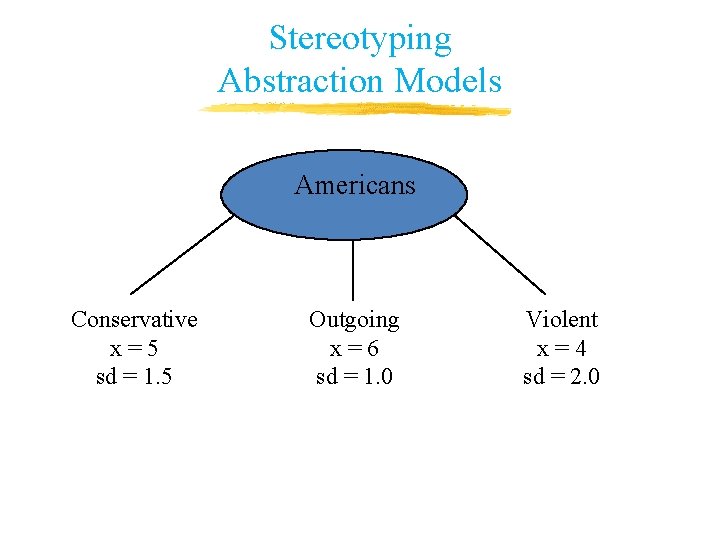
Stereotyping Abstraction vs. Exemplar Models Stereotypes Beliefs about the personal attributes of group members. Abstraction/Schematic Model According to this model, we maintain cognitive representations of social categories in which these categories are associated with specific characteristics and traits. For each of these characteristics, we have a central tendency (e. g. , a mean) and a variance (e. g. , standard deviation).
Stereotyping Abstraction Models Americans Conservative x=5 sd = 1. 5 Outgoing x=6 sd = 1. 0 Violent x=4 sd = 2. 0
Stereotyping Abstraction vs. Exemplar Models Exemplar Model According to this model, we have specific examples (i. e. , exemplars) of people that we have encoded in our memory. If we have to give an evaluation of a group, than we retrieve our representations of these specific people and base our judgment on these exemplars.
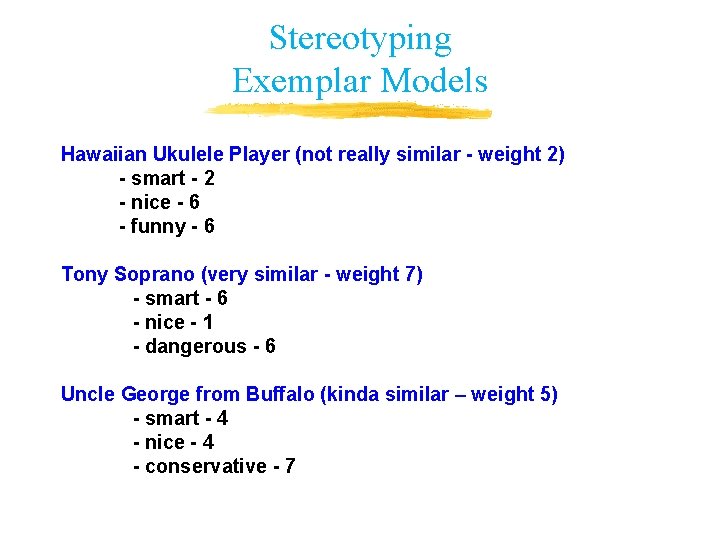
Stereotyping Exemplar Models Hawaiian Ukulele Player (not really similar - weight 2) - smart - 2 - nice - 6 - funny - 6 Tony Soprano (very similar - weight 7) - smart - 6 - nice - 1 - dangerous - 6 Uncle George from Buffalo (kinda similar – weight 5) - smart - 4 - nice - 4 - conservative - 7
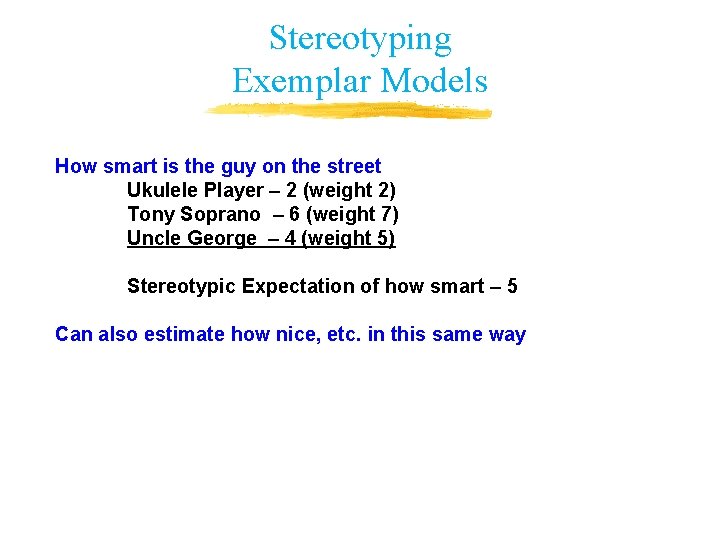
Stereotyping Exemplar Models How smart is the guy on the street Ukulele Player – 2 (weight 2) Tony Soprano – 6 (weight 7) Uncle George – 4 (weight 5) Stereotypic Expectation of how smart – 5 Can also estimate how nice, etc. in this same way
Online vs. Instance-Based Retrieval Abstraction Model - Online Retrieval According to this model, we adjust our estimates of variability and averages for characteristics related to the categories every time we meet a new member of the group. Online we update this representation. We keep an estimate of central tendency and variance of these category-trait associations in our memory and so when we need this estimate we simply retrieve it and use it.
On-Line vs. Instance-Based Retrieval Exemplar Model - Instance-Based Retrieval According to this model, we don’t maintain a running estimate of category-traits associations in our memory. If we need to make a judgment, we retrieve different exemplars from memory and on the basis of these exemplars we make an estimate the instant we need it.
Stereotyping Abstraction vs. Exemplar Models So which model is right? What are the processes related to stereotypic expectations associated with category members? Are Americans conservative? Do Albanians like sports? Are professors smart? Arrogant? Do professors have big feet?
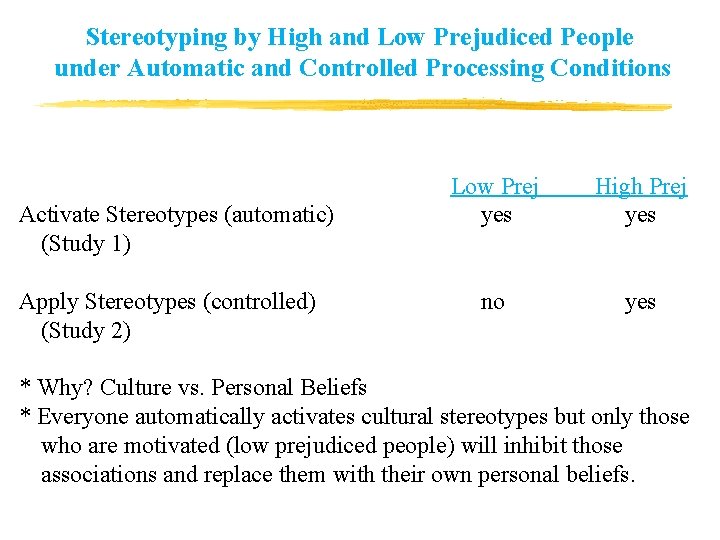
Stereotype Activation and Application Devine (1989) Do we always activate and use stereotypes when judging category members? § Study 1 – Automatic activation of stereotypes § Study 2 – Controlled application of stereotypes
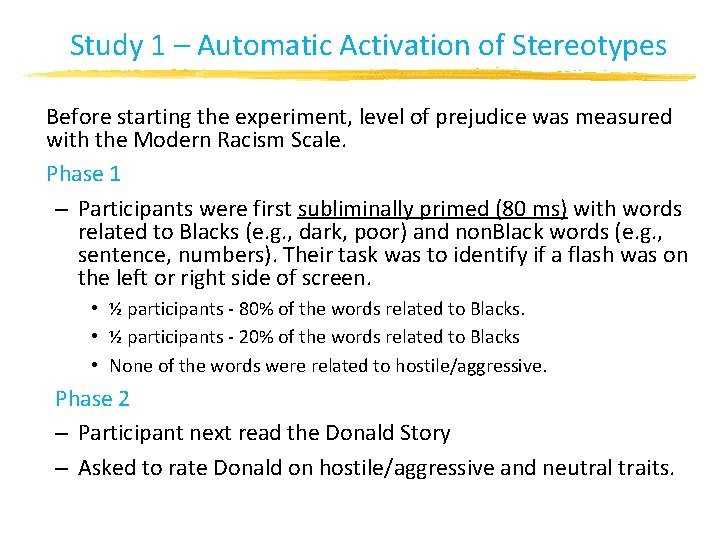
Study 1 – Automatic Activation of Stereotypes Before starting the experiment, level of prejudice was measured with the Modern Racism Scale. Phase 1 – Participants were first subliminally primed (80 ms) with words related to Blacks (e. g. , dark, poor) and non. Black words (e. g. , sentence, numbers). Their task was to identify if a flash was on the left or right side of screen. • ½ participants - 80% of the words related to Blacks. • ½ participants - 20% of the words related to Blacks • None of the words were related to hostile/aggressive. Phase 2 – Participant next read the Donald Story – Asked to rate Donald on hostile/aggressive and neutral traits.
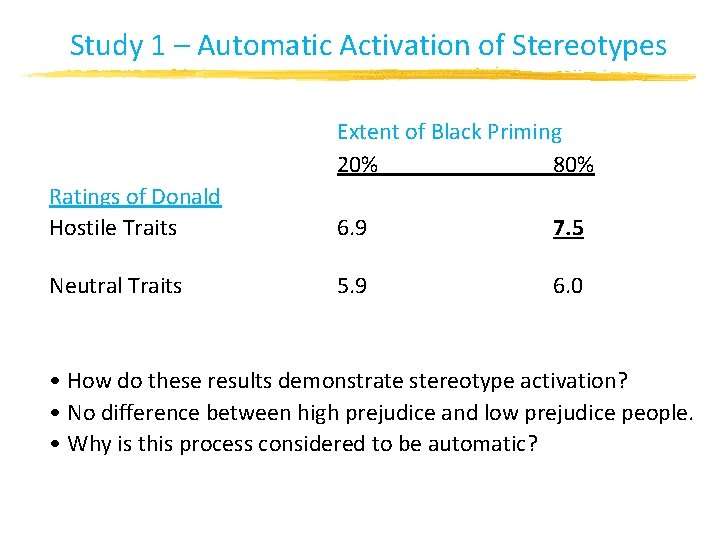
Study 1 – Automatic Activation of Stereotypes Extent of Black Priming 20% 80% Ratings of Donald Hostile Traits 6. 9 7. 5 Neutral Traits 5. 9 6. 0 • How do these results demonstrate stereotype activation? • No difference between high prejudice and low prejudice people. • Why is this process considered to be automatic?
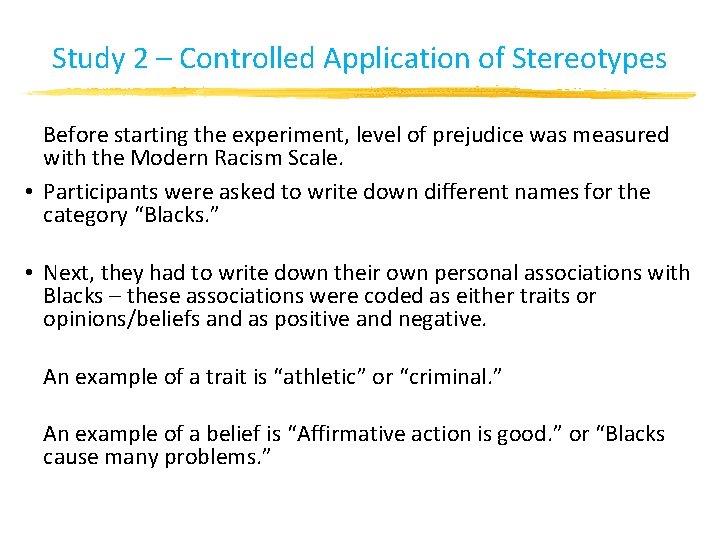
Study 2 – Controlled Application of Stereotypes Before starting the experiment, level of prejudice was measured with the Modern Racism Scale. • Participants were asked to write down different names for the category “Blacks. ” • Next, they had to write down their own personal associations with Blacks – these associations were coded as either traits or opinions/beliefs and as positive and negative. An example of a trait is “athletic” or “criminal. ” An example of a belief is “Affirmative action is good. ” or “Blacks cause many problems. ”
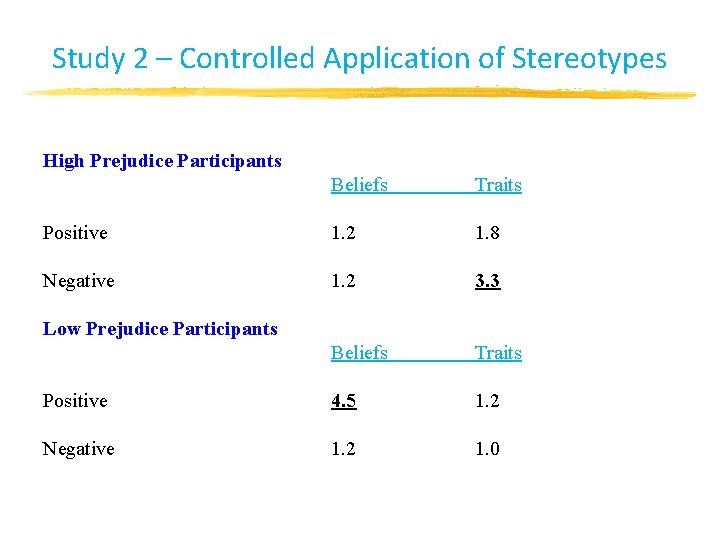
Study 2 – Controlled Application of Stereotypes High Prejudice Participants Beliefs Traits Positive 1. 2 1. 8 Negative 1. 2 3. 3 Beliefs Traits Positive 4. 5 1. 2 Negative 1. 2 1. 0 Low Prejudice Participants
Stereotyping by High and Low Prejudiced People under Automatic and Controlled Processing Conditions Activate Stereotypes (automatic) (Study 1) Apply Stereotypes (controlled) (Study 2) Low Prej yes High Prej yes no yes * Why? Culture vs. Personal Beliefs * Everyone automatically activates cultural stereotypes but only those who are motivated (low prejudiced people) will inhibit those associations and replace them with their own personal beliefs.
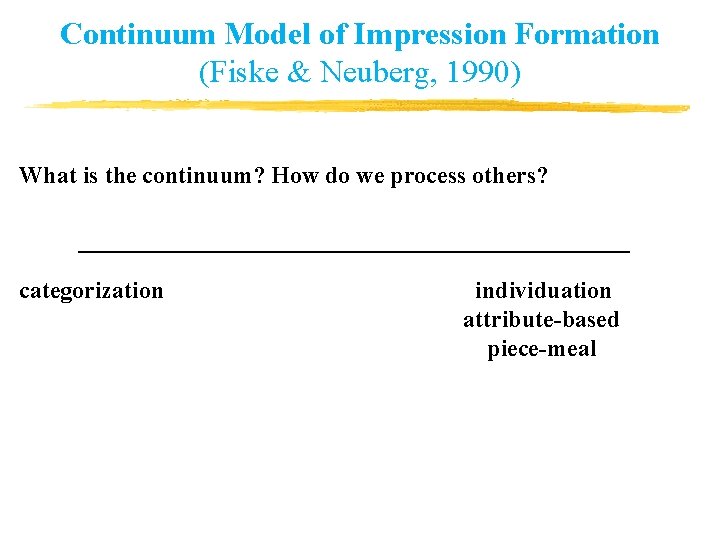
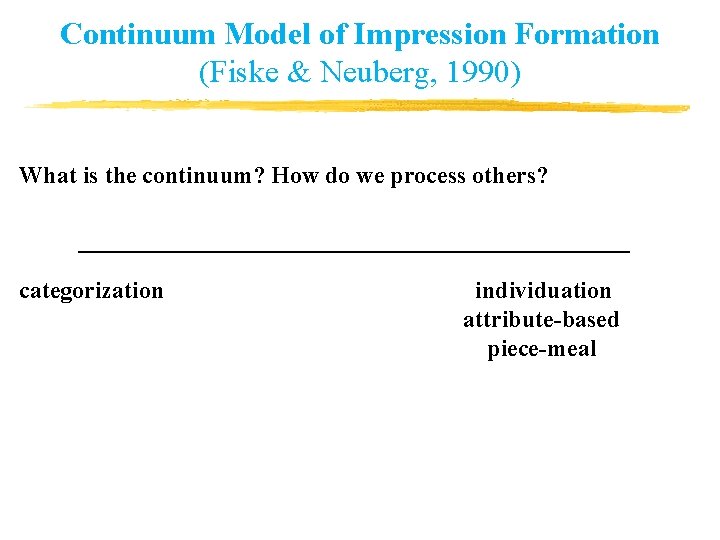
Continuum Model of Impression Formation (Fiske & Neuberg, 1990) What is the continuum? How do we process others? categorization individuation attribute-based piece-meal
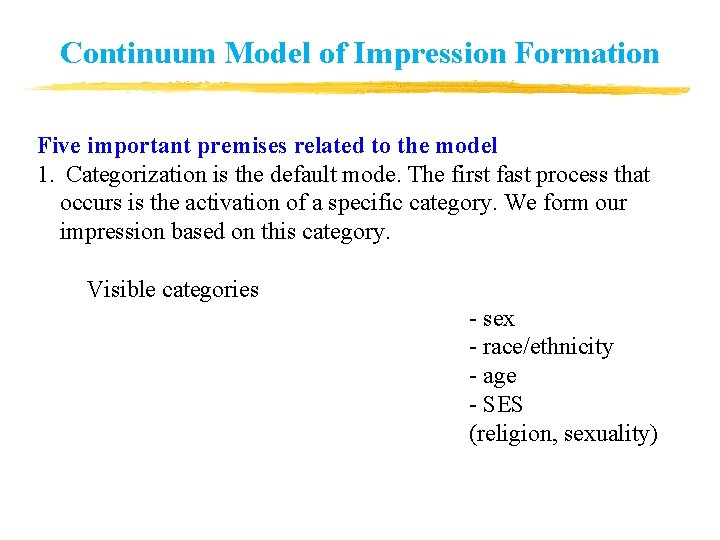
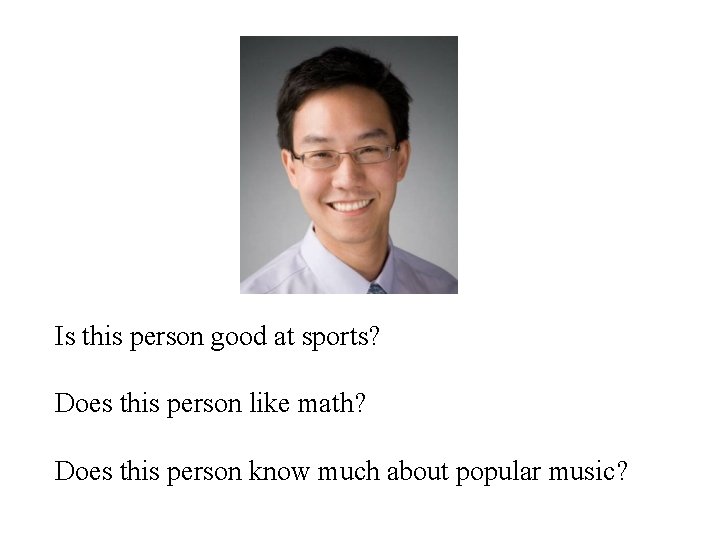
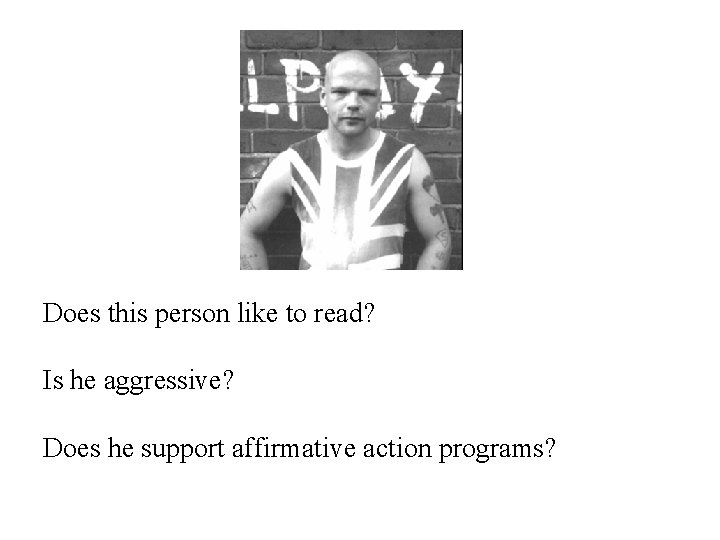
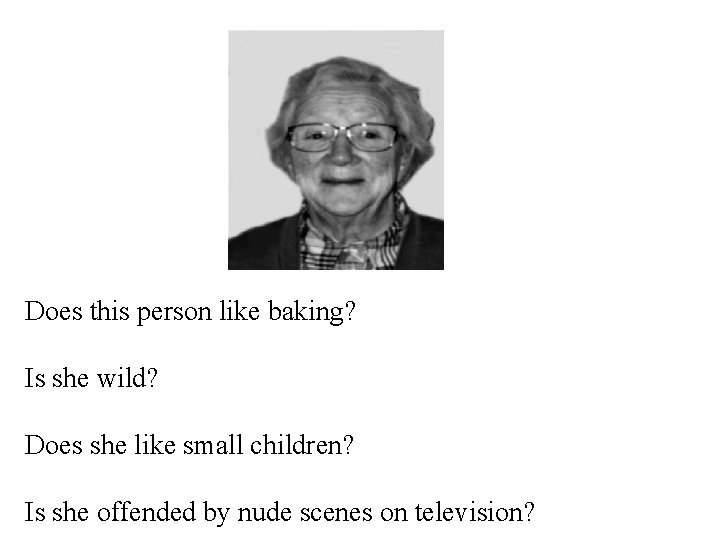
Continuum Model of Impression Formation Five important premises related to the model 1. Categorization is the default mode. The first fast process that occurs is the activation of a specific category. We form our impression based on this category. Visible categories - sex - race/ethnicity - age - SES (religion, sexuality)
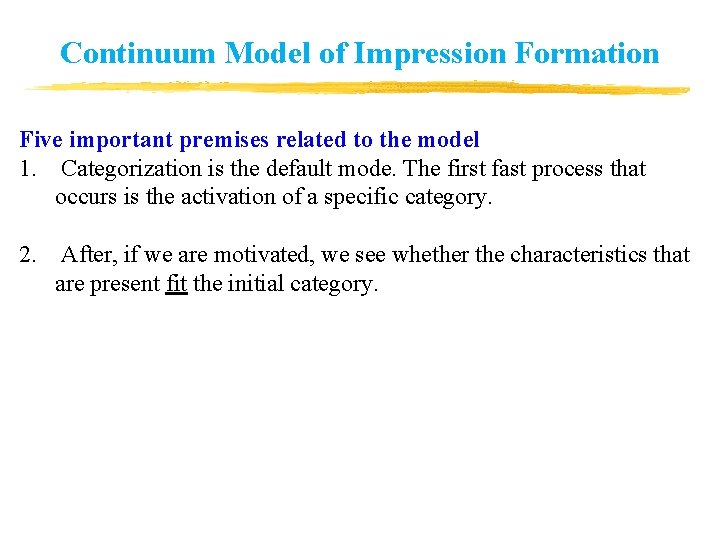
Continuum Model of Impression Formation Five important premises related to the model 1. Categorization is the default mode. The first fast process that occurs is the activation of a specific category. 2. After, if we are motivated, we see whether the characteristics that are present fit the initial category.
Is this person good at sports? Does this person like math? Does this person know much about popular music?
Does this person like to read? Is he aggressive? Does he support affirmative action programs?
Does this person like baking? Is she wild? Does she like small children? Is she offended by nude scenes on television?
Continuum Model of Impression Formation (Fiske & Neuberg, 1990) What is the continuum? How do we process others? categorization individuation attribute-based piece-meal
Continuum Model of Impression Formation Five important premises related to the model 1. Categorization is the default mode. The first fast process that occurs is the activation of a specific category. 2. After if we are motivated, we see whether the characteristics that are present fit the initial category. 3. Where we end up on the continuum is determined by our attention to individual attributes. 4. Motivation is important for where we end up on the continuum. 5. Motivation can also influence our attention and so the Motivation x Attention interaction is critical.
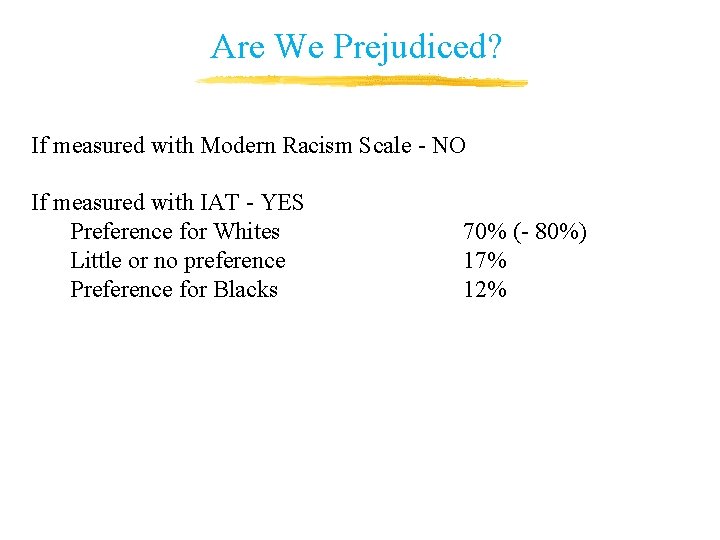
Prejudice A negative attitude toward a group. Modern Prejudice Measures vs. Implicit Prejudice Measures
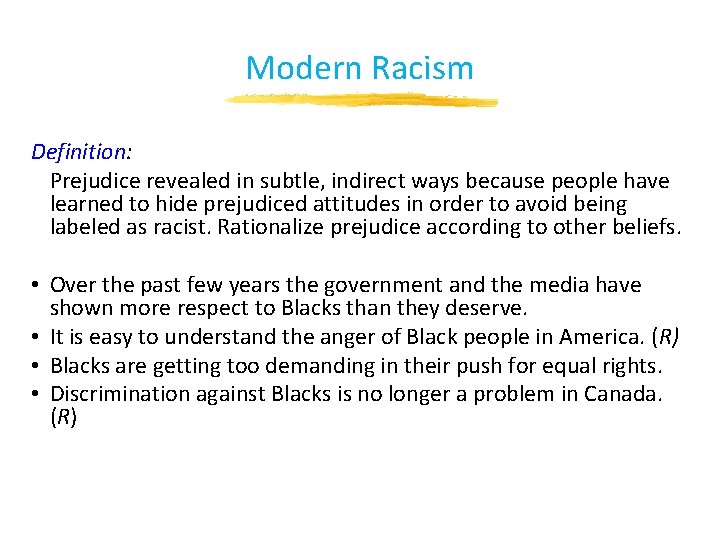
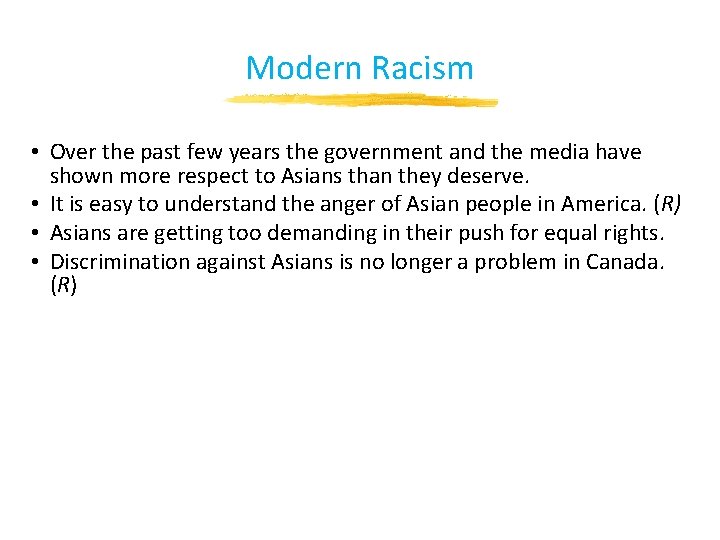
Modern Racism Definition: Prejudice revealed in subtle, indirect ways because people have learned to hide prejudiced attitudes in order to avoid being labeled as racist. Rationalize prejudice according to other beliefs. • Over the past few years the government and the media have shown more respect to Blacks than they deserve. • It is easy to understand the anger of Black people in America. (R) • Blacks are getting too demanding in their push for equal rights. • Discrimination against Blacks is no longer a problem in Canada. (R)
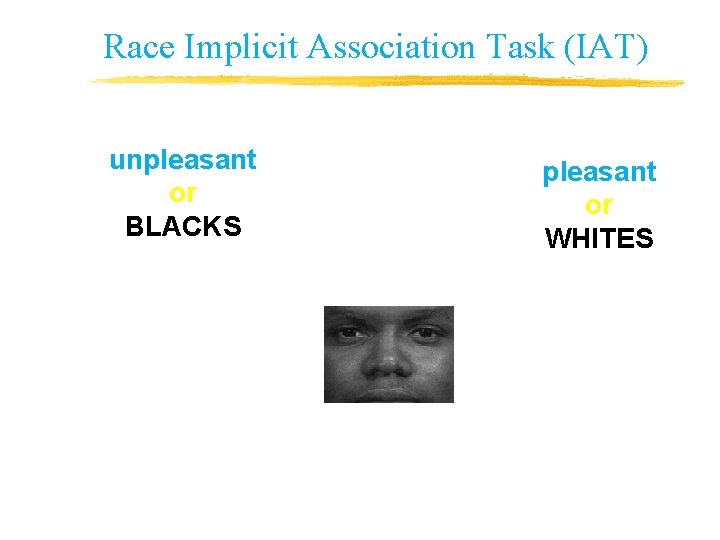
Race Implicit Association Task (IAT) unpleasant or BLACKS pleasant or WHITES
Are We Prejudiced? If measured with Modern Racism Scale - NO If measured with IAT - YES Preference for Whites Little or no preference Preference for Blacks 70% (- 80%) 17% 12%
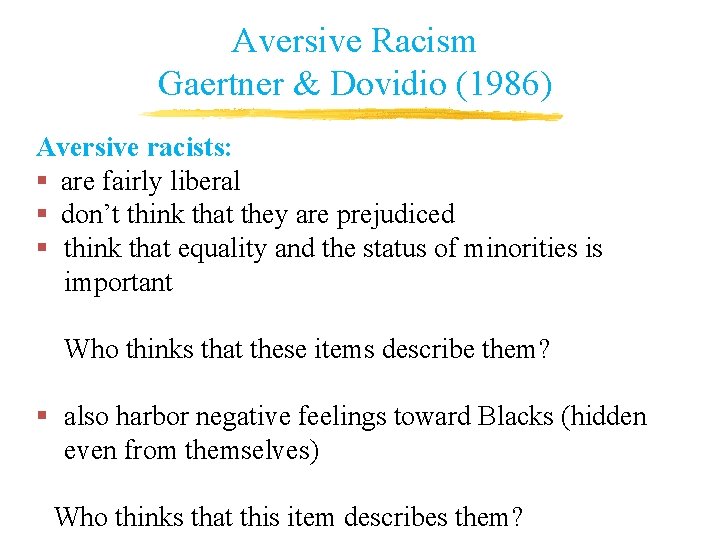
Aversive Racism Gaertner & Dovidio (1986) Aversive racists: § are fairly liberal § don’t think that they are prejudiced § think that equality and the status of minorities is important Who thinks that these items describe them? § also harbor negative feelings toward Blacks (hidden even from themselves) Who thinks that this item describes them?
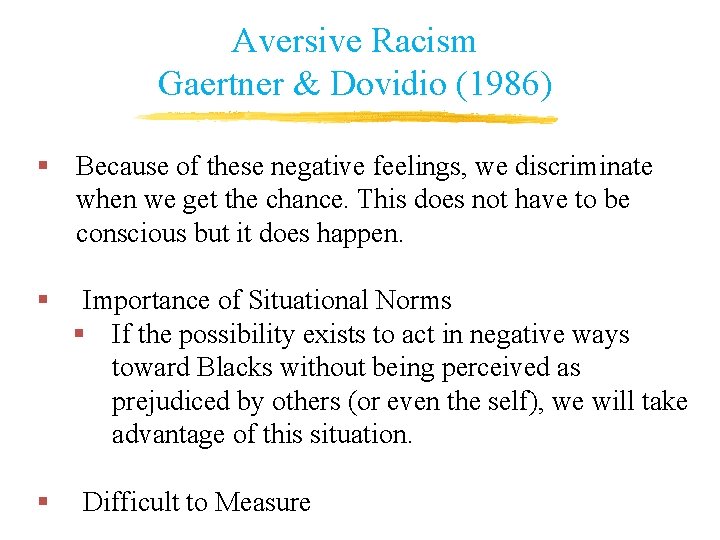
Aversive Racism Gaertner & Dovidio (1986) § Because of these negative feelings, we discriminate when we get the chance. This does not have to be conscious but it does happen. § § Importance of Situational Norms § If the possibility exists to act in negative ways toward Blacks without being perceived as prejudiced by others (or even the self), we will take advantage of this situation. Difficult to Measure
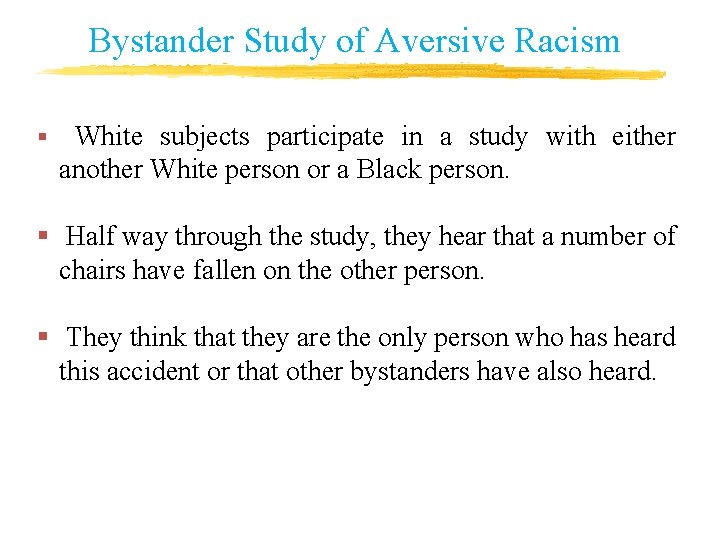
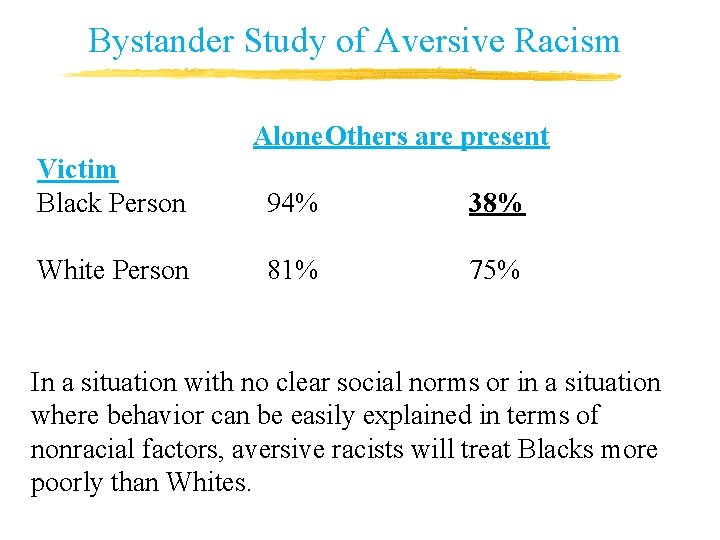
Bystander Study of Aversive Racism § White subjects participate in a study with either another White person or a Black person. § Half way through the study, they hear that a number of chairs have fallen on the other person. § They think that they are the only person who has heard this accident or that other bystanders have also heard.
Bystander Study of Aversive Racism Alone. Others are present Victim Black Person 94% 38% White Person 81% 75% In a situation with no clear social norms or in a situation where behavior can be easily explained in terms of nonracial factors, aversive racists will treat Blacks more poorly than Whites.
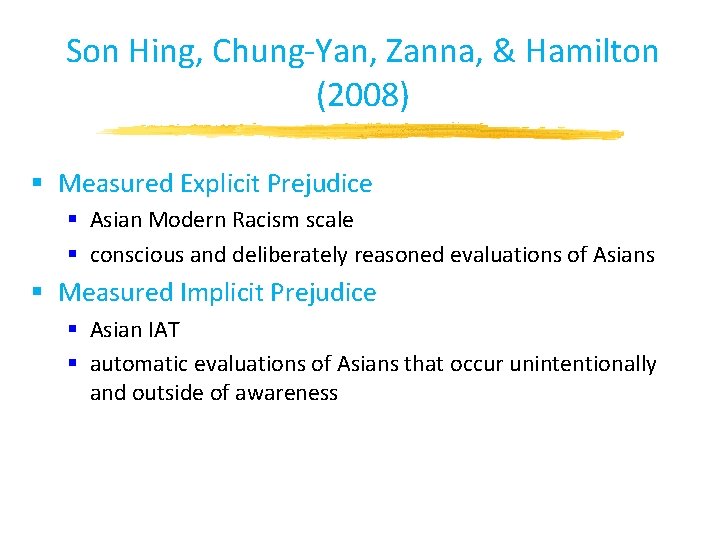
Son Hing, Chung-Yan, Zanna, & Hamilton (2008) § Measured Explicit Prejudice § Asian Modern Racism scale § conscious and deliberately reasoned evaluations of Asians § Measured Implicit Prejudice § Asian IAT § automatic evaluations of Asians that occur unintentionally and outside of awareness
Modern Racism • Over the past few years the government and the media have shown more respect to Asians than they deserve. • It is easy to understand the anger of Asian people in America. (R) • Asians are getting too demanding in their push for equal rights. • Discrimination against Asians is no longer a problem in Canada. (R)
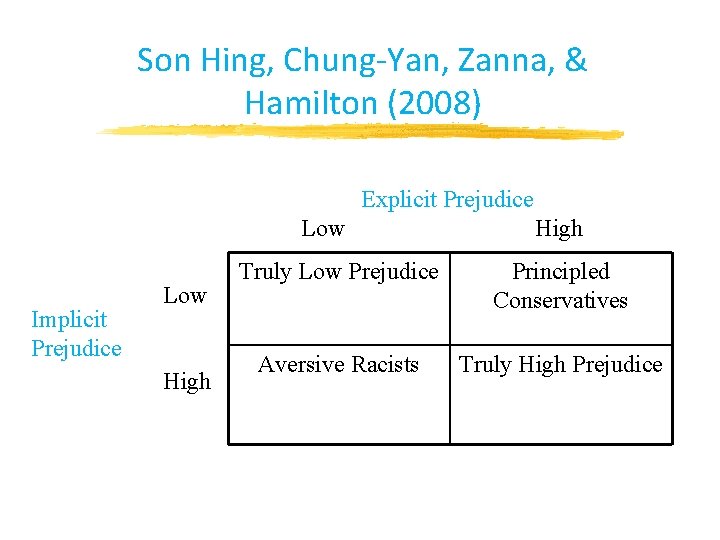
Son Hing, Chung-Yan, Zanna, & Hamilton (2008) Explicit Prejudice Low Implicit Prejudice Low High Truly Low Prejudice Principled Conservatives Aversive Racists Truly High Prejudice
Discrimination: Unequal treatment of the group. Negative behaviour toward group members. Word, Zanna, & Cooper (1974) Self-fulfilling Prophecy Studies Correll, Park, Wittenbrink, & Judd (2002) Shooter Studies
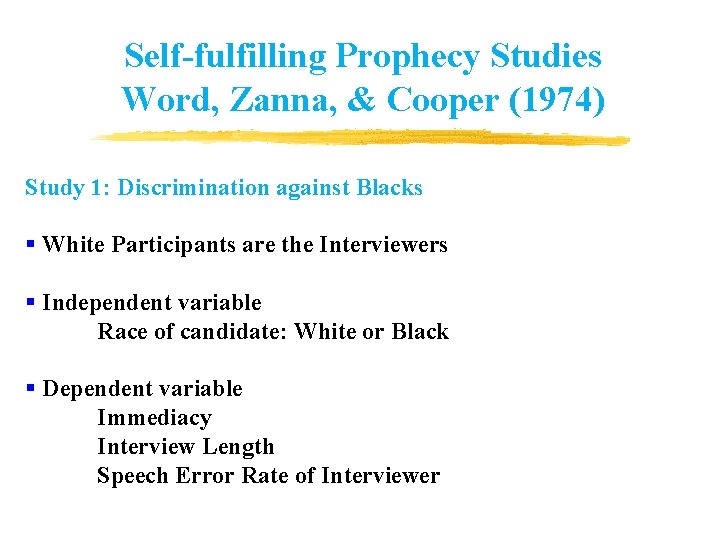
Self-fulfilling Prophecy Studies Word, Zanna, & Cooper (1974) Study 1: Discrimination against Blacks § White Participants are the Interviewers § Independent variable Race of candidate: White or Black § Dependent variable Immediacy Interview Length Speech Error Rate of Interviewer
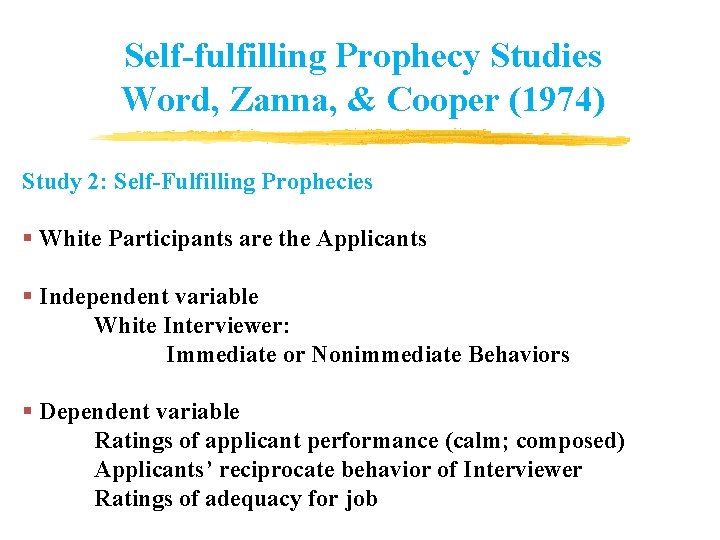
Self-fulfilling Prophecy Studies Word, Zanna, & Cooper (1974) Study 2: Self-Fulfilling Prophecies § White Participants are the Applicants § Independent variable White Interviewer: Immediate or Nonimmediate Behaviors § Dependent variable Ratings of applicant performance (calm; composed) Applicants’ reciprocate behavior of Interviewer Ratings of adequacy for job
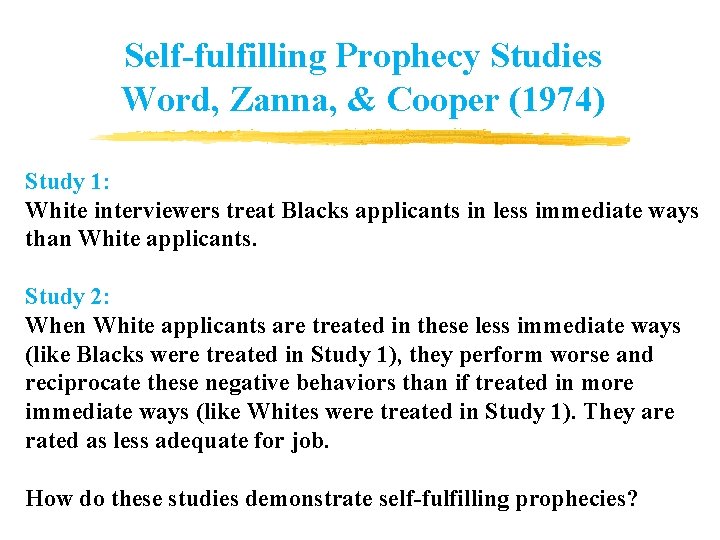
Self-fulfilling Prophecy Studies Word, Zanna, & Cooper (1974) Study 1: White interviewers treat Blacks applicants in less immediate ways than White applicants. Study 2: When White applicants are treated in these less immediate ways (like Blacks were treated in Study 1), they perform worse and reciprocate these negative behaviors than if treated in more immediate ways (like Whites were treated in Study 1). They are rated as less adequate for job. How do these studies demonstrate self-fulfilling prophecies?
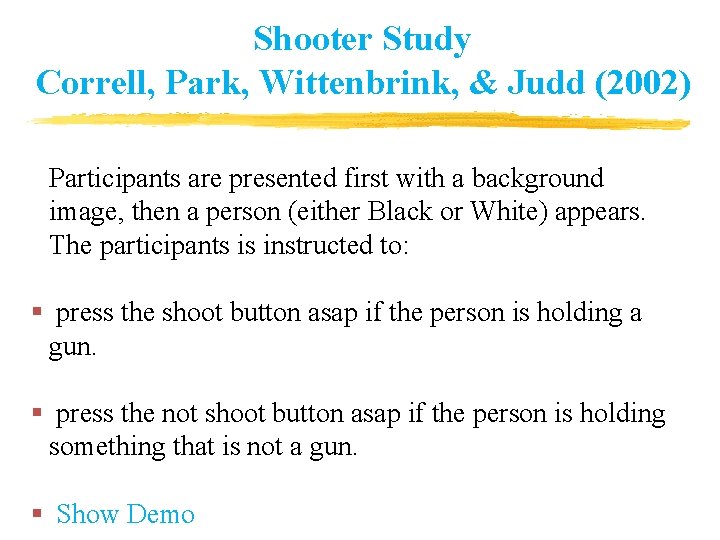
Shooter Study Correll, Park, Wittenbrink, & Judd (2002) Participants are presented first with a background image, then a person (either Black or White) appears. The participants is instructed to: § press the shoot button asap if the person is holding a gun. § press the not shoot button asap if the person is holding something that is not a gun. § Show Demo
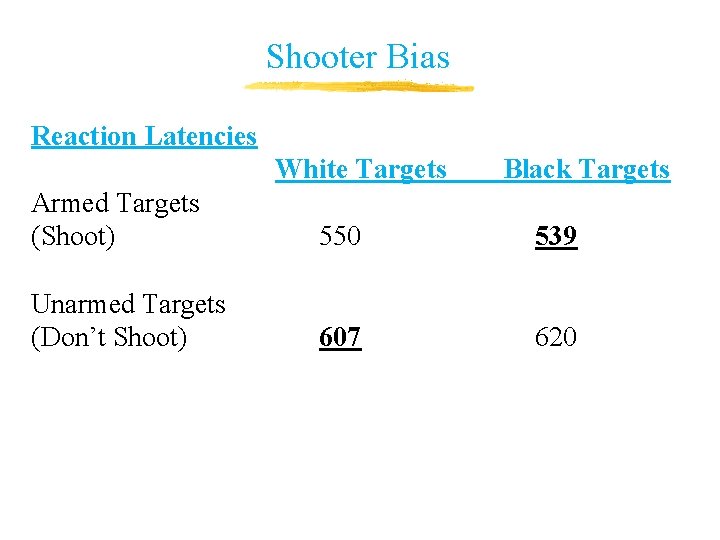
Shooter Bias Reaction Latencies White Targets Black Targets Armed Targets (Shoot) 550 539 Unarmed Targets (Don’t Shoot) 607 620
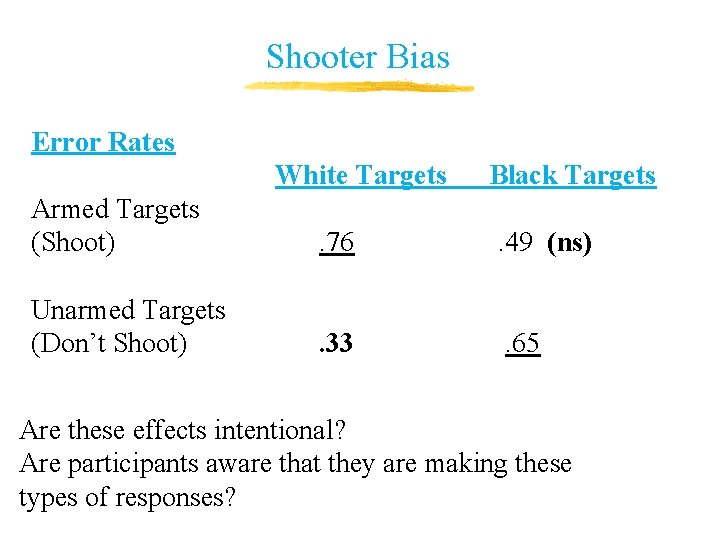
Shooter Bias Error Rates White Targets Black Targets Armed Targets (Shoot) . 76 . 49 (ns) Unarmed Targets (Don’t Shoot) . 33 . 65 Are these effects intentional? Are participants aware that they are making these types of responses?
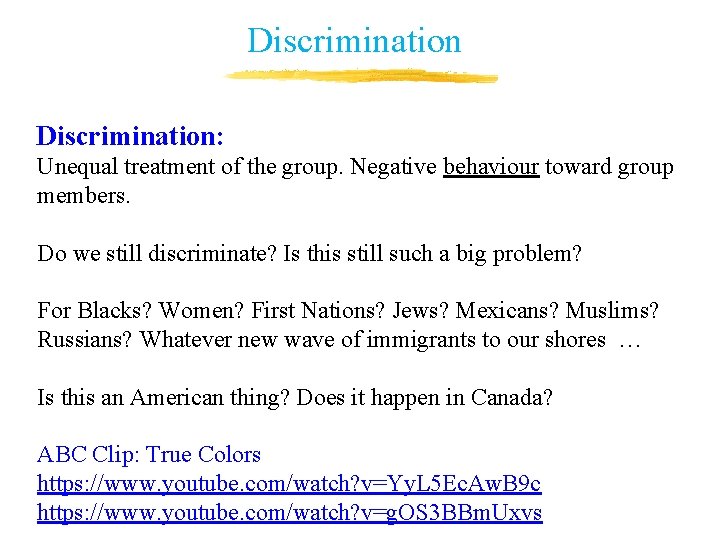
Discrimination: Unequal treatment of the group. Negative behaviour toward group members. Do we still discriminate? Is this still such a big problem? For Blacks? Women? First Nations? Jews? Mexicans? Muslims? Russians? Whatever new wave of immigrants to our shores … Is this an American thing? Does it happen in Canada? ABC Clip: True Colors https: //www. youtube. com/watch? v=Yy. L 5 Ec. Aw. B 9 c https: //www. youtube. com/watch? v=g. OS 3 BBm. Uxvs
Discrimination Janelle Jones University of London
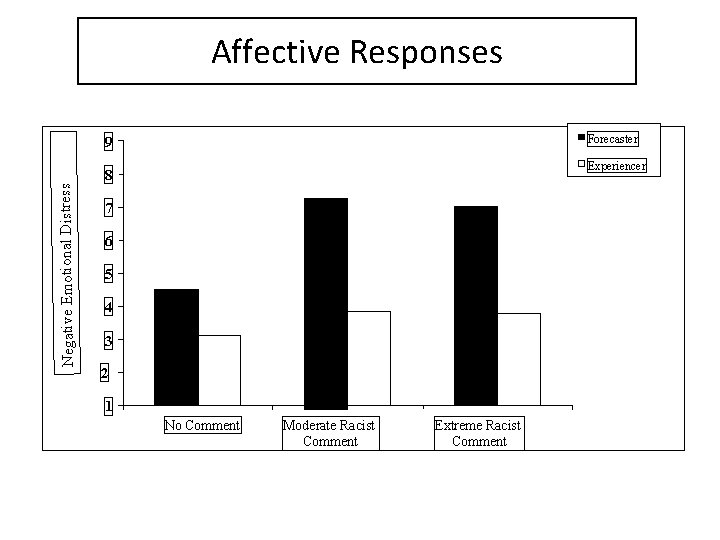
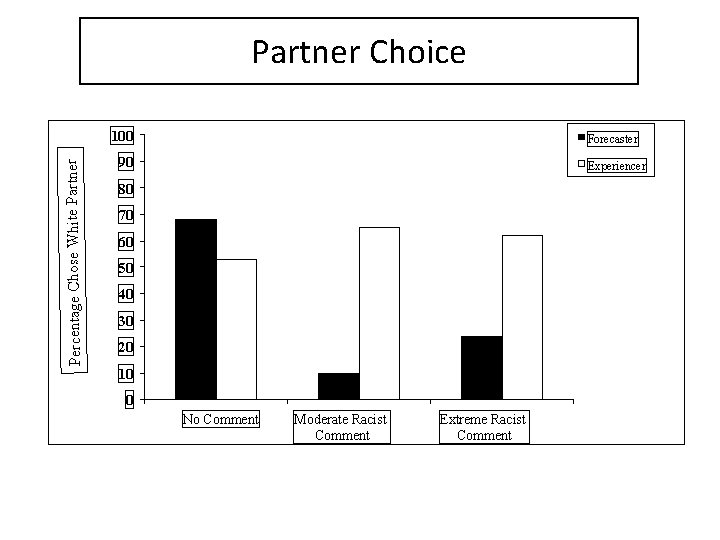
If Racism Is So Prevalent - Why? Affective and Behavioral Responses to Racism Kawakami, Dunn, Karmali, & Dovidio (2009)
Imagine …. . (forecasters) vs. Actually Happens …. (experiencers)
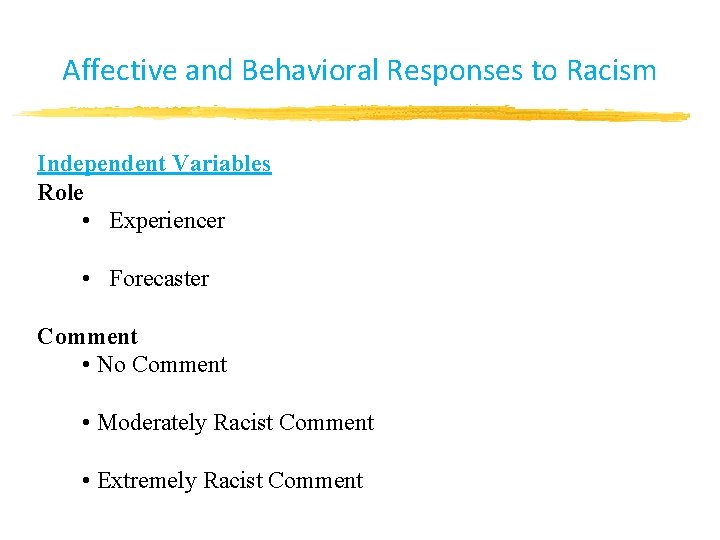
Affective and Behavioral Responses to Racism Independent Variables Role • Experiencer • Forecaster Comment • No Comment • Moderately Racist Comment • Extremely Racist Comment
Affective and Behavioral Responses to Racism Dependent Variables Affect – How upset? Partner Choice
Affective Responses Forecaster 9 Experiencer Negative Emotional Distress 8 7 6 5 4 3 2 1 No Comment Moderate Racist Comment Extreme Racist Comment
Partner Choice Percentage Chose White Partner 100 Forecaster 90 Experiencer 80 70 60 50 40 30 20 10 0 No Comment Moderate Racist Comment Extreme Racist Comment
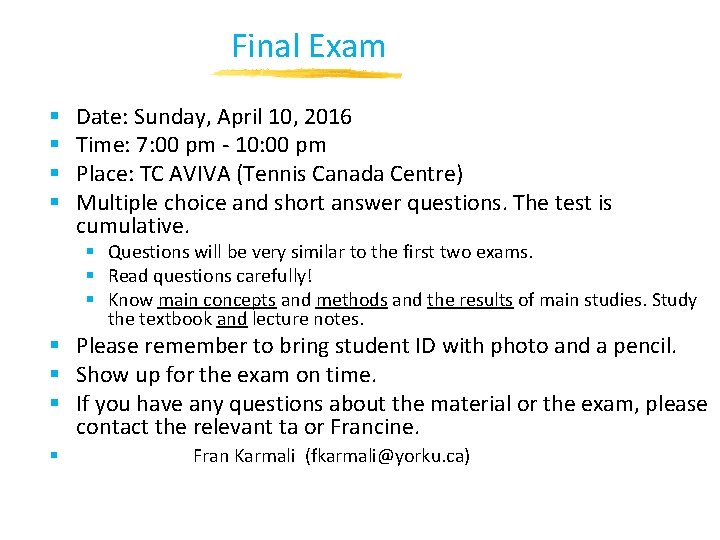
Final Exam § § Date: Sunday, April 10, 2016 Time: 7: 00 pm - 10: 00 pm Place: TC AVIVA (Tennis Canada Centre) Multiple choice and short answer questions. The test is cumulative. § Questions will be very similar to the first two exams. § Read questions carefully! § Know main concepts and methods and the results of main studies. Study the textbook and lecture notes. § Please remember to bring student ID with photo and a pencil. § Show up for the exam on time. § If you have any questions about the material or the exam, please contact the relevant ta or Francine. § Fran Karmali (fkarmali@yorku. ca)
Course Evaluations § Feedback is important to improving courses. § The evaluations are entirely confidential. § Instructors do not receive the evaluation results until after the final grades are assigned. § http: //courseevaluations. yorku. ca/ § The link is open from now until Tuesday, April 5, 2016.
I like social psychology! How can I learn more? § § Volunteer Independent study Honour’s thesis Graduate school
Social Psychological Research at York § I would like to get involved in research at York, how do I volunteer in a lab? § Figure out what area of psychology you like best. What can maintain your interest. § Check out people who are in that area and their websites. What type of research do they do? § Do they accept volunteers into their lab? Ask their graduate students how their lab works. § This is probably the best way to find a thesis supervisor and to learn more about research. § If you are considering grad school or other professional training programs – this is a great strategy to get an academic reference. § When?
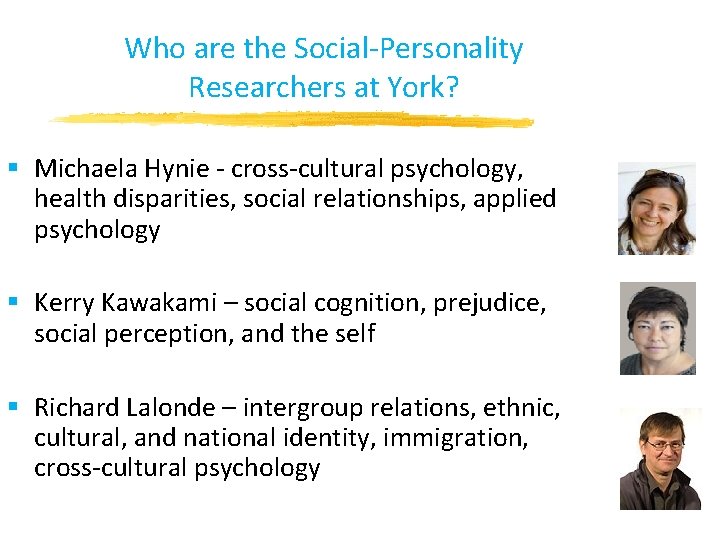
Who are the Social-Personality Researchers at York? § Michaela Hynie - cross-cultural psychology, health disparities, social relationships, applied psychology § Kerry Kawakami – social cognition, prejudice, social perception, and the self § Richard Lalonde – intergroup relations, ethnic, cultural, and national identity, immigration, cross-cultural psychology
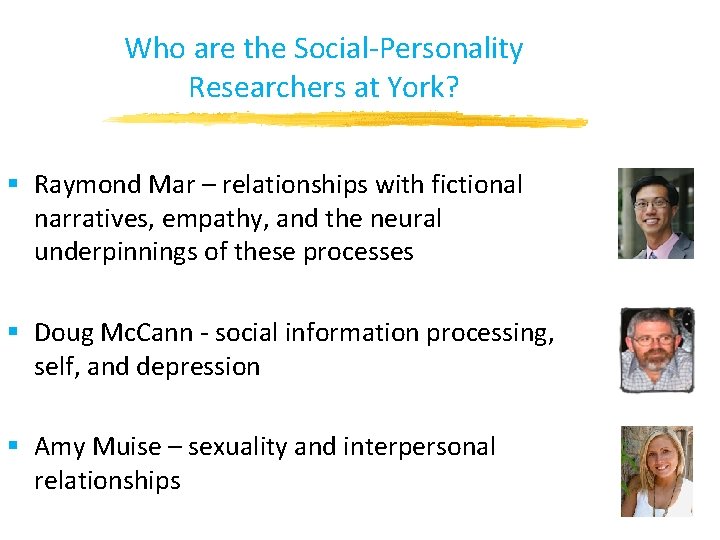
Who are the Social-Personality Researchers at York? § Raymond Mar – relationships with fictional narratives, empathy, and the neural underpinnings of these processes § Doug Mc. Cann - social information processing, self, and depression § Amy Muise – sexuality and interpersonal relationships
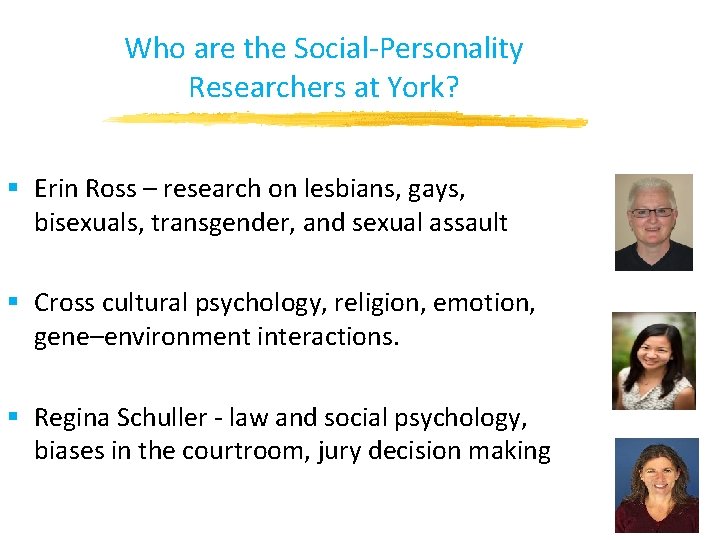
Who are the Social-Personality Researchers at York? § Erin Ross – research on lesbians, gays, bisexuals, transgender, and sexual assault § Cross cultural psychology, religion, emotion, gene–environment interactions. § Regina Schuller - law and social psychology, biases in the courtroom, jury decision making
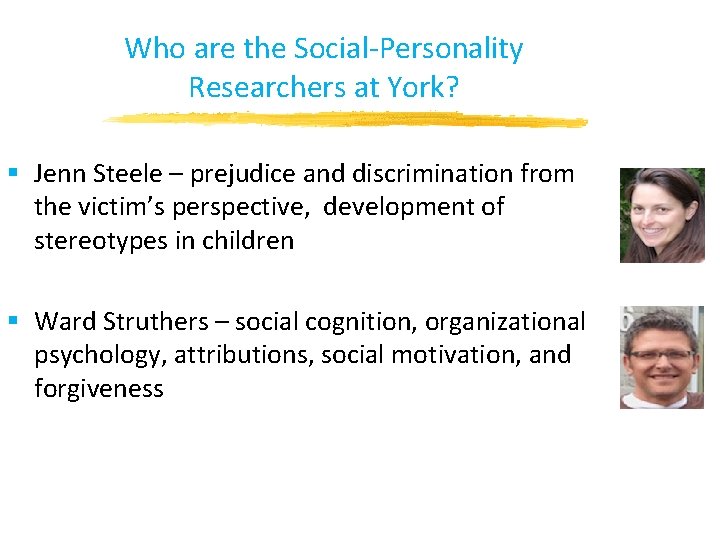
Who are the Social-Personality Researchers at York? § Jenn Steele – prejudice and discrimination from the victim’s perspective, development of stereotypes in children § Ward Struthers – social cognition, organizational psychology, attributions, social motivation, and forgiveness
Social-Personality Research at York Independent Study/Research Project York Specialized Honour’s Thesis (YUSHPP) § Apply to this program online around the end of your second year in early May. § A cumulative GPA of 7. 0 (B+). § Additional course work § A specialized honour’s will make you more competitive for graduate school. http: //yushpp. apps 01. yorku. ca/
Social-Personality Research at York http: //psyc. info. yorku. ca/honours-students/ Psyc 4000 – Honour’s Thesis § Not the specialized program but research conducted with a specific supervisor (approximately 75 students) § It is hard to find a supervisor § Need to fill out a thesis contract with supervisor § Reference letter § Psyc 4170 – Advanced Research in Psychology § Independent research project as part of course, regularly scheduled classes and course work, no individual supervisor but course instructor (approximately 500 students) § Can pursue your own ideas – both good and bad
Social-Personality Research at York Psyc 4175 – Advanced Community Based Applied Research § Course instructor (approximately 25 students) § Need to apply and candidates are screened § Carrying out research in community health organizations
Social/Personality Research after York Graduate school § Research experience (volunteer, independent project, honour’s thesis) § Reference letters § GREs and grades § Personal Statement
Social/Personality Research after York Graduate school § Check out all the programs that interest you (Social/Personality programs at Waterloo, Toronto, Western, Queens, UBC, York, etc). Who is doing research that you are interested in? Personally approach that faculty member and ask about their lab, their research, and whether they are planning on taking on graduate students that year. § Write GREs in spring or summer and apply in fall. § Talk to potential advisors’ graduate students, go visit their labs. § In January you will begin to hear about your applications and by April you need to decide where you want to go.
Yeah!!! We did it!!! § I want to thank you. This has been a fun class to teach and I have appreciated your participation. § Good luck on your final. § Marks will be posted within 2 weeks on the course website. § Enjoy your summer.