
Mahatma Gandhi The Nationalist Movement Early Life Born
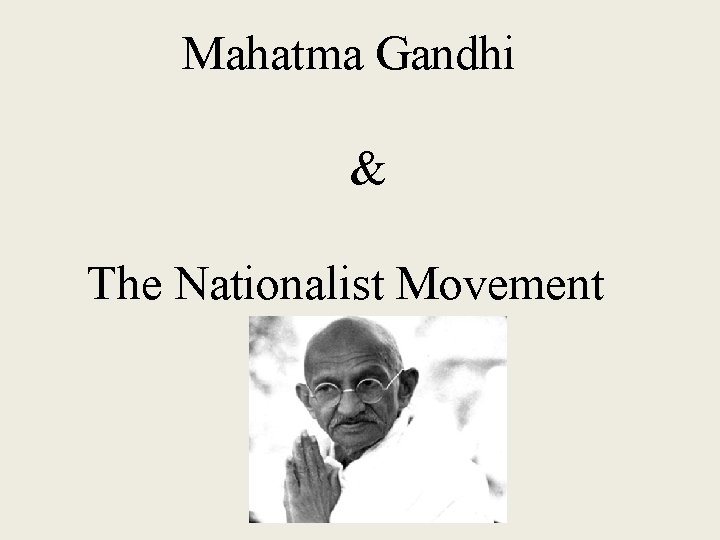
Mahatma Gandhi & The Nationalist Movement
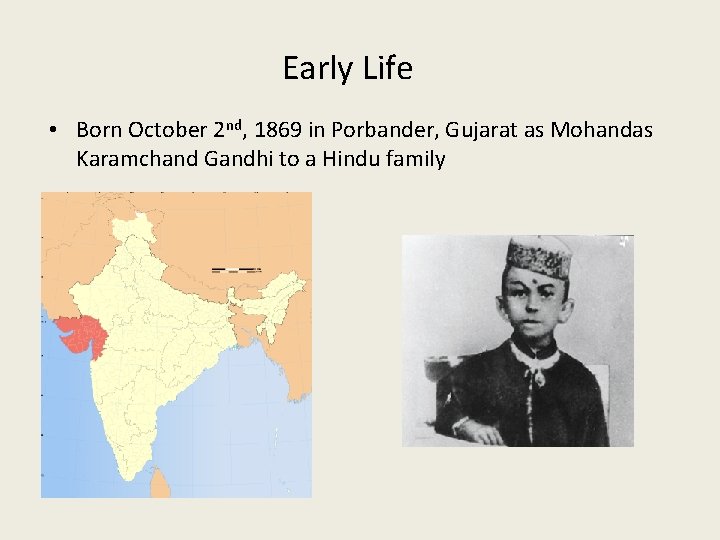
Early Life • Born October 2 nd, 1869 in Porbander, Gujarat as Mohandas Karamchand Gandhi to a Hindu family
• Mahatma Gandhi’s father was a chief minister and Mahatma Gandhi was thus raised in a relatively higher class family • As per tradition of the time and place, Mahatma Gandhi was married at the age of 13 to Kasturbai who was 14 in an arranged marriage • Mahatma Gandhi was an average student overall but was the best within his family. He was therefore sent to Britain to study in hopes that he would succeed his father as chief minister
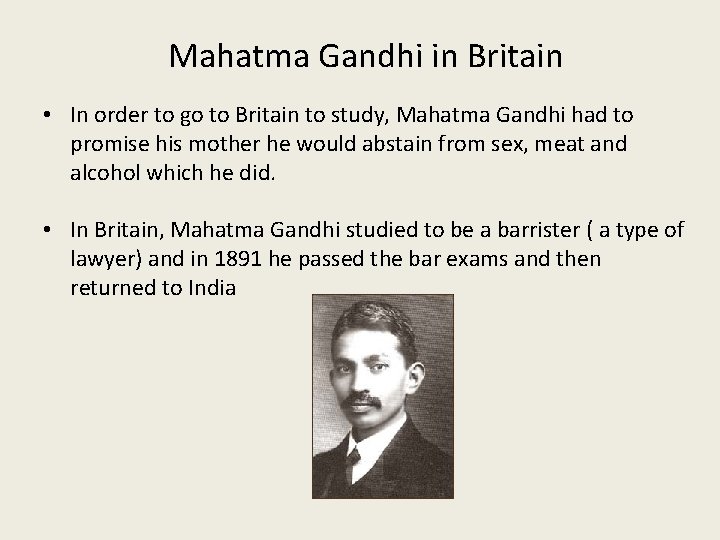
Mahatma Gandhi in Britain • In order to go to Britain to study, Mahatma Gandhi had to promise his mother he would abstain from sex, meat and alcohol which he did. • In Britain, Mahatma Gandhi studied to be a barrister ( a type of lawyer) and in 1891 he passed the bar exams and then returned to India
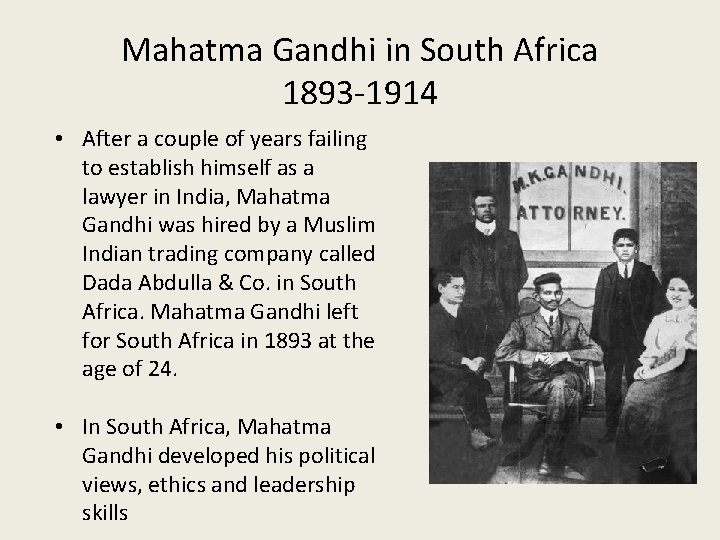
Mahatma Gandhi in South Africa 1893 -1914 • After a couple of years failing to establish himself as a lawyer in India, Mahatma Gandhi was hired by a Muslim Indian trading company called Dada Abdulla & Co. in South Africa. Mahatma Gandhi left for South Africa in 1893 at the age of 24. • In South Africa, Mahatma Gandhi developed his political views, ethics and leadership skills
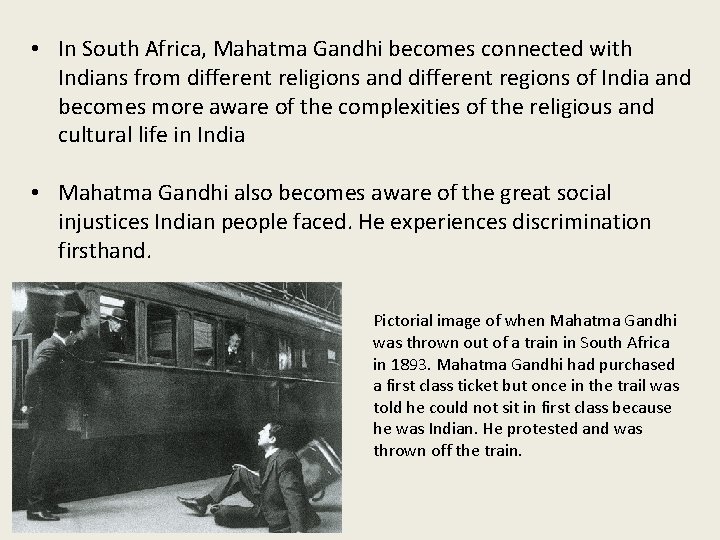
• In South Africa, Mahatma Gandhi becomes connected with Indians from different religions and different regions of India and becomes more aware of the complexities of the religious and cultural life in India • Mahatma Gandhi also becomes aware of the great social injustices Indian people faced. He experiences discrimination firsthand. Pictorial image of when Mahatma Gandhi was thrown out of a train in South Africa in 1893. Mahatma Gandhi had purchased a first class ticket but once in the trail was told he could not sit in first class because he was Indian. He protested and was thrown off the train.
• In South Africa, Mahatma Gandhi develops a non-violent philosophy that leads to tactics and strategies to oppose unjust, discriminatory laws that Indian people faced. This philosophy and political strategy is based on the concepts of: Satyagraha – insistence on truth Ahimsa – cause no injury • Together, satyagraha and ahimsa form Mahatma Gandhi’s strategy of non-violent civil disobedience against unjust laws
• Mahatma Gandhi formed the “Natal Indian Congress” in 1894, thus helping to organize the Indian community of South Africa into a political force • Through the NIC, Mahatma Gandhi attempted negotiation with British South African officials that made little progress • In 1906, however, the British South African government refused to budge on the “Transvaal Asiatic Registration Act” requiring Indians in South Africa to register with the British government and be prepared at all times to show registration papers and give their fingerprint to British officials when asked to do so • Gandhi leads a non-violent campaign (his first major one) against the act. The act was abolished, but reinstated a couple of years later. • Gandhi became a national hero
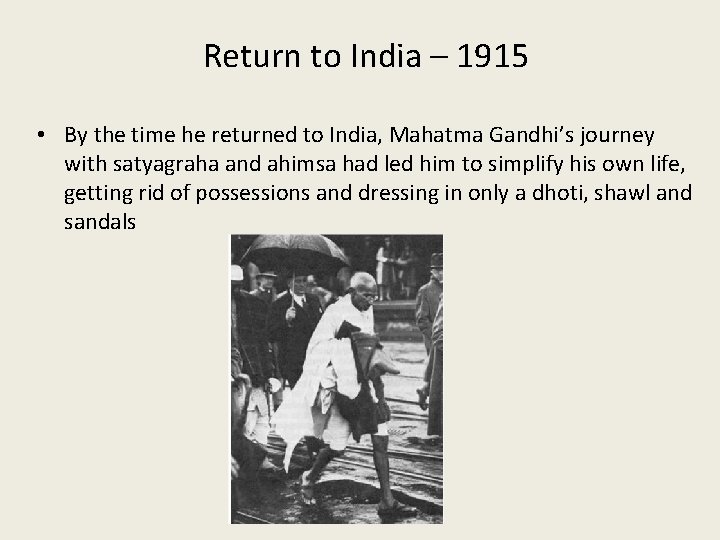
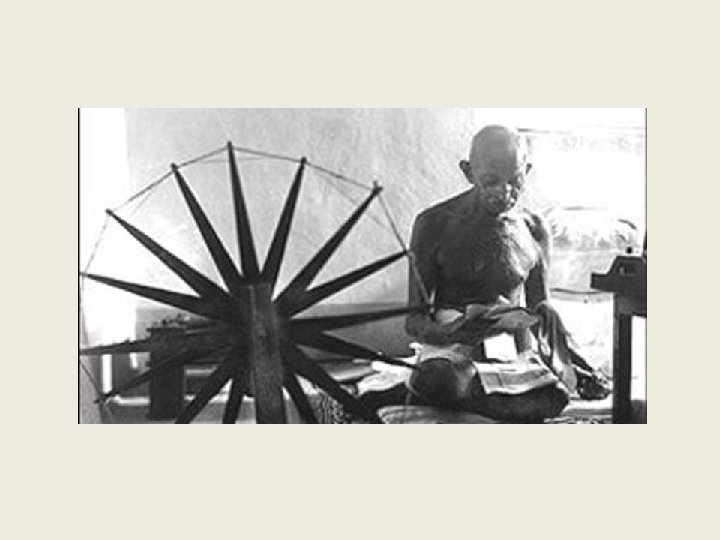
Return to India – 1915 • By the time he returned to India, Mahatma Gandhi’s journey with satyagraha and ahimsa had led him to simplify his own life, getting rid of possessions and dressing in only a dhoti, shawl and sandals
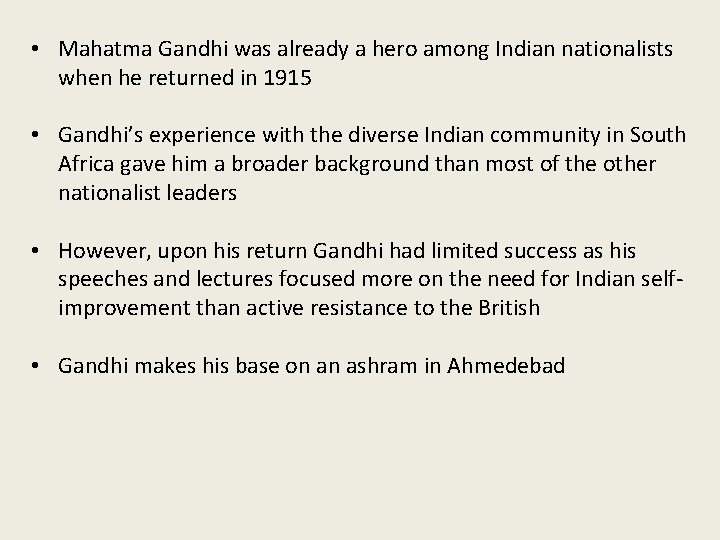
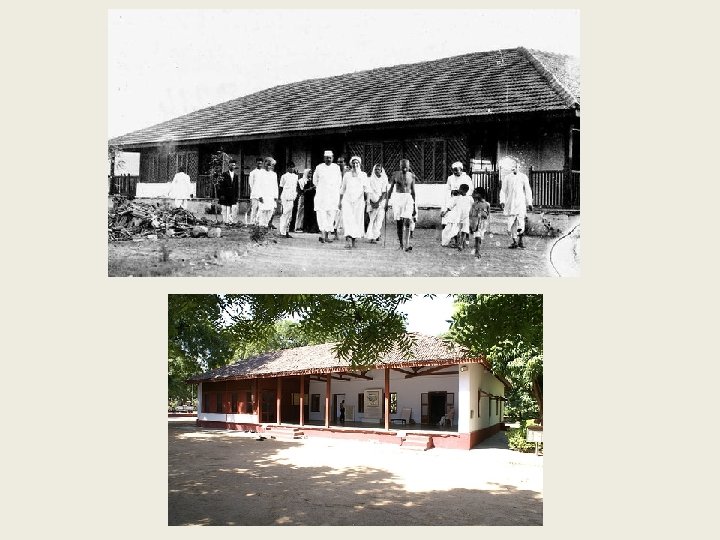
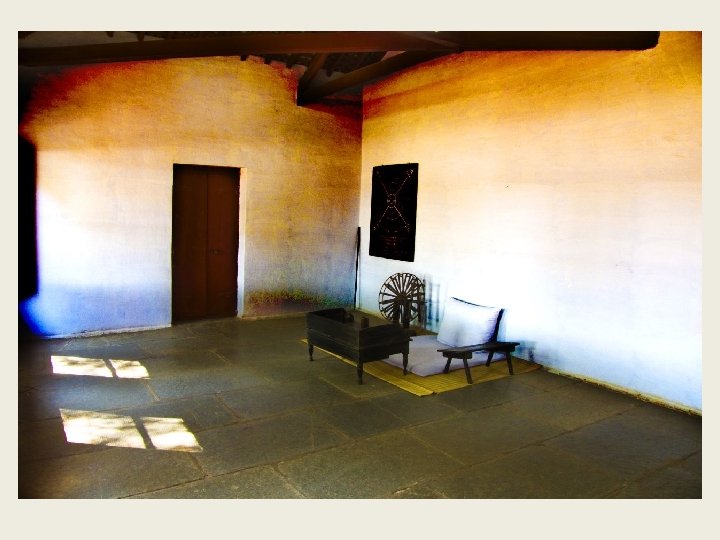
• Mahatma Gandhi was already a hero among Indian nationalists when he returned in 1915 • Gandhi’s experience with the diverse Indian community in South Africa gave him a broader background than most of the other nationalist leaders • However, upon his return Gandhi had limited success as his speeches and lectures focused more on the need for Indian selfimprovement than active resistance to the British • Gandhi makes his base on an ashram in Ahmedebad
Champaran Satyagraha • Indian farmers in the Champaran district of Gujarat were forced to grow indigo by their British landlords even in the face of food shortages in their region • Farmers began revolting and in 1917 Gandhi came to launch a satyagraha campaign • Gandhi inspired a mass civil disobedience among the farmers and was arrested • His arrest inspired even larger protests and the British were forced to negotiate and an agreement was forged giving the farmers more autonomy
• Gandhi was clear to state that the Champaran Satyagraha was simply a humanitarian mission, but it aroused excitement among Indians everywhere for change • Among Indian nationalist leaders, Gandhi was still an enigma. • The nationalist sympathizer Edwin Montagu described Gandhi saying, “he forswears all personal advancement, lives practically on air and is a pure visionary”
Non-Cooperation Movement • The movement was undertaken to A. Restore the status of caliph to the Ottoman sultan B. In response to sense of helplessness after the Jallianwala Massacre and other violence in Punjab and C. To secure Swaraj (independence) for India.
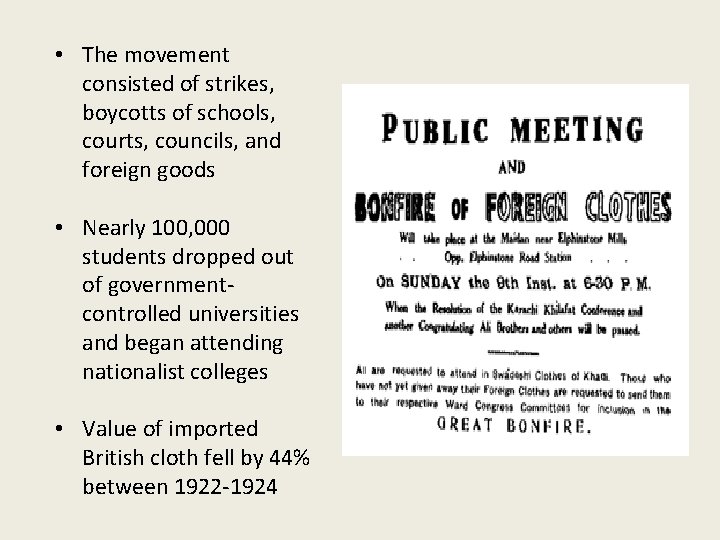
• The movement consisted of strikes, boycotts of schools, courts, councils, and foreign goods • Nearly 100, 000 students dropped out of governmentcontrolled universities and began attending nationalist colleges • Value of imported British cloth fell by 44% between 1922 -1924
• Gandhi himself becomes a leader of the Noncooperation Movement by joining with the Khilafat leaders, bringing them into the INC, and helping to reorganize the INC in 1920 • The INC reorganized creating within it a 350 -member All-India Congress Committee with elected representatives from 21 different Indian regions
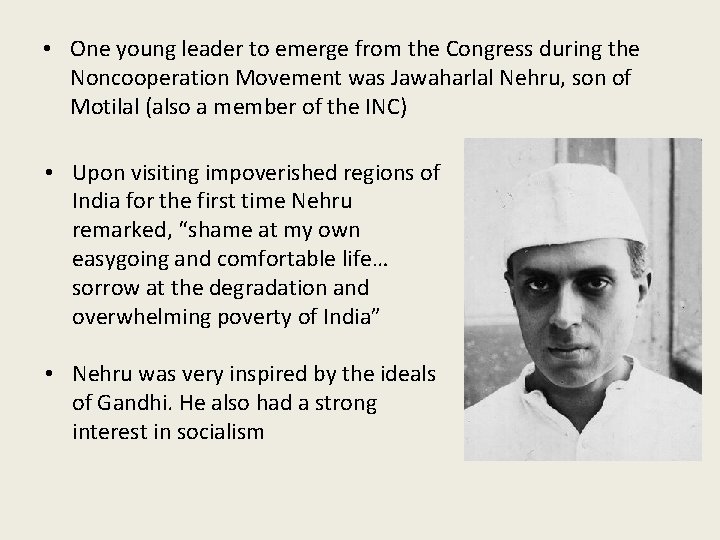
• One young leader to emerge from the Congress during the Noncooperation Movement was Jawaharlal Nehru, son of Motilal (also a member of the INC) • Upon visiting impoverished regions of India for the first time Nehru remarked, “shame at my own easygoing and comfortable life… sorrow at the degradation and overwhelming poverty of India” • Nehru was very inspired by the ideals of Gandhi. He also had a strong interest in socialism
• By the end of 1921, 20, 000 Indians had been jailed for civil disobedience! • The combined Khilafat and Congress movement brought British India into a state of rebellion that turned violent at times causing Gandhi to end his participation in the Noncooperation Movement in 1922 and focused for the next several years on relief projects and village work
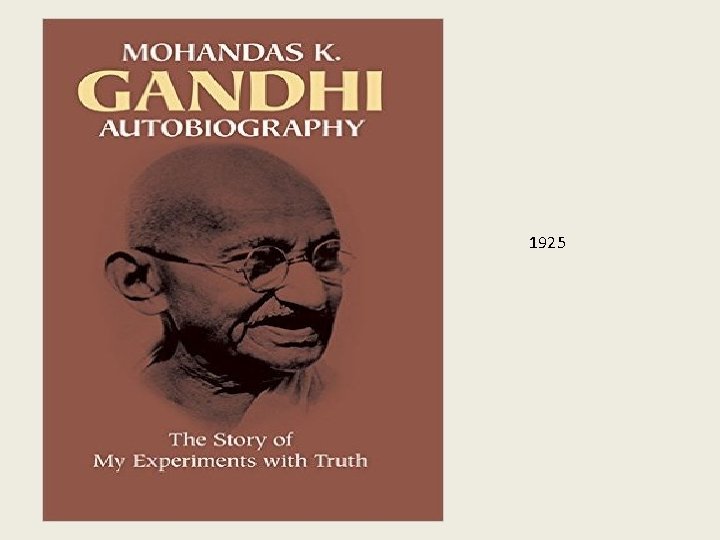
1925
Post-Khalifat Communal Violence & Rise of the Hindu Mahasabha * Between 1924 – 1930 extremist Muslim and Hindu groups rise in prominence and Muslim-Hindu unity is once again broken
• The worldwide Khilifat movement ended in 1924 when the new ruler of Turkey (Kemal Attaturk) abolished the position of Ottoman sultan and caliph • In India, local Muslim leaders therefore assumed caliph -like roles in several regions of the country and led movements to “protect Islam” • The Hindu Mahasabha was an alliance of Hindu revivalists working for cow protection, language reform, and Hindu social welfare mostly in northern India
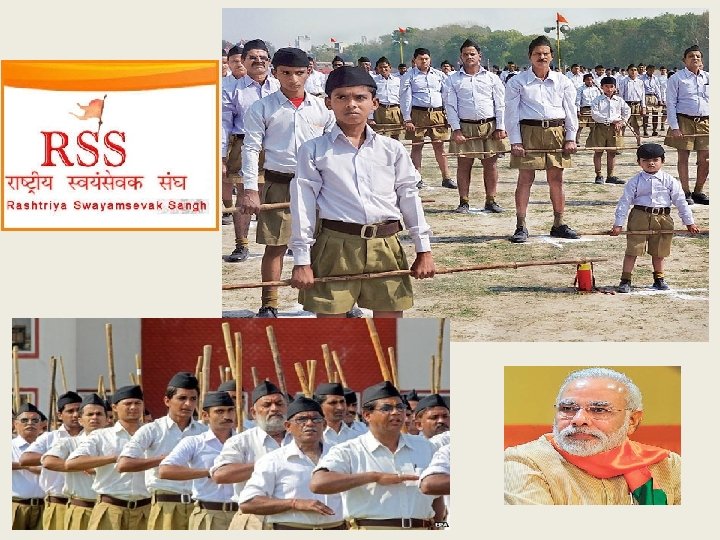
• The Mahasabha had a paramilitary offshoot called the “Rashtriya Swayamsevak Sangh” or the RSS. Members pledged to serve the RSS with “their whole body, heart, and money for in it lies the betterment of Hindus and the country” • In 1926, the Mahasabha beat out INC candidates in provincial elections
Effects of Great Depression on India • The Great Depression which began in 1929 destroyed India’s export market and changed Britain’s economic relationship with India 1929 -1933: Value of Indian exports cut in half 1929 -1933: Value of Indian imports cut in half • The economic stagnation worsened poverty throughout the country • Only growth was in home grown industries, especially in textiles. By the 1930 s, Indian textile mills were producing two-thirds of all textiles bought in India
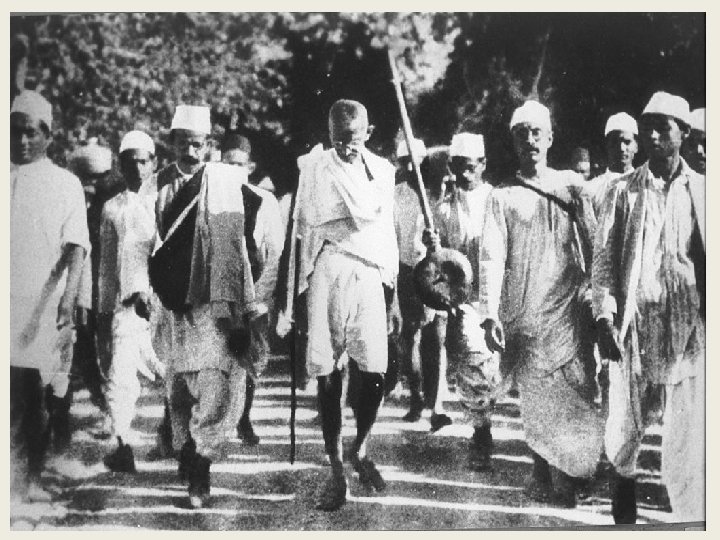
Salt March – 1930 • The most famous of all of Gandhi’s campaigns • The British imposed Salt Tax made it illegal for any Indian to manufacture salt or even collect natural sea salt without paying a tax • Gandhi started a march to the sea on March 12 th, 1930 with 70 followers.
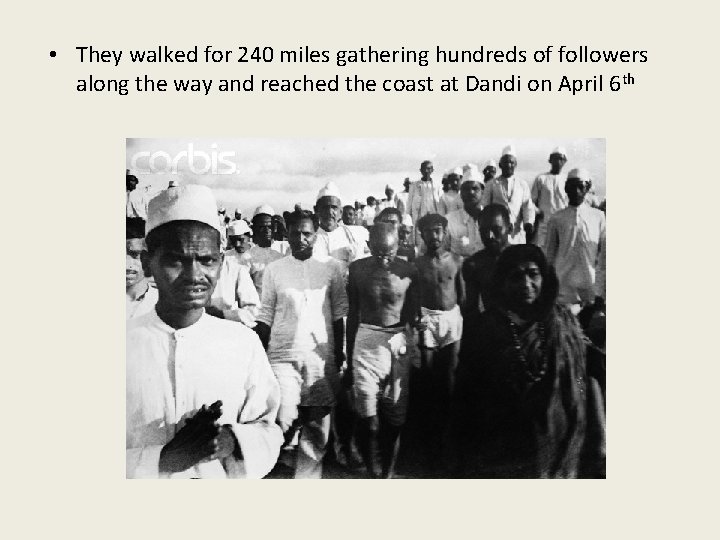
• They walked for 240 miles gathering hundreds of followers along the way and reached the coast at Dandi on April 6 th
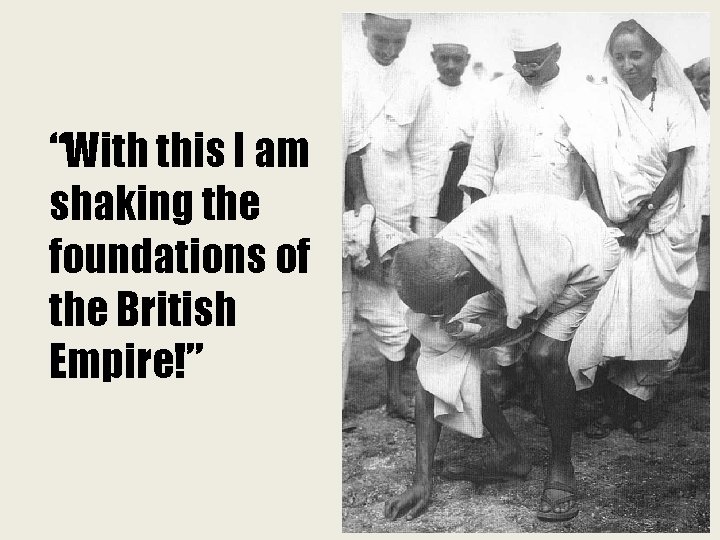
“With this I am shaking the foundations of the British Empire!”
• Gandhi’s next satyagraha was to take over the British owned Dharasana Salt Works. Before he was able to begin the action he was arrested on May 4 th • The action went on as planned starting May 21 st. Hundreds were arrested and hundreds more were beaten by police as they attempted to enter the salt works. The protesters remained non-violent and continued to take the beatings.
• The Salt March and Dharasana Satyagraha served to: 1. Bring worldwide attention and sympathy to the nonviolent struggle in India for independence 2. Increase peasant participation in the independence movement 3. Increased police violence against protesters throughout the land 4. Led to the Round Table Conferences of 1930 -1932. .
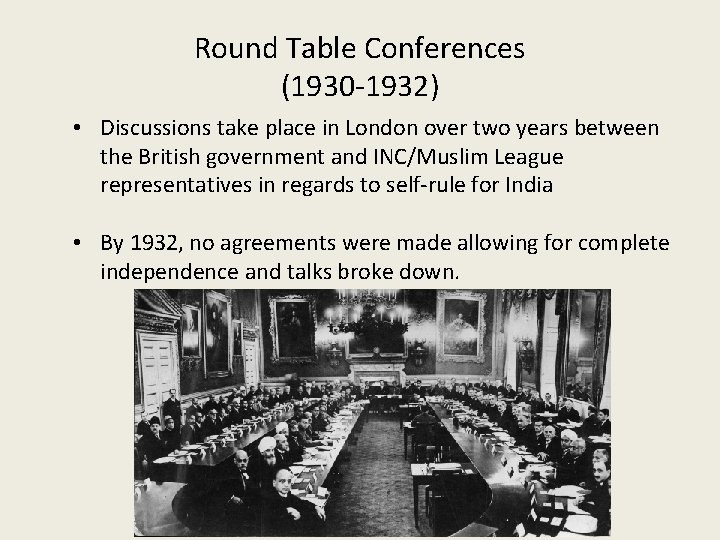
Round Table Conferences (1930 -1932) • Discussions take place in London over two years between the British government and INC/Muslim League representatives in regards to self-rule for India • By 1932, no agreements were made allowing for complete independence and talks broke down.
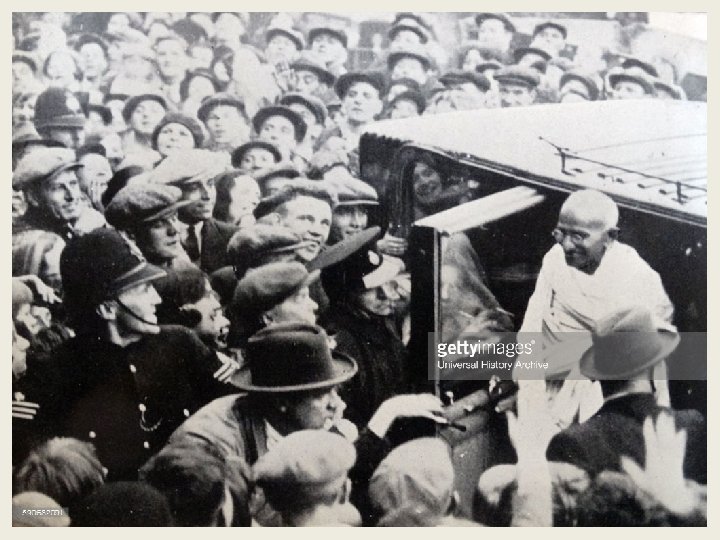
• In 1932, with no agreement made at the conferences, the British designed a system awarding a certain number of seats in provincial governments to members of different religious and social groups based on their populations in those areas. These were known as “Communal Awards” • Untouchables were separated from other Hindus and given their own electorates which Gandhi protested through fast fearing what it would mean for Untouchables to split off from the Hindu community in this kind of way
Poona Pact • Reorganizes the British communal awards placing Untouchables in the same electorate with Hindus but reserving for them a certain number of seats within that Hindu electorate • The Poona Pact results in: -More rights for Untouchables and better attention given to the needs of their communities -A greater divide within the Hindu community as orthodox Hindus dislike being politically associated with Untouchables
Government of India Act (1935) • Preserved control of the central government for the British while ceding provincial control to Indians • The Indian National Congress Party won 8 out of 11 provinces in 1937 elections • Regional parties won 3 out of the 4 Muslim majority provinces • PROBLEM: Winning INC politicians made few concessions to Muslims in the provinces they won
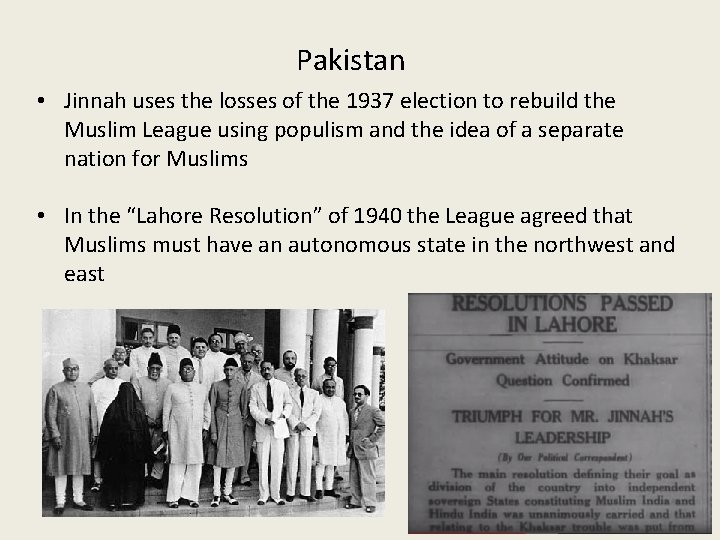
Pakistan • Jinnah uses the losses of the 1937 election to rebuild the Muslim League using populism and the idea of a separate nation for Muslims • In the “Lahore Resolution” of 1940 the League agreed that Muslims must have an autonomous state in the northwest and east
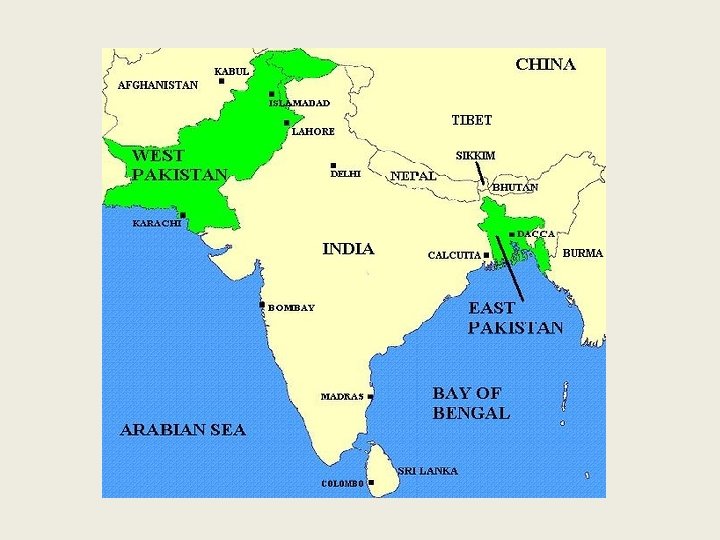
• PAKISTAN PROBLEM – It does not address the political needs of most muslims as the majority of India’s muslims are scattered throughout the country • “Minority Muslim populations needed constitutional safeguards within provincial and central governments, not a Muslim state hundreds, even thousands of miles from their homes” • Some scholars have suggested that Jinnah was using the idea of Pakistan as a way to get concessions from Congress leaders… instead it turned into a popular movement with a lot of momentum
Quit India! • In 1939 with the beginning of WWII, Britain sought India’s help in the war effort. • This time the INC only offered support on the condition of the immediate sharing of power in India’s central government. • When Britain offered only a guarantee of such sharing at the end of the war, Gandhi and the Congress started a new civil disobedience campaign called Quit India
Bengal Famine – 1943 • An estimated 3 million people died of famine related causes between 1943 -1946 • The main causes of the famine are disputed but are largely related to the abrupt changes in local food sources as a result of the British war effort in neighboring Burma • It is in complete agreement that Britain completely failed to prepare for or react to the famine thus leading to its terrible toll on the Bengali population
Independence • At the end of WWII, Britain’s controlling position was untenable as a result of: 1. The continuing opposition and civil disobedience movements led by the INC 2. British debt to India which had accumulated during the war
Independence - PROBLEMS • The major problem facing India’s ability to form a modern democratic state in the 1940 s was how to unite all the various political, religious, and social groups under one government. • The Congress Party, dominated by Hindus, continued to hold the majority of political power and were ready to form a central government under its control • The Congress felt that political differences between Hindus and Muslims could be solved after independence…
• …Muslims felt otherwise. For the Muslim League, religious identity became intertwined with political identity and they required political protection through constitutional safeguards before independence arrived • Agreements could not be forged and Jinnah called for a “Direct Action Day” on August 16 th, 1946 to achieve Pakistan • This resulted in terrible Hindu-Muslim riots throughout India that lasted between 1946 and 1947 and resulted in tens of thousands of deaths
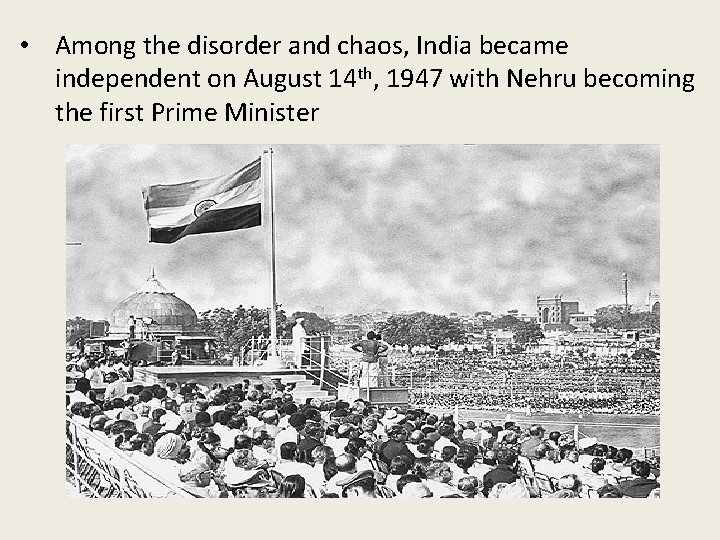
• Among the disorder and chaos, India became independent on August 14 th, 1947 with Nehru becoming the first Prime Minister
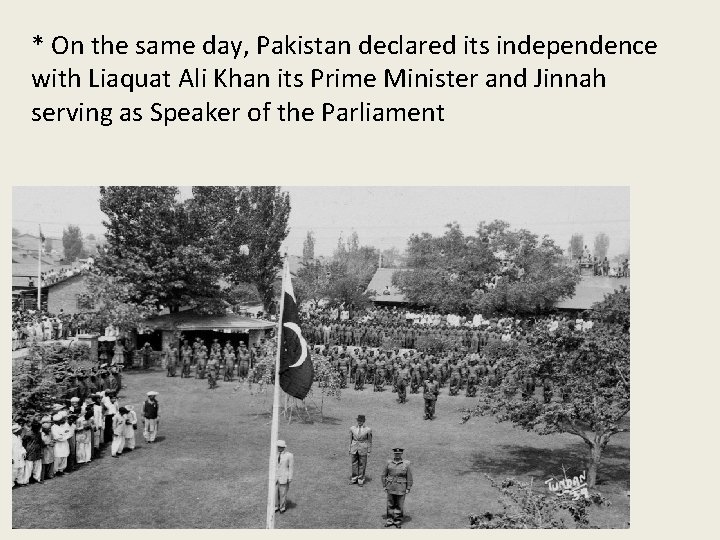
* On the same day, Pakistan declared its independence with Liaquat Ali Khan its Prime Minister and Jinnah serving as Speaker of the Parliament
Partition Violence • With the partition of India and Pakistan more violence broke out between Hindus and Muslims. • By March, 1948 more than 10 million Muslims, Hindus and Sikhs had fled their homes on either side of the border to become refugees within the other country • An estimated 1 million people lost their lives in partition violence
Gandhi’s Last Campaign • Mahatma Gandhi took no part in the final negotiations for partition or independence • He instead focused on stopping the violence taking place and in January 1948 he pledged to fast unto death in Calcutta. He would only stop his fast if the violence stopped there. • As he became increasingly weak, the violence finally came to a stop in that city and Gandhi stopped his fast. • On January 30 th, 1948 Mahatma Gandhi was assassinated by Naturam Godse a right-wing Hindu fundamenalist with ties to the RSS
- Slides: 49