Lecture 3 Pride and Prejudice You are invited

- Slides: 21
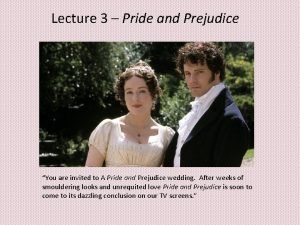
Lecture 3 – Pride and Prejudice “You are invited to A Pride and Prejudice wedding. After weeks of smouldering looks and unrequited love Pride and Prejudice is soon to come to its dazzling conclusion on our TV screens. ”
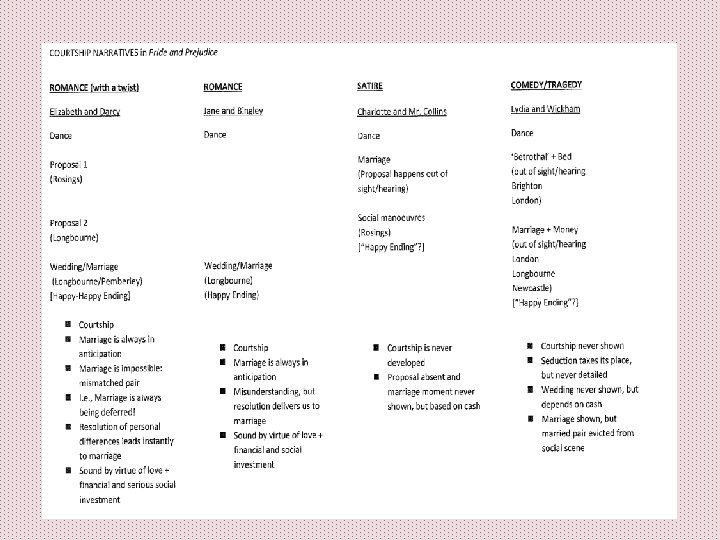
Essay Topic on P & P ‘One may wonder what she [Austen] has to say to the current crop of twenty year olds, for whom ‘love’ is not quite what it was. Today love faces new problems [including ‘futurelessness’ and ‘nationwide condom campaigns’]. But maybe the old opposition, of passion and prudence, never really changes; it just sways on its axis. ’ (Martin Amis) Apply and discuss this comment by English novelist Martin Amis on Austen’s writing to Pride and Prejudice. Does the novel seem to you to be invested in the opposition (or complementarity) of passion and prudence? Prudence = caution, good judgement, care in handling one’s affairs.
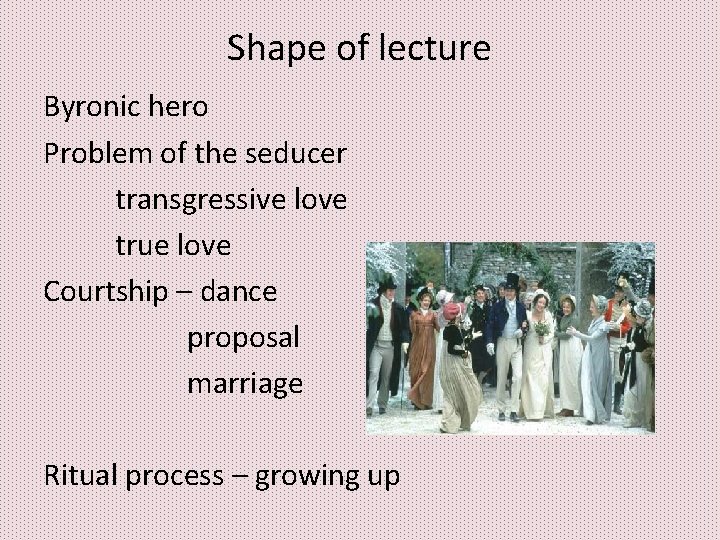
Shape of lecture Byronic hero Problem of the seducer transgressive love true love Courtship – dance proposal marriage Ritual process – growing up
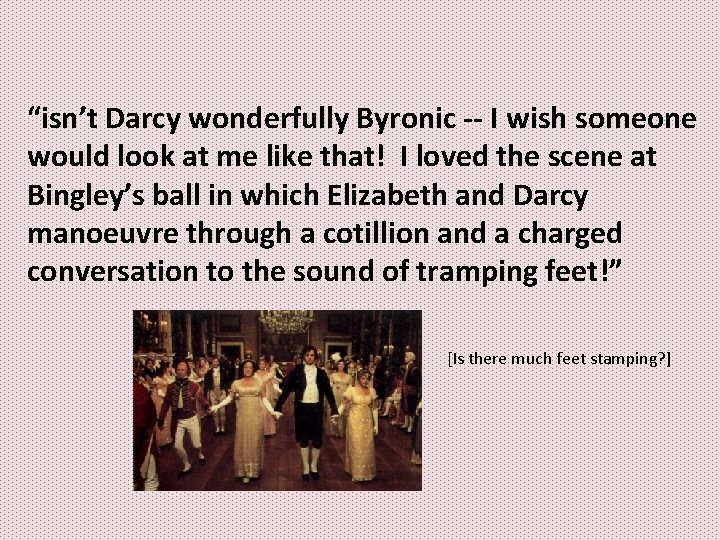
“isn’t Darcy wonderfully Byronic -- I wish someone would look at me like that! I loved the scene at Bingley’s ball in which Elizabeth and Darcy manoeuvre through a cotillion and a charged conversation to the sound of tramping feet!” [Is there much feet stamping? ]
Byron (1788‐ 1824) ‘The great object of life is Sensation -- to feel that we exist -- even though in pain -- it is this “craving void” which drives us to Gamble -- to Battle -- to Travel -- to intemperate but keenly felt pursuits of every description whose principal attraction is the agitation inseparable from their accomplishment. I am but an awkward dissembler. . ’ (September 6, 1814) -- quoted in Romanticism and Gender, Anne Mellor. In another letter of September 26, 1813, Byron writes “I can’t stagnate”.
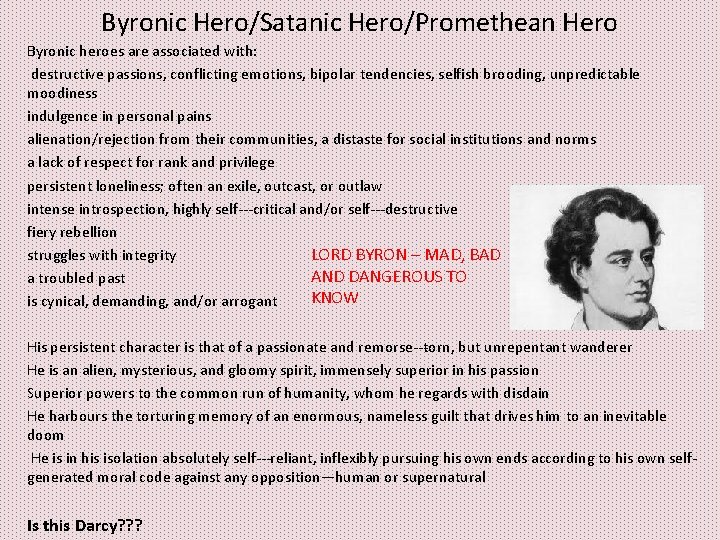
Byronic Hero/Satanic Hero/Promethean Hero Byronic heroes are associated with: destructive passions, conflicting emotions, bipolar tendencies, selfish brooding, unpredictable moodiness indulgence in personal pains alienation/rejection from their communities, a distaste for social institutions and norms a lack of respect for rank and privilege persistent loneliness; often an exile, outcast, or outlaw intense introspection, highly self‐‐‐critical and/or self‐‐‐destructive fiery rebellion struggles with integrity LORD BYRON – MAD, BAD AND DANGEROUS TO a troubled past KNOW is cynical, demanding, and/or arrogant His persistent character is that of a passionate and remorse‐‐‐torn, but unrepentant wanderer He is an alien, mysterious, and gloomy spirit, immensely superior in his passion Superior powers to the common run of humanity, whom he regards with disdain He harbours the torturing memory of an enormous, nameless guilt that drives him to an inevitable doom He is in his isolation absolutely self‐‐‐reliant, inflexibly pursuing his own ends according to his own self‐ generated moral code against any opposition—human or supernatural Is this Darcy? ? ?
In a sense, Austen transforms the notion of the gothic character and the plot of the gothic novel.
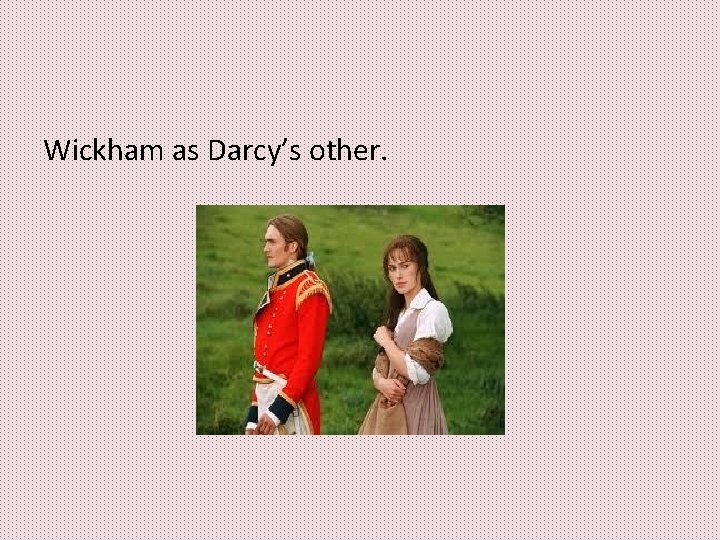
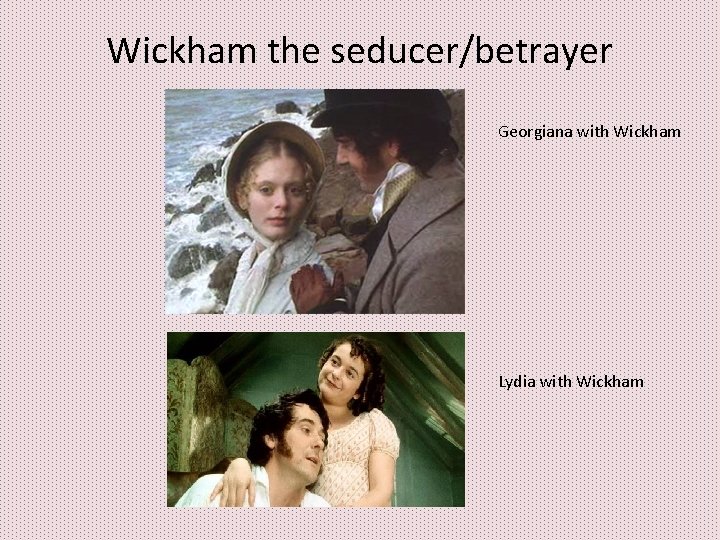
Wickham as Darcy’s other.
Wickham the seducer/betrayer Georgiana with Wickham Lydia with Wickham
Elizabeth to her astonished father with regard to Darcy. • “Indeed, he has no improper pride. ” By this point, pride has become the mark of singularity – the quality most desirable in a lover, when, after all, the singular hero turn his gaze with definitive force upon the heroine.
Both Catherine Belsey and Janice Radway, in their discussion of romance, argue that the three words most commonly used in the English language are I love you. Yet these are the words everyone wishes to hear.
Threshold moments Proposal: entrance to a ritual process – marriage – in which the protagonists not only find themselves, but do so symbolically by having the conditions of their lives changed – they become new people. This final space [the wedding] is a ritual properly described as liminality (threshold). [Victor Turner – a prominent theoretician of ritual]
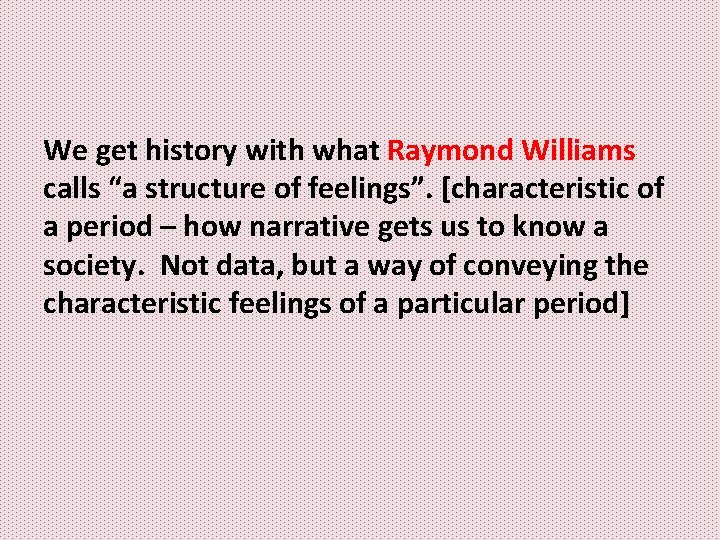
We get history with what Raymond Williams calls “a structure of feelings”. [characteristic of a period – how narrative gets us to know a society. Not data, but a way of conveying the characteristic feelings of a particular period]
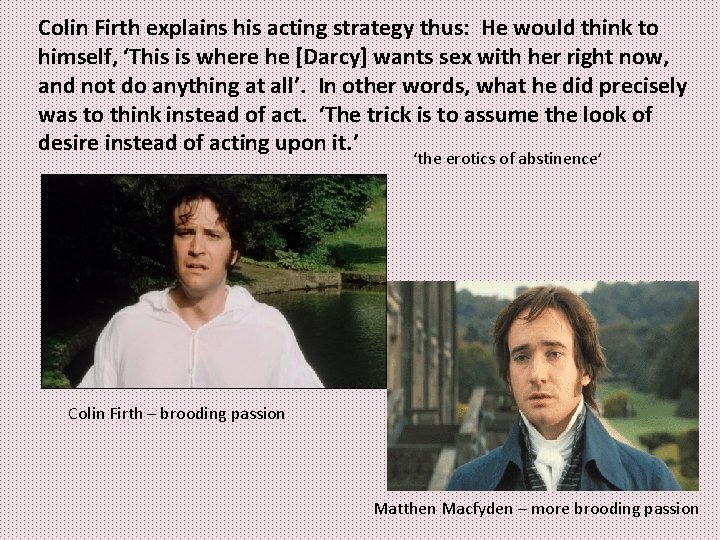
Colin Firth explains his acting strategy thus: He would think to himself, ‘This is where he [Darcy] wants sex with her right now, and not do anything at all’. In other words, what he did precisely was to think instead of act. ‘The trick is to assume the look of desire instead of acting upon it. ’ ‘the erotics of abstinence’ Colin Firth – brooding passion Matthen Macfyden – more brooding passion
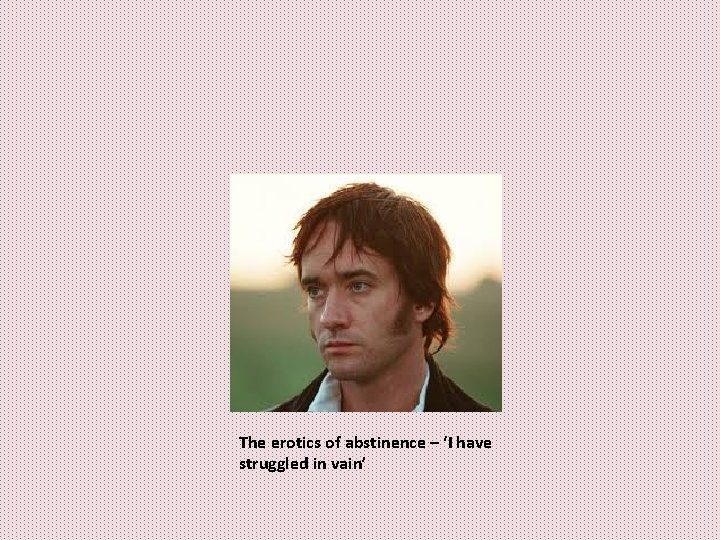
The erotics of abstinence – ‘I have struggled in vain’
Elizabeth’s reaction to Darcy’s second proposal Elizabeth feeling all the more than common awkwardness and anxiety of his situation, now forced herself to speak; and immediately, though not very fluently, gave him to understand, that her sentiments had undergone so material a change, since the period to which he alluded, as to make her receive with gratitude and pleasure, his present assurances. The happiness which this reply produced, was such as he had probably never felt before; and he expressed himself on the occasion as sensibly and as warmly as a man violently in love can be supposed to do. . . he told her of feelings, which, in proving of what importance she was to him, made his affection every moment more valuable. They walked on, without knowing in what direction. . [Vol III, chpt XVI] [Note: Pronouns used by Darcy. “I have struggled”, (first proposal) second -- “You are too generous to trifle with me”. The pronouns are telling.
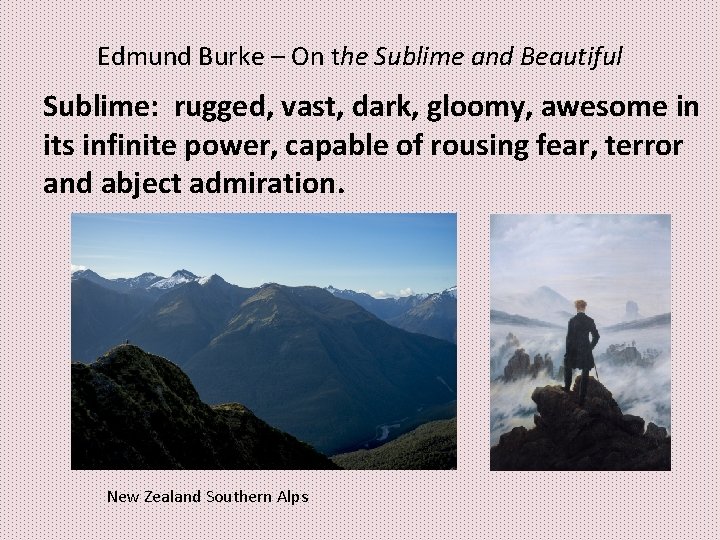
Edmund Burke – On the Sublime and Beautiful Sublime: rugged, vast, dark, gloomy, awesome in its infinite power, capable of rousing fear, terror and abject admiration. New Zealand Southern Alps
‘There are few people whom I really love, and still fewer of whom I think well. The more I see of the world, the more am I dissatisfied with it; and every day confirms my belief of the inconsistency of all human characters, and of the little dependence that can be placed on the appearance of either merit or sense’. (p. 121) [Elizabeth in conversation with Jane]
Elizabeth ‘how despicably have I acted!’. . . I, who have prided myself on my discernment! I, who have valued myself on my abilities!. . . Had I been in love, I could not have been more wretchedly blind. But vanity, not love has been my folly. -- Pleased with the preference of one, and offended by the neglect of the other, on the very beginning of our acquaintance, I have courted prepossession and ignorance, and driven reason away, where either were concerned. Till this moment, I never knew myself. [Vol II, chpt 13]
[Elizabeth] began. . . to comprehend that he was exactly the man, who, in disposition and talents, would most suit her. His understanding and temper, though unlike her own, would have answered all her wishes. It was a union that must have been to the advantage of both; by her ease and liveliness, his mind might have been softened, his manners improved, and from his judgement, information, and knowledge of the world, she must have received benefit of greater importance. ” [Vol III, chpt. VIII]