Learning 5000 Relational Extractors Raphael Hoffmann Congle Zhang

- Slides: 37
Learning 5000 Relational Extractors Raphael Hoffmann, Congle Zhang, Daniel S. Weld University of Washington Talk at ACL 2010 07/12/10
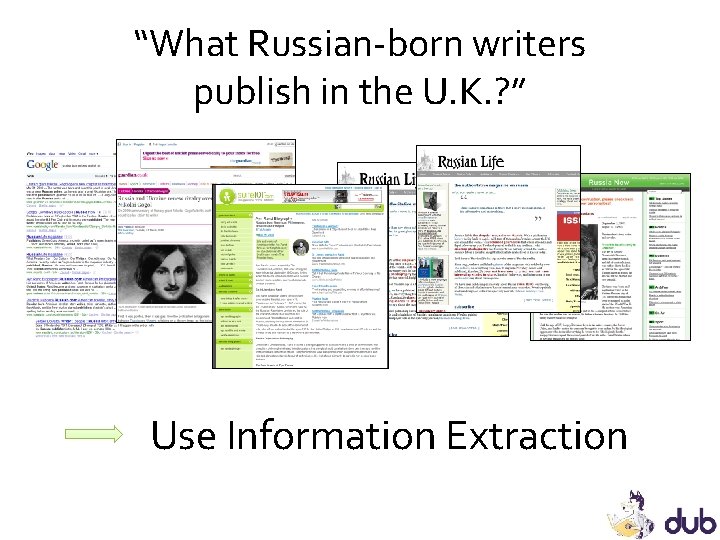
“What Russian-born writers publish in the U. K. ? ” Use Information Extraction
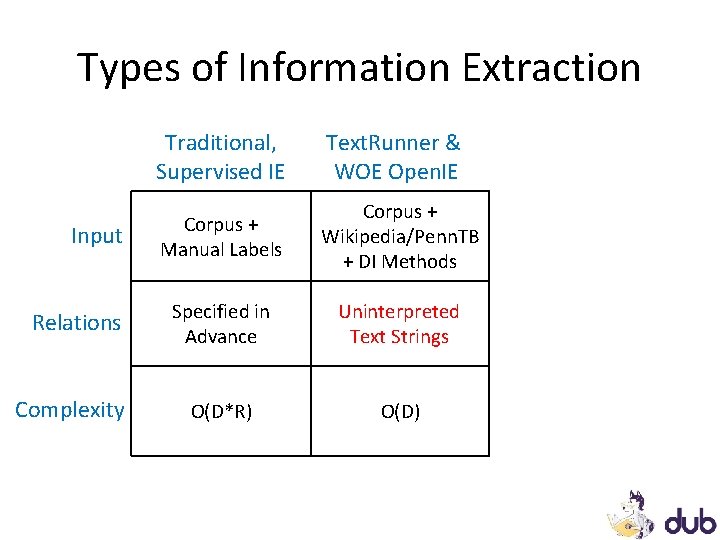
Types of Information Extraction Input Relations Complexity Traditional, Supervised IE Text. Runner & WOE Open. IE Corpus + Manual Labels Corpus + Wikipedia/Penn. TB + DI Methods Specified in Advance Discovered Uninterpreted Automatically Text Strings O(D*R) O(D)
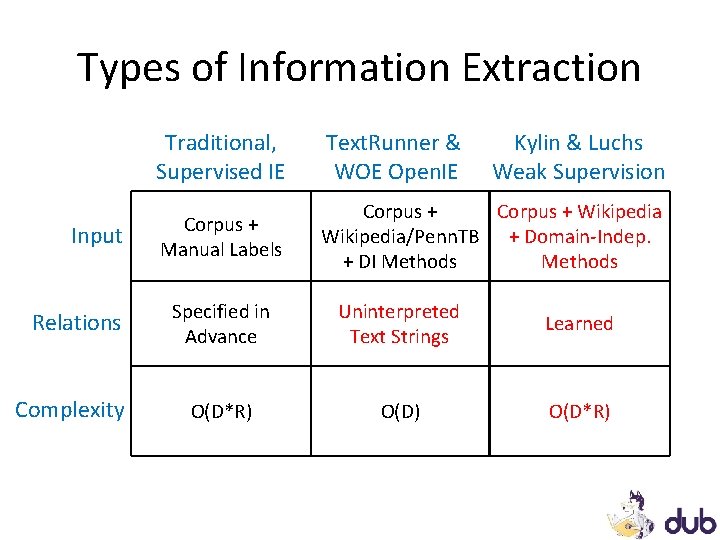
Types of Information Extraction Input Relations Complexity Traditional, Supervised IE Text. Runner & WOE Open. IE Kylin & Luchs Weak Supervision Corpus + Manual Labels Corpus + Wikipedia/Penn. TB + Domain-Indep. + DI Methods Specified in Advance Discovered Uninterpreted Automatically Text Strings Learned O(D*R)
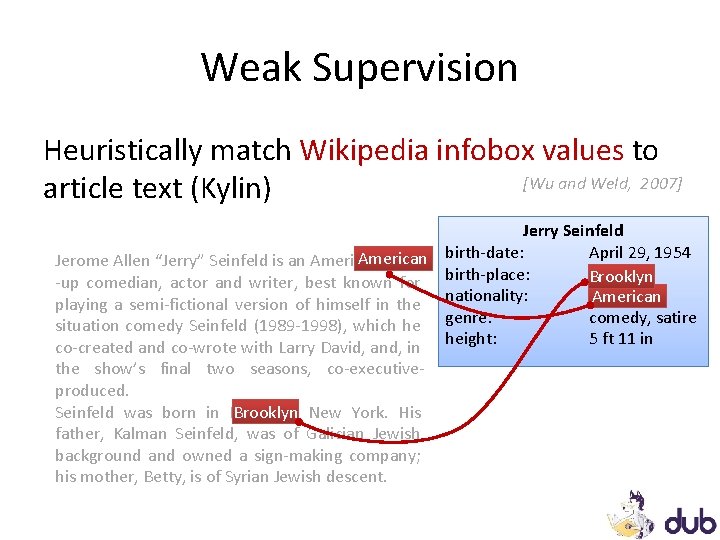
Weak Supervision Heuristically match Wikipedia infobox values to [Wu and Weld, 2007] article text (Kylin) Jerry Seinfeld April 29, 1954 American birth-date: Jerome Allen “Jerry” Seinfeld is an American stand Brooklyn -up comedian, actor and writer, best known for birth-place: American playing a semi-fictional version of himself in the nationality: comedy, satire situation comedy Seinfeld (1989 -1998), which he genre: 5 ft 11 in co-created and co-wrote with Larry David, and, in height: the show’s final two seasons, co-executiveproduced. Seinfeld was born in Brooklyn, Brooklyn New York. His father, Kalman Seinfeld, was of Galician Jewish background and owned a sign-making company; his mother, Betty, is of Syrian Jewish descent.
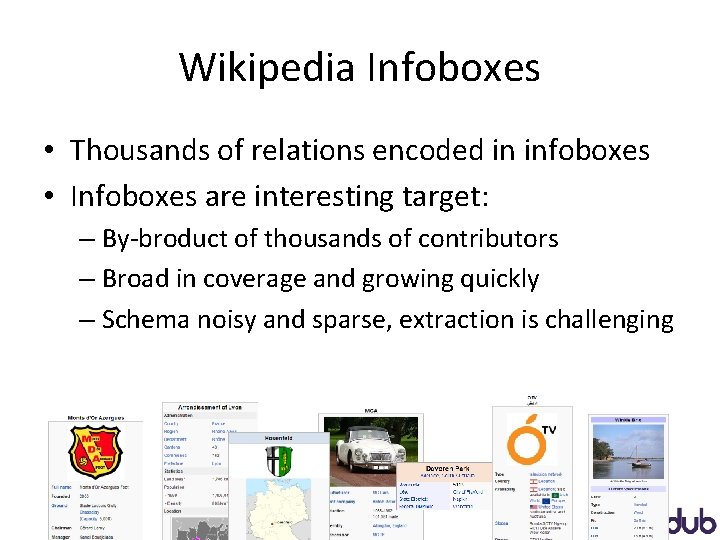
Wikipedia Infoboxes • Thousands of relations encoded in infoboxes • Infoboxes are interesting target: – By-broduct of thousands of contributors – Broad in coverage and growing quickly – Schema noisy and sparse, extraction is challenging
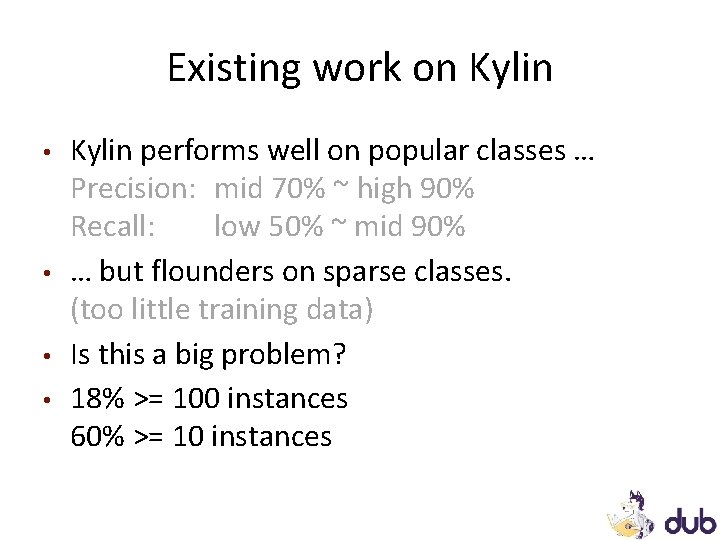
Existing work on Kylin • • Kylin performs well on popular classes … Precision: mid 70% ~ high 90% Recall: low 50% ~ mid 90% … but flounders on sparse classes. (too little training data) Is this a big problem? 18% >= 100 instances 60% >= 10 instances
Contributions • LUCHS – an autonomous, weakly-supervised system which learns 5025 relational extractors • LUCHS introduces dynamic lexicon features, a new technique which dramatically improves performance from sparse data and that way enables scalability • LUCHS reaches an average F 1 score of 61%
Outline • • • Motivation Learning Extractors Extraction with Dynamic Lexicons Experiments Next Steps
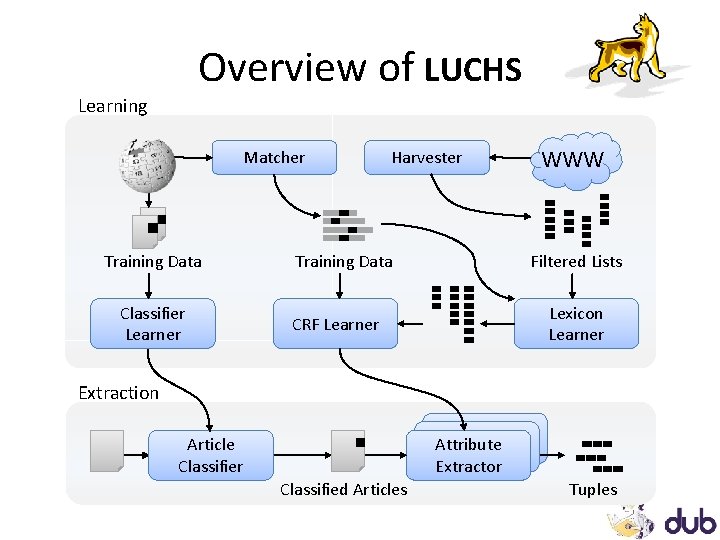
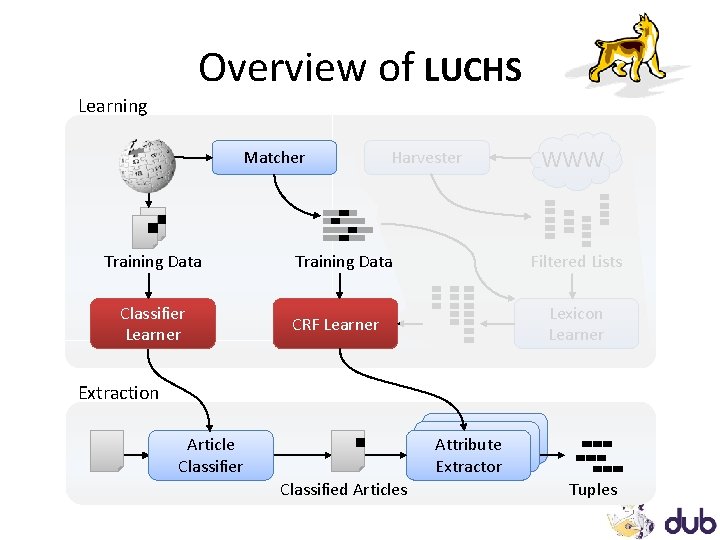
Overview of LUCHS Learning Matcher Training Data Classifier Learner Harvester Training Data WWW Filtered Lists Lexicon Learner CRF Learner Extraction Extractor Attribute Extractor Article Classifier Classified Articles Tuples
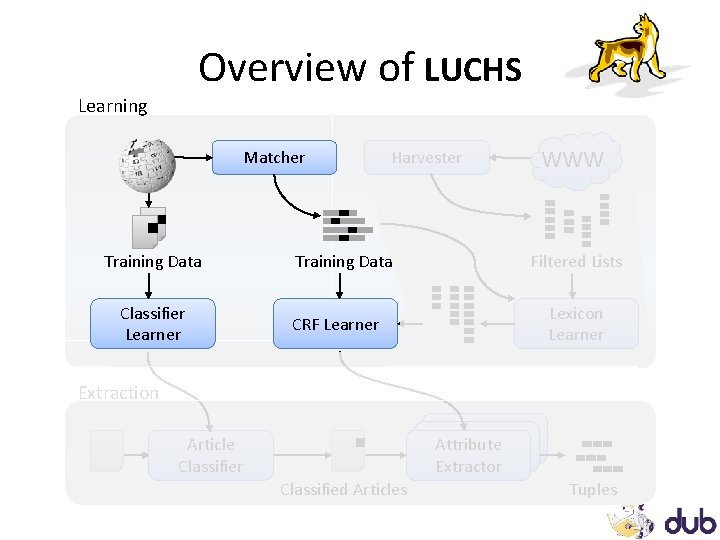
Overview of LUCHS Learning Matcher Training Data Classifier Learner Harvester Training Data WWW Filtered Lists Lexicon Learner CRF Learner Extraction Extractor Attribute Extractor Article Classifier Classified Articles Tuples
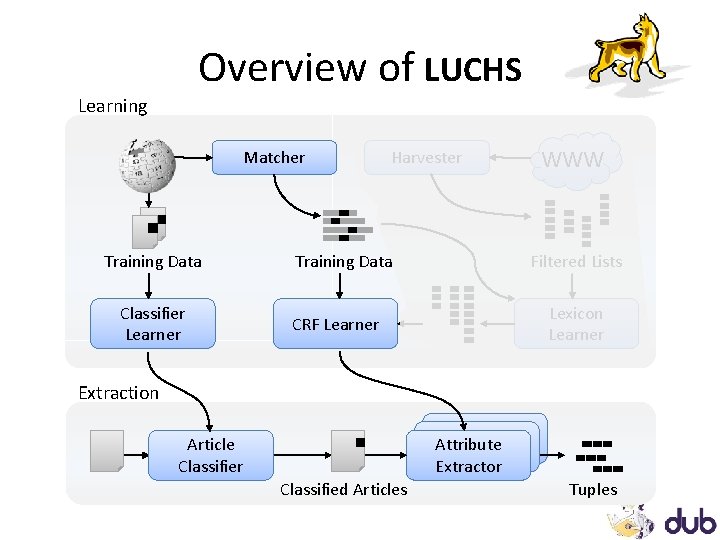
Overview of LUCHS Learning Matcher Training Data Classifier Learner Harvester Training Data WWW Filtered Lists Lexicon Learner CRF Learner Extraction Extractor Attribute Extractor Article Classifier Classified Articles Tuples
Overview of LUCHS Learning Matcher Training Data Classifier Learner Harvester Training Data WWW Filtered Lists Lexicon Learner CRF Learner Extraction Extractor Attribute Extractor Article Classifier Classified Articles Tuples
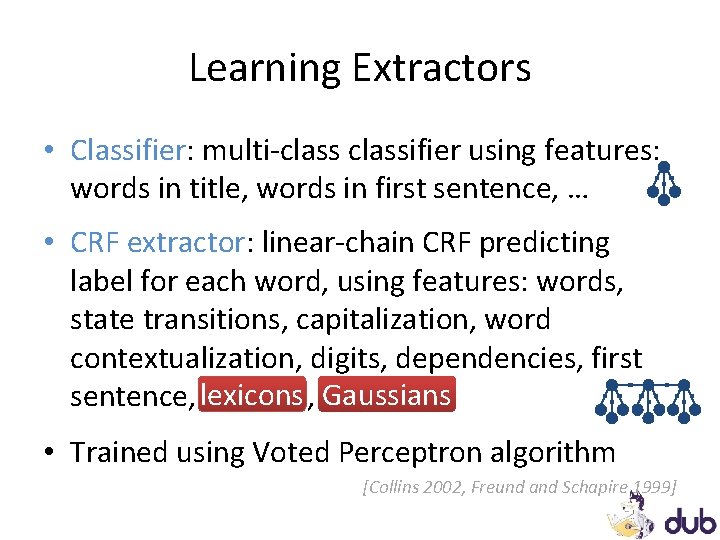
Learning Extractors • Classifier: multi-classifier using features: words in title, words in first sentence, … • CRF extractor: linear-chain CRF predicting label for each word, using features: words, state transitions, capitalization, word contextualization, digits, dependencies, first lexicons Gaussians sentence, lexicons, Gaussians • Trained using Voted Perceptron algorithm [Collins 2002, Freund and Schapire 1999]
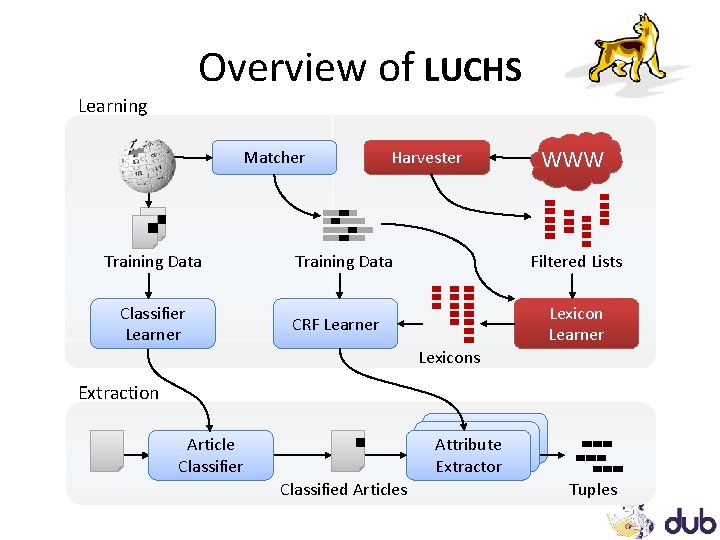
Overview of LUCHS Learning Matcher Training Data Classifier Learner Harvester Training Data WWW Filtered Lists Lexicon Learner CRF Learner Lexicons Extraction Extractor Attribute Extractor Article Classifier Classified Articles Tuples
Outline • • • Motivation Learning Extractors Extraction with Dynamic Lexicons Experiments Next Steps
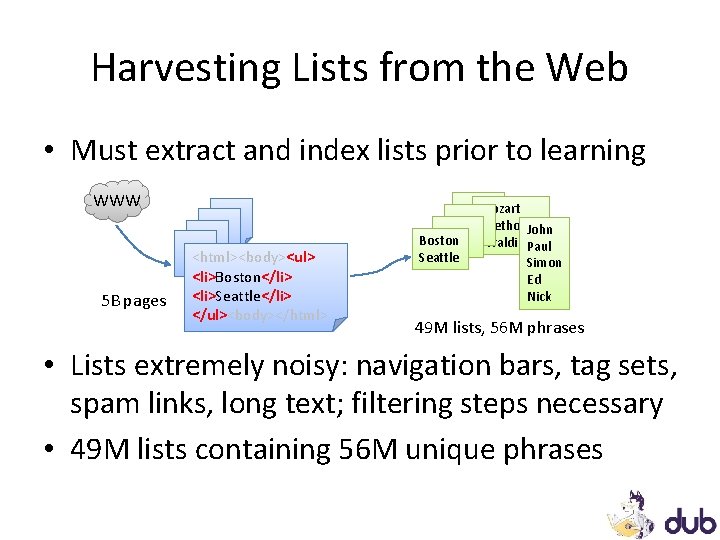
Harvesting Lists from the Web • Must extract and index lists prior to learning WWW 5 B pages <html><body><ul> <li>Boston</li> <li>Seattle</li> </ul><body></html> Mozart Beethoven John Boston Vivaldi Paul Seattle Simon Ed Nick 49 M lists, 56 M phrases • Lists extremely noisy: navigation bars, tag sets, spam links, long text; filtering steps necessary • 49 M lists containing 56 M unique phrases
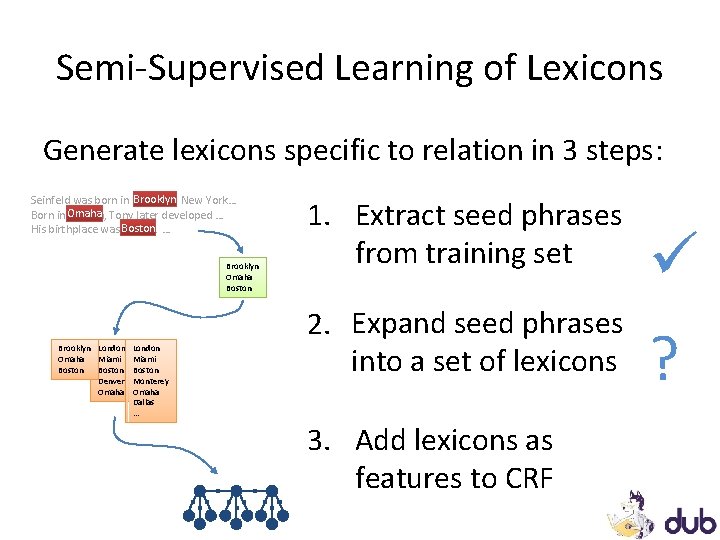
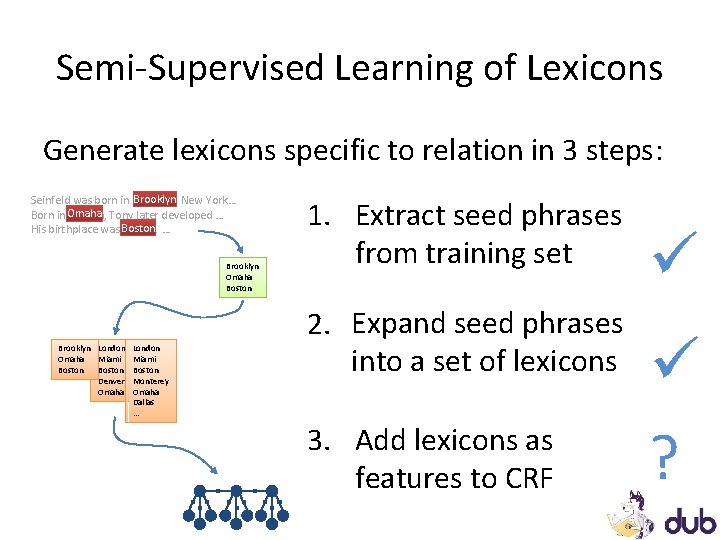
Semi-Supervised Learning of Lexicons Generate lexicons specific to relation in 3 steps: Brooklyn Seinfeld was born in Brooklyn, New York… Omaha Born in Omaha, Tony later developed … Boston His birthplace was Boston. … Brooklyn Omaha Boston Brooklyn London Omaha Miami Boston Denver Monterey Omaha Dallas. . . 1. Extract seed phrases from training set 2. Expand seed phrases into a set of lexicons 3. Add lexicons as features to CRF ?
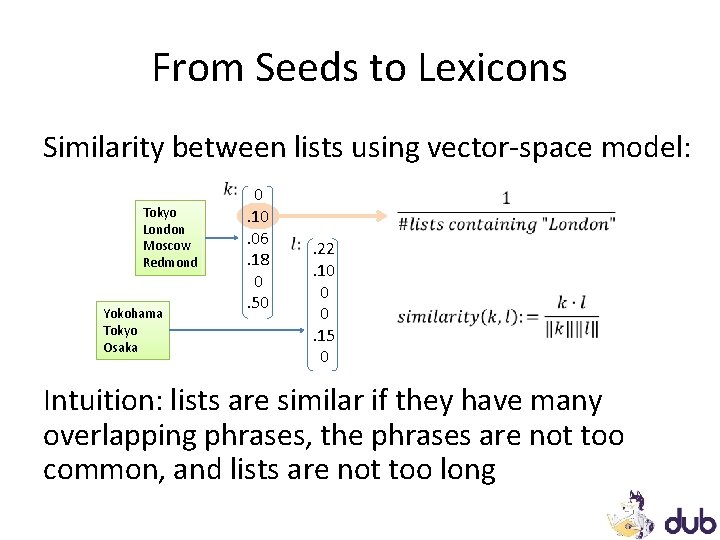
From Seeds to Lexicons Similarity between lists using vector-space model: Tokyo London Moscow Redmond Yokohama Tokyo Osaka 0. 10. 06. 18 0. 50 . 22. 10 0 0. 15 0 Intuition: lists are similar if they have many overlapping phrases, the phrases are not too common, and lists are not too long
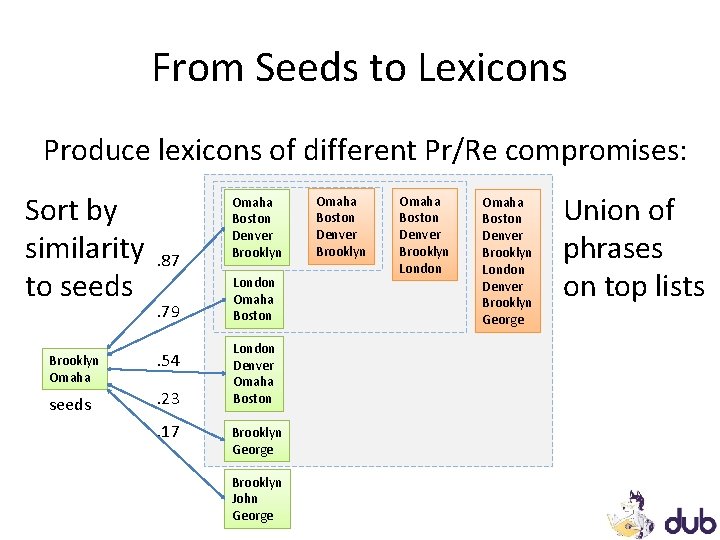
From Seeds to Lexicons Produce lexicons of different Pr/Re compromises: Sort by similarity to seeds . 87. 79 Brooklyn Omaha . 54 seeds . 23. 17 Omaha Boston Denver Brooklyn London Omaha Boston London Denver Omaha Boston Brooklyn George Brooklyn John George Omaha Boston Denver Brooklyn London Denver Brooklyn George Union of phrases on top lists
Semi-Supervised Learning of Lexicons Generate lexicons specific to relation in 3 steps: Brooklyn Seinfeld was born in Brooklyn, New York… Omaha Born in Omaha, Tony later developed … Boston His birthplace was Boston. … Brooklyn Omaha Boston Brooklyn London Omaha Miami Boston Denver Monterey Omaha Dallas. . . 1. Extract seed phrases from training set 2. Expand seed phrases into a set of lexicons 3. Add lexicons as features to CRF ?
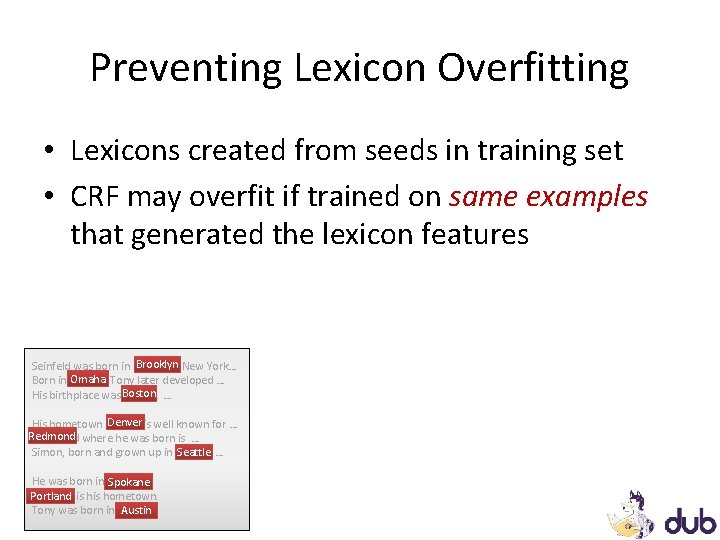
Preventing Lexicon Overfitting • Lexicons created from seeds in training set • CRF may overfit if trained on same examples that generated the lexicon features Brooklyn Seinfeld was born in Brooklyn, New York… Omaha Born in Omaha, Tony later developed … Boston His birthplace was Boston. … Denver His hometown Denver is well known for … Redmond where he was born is … Seattle Simon, born and grown up in Seattle, … He was born in Spokane Portland is hometown. Portland Tony was born in Austin
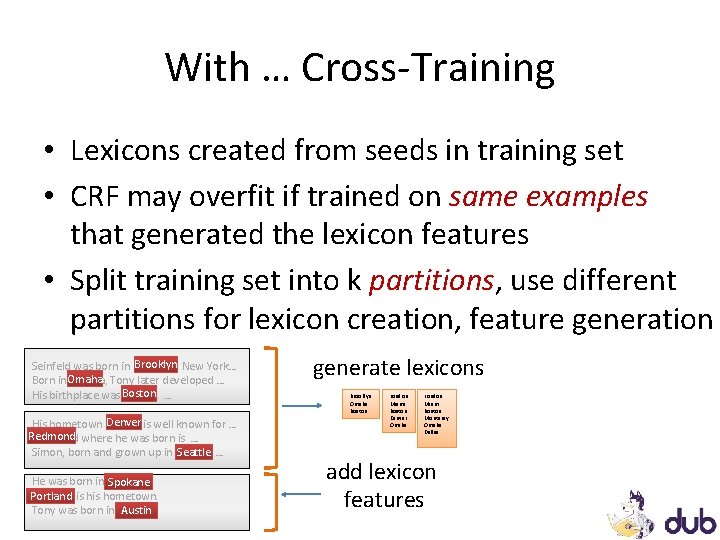
With … Cross-Training • Lexicons created from seeds in training set • CRF may overfit if trained on same examples that generated the lexicon features • Split training set into k partitions, use different partitions for lexicon creation, feature generation Brooklyn Seinfeld was born in Brooklyn, New York… Omaha Born in Omaha, Tony later developed … Boston His birthplace was Boston. … Denver His hometown Denver is well known for … Redmond where he was born is … Seattle Simon, born and grown up in Seattle, … He was born in Spokane Portland is hometown. Portland Tony was born in Austin generate lexicons Brooklyn Omaha Boston London Miami Boston Denver Omaha London Miami Boston Monterey Omaha Dallas. . . add lexicon features
Outline • • • Motivation Learning Extractors Extraction with Dynamic Lexicons Experiments Next Steps
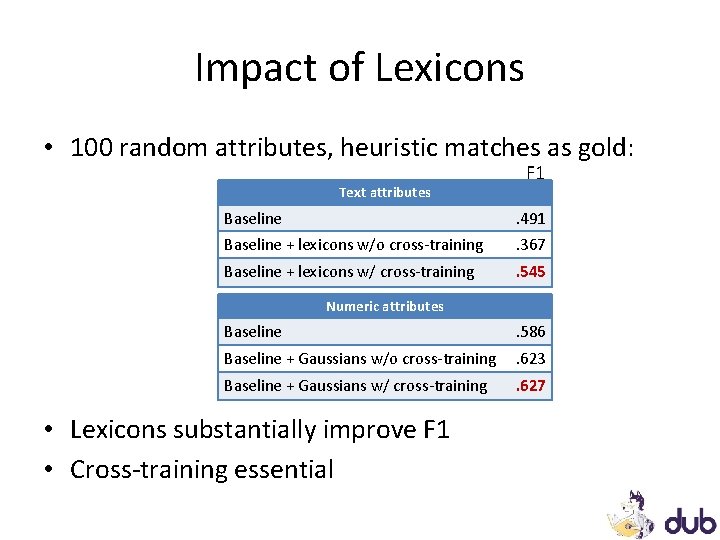
Impact of Lexicons • 100 random attributes, heuristic matches as gold: Text attributes F 1 Baseline . 491 Baseline + lexicons w/o cross-training . 367 Baseline + lexicons w/ cross-training . 545 Numeric attributes Baseline . 586 Baseline + Gaussians w/o cross-training . 623 Baseline + Gaussians w/ cross-training . 627 • Lexicons substantially improve F 1 • Cross-training essential
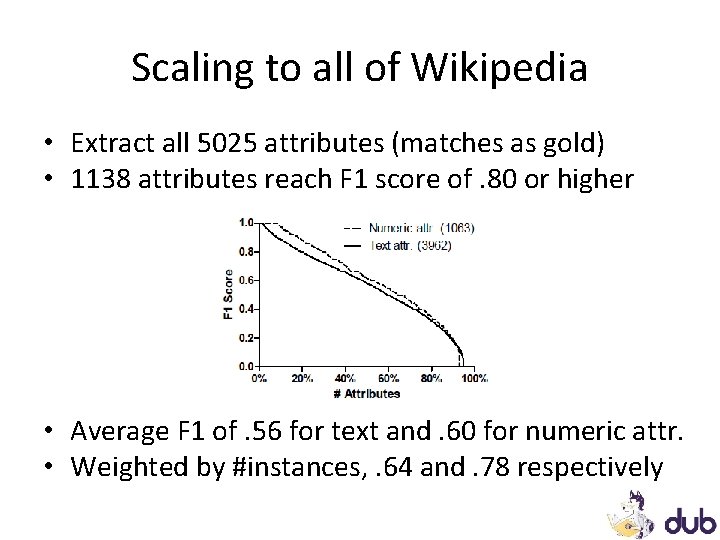
Scaling to all of Wikipedia • Extract all 5025 attributes (matches as gold) • 1138 attributes reach F 1 score of. 80 or higher • Average F 1 of. 56 for text and. 60 for numeric attr. • Weighted by #instances, . 64 and. 78 respectively
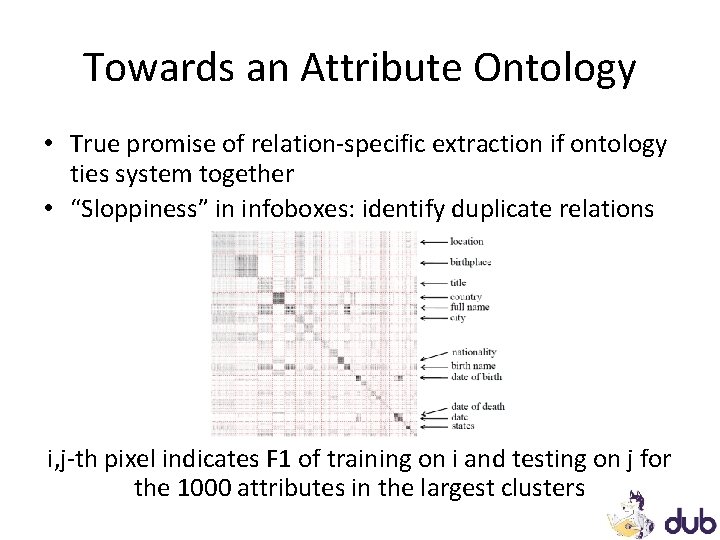
Towards an Attribute Ontology • True promise of relation-specific extraction if ontology ties system together • “Sloppiness” in infoboxes: identify duplicate relations i, j-th pixel indicates F 1 of training on i and testing on j for the 1000 attributes in the largest clusters
Next Steps • LUCHS’ performance may benefit substantially from an ontology & LUCHS may also facilitate ontology learning: thus, learn both jointly • Enhance robustness by performing deeper linguistic analysis; also combine with Open extraction techniques
Related Work – YAGO[Suchanek et al WWW 2007] – Bayesian Knowledge Corroboration [Kasneci et al MSR 2010] – PORE [Wang et al 2007] – Text. Runner [Banko et al IJCAI 2007] – Distant Supervision [Mintz et al ACL 2009] – Kylin [Wu et al CIKM 2007, Wu et al KDD 2008]
Conclusions • Weakly-supervised learning of relation-specific extractors does scale • Introduced dynamic lexicon features, which enable hyper-lexicalized extractors
Thank You!
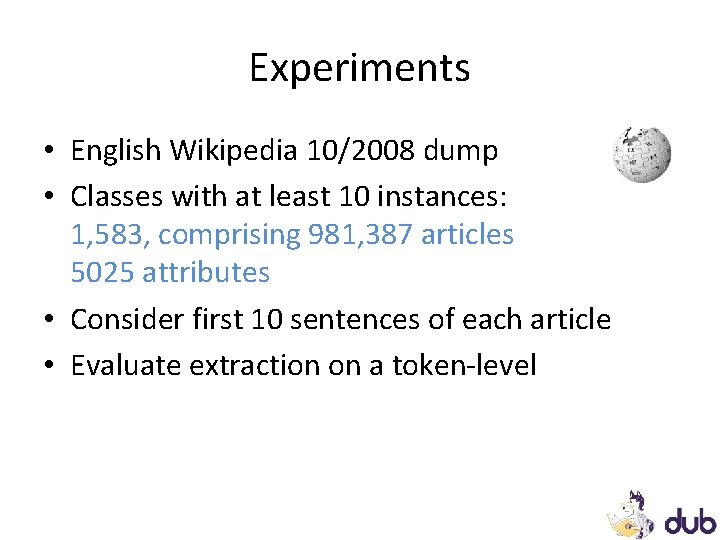
Experiments • English Wikipedia 10/2008 dump • Classes with at least 10 instances: 1, 583, comprising 981, 387 articles 5025 attributes • Consider first 10 sentences of each article • Evaluate extraction on a token-level
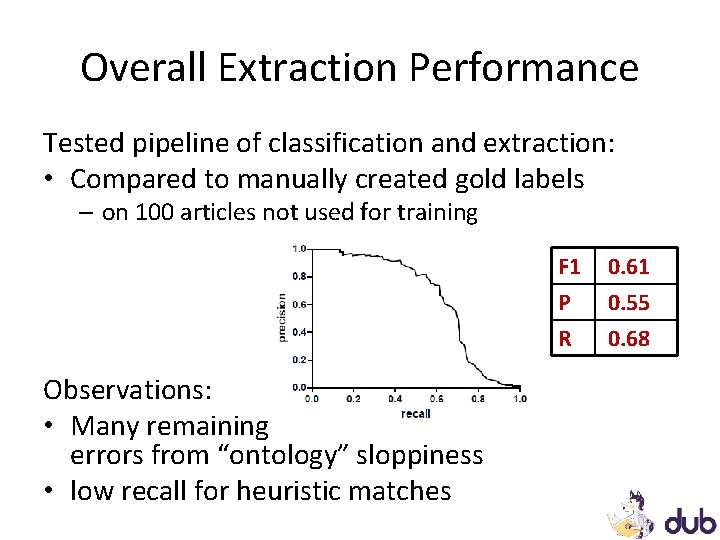
Overall Extraction Performance Tested pipeline of classification and extraction: • Compared to manually created gold labels – on 100 articles not used for training F 1 P R Observations: • Many remaining errors from “ontology” sloppiness • low recall for heuristic matches 0. 61 0. 55 0. 68
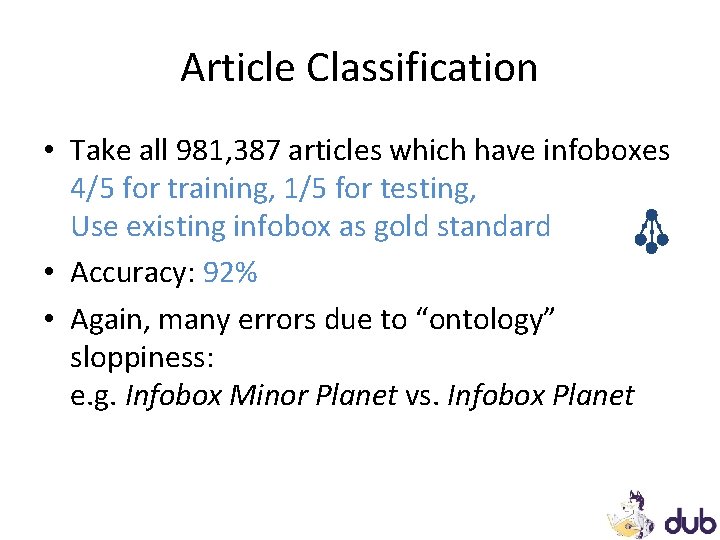
Article Classification • Take all 981, 387 articles which have infoboxes 4/5 for training, 1/5 for testing, Use existing infobox as gold standard • Accuracy: 92% • Again, many errors due to “ontology” sloppiness: e. g. Infobox Minor Planet vs. Infobox Planet
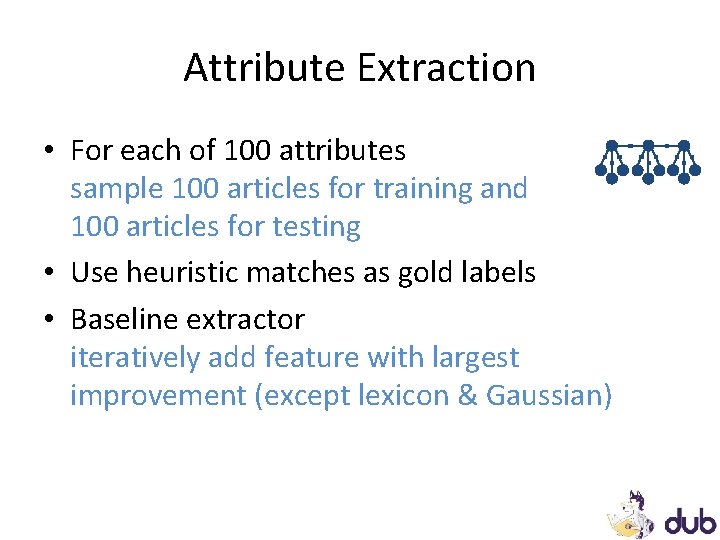
Attribute Extraction • For each of 100 attributes sample 100 articles for training and 100 articles for testing • Use heuristic matches as gold labels • Baseline extractor iteratively add feature with largest improvement (except lexicon & Gaussian)
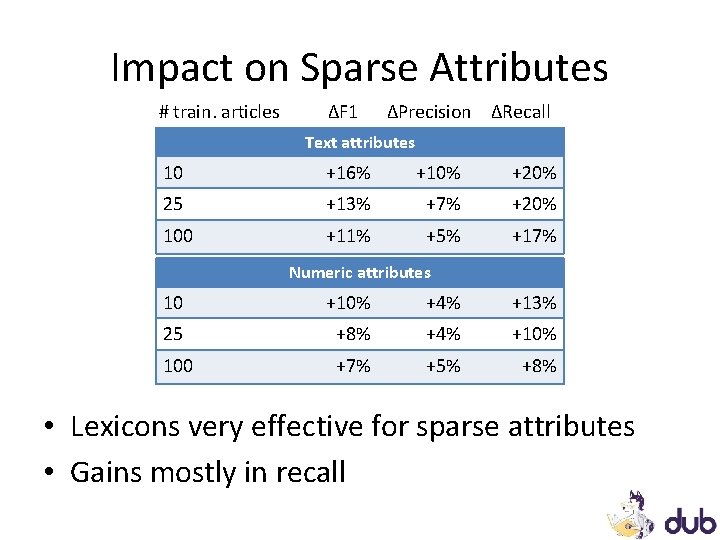
Impact on Sparse Attributes # train. articles ∆F 1 ∆Precision ∆Recall Text attributes 10 +16% +10% +20% 25 +13% +7% +20% 100 +11% +5% +17% Numeric attributes 10 +10% +4% +13% 25 +8% +4% +10% 100 +7% +5% +8% • Lexicons very effective for sparse attributes • Gains mostly in recall
Outline • • • Motivation Learning Extractors Extraction with Dynamic Lexicons Experiments Next Steps