IWORID 2019 The 21 st International Workshop on
- Slides: 17
IWORID 2019 The 21 st International Workshop on Radiation Imaging Detectors 07 -12 July 2019 in Kolympari, Greece Investigation of model observer and human observer performance of a prototype digital breast tomosynthesis Seungyeon Choia, Sunghoon Choib, Donghoon Leea, Young-Wook Choic, and Hee-Joung Kima, b* Department of Radiation Convergence Engineering, College of Health Science, Yonsei University, Wonju, Korea Department of Radiological Science, College of Health Science, Yonsei University, Wonju, Korea c Korea Electrotechnology Research Institute (KERI), Ansan, 15588, Korea a b (Yonsei University) (Medical Physics & Imaging Lab. )
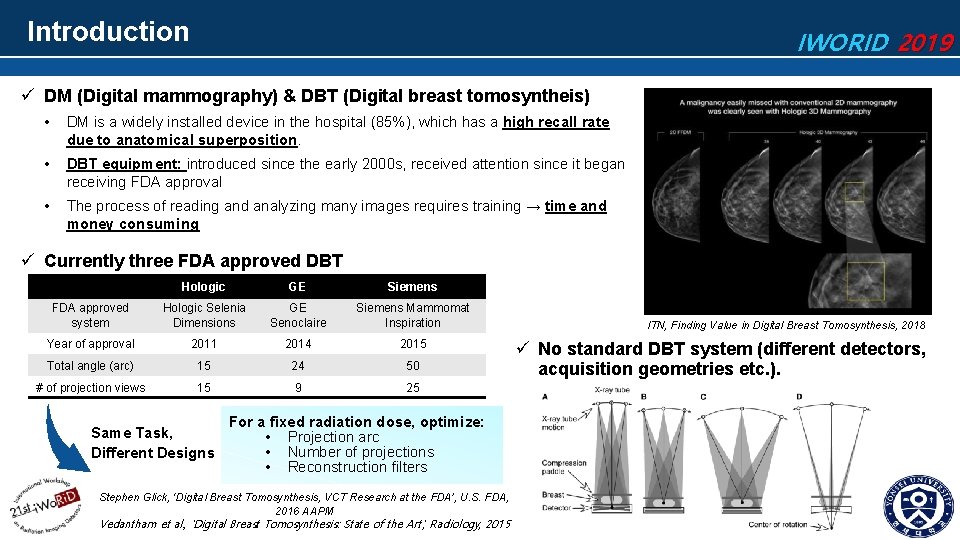
Introduction IWORID 2019 ü DM (Digital mammography) & DBT (Digital breast tomosyntheis) • DM is a widely installed device in the hospital (85%), which has a high recall rate due to anatomical superposition. • DBT equipment: introduced since the early 2000 s, received attention since it began receiving FDA approval • The process of reading and analyzing many images requires training → time and money consuming ü Currently three FDA approved DBT Hologic GE Siemens FDA approved system Hologic Selenia Dimensions GE Senoclaire Siemens Mammomat Inspiration Year of approval 2011 2014 2015 Total angle (arc) 15 24 50 # of projection views 15 9 25 Same Task, Different Designs For a fixed radiation dose, optimize: • Projection arc • Number of projections • Reconstruction filters Stephen Glick, ‘Digital Breast Tomosynthesis, VCT Research at the FDA’, U. S. FDA, 2016 AAPM Vedantham et al. , ‘Digital Breast Tomosynthesis: State of the Art’, Radiology, 2015 ITN, Finding Value in Digital Breast Tomosynthesis, 2018 ü No standard DBT system (different detectors, acquisition geometries etc. ).
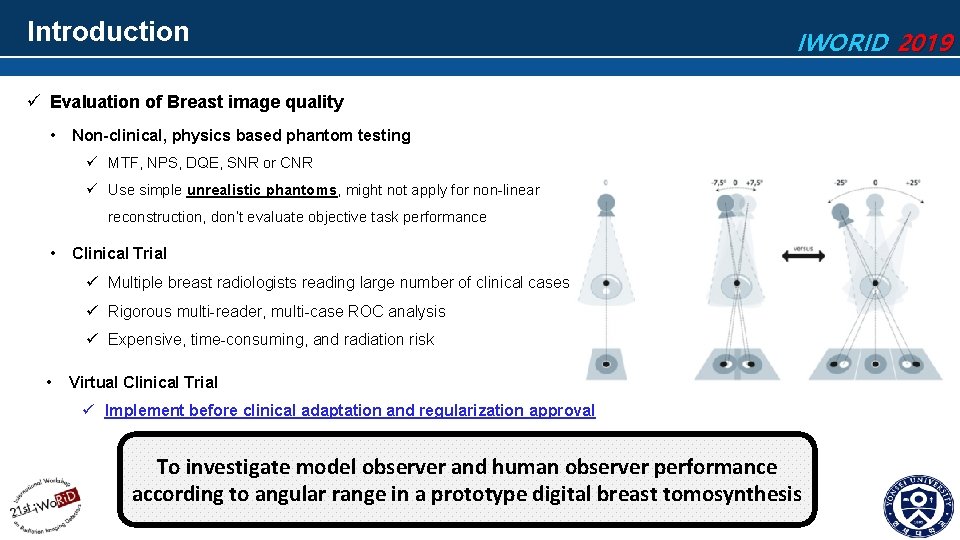
Introduction IWORID 2019 ü Evaluation of Breast image quality • Non-clinical, physics based phantom testing ü MTF, NPS, DQE, SNR or CNR ü Use simple unrealistic phantoms, might not apply for non-linear reconstruction, don’t evaluate objective task performance • Clinical Trial ü Multiple breast radiologists reading large number of clinical cases ü Rigorous multi-reader, multi-case ROC analysis ü Expensive, time-consuming, and radiation risk • Virtual Clinical Trial ü Implement before clinical adaptation and regularization approval To investigate model observer and human observer performance according to angular range in a prototype digital breast tomosynthesis
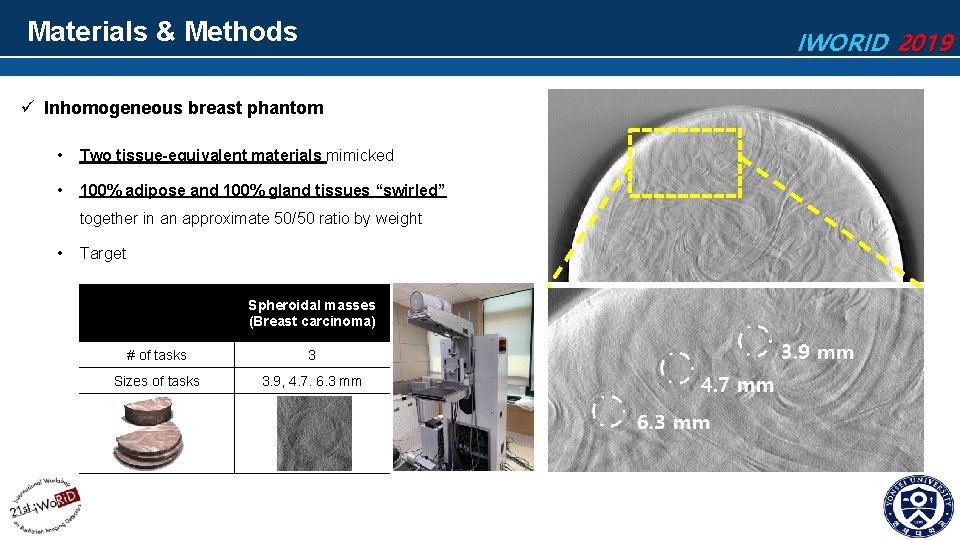
Materials & Methods IWORID 2019 ü Inhomogeneous breast phantom • Two tissue-equivalent materials mimicked • 100% adipose and 100% gland tissues “swirled” together in an approximate 50/50 ratio by weight • Target Spheroidal masses (Breast carcinoma) # of tasks 3 Sizes of tasks 3. 9, 4. 7. 6. 3 mm
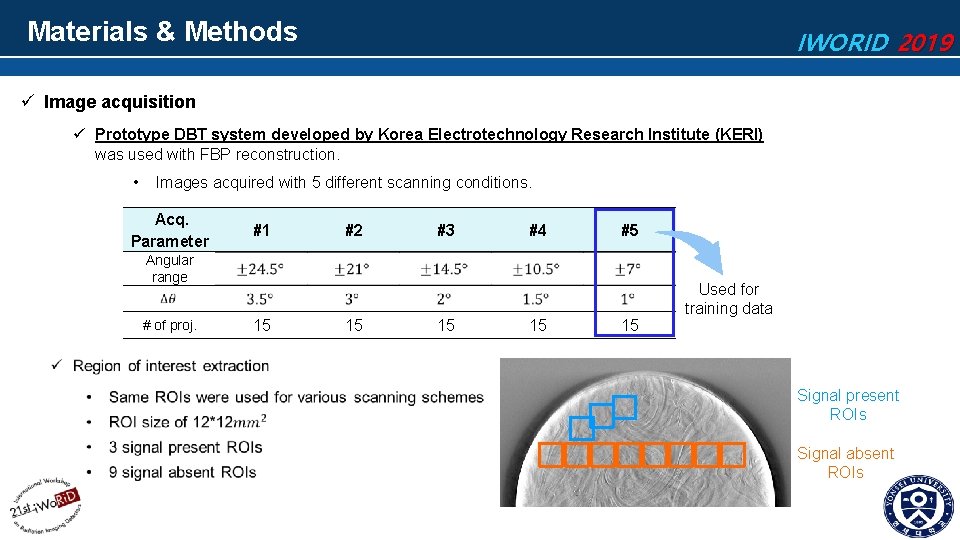
Materials & Methods IWORID 2019 ü Image acquisition ü Prototype DBT system developed by Korea Electrotechnology Research Institute (KERI) was used with FBP reconstruction. • Images acquired with 5 different scanning conditions. Acq. Parameter #1 #2 #3 #4 #5 Angular range # of proj. 15 15 15 Used for training data Signal present ROIs Signal absent ROIs
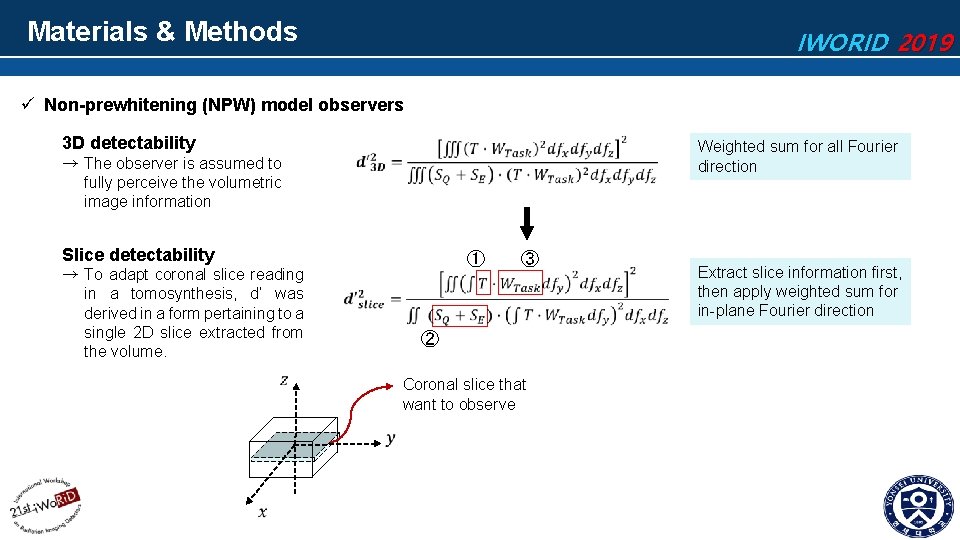
Materials & Methods IWORID 2019 ü Non-prewhitening (NPW) model observers 3 D detectability → The observer is assumed to fully perceive the volumetric image information Weighted sum for all Fourier direction Slice detectability → To adapt coronal slice reading in a tomosynthesis, d’ was derived in a form pertaining to a single 2 D slice extracted from the volume. ① ② Coronal slice that want to observe ③ Extract slice information first, then apply weighted sum for in-plane Fourier direction
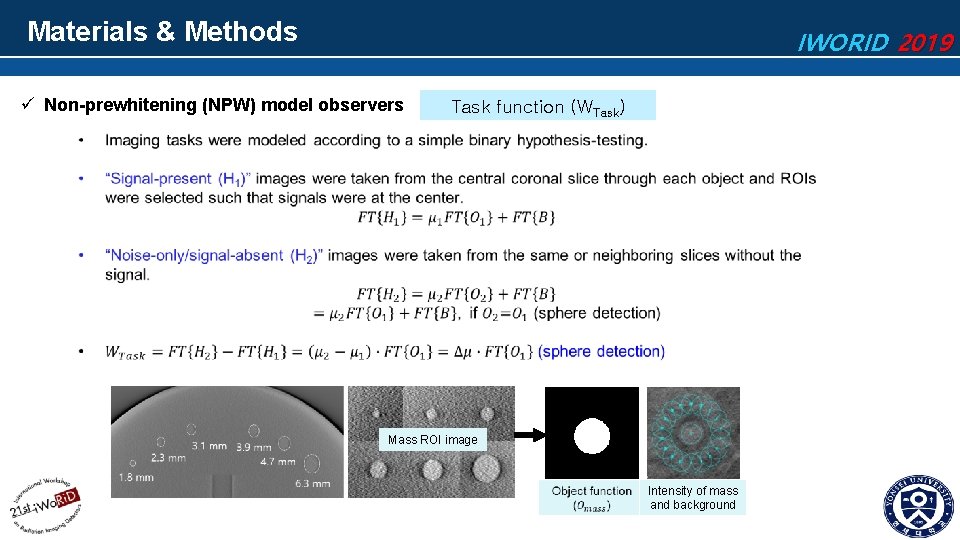
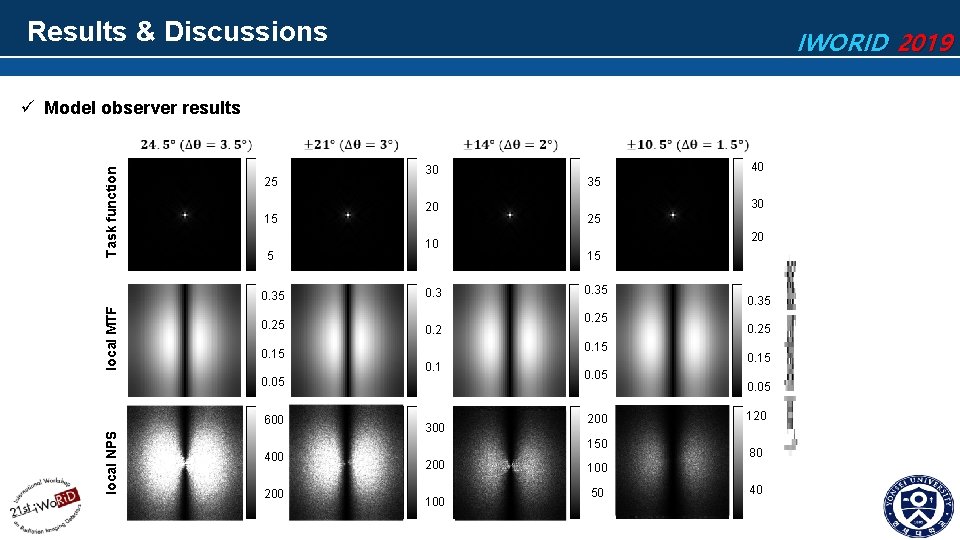
Materials & Methods IWORID 2019 ü Non-prewhitening (NPW) model observers Task function (WTask) Mass ROI image Intensity of mass and background
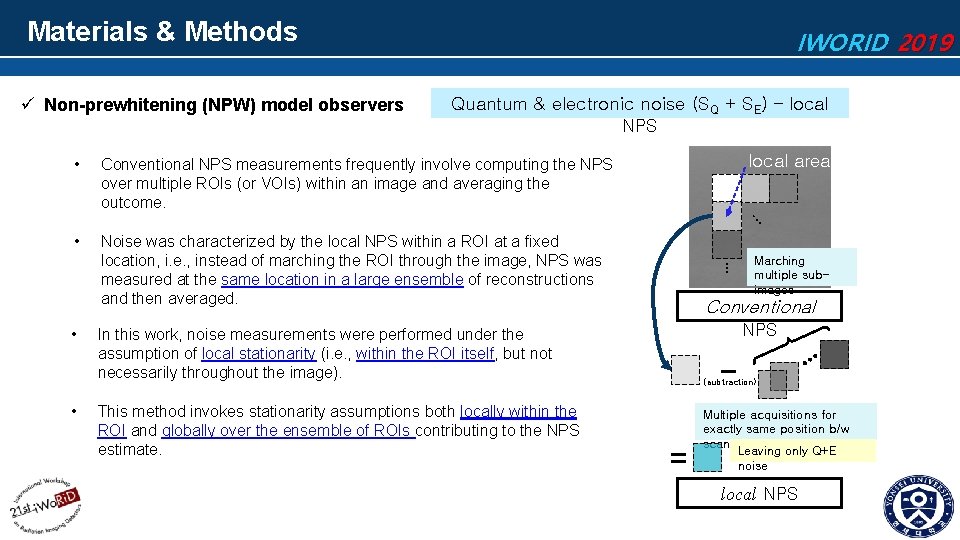
Materials & Methods ü Non-prewhitening (NPW) model observers • • IWORID 2019 Quantum & electronic noise (SQ + SE) – local NPS local area Conventional NPS measurements frequently involve computing the NPS over multiple ROIs (or VOIs) within an image and averaging the outcome. Noise was characterized by the local NPS within a ROI at a fixed location, i. e. , instead of marching the ROI through the image, NPS was measured at the same location in a large ensemble of reconstructions and then averaged. In this work, noise measurements were performed under the assumption of local stationarity (i. e. , within the ROI itself, but not necessarily throughout the image). This method invokes stationarity assumptions both locally within the ROI and globally over the ensemble of ROIs contributing to the NPS estimate. ⋱ ⋮ Marching multiple subimages Conventional NPS ⋰ (subtraction) Multiple acquisitions for exactly same position b/w scans Leaving only Q+E noise local NPS
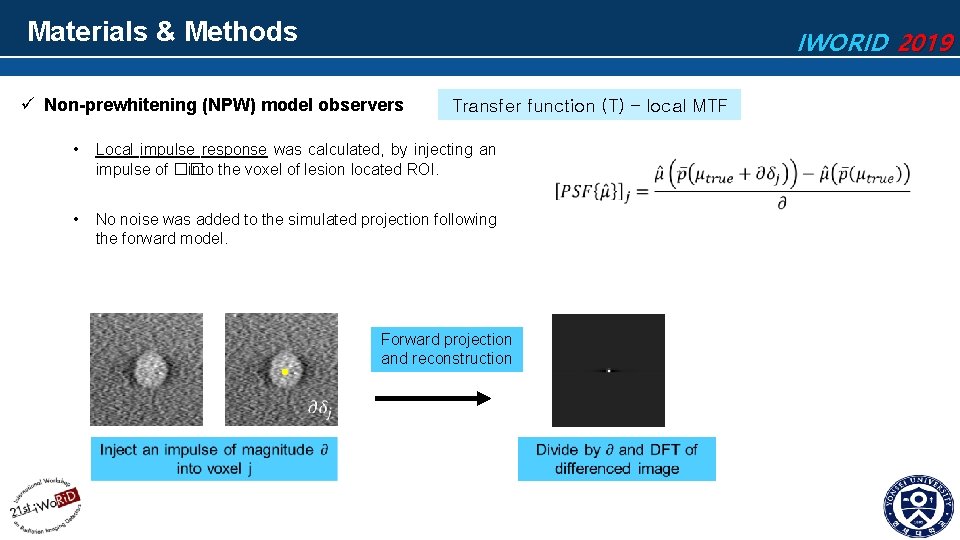
Materials & Methods IWORID 2019 ü Non-prewhitening (NPW) model observers Transfer function (T) – local MTF • Local impulse response was calculated, by injecting an impulse of �� into the voxel of lesion located ROI. • No noise was added to the simulated projection following the forward model. Forward projection and reconstruction
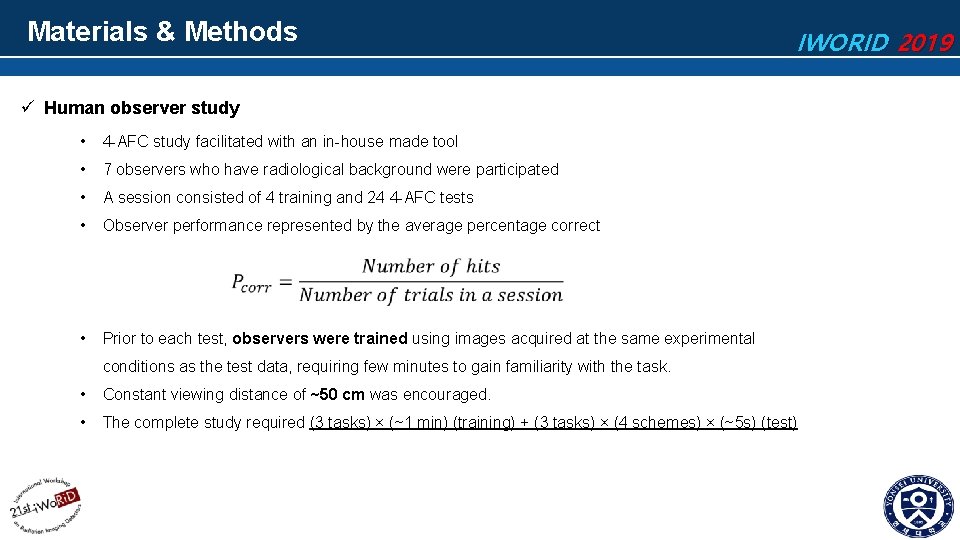
Materials & Methods IWORID 2019 ü Human observer study • 4 -AFC study facilitated with an in-house made tool • 7 observers who have radiological background were participated • A session consisted of 4 training and 24 4 -AFC tests • Observer performance represented by the average percentage correct • Prior to each test, observers were trained using images acquired at the same experimental conditions as the test data, requiring few minutes to gain familiarity with the task. • Constant viewing distance of ~50 cm was encouraged. • The complete study required (3 tasks) × (~1 min) (training) + (3 tasks) × (4 schemes) × (~5 s) (test)
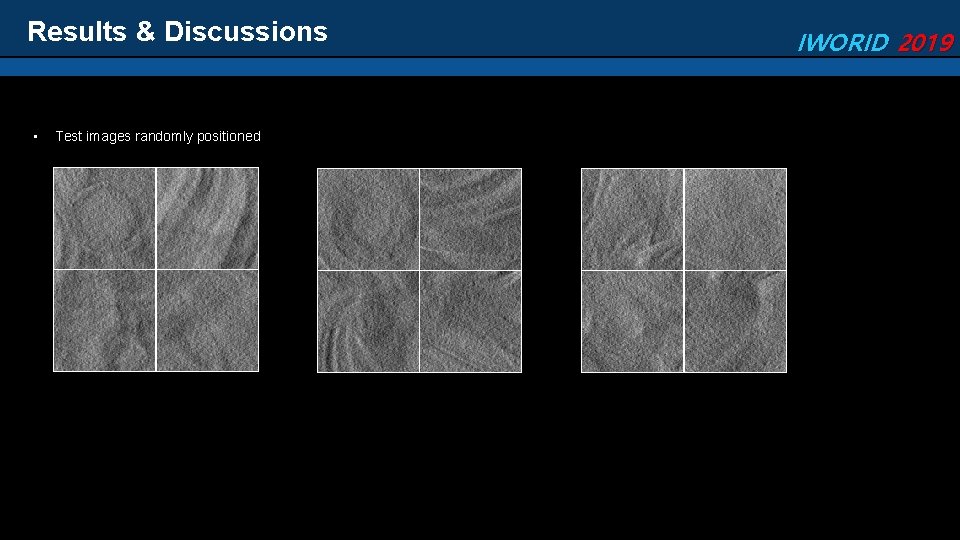
Results & Discussions • Test images randomly positioned IWORID 2019
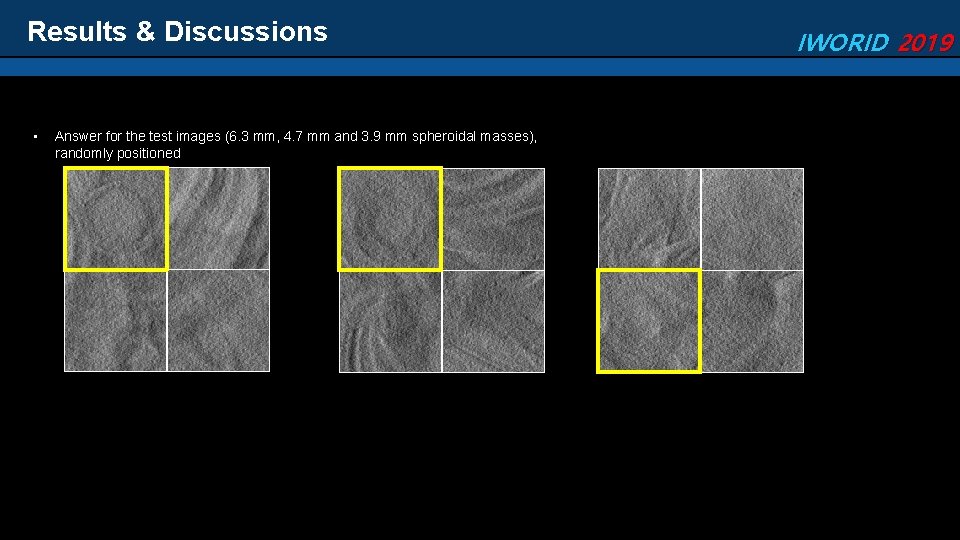
Results & Discussions • Answer for the test images (6. 3 mm, 4. 7 mm and 3. 9 mm spheroidal masses), randomly positioned IWORID 2019
Results & Discussions IWORID 2019 ü Model observer results local MTF 25 15 5 30 20 10 0. 35 0. 3 0. 25 0. 2 0. 15 local NPS 40 35 30 25 20 15 0. 35 0. 25 0. 1 0. 05 600 300 0. 05 200 150 400 200 100 Task function 0. 35 0. 25 0. 15 0. 05 120 80 100 50 40
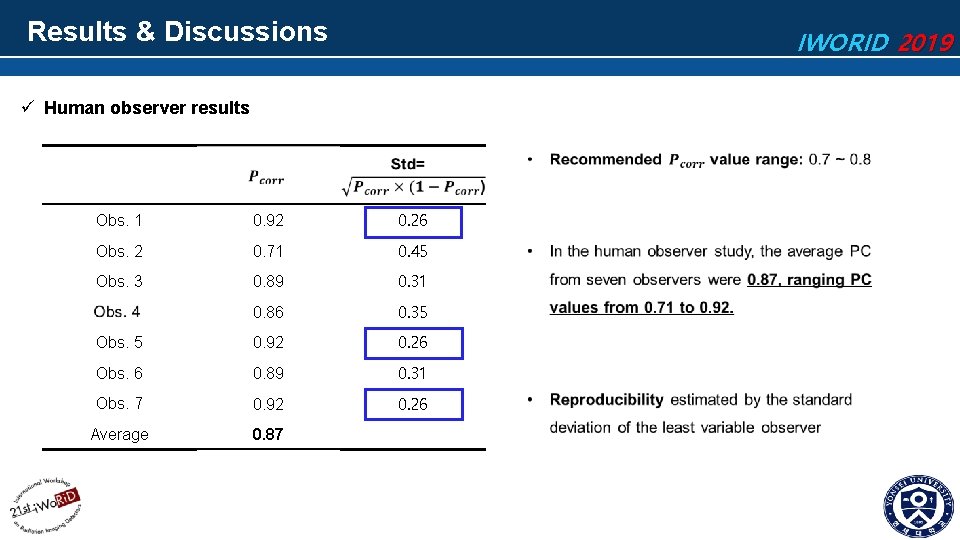
Results & Discussions IWORID 2019 ü Human observer results Obs. 1 0. 92 0. 26 Obs. 2 0. 71 0. 45 Obs. 3 0. 89 0. 31 0. 86 0. 35 Obs. 5 0. 92 0. 26 Obs. 6 0. 89 0. 31 Obs. 7 0. 92 0. 26 Average 0. 87
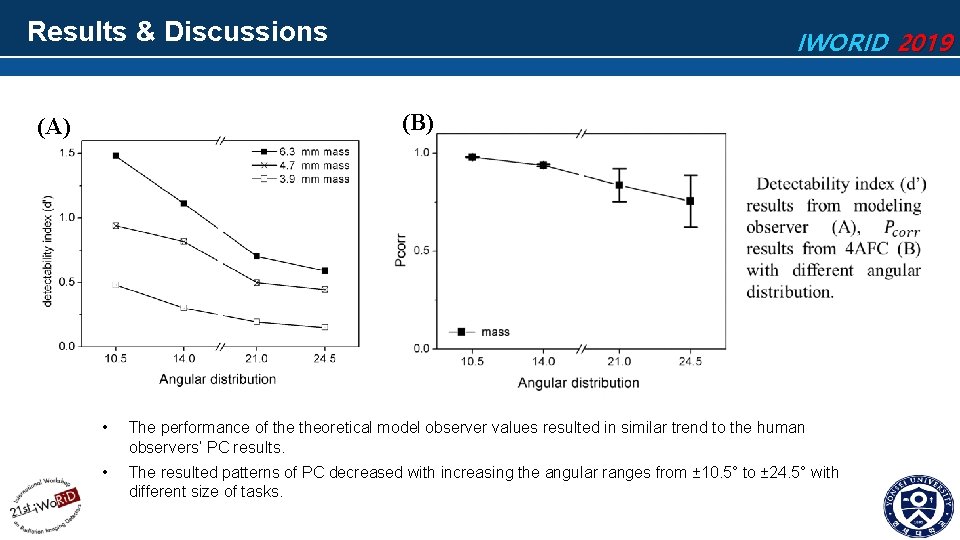
Results & Discussions IWORID 2019 (B) (A) • The performance of theoretical model observer values resulted in similar trend to the human observers’ PC results. • The resulted patterns of PC decreased with increasing the angular ranges from ± 10. 5° to ± 24. 5° with different size of tasks.
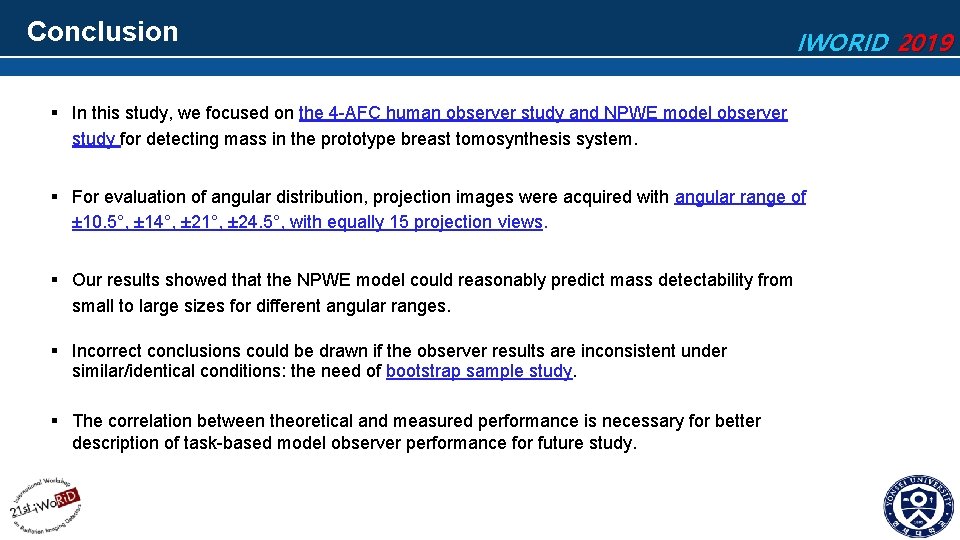
Conclusion IWORID 2019 § In this study, we focused on the 4 -AFC human observer study and NPWE model observer study for detecting mass in the prototype breast tomosynthesis system. § For evaluation of angular distribution, projection images were acquired with angular range of ± 10. 5°, ± 14°, ± 21°, ± 24. 5°, with equally 15 projection views. § Our results showed that the NPWE model could reasonably predict mass detectability from small to large sizes for different angular ranges. § Incorrect conclusions could be drawn if the observer results are inconsistent under similar/identical conditions: the need of bootstrap sample study. § The correlation between theoretical and measured performance is necessary for better description of task-based model observer performance for future study.
Medical Physics & Imaging Laboratory Thanks for your attention Presenter’s e-mail address : sychoi 324@yonsei. ac. kr