ISNE 101 Week 4 Dr Ken Cosh Recap




- Slides: 45
ISNE 101 Week 4 Dr. Ken Cosh
Recap Last week we talked about binary. And hence encoding things into a binary form - digitisation! Remember Huffman? This Week Communication and Networks
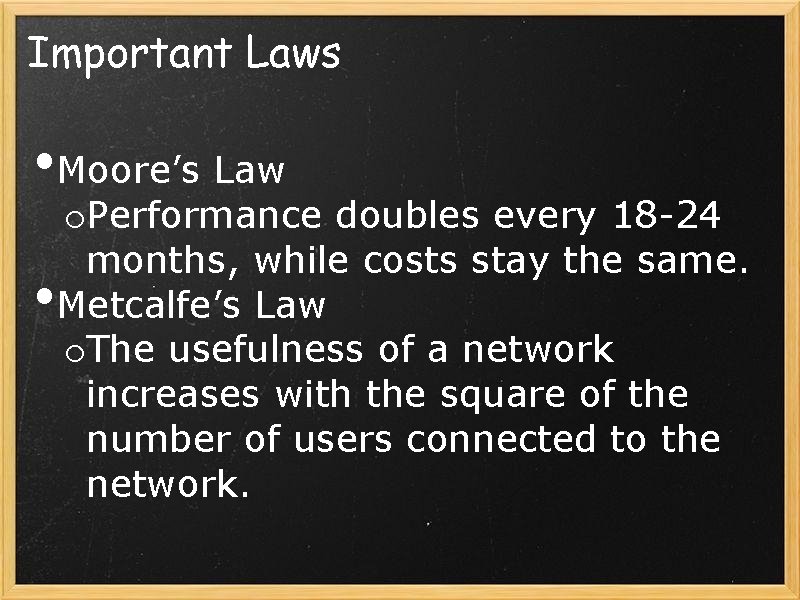
Important Laws • Moore’s Law • o. Performance doubles every 18 -24 months, while costs stay the same. Metcalfe’s Law o. The usefulness of a network increases with the square of the number of users connected to the network.
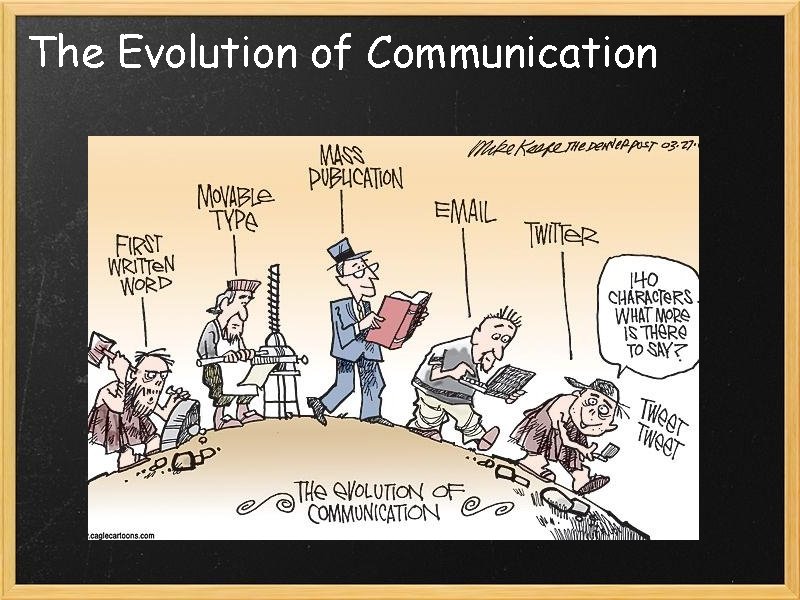
The Evolution of Communication
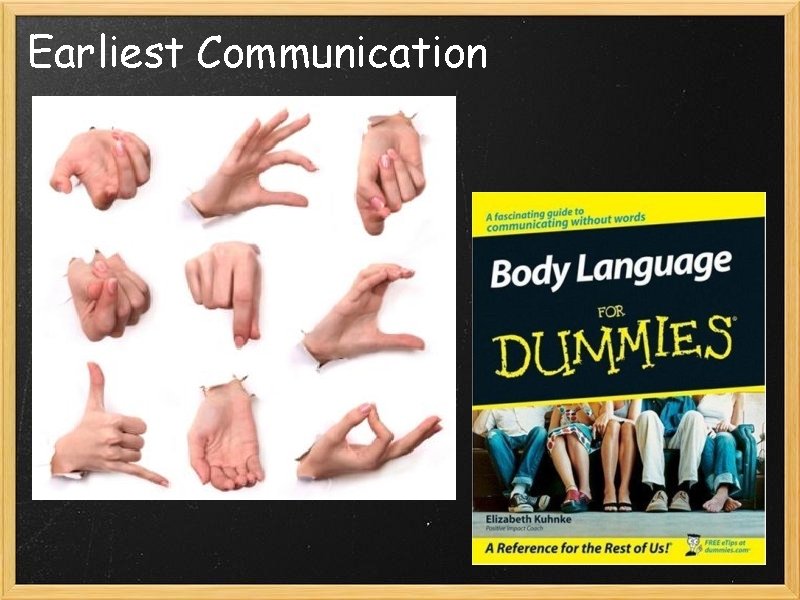
Earliest Communication
Speech Sets Humans apart from animals Estimated 1. 5 million-200, 000 years ago Mutation of the FOXP 2 gene Facilitated transfer of knowledge through generations Forms the basis of written languages.
Progress towards Writing Symbols Allow message longevity but represent speech acts Cave Paintings Oldest date from around 30, 000 BC Petroglyphs Around 10, 000 BC carving developed to make incisions into rock surface Pictograms While Petroglyphs show a single scene, Pictograms narate a story Ideograms represent concepts such as emotions
Writing Around 2 -3, 000 BC the Sumerians developed the first writing system. Evolved from Pictograms Developed into Cuneiform Around 1, 000 characters -> 400 characters (Hittite Cuneiform) Symbols pressed into clay Egyptian Hieroglyphs were derived from Sumerian writing. "It is a complex system, writing figurative, symbolic, and phonetic all at once, in the same text, the same phrase, I would almost say in the same word. " (Champollion)
Developing an Alphabet Egyptian Hieroglyphics were logosyllabic, i. e. symbols stand for; Words Sounds or to place a word in a category The Phonetic components of Hieroglyphs were crucial to developing an alphabet. The Egyptians developed a set of 22 -24 Hieroglyphs which were used to record foreign names etc.
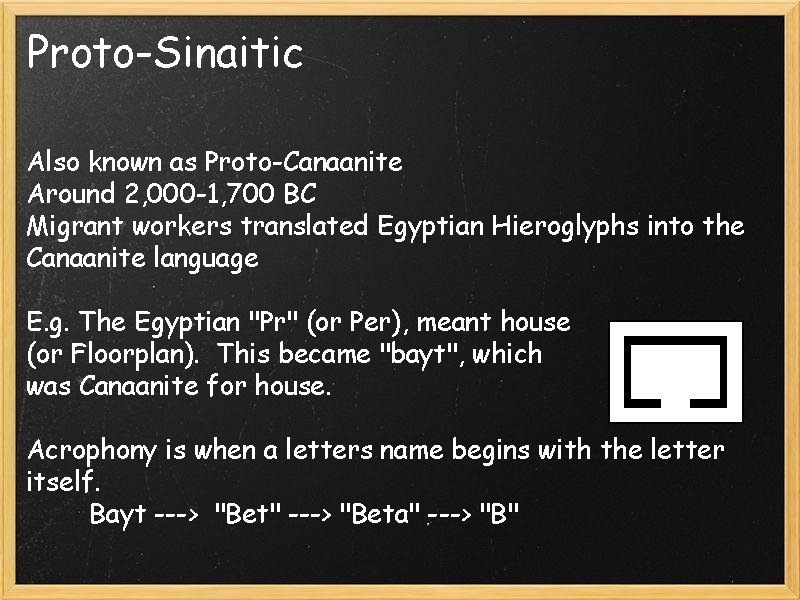
Proto-Sinaitic Also known as Proto-Canaanite Around 2, 000 -1, 700 BC Migrant workers translated Egyptian Hieroglyphs into the Canaanite language E. g. The Egyptian "Pr" (or Per), meant house (or Floorplan). This became "bayt", which was Canaanite for house. Acrophony is when a letters name begins with the letter itself. Bayt ---> "Bet" ---> "Beta" ---> "B"
Spreading the Word
The Greeks Vowels were a hindrance when writing in Pheonician, (as well as Egyptian / Hebrew). But in Greek they were essential, and afforded equal status as consonants. Together with the "Latins" (Romans) the alphabet evolved into this! Other tribes evolved their alphabets differently, but most stem from the Proto-Sinaitic.
Communication Technology? What technology have we discussed so far?
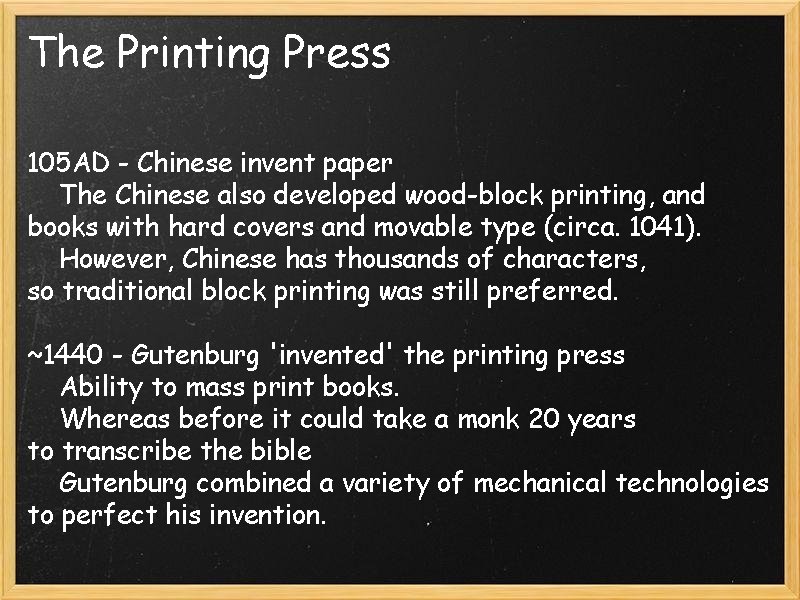
The Printing Press 105 AD - Chinese invent paper The Chinese also developed wood-block printing, and books with hard covers and movable type (circa. 1041). However, Chinese has thousands of characters, so traditional block printing was still preferred. ~1440 - Gutenburg 'invented' the printing press Ability to mass print books. Whereas before it could take a monk 20 years to transcribe the bible Gutenburg combined a variety of mechanical technologies to perfect his invention.
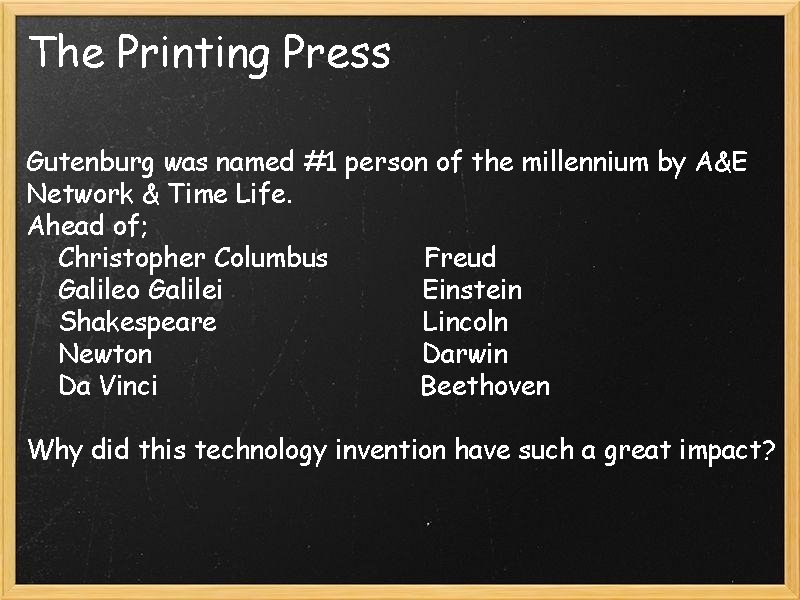
The Printing Press Gutenburg was named #1 person of the millennium by A&E Network & Time Life. Ahead of; Christopher Columbus Freud Galileo Galilei Einstein Shakespeare Lincoln Newton Darwin Da Vinci Beethoven Why did this technology invention have such a great impact?
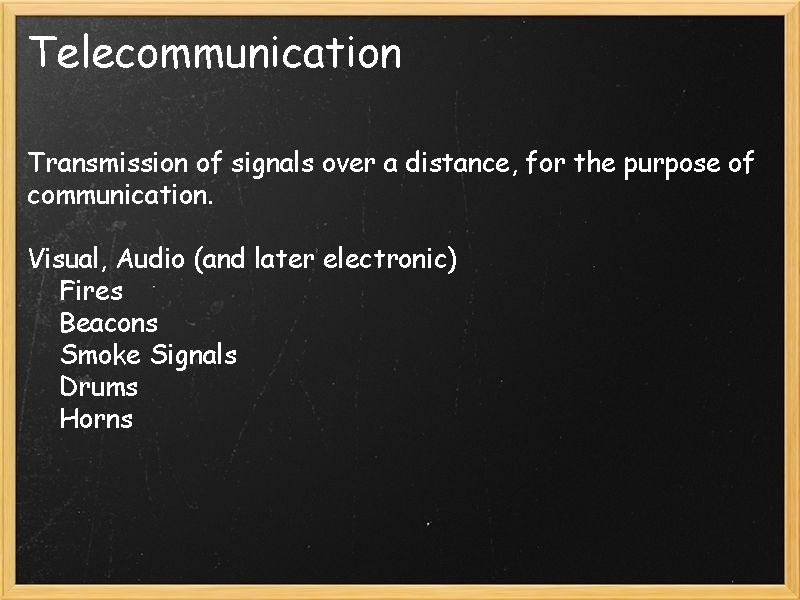
Telecommunication Transmission of signals over a distance, for the purpose of communication. Visual, Audio (and later electronic) Fires Beacons Smoke Signals Drums Horns
Telecommunication The Problem: How do we use fires / beacons / smoke signals to send a message; Consider the fire beacons in Lord of the Rings. N 0 FIRE = No Problem FIRE = Problem! The Solution: Semaphore
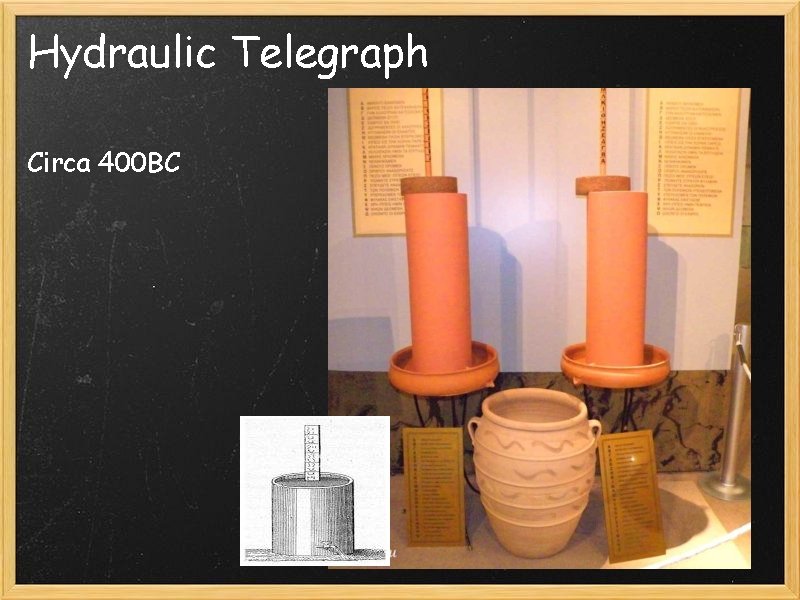
Hydraulic Telegraph Circa 400 BC
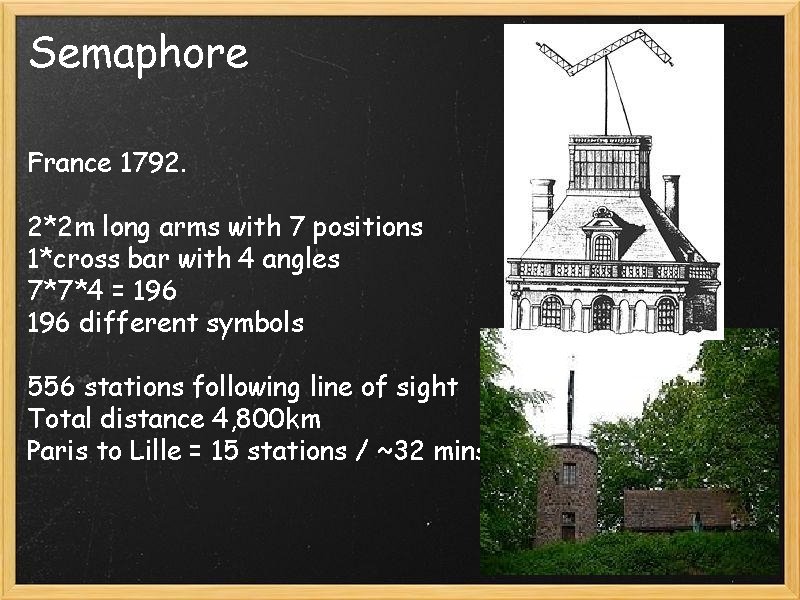
Semaphore France 1792. 2*2 m long arms with 7 positions 1*cross bar with 4 angles 7*7*4 = 196 different symbols 556 stations following line of sight Total distance 4, 800 km Paris to Lille = 15 stations / ~32 mins
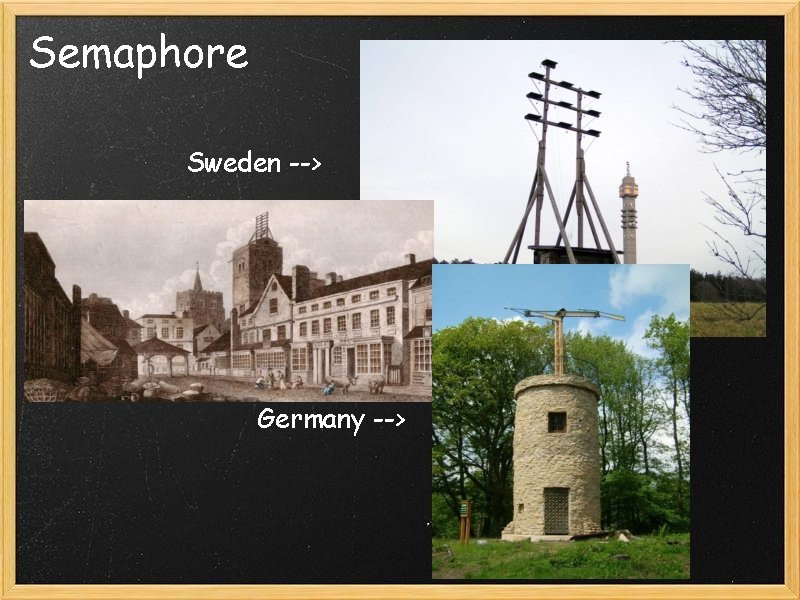
Semaphore Sweden --> UK Germany -->
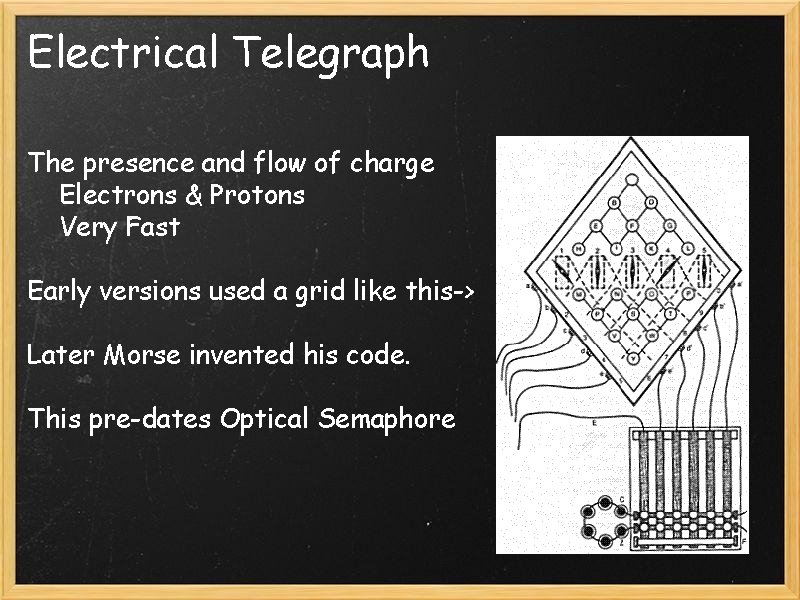
Electrical Telegraph The presence and flow of charge Electrons & Protons Very Fast Early versions used a grid like this-> Later Morse invented his code. This pre-dates Optical Semaphore
Electrical Telegraph Requires 'wires', which is a problem particularly at wartime. Maxwell: "We have strong reason to conclude that light itself is an electromagnetic disturbance in the form of waves propagated through the electromagnetic field. " Marconi demonstrated that communication is possible wirelessly
Telephone, Television. . . 1876: Bell demonstrated the telephone Now the wires can talk. Combine this with Marconi, and the airwaves start to sing we have radio. Add some pictures & we have a TV.
Telecommunication Systems • Comprised of Hardware and Software arranged to transmit data from one location to another. o Establish interface between sender and receiver o Routes messages (packets) along most efficient paths o Basic information processing to make sure the right message gets to the right receiver o Basic editorial tasks, rearranging format, checking for transmission errors o Converts message speeds (from slower cable to speed of computer). o Controls flow of information through a network.
Packet Transfer To improve the efficiency of a network, data streams are broken into packets. Packets are smaller bundles of data. Packets are different sizes dependent on the protocol or standard being used – the X. 25 packet switching standard uses packets sized 128 bytes.
Packet Switching
Protocols • With telecommunications systems using a wide variety of • • diverse devices, a common set of rules are needed to enable them to ‘talk’ to each other. The set of rules is called a Protocol. o TCP/IP o FTP o WAP o HTTP Each device identifies the receivers protocol so they can send data in the right way, and to check it arrived without problem.
Layered Protocols TCP/IP consists of many protocols, which are divided into layers; Application Layer Includes things like Bittorrent, DNS. . . Transport Layer Primarily tasked with forming data packets, adding header information etc. Internet Layer Includes IP, functions such as addressing / routing Link Layer Deals with actual data exchange, error checking, Bit Rate etc.
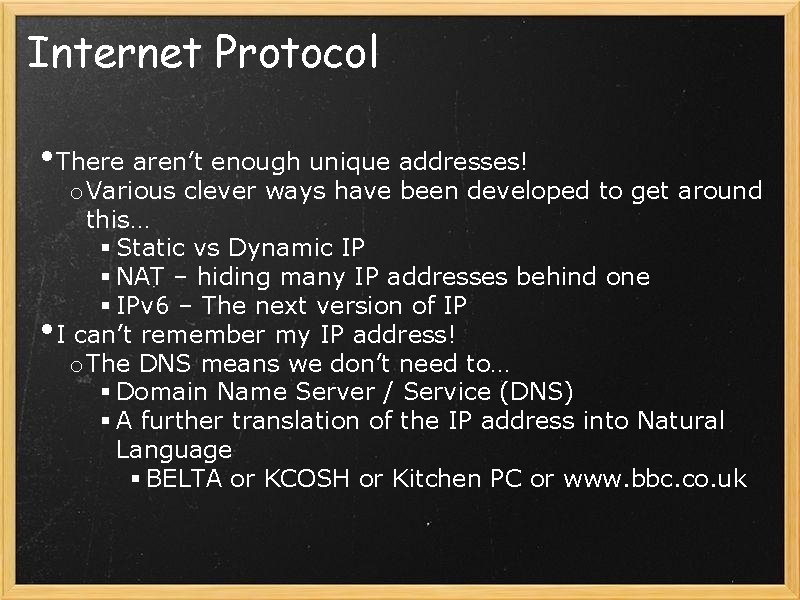
Internet Protocol • Every PC / Printer etc. has a unique IP address. o IP addresses represent a 32 bit word • But, this is translated to ‘decimal-dot’ notation to • • • make life easier! – More like a phone number. o 172. 17. 28. 143 o Each number is between 0 and 255 (i. e. an 8 bit number in binary) Totally 256*256*256 different IP addresses = 4. 3 Billion! Is that enough? Do we still need to remember the 4 numbers?
Internet Protocol • There aren’t enough unique addresses! • o Various clever ways have been developed to get around this… § Static vs Dynamic IP § NAT – hiding many IP addresses behind one § IPv 6 – The next version of IP I can’t remember my IP address! o The DNS means we don’t need to… § Domain Name Server / Service (DNS) § A further translation of the IP address into Natural Language § BELTA or KCOSH or Kitchen PC or www. bbc. co. uk
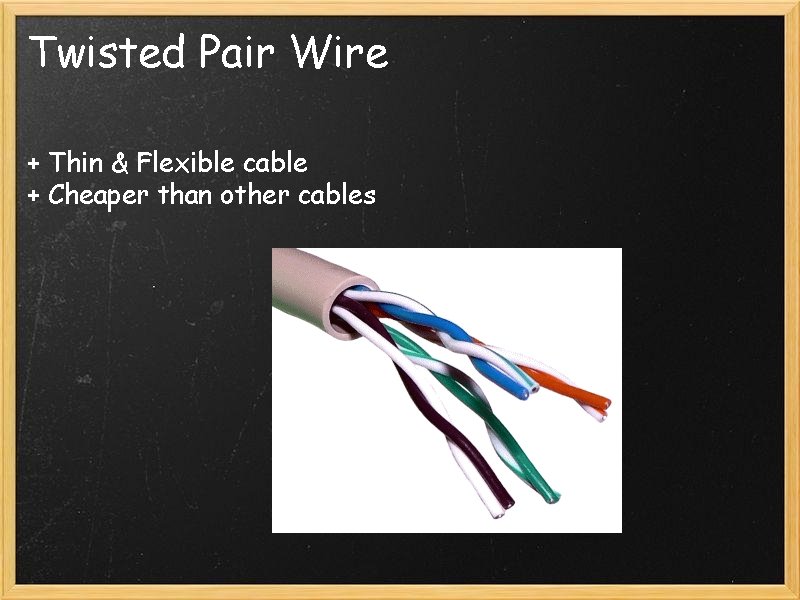
Twisted Pair Wire + Thin & Flexible cable + Cheaper than other cables
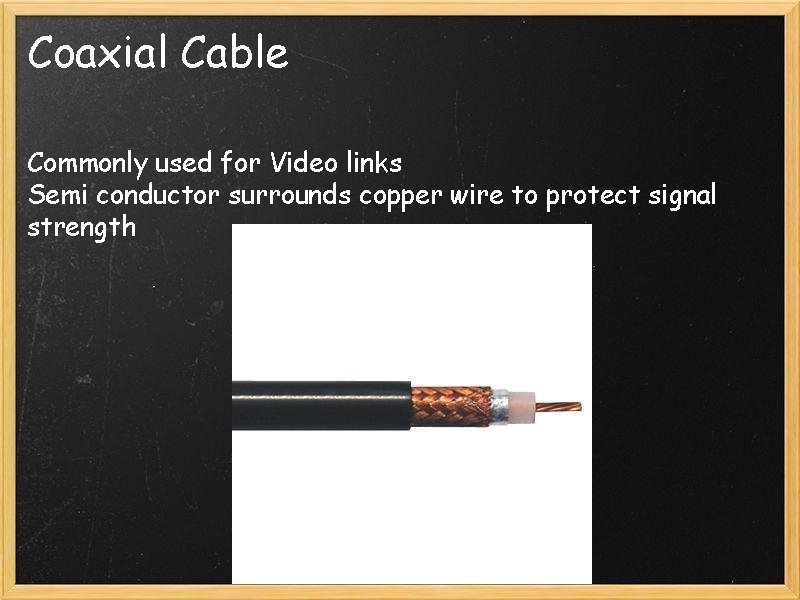
Coaxial Cable Commonly used for Video links Semi conductor surrounds copper wire to protect signal strength
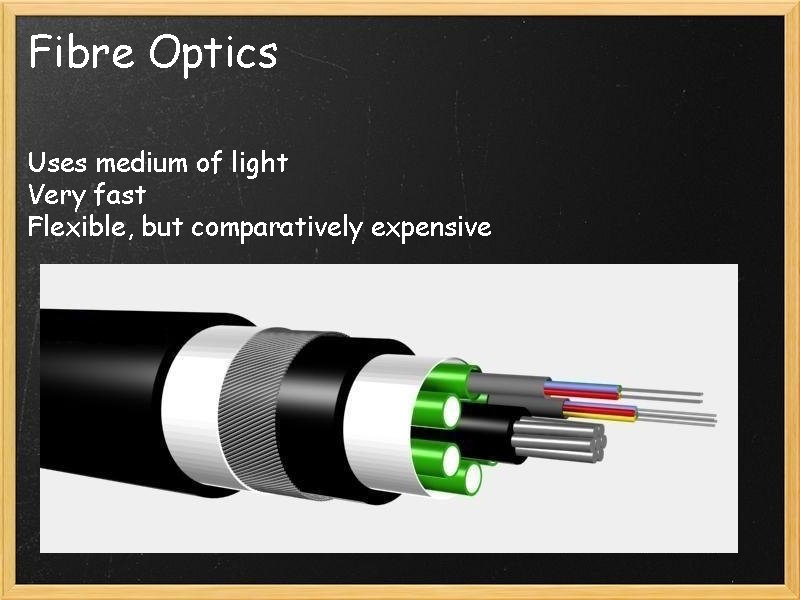
Fibre Optics Uses medium of light Very fast Flexible, but comparatively expensive
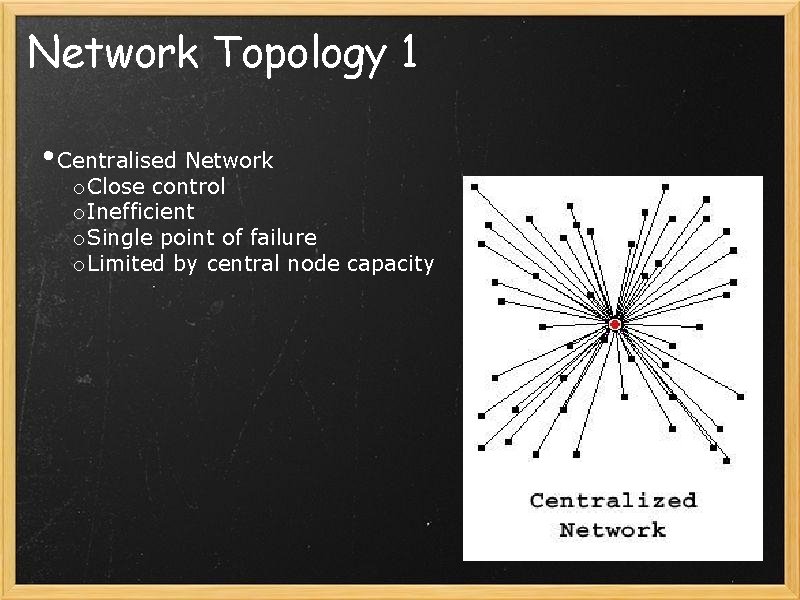
Network Topology 1 • Centralised Network o Close control o Inefficient o Single point of failure o Limited by central node capacity
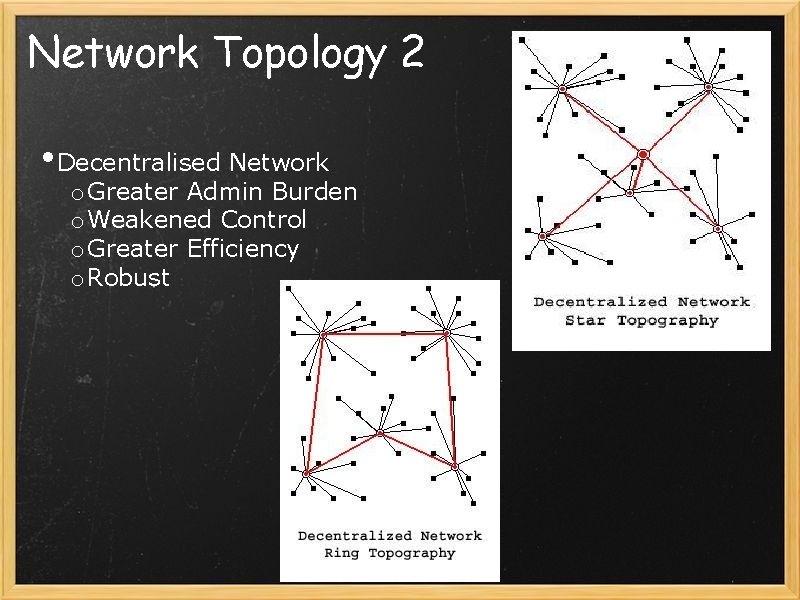
Network Topology 2 • Decentralised Network o Greater Admin Burden o Weakened Control o Greater Efficiency o Robust
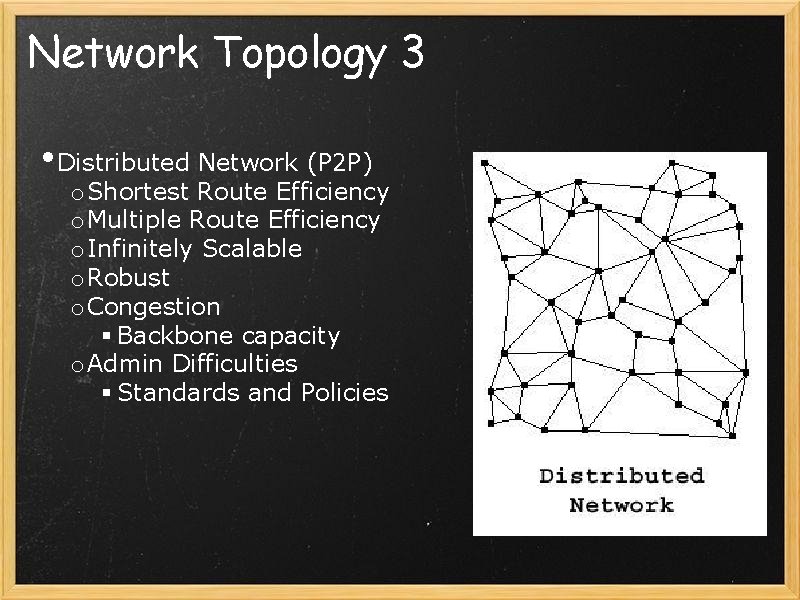
Network Topology 3 • Distributed Network (P 2 P) o Shortest Route Efficiency o Multiple Route Efficiency o Infinitely Scalable o Robust o Congestion § Backbone capacity o Admin Difficulties § Standards and Policies
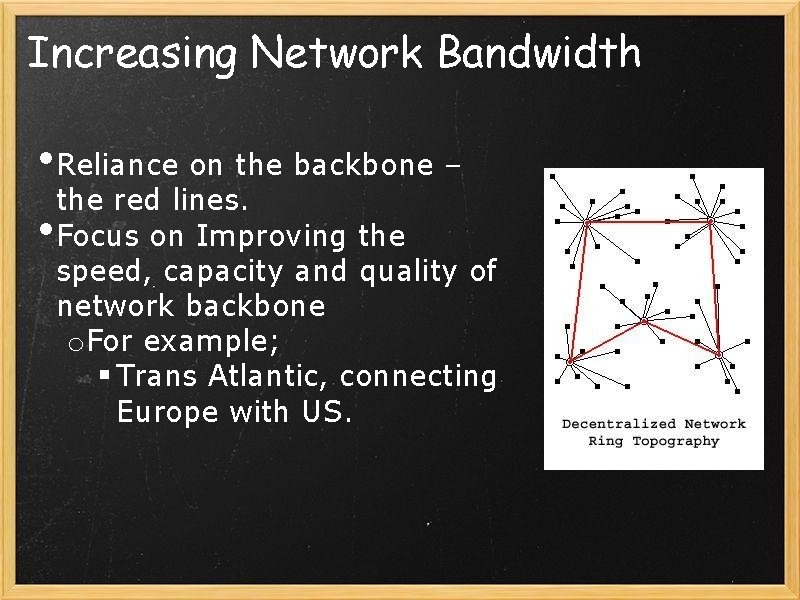
Increasing Network Bandwidth • Reliance on the backbone – the red lines. • Focus on Improving the speed, capacity and quality of network backbone o. For example; § Trans Atlantic, connecting Europe with US.
Wireless Connection? • Still a need for Fibre optics o Wireless connection connects to another machine which is part of the network. o WIFI, Bluetooth § Use Radio transmission to connect to an antennae – like a walkie talkie! § The antennae connects through a router to the network o Ir. DA § Uses infra red to transmit between equipment o The receiver then connects to the rest of the internet.
WAP • Wireless Application Protocol o Used by mobile phones to connect o Mobile phone interface very different from standard web interface § Speed § Data transfer rates of 14. 4 Kbps § Standard modem is 56 Kbps § Size § Limited display size § Navigation § No mouse, just hand scroll keys o WML can be used in oppose to HTML
Routing • Router • o. Chooses the best route through the network for each data stream to take. o. Different packets can take different routes. We can use Tracert to find out which route we are taking
Caching • Caching developed to speed information transfer. o If I want to download the football scores from BBC website. o Maybe so does my friend John etc. o Rather than us all connecting to BBC, via US, once I’ve downloaded the information, we can share it. o It is stored in a cache
The Future? o. Faster Cables o. More Wireless Antennae’s o. More interfaces / devices o. Cheaper connections o. Better reliability
Imagine a world… …where your web-enabled alarm clock wakes you with the latest traffic / news report and sends a message to your coffee machine and toaster to make your breakfast… Gates Proposes Web-Enabled Alarm Clocks http: //www. tomshardware. co. uk/gates-proposesweb, news-6489. html Home Networking http: //www. forbes. com/2001/12/21/1221 networking_print. h tml
Imagine a World. . . …where on leaving your condo, the lift is called to your floor, it then gives you a stock market report and lets you check your email, and if you live on the ground floor, you can always check in your car… And Now, The Internet-Enabled Elevator http: //www 3. interscience. wiley. com/journal/119028142 /abstract Net Enabled Car http: //preview. directmag. com/news/marketing_volkswa gen_debut_netenabled/
Imagine a World. . . …where even the pins in your notice board are connected, collecting data about how they are used… …and the paintings on your wall provide you information, Andy Warhol’s soup cans tells you the time, while a Mondrian gives you the world weather forecast! Pin and Playhttp: //www. comp. lancs. ac. uk/~hwg/publ/ubicomp 2 002 -pins. pdf Informative Art http: //www. viktoria. se/fal/projects/infoart/index. html