IR Coronal Tools Jeff Kuhn Institute for Astronomy
- Slides: 34
IR Coronal Tools: Jeff Kuhn Institute for Astronomy, University of Hawaii • • Current progress and harmonic convergences IR is good Stokes V is better What’s needed
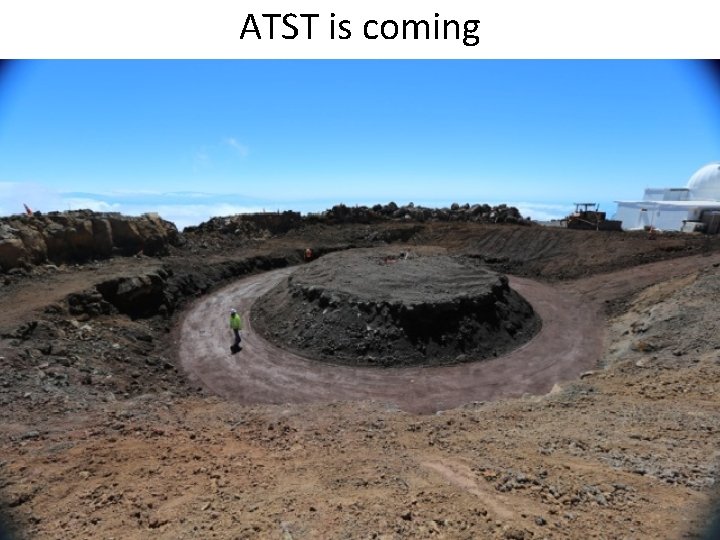
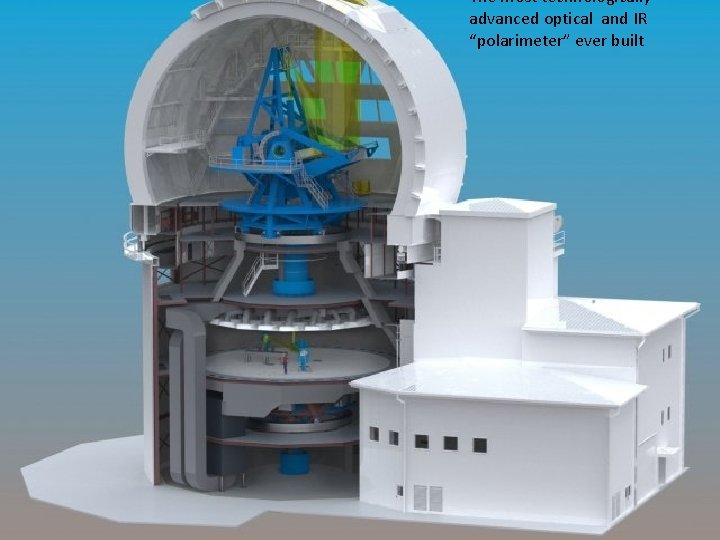
ATST is coming
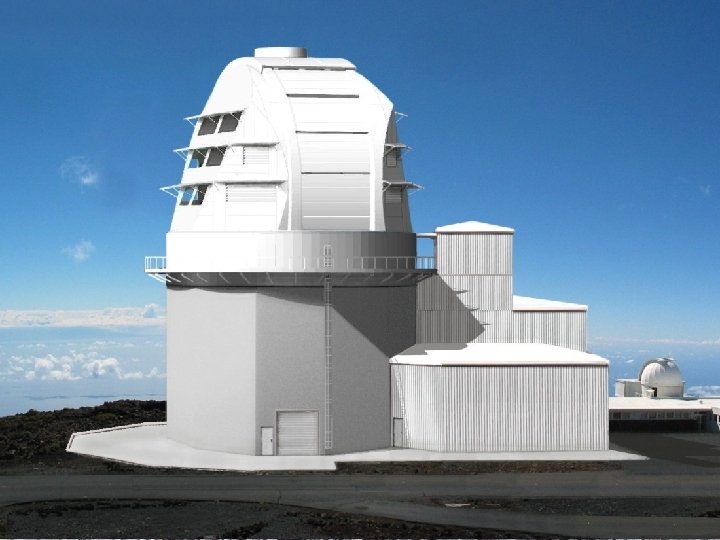
The most technologically advanced optical and IR “polarimeter” ever built
Renaissance opportunities for groundbased coronal science… • ATST’s non-incremental features: – Aperture (by an order of magnitude) – Wavelength opportunity -- IR – Polarimetric sensitivity (including calibration) • Complex problems are “solved” using forward modeling with new observational and computational tools…like we’ve been talking about doing this week. What’s needed to realize all of this?
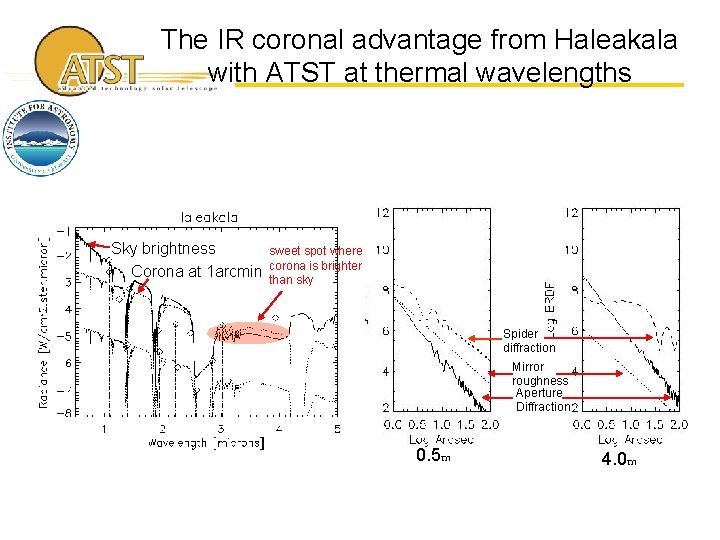
The IR coronal advantage from Haleakala with ATST at thermal wavelengths Sky brightness Corona at 1 arcmin sweet spot where corona is brighter than sky Spider diffraction Mirror roughness Aperture Diffraction 0. 5 m 4. 0 m
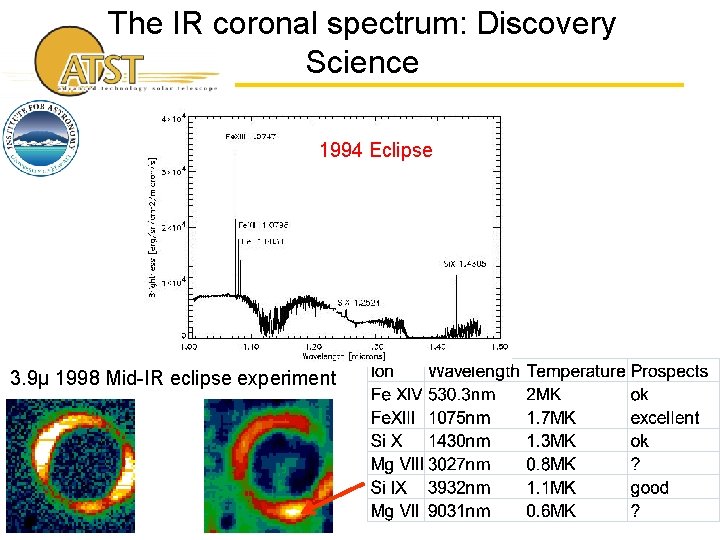
The IR coronal spectrum: Discovery Science 1994 Eclipse 3. 9μ 1998 Mid-IR eclipse experiment
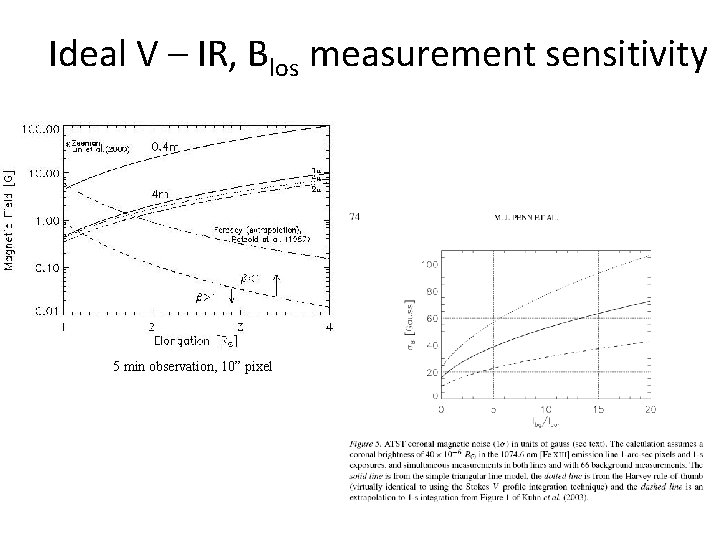
Ideal V – IR, Blos measurement sensitivity 5 min observation, 10” pixel
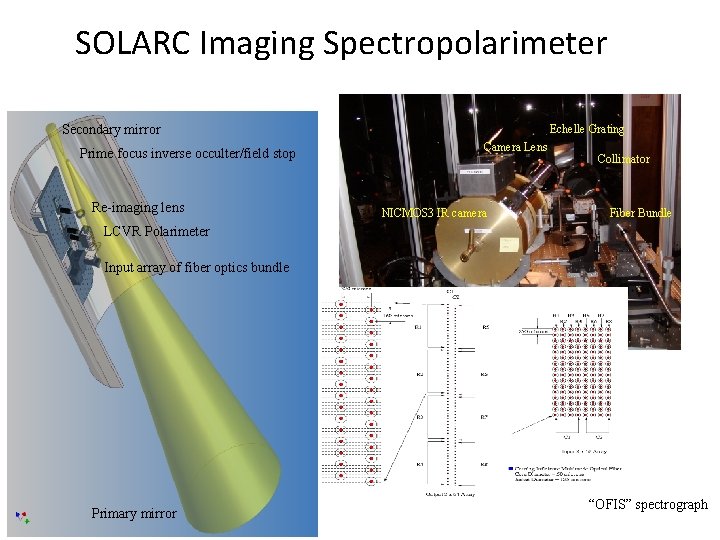
SOLARC Imaging Spectropolarimeter Secondary mirror Prime focus inverse occulter/field stop Re-imaging lens Echelle Grating Camera Lens NICMOS 3 IR camera Collimator Fiber Bundle LCVR Polarimeter Input array of fiber optics bundle Primary mirror “OFIS” spectrograph
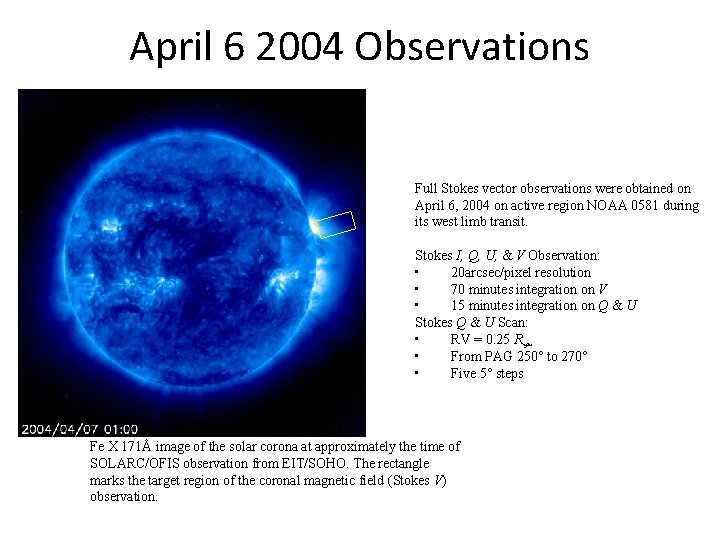
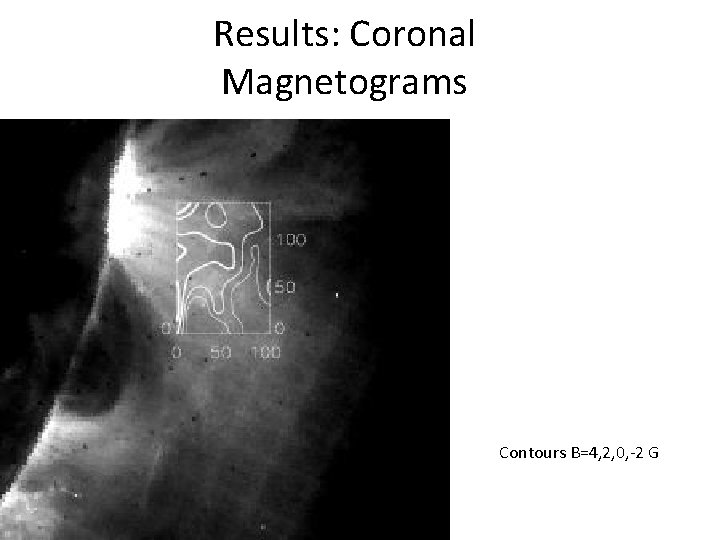
April 6 2004 Observations Full Stokes vector observations were obtained on April 6, 2004 on active region NOAA 0581 during its west limb transit. Stokes I, Q, U, & V Observation: • 20 arcsec/pixel resolution • 70 minutes integration on V • 15 minutes integration on Q & U Stokes Q & U Scan: • RV = 0. 25 R • From PAG 250° to 270° • Five 5° steps Fe X 171Å image of the solar corona at approximately the time of SOLARC/OFIS observation from EIT/SOHO. The rectangle marks the target region of the coronal magnetic field (Stokes V) observation.
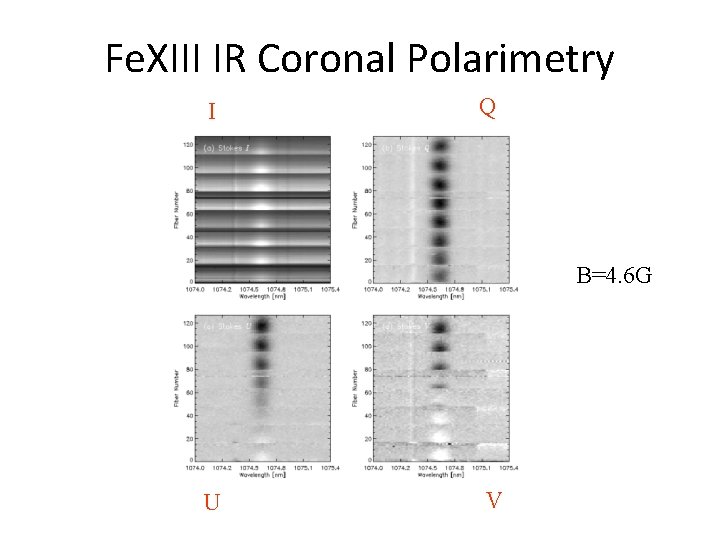
Fe. XIII IR Coronal Polarimetry I Q B=4. 6 G U V
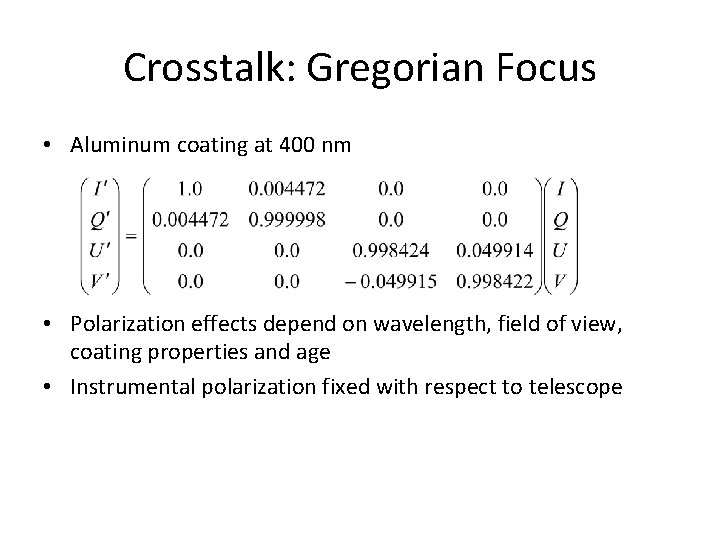
Crosstalk: Gregorian Focus • Aluminum coating at 400 nm • Polarization effects depend on wavelength, field of view, coating properties and age • Instrumental polarization fixed with respect to telescope
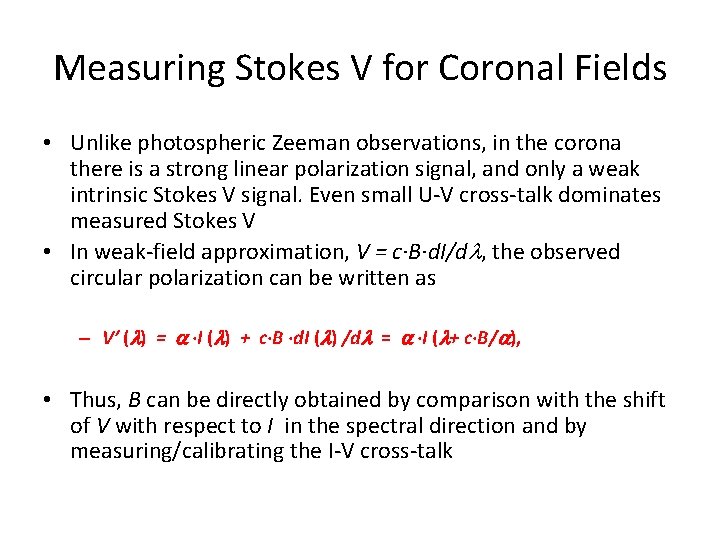
Measuring Stokes V for Coronal Fields • Unlike photospheric Zeeman observations, in the corona there is a strong linear polarization signal, and only a weak intrinsic Stokes V signal. Even small U-V cross-talk dominates measured Stokes V • In weak-field approximation, V = c·B·d. I/d , the observed circular polarization can be written as – V’ ( ) = ·I ( ) + c·B ·d. I ( ) /d = ·I ( + c·B/ ), • Thus, B can be directly obtained by comparison with the shift of V with respect to I in the spectral direction and by measuring/calibrating the I-V cross-talk
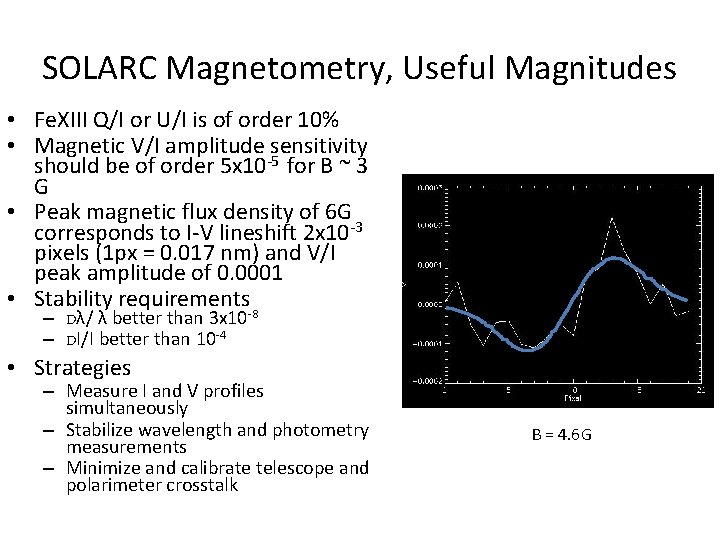
SOLARC Magnetometry, Useful Magnitudes • Fe. XIII Q/I or U/I is of order 10% • Magnetic V/I amplitude sensitivity should be of order 5 x 10 -5 for B ~ 3 G • Peak magnetic flux density of 6 G corresponds to I-V lineshift 2 x 10 -3 pixels (1 px = 0. 017 nm) and V/I peak amplitude of 0. 0001 • Stability requirements-8 – Dλ/ λ better than 3 x 10 – DI/I better than 10 -4 • Strategies – Measure I and V profiles simultaneously – Stabilize wavelength and photometry measurements – Minimize and calibrate telescope and polarimeter crosstalk B = 4. 6 G
Results: Coronal Magnetograms Contours B=4, 2, 0, -2 G
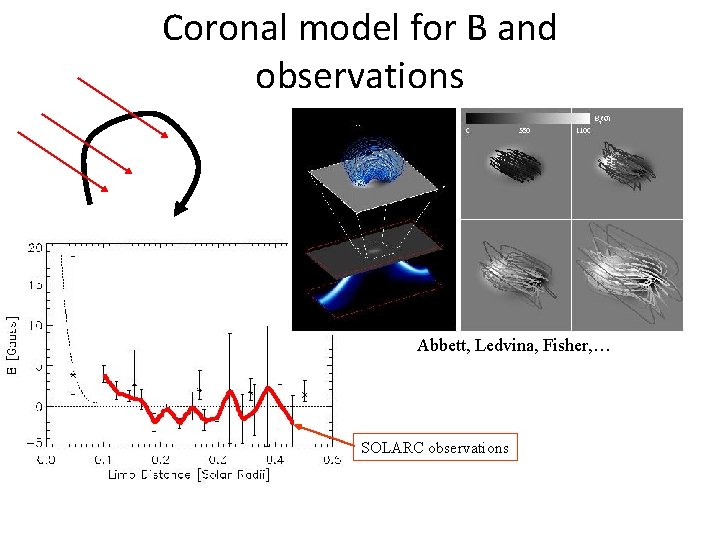
Coronal model for B and observations Abbett, Ledvina, Fisher, … SOLARC observations
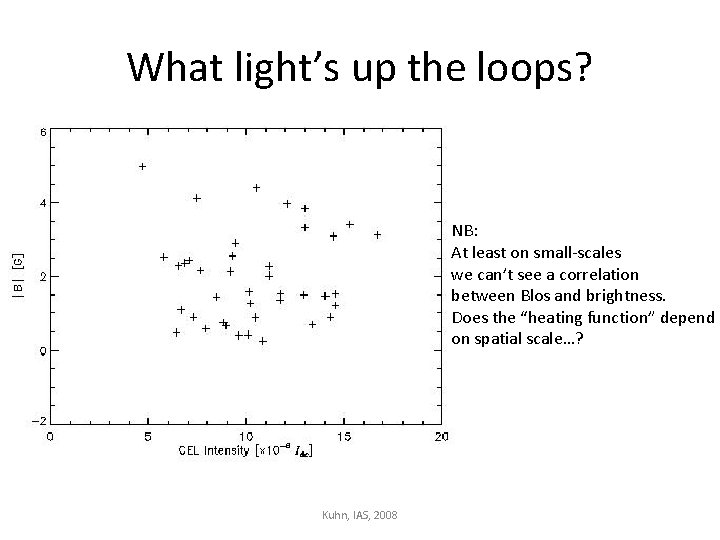
What light’s up the loops? NB: At least on small-scales we can’t see a correlation between Blos and brightness. Does the “heating function” depend on spatial scale…? Kuhn, IAS, 2008
What’s needed? • Observational tools – more than ATST, sensitive polarimetry from the telescope and instruments
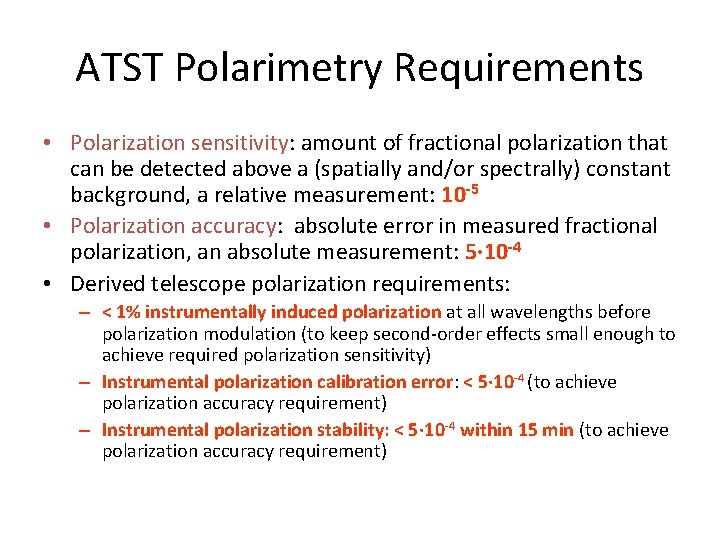
ATST Polarimetry Requirements • Polarization sensitivity: amount of fractional polarization that can be detected above a (spatially and/or spectrally) constant background, a relative measurement: 10 -5 • Polarization accuracy: absolute error in measured fractional polarization, an absolute measurement: 5· 10 -4 • Derived telescope polarization requirements: – < 1% instrumentally induced polarization at all wavelengths before polarization modulation (to keep second-order effects small enough to achieve required polarization sensitivity) – Instrumental polarization calibration error: < 5· 10 -4 (to achieve polarization accuracy requirement) – Instrumental polarization stability: < 5· 10 -4 within 15 min (to achieve polarization accuracy requirement)
What’s needed? • Observational tools – more than ATST, sensitive polarimetry from the telescope and instruments • Instruments designed for sensitive coronal polarimetry (Stokes V and IR)
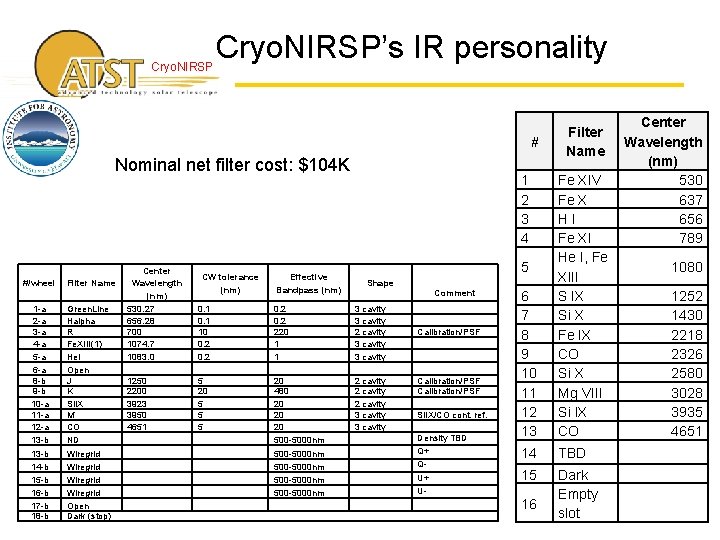
Cryo. NIRSP’s IR personality # Nominal net filter cost: $104 K #/wheel Filter Name 1 -a 2 -a 3 -a 4 -a 5 -a 6 -a 8 -b 9 -b 10 -a 11 -a 12 -a 13 -b 14 -b 15 -b 16 -b 17 -b 18 -b Green. Line Halpha R Fe. XIII(1) He. I Open J K Si. IX M’ CO ND Wiregrid Open Dark (stop) 1 2 3 4 0. 1 10 0. 2 220 1 1 3 cavity 2 cavity 3 cavity 1250 2200 3923 3950 4651 5 20 5 5 5 20 480 20 20 20 500 -5000 nm 500 -5000 nm 2 cavity 3 cavity CW tolerance (nm) Effective Bandpass (nm) 6 7 8 9 10 11 12 13 Fe XIV Fe X HI Fe XI He I, Fe XIII S IX Si X Fe IX CO Si X Mg VIII Si IX CO 14 TBD 15 Dark Empty slot 5 Center Wavelength (nm) 530. 27 656. 28 700 1074. 7 1083. 0 Shape Comment Calibration/PSF Si. IX/CO cont. ref. Density TBD Q+ QU+ U- Filter Name 16 Center Wavelength (nm) 530 637 656 789 1080 1252 1430 2218 2326 2580 3028 3935 4651
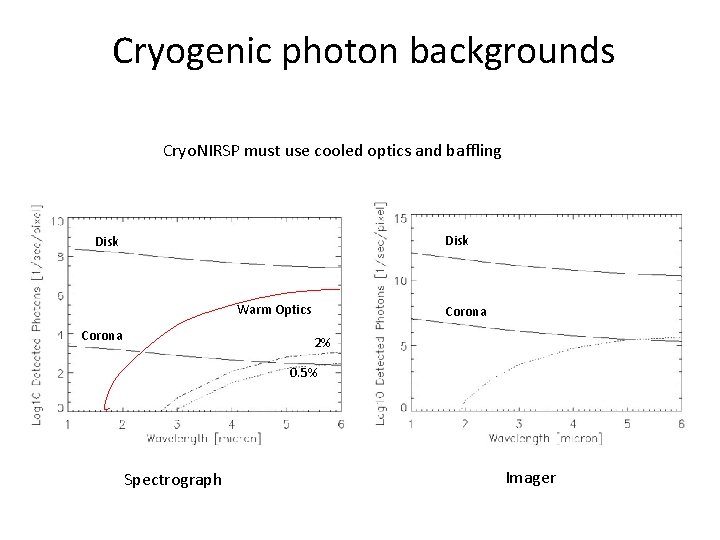
Cryogenic photon backgrounds Cryo. NIRSP must use cooled optics and baffling Disk Warm Optics Corona 2% 0. 5% Spectrograph Imager
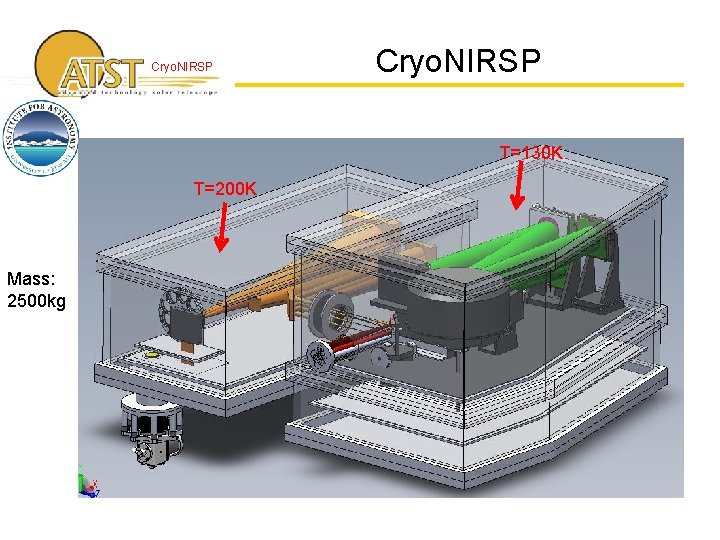
Cryo. NIRSP T=130 K T=200 K Mass: 2500 kg
Cryo. NIRSP What’s needed? • Observational tools – more than just ATST, need sensitive polarimetry from the telescope and instruments • Instruments designed for sensitive coronal polarimetry (Stokes V and IR) • People, and a growing interested community
Cryo. NIRSP How to rebuild community • Let’s do better advertising our progress on the long-standing problems, e. g. coronal magnetometry • Let’s connect with a broader astronomical community, e. g. “night-time solar physics” is a real discipline, more radio, extrasolar planets, stellar magnetism… • Let’s make the hard quantitative interpretation of 3 -d polarimetric tools more accessible, such a tool provides a natural venue for linking broader communities
“forward” and Cryo. NIRSP • … a CN “instrument personality” module that accepts CN instrument configuration parameters and generates simulated “observables” suitable for developing CN-ATST coronal experiments • …starting to look for long-term support for tools like “forward”.
Scalar Algebraic Reconstruction Technique
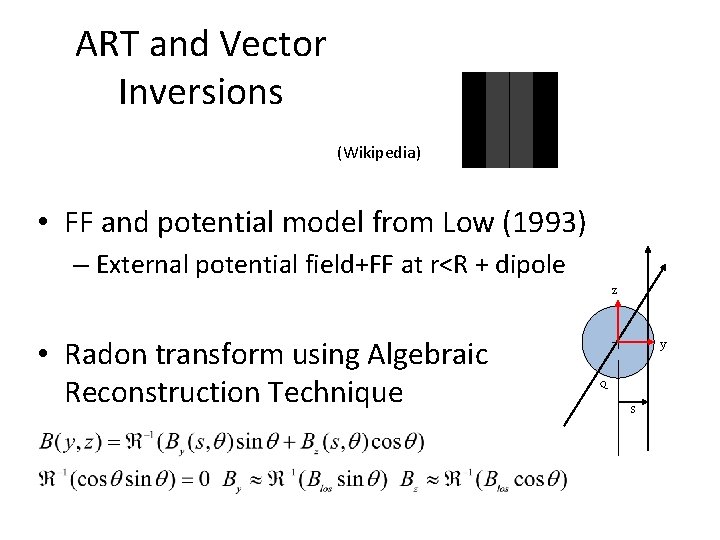
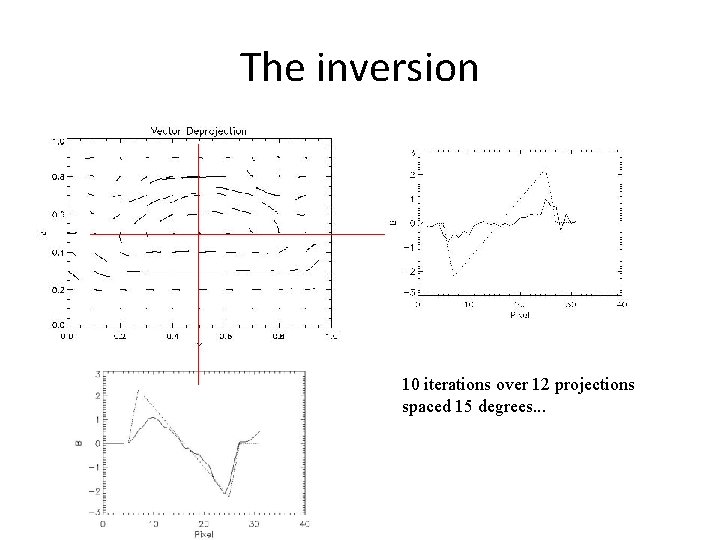
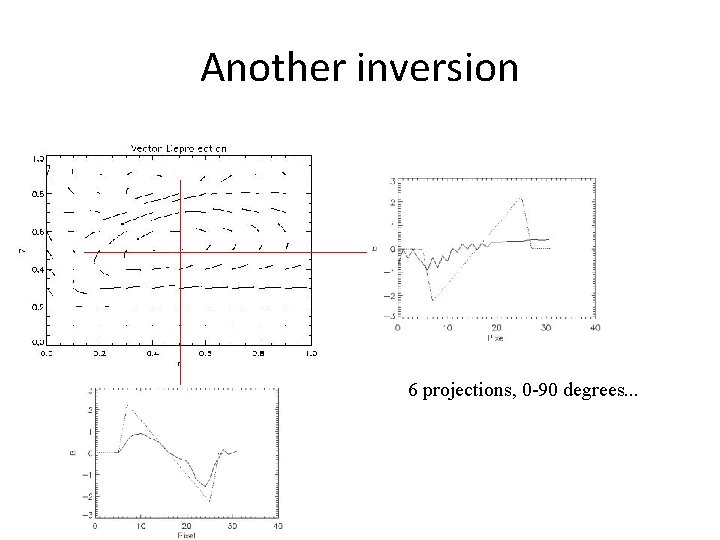
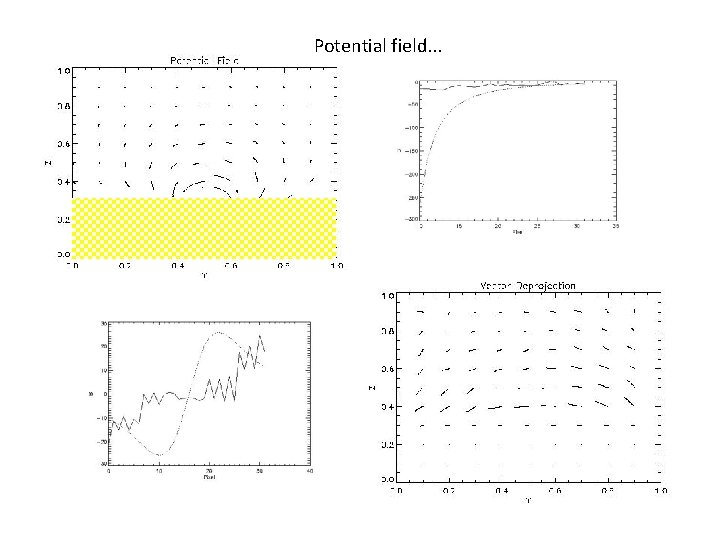
ART and Vector Inversions (Wikipedia) • FF and potential model from Low (1993) – External potential field+FF at r<R + dipole z • Radon transform using Algebraic Reconstruction Technique y Q s
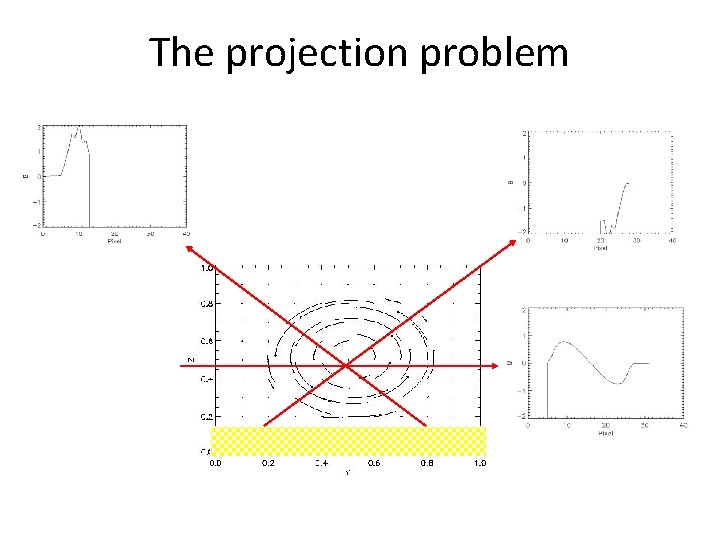
The projection problem
The inversion 10 iterations over 12 projections spaced 15 degrees. . .
Another inversion 6 projections, 0 -90 degrees. . .
Potential field. . .