
Introduction to Algorithms 6 046 J18 401 J
![Hairy recurrence (But not quite as hairy as the quicksort one. ) Prove: E[T(n)]](https://slidetodoc.com/presentation_image/605a9783b4d01e9d934d93778345f456/image-13.jpg "Hairy recurrence (But not quite as hairy as the quicksort one. ) Prove: E[T(n)]")
- Slides: 30
Introduction to Algorithms 6. 046 J/18. 401 J LECTURE 6 Order Statistics • Randomized divide and conquer • Analysis of expected time • Worse-case linear-time order statistics • Analysis Prof. Erik Demaine September 28, 2005 Copyright© 2001 -5 Erik D. Demaine and Charles E. Leiserson L 6. 1
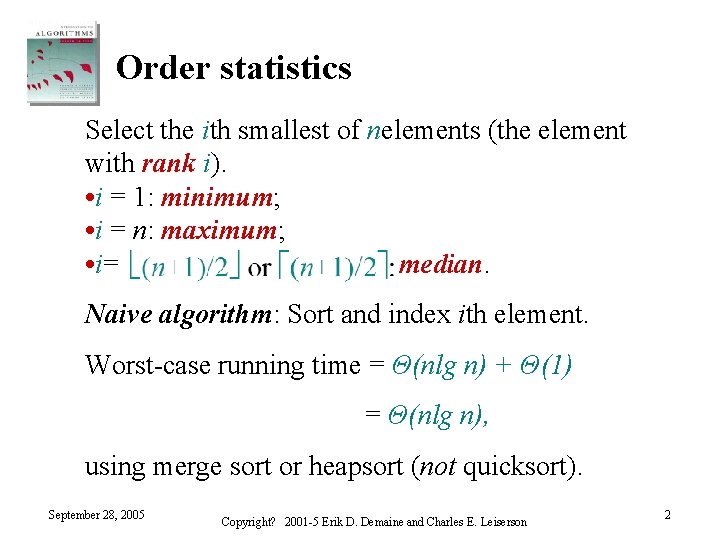
Order statistics Select the ith smallest of nelements (the element with rank i). • i = 1: minimum; • i = n: maximum; • i= median. Naive algorithm: Sort and index ith element. Worst-case running time = Θ(nlg n) + Θ(1) = Θ(nlg n), using merge sort or heapsort (not quicksort). September 28, 2005 Copyright? 2001 -5 Erik D. Demaine and Charles E. Leiserson 2
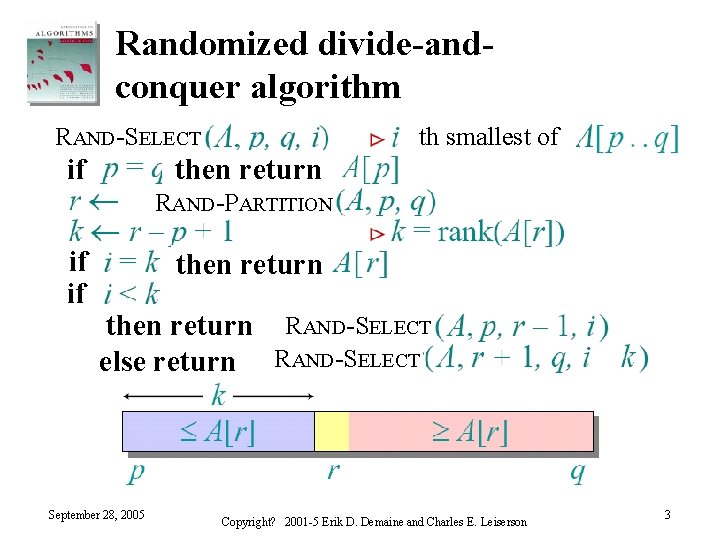
Randomized divide-andconquer algorithm RAND-SELECT if th smallest of then return RAND-PARTITION if if then return RAND-SELECT else return RAND-SELECT September 28, 2005 Copyright? 2001 -5 Erik D. Demaine and Charles E. Leiserson 3
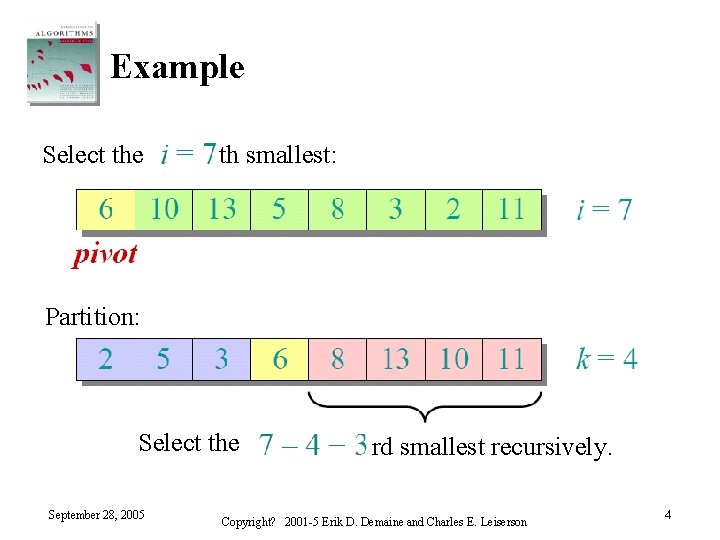
Example Select the th smallest: Partition: Select the September 28, 2005 rd smallest recursively. Copyright? 2001 -5 Erik D. Demaine and Charles E. Leiserson 4
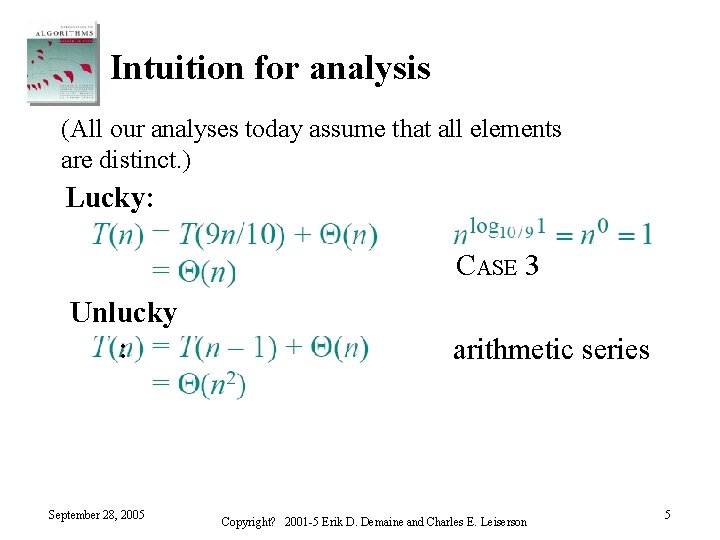
Intuition for analysis (All our analyses today assume that all elements are distinct. ) Lucky: CASE 3 Unlucky : September 28, 2005 arithmetic series Copyright? 2001 -5 Erik D. Demaine and Charles E. Leiserson 5
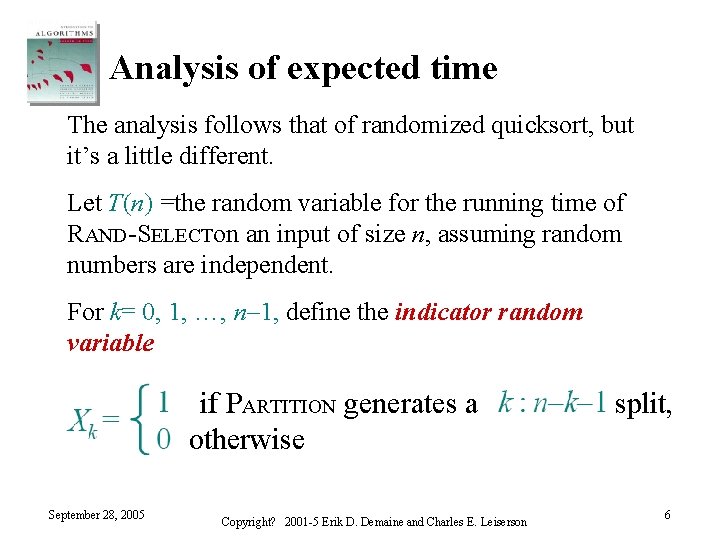
Analysis of expected time The analysis follows that of randomized quicksort, but it’s a little different. Let T(n) =the random variable for the running time of RAND-SELECTon an input of size n, assuming random numbers are independent. For k= 0, 1, …, n– 1, define the indicator random variable if PARTITION generates a otherwise September 28, 2005 Copyright? 2001 -5 Erik D. Demaine and Charles E. Leiserson split, 6
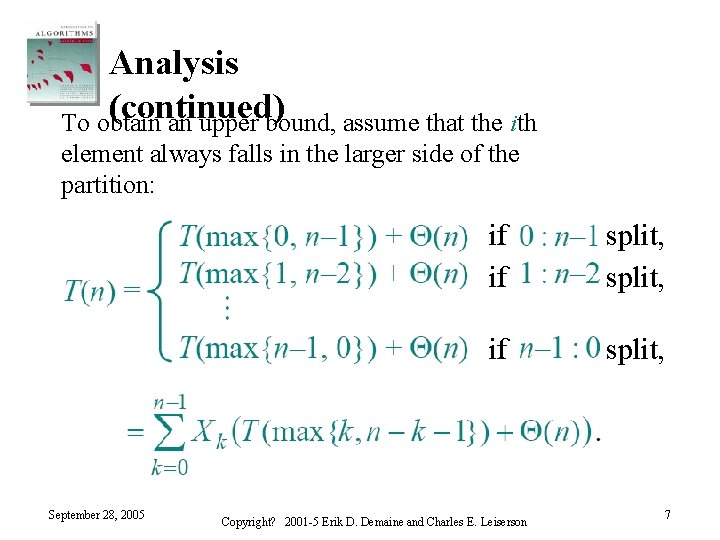
Analysis (continued) To obtain an upper bound, assume that the ith element always falls in the larger side of the partition: September 28, 2005 if if split, Copyright? 2001 -5 Erik D. Demaine and Charles E. Leiserson 7
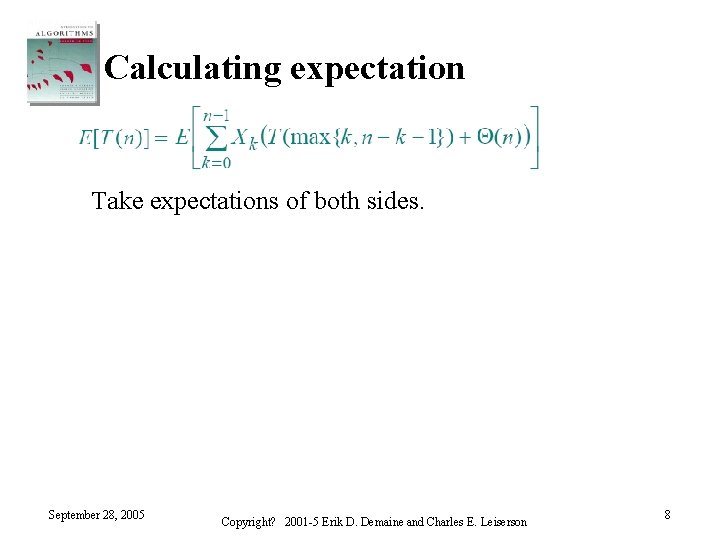
Calculating expectation Take expectations of both sides. September 28, 2005 Copyright? 2001 -5 Erik D. Demaine and Charles E. Leiserson 8
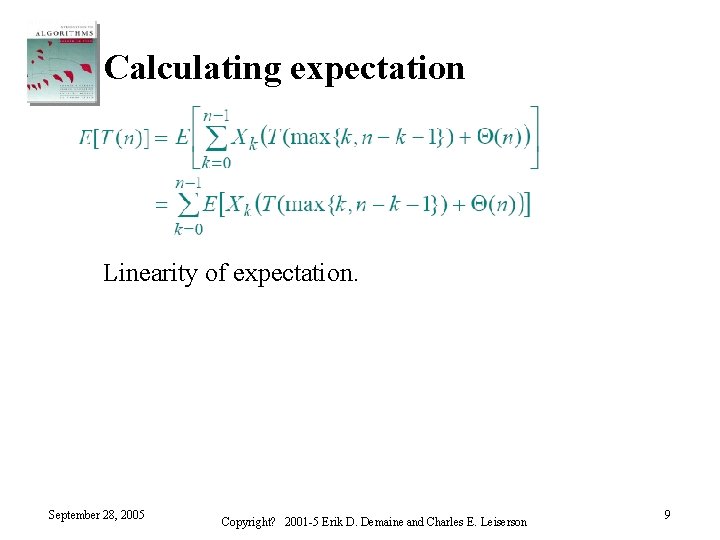
Calculating expectation Linearity of expectation. September 28, 2005 Copyright? 2001 -5 Erik D. Demaine and Charles E. Leiserson 9
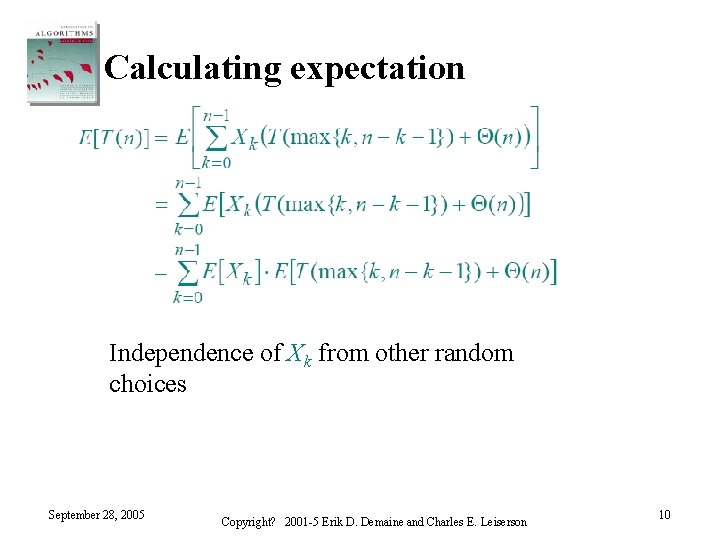
Calculating expectation Independence of Xk from other random choices September 28, 2005 Copyright? 2001 -5 Erik D. Demaine and Charles E. Leiserson 10
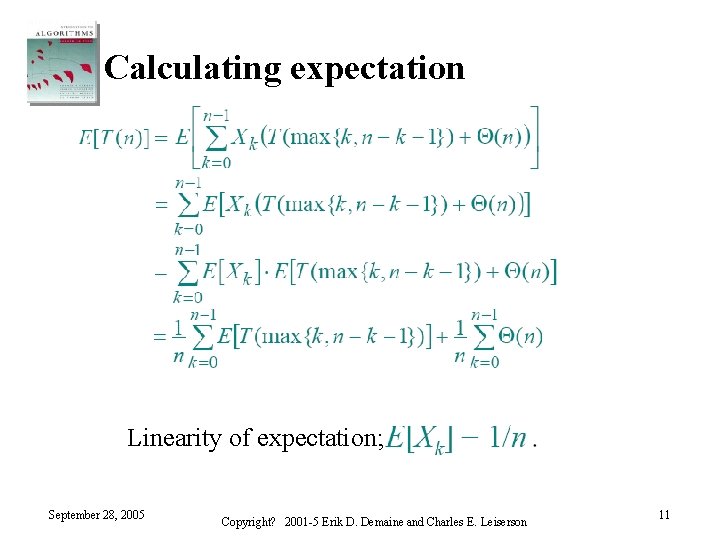
Calculating expectation Linearity of expectation; September 28, 2005 Copyright? 2001 -5 Erik D. Demaine and Charles E. Leiserson 11
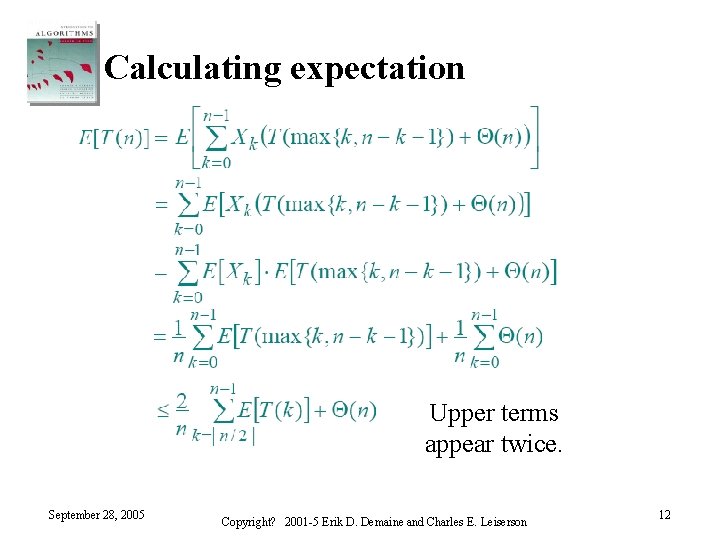
Calculating expectation Upper terms appear twice. September 28, 2005 Copyright? 2001 -5 Erik D. Demaine and Charles E. Leiserson 12
Hairy recurrence (But not quite as hairy as the quicksort one. ) Prove: E[T(n)] ≤ cn for constant c > 0. • The constant c can be chosen large enough so that E[T(n)]≤ cn for the base cases. Use fact: September 28, 2005 (exercise). Copyright? 2001 -5 Erik D. Demaine and Charles E. Leiserson 13
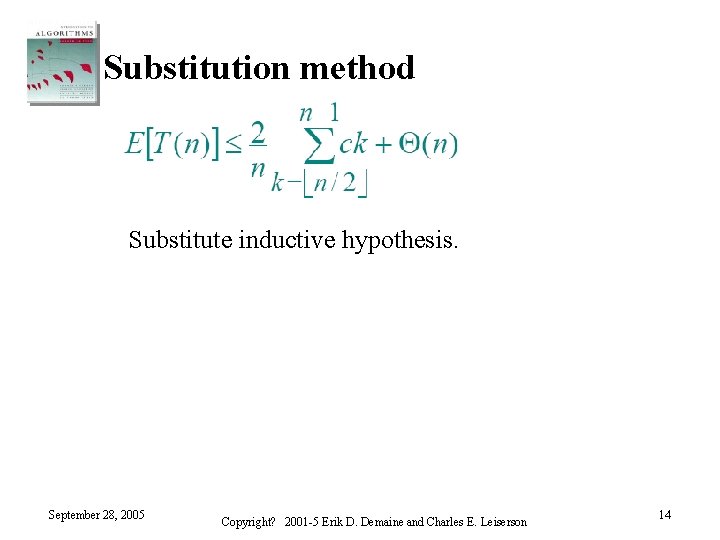
Substitution method Substitute inductive hypothesis. September 28, 2005 Copyright? 2001 -5 Erik D. Demaine and Charles E. Leiserson 14
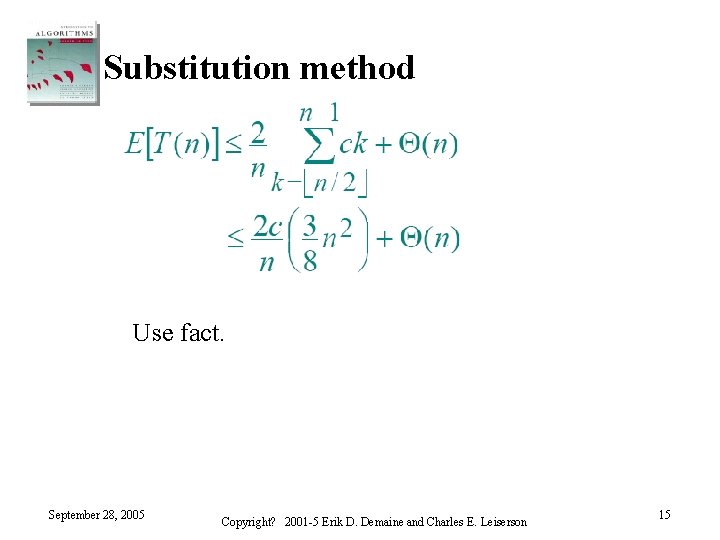
Substitution method Use fact. September 28, 2005 Copyright? 2001 -5 Erik D. Demaine and Charles E. Leiserson 15
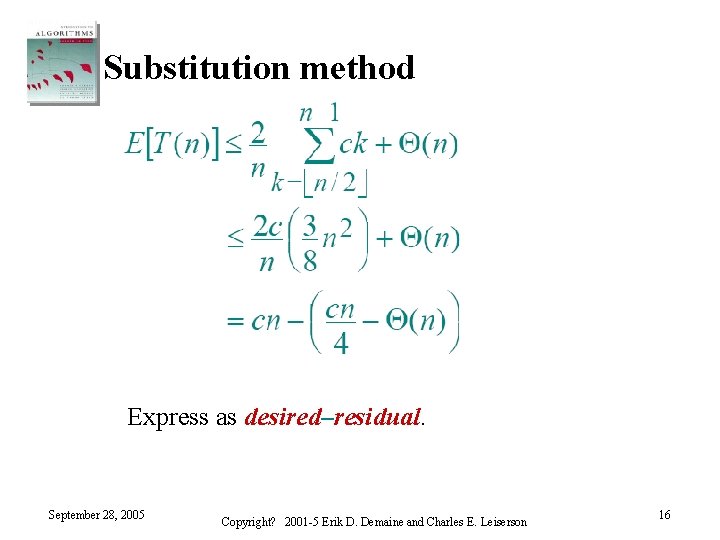
Substitution method Express as desired–residual. September 28, 2005 Copyright? 2001 -5 Erik D. Demaine and Charles E. Leiserson 16
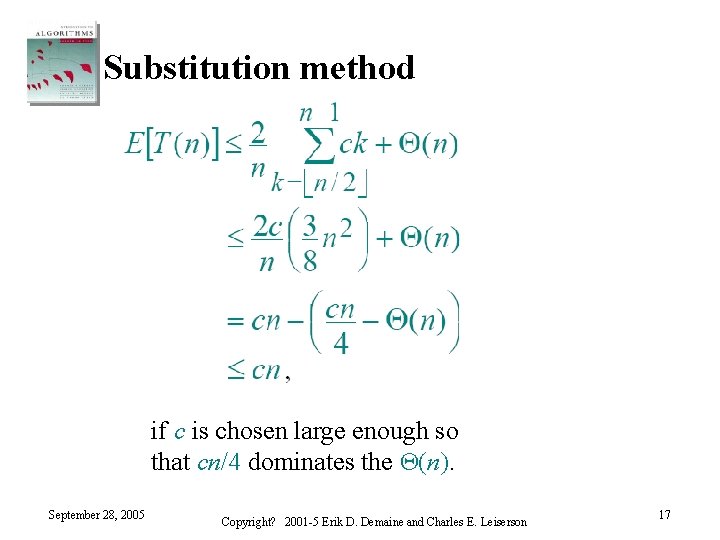
Substitution method if c is chosen large enough so that cn/4 dominates the Θ(n). September 28, 2005 Copyright? 2001 -5 Erik D. Demaine and Charles E. Leiserson 17
Summary of randomized order-statistic selection • Works fast: linear expected time. • Excellent algorithm in practice. • But, the worst case is very bad: Θ(n 2). Q. Is there an algorithm that runs in linear time in the worst case? A. Yes, due to Blum, Floyd, Pratt, Rivest, and Tarjan [1973]. IDEA : Generate a good pivot recursively. September 28, 2005 Copyright? 2001 -5 Erik D. Demaine and Charles E. Leiserson 18
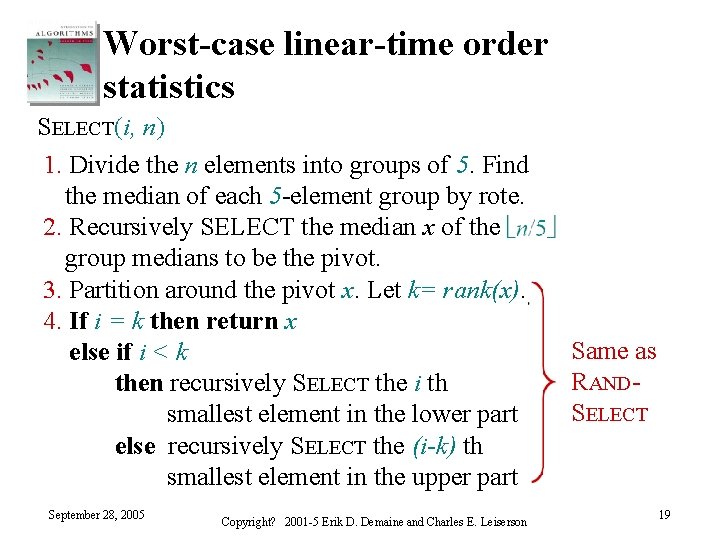
Worst-case linear-time order statistics SELECT(i, n) 1. Divide the n elements into groups of 5. Find the median of each 5 -element group by rote. 2. Recursively SELECT the median x of the n/5 group medians to be the pivot. 3. Partition around the pivot x. Let k= rank(x). 4. If i = k then return x else if i < k then recursively SELECT the i th smallest element in the lower part else recursively SELECT the (i-k) th smallest element in the upper part September 28, 2005 Copyright? 2001 -5 Erik D. Demaine and Charles E. Leiserson Same as RANDSELECT 19
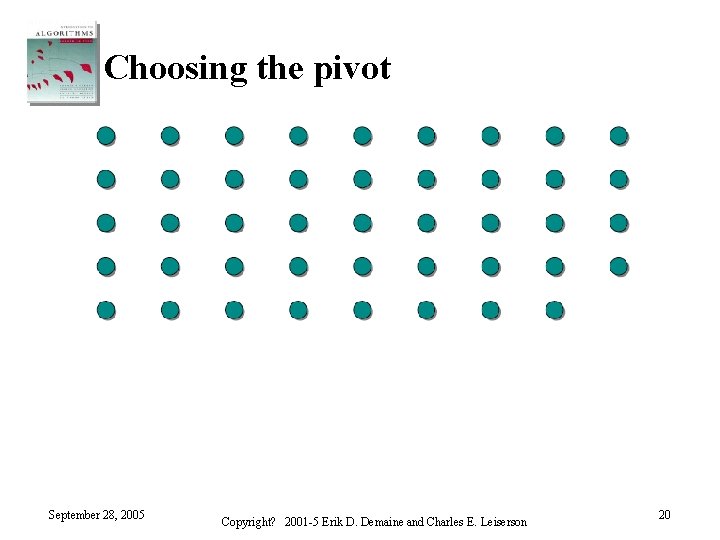
Choosing the pivot September 28, 2005 Copyright? 2001 -5 Erik D. Demaine and Charles E. Leiserson 20
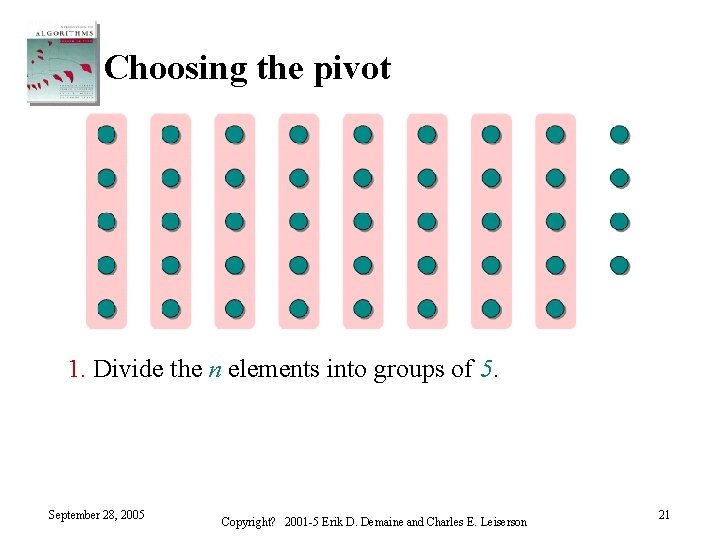
Choosing the pivot 1. Divide the n elements into groups of 5. September 28, 2005 Copyright? 2001 -5 Erik D. Demaine and Charles E. Leiserson 21
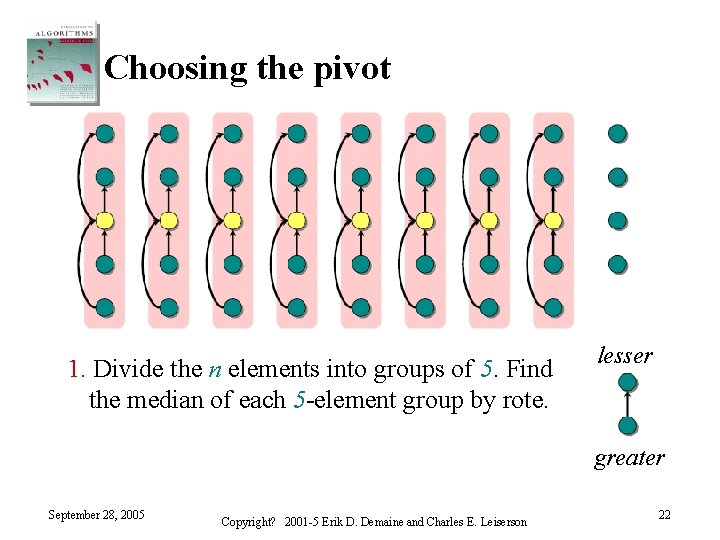
Choosing the pivot 1. Divide the n elements into groups of 5. Find the median of each 5 -element group by rote. lesser greater September 28, 2005 Copyright? 2001 -5 Erik D. Demaine and Charles E. Leiserson 22
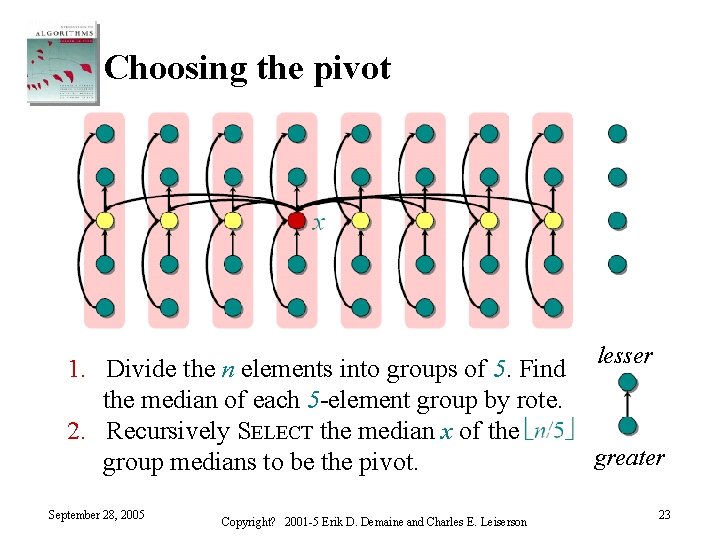
Choosing the pivot 1. Divide the n elements into groups of 5. Find the median of each 5 -element group by rote. 2. Recursively SELECT the median x of the n/5 group medians to be the pivot. September 28, 2005 Copyright? 2001 -5 Erik D. Demaine and Charles E. Leiserson lesser greater 23
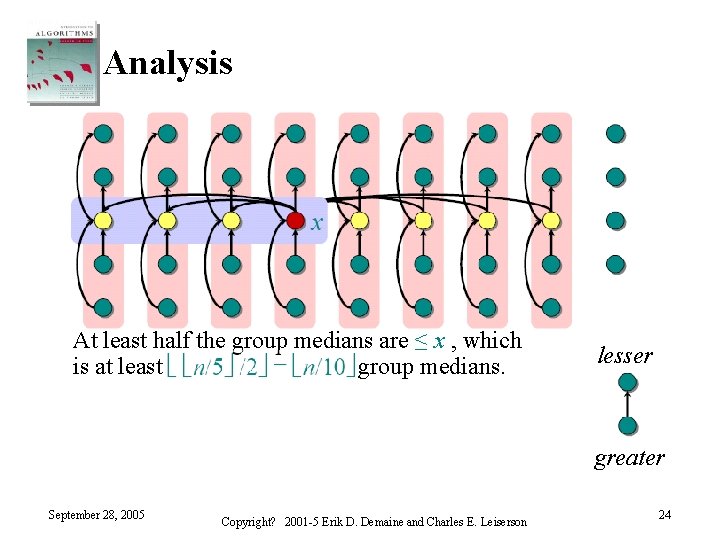
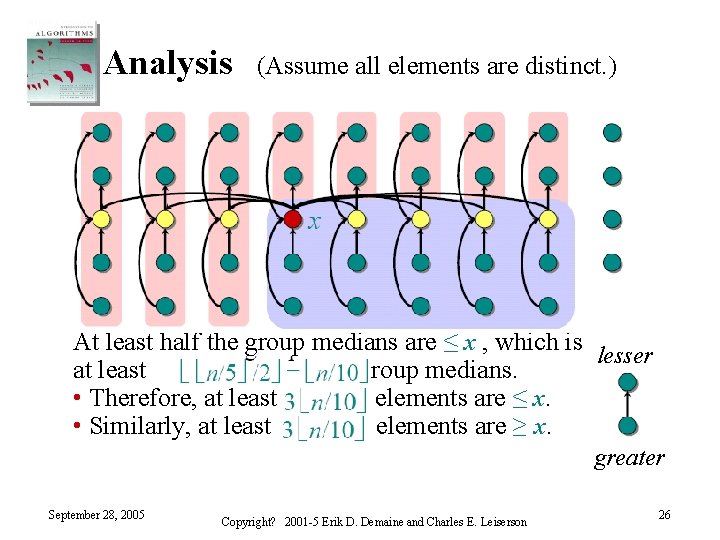
Analysis At least half the group medians are ≤ x , which is at least n/5/2= n/10 group medians. lesser greater September 28, 2005 Copyright? 2001 -5 Erik D. Demaine and Charles E. Leiserson 24
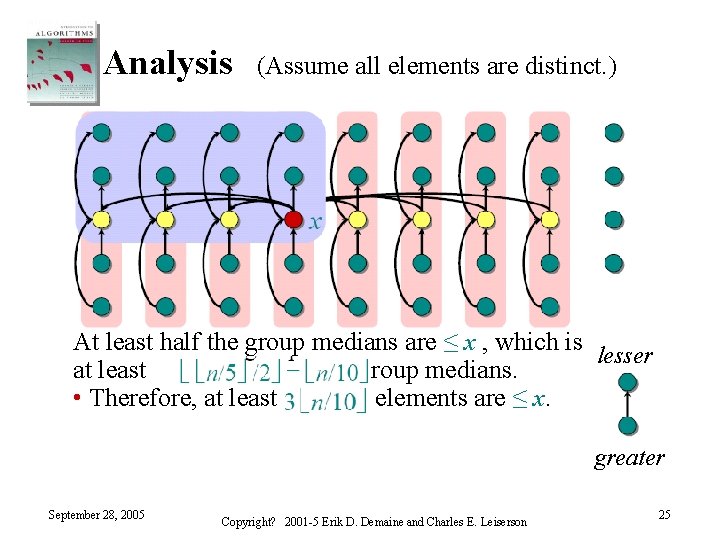
Analysis (Assume all elements are distinct. ) At least half the group medians are ≤ x , which is lesser at least n/5/2= n/10 group medians. • Therefore, at least 3 n/10 elements are ≤ x. greater September 28, 2005 Copyright? 2001 -5 Erik D. Demaine and Charles E. Leiserson 25
Analysis (Assume all elements are distinct. ) At least half the group medians are ≤ x , which is lesser at least n/5/2= n/10 group medians. • Therefore, at least 3 n/10 elements are ≤ x. • Similarly, at least 3 n/10 elements are ≥ x. greater September 28, 2005 Copyright? 2001 -5 Erik D. Demaine and Charles E. Leiserson 26
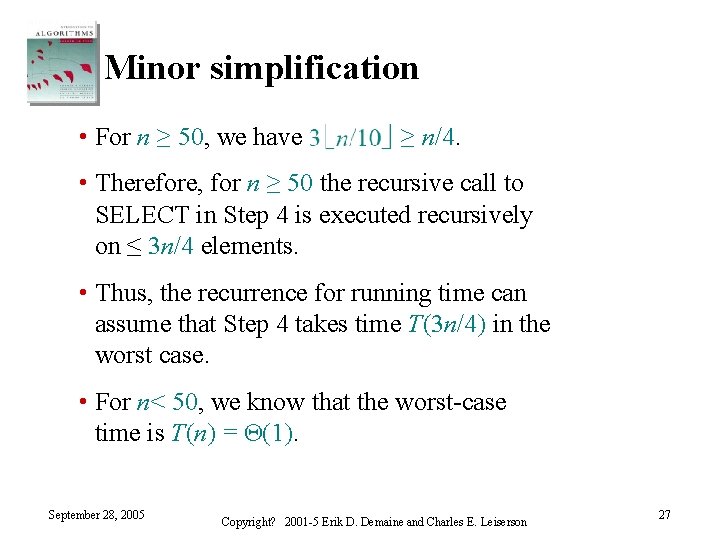
Minor simplification • For n ≥ 50, we have 3 n/10 ≥ n/4. • Therefore, for n ≥ 50 the recursive call to SELECT in Step 4 is executed recursively on ≤ 3 n/4 elements. • Thus, the recurrence for running time can assume that Step 4 takes time T(3 n/4) in the worst case. • For n< 50, we know that the worst-case time is T(n) = Θ(1). September 28, 2005 Copyright? 2001 -5 Erik D. Demaine and Charles E. Leiserson 27
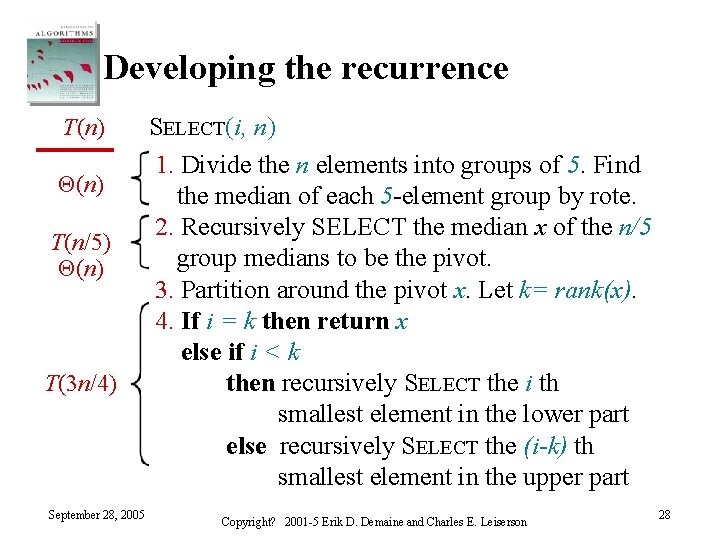
Developing the recurrence T(n) Θ(n) T(n/5) Θ(n) T(3 n/4) September 28, 2005 SELECT(i, n) 1. Divide the n elements into groups of 5. Find the median of each 5 -element group by rote. 2. Recursively SELECT the median x of the n/5 group medians to be the pivot. 3. Partition around the pivot x. Let k= rank(x). 4. If i = k then return x else if i < k then recursively SELECT the i th smallest element in the lower part else recursively SELECT the (i-k) th smallest element in the upper part Copyright? 2001 -5 Erik D. Demaine and Charles E. Leiserson 28
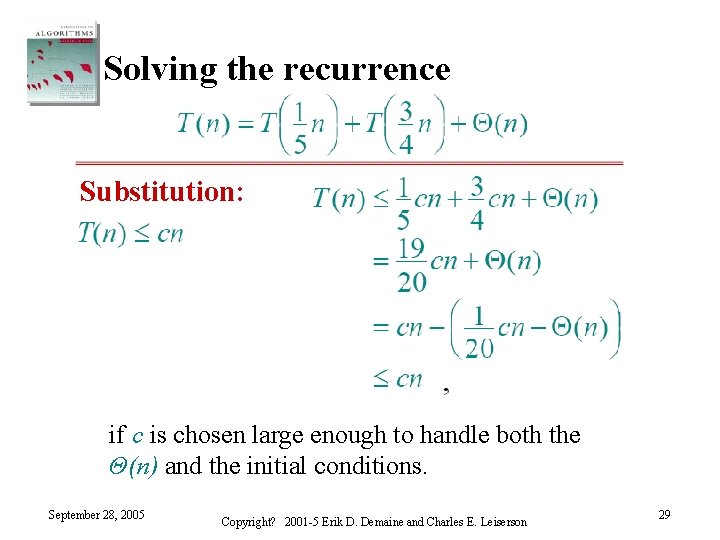
Solving the recurrence Substitution: if c is chosen large enough to handle both the Θ(n) and the initial conditions. September 28, 2005 Copyright? 2001 -5 Erik D. Demaine and Charles E. Leiserson 29
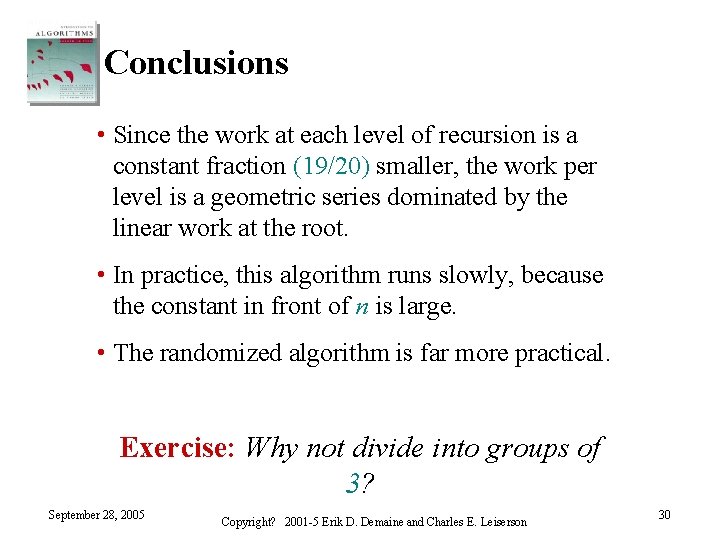
Conclusions • Since the work at each level of recursion is a constant fraction (19/20) smaller, the work per level is a geometric series dominated by the linear work at the root. • In practice, this algorithm runs slowly, because the constant in front of n is large. • The randomized algorithm is far more practical. Exercise: Why not divide into groups of 3? September 28, 2005 Copyright? 2001 -5 Erik D. Demaine and Charles E. Leiserson 30