
BMB 401 SPRING 2019 BIOCHEMISTRY for the BIOMEDICAL
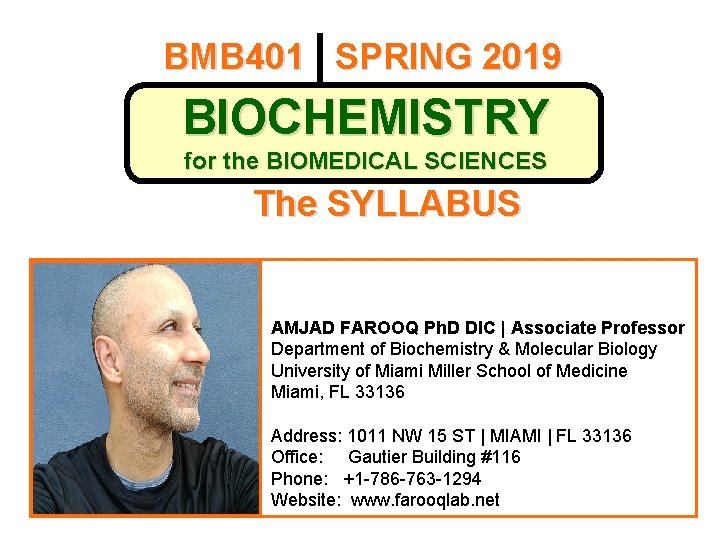
BMB 401 | SPRING 2019 BIOCHEMISTRY for the BIOMEDICAL SCIENCES The SYLLABUS AMJAD FAROOQ Ph. D DIC | Associate Professor Department of Biochemistry & Molecular Biology University of Miami Miller School of Medicine Miami, FL 33136 Address: 1011 NW 15 ST | MIAMI | FL 33136 Office: Gautier Building #116 Phone: +1 -786 -763 -1294 Website: www. farooqlab. net
0. INTRODUCTION § 0. 1 The Syllabus
AIMS and GOALS The aims of BMB 401 are to: (1) Provide students with an in-depth understanding of the structure and function of biomolecules such as proteins, carbohydrates, lipids, and nucleic acids from a biochemical perspective (2) Encourage students to apply logic and rationale to understanding various biochemical concepts and phenomena rather than resort to rote learning (3) Equip students with the necessary biochemical foundation to embark on a career in a wide array of fields such as: - Medicine - Agriculture - Environment - Nutrition - Nanotechnology - Health industry - Pharmaceutical industry - Forensic science
COURSE CONTENT BMB 401 is a 4 -credit course and fittingly divided into FOUR equally-weighted modules (or parts): I. MEMBRANE BIOCHEMSITRY Biochemical properties and cellular functions of carbohydrates and lipids, biological membranes, membrane transport, and transmembrane signaling II. PROTEIN BIOCHEMSITRY Biochemical insights into the structure, function, and allosteric regulation of proteins, including catalysis and kinetics of enzymes III. METABOLIC BIOCHEMISTRY Biochemical insights into various metabolic pathways with particular emphasis on the oxidation of food and nutrients to generate energy for the sustenance of life IV. NUCLEAR BIOCHEMISTRY Biochemical insights into how genetic information in the form of DNA and RNA within the nucleus is used to direct protein synthesis and cellular processes In terms of class structure, the course is comprised of: q 100 -150 min class duration (2: 00 pm-4: 45 pm) q 24 x lecture classes (didactic and dialectic) q 04 x exam classes (modular assessment) q 2800 -4200 min contact time—equivalent to 4 -6 credit hours! Course material is available for download @ farooqlab. net
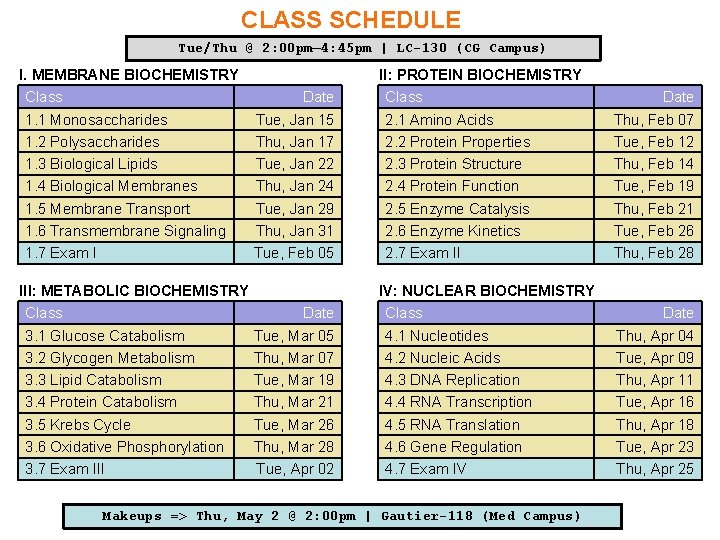
CLASS SCHEDULE Tue/Thu @ 2: 00 pm— 4: 45 pm | LC-130 (CG Campus) I. MEMBRANE BIOCHEMISTRY Class Date 1. 1 Monosaccharides Tue, Jan 15 1. 2 Polysaccharides Thu, Jan 17 1. 3 Biological Lipids Tue, Jan 22 1. 4 Biological Membranes Thu, Jan 24 1. 5 Membrane Transport Tue, Jan 29 1. 6 Transmembrane Signaling Thu, Jan 31 1. 7 Exam I Tue, Feb 05 II: PROTEIN BIOCHEMISTRY Class 2. 1 Amino Acids 2. 2 Protein Properties 2. 3 Protein Structure 2. 4 Protein Function 2. 5 Enzyme Catalysis 2. 6 Enzyme Kinetics 2. 7 Exam II Date Thu, Feb 07 Tue, Feb 12 Thu, Feb 14 Tue, Feb 19 Thu, Feb 21 Tue, Feb 26 Thu, Feb 28 III: METABOLIC BIOCHEMISTRY Class 3. 1 Glucose Catabolism 3. 2 Glycogen Metabolism 3. 3 Lipid Catabolism 3. 4 Protein Catabolism 3. 5 Krebs Cycle 3. 6 Oxidative Phosphorylation 3. 7 Exam III IV: NUCLEAR BIOCHEMISTRY Class 4. 1 Nucleotides 4. 2 Nucleic Acids 4. 3 DNA Replication 4. 4 RNA Transcription 4. 5 RNA Translation 4. 6 Gene Regulation 4. 7 Exam IV Date Thu, Apr 04 Tue, Apr 09 Thu, Apr 11 Tue, Apr 16 Thu, Apr 18 Tue, Apr 23 Thu, Apr 25 Date Tue, Mar 05 Thu, Mar 07 Tue, Mar 19 Thu, Mar 21 Tue, Mar 26 Thu, Mar 28 Tue, Apr 02 Makeups => Thu, May 2 @ 2: 00 pm | Gautier-118 (Med Campus)
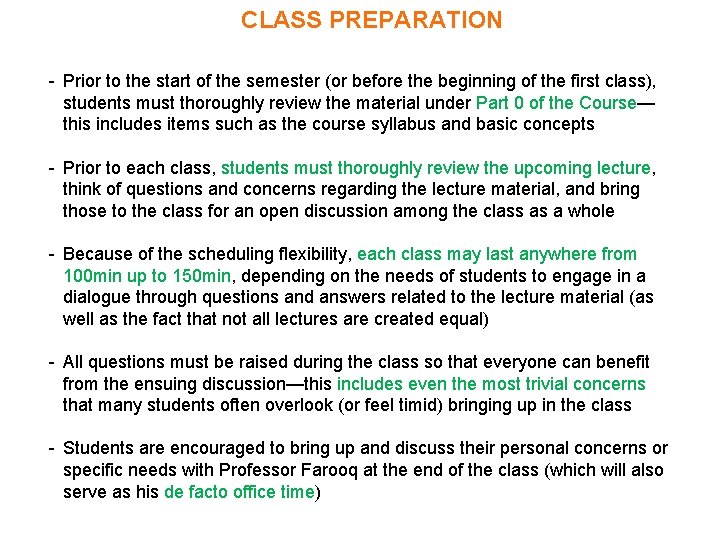
CLASS PREPARATION - Prior to the start of the semester (or before the beginning of the first class), students must thoroughly review the material under Part 0 of the Course— this includes items such as the course syllabus and basic concepts - Prior to each class, students must thoroughly review the upcoming lecture, think of questions and concerns regarding the lecture material, and bring those to the class for an open discussion among the class as a whole - Because of the scheduling flexibility, each class may last anywhere from 100 min up to 150 min, depending on the needs of students to engage in a dialogue through questions and answers related to the lecture material (as well as the fact that not all lectures are created equal) - All questions must be raised during the class so that everyone can benefit from the ensuing discussion—this includes even the most trivial concerns that many students often overlook (or feel timid) bringing up in the class - Students are encouraged to bring up and discuss their personal concerns or specific needs with Professor Farooq at the end of the class (which will also serve as his de facto office time)
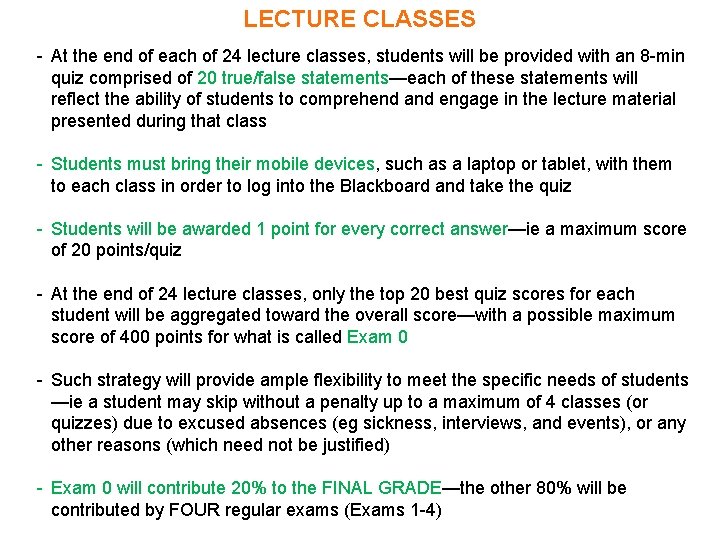
LECTURE CLASSES - At the end of each of 24 lecture classes, students will be provided with an 8 -min quiz comprised of 20 true/false statements—each of these statements will reflect the ability of students to comprehend and engage in the lecture material presented during that class - Students must bring their mobile devices, such as a laptop or tablet, with them to each class in order to log into the Blackboard and take the quiz - Students will be awarded 1 point for every correct answer—ie a maximum score of 20 points/quiz - At the end of 24 lecture classes, only the top 20 best quiz scores for each student will be aggregated toward the overall score—with a possible maximum score of 400 points for what is called Exam 0 - Such strategy will provide ample flexibility to meet the specific needs of students —ie a student may skip without a penalty up to a maximum of 4 classes (or quizzes) due to excused absences (eg sickness, interviews, and events), or any other reasons (which need not be justified) - Exam 0 will contribute 20% to the FINAL GRADE—the other 80% will be contributed by FOUR regular exams (Exams 1 -4)
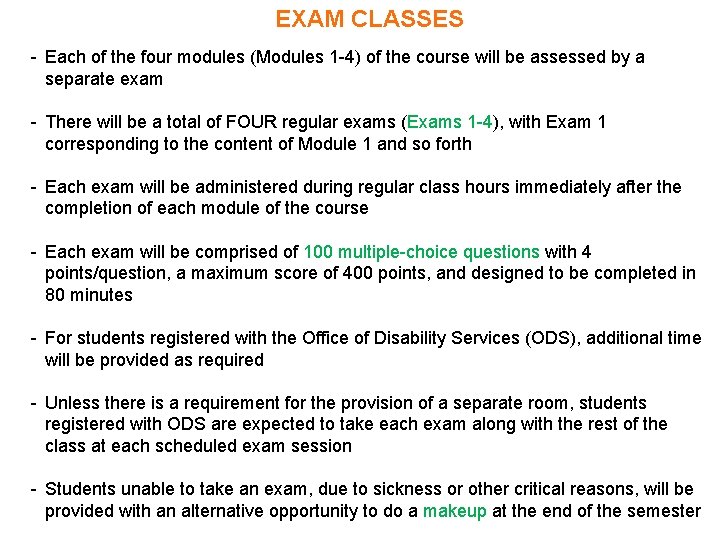
EXAM CLASSES - Each of the four modules (Modules 1 -4) of the course will be assessed by a separate exam - There will be a total of FOUR regular exams (Exams 1 -4), with Exam 1 corresponding to the content of Module 1 and so forth - Each exam will be administered during regular class hours immediately after the completion of each module of the course - Each exam will be comprised of 100 multiple-choice questions with 4 points/question, a maximum score of 400 points, and designed to be completed in 80 minutes - For students registered with the Office of Disability Services (ODS), additional time will be provided as required - Unless there is a requirement for the provision of a separate room, students registered with ODS are expected to take each exam along with the rest of the class at each scheduled exam session - Students unable to take an exam, due to sickness or other critical reasons, will be provided with an alternative opportunity to do a makeup at the end of the semester
MAKEUP EXAMS - Students are reminded that the makeup exams will be potentially harder and will likely involve essay questions in lieu of multiple-choice format - Only one makeup will be allowed—ie a student must not miss more than one exam lest they forfeit the score on each additional exam not taken during the semester - Students wishing to makeup an exam at the end of the semester must provide documented evidence to justify their reasons for having missed an earlier exam - Such evidence may include predated documents (dated prior to the missed exam for which the makeup is being undertaken) such as: q a doctor’s note indicating that the student is unable to take a scheduled exam due to heath reasons; q an interview letter indicating that the student is unable to take a scheduled exam due to being out of town (flight and travel info must also be provided); q a written record for a university event at which the student is required to partake and that overlaps with a scheduled exam. - The above documents must be brought with and made available prior to taking a makeup exam scheduled at the end of the semester in Gautier Bldg (Med campus) - Under no circumstances, students will be allowed to do a makeup exam for reasons other than those listed above
EXAM INSTRUCTIONS - All students are expected to abide by the Honor Code—students should not receive or provide help from any source during an exam and any irregularities witnessed must be reported to the proctor(s) and to the Honor Council - All personal devices such as cell phones and calculators must be switched off and put away—ditto for personal belongings such as bags that must be neatly tucked away under the desk - Each of the FOUR exams will be administered electronically, or digitally, via the Blackboard—detailed instructions on taking digital exams are provided at: Blackboard => Assessments => Regular Exams - Each exam will require the installation of Respondus Lockdown Browser on each student’s digital device such as a laptop or a tablet—it is the student’s responsibility to thoroughly familiarize with the use of Respondus browser so that inadvertent errors can be avoided during an exam - Unless there is a technical issue (eg login or device failure), students must NOT raise their hands to ask for any help whatsoever with exam questions—and—they are expected to understand comprehend the biochemical language used to set up the question and select the correct response exclusively on their own without help or clarification from anyone
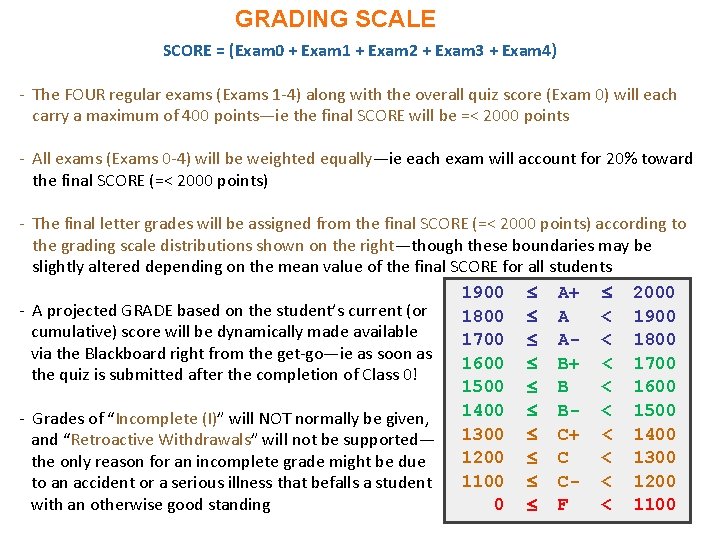
GRADING SCALE SCORE = (Exam 0 + Exam 1 + Exam 2 + Exam 3 + Exam 4) - The FOUR regular exams (Exams 1 -4) along with the overall quiz score (Exam 0) will each carry a maximum of 400 points—ie the final SCORE will be =< 2000 points - All exams (Exams 0 -4) will be weighted equally—ie each exam will account for 20% toward the final SCORE (=< 2000 points) - The final letter grades will be assigned from the final SCORE (=< 2000 points) according to the grading scale distributions shown on the right—though these boundaries may be slightly altered depending on the mean value of the final SCORE for all students 1900 A+ 2000 - A projected GRADE based on the student’s current (or 1800 A < 1900 cumulative) score will be dynamically made available 1700 A- < 1800 via the Blackboard right from the get-go—ie as soon as 1600 B+ < 1700 the quiz is submitted after the completion of Class 0! 1500 B < 1600 1400 B- < 1500 - Grades of “Incomplete (I)” will NOT normally be given, and “Retroactive Withdrawals” will not be supported— 1300 C+ < 1400 1200 C < 1300 the only reason for an incomplete grade might be due 1100 C- < 1200 to an accident or a serious illness that befalls a student with an otherwise good standing 0 F < 1100
CLASSROOM ETIQUETTE - Other than service animals, no pets are allowed in the classroom - Students should exercise punctuality and arrive at least 5 min prior to the scheduled time for each class - Prior to entering the classroom, cell phones and other portable devices must be switched off—this should ensure that students can focus their energy on the lecture material in lieu of being cybertracted - No chatting is allowed in the classroom at any time—students should refrain from holding high-pitched conversations prior to the commencement or after the conclusion of the lecture - When taking a quiz/exam, students must stay put and avoid chatting even if they have submitted the quiz/exam before the allotted time—they must leave the auditorium quietly without causing distraction to others - As a reward for good classmanship (eg proctorship, punctuality, pas de chatting, switching off personal devices, and eagerness toward learning), students will be awarded bonus points so as to offset the grading scale in their favor come the end of the semester—the bonus points awarded will be proportional to the extent to which the class as a whole abides by the rules and guidelines
HELP LINES For any questions, queries, or concerns vis-à-vis BMB 401, Professor Farooq can be reached as follows (in the order of his strong preference): (1) Class—First-and-foremost, students are advised to get hold of Professor Farooq after each class when he will make himself available for up to an hour (this post-class extra time is essentially his office time to meet with students and resolve their specific needs and concerns) (2) Office—With an open-door policy, students are most welcome to drop by Professor Farooq’s office—Gautier-116 @ the Medical campus—anytime without a prior appointment though they are advised to call in advance to check his availability (3) Phone—Students may also call Professor Farooq anytime @ 786 -7631294 (pas de texting)—an exclusive number established for the BMB 401 students—to discuss class material or any other matters that require his prompt attention q Students must never email Professor Farooq under any circumstances q When communicating with Professor Farooq, students are advised to address him as such—students should avoid uncourteous salutations such as “Hi Doctor” or “Hi Professor”!
- Slides: 13