Intonation in Australian languages Janet Fletcher School of

- Slides: 51
Intonation in Australian languages Janet Fletcher School of Languages and Linguistics University of Melbourne
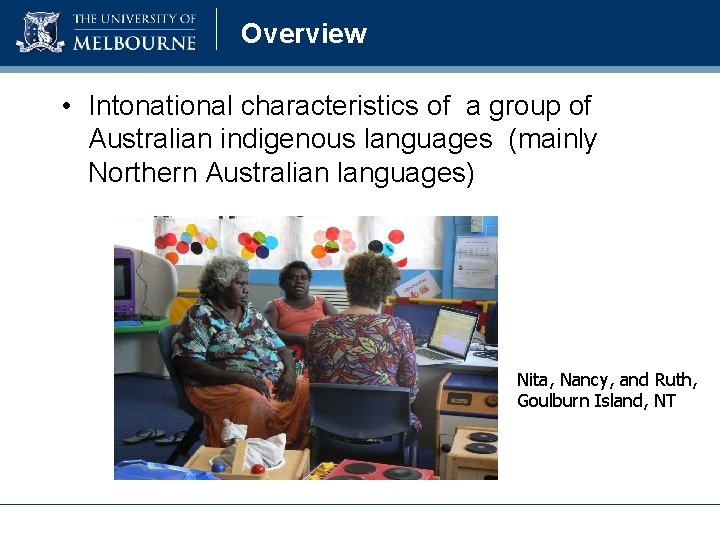
Overview • Intonational characteristics of a group of Australian indigenous languages (mainly Northern Australian languages) Nita, Nancy, and Ruth, Goulburn Island, NT
Why is it useful to know about intonation in Australian languages? • Many descriptions of intonation are based on handful of well-studied languages – English, German, Japanese etc. • Need to understand less-well described languages to test and refine our understanding of how intonation works across a range of languages
Australian Aboriginal Languages • Before 1788 – 200 -250 distinct languages • Present day – 70 languages – fewer than 10 have > 1, 000 speakers – most have < 50 speakers – 20 languages or less being transmitted to next generation – Kriol, a “mixed language”, is often spoken – Speakers are often multi-lingual
A bit of background • 2006 Census: – 455, 000 Australians identified as indigenous – 47, 000 Australians (12 % of the indigenous population) claimed to speak an Aboriginal language
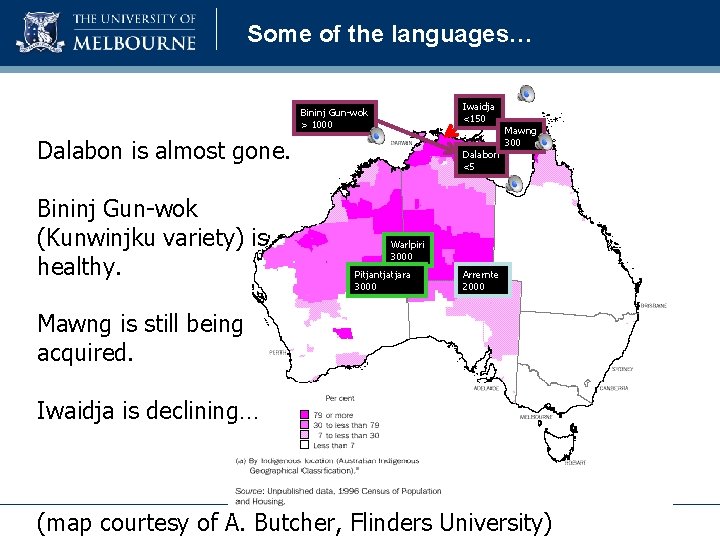
Some of the languages… Iwaidja <150 Bininj Gun-wok > 1000 Dalabon is almost gone. Bininj Gun-wok (Kunwinjku variety) is healthy. Dalabon <5 Mawng 300 Warlpiri 3000 Pitjantjatjara 3000 Arrernte 2000 Mawng is still being acquired. Iwaidja is declining… (map courtesy of A. Butcher, Flinders University)
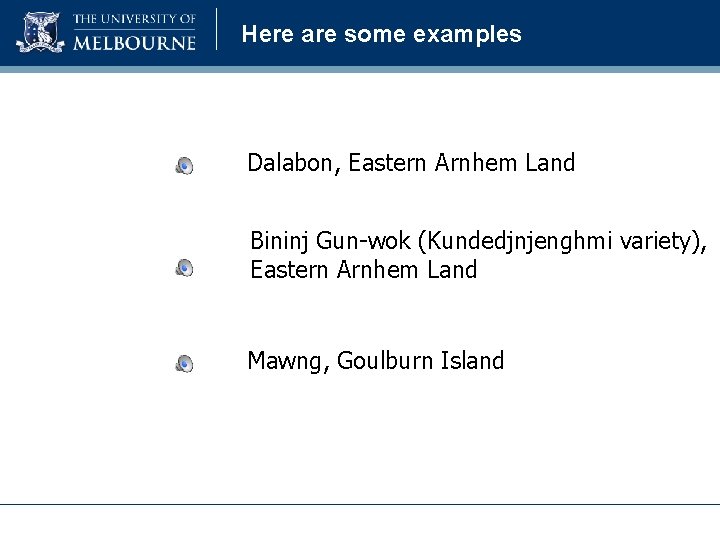
Here are some examples Dalabon, Eastern Arnhem Land Bininj Gun-wok (Kundedjnjenghmi variety), Eastern Arnhem Land Mawng, Goulburn Island
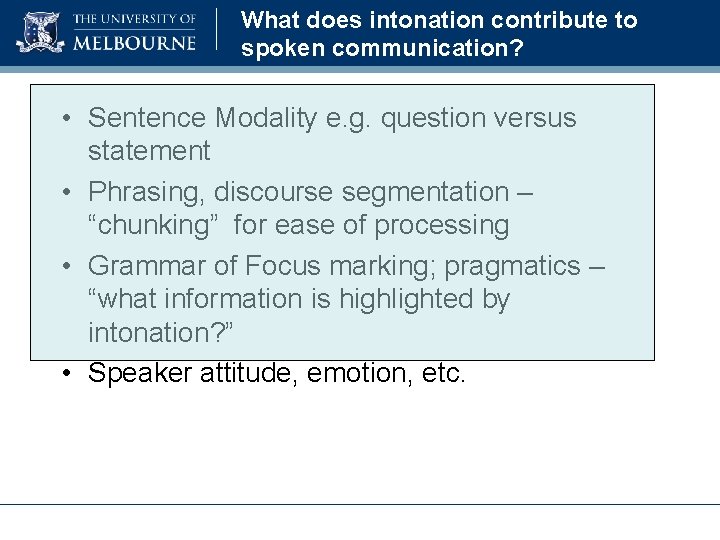
What does intonation contribute to spoken communication? • Sentence Modality e. g. question versus statement • Phrasing, discourse segmentation – “chunking” for ease of processing • Grammar of Focus marking; pragmatics – “what information is highlighted by intonation? ” • Speaker attitude, emotion, etc.
Analysing Intonation – AUTOSEGMENTAL METRICAL MODELS • Tone Target Model – intonation patterns are broken down into sequences of tones, L (low) H (high) • pitch accents, phrase & boundary tones – these define the intonational phrase in English and German
Accented versus Unaccented Words • Words can be accented or unaccented in an intonational phrase • An extra PITCH movement or TONE TARGET makes one word stand out from surrounding words • PITCH ACCENTS
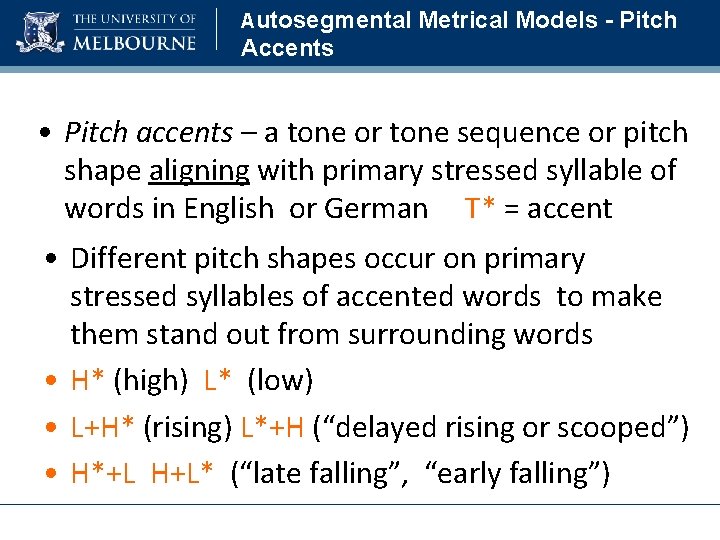
Autosegmental Metrical Models - Pitch Accents • Pitch accents – a tone or tone sequence or pitch shape aligning with primary stressed syllable of words in English or German T* = accent • Different pitch shapes occur on primary stressed syllables of accented words to make them stand out from surrounding words • H* (high) L* (low) • L+H* (rising) L*+H (“delayed rising or scooped”) • H*+L H+L* (“late falling”, “early falling”)
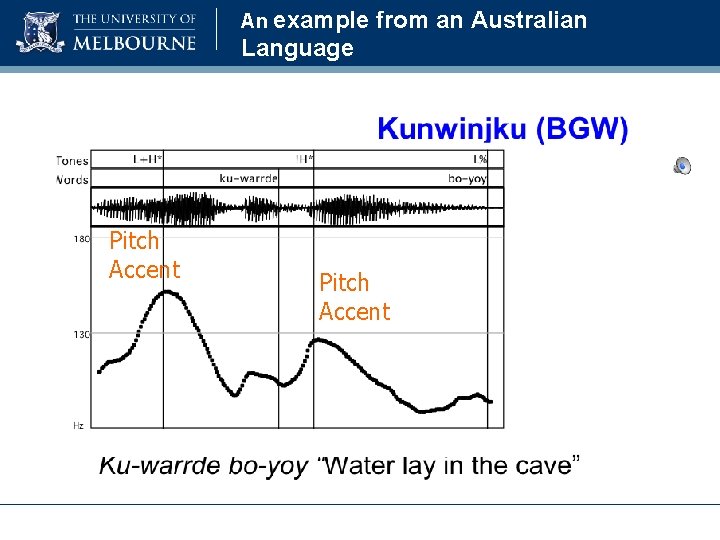
An example from an Australian Language Pitch Accent
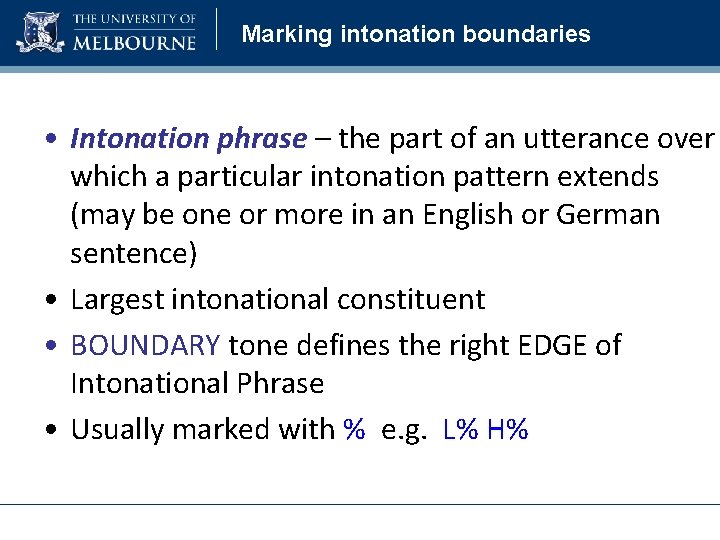
Marking intonation boundaries • Intonation phrase – the part of an utterance over which a particular intonation pattern extends (may be one or more in an English or German sentence) • Largest intonational constituent • BOUNDARY tone defines the right EDGE of Intonational Phrase • Usually marked with % e. g. L% H%
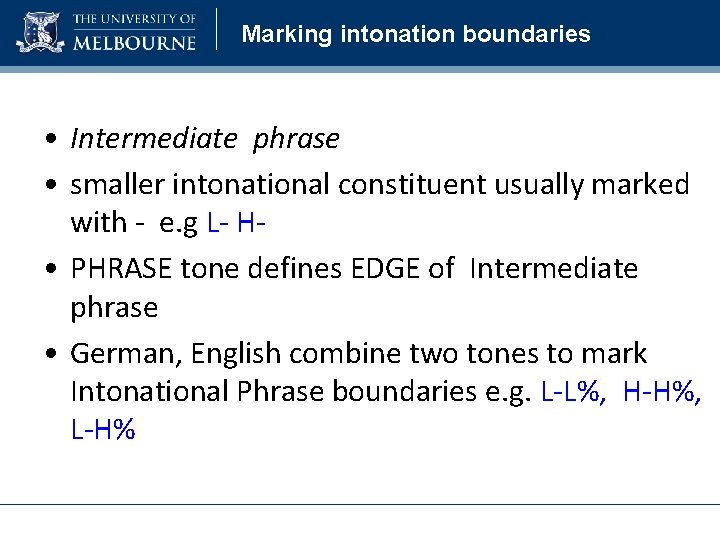
Marking intonation boundaries • Intermediate phrase • smaller intonational constituent usually marked with - e. g L- H • PHRASE tone defines EDGE of Intermediate phrase • German, English combine two tones to mark Intonational Phrase boundaries e. g. L-L%, H-H%, L-H%
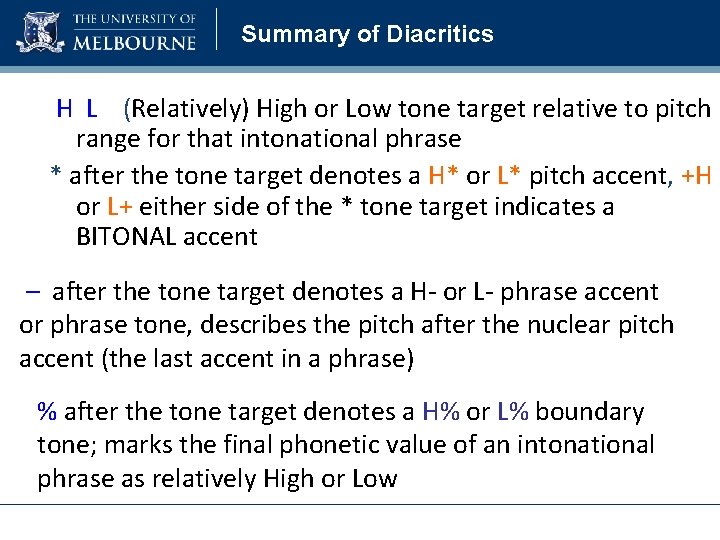
Summary of Diacritics H L (Relatively) High or Low tone target relative to pitch range for that intonational phrase * after the tone target denotes a H* or L* pitch accent, +H or L+ either side of the * tone target indicates a BITONAL accent – after the tone target denotes a H- or L- phrase accent or phrase tone, describes the pitch after the nuclear pitch accent (the last accent in a phrase) % after the tone target denotes a H% or L% boundary tone; marks the final phonetic value of an intonational phrase as relatively High or Low
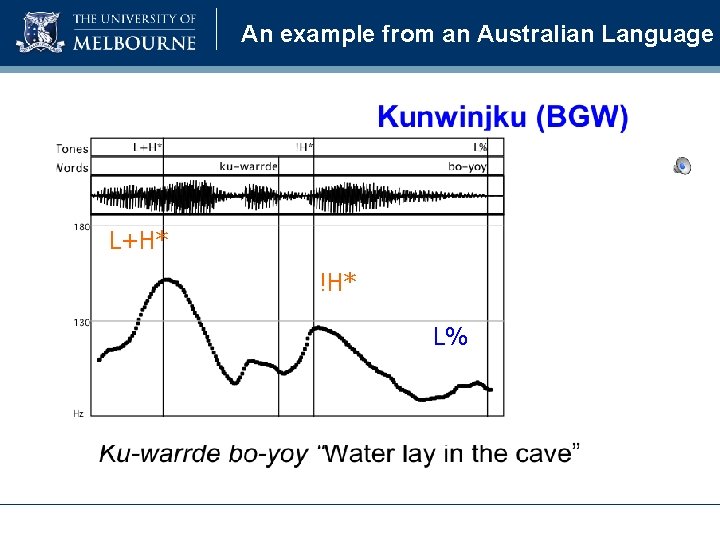
An example from an Australian Language L+H* !H* L%
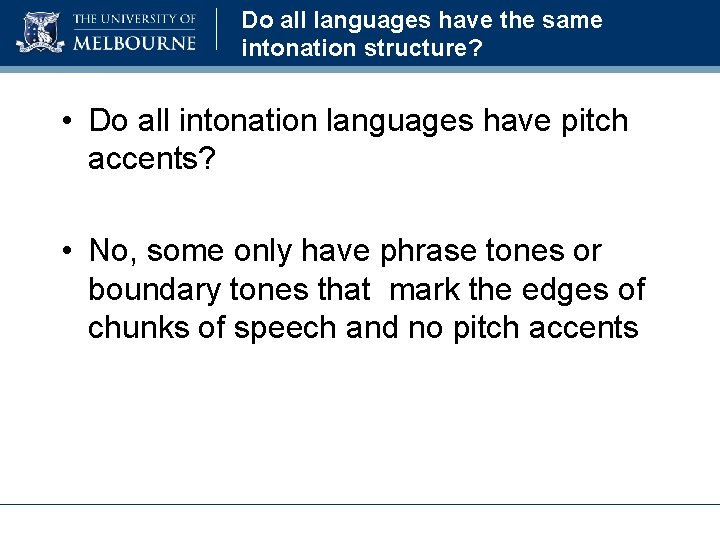
Do all languages have the same intonation structure? • Do all intonation languages have pitch accents? • No, some only have phrase tones or boundary tones that mark the edges of chunks of speech and no pitch accents
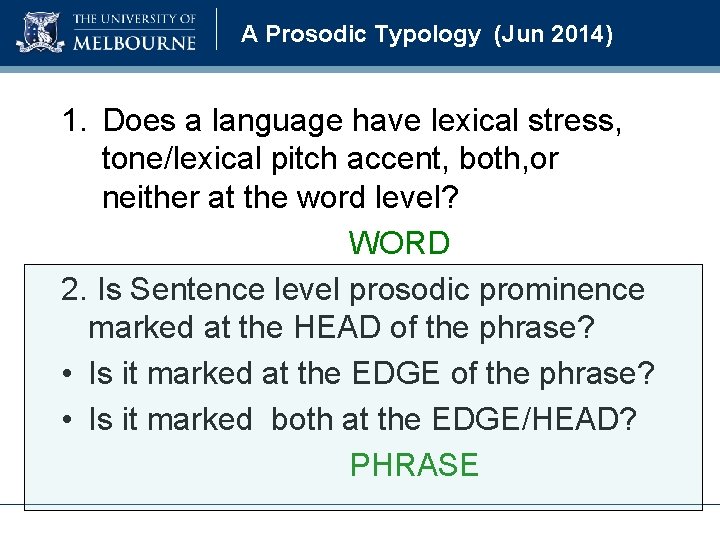
A Prosodic Typology (Jun 2014) 1. Does a language have lexical stress, tone/lexical pitch accent, both, or neither at the word level? WORD 2. Is Sentence level prosodic prominence marked at the HEAD of the phrase? • Is it marked at the EDGE of the phrase? • Is it marked both at the EDGE/HEAD? PHRASE
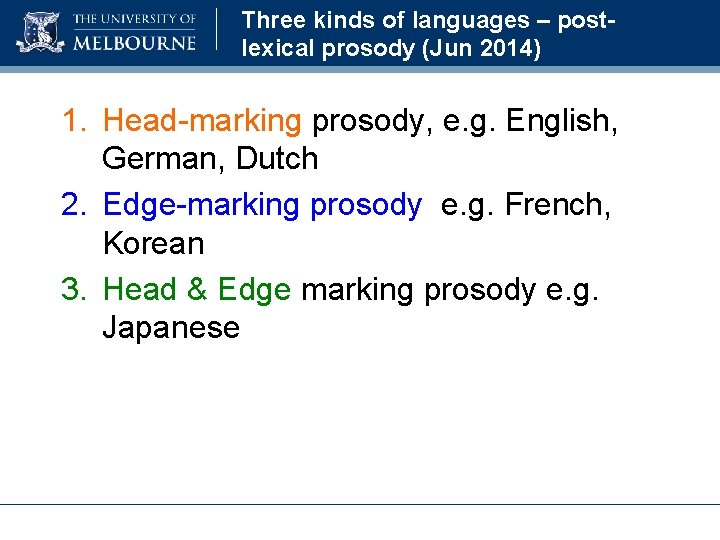
Three kinds of languages – postlexical prosody (Jun 2014) 1. Head-marking prosody, e. g. English, German, Dutch 2. Edge-marking prosody e. g. French, Korean 3. Head & Edge marking prosody e. g. Japanese
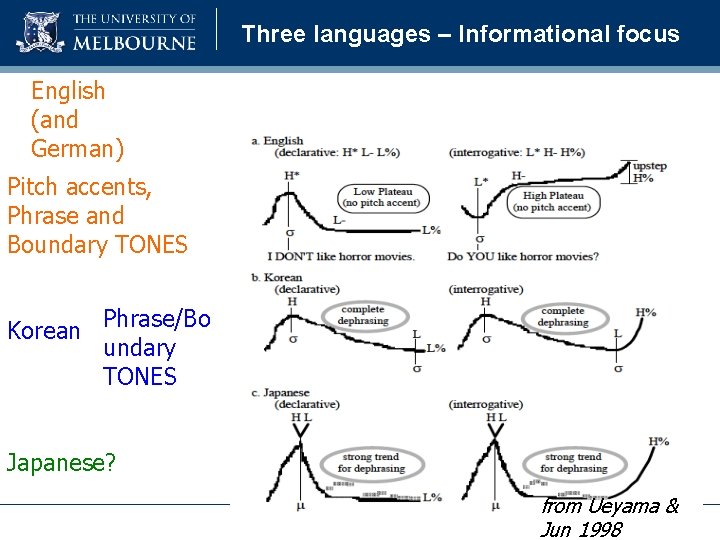
Three languages – Informational focus English (and German) Pitch accents, Phrase and Boundary TONES Korean Phrase/Bo undary TONES Japanese? from Ueyama & Jun 1998
What are we trying to find out? • Challenge 1: What are the characteristic • • • intonational “tunes” or melodies of Australian languages? Challenge 2: What is the intonational typology of Australian languages relative to other languages of the world? Are Australian languages Head-marking, Edgemarking, or Head- and Edge- marking? Challenge 3: What functions do tunes have in Australian languages?
Australian Indigenous Languages • Typical and (atypical) tunes of Australian languages
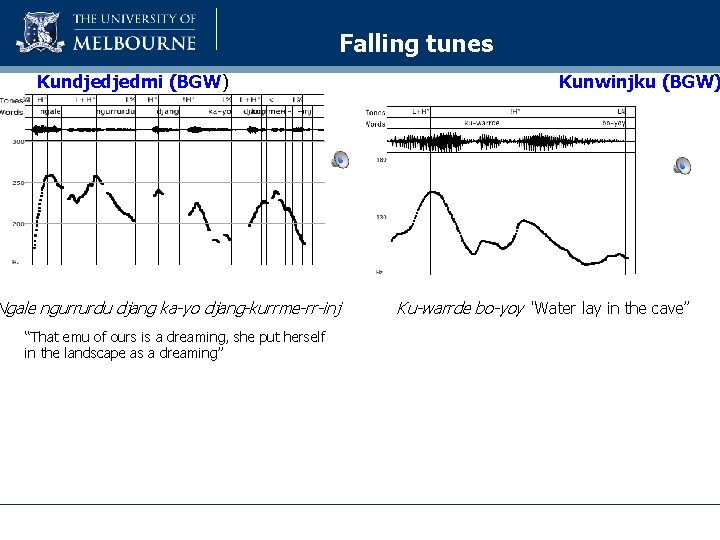
Falling tunes Kundjedjedmi (BGW) Ngale ngurrurdu djang ka-yo djang-kurrme-rr-inj “That emu of ours is a dreaming, she put herself in the landscape as a dreaming” Kunwinjku (BGW) Ku-warrde bo-yoy “Water lay in the cave”
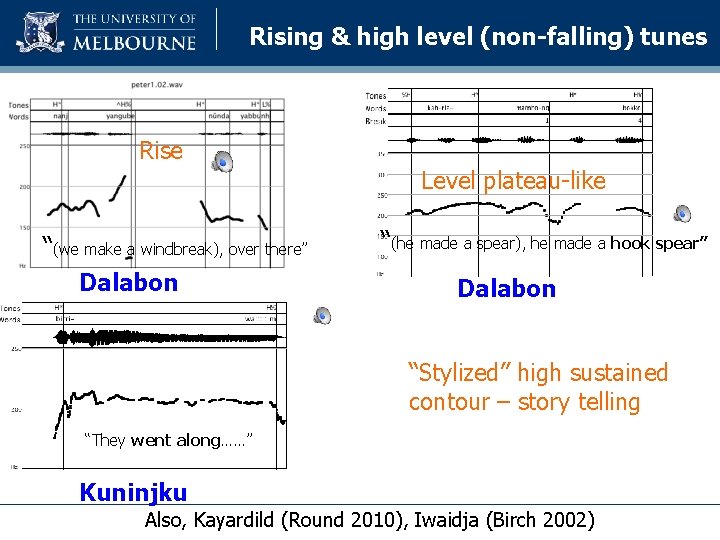
Rising & high level (non-falling) tunes Rise Level plateau-like “(we make a windbreak), over there” Dalabon “(he made a spear), he made a hook spear” Dalabon “Stylized” high sustained contour – story telling “They went along……” Kuninjku Also, Kayardild (Round 2010), Iwaidja (Birch 2002)
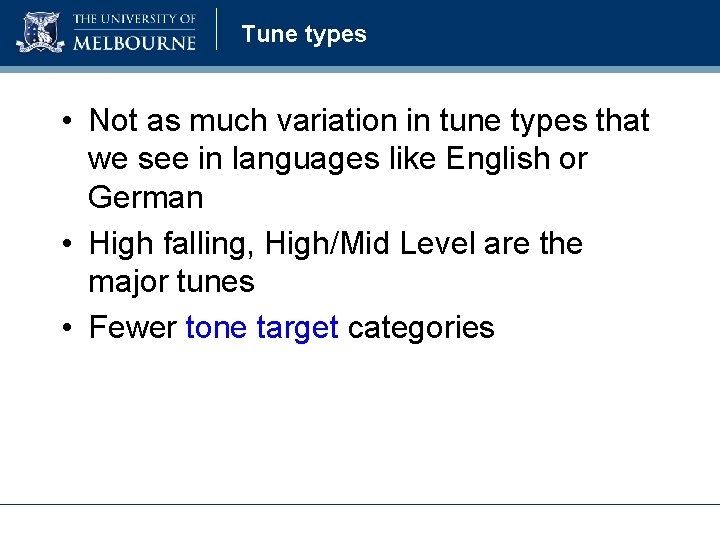
Tune types • Not as much variation in tune types that we see in languages like English or German • High falling, High/Mid Level are the major tunes • Fewer tone target categories
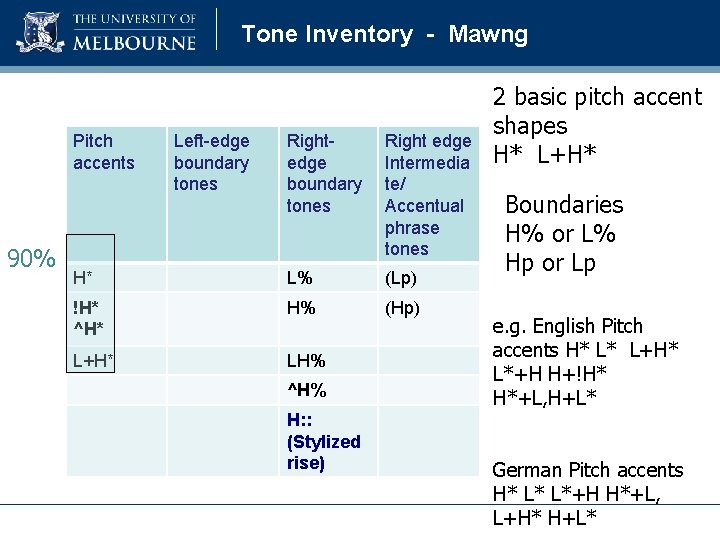
Tone Inventory - Mawng Pitch accents 90% Left-edge boundary tones Right edge Intermedia te/ Accentual phrase tones H* L% (Lp) !H* ^H* H% (Hp) L+H* LH% ^H% H: : (Stylized rise) 2 basic pitch accent shapes H* L+H* Boundaries H% or L% Hp or Lp e. g. English Pitch accents H* L* L+H* L*+H H+!H* H*+L, H+L* German Pitch accents H* L* L*+H H*+L, L+H* H+L*
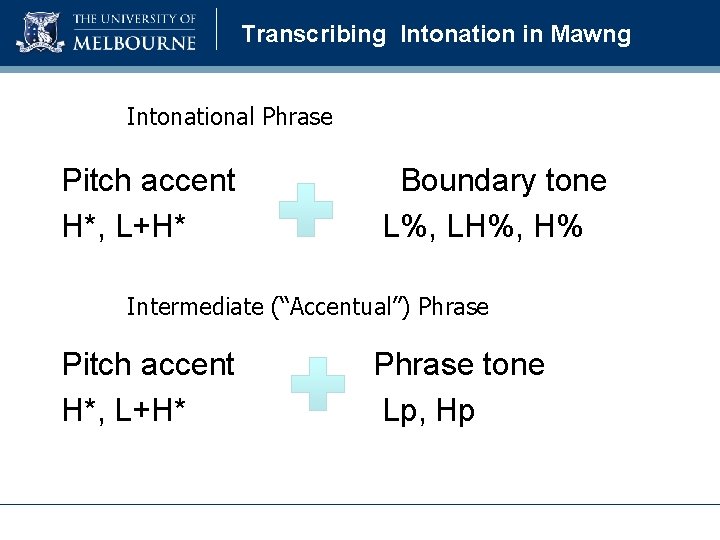
Transcribing Intonation in Mawng Intonational Phrase Pitch accent H*, L+H* Boundary tone L%, LH%, H% Intermediate (“Accentual”) Phrase Pitch accent H*, L+H* Phrase tone Lp, Hp
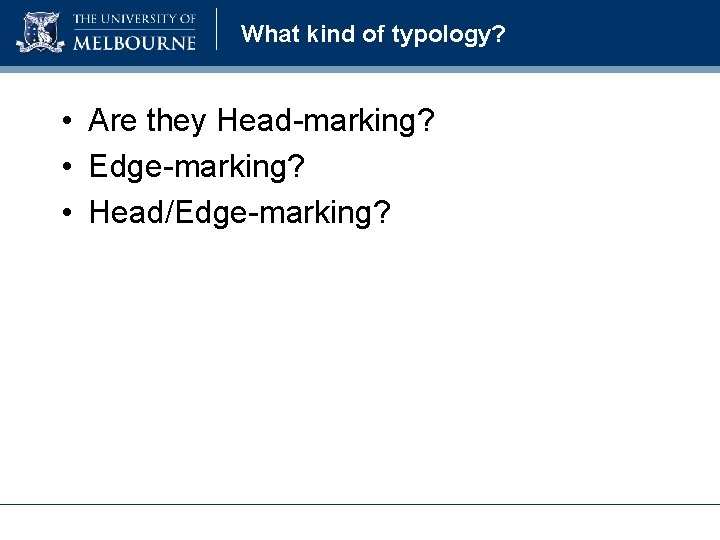
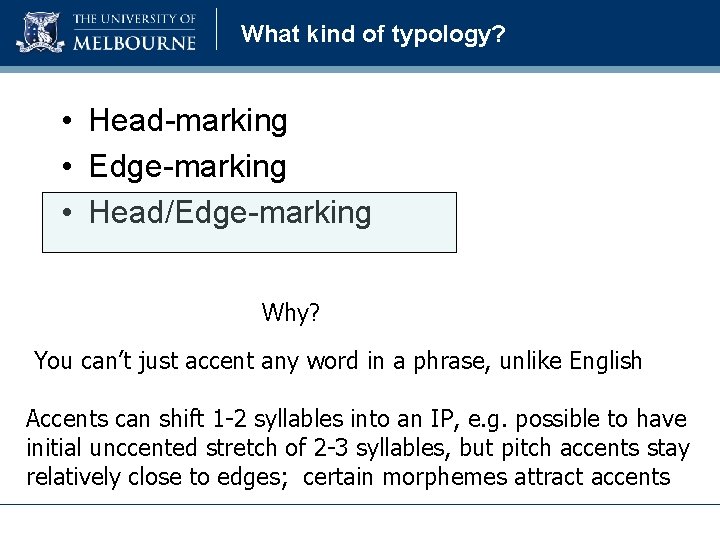
What kind of typology? • Are they Head-marking? • Edge-marking? • Head/Edge-marking?
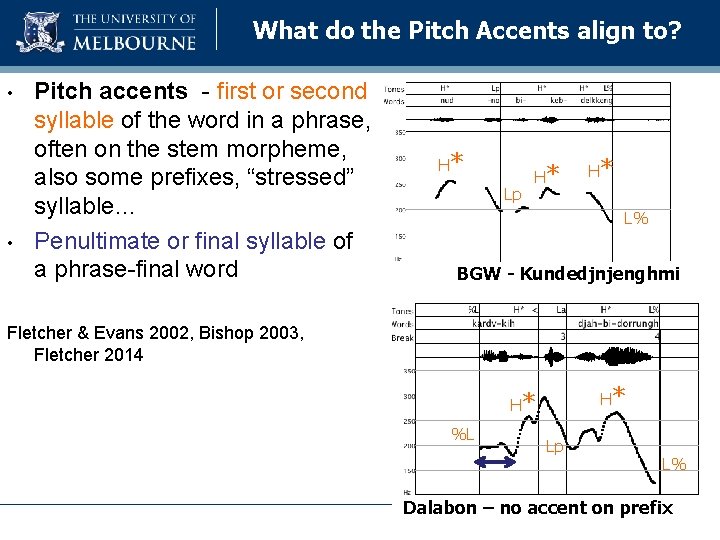
What do the Pitch Accents align to? • • Pitch Stress-accent? accents - first or second syllable of the word in a phrase, often on the stem morpheme, also some prefixes, “stressed” syllable… Penultimate or final syllable of a phrase-final word H* Lp H* H* L% BGW - Kundedjnjenghmi Fletcher & Evans 2002, Bishop 2003, Fletcher 2014 H* H* %L Lp L% Dalabon – no accent on prefix
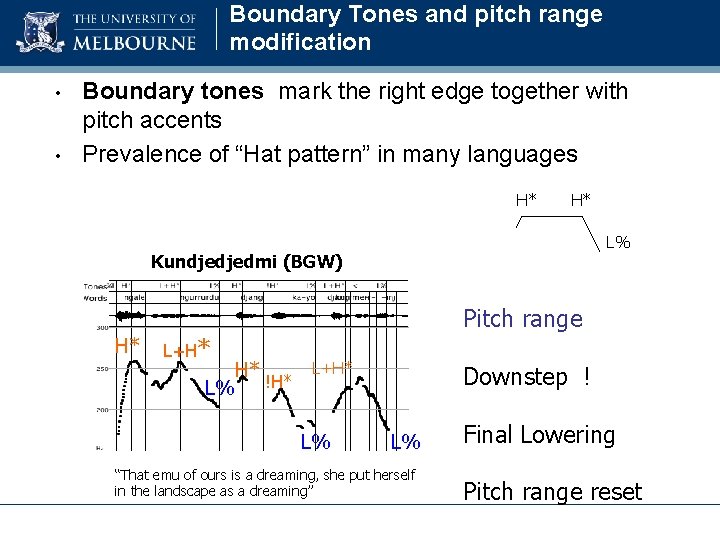
Boundary Tones and pitch range modification • • Boundary tones mark the right edge together with pitch accents Prevalence of “Hat pattern” in many languages H* H* L% Kundjedjedmi (BGW) Pitch range H* L+H* L% H* !H* L+H* L% Downstep ! L% “That emu of ours is a dreaming, she put herself in the landscape as a dreaming” Final Lowering Pitch range reset
Importance of Edges? • Intonational Phrases often align with a single grammatical word made up of many morphemes (mildly – highly polysynthetic languages) • words can be up to 12 morphemes long in Bininj Gun-wok!! • Broken into smaller prosodic constituents
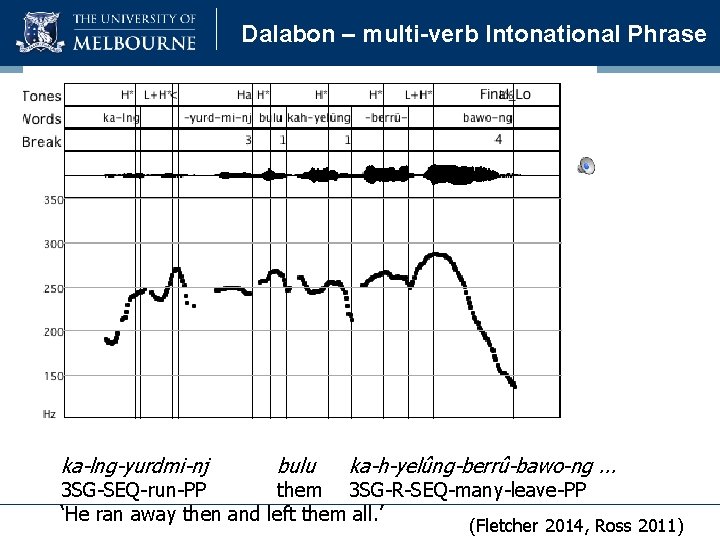
Dalabon – multi-verb Intonational Phrase ka-lng-yurdmi-nj bulu ka-h-yelûng-berrû-bawo-ng. . . 3 SG-SEQ-run-PP them 3 SG-R-SEQ-many-leave-PP ‘He ran away then and left them all. ’ (Fletcher 2014, Ross 2011)
What kind of typology? • Head-marking • Edge-marking • Head/Edge-marking Why? You can’t just accent any word in a phrase, unlike English Accents can shift 1 -2 syllables into an IP, e. g. possible to have initial unccented stretch of 2 -3 syllables, but pitch accents stay relatively close to edges; certain morphemes attract accents
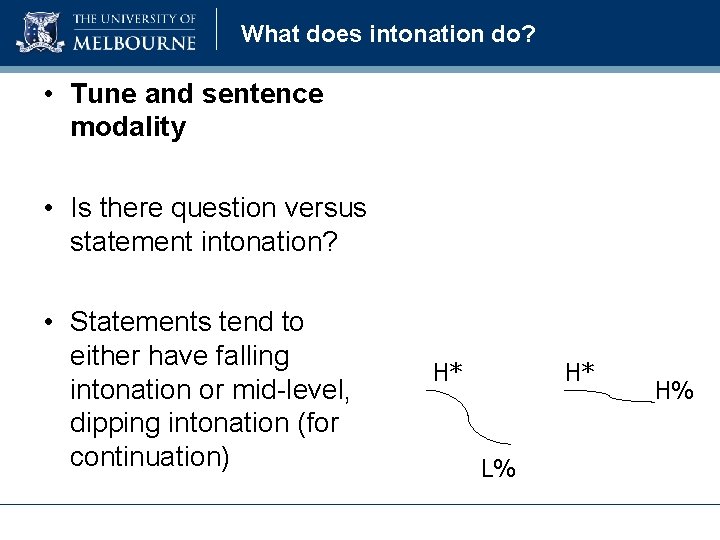
What does intonation do? • Tune and sentence modality • Is there question versus statement intonation? • Statements tend to either have falling intonation or mid-level, dipping intonation (for continuation) H* H* L% H%
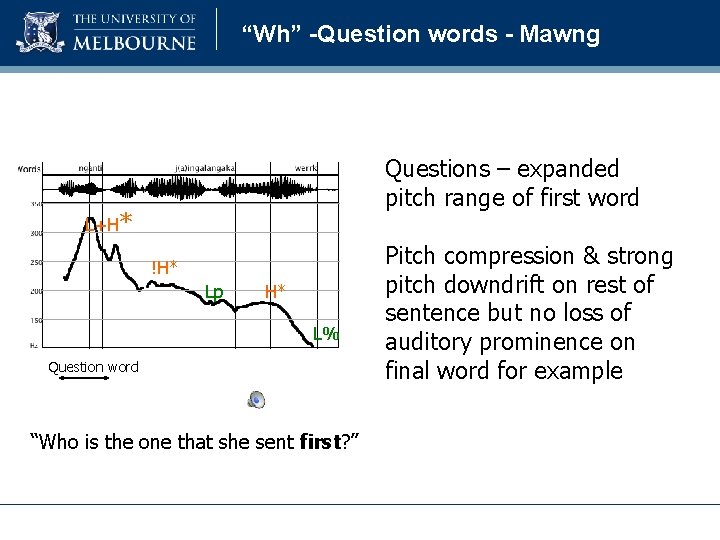
“Wh” -Question words - Mawng Questions – expanded pitch range of first word L+H* !H* Lp H* L% Question word “Who is the one that she sent first? ” Pitch compression & strong pitch downdrift on rest of sentence but no loss of auditory prominence on final word for example
Interrogative intonation in Mawng • Question word is often first in the utterance (not unusual in the world’s languages!) • Location of the highest pitch peak, pitch downdrift or compression through rest of the phrase • Similar pattern is realised without question word
Interrogative intonation in Mawng • Are there ever question rises? • Yes, in Warlpiri, Ngalagkan, Murrinh-patha • People don’t ask a lot of yes/no questions!! • Rising intonation is not so prevalent • Possibly leads to intercultural communication problems…. .
Information Structure - Focus • How do Australian languages use intonation to highlight important information in connected speech?
Two general intonation strategies – information structure • New/salient information: pitch accents on some kind of constituent • Local pitch range or register reset at the beginning of intonational phrases • Suspension of global pitch downtrends • Modification of prosodic structure can give insights on the nature of prosodic typology
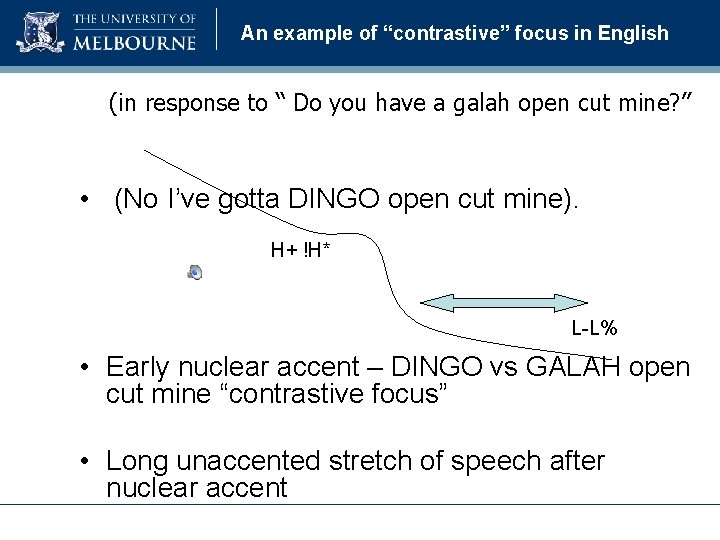
An example of “contrastive” focus in English (in response to “ Do you have a galah open cut mine? ” • (No I’ve gotta DINGO open cut mine). H+ !H* L-L% • Early nuclear accent – DINGO vs GALAH open cut mine “contrastive focus” • Long unaccented stretch of speech after nuclear accent
Word order • Australian - ‘free word order’ • Putting a word into initial position - focus (or discourse prominence) in a large number of Australian languages (Baker and Mushin 2008)
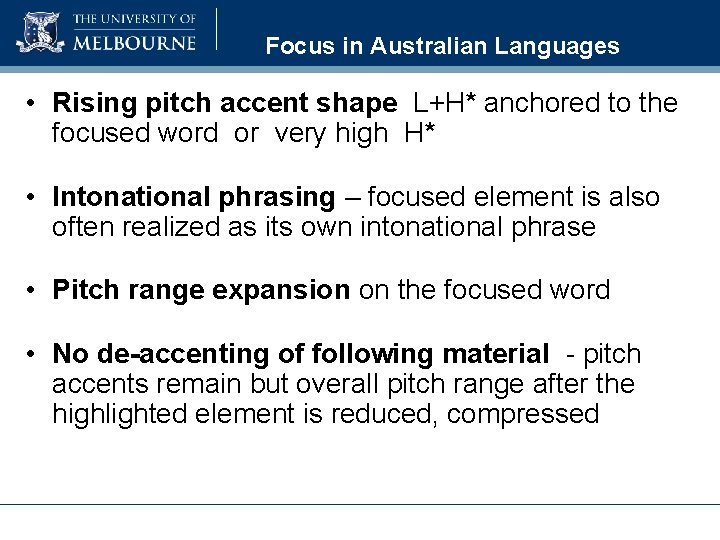
Focus in Australian Languages • Rising pitch accent shape L+H* anchored to the focused word or very high H* • Intonational phrasing – focused element is also often realized as its own intonational phrase • Pitch range expansion on the focused word • No de-accenting of following material - pitch accents remain but overall pitch range after the highlighted element is reduced, compressed
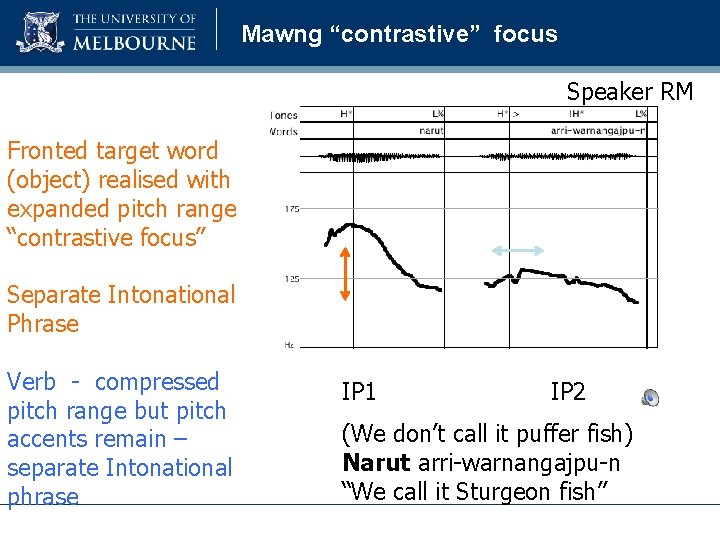
Mawng “contrastive” focus Speaker RM Fronted target word (object) realised with expanded pitch range “contrastive focus” Separate Intonational Phrase Verb - compressed pitch range but pitch accents remain – separate Intonational phrase IP 1 IP 2 (We don’t call it puffer fish) Narut arri-warnangajpu-n “We call it Sturgeon fish”
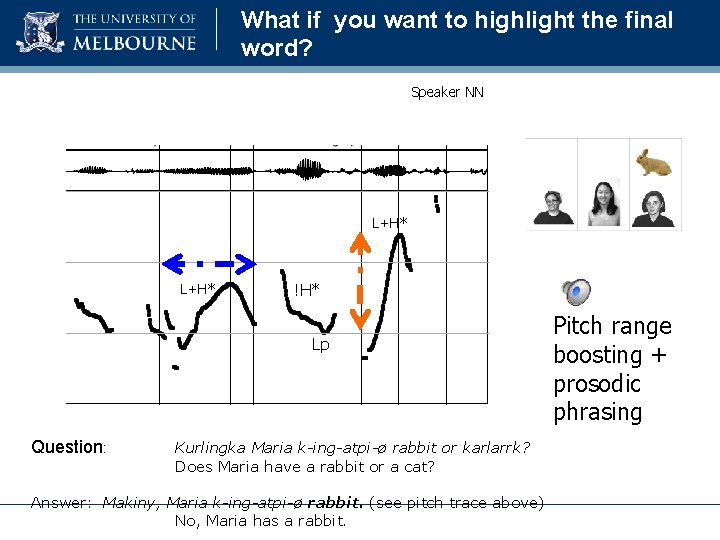
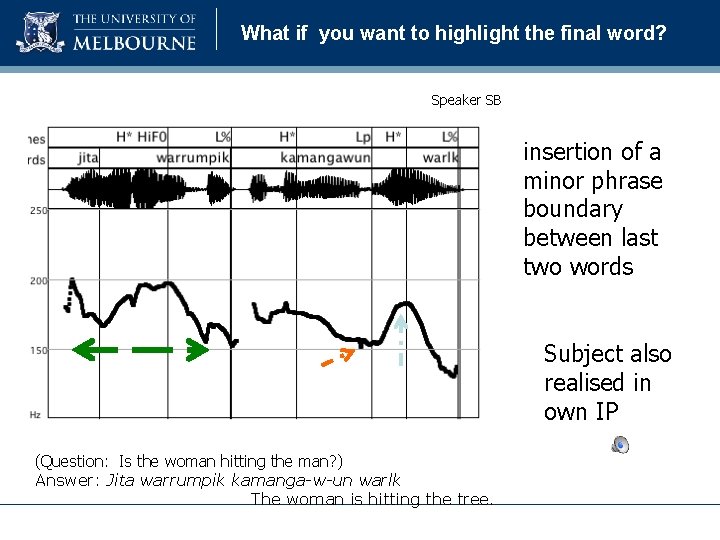
What if you want to highlight the final word? Speaker NN L+H* !H* Lp Question: Kurlingka Maria k-ing-atpi-ø rabbit or karlarrk? Does Maria have a rabbit or a cat? Answer: Makiny, Maria k-ing-atpi-ø rabbit. (see pitch trace above) No, Maria has a rabbit. Pitch range boosting + prosodic phrasing
What if you want to highlight the final word? Speaker SB L % insertion of a minor phrase boundary between last two words Subject also realised in own IP (Question: Is the woman hitting the man? ) Answer: Jita warrumpik kamanga-w-un warlk The woman is hitting the tree.
Intonation in Australian Languages • Fewer “tones” i. e. fewer intonational pitch accent shapes compared to Germanic languages, e. g. German, Dutch, English; fewer complex intonational conours • Importance of intonational phrasing and pitch range manipulation to signal a range of “traditional” functions associated with intonation
Acknowledgements • Our language consultants • Nick Evans, Ruth Singer, Marija Tabain, Andy Butcher, Debbie Loakes, Hywel Stoakes, Simone Graetzer, Anna Parsons • Australian Research Council and University of Melbourne
References & Bibliography • • • Baker, Brett & Ilana Mushin (2008). Discourse and grammar in Australian languages. In Mushin, Ilana & Brett Baker (eds. ) Discourse and grammar in Australian languages. Amsterdam: John Benjamins. 1 -24. Beckman, M. & Venditti, J. 2010. Tone and Intonation. In. W. Hardcastle et al. (eds. ) Handbook of the Phonetic Sciences (2 nd ed). Wiley-Blackwell Beckman, M. et al. (2005). The original To. BI system and the evolution of the To. BI framework. In S-Jun (ed. ) Prosodic Typology: The phonology of intonation and phrasing. Oxford: OUP Birch, B. 2002. The IP as domain of syllabification. Proceedings of the 1 st International Conference on Speech Prosody, B. Bel and I. Marlien, Eds. Aix-en. Provence: Laboratoire Parole at Langage, 2002 Bishop, J. 2003. Aspects of prosody and intonation in Bininj Gun-wok. Ph. D thesis (available online through the University of Melbourne e-prints repository) Bishop, J. and Fletcher 2005. Intonation in six dialects of Bininj Gun-wok. In Jun S-A. Prosodic Typology, Oxford: OUP Butcher, A. (2006). Bruce, G. (1977). Swedish word accents in sentence perspective. Lund: CWK Gleerup. Fitzpatrick, J. (2000) On intonational typology. In Peter Siemund (ed. ) Methodological Issues in Language Typology. Sprachtypologie und Universalienforschung 53: 88 -96.
References & Bibliography • • Fletcher J. (2014). Intonation in Dalabon, in. S-A. Jun (ed. ) Prosodic Typology II, Oxford: OUP Fletcher J. 2005. Exploring the Phonetics of Spoken Narratives in Australian Indigenous Languages. In Hardcastle WJ & Mackenzie Beck J (eds), A Figure of Speech: A Festschrift for John Laver. New Jersey, United States: Lawrence Erlbaum Associates, pp. 201 -226. Fletcher, J. and Evans N. 2000. Intonational downtrends in Mayali. AJL 20, 23 -38. Fletcher, J. and Evans N. 2002. An acoustic phonetic analysis of intonational prominence in two Australian languages, JIPA 32, 123– 40. Fletcher, J. , Stoakes, H. , Loakes, D. , Butcher A. 2007, Spectral and durational properties of vowels in Kunwinjku. Proceedings of the 16 th International Congress of Phonetic Sciences. 937 -940. SAARBRUCKEN, Germany: UNIVERSITY OF SAARLAND. Fletcher J, Butcher A, Loakes D, & Stoakes H. (2010). Aspects of nasal realization and the place of articulation imperative in Bininj Gun-Wok. In Tabain M. et al. (eds), Proceedings SST 2010, 78 -81. Melbourne, Australia: Australasian Speech Science and Technology Australia (ASSTA). Fletcher, J. , N. Evans, and E. Round, (2002). Left-Edge tonal events in. Kayardild (Australian): a typological perspective. Proceedings of the 1 st International Conference on Speech Prosody, B. Bel and I. Marlien, Eds. Aix-en-Provence: Laboratoire Parole at Langage, 2002, pp. 295 -298.
References & Bibliography • • • Fletcher, J. , Singer, R. , Loakes, D. (2012). Intonation and focus-marking strategies in Mawng. Tone and Intonation in Europe 5. Oxford, September 2012. Hale, Kenneth (1983). Warlpiri and the grammar of non-configurational languages. Natural language and linguistic theory 1: 5 -47. Hualde, J. (2006). Remarks on word-prosodic typology. Proceedings of the Berkeley Linguistics Society, 32 King, H. (1998). The declarative intonation of Dyirbal. Lincom Europa Gussenhoven, C. (2004). The phonology of tone and Intonation. Cambridge: CUP Ladd, D. R. (2008). Intonational phonology. Cambridge: CUP Pierrehumbert, J. (1980): The Phonology and Phonetics of English Intonation. Ph. D. dissertation, MIT. Pierrehumbert, J. & Hirschberg, J. (1990): The meaning of intonational contours in the interpretation of discourse, in: Cohen, P. R. el al. (eds. ), Intentions and Communication, Cambridge: MIT Press. 271– 311. Ross, B. (2011). Prosody and grammar in Dalabon and Kayardild. Ph. D thesis, University of Melbourne (available through Uni. Melb e-prints)
References • • • Ross, B. , Fletcher, J. & Nordlinger (in press. ). Intonation and grammatical structure in Dalabon, Australian Journal of Linguistics Round, E. (2010). Tone height binarity and register in intonation: the case from Kayardild (Australian). Proceedings of Speech Prosody 2010 Simard, Candide (2010). The Prosodic Contours of Jaminjung, a Language of Northern Australia. Manchester: University of Manchester Ph. D.