
Janet Belskys Experiencing the Lifespan 2 e Chapter
Janet Belsky’s Experiencing the Lifespan, 2 e Chapter 12: Midlife Robin Lee, Middle Tennessee State University
Midlife: Setting the Context n This stage typically runs from 40 s to the 60 s. n n Research found that half of people in their 60 s and early 70 s consider themselves middle-aged. Characterized by diversity regarding lifestyles and perceptions A 40 -year-old with a chronic age-related disease might call be considered “old. ” An 80 -year-old who is still at the peak of her career might consider herself middle-aged.
Questions regarding personality 1. 2. 3. Does personality change over time? Does entering new stages of life or having significant life experiences change personality? Do people become more confident with age?
Does personality change over time? n 1. 2. n P P P n Personality: contradictory views that are both correct depending on circumstances No change (personality remains the same) Change occurs in new stages of life due to life experiences Temperamental dispositions begin to stabilize by mid-20 s Neuroticism Extraversion Openness to experience Conscientiousness Agreeableness. Positive traits (agreeableness, conscientious) actually tend to strengthen with age.
Temperamental dispositions § § § Neuroticism ü Tendency toward mental health vs. psychological disturbance ü resilient, stable and well-adjusted vs. hostile and high-strung Extraversion ü Outgoing attitudes (warmth, gregariousness) ü Social and friendly Openness to experience ü Tendency to be risk-takers, seeking out new experiences Conscientiousness ü Industrious worker ü Hardworking, self-disciplined, reliable vs. erratic, irresponsible, forgetfulness ü Tend to live longer Agreeableness ü Kindness, empathy, ability to compromise ü Pleasant, loving, easy to get along with vs. stubborn, hot-tempered, prone to fights
Erikson’s Psychosocial Stage: Generativity n Generativity – focus on nurturing the next generation and enriching the lives of others n n If generativity is not achieved, stagnation occurs, having no sense of purpose in life. Dan Mc. Adams (2001) – research focused on scientifically testing the ideas of Erikson. n Measures of generativity included: P Generative attitudes P Generative goals and priorities P Generative activities
Does entering new stages of life or having significant life experiences change personality? n Highly generative people rate their lives as much more fulfilling than non-generative people. n n Life events such as grand parenting are positive Less generative people report worrying about getting older Highly generative people have a positive impact on their children. Highly generative people report having positive childhoods. n In telling their life stories highly generative people: § Describe redemption sequences – “bad” events that turned out § for the good Describe a commitment script – childhood memories of feeling special and an enduring generative mission
Understanding Highly Generative people n Exceptionally generative people – prize-winning community activists interested in improving society n n Have a strong sense of agency (personal power) and motivation to do good Tend to be more forgiving toward parents Can deal better with adversity Generativity is expressed in different ways depending on culture and gender n African Americans are more likely to be unusually generative. ü Perhaps dealing with traumas (such as discrimination) can make us more caring people.
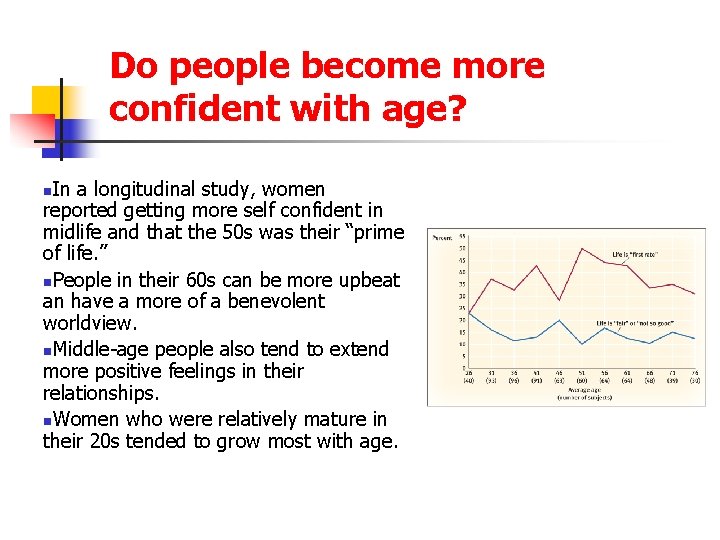
Do people become more confident with age? In a longitudinal study, women reported getting more self confident in midlife and that the 50 s was their “prime of life. ” n. People in their 60 s can be more upbeat an have a more of a benevolent worldview. n. Middle-age people also tend to extend more positive feelings in their relationships. n. Women who were relatively mature in their 20 s tended to grow most with age. n
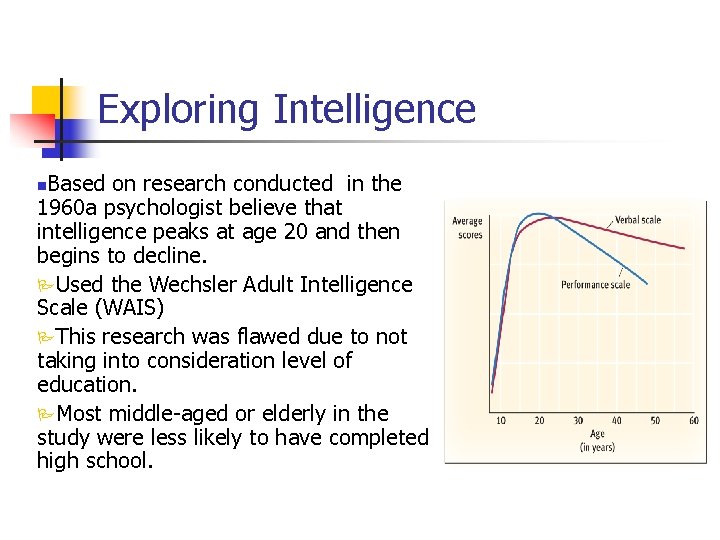
Exploring Intelligence Based on research conducted in the 1960 a psychologist believe that intelligence peaks at age 20 and then begins to decline. PUsed the Wechsler Adult Intelligence Scale (WAIS) PThis research was flawed due to not taking into consideration level of education. PMost middle-aged or elderly in the study were less likely to have completed high school. n
Improving the research on Intelligence: The Seattle Longitudinal Study n n Improvements to the research: combining both longitudinal and cross-sectional methods n Controls for the biases of each research technique Findings: n Overall intelligence peaks in the late 40 s and early 50 s. n Age patterns differ for different tests. On a test measuring knowledge base, scores rose until the late 50 s. On tests involving fast performance, abilities decline at a younger age.
Two Basic Types of Intelligence: Fluid and Crystallized n Crystallized intelligence: Accumulated knowledge n n n Tends to increase with age, until about late 50 s Then begins to fall Fluid intelligence: ability to reason quickly when facing totally new intellectual tasks n n Linked to nervous system Because of this link, begins to decline early in adult life (not much we can do about this)
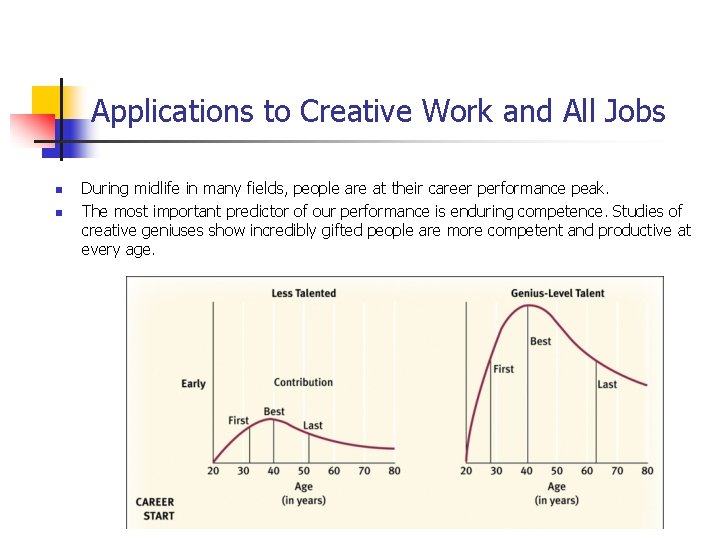
Applications to Creative Work and All Jobs n n During midlife in many fields, people are at their career performance peak. The most important predictor of our performance is enduring competence. Studies of creative geniuses show incredibly gifted people are more competent and productive at every age.
What affects intelligence? n Healthy living (lack of major health concerns or illnesses) n n Terminal drop – changes in crystallized intelligence can predict having a terminal disease. Mental exercise n Engaging in mentally enriching activities (e. g. , reading, attending lectures).
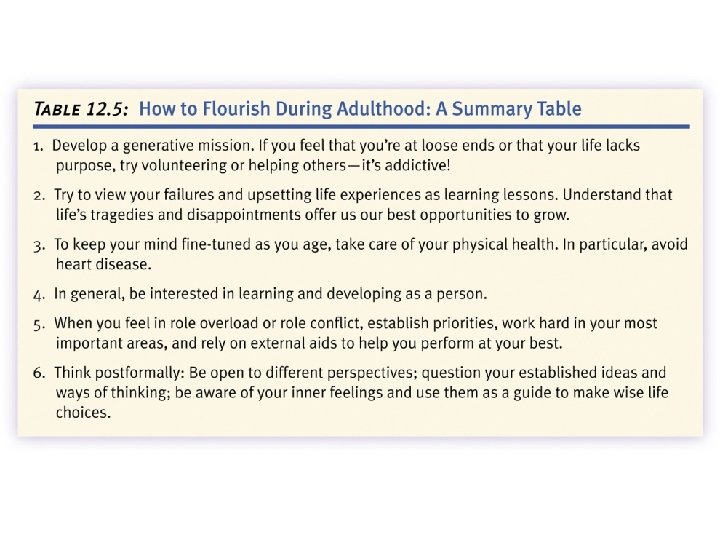
Keeping mentally sharp! 1. Develop a hobby or life passion that challenges your mind. n n Preferably during the younger years Practicing is key 2. Throughout life, put yourself in intellectually challenging situations and keep learning. n In jobs or activities. 3. Pay attention to your physical health. n Particularly guard against heart disease 4. When you are having trouble performing, use selective optimization with compensation. n n Selection: prioritize- focusing on what is most important Optimize: work harder in those tasks Compensate: rely on external aids to help you function to your best Use this approach not just when you are older, but at every age!!
Post- formal thought: A new perspective n n Does the standard IQ test what is important to being an intelligent adult? Is there an adult stage of Piaget’s theory? n Formal operations (adolescents) n Post–formal thought (adults) P Adult form of intelligence that involves being sensitive to different perspectives, making decisions based on feelings, being interested in exploring new questions.
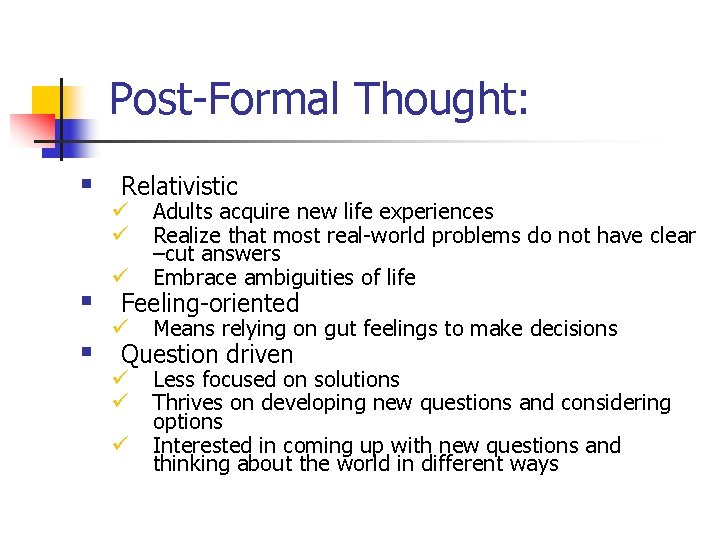
Post-Formal Thought: § Relativistic ü Adults acquire new life experiences Realize that most real-world problems do not have clear –cut answers Embrace ambiguities of life ü Means relying on gut feelings to make decisions ü ü Less focused on solutions Thrives on developing new questions and considering options Interested in coming up with new questions and thinking about the world in different ways ü ü § Feeling-oriented § Question driven ü
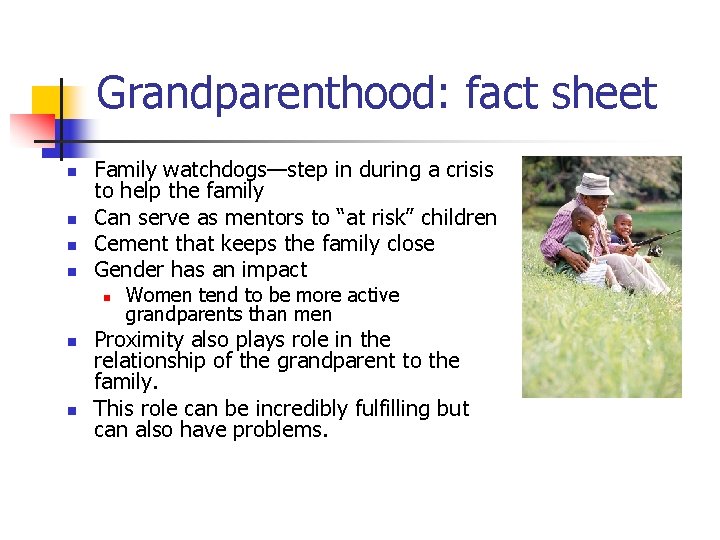
Grandparenthood: fact sheet n n Family watchdogs—step in during a crisis to help the family Can serve as mentors to “at risk” children Cement that keeps the family close Gender has an impact n n n Women tend to be more active grandparents than men Proximity also plays role in the relationship of the grandparent to the family. This role can be incredibly fulfilling but can also have problems.
Grandparent Problems n n n Grandparents must tread lightly on spoiling vs. interfering. Careful not to criticize the parents or risk being cut off from visits. Divorce can have an impact on the grandparent’s access to grandchildren. Maternal grandmothers can typically be more involved with grandchildren than paternal grandparents. Maternal grandmothers may sometimes be over-involved. Caregiving Grandmothers have increased in recent decades. P May take on a full-time parenting role due to child’s serious problems P Tend to be low-socioeconomic status
Adult Caregivers: Providing Parent Care § Parent care – adult children’s care for their disabled elderly parents. § Highly stressful role because it violates the principle: “parents care for their children, not the reverse”. § Usually performed by daughters, unless there are no sisters and § § the dad needs care Typically occurs in the 50 s, when there can also be pressure to take care of grandchildren Some may still be dealing with pressures of a full time job too.
What makes parent care easier? § An enduring loving attachment to the parent § Intensity of care needed § Care for difficult conditions such as Alzheimer’s disease can be more stressful § Receiving outside help and support
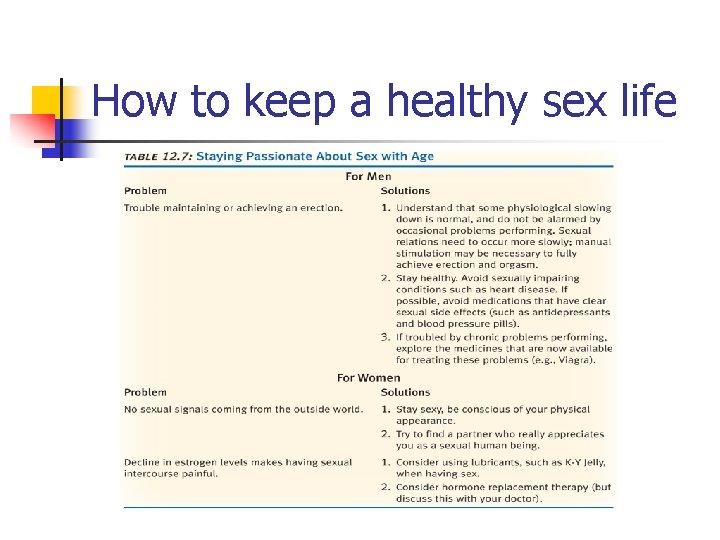
Sexuality: A fact sheet n n A myth is that middle-aged people may feel worse about our bodies in midlife; actually young women (as a group) feel worse about their bodies than middle aged women! Female changes: n n n Reach peak in the 30 s Physiologically there are far fewer changes, but many women give up having sex due to not having a partner (or not being seen as attractive) Male changes (by midlife): n n n Trouble getting and keeping an erection Not able to have sex more than once in a 24 hour period. Erections not as intense Physiologically, men decline from a young age Reason for sales of erection-stimulating drugs
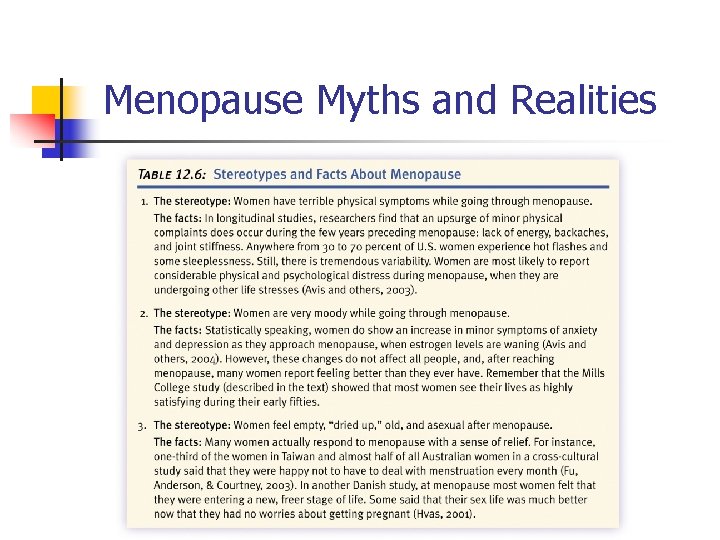
Menopause: A fact sheet n n Defining marker: not having menstruated for a year Cause: ovulation becomes erratic and then ceases n Perimenopause – (winding down period) is most difficult P hot n n flashes, mood swings can occur Variable symptoms - Some women have less trouble; others have severe difficulties Post-menopause - vaginal walls thin and lubrication decreases Major sexual consequence: Intercourse becomes painful Effects on desire: Also varies P Some women report feeling sexier when they don’t need to use contraception)
Menopause Myths and Realities
How to keep a healthy sex life
- Slides: 26