
Federal Power and Free Press Hadassah Amani Danelle

- Slides: 52
Federal Power and Free Press Hadassah Amani, Danelle Antelo, Ilana Balog, and Sabrina Diamond
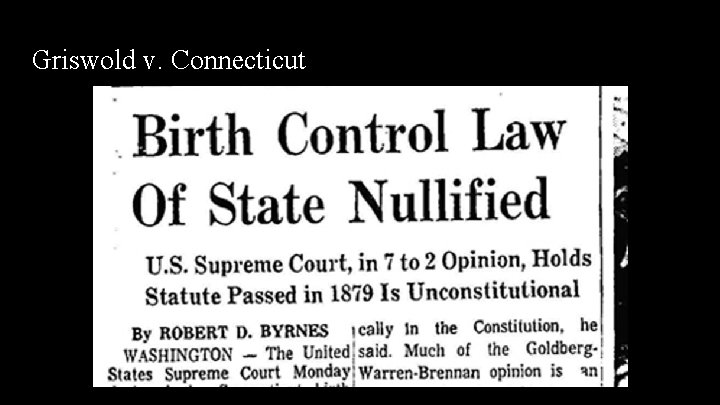
Griswold v. Connecticut
Griswold v. Connecticut Background ● ● ● ● Appellants: Estelle T. Griswold, Executive Director of Planned Parenthood and C. Lee Buxton, Medical Director of Planned Parenthood Appellee: State of Connecticut Location: Planned Parenthood Clinic Griswold and Buxton gave information, instruction, and other medical advice to married couples concerning birth control. Connecticut state law stated that it was a crime for any person to use any drug to prevent conception. Griswold and the Medical Director were convicted as accessories for giving married couples advice about preventing conception and prescribing a contraceptive. Argued from March 29 to March 30, 1965 Decided on June 7, 1965 Griswold and Buxton were arrested, tried, and found guilty. This decision was upheld by the appellate court and Connecticut Supreme Court. Griswold appealed her conviction to the United States Supreme Court.
Griswold v. Connecticut Decision ● ● ● Griswold argued that the Connecticut law violated the Fourteenth Amendment. The oral argument given by her attorneys was that the right to privacy is implicitly stated in the Bill of Rights, and the use of contraception is a private matter protect by this right. Connecticut argued that their law should be upheld. The oral argument given by the attorney representing Connecticut was that the right to privacy was not given in the Constitution nor any of the Amendments, and the Ninth Amendment prohibits the Courts from reviewing state laws. The Supreme Court ruled in a 7 -2 majority that the Connecticut law was unconstitutional. The opinion of the court, written by Justice William O. Douglas, stated that the First, Fourth, Fifth, and Fourteenth Amendments, together, create a zone of privacy that the Connecticut law was infringing upon. This is a landmark case because it established the right to privacy provided in the Bill of Rights and set the precedent for future cases regarding the right to privacy and women’s rights.
Buckley v. Valeo
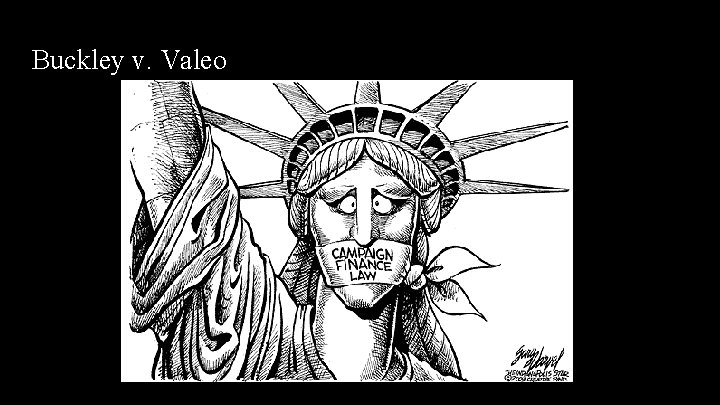
Buckley v. Valeo Background ● ● Appellant: Sen. James L. Buckley Appellee: Francis R. Valeo, Secretary of the Senate Location: Congress A group of politicians filed a suit in a United States district court alleging that limits on expenditures by the Federal Election Campaign Act of 1971 violated the First Amendment provisions of freedom of speech and association. ● Argued on November 10, 1975 ● Decided on January 30, 1976 ● After filing the suit, the district court passed the case to the United States Court of Appeals for the District of Columbia, which upheld most provisions of the law. Buckley then appealed to the United States Supreme Court.
Buckley v. Valeo Decision ● ● Buckley argued that limiting the amount of contributions to campaigns and limiting the amount of expenditures limited the right to free speech provided by the First Amendment. The oral argument given by the attorneys representing Buckley stated the law infringed upon First Amendment rights because limiting contributions and spending is limiting “the communication itself”. The oral argument given by the attorneys representing Valeo stated that challenges to the law were premature and mostly speculative because the law had not been enacted for long enough. Also, they pointed out that provisions of the law provided for “compelling public needs”. The Supreme Court came to a 7 -1 ruling. The opinion of the court, written per curiam, stated that while contribution limits to political campaigns were constitutional, limiting the amount of money spent in independent expenditures was not. This is a landmark case because it established that giving money to a political party or candidate is a form of protected speech and set precedent for future regulation of political campaigns.
United States v. The Amistad
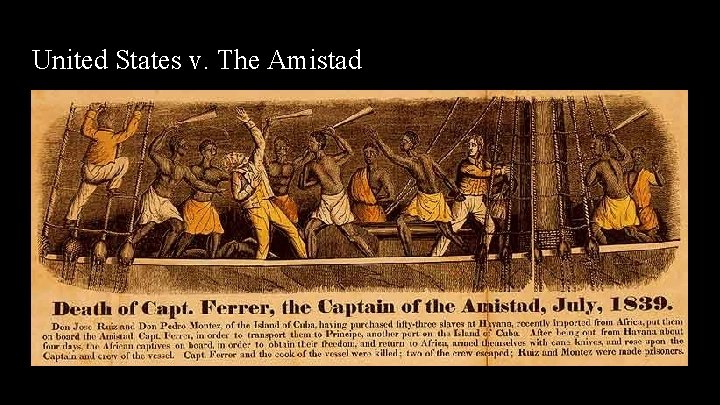
United States v. The Amistad Background ● ● ● ● Appellant: United States Appellee: The Amistad Location: The Amistad On June 27, 1839, a slave uprising occurred on the Spanish Ship The Amistad. The slaves, who were 53 Africans who had been abducted from Sierra Leone, killed the entire crew on board. On August 26, 1839, Lieutenant Thomas Gedney of the American ship Washington discovered the ship and brought everyone on board to the district court of Connecticut. Argued on February 23, 1841 Decided on March 9, 1841 The Africans were imprisoned for murder, but the charges were later dismissed. They continued to be held over property rights. A trial was held in district court in Connecticut where it was decided that the case fell within Federal jurisdiction. The case then went to the Supreme Court.
United States v. The Amistad Decision ● ● ● In the oral argument for the United States, Attorney General Henry D. Gilpin argued that papers from The Amistad proved that the Africans were Spanish property and should be returned to the Spanish government. In the oral argument for the Africans, attorney Roger Sherman Baldwin argued that the Spanish government wanted the return of slaves who had already been freed previously by the district court. Also, because the Africans were illegally purchased, they could not be claimed. The Supreme Court ruled in a 7 -1 majority that the kidnapping of the Africans was illegal. The opinion of the court, written by Justice Joseph Story, stated that the kidnapping and transportation of the Africans was illegal because the slave trade was illegal under Spanish law. The Africans were free people who were guaranteed respect to their rights by the United States government. Also, because the Africans were in control of the ship when it entered American waters, they were free and did not need to be transported back to Africa. This was a landmark case because it set the precedent for future cases regarding property rights and the slave trade in the United States.
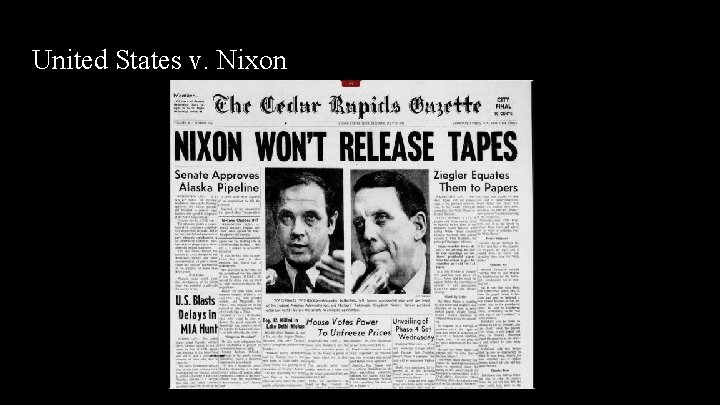
United States v. Nixon
United States v. Nixon Background ● ● ● ● Petitioner: United States. Argued by Leon Jawarski and Philip A. Lacovara Respondent: Richard M. Nixon. Argued by James D. St. Clair Lower court: United States Courts of Appeals for the District of Columbia Circuit Argued: July 8 th, 1974 Decided: July 24 th, 1974 The Special Prosecutor in the Watergate Scandal requested audio tapes of conversations between Nixon and his advisors discussing the scandal in the Oval Office. The President refused to adhere to the subpoena due to his power of executive privilege. The President also argued that the dispute was nonjusticiable because it was an intra-executive conflict. The District court rejected the Presidents contentions and ordered an in camera examination of the subpoenaed material. The President sought an appeal and the Special Prosecutor filed a petition for a writ of certiorari which the court approved, bringing it to the supreme court for a final decision.
United States v. Nixon Decision ● ● ● Issue: Is the President's constitutional power of executive privilege absolute? President Nixon's lawyers oral argument was that the tapes were protected by executive privilege and only the President should decide when to reveal his communications with his aides to the public or other branches of government. They also argued that since it was an issue within the executive branch in which the courts had no jurisdiction. The lawyers on behalf of the United States oral argument was that the tapes were essential in solving a criminal investigation and that should be more important than protecting the privacy of the president and his aides. Not handing in the tapes would be dangerous for the legal system and the rule of law. In a unanimous opinion given by Chief Burger, the Supreme Court ruled that the courts did have jurisdiction and that it wasn't a breech on separation of powers. They also decided there was limited executive privilege in areas of military or diplomatic affairs but that “the fundamental demands of due process of law in the fair administration of justice” was more important. The court ordered Nixon to release the tapes, and he resigned shortly after. Us V. Nixon was a landmark case because it helped define the powers of the executive branch, more specifically the president and executive privilege. The supreme court recognized executive privilege was legitimate while also setting boundaries and reaffirming the separation of powers between branches.
Bush v. Gore
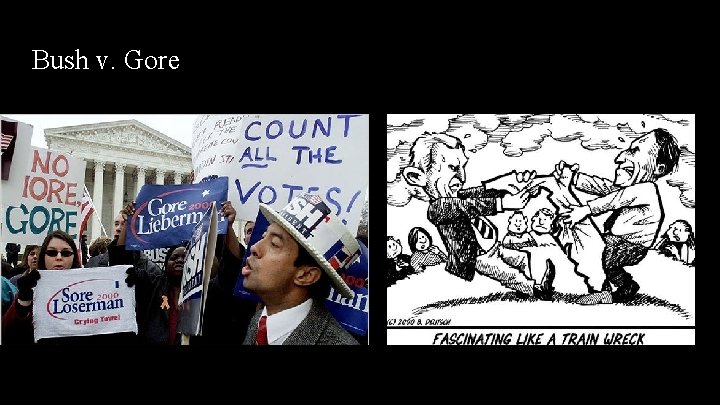
Bush v. Gore Background ● ● ● ● Petitioner: George W. Bush, represented by Theodore B. Olsen. Respondent: Albert Gore. represented by David Boies. Lower Court: Florida Supreme Court Argued: December 11 th, 2000 Decided: December 12 th, 2000 After a close race in many states, Florida became the focus of the election as fewer than 600 votes separated the candidates. According the Florida Law, a machine recount of all the votes was needed because the margin of victory was less than 0. 5 percent. By November 10 th, the machine recount was finished and Bush had won by 327 votes out of 6 million cast. Reports of widespread problems with ballots started surfacing, for example conflicting ballots and undervotes, and Al Gore demanded a recount. The Florida Supreme Court ruled in support of Al Gore, ordering manual recounts in districts with statistically significant number of undervotes and Bush issued a writ of certiorari to the U. S. Supreme Court. The supreme court agreed to hear their oral arguments and ordered, in a 5 -4 decision, to halt the manual recounts.
Bush v. Gore Decision ● ● ● ● Issue: Do standardless manual recounts violate the equal protection and due process clauses of the Constitution? Bush’s lawyers oral argument was that the Florida Supreme Court had exceeded its authority by authorizing the recount of undervotes. They argued that the Florida Supreme Court was violating the 14 th amendment; specifically the equal protection clause which guarantees individuals that their ballots can’t be devalued by “later arbitrary and disparate treatment” and that each vote must be counted the same way. Gore’s lawyers oral argument was that since the case was already decided at the state level, it shouldn’t be tried at a federal level. They argued that the Supreme Court has no place getting involved in the matter. The court's decision, 7 -2, was that the Florida Supreme Courts methods of recounting the ballots was unconstitutional. Different standards were applied ballot to ballot, which violates the equal protection clause. 5 -4 of the justices agreed that there was no way to create a constitutional recount in the time remaining to announce a winner. With the Supreme Court's decision, Florida’s electoral votes were given to Bush and he won the election. Bush V Gore was a landmark case because it was extremely controversial. 2 majority opinions and 4 minority opinions were filed, each with different reasons justifying their opinions. Some people argue the case was decided based on party lines and not based on the constitution.
Gibbons v. Ogden
Gibbons v. Ogden Background ● ● ● ● Appellant: Thomas Gibbons, defended by Daniel Webster and William Wirt (attorney general of the United States) Appellee: Aaron Ogden, defended by Thomas Eddent and Thomas Oakley. Location: Ferry line between New Jersey and New York Lower court: state appellate court Argued: February 4 th- 9 th, 1824 Decided: March 2 nd, 1824 by the Marshall Court New York state had issued a monopoly to Robert Livingston and Robert Fulton for operating steamboats in New York waters, and they issued Ogden a license to operate their ferries. Gibbons ran a competing ferry service, therefore violating the monopoly. When he was taken to state court he argued that since his license was issued by the federal government he had the right to operate his ferry. The Court of Chancery of New York ruled in favor of Ogden, demanding that Gibbons stop his boats. Gibbons appealed his case to the Court of Errors of New York, which also agreed with Ogden. Gibbons then appealed the case to the Supreme Court.
Gibbons v. Ogden Decision ● ● ● Issue: Who has the power to regulate interstate commerce- state or national government? Gibbon’s lawyers argued that according to article 1, section 8 congress has exclusive power over interstate commerce, therefore Gibbons federal license to operate steamboats over-ruled Ogdens state license. Ogdens Lawyers argued that states should have full concurrent powers with Congress regarding interstate commerce because states already often pass laws regarding interstate matters. They said since states should be able to make laws about interstate commerce, the monopoly stands and Ogden’s license is valid. The supreme court, under Chief Justice Marshall, unanimously decided that under the supremacy clause in the constitution, the state license to operate steamships was void because it interfered with federal law. The court concluded that regulations of navigation in regards to conducting interstate commerce was a power reserved to congress. Chief marshall also developed a clear definition of “interstate commerce” including navigation on interstate waterways. Importance: Gibbons V. Ogden helped expand the powers of the federal government and better defined the national government's power to regulate interstate commerce as well as setting a precedent for the enactment of the supremacy clause.
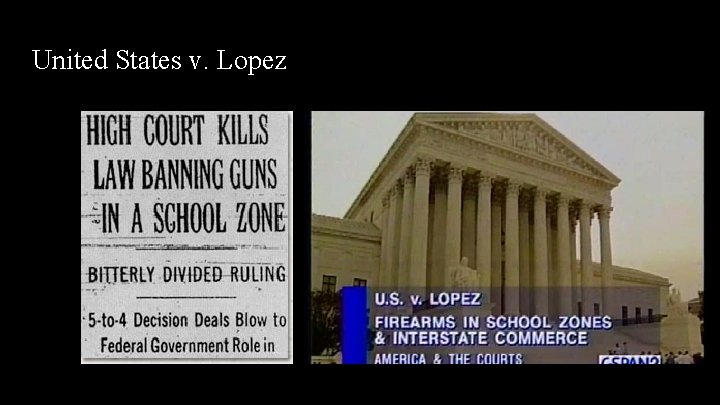
United States v. Lopez
United States v. Lopez Background ● ● ● ● ● Petitioner: United States, represented by Drew S. Days III Respondent: Lopez defended by John R. Carter Location: Edison High School Lower Court: United States Court of Appeals for 5 th circuit Argued: November 8 th, 1994 Decided: April 26 th, 1996 by Rehnquist Court A 12 th grade student, Alfonzo Lopez brought a firearm to school. He was charged under Texas law with firearm possession on school premise. The next day the state charges were dropped and federal agents charged lopez with violating federal law; the Gun-Free Zones School act of 1990. Lopez was found guilty and sentenced to 6 months in prison. Lopez filled an appeal and the Court of Appeals reversed the decision of the lower court because the act was outside Congress’ commerce power. This decision was appealed and the supreme court accepted the case.
United States v. Lopez Decision ● ● ● Issue: Is the 1990 Gun-Free School Zones Act unconstitutional because it exceeds the power of congress to make laws under the commerce clause? The lawyers representing Lopez argued that the Gun Free School Zone act was unconstitutional because schools were controlled by state and local governments and that the federal government had no authority over them. They argued that the commerce clause didn’t justify the creation of this law. The lawyers representing the United States oral argument was that the law wasn’t an overextension of the interstate commerce laws because guns in schools lead to violence causing people to be reluctant to travel through those areas. They also argued that the disruptions to the learning environment results in less educated citizens, which would negatively affect commerce. In a 5 -4 decision the court declared the 1990 gun-free school act unconstitutional. The court ruled that this act exceeds congress’ power to regulate commerce because the possession of a gun in a school isn’t an economic activity. They stated that the if they agreed with the United States on this case it would give the federal government too much power through the commerce clause leading the government to have control over virtually any activity by an individual. Landmark case because it limited congress’ powers, especially when it comes to gun control laws. This was the first case that limited congress’ power under the commerce law.
Marbury v. Madison
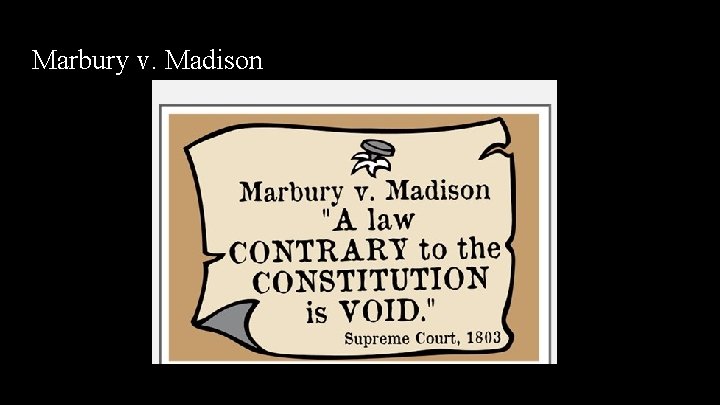
Marbury v. Madison ● ● ● ● Petitioner: William Marbury Respondent: James Madison, Secretary of State Location: The White House Argued: February 11, 1803 Decided: February 24, 1803 By: Marshall Court On the behalf of several other judges, Marbury sued Madison for missing commissions. Marbury’s lawyer issued a Writ of Mandamus which led the case straight to the Supreme Court. Secretary of State James Madison was ordered by Thomas Jefferson to withhold any commissions (appointment papers in this case) to prevent the fulfillment of the judiciary act. Decision: Chief Justice John Marshall ruled that the law that gave them such powers was itself unconstitutional. Landmark case: This case is considered the most important Supreme Court case because it established judicial review. It was the first case to actually define certain powers of the judicial branch. The court established the power to interpret the words of the constitution.
Reynolds v. Sims
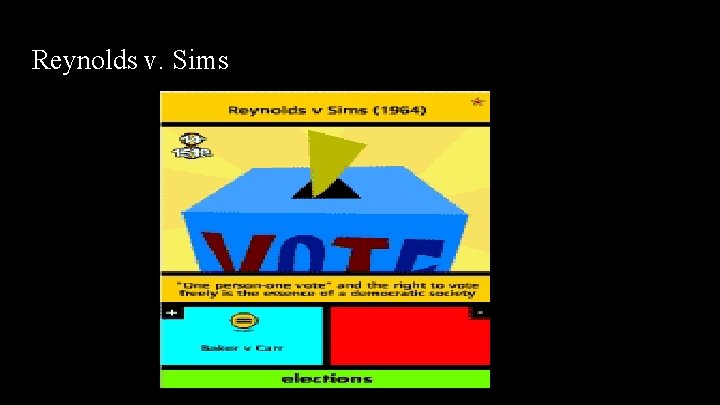
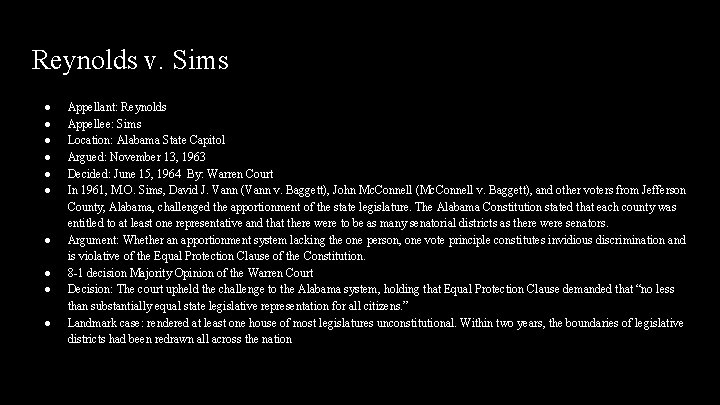
Reynolds v. Sims ● ● ● ● ● Appellant: Reynolds Appellee: Sims Location: Alabama State Capitol Argued: November 13, 1963 Decided: June 15, 1964 By: Warren Court In 1961, M. O. Sims, David J. Vann (Vann v. Baggett), John Mc. Connell (Mc. Connell v. Baggett), and other voters from Jefferson County, Alabama, challenged the apportionment of the state legislature. The Alabama Constitution stated that each county was entitled to at least one representative and that there were to be as many senatorial districts as there were senators. Argument: Whether an apportionment system lacking the one person, one vote principle constitutes invidious discrimination and is violative of the Equal Protection Clause of the Constitution. 8 -1 decision Majority Opinion of the Warren Court Decision: The court upheld the challenge to the Alabama system, holding that Equal Protection Clause demanded that “no less than substantially equal state legislative representation for all citizens. ” Landmark case: rendered at least one house of most legislatures unconstitutional. Within two years, the boundaries of legislative districts had been redrawn all across the nation
Worcester v. Georgia
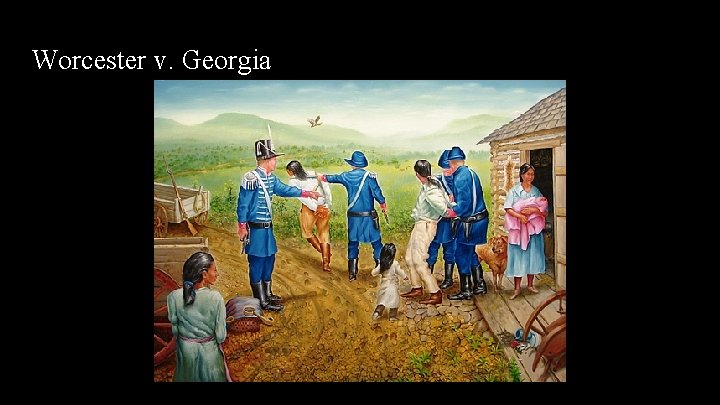
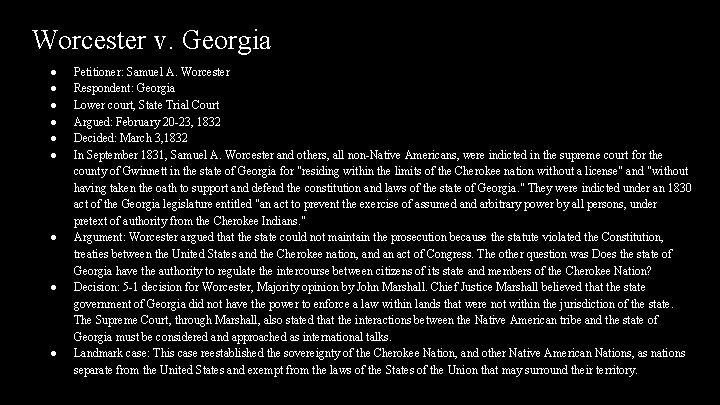
Worcester v. Georgia ● ● ● ● ● Petitioner: Samuel A. Worcester Respondent: Georgia Lower court, State Trial Court Argued: February 20 -23, 1832 Decided: March 3, 1832 In September 1831, Samuel A. Worcester and others, all non-Native Americans, were indicted in the supreme court for the county of Gwinnett in the state of Georgia for "residing within the limits of the Cherokee nation without a license" and "without having taken the oath to support and defend the constitution and laws of the state of Georgia. " They were indicted under an 1830 act of the Georgia legislature entitled "an act to prevent the exercise of assumed and arbitrary power by all persons, under pretext of authority from the Cherokee Indians. " Argument: Worcester argued that the state could not maintain the prosecution because the statute violated the Constitution, treaties between the United States and the Cherokee nation, and an act of Congress. The other question was Does the state of Georgia have the authority to regulate the intercourse between citizens of its state and members of the Cherokee Nation? Decision: 5 -1 decision for Worcester, Majority opinion by John Marshall. Chief Justice Marshall believed that the state government of Georgia did not have the power to enforce a law within lands that were not within the jurisdiction of the state. The Supreme Court, through Marshall, also stated that the interactions between the Native American tribe and the state of Georgia must be considered and approached as international talks. Landmark case: This case reestablished the sovereignty of the Cherokee Nation, and other Native American Nations, as nations separate from the United States and exempt from the laws of the States of the Union that may surround their territory.
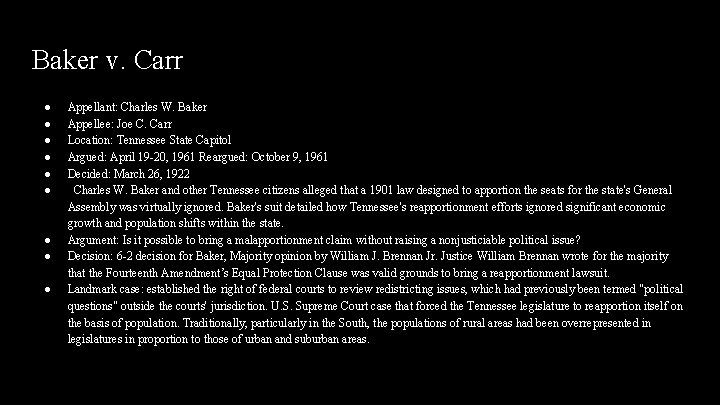
Baker v. Carr
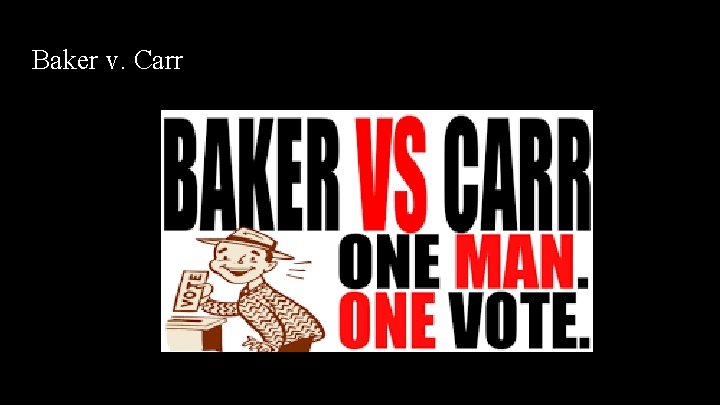
Baker v. Carr ● ● ● ● ● Appellant: Charles W. Baker Appellee: Joe C. Carr Location: Tennessee State Capitol Argued: April 19 -20, 1961 Reargued: October 9, 1961 Decided: March 26, 1922 Charles W. Baker and other Tennessee citizens alleged that a 1901 law designed to apportion the seats for the state's General Assembly was virtually ignored. Baker's suit detailed how Tennessee's reapportionment efforts ignored significant economic growth and population shifts within the state. Argument: Is it possible to bring a malapportionment claim without raising a nonjusticiable political issue? Decision: 6 -2 decision for Baker, Majority opinion by William J. Brennan Jr. Justice William Brennan wrote for the majority that the Fourteenth Amendment’s Equal Protection Clause was valid grounds to bring a reapportionment lawsuit. Landmark case: established the right of federal courts to review redistricting issues, which had previously been termed "political questions" outside the courts' jurisdiction. U. S. Supreme Court case that forced the Tennessee legislature to reapportion itself on the basis of population. Traditionally, particularly in the South, the populations of rural areas had been overrepresented in legislatures in proportion to those of urban and suburban areas.
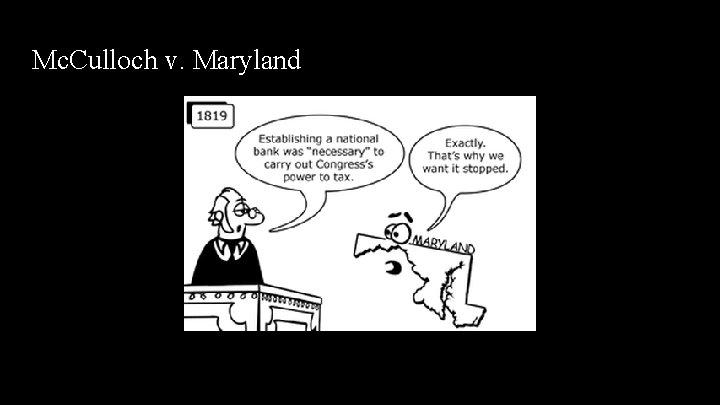
Mc. Culloch v. Maryland
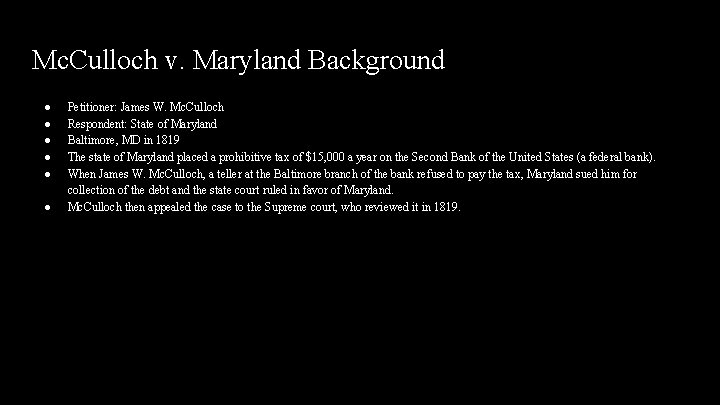
Mc. Culloch v. Maryland Background ● ● ● Petitioner: James W. Mc. Culloch Respondent: State of Maryland Baltimore, MD in 1819 The state of Maryland placed a prohibitive tax of $15, 000 a year on the Second Bank of the United States (a federal bank). When James W. Mc. Culloch, a teller at the Baltimore branch of the bank refused to pay the tax, Maryland sued him for collection of the debt and the state court ruled in favor of Maryland. Mc. Culloch then appealed the case to the Supreme court, who reviewed it in 1819.
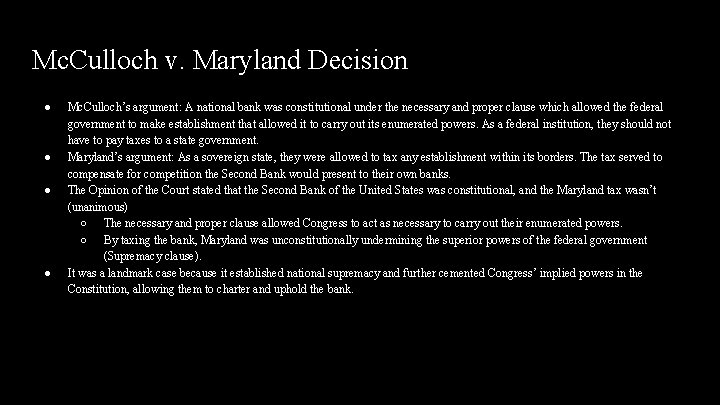
Mc. Culloch v. Maryland Decision ● ● Mc. Culloch’s argument: A national bank was constitutional under the necessary and proper clause which allowed the federal government to make establishment that allowed it to carry out its enumerated powers. As a federal institution, they should not have to pay taxes to a state government. Maryland’s argument: As a sovereign state, they were allowed to tax any establishment within its borders. The tax served to compensate for competition the Second Bank would present to their own banks. The Opinion of the Court stated that the Second Bank of the United States was constitutional, and the Maryland tax wasn’t (unanimous) ○ The necessary and proper clause allowed Congress to act as necessary to carry out their enumerated powers. ○ By taxing the bank, Maryland was unconstitutionally undermining the superior powers of the federal government (Supremacy clause). It was a landmark case because it established national supremacy and further cemented Congress’ implied powers in the Constitution, allowing them to charter and uphold the bank.
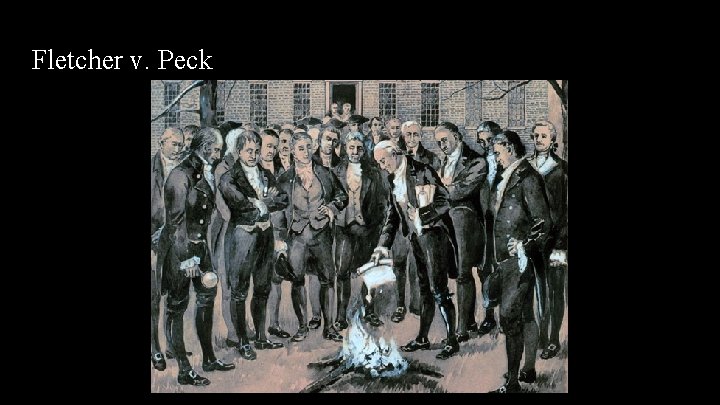
Fletcher v. Peck
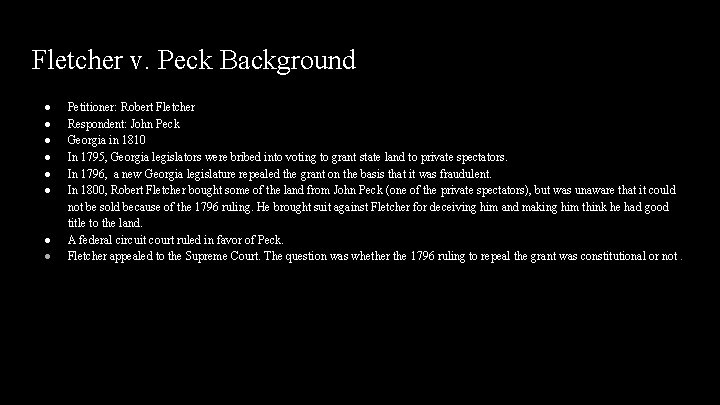
Fletcher v. Peck Background ● ● ● ● Petitioner: Robert Fletcher Respondent: John Peck Georgia in 1810 In 1795, Georgia legislators were bribed into voting to grant state land to private spectators. In 1796, a new Georgia legislature repealed the grant on the basis that it was fraudulent. In 1800, Robert Fletcher bought some of the land from John Peck (one of the private spectators), but was unaware that it could not be sold because of the 1796 ruling. He brought suit against Fletcher for deceiving him and making him think he had good title to the land. A federal circuit court ruled in favor of Peck. Fletcher appealed to the Supreme Court. The question was whether the 1796 ruling to repeal the grant was constitutional or not.
Fletcher v. Peck Decision ● ● Fletcher’s argument: Georgia never had title to the land thus could not transfer it to Peck (who subsequently sold it to Fletcher). This meant that sale in 1795 by Georgia to Peck was not good because of fraud on the part of Peck in obtaining the land. As a consequence, he sale from Peck to Fletcher was not good because the Georgia legislature had repealed the act that gave Peck title. Peck’s argument: The Opinion of the Court was in favor of Peck, stating that nothing in the state constitution prohibited Peck from selling the land to Fletcher (unanimous). ○ The 1795 sale could not be overturned because of fraud. ○ The government also could not take away property without compensation. ○ The “contract clause” of the Constitution prohibited the state from interfering in contract obligations. This was a landmark case because it established a strict interpretation of the contract clause and was the first time the Supreme Court invalidated a state law on Constitutional grounds.
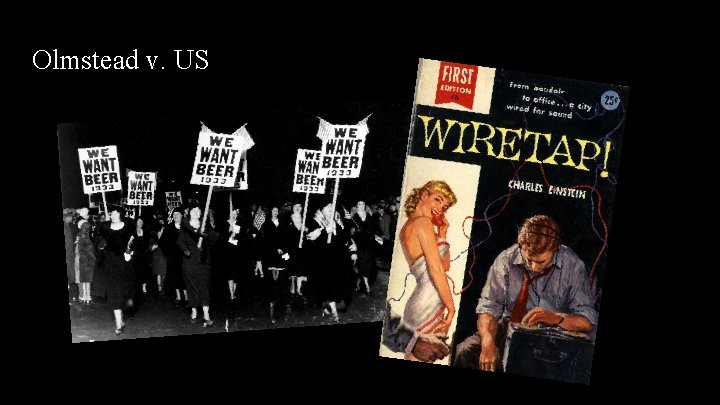
Olmstead v. US
Olmstead v. US Background ● ● ● ● Petitioner: Roy Olmstead Respondent: United States Seattle, WA in 1928 Olmstead was a business owner who was conspiring to smuggle and distribute alcohol, which violated the National Prohibition Act. Federal agents suspected him and wiretapped phones in his office basement and around his home. With the information they obtained, they discovered that Olmstead’s plan involved about fifty other “employees” and would bring him over $2 million in profit every year. He was convicted of conspiracy and other crimes with information from his phone calls used as evidence. He challenged his conviction in a District Court in Washington and after his case made it to a Circuit Court of Appeals, it was sent to the Supreme Court by a writ of certiorari.
Olmstead v. US Decision ● ● Olmstead’s argument: The evidence against him was unethically obtained and invaded his privacy, violating the 4 th and 5 th Amendments to the Constitution. U. S. argument: The information was not illegally obtained because the taps were not illegally planted; they were placed on the streets around Olmstead’s home and in his office building, neither of which were private property. The Supreme Court ruled in favor of the U. S. (5 -4) ○ Phone conversations are not “tangible” evidence under the Fourth Amendment. Wiretapping is not the same as search and seizure because there is no physical tampering. ○ Olmstead was not forced to self-incriminate because the conversations he had were completely voluntary (5 th amendment rights not infringed). ○ Although wiretapping may be unethical, a court can’t disregard evidence based on that. This was a landmark case because it diminished the bounds of the exclusionary rule. It was later overturned by Katz v. US in 1967.
New York Times v. United States
New York Times v. United States Background ● ● ● ● Petitioner: New York Times Company Respondent: United States Location: Former New York Times Headquarters The Nixon administration attempted to exercise prior restraint on the New York Times and Washington Post regarding illegally leaked documents—the “Pentagon Papers”—from a study of the history of American activities in Vietnam. Argued on June 26, 1971 Decided on June 30, 1971 The United States government obtained a court order preventing the New York Times from continuing to publish the documents. After the Washington Post began publishing the documents, the government tried to get an order to stop them, but the request was denied. The New York Times appealed their case to the US Court of Appeals, and the appeals from both the New York Times and the Federal Government regarding the Washington Post case led to the case going to the Supreme Court within two weeks of the appeal.
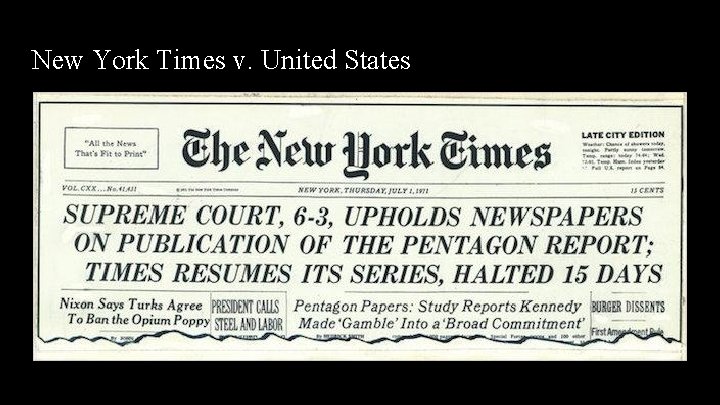
New York Times v. United States Decision ● ● ● In the oral argument given in support of the New York Times, the attorney representing the New York Times argued that the publication of the documents was protected under the free press provided by the First Amendment. Also, the government failed to show that the publication of the papers would endanger national security. In the oral argument given in support of the United States, the attorneys representing the United States argued that the First Amendment does not guarantee freedom of the press when national security is endangered. Also, allowing the publication of the documents would set a precedent that could possibly endanger national security in similar future cases. The Supreme Court ruled in a 6 -3 majority that the prior restraint the Federal Government attempted to exercise over the New York Times was unconstitutional. The opinion of the court, written per curiam, stated that Federal Government failed to show evidence that the publication of the documents would endanger national safety. This is a landmark case because it set the precedent for future cases regarding the press and clearly defined the importance of the free press to inform citizens of the governments actions.
Near v. Minnesota
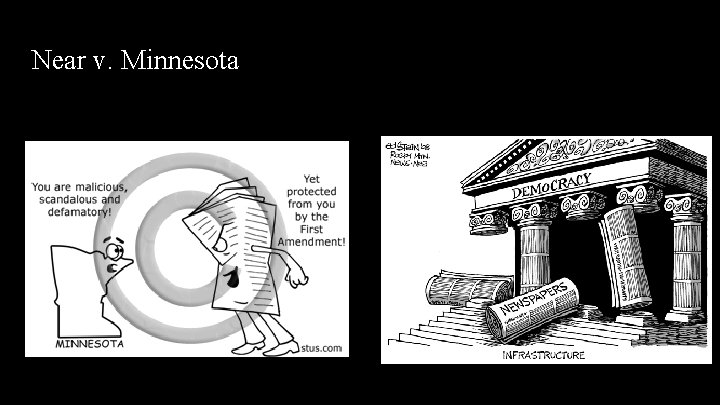
Near v. Minnesota Background ● ● ● ● Appellant: Jay Near Appellee: Minnesota Lower court: Minnesota Supreme Court Argued: January 30 th, 1930 Decided: June 1 st, 1931 by the Hughes Court Jay Near published a “scandal” sheet in Minneapolis, in which he attacked local officials and accused them of being involved with gangsters. Minnesota officials obtained an injunction to prevent Near from publishing his newspaper under a state law called the Minnesota Gag Law of 1925. The law permitted a judge, without a jury, to stop the publication of any newspaper or magazine that the judge found “obscene, lewd and lascivious” or “malicious, scandalous and defamatory. ” The law also stated that a newspaper could be permanently stopped from future publications. Near fought the injunction and took it to the Minnesota state court, where it was upheld. He then appealed his case to the Supreme Court, arguing that the Minnesota Gag Law was unconstitutional and violated his first amendment rights.
Near v. Minnesota Decision ● ● ● Issue: Does the Minnesota “gag law” violate the rights given under the 1 st amendment? Near’s lawyers oral argument was that the Gag Law was unconstitutional because it exhibited a form or prior restraint, an attempt by government to prohibit communication of information before publication. They argued that type of censorship is specifically prohibited by the 1 st amendment, therefore the Gag Law is unconstitutional. The lawyers representing the state of Minnesota argued that hateful speech is not protected under the constitution because it can lead to violence or riots. The supreme court decided, 5 -4, that under the Free Press Clause of the first amendment, the government can’t censor or prohibit a publication in advanced. They stated that the state ordering the injunction was unconstitutional and that the Gag Law does violate the rights given under the first amendment. Near V. Minnesota was a landmark case because it stated that prior restraint violates the first amendment and stated that government can’t limit a publication in advanced.
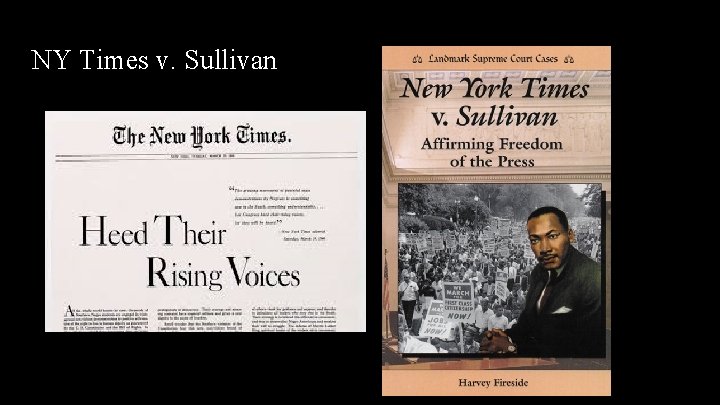
NY Times v. Sullivan
NY Times v. Sullivan ● ● ● ● ● Petitioner: New York Times Company Respondent: Sullivan Location: New York Times Office Argued: January 6, 1964 Decided: March 9, 1964 By: Warren Court L. B. Sullivan, the Montgomery city commissioner, filed a libel action against the newspaper and four black ministers who were listed as endorsers of the ad, claiming that the allegations against the Montgomery police defamed him personally. Argument: Did Alabama's libel law, by not requiring Sullivan to prove that an advertisement personally harmed him and dismissing the same as untruthful due to factual errors, unconstitutionally infringe on the First Amendment's freedom of speech and freedom of press protections? Decision: Unanimous decision for The New York Times Company, Majority Opinion by William J. Brennan Jr. The Court ruled that free and open debate about the conduct of public officials was more important than occasional, honest factual errors that might hurt or damage officials’ reputations. They said that the First Amendment protects the publication of all statements, even false ones, about the conduct of public officials except when statements are made with actual malice (with knowledge that they are false or in reckless disregard of their truth or falsity). Landmark case: This is a landmark United States Supreme Court case that held that the court must find evidence of actual malice before it can hold the press guilty for defamation and libel against a public figure. This was a landmark Supreme Court decision regarding freedom of the press.
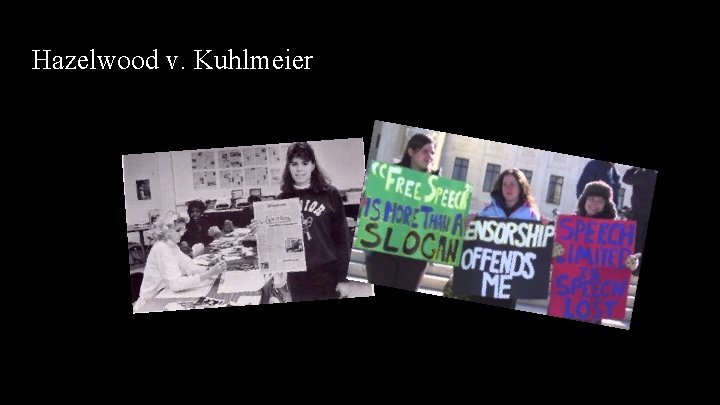
Hazelwood v. Kuhlmeier
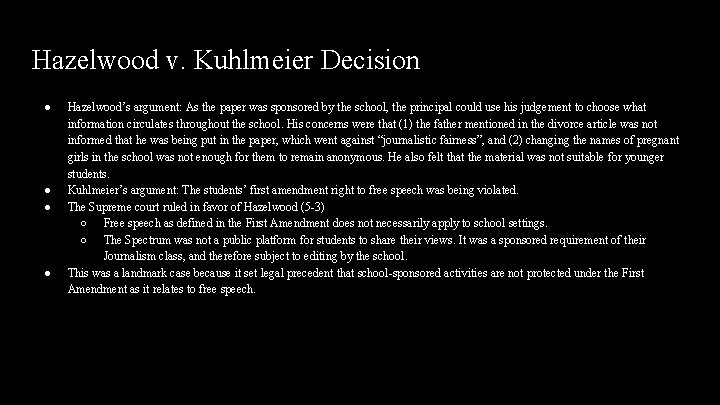
Hazelwood v. Kuhlmeier Background ● ● ● ● Petitioner: Hazelwood School District Respondent: Cathy Kuhlmeier St. Louis, MI in 1988 Hazelwood East High School published a weekly newspaper called The Spectrum, which was written and edited by students. In the final edition of the paper, the school’s principal found two articles he thought were inappropriate. ○ One was about divorce. A girl was interviewed and blamed her parents’ divorce on her father. ○ The other was about teen pregnancy. Pregnant girls attending the school were interviewed about their stories. The girls’ names were changed to ensure privacy. The principal prohibited the articles from being published unless entire pages were taken out. Cathy Kuhlmeier, along with two other Hazelwood alumni, brought the case to a local district court, which ruled in favor of the students. The school appealed to the Supreme Court, who granted certiorari.
Hazelwood v. Kuhlmeier Decision ● ● Hazelwood’s argument: As the paper was sponsored by the school, the principal could use his judgement to choose what information circulates throughout the school. His concerns were that (1) the father mentioned in the divorce article was not informed that he was being put in the paper, which went against “journalistic fairness”, and (2) changing the names of pregnant girls in the school was not enough for them to remain anonymous. He also felt that the material was not suitable for younger students. Kuhlmeier’s argument: The students’ first amendment right to free speech was being violated. The Supreme court ruled in favor of Hazelwood (5 -3) ○ Free speech as defined in the First Amendment does not necessarily apply to school settings. ○ The Spectrum was not a public platform for students to share their views. It was a sponsored requirement of their Journalism class, and therefore subject to editing by the school. This was a landmark case because it set legal precedent that school-sponsored activities are not protected under the First Amendment as it relates to free speech.
Sources ● ● ● ● ● https: //www. oyez. org/cases/1964/496 https: //www. law. cornell. edu/supremecourt/text/381/479 http: //www. course-notes. org/us_gov_and_politics/case_briefs/griswold_v_connecticut https: //embryo. asu. edu/pages/griswold-v-connecticut-1965 http: //www. phschool. com/atschool/ss_web_codes/supreme_court_cases/griswold. html https: //www. oyez. org/cases/1973/73 -1766 https: //www. casebriefs. com/blog/law/evidence-keyed-to-waltz/governmental-priveleges/united-states-v-nixon/ http: //caselaw. findlaw. com/us-supreme-court/418/683. html https: //www. law. cornell. edu/supremecourt/text/424/1 https: //www. oyez. org/cases/1975/75 -436 https: //globalfreedomofexpression. columbia. edu/cases/buckley-v-valeo/ https: //www. britannica. com/event/Buckley-v-Valeo https: //www. law. cornell. edu/supremecourt/text/418/683 https: //www. britannica. com/event/Bush-v-Gore https: //www. casebriefs. com/blog/law/constitutional-law-keyed-to-shanor/equal-protection-clause/bush-v-gore/2/ http: //www. phschool. com/curriculum_support/interactive_constitution/scc 43. htm http: //landmarkcases. org/en/Page/394/Background_Summary__Questions_ http: //www. billofrightsinstitute. org/educate/educator-resources/lessons-plans/landmark-supreme-court-cases-elessons/us-v-lopez-1995/ https: //www. thirteen. org/wnet/supremecourt/antebellum/landmark_mcculloch. html https: //www. oyez. org/cases/1789 -1850/17 us 316
Sources ● ● ● ● ● https: //www. thirteen. org/wnet/supremecourt/capitalism/landmark_fletcher. html https: //www. oyez. org/cases/1789 -1850/10 us 87 http: //fas-history. rutgers. edu/clemens/constitutional 1/fletcher. html https: //www. oyez. org/cases/1900 -1940/277 us 438 https: //supreme. justia. com/cases/federal/us/277/438/case. html https: //www. oyez. org/cases/1987/86 -836 http: //www. uscourts. gov/educational-resources/educational-activities/facts-and-case-summary-hazelwood-v-kuhlmeier https: //www. oyez. org/cases/1789 -1850/None https: //www. archives. gov/education/lessons/amistad https: //www. law. cornell. edu/background/amistad/priorhist. html Civil Liberties and Rights Packet www. ourdocuments. gov www. kids. laws. com www. supreme. justia. com www. landmarkcases. c-span. org https: //www. oyez. org/cases/1970/1873 https: //www. law. cornell. edu/supremecourt/text/403/713 https: //billofrightsinstitute. org/educate/educator-resources/lessons-plans/landmark-supreme-court-cases-elessons/new-york-times-v-unitedstates-1971/ https: //globalfreedomofexpression. columbia. edu/cases/new-york-times-co-v-united-states/