
Saturns Poles Hotspots and Hexagons from Cassini L
- Slides: 20
Saturn’s Poles: Hotspots and Hexagons from Cassini L. N. Fletcher, P. G. J. Irwin, G. S. Orton, N. A. Teanby, R. K. Achterberg, G. L. Bjoraker, P. L. Read, A. A. Simon-Miller, C. Howett, R. de Kok, N. Bowles, S. B. Calcutt, B. Hesman, F. M. Flasar Saturn’s Polar Dynamics Leigh Fletcher, January 2008
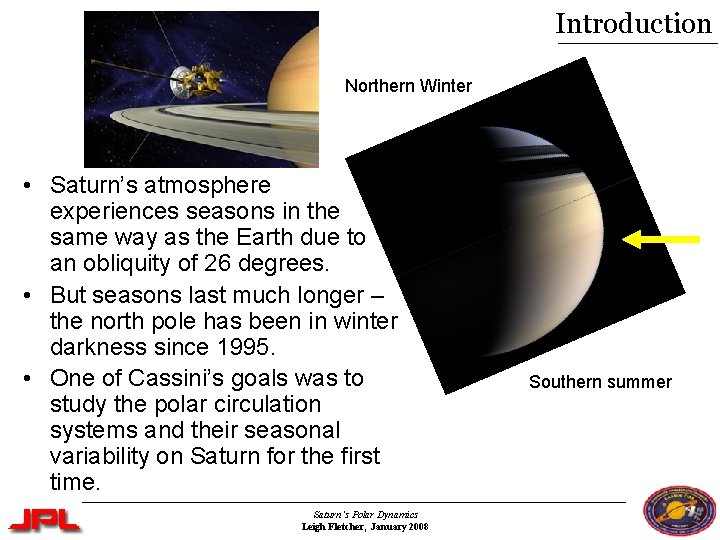
Introduction Northern Winter • Saturn’s atmosphere experiences seasons in the same way as the Earth due to an obliquity of 26 degrees. • But seasons last much longer – the north pole has been in winter darkness since 1995. • One of Cassini’s goals was to study the polar circulation systems and their seasonal variability on Saturn for the first time. Saturn’s Polar Dynamics Leigh Fletcher, January 2008 Southern summer
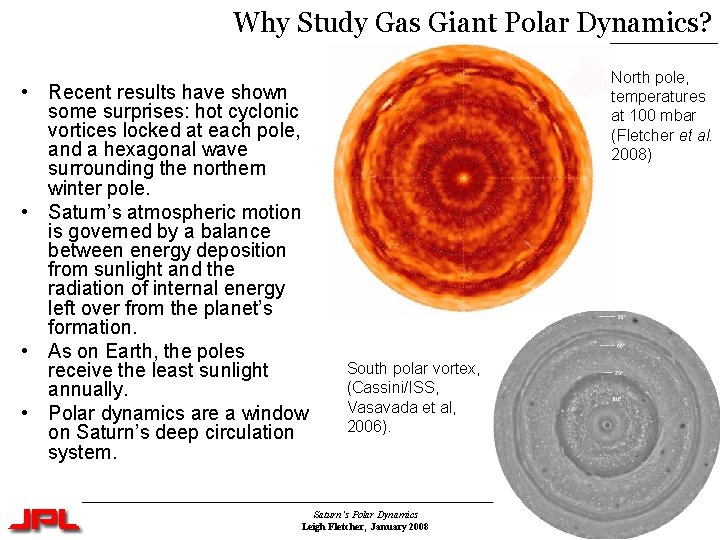
Why Study Gas Giant Polar Dynamics? • Recent results have shown some surprises: hot cyclonic vortices locked at each pole, and a hexagonal wave surrounding the northern winter pole. • Saturn’s atmospheric motion is governed by a balance between energy deposition from sunlight and the radiation of internal energy left over from the planet’s formation. • As on Earth, the poles receive the least sunlight annually. • Polar dynamics are a window on Saturn’s deep circulation system. North pole, temperatures at 100 mbar (Fletcher et al. 2008) South polar vortex, (Cassini/ISS, Vasavada et al, 2006). Saturn’s Polar Dynamics Leigh Fletcher, January 2008
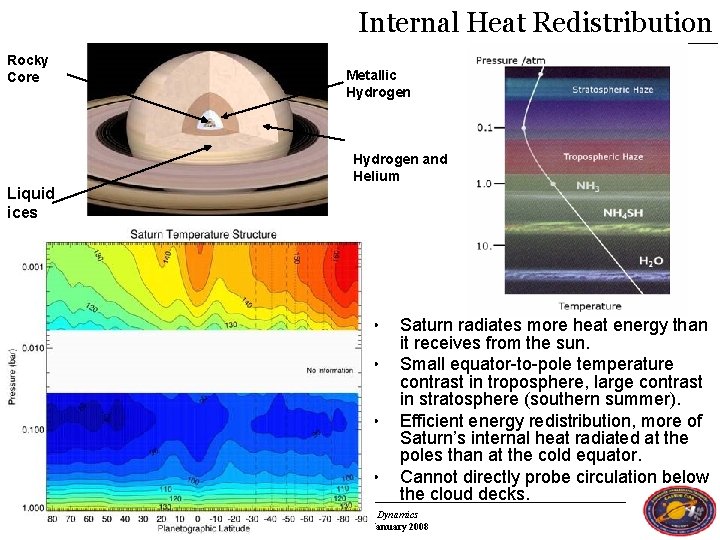
Internal Heat Redistribution Rocky Core Metallic Hydrogen and Helium Liquid ices • • Saturn radiates more heat energy than it receives from the sun. Small equator-to-pole temperature contrast in troposphere, large contrast in stratosphere (southern summer). Efficient energy redistribution, more of Saturn’s internal heat radiated at the poles than at the cold equator. Cannot directly probe circulation below the cloud decks. Saturn’s Polar Dynamics Leigh Fletcher, January 2008
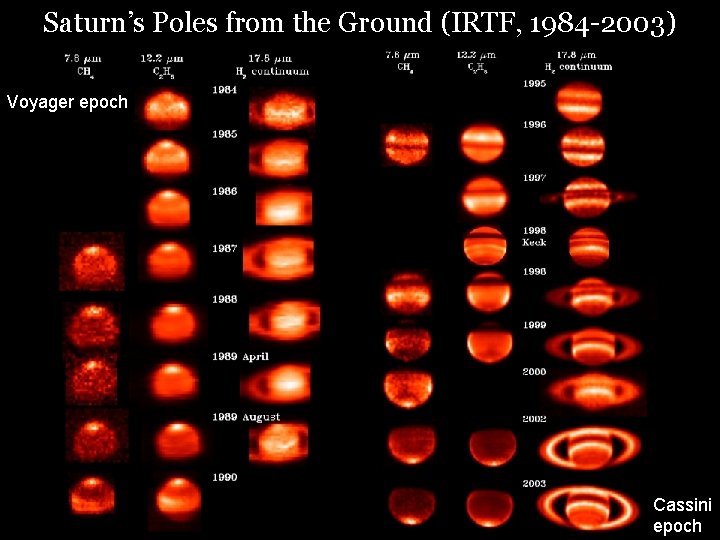
Saturn’s Poles from the Ground (IRTF, 1984 -2003) Voyager epoch Saturn’s Polar Dynamics Leigh Fletcher, January 2008 Cassini epoch
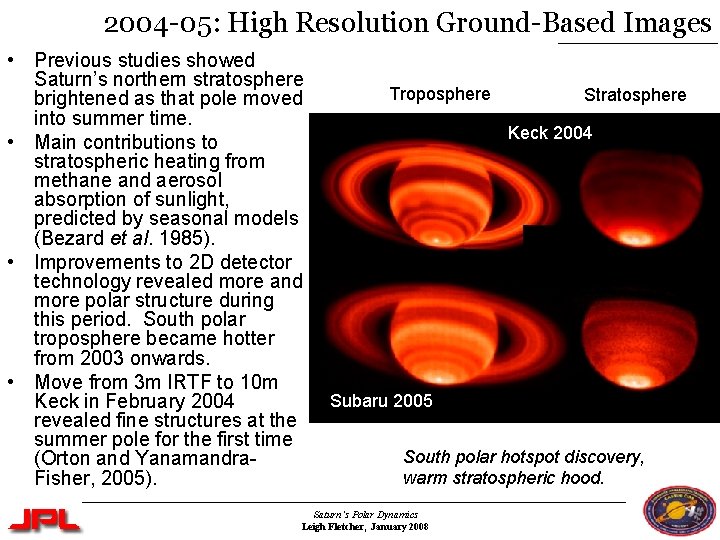
2004 -05: High Resolution Ground-Based Images • Previous studies showed Saturn’s northern stratosphere brightened as that pole moved into summer time. • Main contributions to stratospheric heating from methane and aerosol absorption of sunlight, predicted by seasonal models (Bezard et al. 1985). • Improvements to 2 D detector technology revealed more and more polar structure during this period. South polar troposphere became hotter from 2003 onwards. • Move from 3 m IRTF to 10 m Keck in February 2004 revealed fine structures at the summer pole for the first time (Orton and Yanamandra. Fisher, 2005). Troposphere Stratosphere Keck 2004 Subaru 2005 South polar hotspot discovery, warm stratospheric hood. Saturn’s Polar Dynamics Leigh Fletcher, January 2008
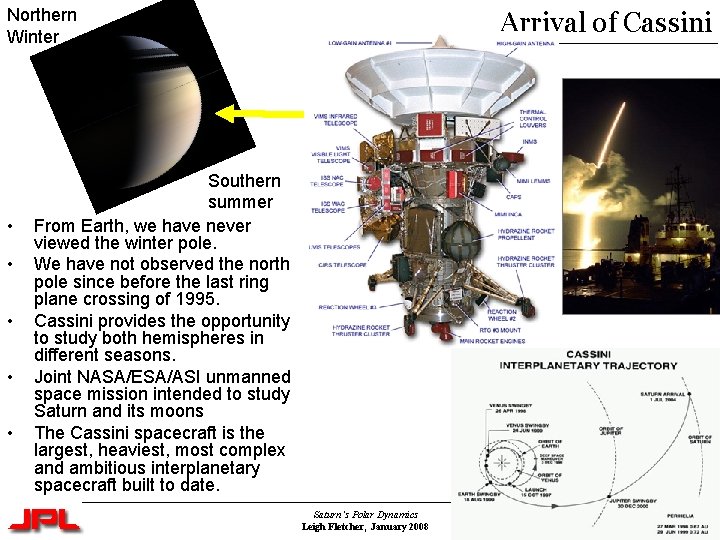
Northern Winter • • • Arrival of Cassini Southern summer From Earth, we have never viewed the winter pole. We have not observed the north pole since before the last ring plane crossing of 1995. Cassini provides the opportunity to study both hemispheres in different seasons. Joint NASA/ESA/ASI unmanned space mission intended to study Saturn and its moons The Cassini spacecraft is the largest, heaviest, most complex and ambitious interplanetary spacecraft built to date. Saturn’s Polar Dynamics Leigh Fletcher, January 2008
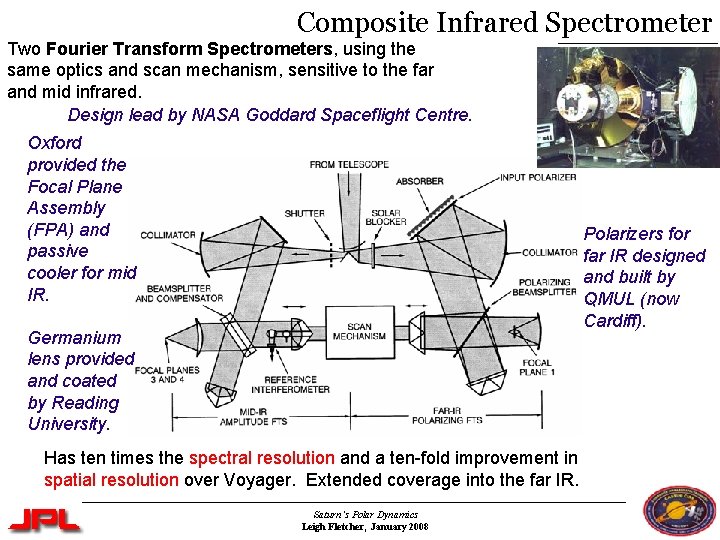
Composite Infrared Spectrometer Two Fourier Transform Spectrometers, using the same optics and scan mechanism, sensitive to the far and mid infrared. Design lead by NASA Goddard Spaceflight Centre. Oxford provided the Focal Plane Assembly (FPA) and passive cooler for mid IR. Polarizers for far IR designed and built by QMUL (now Cardiff). Germanium lens provided and coated by Reading University. Has ten times the spectral resolution and a ten-fold improvement in spatial resolution over Voyager. Extended coverage into the far IR. Saturn’s Polar Dynamics Leigh Fletcher, January 2008
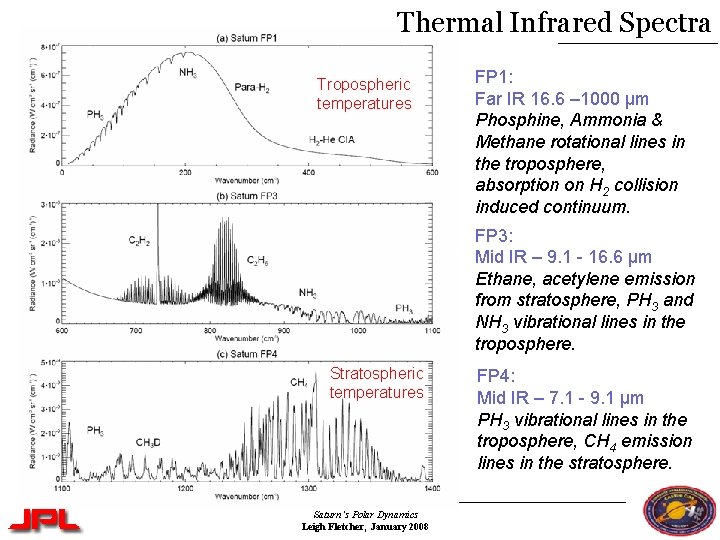
Thermal Infrared Spectra Tropospheric temperatures FP 1: Far IR 16. 6 – 1000 µm Phosphine, Ammonia & Methane rotational lines in the troposphere, absorption on H 2 collision induced continuum. FP 3: Mid IR – 9. 1 - 16. 6 µm Ethane, acetylene emission from stratosphere, PH 3 and NH 3 vibrational lines in the troposphere. Stratospheric temperatures Saturn’s Polar Dynamics Leigh Fletcher, January 2008 FP 4: Mid IR – 7. 1 - 9. 1 µm PH 3 vibrational lines in the troposphere, CH 4 emission lines in the stratosphere.
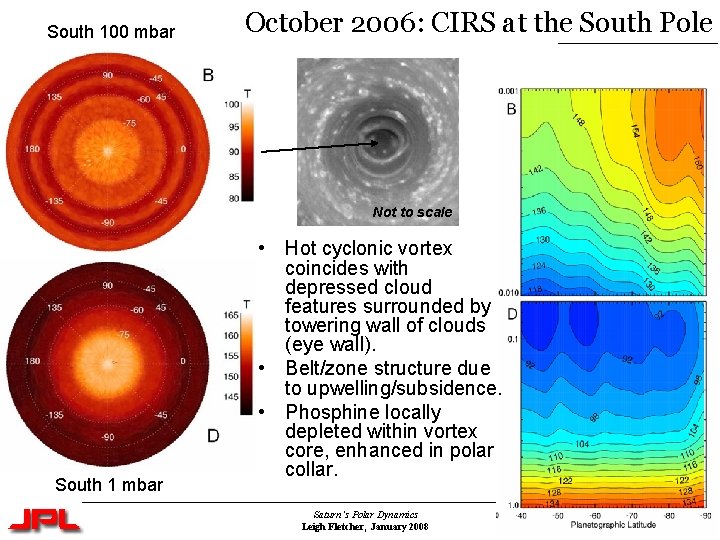
South 100 mbar October 2006: CIRS at the South Pole Not to scale South 1 mbar • Hot cyclonic vortex coincides with depressed cloud features surrounded by towering wall of clouds (eye wall). • Belt/zone structure due to upwelling/subsidence. • Phosphine locally depleted within vortex core, enhanced in polar collar. Saturn’s Polar Dynamics Leigh Fletcher, January 2008
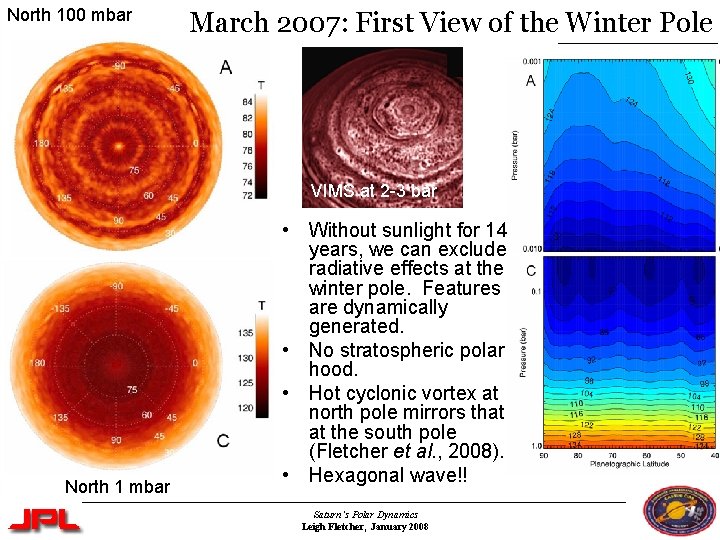
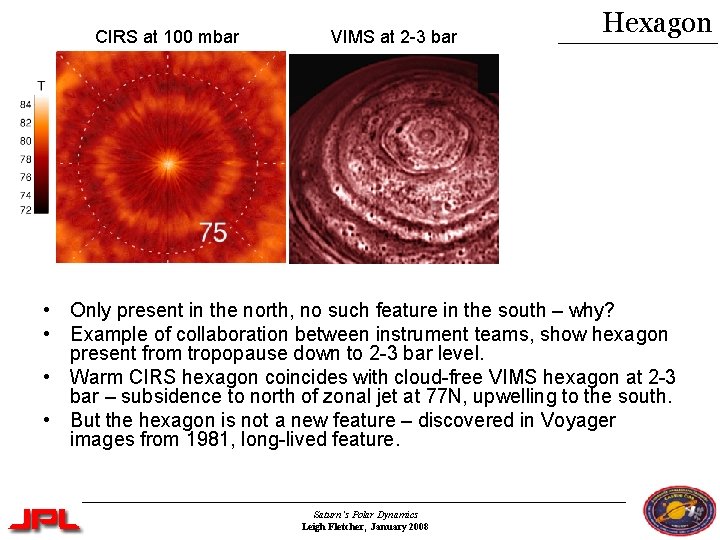
North 100 mbar March 2007: First View of the Winter Pole VIMS at 2 -3 bar North 1 mbar • Without sunlight for 14 years, we can exclude radiative effects at the winter pole. Features are dynamically generated. • No stratospheric polar hood. • Hot cyclonic vortex at north pole mirrors that at the south pole (Fletcher et al. , 2008). • Hexagonal wave!! Saturn’s Polar Dynamics Leigh Fletcher, January 2008
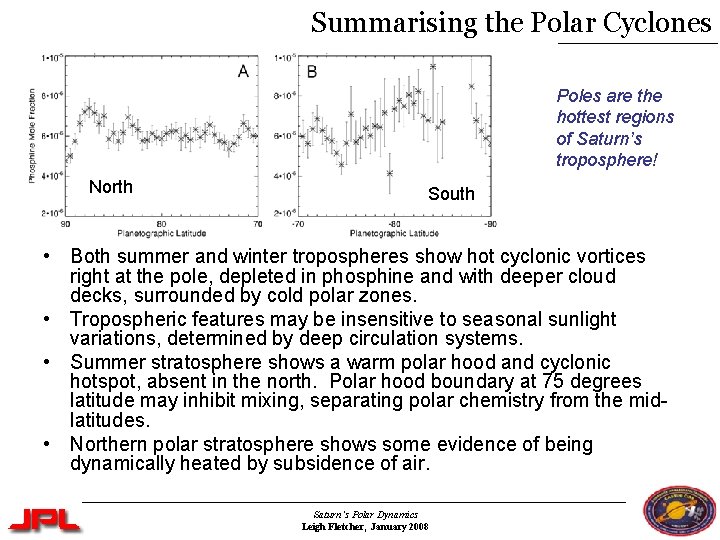
Summarising the Polar Cyclones Poles are the hottest regions of Saturn’s troposphere! North South • Both summer and winter tropospheres show hot cyclonic vortices right at the pole, depleted in phosphine and with deeper cloud decks, surrounded by cold polar zones. • Tropospheric features may be insensitive to seasonal sunlight variations, determined by deep circulation systems. • Summer stratosphere shows a warm polar hood and cyclonic hotspot, absent in the north. Polar hood boundary at 75 degrees latitude may inhibit mixing, separating polar chemistry from the midlatitudes. • Northern polar stratosphere shows some evidence of being dynamically heated by subsidence of air. Saturn’s Polar Dynamics Leigh Fletcher, January 2008
CIRS at 100 mbar VIMS at 2 -3 bar Hexagon • Only present in the north, no such feature in the south – why? • Example of collaboration between instrument teams, show hexagon present from tropopause down to 2 -3 bar level. • Warm CIRS hexagon coincides with cloud-free VIMS hexagon at 2 -3 bar – subsidence to north of zonal jet at 77 N, upwelling to the south. • But the hexagon is not a new feature – discovered in Voyager images from 1981, long-lived feature. Saturn’s Polar Dynamics Leigh Fletcher, January 2008
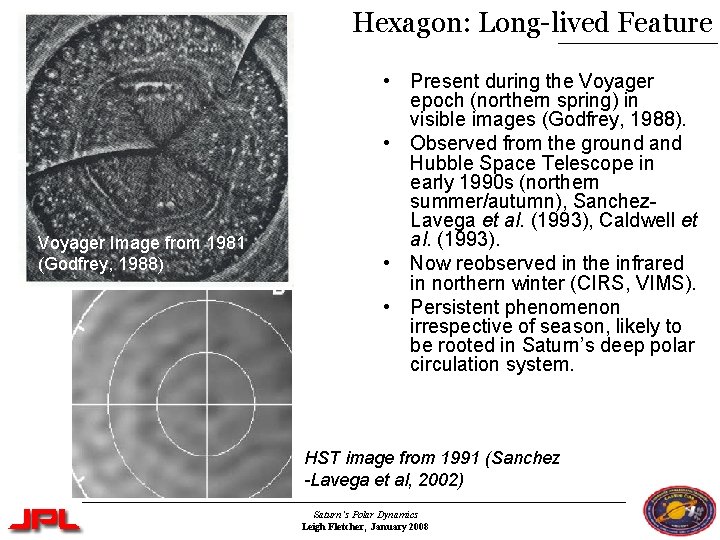
Hexagon: Long-lived Feature Voyager Image from 1981 (Godfrey, 1988) • Present during the Voyager epoch (northern spring) in visible images (Godfrey, 1988). • Observed from the ground and Hubble Space Telescope in early 1990 s (northern summer/autumn), Sanchez. Lavega et al. (1993), Caldwell et al. (1993). • Now reobserved in the infrared in northern winter (CIRS, VIMS). • Persistent phenomenon irrespective of season, likely to be rooted in Saturn’s deep polar circulation system. HST image from 1991 (Sanchez -Lavega et al, 2002) Saturn’s Polar Dynamics Leigh Fletcher, January 2008
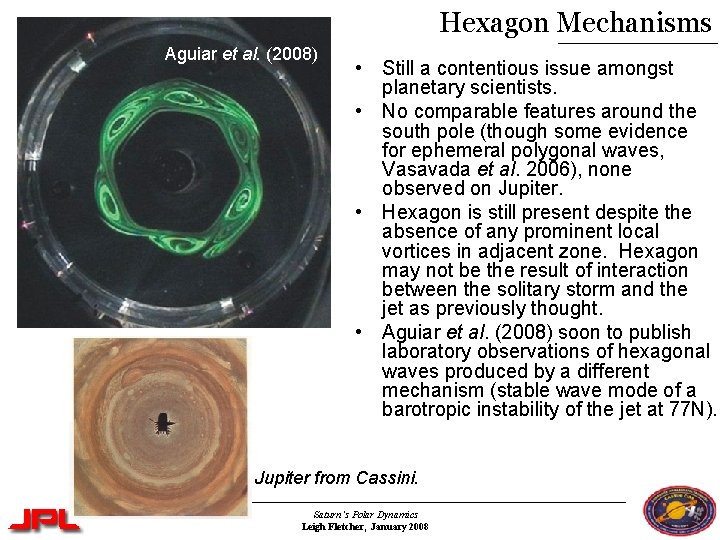
Hexagon Mechanisms Aguiar et al. (2008) • Still a contentious issue amongst planetary scientists. • No comparable features around the south pole (though some evidence for ephemeral polygonal waves, Vasavada et al. 2006), none observed on Jupiter. • Hexagon is still present despite the absence of any prominent local vortices in adjacent zone. Hexagon may not be the result of interaction between the solitary storm and the jet as previously thought. • Aguiar et al. (2008) soon to publish laboratory observations of hexagonal waves produced by a different mechanism (stable wave mode of a barotropic instability of the jet at 77 N). Jupiter from Cassini. Saturn’s Polar Dynamics Leigh Fletcher, January 2008
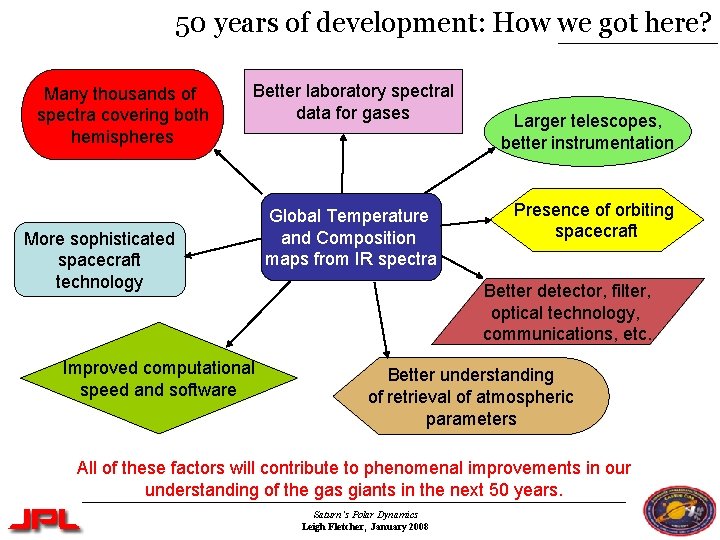
50 years of development: How we got here? Many thousands of spectra covering both hemispheres Better laboratory spectral data for gases More sophisticated spacecraft technology Improved computational speed and software Global Temperature and Composition maps from IR spectra Larger telescopes, better instrumentation Presence of orbiting spacecraft Better detector, filter, optical technology, communications, etc. Better understanding of retrieval of atmospheric parameters All of these factors will contribute to phenomenal improvements in our understanding of the gas giants in the next 50 years. Saturn’s Polar Dynamics Leigh Fletcher, January 2008
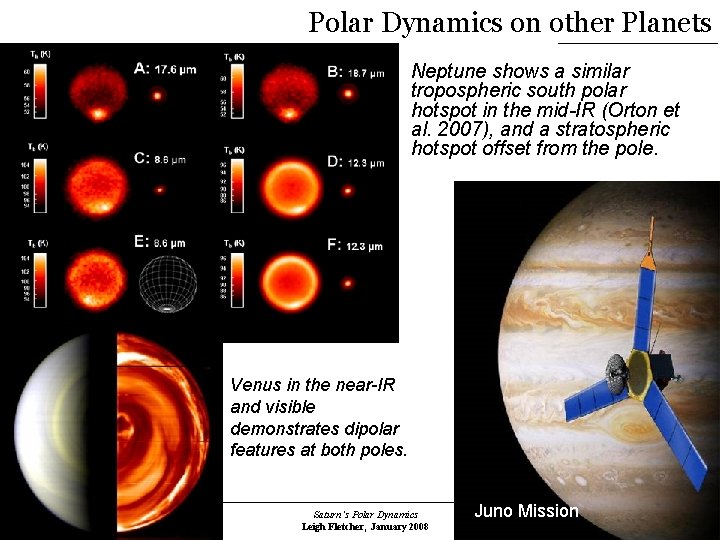
Polar Dynamics on other Planets • Neptune shows a similar tropospheric south polar hotspot in the mid-IR (Orton et al. 2007), and a stratospheric hotspot offset from the pole. Venus in the near-IR and visible demonstrates dipolar features at both poles. Saturn’s Polar Dynamics Leigh Fletcher, January 2008 Juno Mission
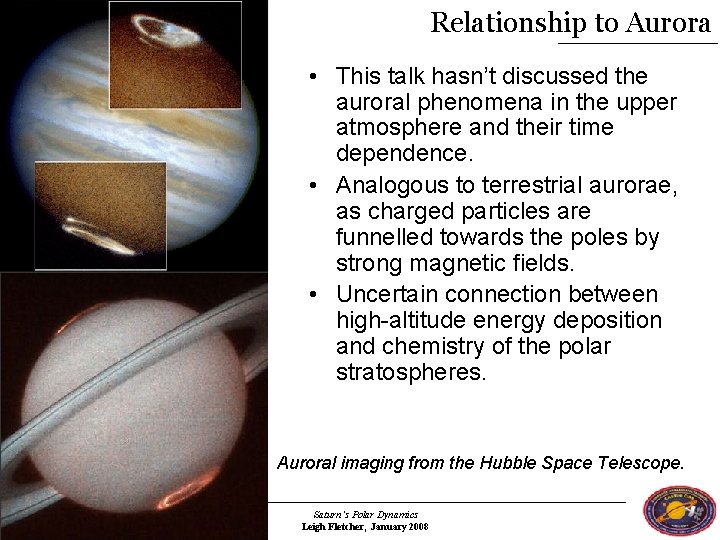
Relationship to Aurora • This talk hasn’t discussed the auroral phenomena in the upper atmosphere and their time dependence. • Analogous to terrestrial aurorae, as charged particles are funnelled towards the poles by strong magnetic fields. • Uncertain connection between high-altitude energy deposition and chemistry of the polar stratospheres. Auroral imaging from the Hubble Space Telescope. Saturn’s Polar Dynamics Leigh Fletcher, January 2008
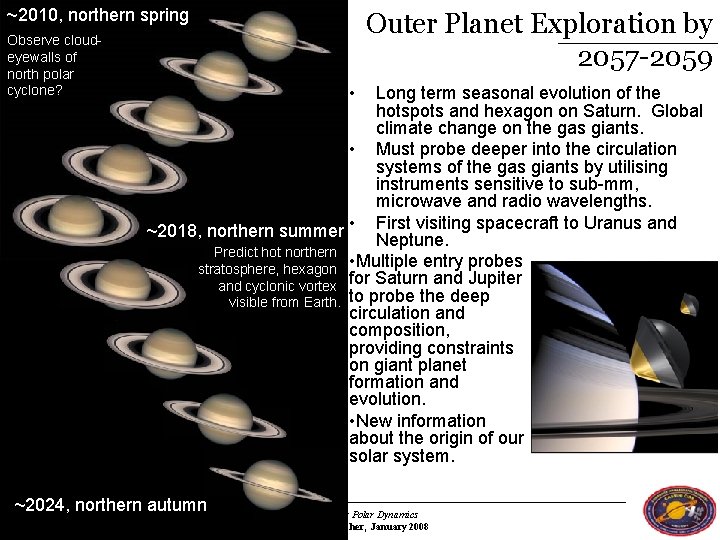
~2010, northern spring Observe cloudeyewalls of north polar cyclone? Outer Planet Exploration by 2057 -2059 • Long term seasonal evolution of the hotspots and hexagon on Saturn. Global climate change on the gas giants. • Must probe deeper into the circulation systems of the gas giants by utilising instruments sensitive to sub-mm, microwave and radio wavelengths. ~2018, northern summer • First visiting spacecraft to Uranus and Neptune. Predict hot northern stratosphere, hexagon • Multiple entry probes and cyclonic vortex for Saturn and Jupiter visible from Earth. to probe the deep circulation and composition, providing constraints on giant planet formation and evolution. • New information about the origin of our solar system. ~2024, northern autumn Saturn’s Polar Dynamics Leigh Fletcher, January 2008
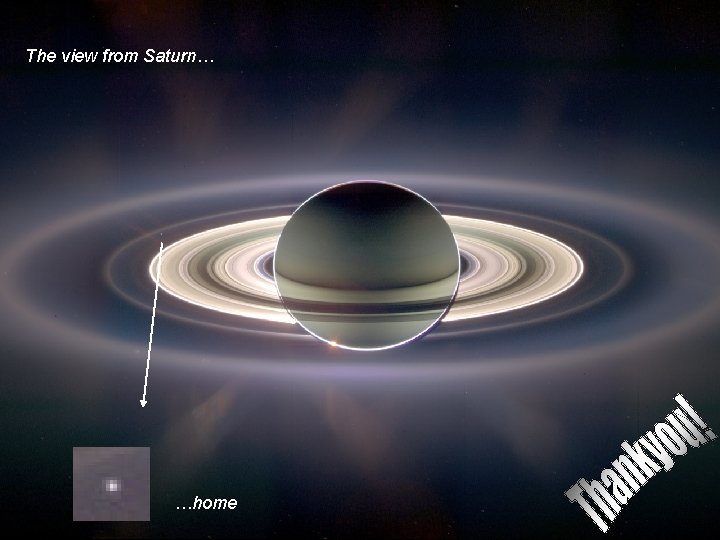
The view from Saturn… …home Saturn’s Polar Dynamics Leigh Fletcher, January 2008