Imperial College London 4 I 10 Green Chemistry

- Slides: 28
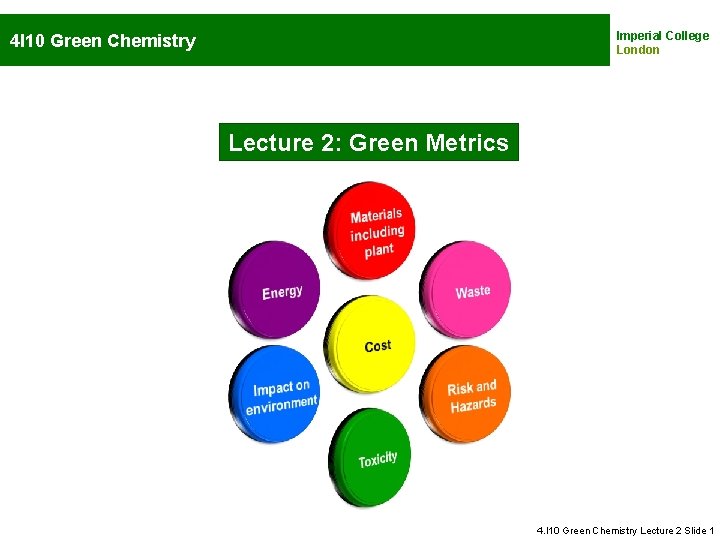
Imperial College London 4 I 10 Green Chemistry Lecture 2: Green Metrics 4. I 10 Green Chemistry Lecture 2 Slide 1
From the end of last week’s lecture Imperial College London Green Chemistry is often said to be a 'cradle to grave' approach. Explain what this term means with specific reference to the industrial production of polyethylene. 5 marks ‘Cradle to grave’ describes the need to consider ALL factors in the production of a chemical from the source of the raw materials, to the disposal / recycle of the product once its useful lifetime has ended. Possible factors might include: • ethylene is produced from petroleum feedstocks (is biomass an alternative, renewable source? ) • catalysts greatly reduce the temperature and pressure conditions • no solvents are used (gas phase monomer passed over a solid catalyst) • minimal waste • polyethylene is non-degradable, therefore it contributes significantly to landfill; recycling is difficult and energy intensive • energy requirements, transportation to market etc. 4. I 10 -2 -2
Lecture 2: Learning Objectives Imperial College London By the end of today's lecture you should be able to: (i) discuss (but not memorise) the 12 Principles of Green Chemistry; (ii) calculate Atom Economies, E-factors and Effective Mass Yields for chemical processes; (iii) discuss the advantages and disadvantages of each approach; (iv) describe the competing processes for the industrial production of • dimethyl carbonate • lactic acid 4. I 10 -2 -3
Today’s lecture Imperial College London How can we measure the ‘greenness’ of a chemical reaction? OR, given two chemical processes, how can we decide which is most consistent with the Principles of Green Chemistry? 4. I 10 -2 -4
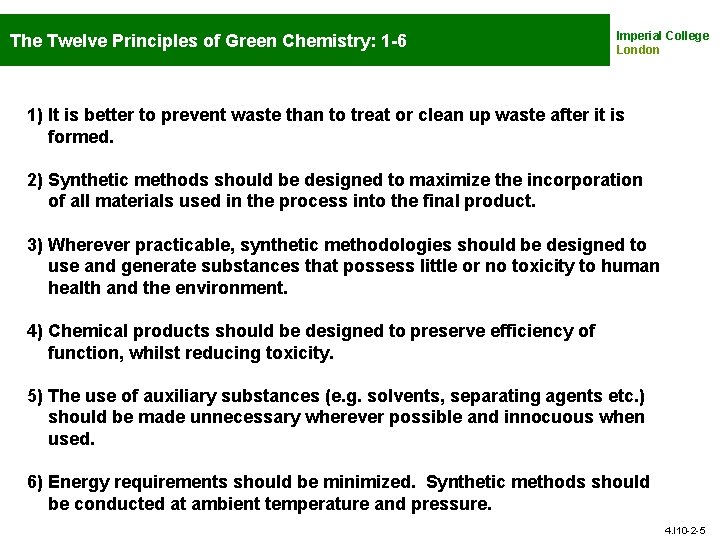
The Twelve Principles of Green Chemistry: 1 -6 Imperial College London 1) It is better to prevent waste than to treat or clean up waste after it is formed. 2) Synthetic methods should be designed to maximize the incorporation of all materials used in the process into the final product. 3) Wherever practicable, synthetic methodologies should be designed to use and generate substances that possess little or no toxicity to human health and the environment. 4) Chemical products should be designed to preserve efficiency of function, whilst reducing toxicity. 5) The use of auxiliary substances (e. g. solvents, separating agents etc. ) should be made unnecessary wherever possible and innocuous when used. 6) Energy requirements should be minimized. Synthetic methods should be conducted at ambient temperature and pressure. 4. I 10 -2 -5
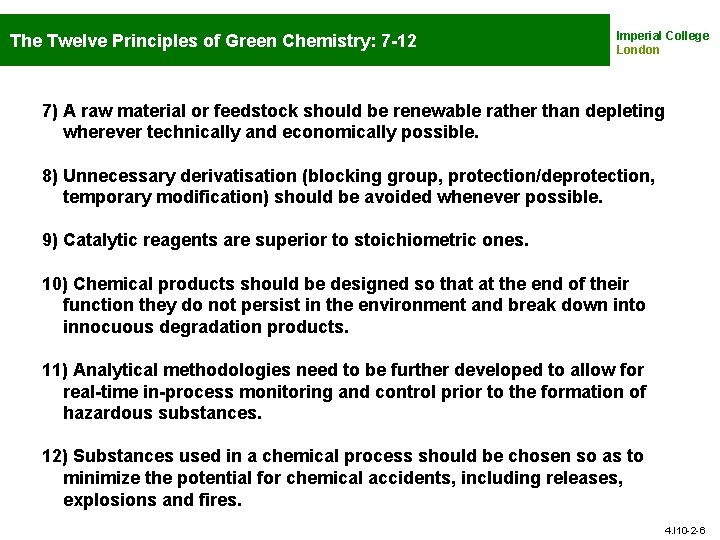
The Twelve Principles of Green Chemistry: 7 -12 Imperial College London 7) A raw material or feedstock should be renewable rather than depleting wherever technically and economically possible. 8) Unnecessary derivatisation (blocking group, protection/deprotection, temporary modification) should be avoided whenever possible. 9) Catalytic reagents are superior to stoichiometric ones. 10) Chemical products should be designed so that at the end of their function they do not persist in the environment and break down into innocuous degradation products. 11) Analytical methodologies need to be further developed to allow for real-time in-process monitoring and control prior to the formation of hazardous substances. 12) Substances used in a chemical process should be chosen so as to minimize the potential for chemical accidents, including releases, explosions and fires. 4. I 10 -2 -6
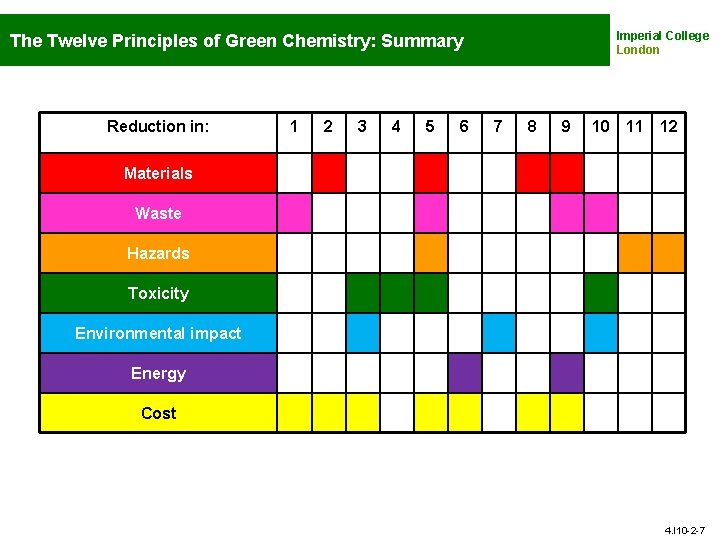
Imperial College London The Twelve Principles of Green Chemistry: Summary Reduction in: 1 2 3 4 5 6 7 8 9 10 11 12 Materials Waste Hazards Toxicity Environmental impact Energy Cost 4. I 10 -2 -7
Two syntheses of dimethyl carbonate - which is greener? Imperial College London 1. Traditional synthesis from phosgene and methanol phosgene 2. Modern synthesis - methanol carbonylation Route 2 is preferred since it avoids the use of phosgene and it gives less harmful side-products (route 2 also produces purer product, so energy intensive purification steps are eliminated). Some decisions are straightforward 4. I 10 -2 -8
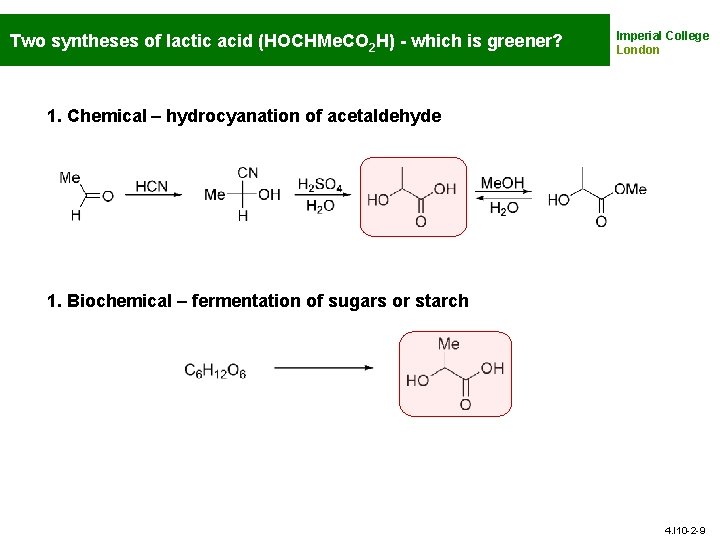
Two syntheses of lactic acid (HOCHMe. CO 2 H) - which is greener? Imperial College London 1. Chemical – hydrocyanation of acetaldehyde 1. Biochemical – fermentation of sugars or starch 4. I 10 -2 -9
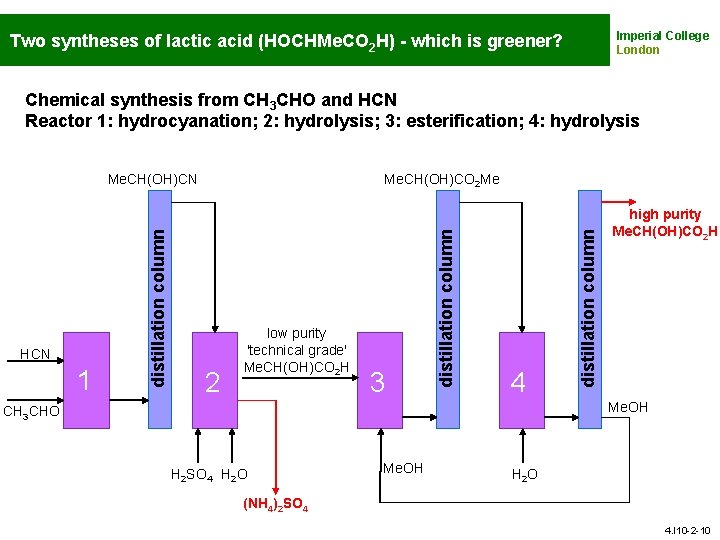
Imperial College London Two syntheses of lactic acid (HOCHMe. CO 2 H) - which is greener? Chemical synthesis from CH 3 CHO and HCN Reactor 1: hydrocyanation; 2: hydrolysis; 3: esterification; 4: hydrolysis 2 low purity 'technical grade' Me. CH(OH)CO 2 H 3 4 distillation column 1 Me. CH(OH)CO 2 Me distillation column HCN distillation column Me. CH(OH)CN high purity Me. CH(OH)CO 2 H Me. OH CH 3 CHO H 2 SO 4 H 2 O Me. OH H 2 O (NH 4)2 SO 4 4. I 10 -2 -10
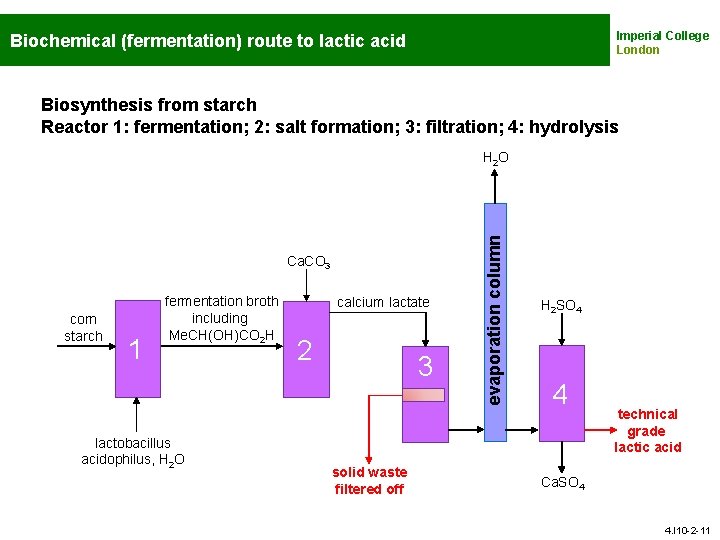
Imperial College London Biochemical (fermentation) route to lactic acid Biosynthesis from starch Reactor 1: fermentation; 2: salt formation; 3: filtration; 4: hydrolysis Ca. CO 3 corn starch 1 fermentation broth including Me. CH(OH)CO 2 H lactobacillus acidophilus, H 2 O calcium lactate 2 3 solid waste filtered off evaporation column H 2 O H 2 SO 4 4 technical grade lactic acid Ca. SO 4 4. I 10 -2 -11
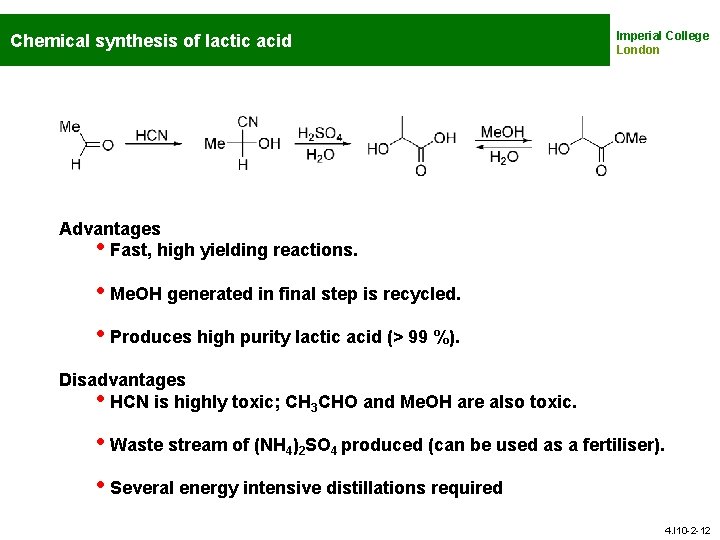
Chemical synthesis of lactic acid Imperial College London Advantages • Fast, high yielding reactions. • Me. OH generated in final step is recycled. • Produces high purity lactic acid (> 99 %). Disadvantages • HCN is highly toxic; CH 3 CHO and Me. OH are also toxic. • Waste stream of (NH 4)2 SO 4 produced (can be used as a fertiliser). • Several energy intensive distillations required 4. I 10 -2 -12
Biochemical synthesis of lactic acid Imperial College London Advantages • Renewable feedstocks. • Uses non-hazardous materials. Disadvantages • Slow (every cycle takes 4 -6 days). • Quantity of product per reactor volume is low. • Evaporation is required (due to low salt concentration) energetically intensive. • Technical grade lactic acid (ca. 85 % purity) produced. In order to produce high purity product, the material still has to undergo the methanol transesterification process outlined on slide 10. • Waste stream of Ca. SO 4 produced and very large quantities of waste water. Some decisions are more difficult! 4. I 10 -2 -13
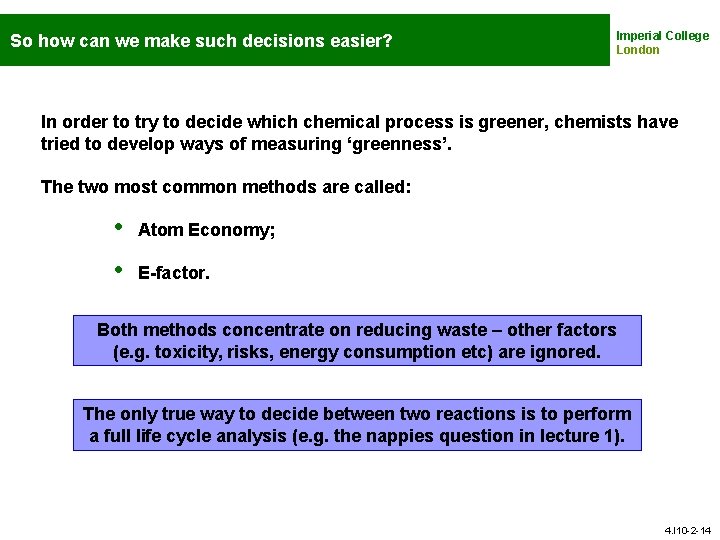
So how can we make such decisions easier? Imperial College London In order to try to decide which chemical process is greener, chemists have tried to develop ways of measuring ‘greenness’. The two most common methods are called: • Atom Economy; • E-factor. Both methods concentrate on reducing waste – other factors (e. g. toxicity, risks, energy consumption etc) are ignored. The only true way to decide between two reactions is to perform a full life cycle analysis (e. g. the nappies question in lecture 1). 4. I 10 -2 -14
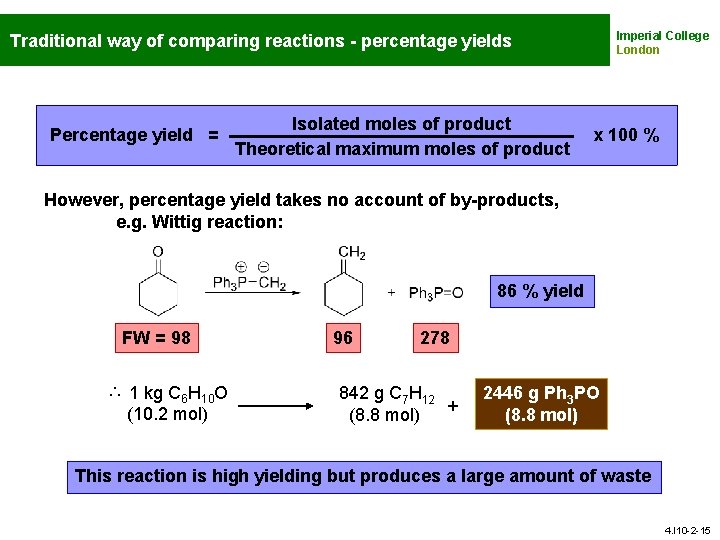
Imperial College London Traditional way of comparing reactions - percentage yields Percentage yield = Isolated moles of product Theoretical maximum moles of product x 100 % However, percentage yield takes no account of by-products, e. g. Wittig reaction: 86 % yield FW = 98 ∴ 1 kg C 6 H 10 O (10. 2 mol) 96 278 842 g C 7 H 12 + (8. 8 mol) 2446 g Ph 3 PO (8. 8 mol) This reaction is high yielding but produces a large amount of waste 4. I 10 -2 -15
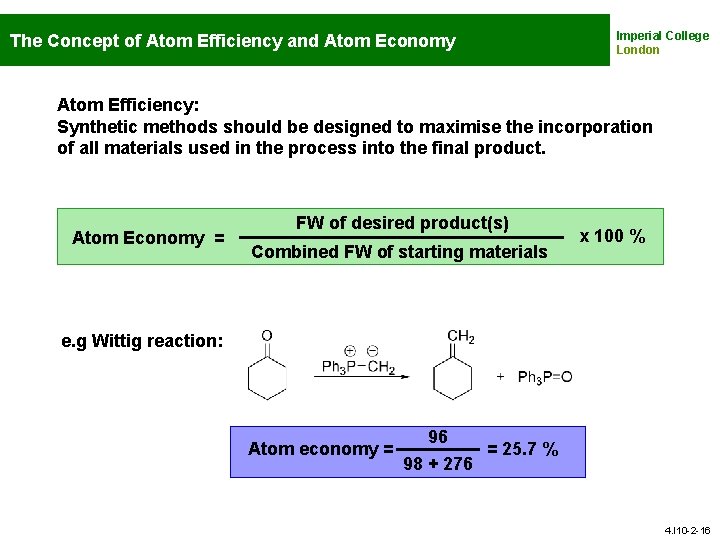
The Concept of Atom Efficiency and Atom Economy Imperial College London Atom Efficiency: Synthetic methods should be designed to maximise the incorporation of all materials used in the process into the final product. Atom Economy = FW of desired product(s) Combined FW of starting materials x 100 % e. g Wittig reaction: Atom economy = 96 = 25. 7 % 98 + 276 4. I 10 -2 -16
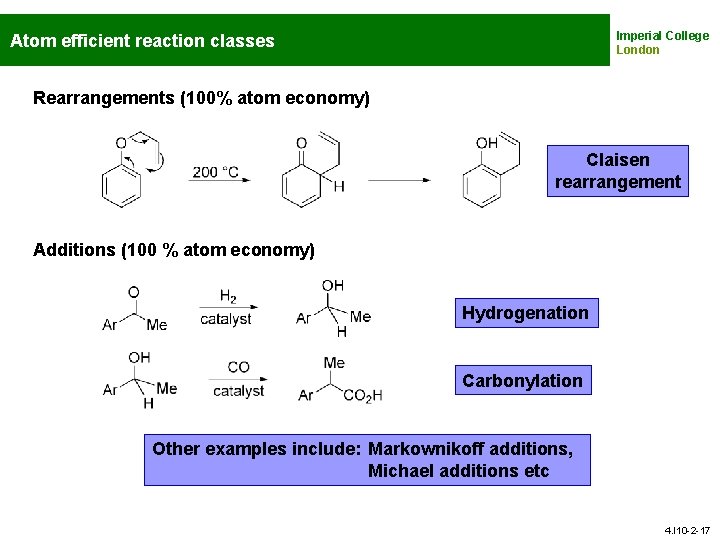
Imperial College London Atom efficient reaction classes Rearrangements (100% atom economy) Claisen rearrangement Additions (100 % atom economy) Hydrogenation Carbonylation Other examples include: Markownikoff additions, Michael additions etc 4. I 10 -2 -17
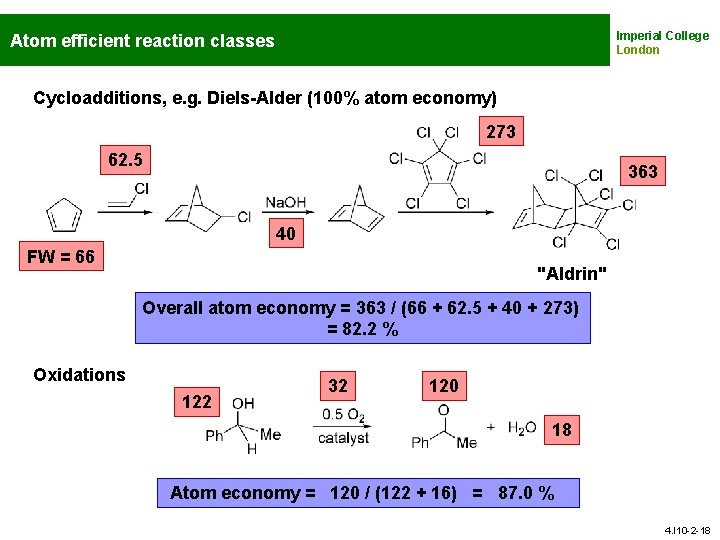
Imperial College London Atom efficient reaction classes Cycloadditions, e. g. Diels-Alder (100% atom economy) 273 62. 5 363 40 FW = 66 "Aldrin" Overall atom economy = 363 / (66 + 62. 5 + 40 + 273) = 82. 2 % Oxidations 122 32 120 18 Atom economy = 120 / (122 + 16) = 87. 0 % 4. I 10 -2 -18
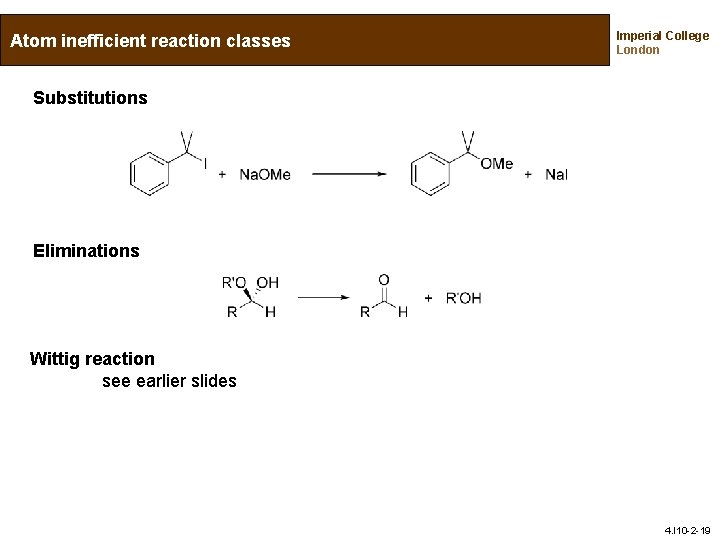
Atom inefficient reaction classes Imperial College London Substitutions Eliminations Wittig reaction see earlier slides 4. I 10 -2 -19
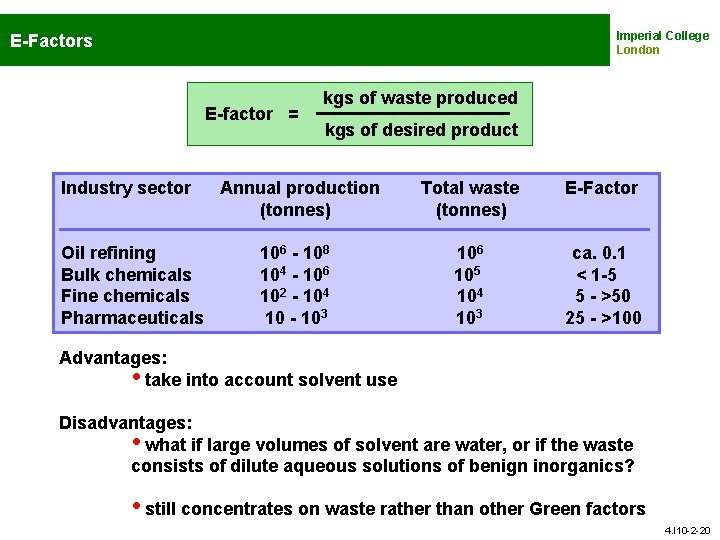
Imperial College London E-Factors E-factor = Industry sector Oil refining Bulk chemicals Fine chemicals Pharmaceuticals kgs of waste produced kgs of desired product Annual production (tonnes) Total waste (tonnes) E-Factor 106 - 108 104 - 106 102 - 104 10 - 103 106 105 104 103 ca. 0. 1 < 1 -5 5 - >50 25 - >100 Advantages: • take into account solvent use Disadvantages: • what if large volumes of solvent are water, or if the waste consists of dilute aqueous solutions of benign inorganics? • still concentrates on waste rather than other Green factors 4. I 10 -2 -20
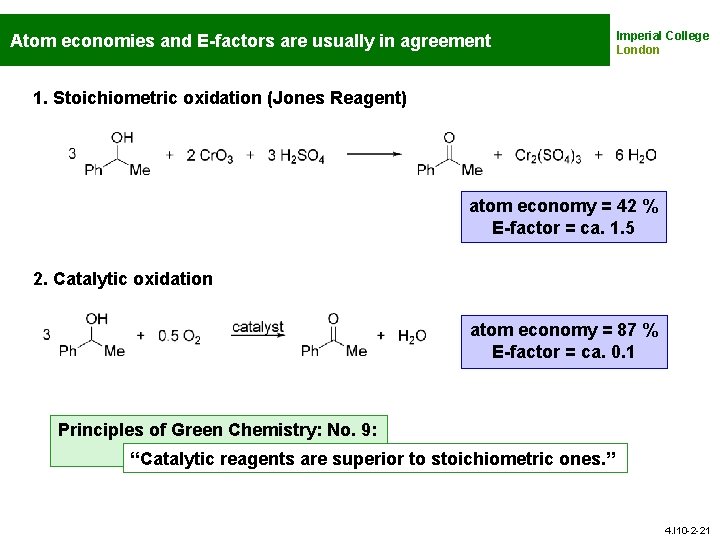
Atom economies and E-factors are usually in agreement Imperial College London 1. Stoichiometric oxidation (Jones Reagent) atom economy = 42 % E-factor = ca. 1. 5 2. Catalytic oxidation atom economy = 87 % E-factor = ca. 0. 1 Principles of Green Chemistry: No. 9: “Catalytic reagents are superior to stoichiometric ones. ” 4. I 10 -2 -21
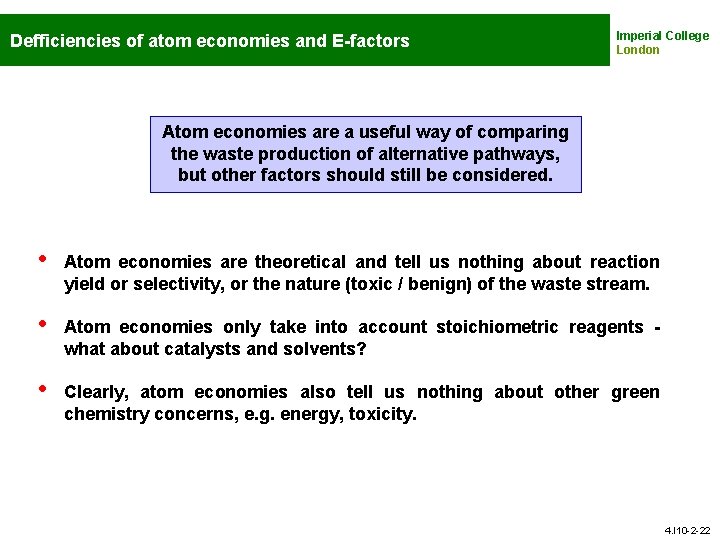
Defficiencies of atom economies and E-factors Imperial College London Atom economies are a useful way of comparing the waste production of alternative pathways, but other factors should still be considered. • Atom economies are theoretical and tell us nothing about reaction yield or selectivity, or the nature (toxic / benign) of the waste stream. • Atom economies only take into account stoichiometric reagents what about catalysts and solvents? • Clearly, atom economies also tell us nothing about other green chemistry concerns, e. g. energy, toxicity. 4. I 10 -2 -22
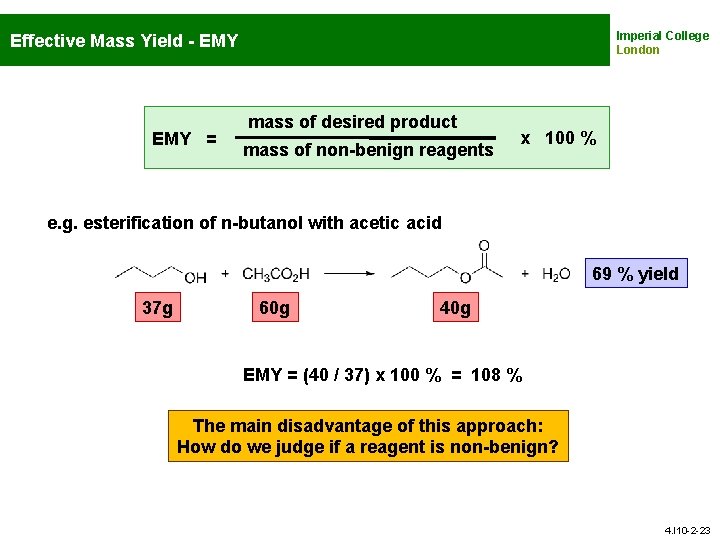
Imperial College London Effective Mass Yield - EMY = mass of desired product mass of non-benign reagents x 100 % e. g. esterification of n-butanol with acetic acid 69 % yield 37 g 60 g 40 g EMY = (40 / 37) x 100 % = 108 % The main disadvantage of this approach: How do we judge if a reagent is non-benign? 4. I 10 -2 -23
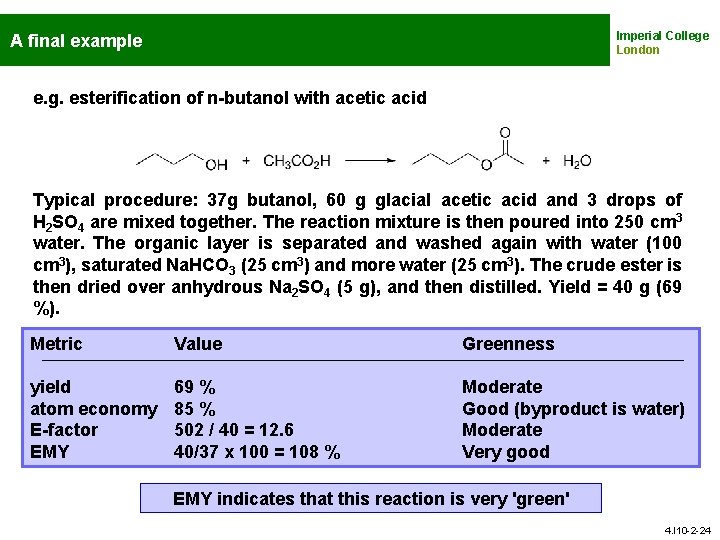
Imperial College London A final example e. g. esterification of n-butanol with acetic acid Typical procedure: 37 g butanol, 60 g glacial acetic acid and 3 drops of H 2 SO 4 are mixed together. The reaction mixture is then poured into 250 cm 3 water. The organic layer is separated and washed again with water (100 cm 3), saturated Na. HCO 3 (25 cm 3) and more water (25 cm 3). The crude ester is then dried over anhydrous Na 2 SO 4 (5 g), and then distilled. Yield = 40 g (69 %). Metric Value Greenness yield atom economy E-factor EMY 69 % 85 % 502 / 40 = 12. 6 40/37 x 100 = 108 % Moderate Good (byproduct is water) Moderate Very good EMY indicates that this reaction is very 'green' 4. I 10 -2 -24
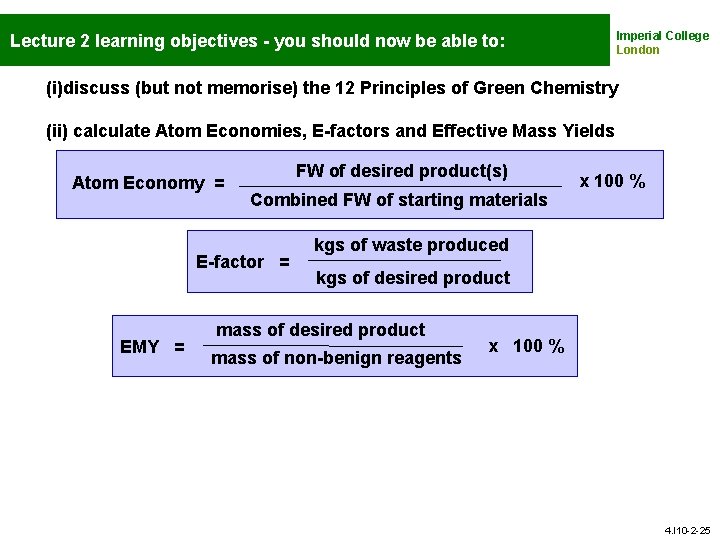
Imperial College London Lecture 2 learning objectives - you should now be able to: (i)discuss (but not memorise) the 12 Principles of Green Chemistry (ii) calculate Atom Economies, E-factors and Effective Mass Yields Atom Economy = FW of desired product(s) Combined FW of starting materials E-factor = EMY = x 100 % kgs of waste produced kgs of desired product mass of non-benign reagents x 100 % 4. I 10 -2 -25
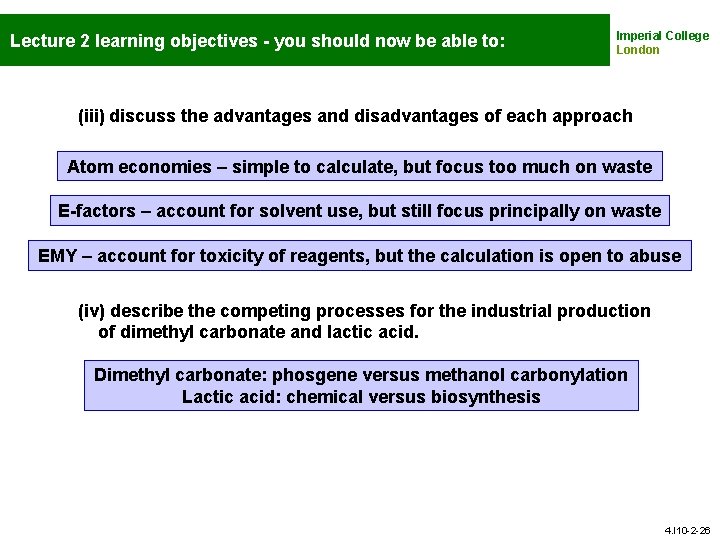
Lecture 2 learning objectives - you should now be able to: Imperial College London (iii) discuss the advantages and disadvantages of each approach Atom economies – simple to calculate, but focus too much on waste E-factors – account for solvent use, but still focus principally on waste EMY – account for toxicity of reagents, but the calculation is open to abuse (iv) describe the competing processes for the industrial production of dimethyl carbonate and lactic acid. Dimethyl carbonate: phosgene versus methanol carbonylation Lactic acid: chemical versus biosynthesis 4. I 10 -2 -26
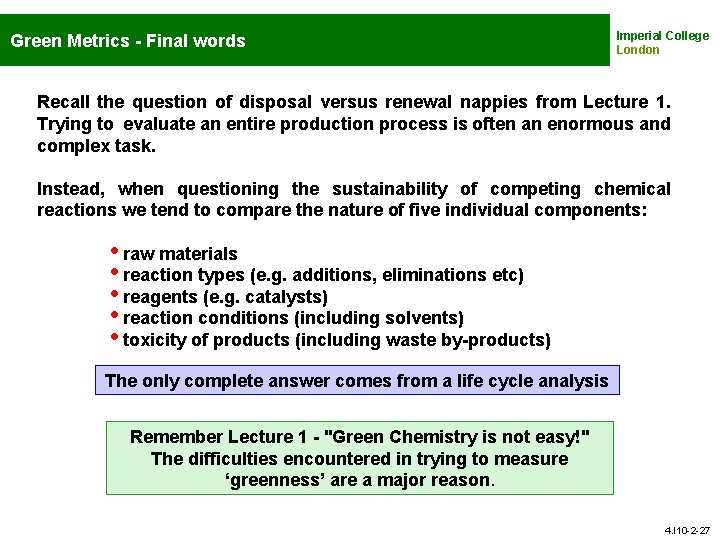
Green Metrics - Final words Imperial College London Recall the question of disposal versus renewal nappies from Lecture 1. Trying to evaluate an entire production process is often an enormous and complex task. Instead, when questioning the sustainability of competing chemical reactions we tend to compare the nature of five individual components: • raw materials • reaction types (e. g. additions, eliminations etc) • reagents (e. g. catalysts) • reaction conditions (including solvents) • toxicity of products (including waste by-products) The only complete answer comes from a life cycle analysis Remember Lecture 1 - "Green Chemistry is not easy!" The difficulties encountered in trying to measure ‘greenness’ are a major reason. 4. I 10 -2 -27
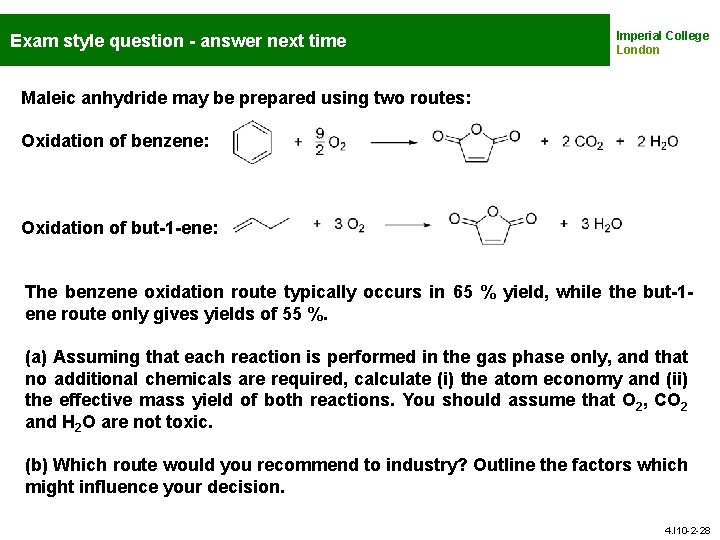
Exam style question - answer next time Imperial College London Maleic anhydride may be prepared using two routes: Oxidation of benzene: Oxidation of but-1 -ene: The benzene oxidation route typically occurs in 65 % yield, while the but-1 ene route only gives yields of 55 %. (a) Assuming that each reaction is performed in the gas phase only, and that no additional chemicals are required, calculate (i) the atom economy and (ii) the effective mass yield of both reactions. You should assume that O 2, CO 2 and H 2 O are not toxic. (b) Which route would you recommend to industry? Outline the factors which might influence your decision. 4. I 10 -2 -28