Humongous Insurance Euthanasia SOPs and Legal Issues Presented
- Slides: 96
Humongous Insurance Euthanasia – SOPs and Legal Issues Presented by Wendy Blount, D. V. M.
Legal – DEA, DPS • DEA = Drug Enforcement Agency – – Under the Department of Justice At one DEA license per shelter premise Renewed every 3 years - $850 for vets Every person who handles controlled drugs is required to register (USC. 21. 13 C. 822) • Texas DPS = Department of Public Safety – Issued state licenses for controlled drugs until last year ($25 per year) – These are no longer necessary, as this jurisdiction was transferred to the Pharmacy Board – Used to be only one vet per location needed a DEA license, but all needed DPS license – Now all vets who handle controlled drugs need a DEA license 2 CONFIDENTIAL
Legal – TBVME • TBVME = Texas Board of Veterinary Medical Examiners – Pharmacy Board delegates to TBVME enforcement of prescription and controlled drug use infractions, when treating animals with drugs – Because shelters care for sick animals, they have to deal with the Vet Board – Shelter staff must take care to avoid violating laws which prohibit practicing medicine without a license – Administration of any vaccine or drug (OTC, prescription, controlled) to any animal you do not own is defined as the practice of veterinary medicine (Vet Act 801. 002(5) ) 3 CONFIDENTIAL
Legal – DEA, DPS • Texas DSHS (Dept of State Health Services) – Requires that euthanasia at animal shelters be performed only by a veterinarian or a trained euthanasia technician – Training must take place within 120 days of employment – Re-training every three years – Fewer hours required for renewal – Violation is a Class B Misdemeanor – Texas Health & Safety Code – Section 821 Subchapter C - Euthanasia 12 CONFIDENTIAL
Legal – DEA, DPS • Types of Medicines – Over the counter (OTC) Drugs • Regulated by the FDA • No prescription required • Treat things that will usually resolve on their own eventually • Capstar®, ivermectin, Safeguard® – Legend Drugs (aka Dangerous Drugs) – • require a prescription • Regulated by the FDA • Antibiotics, NSAID pain medicines • Controlled drugs are a special type of legend drug that must be logged 13 CONFIDENTIAL
Legal – DEA, DPS • Types of Medicines – Biologics (vaccines) – • no prescription required • Regulated by the USDA • Texas requires rabies vaccine given under direct supervision of a DVM • Direct supervision = on the premise – Pesticides • Regulated by the EPA • Using in a way other than on the label is illegal 14 CONFIDENTIAL
Legal – DEA, DPS • Controlled Substances – Schedules I-V indicate decreasing control and likelihood of abuse or dependence – I – can not be possessed legally without permission from DEA (heroin, cocaine, etc. ), no medical use – II – sodium pentobarbital (Soccumb, Fatal Plus, Sleepaway). Must be ordered with a special DEA form. – III - pentobarbital + phenytoin (Beuthanasia, Euthasol, Somnasol) • Also pentobarbital + lidocaine + paralyzing agent (T-61 – available in Canada) – IV - diazepam – V – Robitussin and Lomotil 15 drug log on V CONFIDENTIAL • Don’t need to keep
Legal – DEA, DPS • Additives to Schedule III euthanasia solutions – Phenytoin – Beuthanasia, Somnosol, Euthasol • Antiseizure and muscle relaxant can smooth the process when owner present • Thick solution – use a 20 g needle – Lidocaine –FP 3 (Fatal Plus 3) • Local anesthetic can aid in prevention pain if extravasated • Abuse potential less – causes heart arrhythmias • Dilates blood vessels to quicken absorption after IP injection 16 CONFIDENTIAL
Legal – DEA, DPS • Controlled drugs I-IV must be under lock and key at all times • Failure to secure drugs and prevent theft can result in prosecution of the DEA licensee – Also failure to report missing drugs • Direct Licensing – In some states including Texas, shelters can hold a DEA license limited to sodium pentobarbital (schedule IIN or IIA) 17 CONFIDENTIAL
Other Legal Issues • Animal Ownership – shelter must be the legal owner, or have signed permission from the owner for euthanasia (surrender suggested) • Wildlife – euthanized at shelter’s discretion • Good Samaritan laws in Texas allow veterinarians and trained euthanasia techs at releasing agencies to administer euthanasia to animals they do not own during the stray hold period • Local policies and laws that establish ownership by the shelter on intake can make things less complicated – Policies should also ensure the stray hold period and ensure ownership reclaim during that period 18 CONFIDENTIAL
Allowable Methods of Euthanasia Texas Administrative Code, TITLE 25 HEALTH SERVICES. PART 1 DEPARTMENT OF STATE HEALTH SERVICES, CHAPTER 169 ZOONOSIS CONTROL, SUBCHAPTER D STANDARDS FOR ALLOWABLE METHODS OF EUTHANASIA FOR ANIMALS IN THE CUSTODY OF AN ANIMAL SHELTER RULE § 169. 84 Allowable Methods of Euthanasia • Only pentobarbital may be used to euthanize a dog or cat in the custody of an animal shelter. • IV is preferred, then IP • Also allowed – intraosseous, intraorgan (heart, liver, spleen, kidney) – Only if unconscious • New, sterile needle for each animal • Out of view of members of the public and other animals except mother 19 and litter CONFIDENTIAL
Allowable Methods of Euthanasia Texas Administrative Code, TITLE 25 HEALTH SERVICES. PART 1 DEPARTMENT OF STATE HEALTH SERVICES, CHAPTER 169 ZOONOSIS CONTROL, SUBCHAPTER D STANDARDS FOR ALLOWABLE METHODS OF EUTHANASIA FOR ANIMALS IN THE CUSTODY OF AN ANIMAL SHELTER RULE § 169. 84 Allowable Methods of Euthanasia • Euthanize mother first followed immediately by the litter • Remove carcasses prior to entry of live animal • Quiet location with sufficient lighting for visual accuracy • Use appropriate dose (IP 3 -4 x IV) • Place animal in quiet place with no contact with other animals after IP injection – OK to leave littermates together + with mother 20 CONFIDENTIAL
Allowable Methods of Euthanasia Texas Administrative Code, TITLE 25 HEALTH SERVICES. PART 1 DEPARTMENT OF STATE HEALTH SERVICES, CHAPTER 169 ZOONOSIS CONTROL, SUBCHAPTER D STANDARDS FOR ALLOWABLE METHODS OF EUTHANASIA FOR ANIMALS IN THE CUSTODY OF AN ANIMAL SHELTER RULE § 169. 84 Allowable Methods of Euthanasia • Dispose of carcasses to minimize scavenging by wildlife (Article – fined tens of thousands $$$) • Species other than dogs and cats euthanized according to most recent AVMA Guidelines on Euthanasia (2013) • minimize the fear, anxiety, and distress of the animal • Monitor from injection to death • Death must be confirmed prior to disposal 21 CONFIDENTIAL
Drug Law Exceptions for Shelters Allows Direct DEA Licensing for shelters Texas Health & Safety Code – Section 481. 111. Texas Controlled Substance Act Exemptions The provisions of this chapter relating to the possession of denatured sodium pentobarbital do not apply to possession by personnel of a humane society or an animal control agency for the purpose of destroying injured, sick, homeless, or unwanted animals if the humane society or animal control agency is registered with the DEA. 22 CONFIDENTIAL
Drug Law Exceptions for Shelters Allows municipal shelters to have certain uncontrolled dangerous prescription drugs such as xylazine and acepromazine HEALTH AND SAFETY CODE TITLE 6. FOOD, DRUGS, ALCOHOL, AND HAZARDOUS SUBSTANCES SUBTITLE C. SUBSTANCE ABUSE REGULATION AND CRIMES CHAPTER 483. DANGEROUS DRUGS Sec. 483. 041. POSSESSION OF DANGEROUS DRUG. • Subsection (a) does not apply to the possession of a dangerous drug in the usual course of business or practice or in the performance of official duties by the following persons or an agent or employee of the person: …(5) an officer or employee of the federal, state, or local government; 23 CONFIDENTIAL
Drug Logs and Safes One running log for all euthanasia drugs • bottles added to inventory as they arrive • Subtractions as drug is used • Nearly impossible to alter Separate page for each bottle of drug • Easier to keep up with, as each bottle has a definitive beginning and end • Sample Daily Drug Log • Sample Drug Inventory Log 24 CONFIDENTIAL
Drug Logs and Safes • • Log book should be bound – 3 -ring binders discouraged Each page is numbered so pages can not be easily removed Using front & back of pages makes altering difficult Digital logs save time, but can be easier to alter if no login with each entry – Software login timeout is crucial – Software can track who did what when • Though not required, it’s a good idea to lock the drug log book up – ideally 25 CONFIDENTIAL separately from drugs
Drug Logs and Safes Daily drug log sheets must contain for each entry: • date • Pet owner and name/ID • Description – species (breed, color) • (Purpose of drug used) • Amount used • Balance on hand after each use • Name of person administering the drug 26 CONFIDENTIAL
Drug Logs and Safes • DEA requires keeping controlled drug logs for 2 years – Texas Veterinary Practice Act (Board Rule 573. 50) requires 5 years if vet is the licensee • All drugs must be entered into the log when they arrive • All drugs must be entered into the log as used • Accessed only by designated personnel – Texas requires Euthanasia Training – Must keep a running list of those with access 27 CONFIDENTIAL
Drug Logs and Safes • Main supply should be in a substantially constructed safe – – Heavier than 750 pounds is recommended Combination and key is ideal Swipe cards keep log of every access Drug inventory log can be used here • Daily supply can be in a double locked metal box – Daily drug log used here • All safes securely locked AT ALL TIMES – Secured to floor, wall or vehicle interior – Make them difficult to find – Mark Keys “Do Not Duplicate” 28 CONFIDENTIAL
Drug Inventory • 6 month supply should be kept on hand in the main safe, to avoid back orders • DEA requires inventory every 2 years (form 1 form 2) • I recommend monthly inventory • Many businesses with DEA license deal with drug diversion sooner or later – Personal use – To sell • Frequent inventory will allow you to deal swiftly with diversion 29 CONFIDENTIAL
Drug Inventory • What are the red flags of drug diversion? – Unexplained employee absences – Anxious to take breaks – Ineffective drugs – diluted • Colored drugs allow detections of dilution • Sleepaway is clear (can add B 12 to color pink) – Single employee responsible for controlled drug inventory • Never takes vacations • may appear to be the most reliable employee 30 CONFIDENTIAL
Written Euthanasia Protocol – Why? • Ensures consistency in humane treatment and safe handling of animals • Relieves stress of decision making for euthanasia candidate selection • Establishes a document to refer to in case of public relations issues or shelter conflict • Ensures that personnel are properly trained, supported and protected from injury • Provides a process for preventing and dealing with euthanasia related stress 31 CONFIDENTIAL
Written Euthanasia Protocol – Why? • ensures that staff is aware of local, state and federal laws, and obeys them. • educates the euthanasia techs about proper euthanasia procedures, and helps them develop confidence with experience, which in turn reduces stress. 32 CONFIDENTIAL
Protocol Components • Euth Tech Selection Criteria • Euth Tech training and re-training • Animal Selection Criteria and process for selection • SOP for euthanasia process • Required equipment • Drug Logs and Euthanasia Room Maintenance Logs • Emergency Protocols • Grievance Process • Compassion Fatigue Programs 33 CONFIDENTIAL
Protocol Components • Provision for regular review and revision of the euthanasia protocol – Yearly is good • Consequences for failing to follow policies • The policy should be made public – Post it on your website or facebook page 34 CONFIDENTIAL
Euthanasia Tech Selection • • • Criminal background check Drug Test Check references!!! Selected by a panel of supervisors Periodically evaluate suitability for the job – Circumstances can change 35 CONFIDENTIAL
Killing Caring Paradox • Those who care the most and are most likely to be hurt by performing euthanasia are precisely those who will do it with the most skill • Those who care the least and are least likely to be hurt by performing euthanasia are the least likely to perform the task well • Those who care for the animals at the shelter and bond with them are often the same people who are asked to kill them when the time comes 36 CONFIDENTIAL
Euthanasia Tech Training • On the job training – shadowing and supervision, until certified by supervisor to work without supervision • Opportunity for Feedback – Trainee to trainer – Trainer to trainee • There is no substitute for experience – Those who are skilled at venipuncture got that way by doing it many times over and over – Everyone starts as a beginner – This course teaches what you need to know to begin to develop your skills 37 CONFIDENTIAL
Euthanasia Tech Training • AHA Guidelines - requirements for unsupervised euthanasia techs – – At least 3 months employment at the shelter Completion of a euthanasia certification course One month as a trainee Practical exam by a panel of experienced euthanasia techs at the shelter – Yearly performance review 38 CONFIDENTIAL
Selection of Animals • Best if decision is made by a panel rather than one person – Reduces stress on shelter workers – Makes decision somewhat more objective • Committee with an odd number of people is ideal • Anonymous voting might be appropriate for the difficult cases • Sample Euthanasia Selection Flow Chart 39 CONFIDENTIAL
Selection of Animals • Animal criteria to be considered – Age, condition and medical issues – Behavioral issues – more than one evaluation by more than one person if possible – Shelter space, population and resources • Would others be better off if chosen to live? – What quality of life can the shelter provide? • Is the animal better off at the shelter than where it came from? – Does the animal put other animals or people at risk? – Demand for pets – owners or foster care – Owner request 40 CONFIDENTIAL
Selection of Animals • Euthanasia Selection Protocol should include – “Stray hold period” • number of days that strays must be held prior to being considered for adoption – “Minimum adoptive period” • minimum time on the adoption floor for adoptable animals prior to considering euthanasia – Exceptions for humane euthanasia of severely ill or injured animals – Method to resolve controversy over whether a particular animal will be euthanized 41 CONFIDENTIAL
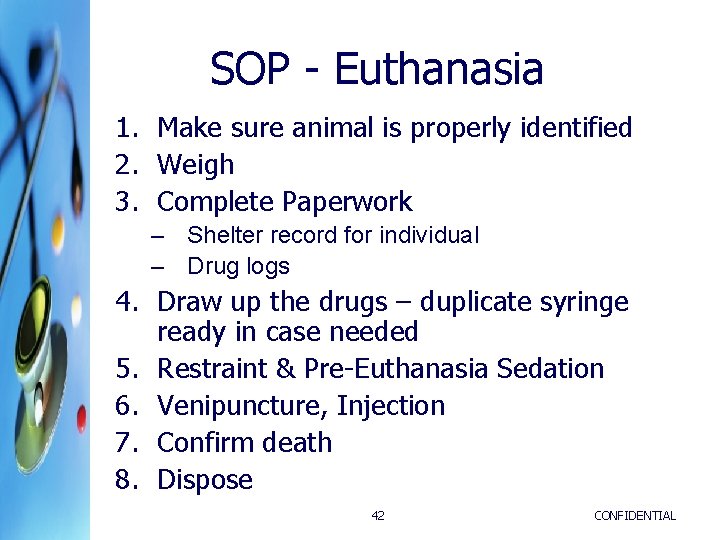
SOP - Euthanasia 1. Make sure animal is properly identified 2. Weigh 3. Complete Paperwork – Shelter record for individual – Drug logs 4. Draw up the drugs – duplicate syringe ready in case needed 5. Restraint & Pre-Euthanasia Sedation 6. Venipuncture, Injection 7. Confirm death 8. Dispose 42 CONFIDENTIAL
SOP - Euthanasia Sample SOPs • 4 ACT • HSUS – Rescue Group SOP • ASPCA – Detailed Open Admission Shelter SOP Article: John Katz – I Chose a Child’s face Over My Dog 43 CONFIDENTIAL
Animal Identification • • Check breed, color, weight and sex against record Check shelter ID collar if present Check for pet/owner ID tags on collar** Check for identifying tattoo** Scan for microchip one more time** If IDs found, attempt to contact owner** If owner request, confirm that Euthanasia Consent or surrender form is signed • Required by law** (TAC-25. 1. 169 D§ 169. 83 ) 44 CONFIDENTIAL
Euthanasia Room Logs • • • Clean and Disinfect after each session Re-stock after each session Update Order List and Wish List Accident Report Log SDS and OSHA Right to Know Station – Zoonosis information – SDS for each hazardous chemical used – Make sure containers of hazardous materials are properly labeled • Controlled Drug Logs 45 CONFIDENTIAL
Restraint Protocol • Effective restraint requires experience – For some animals, less restraint is more effective and less stressful – Not enough restraint can allow injury – Experience tells you how much is needed – A quiet environment and calm people can go along way to minimizing the need for restraint – Euthanasia should never be performed alone • minimum 2 people • 1 Euth tech and one assistant 46 CONFIDENTIAL
Restraint Protocol • Fractious animals may need to be sedated or even anesthetized prior to euthanasia, by IM injection – To decrease the animal’s distress – To ensure safety for the personnel – To make the IV, IP or IC injection easier to achieve • You will probably need to work with a vet to get sedation drugs, especially if using controlled drugs for sedation 47 CONFIDENTIAL
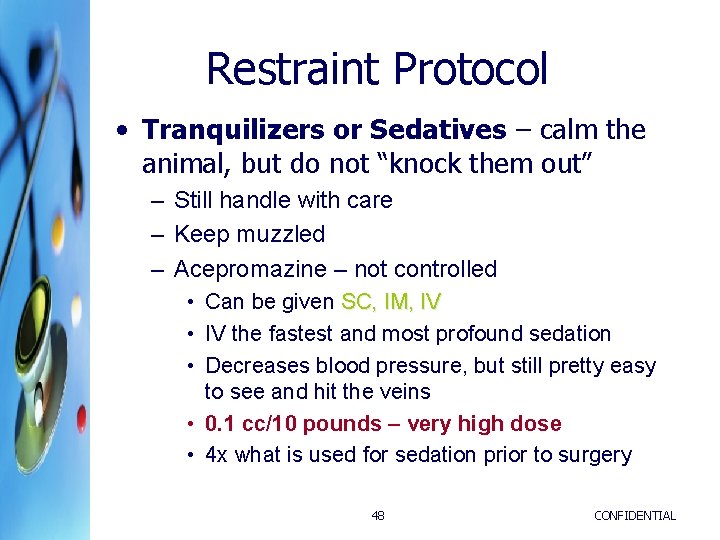
Restraint Protocol • Tranquilizers or Sedatives – calm the animal, but do not “knock them out” – Still handle with care – Keep muzzled – Acepromazine – not controlled • Can be given SC, IM, IV • IV the fastest and most profound sedation • Decreases blood pressure, but still pretty easy to see and hit the veins • 0. 1 cc/10 pounds – very high dose • 4 x what is used for sedation prior to surgery 48 CONFIDENTIAL
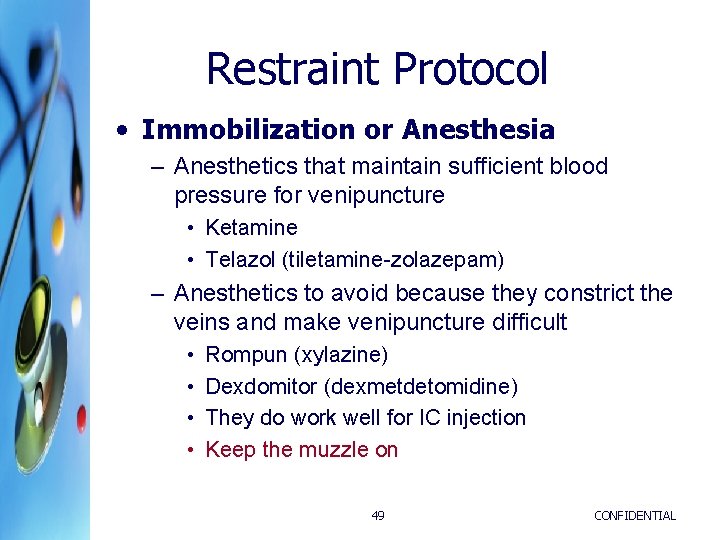
Restraint Protocol • Immobilization or Anesthesia – Anesthetics that maintain sufficient blood pressure for venipuncture • Ketamine • Telazol (tiletamine-zolazepam) – Anesthetics to avoid because they constrict the veins and make venipuncture difficult • • Rompun (xylazine) Dexdomitor (dexmetdetomidine) They do work well for IC injection Keep the muzzle on 49 CONFIDENTIAL
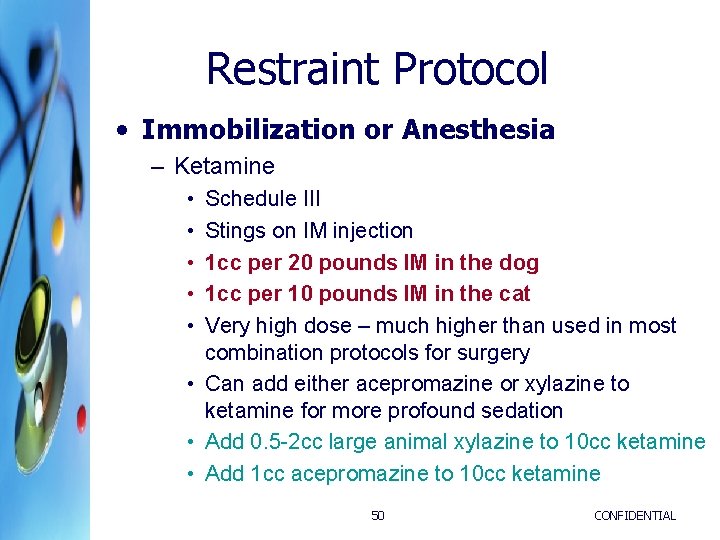
Restraint Protocol • Immobilization or Anesthesia – Ketamine • • • Schedule III Stings on IM injection 1 cc per 20 pounds IM in the dog 1 cc per 10 pounds IM in the cat Very high dose – much higher than used in most combination protocols for surgery • Can add either acepromazine or xylazine to ketamine for more profound sedation • Add 0. 5 -2 cc large animal xylazine to 10 cc ketamine • Add 1 cc acepromazine to 10 cc ketamine 50 CONFIDENTIAL
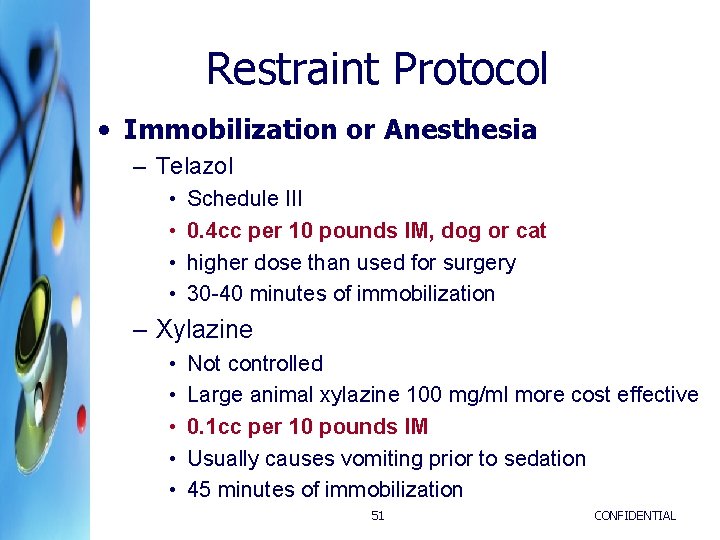
Restraint Protocol • Immobilization or Anesthesia – Telazol • • Schedule III 0. 4 cc per 10 pounds IM, dog or cat higher dose than used for surgery 30 -40 minutes of immobilization – Xylazine • • • Not controlled Large animal xylazine 100 mg/ml more cost effective 0. 1 cc per 10 pounds IM Usually causes vomiting prior to sedation 45 minutes of immobilization 51 CONFIDENTIAL
Restraint Protocol • Sedation or Anesthesia prior to euthanasia can smooth the process – good for owner present euthanasia – Prevents agonal gasping which can be very disturbing to the owner – Can sedate with acepromazine first – can use butterfly catheter, to easily change IV injection syringes 52 CONFIDENTIAL
Restraint Protocol • Euthanasia solutions that contain sedative phenytoin in addition to pentobarbital are smoother – Beuthanasia, Euthasol, Somnasol (schedule III) – These solutions are bright pink 53 CONFIDENTIAL
Euthanasia Room & Equipment • Quiet Room away from the public and the bustle of the shelter, distraction free – Dismantle PA system here – Turn off phone ringers when euthanizing – Single purpose room prevents interruptions • Soothing environment – Some like colorful murals, and others find them not serious enough – Some like music, and others prefer silence – Natural light is nice – sky lights (no windows) – Comfortable temperature and good ventilation 54 CONFIDENTIAL
Euthanasia Room & Equipment • Good lighting essential to visualize veins – Surgery light works well • “Do Not Knock, Do Not Enter” Signal when euthanasia in process – Red dark room light won’t alert those who don’t need to know – “Quiet Please” sign on door – If door locked, make sure key is readily available in case of emergency 55 CONFIDENTIAL
Euthanasia Room & Equipment • Easy access to body disposal – Exit to vehicle parking is convenient when owners want to pick up body • Shelter animals should not observe euthanasia of other animals, or see bodies • AHA recommends minimum room size 10 x 12 feet – Room to euthanize large dogs on the floor • Sink with hot and cold water & hand soap • Hand sanitizer is also nice 56 CONFIDENTIAL
Euthanasia Room & Equipment • Separate quiet, small room with cages is great for animals already injected IP • Insulated doors keep disturbing noise out and euthanasia noise in • Comfortable elevated table – Hydraulic lift is nice – Easy to clean after each use • Storage in room for all needed supplies • Lock box for controlled drugs 57 CONFIDENTIAL
Euthanasia Room & Equipment • Restraint gate for fractious large dogs – Kennel door parallel to a wall with 3 -4 inch gap • Squeeze cage for fractious small dogs and cats • Walk on Scale for accurate weight • Microchip Scanner • Clippers – Allow better visualization of veins – But frightens some animals (especially cats) • Tourniquets if desired (rubber band, hemostat) – Some prefer to have an assistant hold off the vein 58 CONFIDENTIAL
Euthanasia Room & Equipment • Restraint equipment • Needles, Catheters, Syringes • Alcohol and cotton balls or gauze to wet down fur to help visualize veins • Nitrile exam gloves to protect providers • Calculator for drug doses • Drugs for pre-euthanasia sedation • Euthanasia room Logs and Euthanasia Protocol • Equipment to check vital signs and reflexes – Stethoscope (good quality – Littman is good) – Penlight – Hemostats 59 CONFIDENTIAL
Euthanasia Room & Equipment • Cadaver bags and materials used to identify the individual bodies • Body storage – – Transport cart Freezer Vehicle Incinerator • First Aid Kit • Eye wash station 60 CONFIDENTIAL
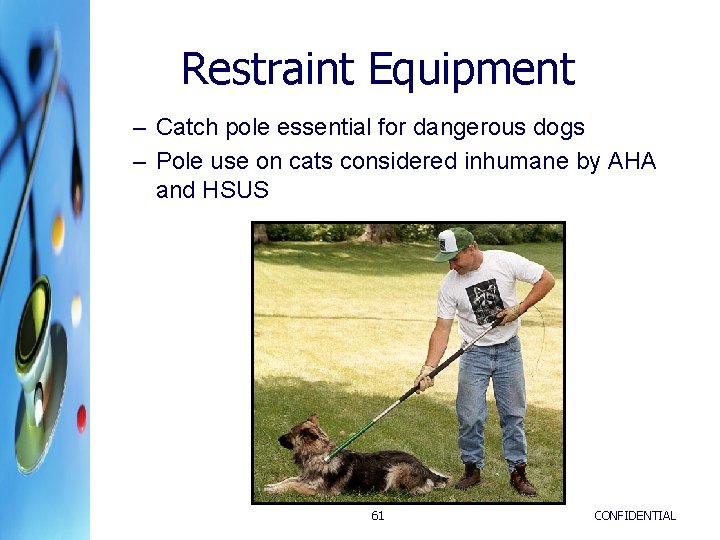
Restraint Equipment – Catch pole essential for dangerous dogs – Pole use on cats considered inhumane by AHA and HSUS 61 CONFIDENTIAL
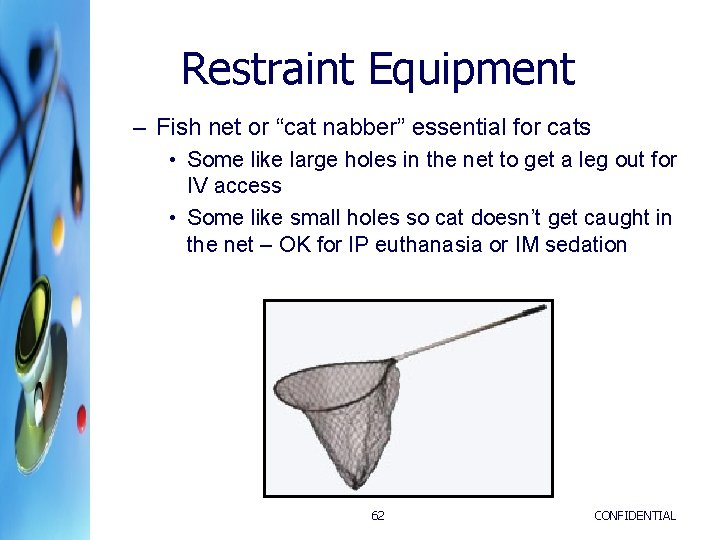
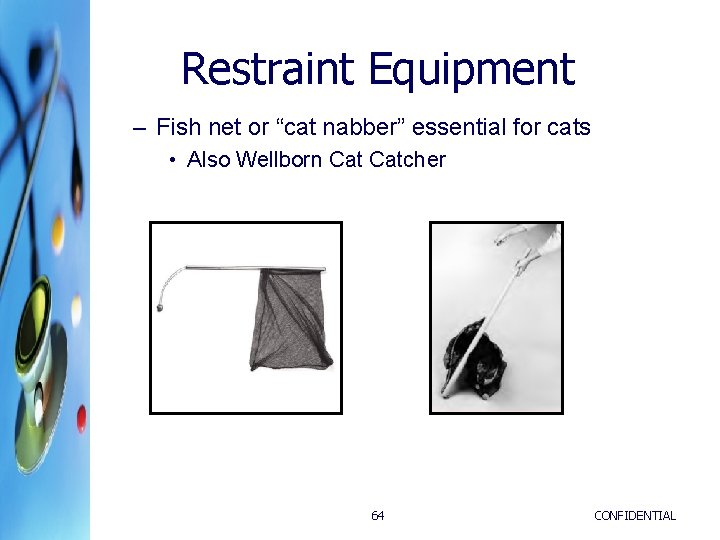
Restraint Equipment – Fish net or “cat nabber” essential for cats • Some like large holes in the net to get a leg out for IV access • Some like small holes so cat doesn’t get caught in the net – OK for IP euthanasia or IM sedation 62 CONFIDENTIAL
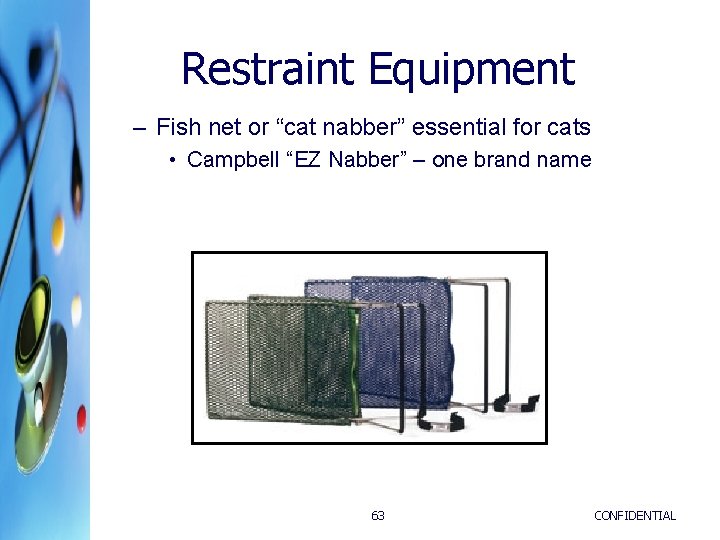
Restraint Equipment – Fish net or “cat nabber” essential for cats • Campbell “EZ Nabber” – one brand name 63 CONFIDENTIAL
Restraint Equipment – Fish net or “cat nabber” essential for cats • Also Wellborn Catcher 64 CONFIDENTIAL
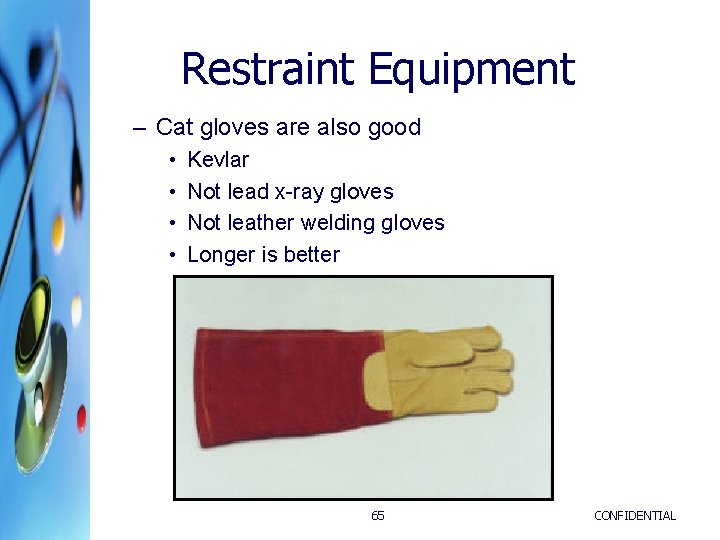
Restraint Equipment – Cat gloves are also good • • Kevlar Not lead x-ray gloves Not leather welding gloves Longer is better 65 CONFIDENTIAL
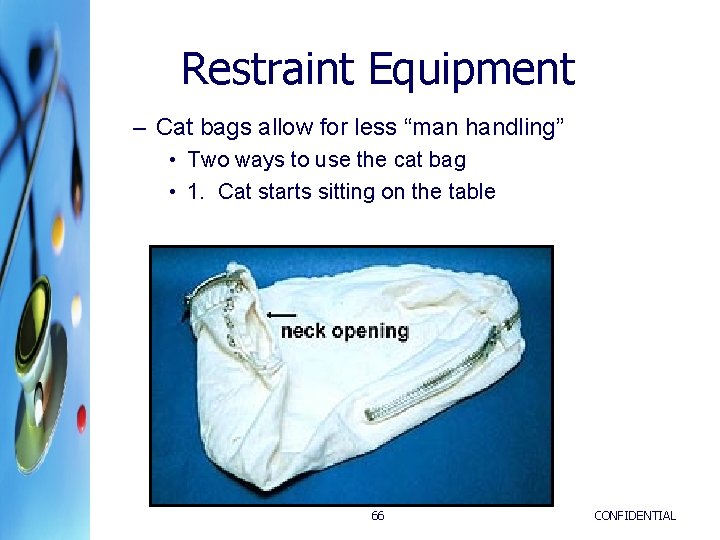
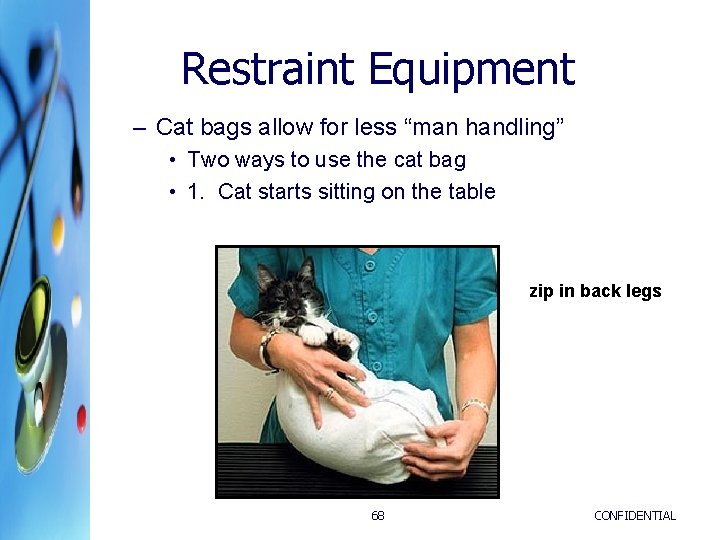
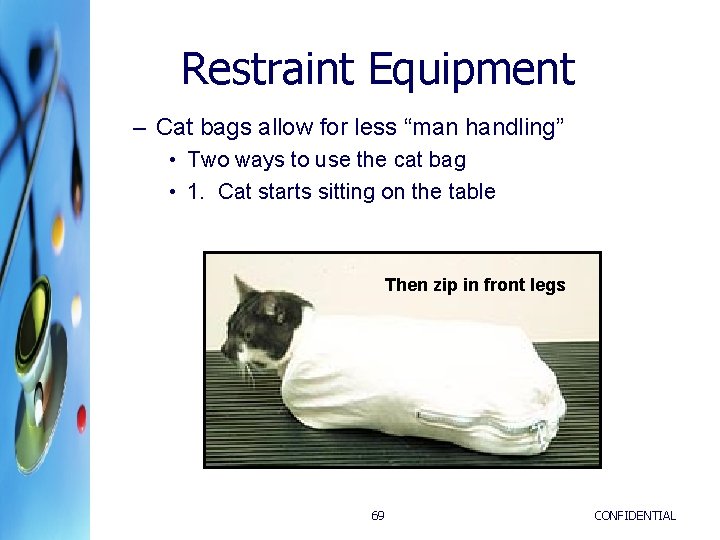
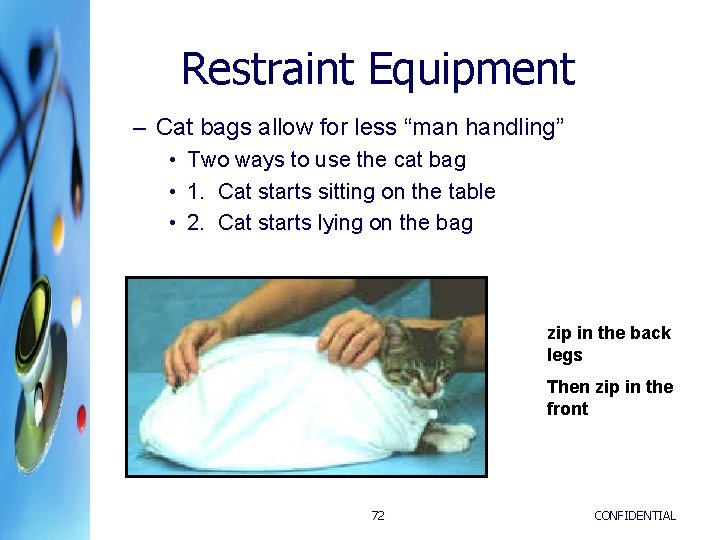
Restraint Equipment – Cat bags allow for less “man handling” • Two ways to use the cat bag • 1. Cat starts sitting on the table 66 CONFIDENTIAL
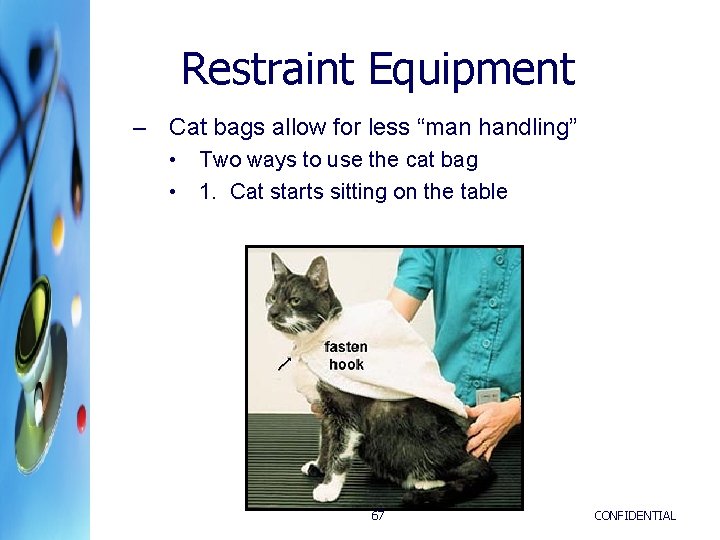
Restraint Equipment – Cat bags allow for less “man handling” • Two ways to use the cat bag • 1. Cat starts sitting on the table 67 CONFIDENTIAL
Restraint Equipment – Cat bags allow for less “man handling” • Two ways to use the cat bag • 1. Cat starts sitting on the table zip in back legs 68 CONFIDENTIAL
Restraint Equipment – Cat bags allow for less “man handling” • Two ways to use the cat bag • 1. Cat starts sitting on the table Then zip in front legs 69 CONFIDENTIAL
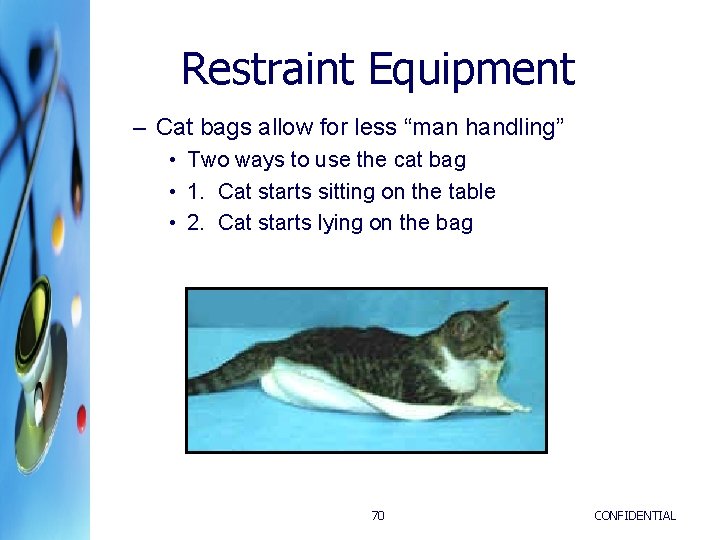
Restraint Equipment – Cat bags allow for less “man handling” • Two ways to use the cat bag • 1. Cat starts sitting on the table • 2. Cat starts lying on the bag 70 CONFIDENTIAL
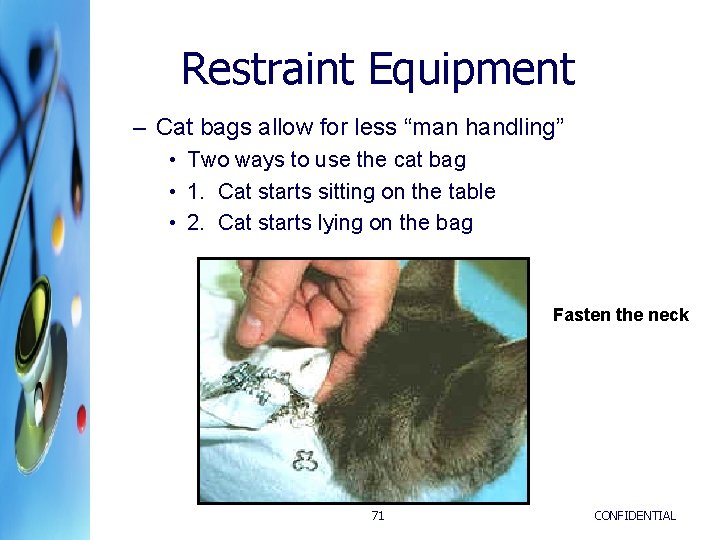
Restraint Equipment – Cat bags allow for less “man handling” • Two ways to use the cat bag • 1. Cat starts sitting on the table • 2. Cat starts lying on the bag Fasten the neck 71 CONFIDENTIAL
Restraint Equipment – Cat bags allow for less “man handling” • Two ways to use the cat bag • 1. Cat starts sitting on the table • 2. Cat starts lying on the bag zip in the back legs Then zip in the front 72 CONFIDENTIAL
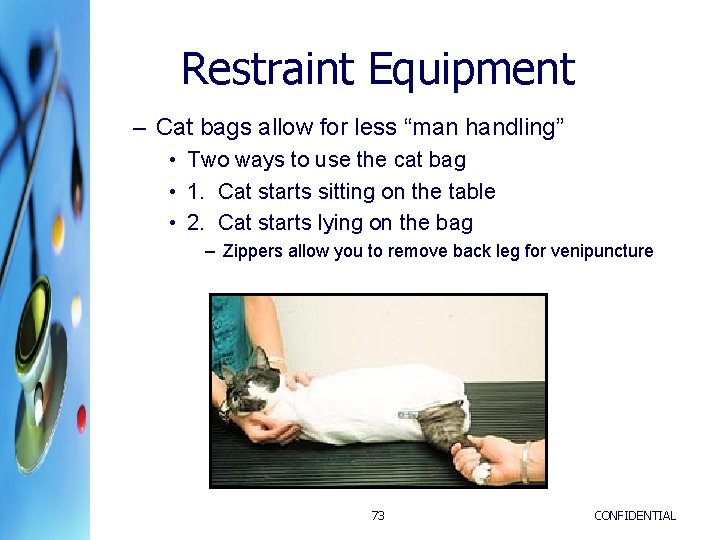
Restraint Equipment – Cat bags allow for less “man handling” • Two ways to use the cat bag • 1. Cat starts sitting on the table • 2. Cat starts lying on the bag – Zippers allow you to remove back leg for venipuncture 73 CONFIDENTIAL
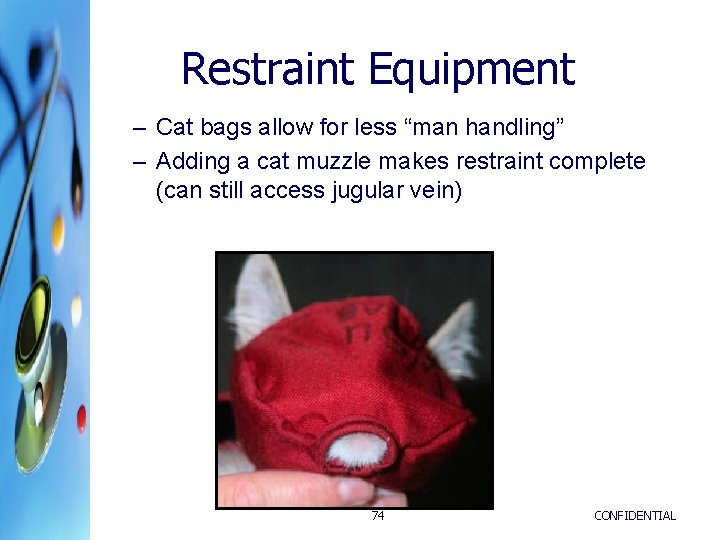
Restraint Equipment – Cat bags allow for less “man handling” – Adding a cat muzzle makes restraint complete (can still access jugular vein) 74 CONFIDENTIAL
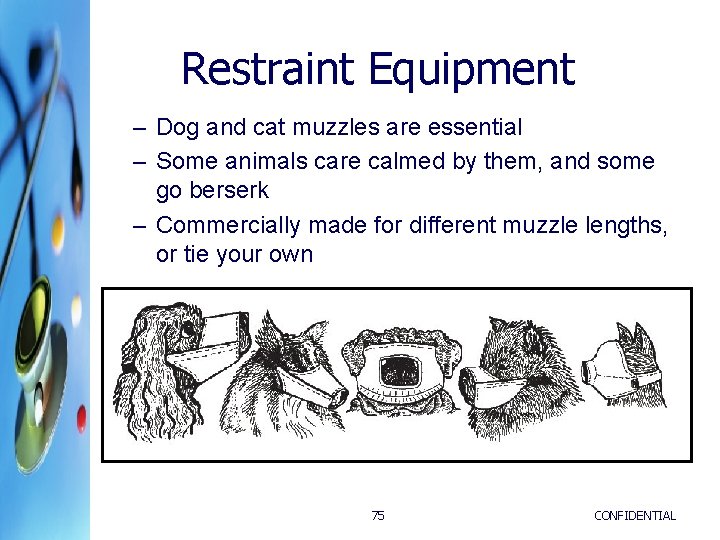
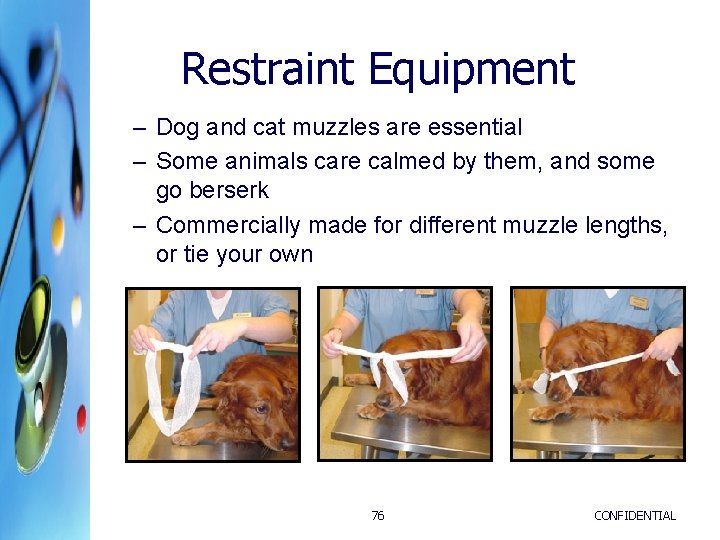
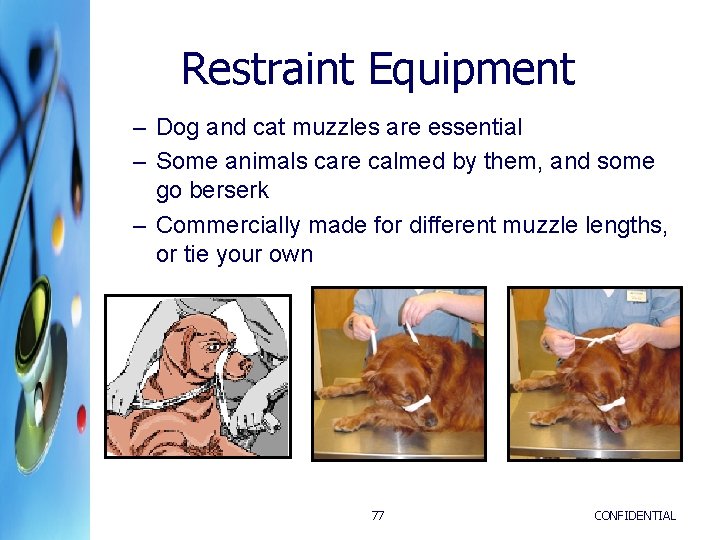
Restraint Equipment – Dog and cat muzzles are essential – Some animals care calmed by them, and some go berserk – Commercially made for different muzzle lengths, or tie your own 75 CONFIDENTIAL
Restraint Equipment – Dog and cat muzzles are essential – Some animals care calmed by them, and some go berserk – Commercially made for different muzzle lengths, or tie your own 76 CONFIDENTIAL
Restraint Equipment – Dog and cat muzzles are essential – Some animals care calmed by them, and some go berserk – Commercially made for different muzzle lengths, or tie your own 77 CONFIDENTIAL
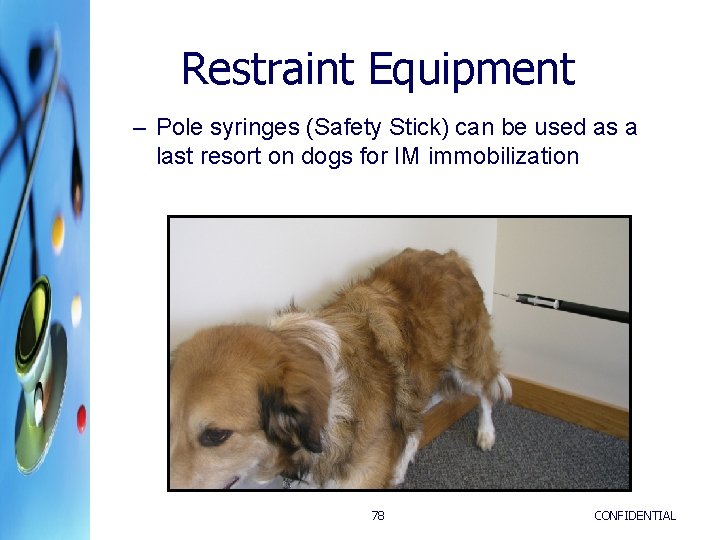
Restraint Equipment – Pole syringes (Safety Stick) can be used as a last resort on dogs for IM immobilization 78 CONFIDENTIAL
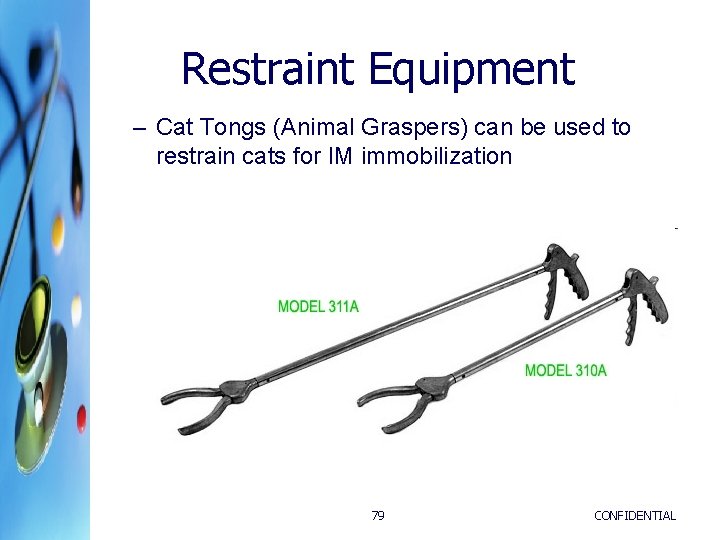
Restraint Equipment – Cat Tongs (Animal Graspers) can be used to restrain cats for IM immobilization 79 CONFIDENTIAL
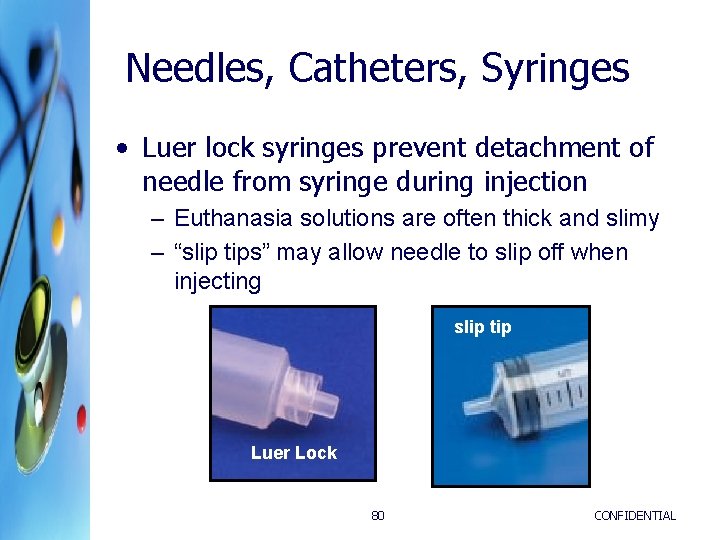
Needles, Catheters, Syringes • Luer lock syringes prevent detachment of needle from syringe during injection – Euthanasia solutions are often thick and slimy – “slip tips” may allow needle to slip off when injecting slip tip Luer Lock 80 CONFIDENTIAL
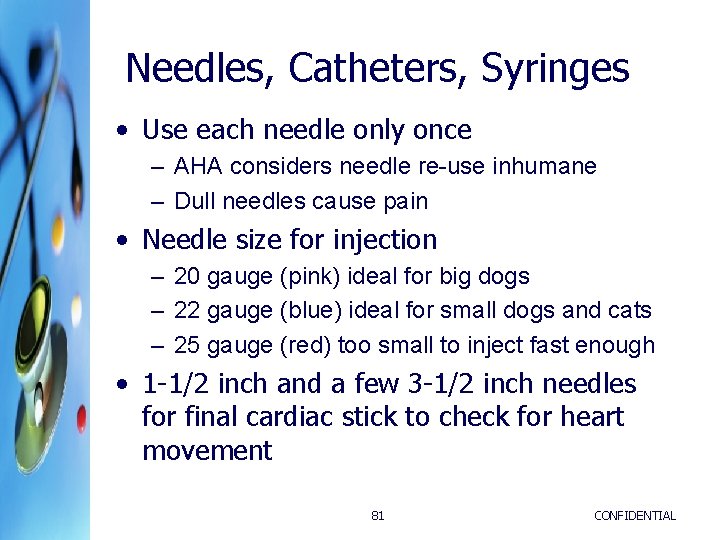
Needles, Catheters, Syringes • Use each needle only once – AHA considers needle re-use inhumane – Dull needles cause pain • Needle size for injection – 20 gauge (pink) ideal for big dogs – 22 gauge (blue) ideal for small dogs and cats – 25 gauge (red) too small to inject fast enough • 1 -1/2 inch and a few 3 -1/2 inch needles for final cardiac stick to check for heart movement 81 CONFIDENTIAL
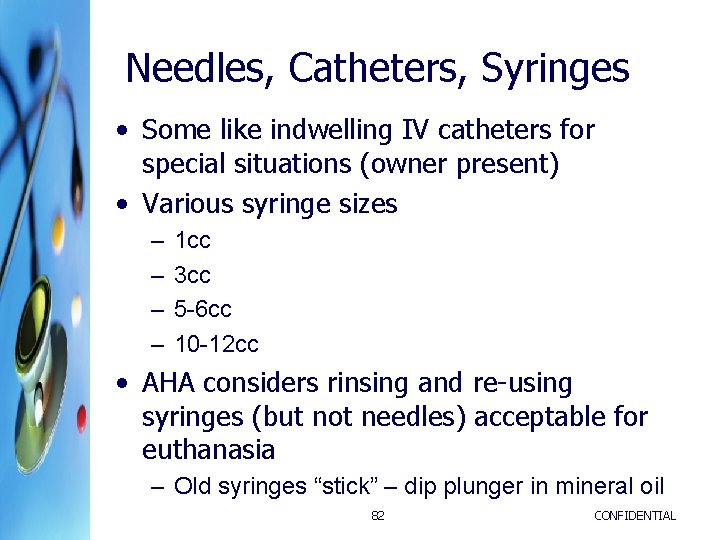
Needles, Catheters, Syringes • Some like indwelling IV catheters for special situations (owner present) • Various syringe sizes – – 1 cc 3 cc 5 -6 cc 10 -12 cc • AHA considers rinsing and re-using syringes (but not needles) acceptable for euthanasia – Old syringes “stick” – dip plunger in mineral oil 82 CONFIDENTIAL
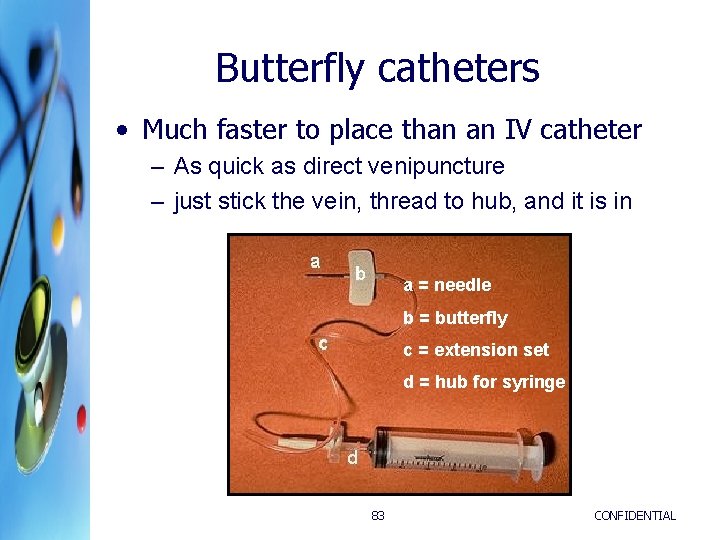
Butterfly catheters • Much faster to place than an IV catheter – As quick as direct venipuncture – just stick the vein, thread to hub, and it is in a = needle b = butterfly c = extension set d = hub for syringe 83 CONFIDENTIAL
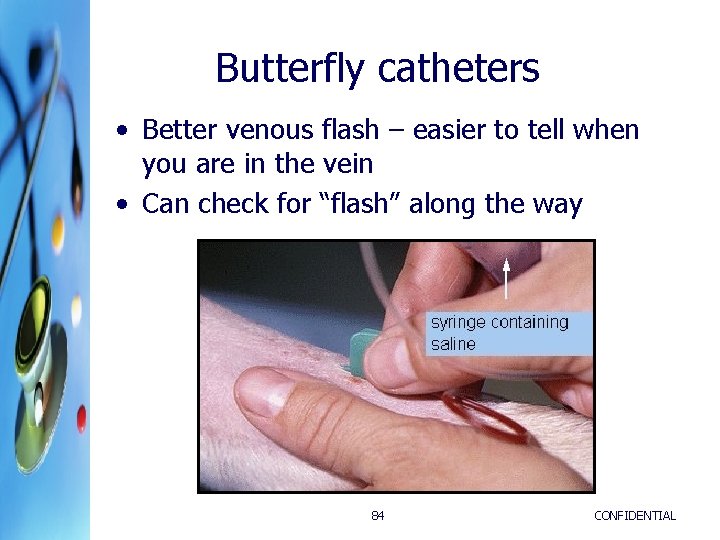
Butterfly catheters • Better venous flash – easier to tell when you are in the vein • Can check for “flash” along the way 84 CONFIDENTIAL
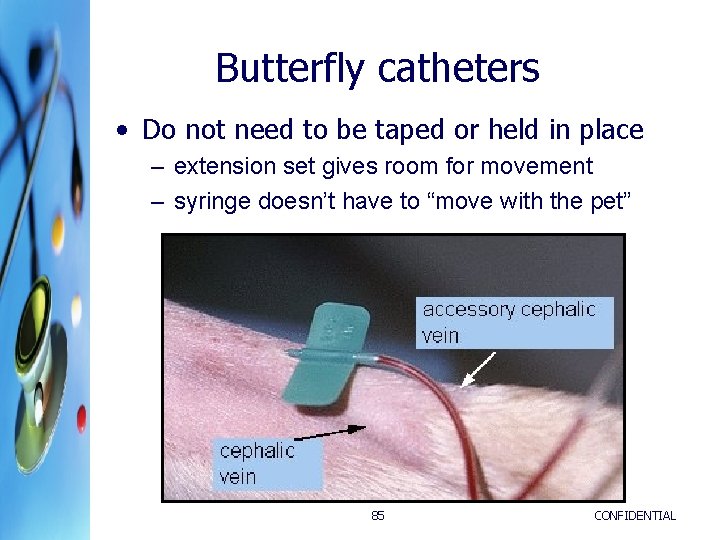
Butterfly catheters • Do not need to be taped or held in place – extension set gives room for movement – syringe doesn’t have to “move with the pet” 85 CONFIDENTIAL
Butterfly catheters • Allow detachment of one syringe and attachment of another without removing the needle – Nice when animal is being anesthetized prior to euthanasia – Ideal in case re-dose is needed • Ideal for owner present euthanasias – if animal is not fractious – when there is no time to tape in a standard IV catheter – No painful extravasation • Size – No smaller than 22 gauge (too slow) – 19 gauge better for large dogs 86 CONFIDENTIAL
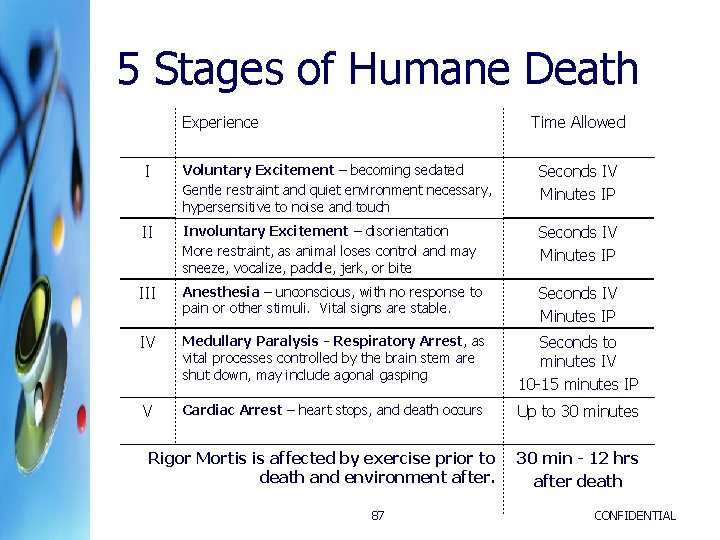
5 Stages of Humane Death Experience Time Allowed I Voluntary Excitement – becoming sedated Gentle restraint and quiet environment necessary, hypersensitive to noise and touch Seconds IV Minutes IP II Involuntary Excitement – disorientation More restraint, as animal loses control and may sneeze, vocalize, paddle, jerk, or bite Seconds IV Minutes IP III Anesthesia – unconscious, with no response to pain or other stimuli. Vital signs are stable. Seconds IV Minutes IP IV Medullary Paralysis - Respiratory Arrest, as vital processes controlled by the brain stem are shut down, may include agonal gasping Seconds to minutes IV 10 -15 minutes IP V Cardiac Arrest – heart stops, and death occurs Up to 30 minutes Rigor Mortis is affected by exercise prior to death and environment after. 87 30 min - 12 hrs after death CONFIDENTIAL
Voluntary Excitement inject through this phase as quickly as possible Reduced by tranquilization or anesthesia • Panting • Struggling • Vocalizing • Salivating • Elimination • Increased heart rate and respiration • Trembling • Pupil dilation or constriction 88 CONFIDENTIAL
Involuntary Excitement inject through this phase as quickly as possible Reduced by tranquilization or anesthesia • Disorientation • Paddling • Biting • Vocalization • Stiffness • Unpredictable behavior • Some call it “a swim” or “swimming” • This is the most dangerous stage 89 CONFIDENTIAL
Verification of Death • No heart sounds, no pulse, no breathing – Agonal gasping may happen during death • No Reflexes – Pupils don’t constrict in response to penlight – No blink when cornea touched – No response to toe pinch with hemostats • No heart movement – Can have heart beats that you can’t hear with a stethoscope, and don’t make pulses – Cardiac Puncture with needle attached – Watch for movement of heart • Rigor Mortis – 30 minutes to 12 hours – The only foolproof verification of death 90 CONFIDENTIAL
Failure to Verify Death Richmond, Virginia • did not confirm death accurately on all animals and disposed of them in the local landfill. • There was public outrage when private citizens saw dogs stumbling around in the dumpsters/landfill that had "revived" from euthanasia. 91 CONFIDENTIAL
Failure to Verify Death East Texas • Goat – no breathing, no detectable pulses and no heart sounds. The goat was placed on the back porch of a veterinary clinic after euthanasia. – The goat was found grazing in the yard late that afternoon. • Cat was euthanized after hours, and the body placed in a casket for owner pick-up the next day. – The next morning, the tech heard sounds from the box, and the cat was alive. • In these cases, noticeable respiration probably temporarily stopped, but started again shortly after observations for respirations stopped. 92 CONFIDENTIAL
Failure to Verify Death We are required by law to verify death after euthanasia and before disposing of the body Most veterinarians verify death only by watching for breathing, listening to heart sounds and palpating pulses When blood pressure is low, the heart can be beating without making detectable sounds or pulses. Breathing can be difficult to see. 93 CONFIDENTIAL
Failure to Verify Death ST. LOUIS, MO • 1 year-old Basenji mix was put in the gas chamber on Friday • When the death chamber's door swung open Monday, the dog stood very much alive, his tail and tongue wagging. • Shelter director did not have the heart to put him back in there and re-gas him, so he was transferred to a limited admission shelter • Quentin's ordeal was played and replayed on local TV stations, drawing people looking to adopt him 94 CONFIDENTIAL
Failure to Verify Death WEST VALLEY CITY, UT • Cat named Andrea was put in the CO chamber after being in the shelter for 30 days • The cat survived, so was gassed again. • No vital signs, was placed in a plastic bag and then in the freezer • Opened the freezer later and found that she was hypothermic, had vomited, but was still alive • The shelter decided to stop trying to kill her • A local humane worker adopted her 95 CONFIDENTIAL
Disposal • Ideally remove each animal from the Euthanasia room as it is euthanized • Disposal of Bodies – Cremation – Land fill – not ideal • Animals who eat the meat or drink blood of euthanized animals can die of phenobarbital toxicity • Those who improperly dispose of the animals are legally responsible (bald eagle) – Return to owner – they must sign that they will dispose in a way that scavengers cannot access 96 CONFIDENTIAL
Disposal • Disposal of Sharps – Put in biohazard sharps containers only – Disposed of per local laws • Disposal of Medical records – old medical records should always be shredded prior to garbage • Disposal of Chemical Spills – per MSDS 97 CONFIDENTIAL
Emergencies • Mistakes – – – Sadly, animals are rarely euthanized by mistake Mistaken identity or instructions (Medlen vs. Strickland, case) Syringes mislabeled or misidentified (case) There should be written protocols to deal with this In case of pentobarbital overdose which is not fatal, animals can survive if supported for hours to days (IV fluids, ventilation) (case) – All syringes containing pentobarbital should be marked POISON & solution probably colored • Bites from unvaccinated animals should result in submission of the head to the state health dept for rabies testing 98 CONFIDENTIAL
Emergencies • Person accidentally injected with pentobarbital should be taken to the emergency room immediately, or an ambulance called • Pentobarbital sprayed into the eyes should be washed thoroughly at the eyewash station, and then see a doctor • Keys to lock box containing small quantities of pentobarbital should be available to those who might need to perform emergency euthanasia • Treat all animals as if they might have zoonosis 99 CONFIDENTIAL
Owner Request Euthanasia • Optional for the Agency – Shelters are not obligated to perform euthanasia on demand – Shelters are not obligated to perform convenience euthanasias – Once euthanasia contract is signed, shelter is legally obligated to perform euthanasia, unless specified otherwise in the contract – If you don’t want to do the euthanasia, don’t agree to do it by letting owner sign the form 100 CONFIDENTIAL
Owner Request Euthanasia • Optional for Provider – Technicians should be able to opt out of any euthanasia, and have it assigned to another euthanasia tech • Fees – at shelter discretion • Location – In the shelter is always safest – In the field is riskier, and should be covered by insurance, and is probably not legal in Texas – Exam room is usually more appropriate than the shelter euthanasia room • Paperwork – get signed permission ALWAYS 101 CONFIDENTIAL
Euthanasia of Pets Owned by the Public • HASC. 10. 821. SCh. C - Sec. 821. 052. METHODS OF EUTHANASIA. (a) A person may euthanize a dog or cat in the custody of an animal shelter… • If completed euthanasia training within 120 days of employment by an animal shelter. • TAC. 25. 169. SCh. D – Health Board Rule Supports HASC. 10. 821. SCh. C • Administering any drug to an animal you do not own, including pentobarbital for euthanasia, is defined as the practice of veterinary medicine 102 CONFIDENTIAL
Euthanasia of Pets Owned by the Public • TOC. 4. 801. § 801. 004 - This chapter (the Vet Licensing Act) does not apply to: (1) the treatment or care of an animal in any manner by the owner of the animal, an employee of the owner, or a designated caretaker of the animal, unless the ownership, employment, or designation is established with the intent to violate this chapter; … (6) an animal shelter employee who performs euthanasia in the course and scope of the person's employment if the person has successfully completed training in accordance with Chapter 829, Health and Safety Code; 103 CONFIDENTIAL
Euthanasia of Pets Owned by the Public • There is no specific prohibition of a trained ACO providing euthanasia to an animal not in the custody of a shelter • However… you must use materials legally in your possession (pentobarbital must be obtained and possessed under a DEA licensee and on the premise licensed) • You cannot administer pentobarbital off-site unless you are a licensed veterinarian • On-site Euthanasia of pets owned by the public is not illegal, but is frowned upon by some vets • You can solve this problem by requiring surrender CONFIDENTIAL prior to euthanasia 104