Chapter 3 Medical Legal and Ethical Issues Introduction

- Slides: 59
Chapter 3 Medical, Legal, and Ethical Issues
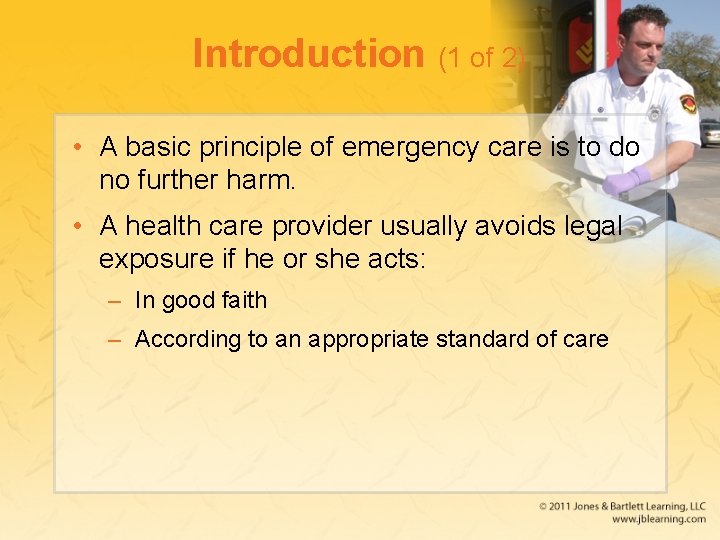
Introduction (1 of 2) • A basic principle of emergency care is to do no further harm. • A health care provider usually avoids legal exposure if he or she acts: – In good faith – According to an appropriate standard of care
Introduction (2 of 2) • The EMT is often the first link in the chain of prehospital care. • Litigation against EMS will increase due to wider availability and more complex care.
Consent (1 of 2) • Consent is permission to render care. • A person must give consent for treatment. • If the patient is conscious and rational, he or she has a legal right to refuse care.
Consent (2 of 2) • Foundation of consent is decision-making capacity. – Can understand information provided – Can make informed choice regarding medical care • Patient autonomy is right of patient to make decisions about his or health.
Expressed Consent • Patient acknowledges he or she wants you to provide care or transport. • To be valid, patient must provide informed consent. – You have explained treatment, risks, and benefits to patient.
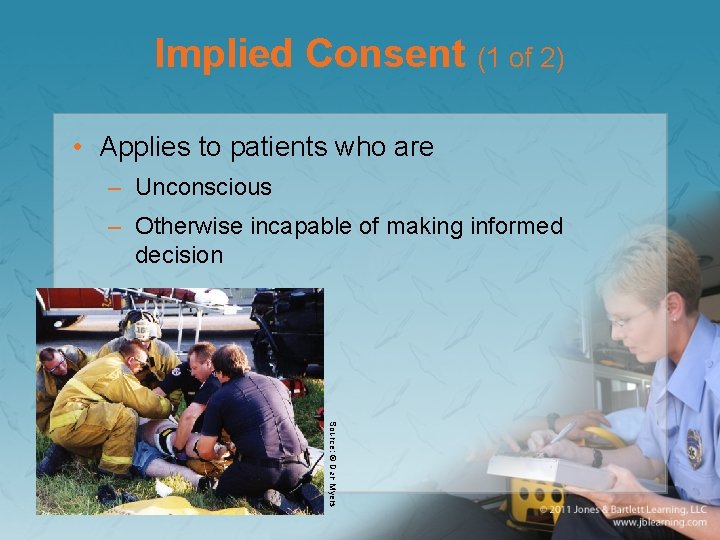
Implied Consent (1 of 2) • Applies to patients who are – Unconscious – Otherwise incapable of making informed decision Source: © Dan Myers
Implied Consent (2 of 2) • Should never be used unless there is a threat to life or limb. • Principle of implied consent is known as the emergency doctrine. • Good to get consent from a spouse or relative.
Involuntary Consent • Applies to patients who are: – Mentally ill – In behavioral crisis – Developmentally delayed • Obtain consent from guardian – Not always possible, so understand local provisions
Minors and Consent (1 of 2) • Parent or legal guardian gives consent. • In some states, a minor can give consent. – Depending on age and maturity – Emancipated minors (married, armed services, parents) • Teachers and school officials may act in place of parents.
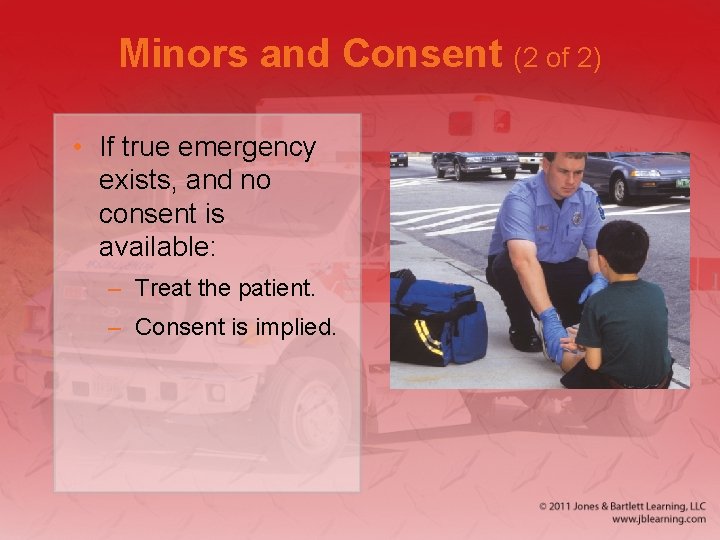
Minors and Consent (2 of 2) • If true emergency exists, and no consent is available: – Treat the patient. – Consent is implied.
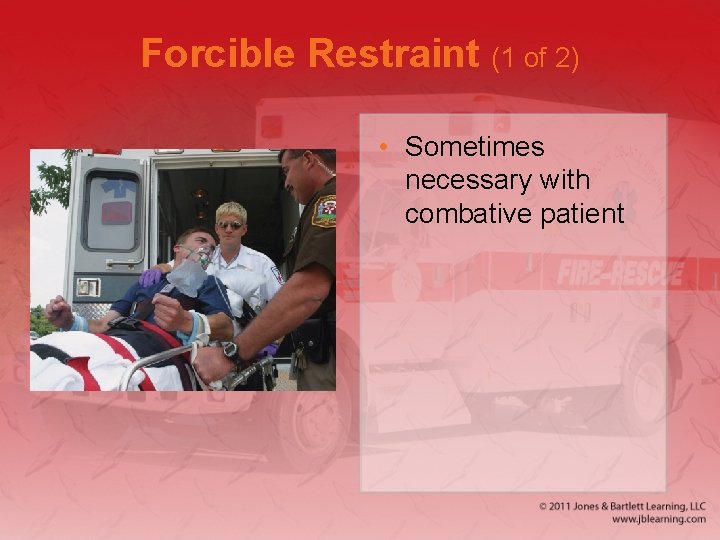
Forcible Restraint (1 of 2) • Sometimes necessary with combative patient
Forcible Restraint (2 of 2) • Is legally permissible – But generally you must consult medical control for authorization. – In some states, only a law enforcement officer may forcibly restrain.
The Right to Refuse Treatment (1 of 2) • Conscious, alert adults with decision-making capacity: – Have the right to refuse treatment – Can withdraw from treatment at any time – Even if the result is death or serious injury • Places burden on EMT to clarify need for treatment
The Right to Refuse Treatment (2 of 2) • Before you leave a scene where a patient, parent, or caregiver has refused care: – Encourage them again to allow care. – Ask them to sign a refusal of care form. – Document all refusals. – A witness is valuable in these situations.
Confidentiality (1 of 2) • Information should remain confidential. • Information generally cannot be disclosed except: – If patient signs a release – If legal subpoena is presented – If it is needed by billing personnel
Confidentiality (2 of 2) • HIPAA (Health Insurance Portability and Accountability Act of 1996) – Contains a section on patient privacy – Strengthens privacy laws – Safeguards patient confidentiality – Considers information to be protected health information (PHI)
Advance Directives (1 of 3) • Advance directive specifies treatment should the patient become unconscious or unable to make decisions. • A do not resuscitate (DNR) order is an advance directive that gives permission not to resuscitate. – “Do not resuscitate” does not mean “do not treat. ”
Advance Directives (2 of 3) • Advance directive is also called: – Living will – Health care directive
Advance Directives (3 of 3) • Some patients may have named surrogates to make decisions for them. – Durable powers of attorney for health care – Also known as health care proxies
Physical Signs of Death (1 of 4) • A physician determines cause of death. • Presumptive signs of death: – Unresponsiveness to painful stimuli – Lack of a carotid pulse or heartbeat – Absence of breath sounds – No deep tendon or corneal reflexes
Physical Signs of Death (2 of 4) • Presumptive signs of death (cont’d): – Absence of eye movement – No systolic blood pressure – Profound cyanosis – Lowered or decreased body temperature
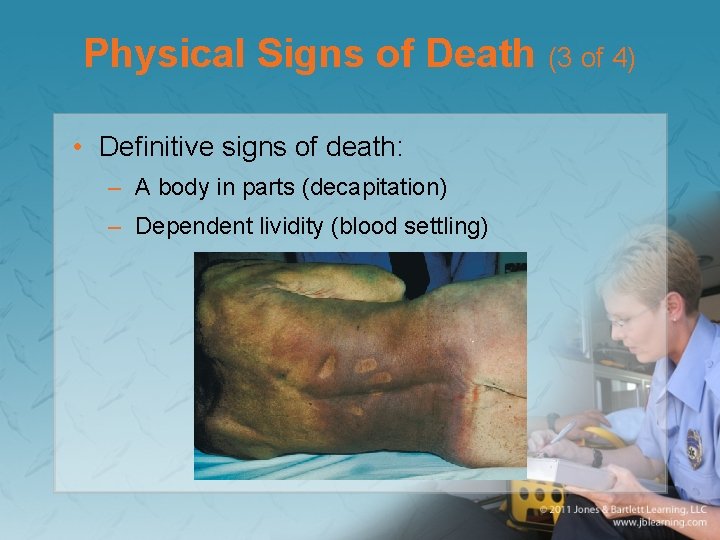
Physical Signs of Death (3 of 4) • Definitive signs of death: – A body in parts (decapitation) – Dependent lividity (blood settling)
Physical Signs of Death (4 of 4) • Definitive signs of death (cont’d): – Rigor mortis (stiffening) – Putrefaction (decomposition)
Medical Examiner Cases (1 of 2) • Involvement depends on nature/scene of death. • Examiner notified in cases of: – Dead on arrival (DOA)/dead on scene (DOS) – Death without previous medical care – Suicide – Violent death
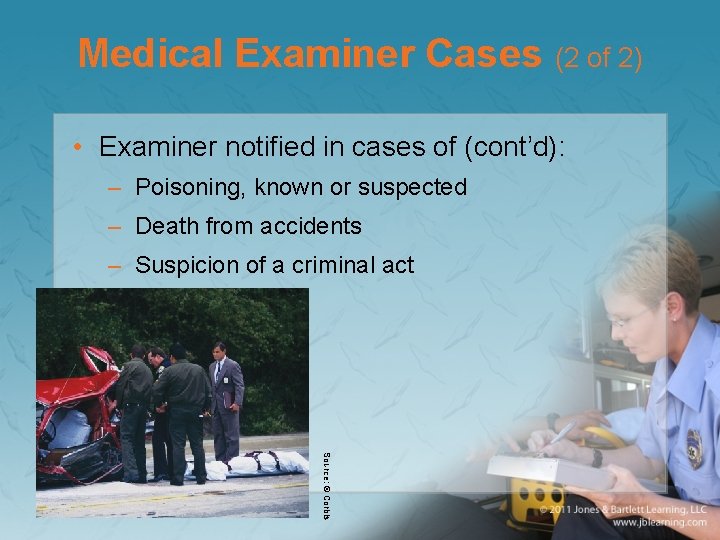
Medical Examiner Cases (2 of 2) • Examiner notified in cases of (cont’d): – Poisoning, known or suspected – Death from accidents – Suspicion of a criminal act Source: © Corbis
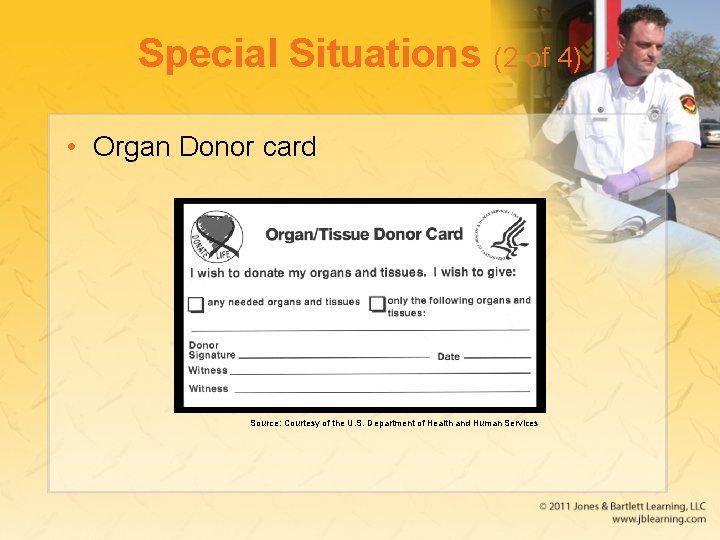
Special Situations (1 of 4) • Organ Donors – Expressed a wish to donate organs – Evidenced by information on: • Organ donor card and/or • Driver’s license – Your priority is to save patient’s life. – Remember that organs need oxygen.
Special Situations (2 of 4) • Organ Donor card Source: Courtesy of the U. S. Department of Health and Human Services
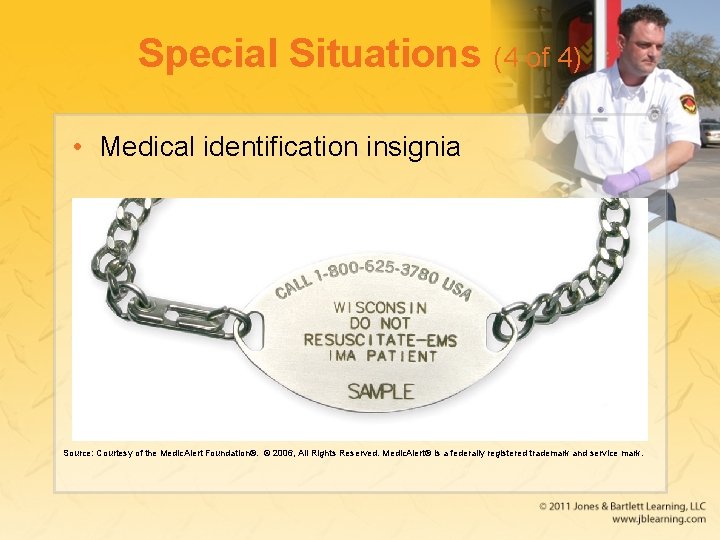
Special Situations (3 of 4) • Medical identification insignia – Bracelet, necklace, or card indicating: • DNR order • Allergies • Diabetes, epilepsy, or other serious condition • Helpful in patient assessment and treatment
Special Situations (4 of 4) • Medical identification insignia Source: Courtesy of the Medic. Alert Foundation®. © 2006, All Rights Reserved. Medic. Alert® is a federally registered trademark and service mark.
Scope of Practice (1 of 3) • Outlines the care you are able to provide • Usually defined by state law
Scope of Practice (2 of 3) • Medical director further defines by developing: – Protocols – Standing orders
Scope of Practice (3 of 3) • Carrying out procedures outside scope of practice may be considered: – Negligence – Criminal offense
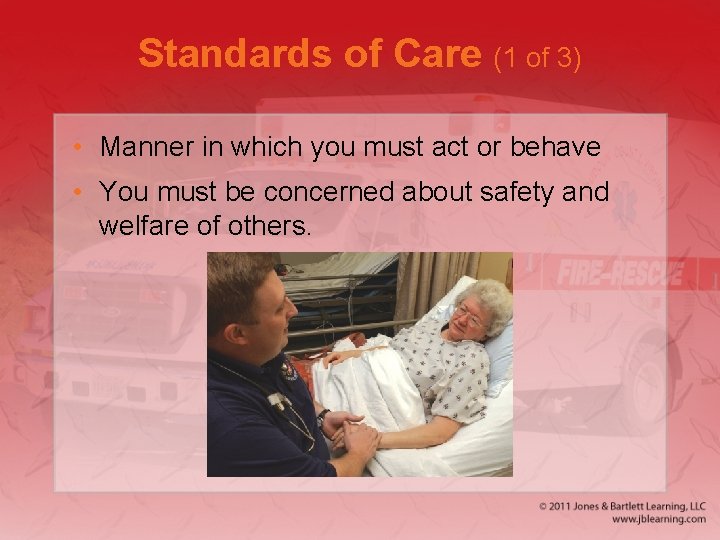
Standards of Care (1 of 3) • Manner in which you must act or behave • You must be concerned about safety and welfare of others.
Standards of Care (2 of 3) • Standards of care established by: – Local custom – Statutes • Protocols – Professional or institutional standards • Example: AHA CPR guidelines – Textbooks • Example: NHTSA
Standards of Care (3 of 3) • Standards of care established by (cont’d): – Standards imposed by states • Medical Practices Act • Certification • Licensure
Duty to Act • Individual’s responsibility to provide patient care • Duty to act applies: – Once your ambulance responds to a call – Treatment is begun
Negligence (1 of 2) • Failure to provide same care that person with similar training would provide in same or similar situation.
Negligence (2 of 2) • All four of the following elements must be present for negligence to apply: – Duty – Breach of duty – Damages – Causation
Abandonment • Unilateral termination of care by EMT without: – Patient’s consent – Making provisions for continuing care • Abandonment may take place: – At scene – In emergency department
Assault and Battery, and Kidnapping (1 of 2) • Assault: Unlawfully placing person in fear of immediate bodily harm – Example: restraint • Battery: Unlawfully touching a person – Example: providing care without consent
Assault and Battery, and Kidnapping (2 of 2) • Kidnapping: Seizing, confining, abducting, or carrying away by force – Example: transport against will – A false imprisonment charge is more likely (defined as unauthorized confinement of a person).
Defamation (1 of 2) • Communication of false information that damages reputation of a person – Libel if written – Slander if spoken
Defamation (2 of 2) • Defamation could happen with: – False statement on a run report – Inappropriate comments made during conversation • Run report should be accurate, relevant, and factual.
Good Samaritan Laws and Immunity (1 of 2) • If you reasonably help another person, you will not be held liable for error/omission • Good Samaritan actions to be met: – Good faith – Without expectation of compensation – Within scope of training – Did not act in grossly negligent manner
Good Samaritan Laws and Immunity (2 of 2) • Gross negligence is conduct that constitutes willful or reckless disregard. • There is another group of laws that grants immunity from liability to official providers. – Laws vary; always consult with the medical director.
Records and Reports (1 of 3) • Compile record for all incidents involving sick or injured patients • Important safeguard against legal complications
Records and Reports (2 of 3) • Courts consider: – An action not recorded was not performed – Incomplete or untidy reports is evidence of poor emergency medical care
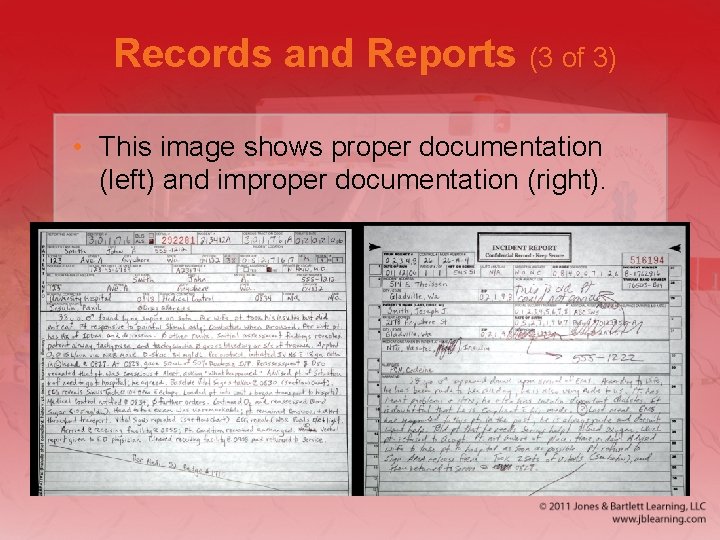
Records and Reports (3 of 3) • This image shows proper documentation (left) and improper documentation (right).
Special Mandatory Reporting Requirements (1 of 3) • Most states have a reporting obligation: – Abuse of children, older persons, and others – Injury during commission of a felony – Drug-related injuries – Childbirth
Special Mandatory Reporting Requirements (2 of 3) • Most states have a reporting obligation (cont’d): – Attempted suicides – Dog bites – Communicable diseases – Assaults – Domestic violence
Special Mandatory Reporting Requirements (3 of 3) • Most states have a reporting obligation (cont’d): – Sexual assault – Exposures to infectious disease – Transport of patients in restraints – Scene of a crime – The deceased
Ethical Responsibilities (1 of 2) • Ethics: Philosophy of right and wrong, moral duties, ideal professional behavior • Morality: Code of conduct affecting character, conduct, and conscience. • Bioethics: Specifically addresses issues that arise in practice of health care
Ethical Responsibilities (2 of 2) • Requires you to evaluate and apply ethical standards – Your own – Those of the profession • Be honest in reporting. • Keep accurate records.
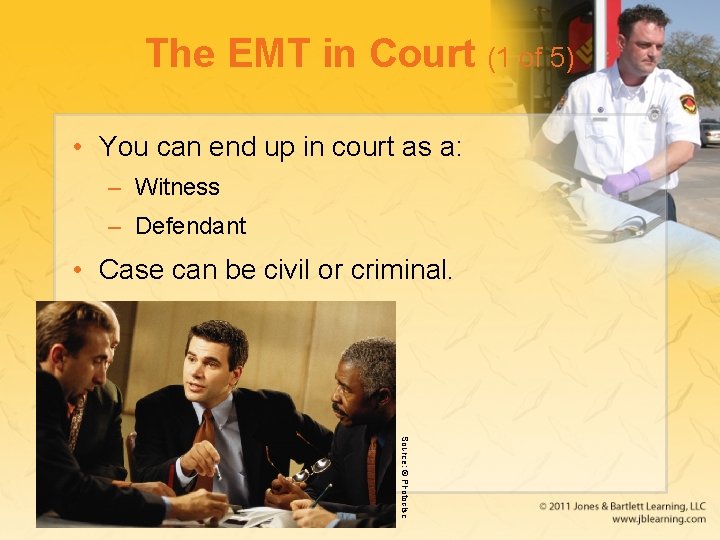
The EMT in Court (1 of 5) • You can end up in court as a: – Witness – Defendant • Case can be civil or criminal. Source: © Photodisc
The EMT in Court (2 of 5) • Whenever called to testify, notify: – Your service director – Legal counsel • As witness: – Remain neutral – Review run report before court
The EMT in Court (3 of 5) • As a defendant, an attorney is required. • Defenses may include: – Statute of limitations – Governmental immunity – Contributory negligence
The EMT in Court (4 of 5) • Discovery allows both sides to obtain more information through: – Interrogatories • Written requests or questions – Depositions • Oral requests or questions
The EMT in Court (5 of 5) • Most cases are settled following the discovery phase during the settlement phase. • If not settled, the case goes to trial • Damages that may be awarded: – Compensatory damages – Punitive damages