
Ethical Case Study Nike By Jaycie Kayley Shannon
Ethical Case Study: Nike By Jaycie, Kayley, & Shannon
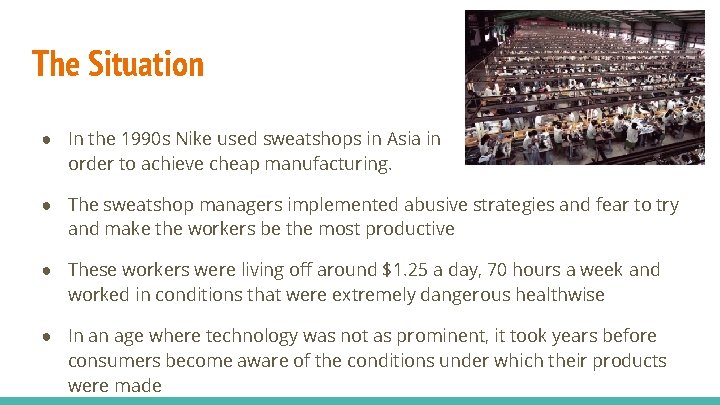
The Situation ● In the 1990 s Nike used sweatshops in Asia in order to achieve cheap manufacturing. ● The sweatshop managers implemented abusive strategies and fear to try and make the workers be the most productive ● These workers were living off around $1. 25 a day, 70 hours a week and worked in conditions that were extremely dangerous healthwise ● In an age where technology was not as prominent, it took years before consumers become aware of the conditions under which their products were made
“Behind the Swoosh” Documentary https: //www. youtube. com/watch? v=M 5 u. YCWVfu. PQ ● What are the unethical decisions Nike made in this situation? ● What are the prominent faces of evil in this video clip?

The Factory ● According to statistics taken in 2005, Nike had over 200 sweatshops all over Asia, including China, Thailand, South Korea, Vietnam, & Indonesia. They also produce goods in many other countries around the world, totaling to about 1, 000 overseas factories. ● In these factories, workers performed their jobs in harsh conditions, with little to no breaks, and are subject to physical and verbal abuse all while receiving an hourly wage of 50 cents. ● “The 10, 000 mostly female workers at the Taiwanese-operated Pou Chen plant make around 50 cents an hour. That’s enough, for food and bunkhouse-type lodging, but little else. ”

Shadow of Power ● The more power a corporation has, the easier it is for abuse to occur. ○ Nike is a powerful and influential corporation, making it easier for them to take advantage of vulnerable populations. ● The shadow of power can lead to mismanaged information ○ People were not necessarily aware of what Nike was doing that the time. Nike obviously did not advertise the fact that they use sweatshops, causing people to not be informed about what they were supporting.

Shadow of Privilege ● More power, more privilege ○ The more power Nike gets, the more privilege they receive too. ● Wealthy corporations in other countries ○ Nike is an extremely wealthy company, which gives them the ability to be globalized. They have the privilege of expanding world-wide. However, Nike chose to use this privilege to take advantage of vulnerable populations all over the world. ● Few benefit at the expense of many ○ The company is reeling in money and satisfying the needs of consumers, while thousands of workers are suffering from awful conditions and receiving insignificant amounts of pay.

Unhealthy Motivators: Selfishness ● Johnson (2015) states that “A great deal of destructive leadership behavior is driven by self-centeredness, which manifests through pride, greed, narcissism, and Machiavellianism” (p. 45). ○ Nike failed to resist their greed for generating profit, and in turn ended up running hundreds of sweatshops all over the world where laborers received terrible treatment with little pay. ● “Machiavellian leaders often engage in deception because they want to generate positive impressions while they get their way” (Johnson, 2015, p. 46). ○ The public was unaware of the hundreds of sweatshops that were operating all over the world. Nike kept this information secretive in order to have the best image and appeal to

Faces of Evil ● Administrative/Bureaucratic Evil ● Sanctioned Destruction ○ Since these sweatshops were overseas, it became easier for Nike to dehumanize the people working in them. ● Evil as a Choice ○ The executives in Nike chose to create these ○ The workers who were managers in sweatshops chose to brutally enforce Nike’s agenda

Follower Ethics ● Bystanders: “They let destructive leaders have their way because they think they will be punished if they object” (Johnson, 2015, p. 47). ○ Employees who were aware of the conditions and unethical practices going on in the factories ○ Consumers/buyers who continued to purchase Nike products even after the reality of sweatshops was exposed to the public ● Acolytes: “They actively partner with the leader because they share the leader’s goals and values” (Johnson, 2015, p. 48).
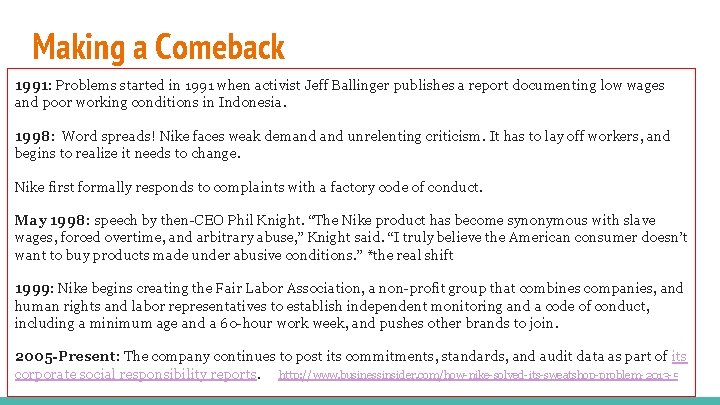
Making a Comeback 1991: Problems started in 1991 when activist Jeff Ballinger publishes a report documenting low wages and poor working conditions in Indonesia. 1998: Word spreads! Nike faces weak demand unrelenting criticism. It has to lay off workers, and begins to realize it needs to change. Nike first formally responds to complaints with a factory code of conduct. May 1998: speech by then-CEO Phil Knight. “The Nike product has become synonymous with slave wages, forced overtime, and arbitrary abuse, ” Knight said. “I truly believe the American consumer doesn’t want to buy products made under abusive conditions. ” *the real shift 1999: Nike begins creating the Fair Labor Association, a non-profit group that combines companies, and human rights and labor representatives to establish independent monitoring and a code of conduct, including a minimum age and a 60 -hour work week, and pushes other brands to join. 2005 -Present: The company continues to post its commitments, standards, and audit data as part of its corporate social responsibility reports. http: //www. businessinsider. com/how-nike-solved-its-sweatshop-problem-2013 -5

Nike’s Current Code of Ethics ● “Inside the Lines”: defines the standards of conduct they expect employees to follow and includes topics on employee activity, ethical behavior, product safety, legal compliance, competition and use of resources. ● Ethics: creating an ethical climate, social responsibility ● Distinction between suppliers and employees : the rules apply to everyone How is the company enforcing their code? ● Each year, Nike requires all employees to read, sign, and understand their code of ethics. ● Operates a global toll-free Alert. Line for employees to confidentially report any
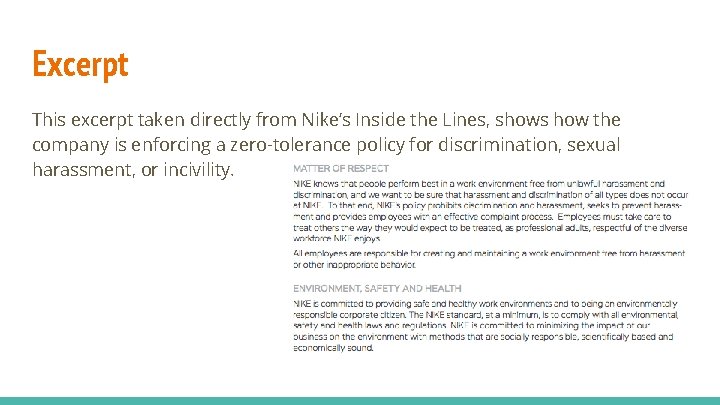
Excerpt This excerpt taken directly from Nike’s Inside the Lines, shows how the company is enforcing a zero-tolerance policy for discrimination, sexual harassment, or incivility.

Reference List ● Bradford, H. (2011, July 13). Nike Faces New Worker Abuse Claims In Indonesia. Retrieved April 04, 2016, from http: //www. huffingtonpost. com/2011/07/13/nike-faces-new-workerabuse-indonesia_n_896816. html ● Wazir, B. (2001, May 19). Nike accused of tolerating sweatshops. Retrieved April 04, 2016, from http: //www. theguardian. com/world/2001/may/20/burhanwazir. theobserver ● Teather, D. (2005, April 14). Nike lists abuses at Asian factories. Retrieved April 04, 2016, from http: //www. theguardian. com/business/2005/apr/14/ethicalbusiness. money ● Nisen, M. (2013, May 09). How Nike Solved Its Sweatshop Problem. Retrieved April 04, 2016, from http: //www. businessinsider. com/how-nike-solved-its-sweatshop-problem 2013 -5 ● Burch, S. (2012, July 06). How activism forced Nike to change its ethical game | Simon Birch. Retrieved April 06, 2016, from http: //www. theguardian. com/environment/greenliving-blog/2012/jul/06/activism-nike
- Slides: 13