
Humongous Insurance Euthanasia Training Presented by Wendy Blount
Humongous Insurance Euthanasia Training Presented by Wendy Blount, D. V. M.
Housekeeping • Your packet: – Agenda – Discussion Questions – Flash drive with all materials – Power. Points (. pptx and. pdfs), statutes cited, articles guidelines referred to, videos, © materials – Paper and pen • Updated materials also accessible and downloadable at http: //wendyblount. com/euthanasia. php • Printed Power. Point slides handed out after each section • Break for 10 minutes each hour 2 CONFIDENTIAL
Housekeeping • We will review Discussion Questions over lunch (12: 30 -1: 30 pm) • Test 2: 30 -3: 30 pm (70% is passing) • Re-trainees may leave after completing test • Re-trainees get your training certificate after your test is graded • Re-Trainees - need to show previous certificate • Initial Trainees must attend the hands on lab (3: 30 -5: 30 pm) • Initial Trainees get certificate when their test is graded, and they complete their laboratory euthanasia • This is a Training, not a Certification Course 3 CONFIDENTIAL
The Necessary Evil • 7 puppies and kittens are born for each human baby born • Overpopulation leads to surplus, neglect and even cruelty – Pet owners not yet fully educated on the importance of spay-neuter, though we have made progress in this area – Spay/neuter not affordable to all – Despite tremendous success in re-homing, supply of pets still overwhelms resources 4 CONFIDENTIAL
The Necessary Evil • Limited Resources: – 4, 000 – 6, 000 animal shelters cover the needs of millions of animals – There are more animals shelters than human shelters – However, animals shelters serve as jails, orphanages, foster programs, halfway houses, rehab centers, free clinics, homeless shelters and victim’s assistance, so comparison may not be appropriate • Compassion Fatigue: the price to pay 5 CONFIDENTIAL
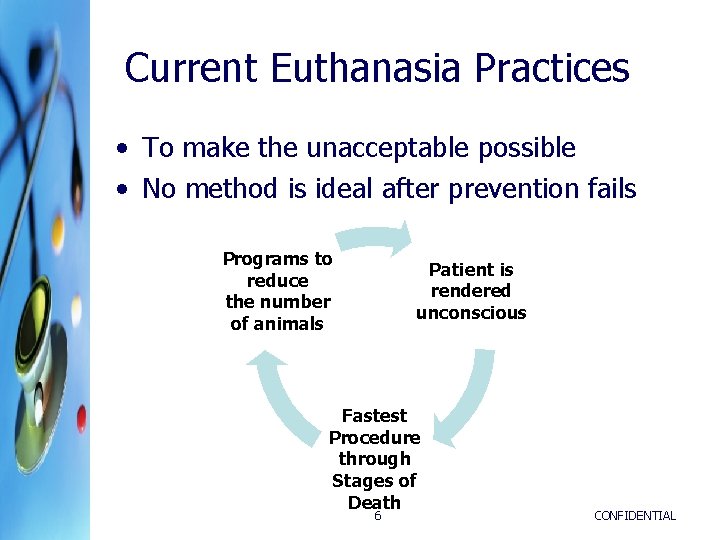
Current Euthanasia Practices • To make the unacceptable possible • No method is ideal after prevention fails Programs to reduce the number of animals Patient is rendered unconscious Fastest Procedure through Stages of Death 6 CONFIDENTIAL
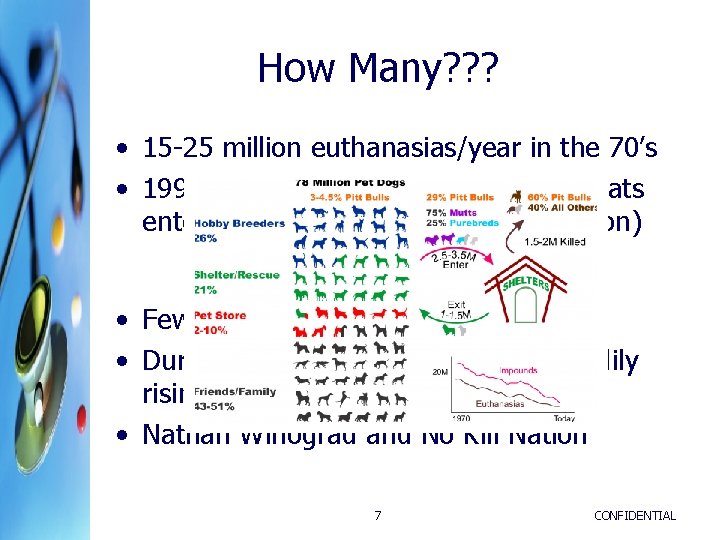
How Many? ? ? • 15 -25 million euthanasias/year in the 70’s • 1997 – NCPPSP – 56% dogs & 71% cats entering shelters euthanized (10 million) • 16% dogs 2% cats reunited with owners • 25% dogs 24% cats adopted • Fewer than 4 million in 2010 • During that time, pet ownership steadily rising • Nathan Winograd and No Kill Nation 7 CONFIDENTIAL
How Many? ? ? • 15 -25 million euthanasias/year in the 70’s • 1997 – NCPPSP – 56% dogs & 71% cats entering shelters euthanized (10 million) • 16% dogs 2% cats reunited with owners • 25% dogs 24% cats adopted • Fewer than 4 million in 2010 • During that time, pet ownership steadily rising • Nathan Winograd and No Kill Nation • Is “No Kill” a reasonable goal? What is it? 8 CONFIDENTIAL
No Kill vs. Open Admission • What does “No Kill” Mean? – – • • Limited Admission – politically correct >90 -95% Live Release Rate (LRR) 5 -10% of dogs and cats are not suitable pets This percentage is arbitrary, and will increase as fewer dogs and cats are surrendered Managed Admission Open Admission – “Kill Shelter” AHA Position Statement on “No Kill” – 2016 Asilomar Accords - 2005 9 CONFIDENTIAL
No Kill vs. Open Admission • “No Kill” Shelter in Community with Pet Excess Problem – Hoarder Shelter, unless there is also an open admission shelter • “Open Admission” Shelter in Community with a home for every suitable pet – “No Kill” Shelter in a “No Kill” Community • Some counties in Texas have no animal shelter, no animal control services and no veterinarian • We’ve made great progress, but we still CONFIDENTIAL have along way to 10 go
No Kill vs. Open Admission • Every shelter *must* track numbers – Intakes – Outcomes • LRR - healthy release to adoption, healthy release to transfer, release to hospice (current ideal >90%) • died in shelter/foster, lost in the system (ideal <2%) – Euthanasias per 1, 000 capita • Include euthanasias from *all* shelters in the area • Ideal is <5 euthanasias per 1, 000 capita • Is a more honest assessment of how a *community* is doing, than the assessment of how a shelter is doing with what they happen to admit – Tracking Euthanasia Rate is Dangerous • counts death in shelter/foster as a good outcome 11 CONFIDENTIAL
History of Euthanasia • “Euthanasia” at animal pounds at the turn of the 20 th century – – Shooting Clubbing Decapitation Drowning • “Humane” killing of food animals – Stunning by bolt trauma or pithing – Exsanguination (bleeding out) – Cervical dislocation (neck wringing) 12 CONFIDENTIAL
History of Euthanasia • Poisoning early 19 th century – Paralytics to suffocate (succinylcholine, anectine, nictone, strychnine) – Magnesium or potassium to stop heart • Commercial electrocution – Primitive machine in 1915 – “More humane” electrocution chamber 1970 • Hypoxic chemicals (CO, CO 2) and decompression chambers (60’s, 70’s) – Engine exhaust generated CO – Then commercial CO chambers 13 CONFIDENTIAL
History of Euthanasia • Humane Slaughter Act – 1958, 1978, 2002 – Rendering animals unconscious prior to euthanasia becomes paramount – Chambers not appropriate for large numbers of animals (injure each other) – Restraint is harder on caretakers, but better for the animal • CNS depressants (sodium pentobarbital) – Controlled substances are complex to handle – IC injection acceptable in the 80’s – Now IV is preferred (IP OK for small pets) 14 CONFIDENTIAL
History of Euthanasia • The Millennium – Not much has changed about the way euthanasia has been performed – But much has changed about *if* and *why* it should be performed – CO & other euthanasia methods no longer acceptable for dogs and cats – Spay-neuter works hand in hand with euthanasia to achieve the No Kill community, so all shelters in a community can collectively achieve <5 euths/1, 000 capita 15 CONFIDENTIAL
Guidelines AVMA Panel on Euthanasia established Guidelines for ideal euthanasia (1963, 1972, 1978, 1986, 2000, 2007, 2013) 1. Speed and reliability to produce unconsciousness prior to death 2. Painless and minimal distress to animals 3. Safe for euthanasia tech and assistants 4. Not disturbing to personnel 5. Equipment easy to maintain 6. Easy to Administer 16 CONFIDENTIAL
Guidelines AVMA Panel on Euthanasia established Guidelines for ideal euthanasia (1963, 1972, 1978, 1986, 2000, 2007, 2013) 7. Method must be species appropriate 8. Inexpensive 9. Time efficient 10. Can be used for all ages and species and health conditions 11. Portable – can be used in the field 12. Must be legally compliant with federal, state and local laws 17 CONFIDENTIAL
Guidelines Other considerations for Ideal Euthanasia Method • • Irreversible Allows for post-mortem examination HSUS Statement on Euthanasia Methods for Animal Shelters – 2013 – 5 Elements 1. 2. 3. 4. 5. Compassion Knowledge Skills via training and experience State of the art techniques Wisdom to know when to perform euthanasia 18 CONFIDENTIAL
Guidelines AHA Operational Guide – Euthanasia by Injection – 2010 Replaced by – AHA Policy on Animal Shelter Euthanasia - 2016 NACA Euthanasia Guidelines - 2014 AAEP Euthanasia Guidelines – 2016 AABP Euthanasia Guidelines – 2016 AVMA Humane Slaughter Guidelines - 2016 19 CONFIDENTIAL
Guidelines • AHA Shelter Role in Pet Loss and Grief – 2016 • AHA Euthanasia Decision Guidelines – 2016 • AVMA Hospice & EOL Guidelines – 2017 • AAHA Hospice & EOL Guidelines – 2016 20 CONFIDENTIAL
Theories and Principles IV Sodium Pentobarbital comes closest to ideal euthanasia method • It stops the brain from functioning • Endorsed by – – – AHA – American Humane Association ASPCA – American Society for the Prevention of Cruelty to Animals AVMA – American Veterinary Medical Association HSUS – Humane Society of the United States NACA – National Animal Control Association AAEP – American Association Equine Practitioners 21 CONFIDENTIAL
Theories and Principles Why is unconsciousness before death important? • • All animals experience hypoxia before death Hypoxia = low oxygen levels Hypoxia is painful No pain is perceived when unconscious Brain function must be stopped before other organs stop Organ failure other than brain is often painful When brain function stops, all other functions will stop within minutes after that 22 CONFIDENTIAL
Theories and Principles • Shelter workers become the “Sin Eaters” for pet owners who can not or will not continue to care for their pets – “Sin Eaters” designated by some communities to accept guilt for the recently deceased, so they can be absolved and “saved” • Shelters do not cause the need for euthanasia – The community causes the need for shelters, through mass production and mismanagement of animals 23 CONFIDENTIAL
Theories and Principles • “No Kill” Services – Add resources for re-homing pets – But they deflect responsibility of euthanasia to other organizations • Selection of candidates has improved – Volume of unwanted pets has decreased – Public concern has increased – Not as many “adoptable” animals are being killed 24 CONFIDENTIAL
Theories and Principles • Programs to reduce the need – – Mandated public education in schools Low cost spay-neuter clinics Anti-puppy mill campaigning & breeder licensing Programs to keep pets in their homes • Behavior hotlines & pet training programs • Low cost medical services for the indigent • Pet food banks – – Intervention and prosecution of animal abuse Legislation to allow intervention Pet identification to reunite lost pets with owners Leash laws that are enforced 25 CONFIDENTIAL
Theories and Principles • Public must not be shielded from the crisis, despite the need for fundraising • Hiding the problem will not make it go away • Hiding the problem will probably allow it to grow EXPONENTIALLY • Doing nothing allows things to get out of control quickly 26 CONFIDENTIAL
Definitions • Euthanasia – – “good death” which prevents prolonged suffering and/or pain, when death is unavoidable – “eu” – Greek for Good – “thanatos” – Greek for Death • Ending the life of a healthy animals may not truly be considered euthanasia, because death is not imminent • Sadly, the surplus of unwanted pets requires killing in addition to euthanasia. • For our purposes, euthanasia is used to described humane death applied to animals 27 CONFIDENTIAL
- Slides: 27