HORIZONS AMI Trial A Prospective Randomized Comparison of
- Slides: 36
HORIZONS AMI Trial A Prospective, Randomized Comparison of Bivalirudin vs. Heparin Plus Glycoprotein IIb/IIIa Inhibitors During Primary Angioplasty in Acute Myocardial Infarction – One Year Results – Roxana Mehran MD for the HORIZONS-AMI Investigators, TCT 2008
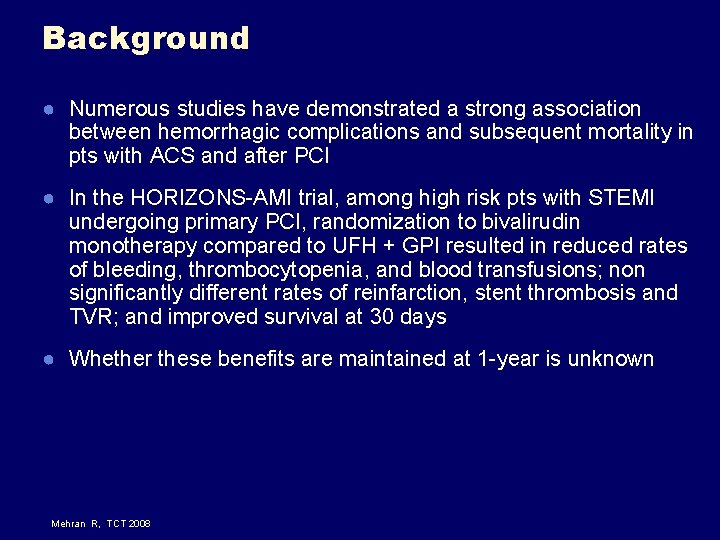
Background ● Numerous studies have demonstrated a strong association between hemorrhagic complications and subsequent mortality in pts with ACS and after PCI ● In the HORIZONS-AMI trial, among high risk pts with STEMI undergoing primary PCI, randomization to bivalirudin monotherapy compared to UFH + GPI resulted in reduced rates of bleeding, thrombocytopenia, and blood transfusions; non significantly different rates of reinfarction, stent thrombosis and TVR; and improved survival at 30 days ● Whether these benefits are maintained at 1 -year is unknown Mehran R, TCT 2008
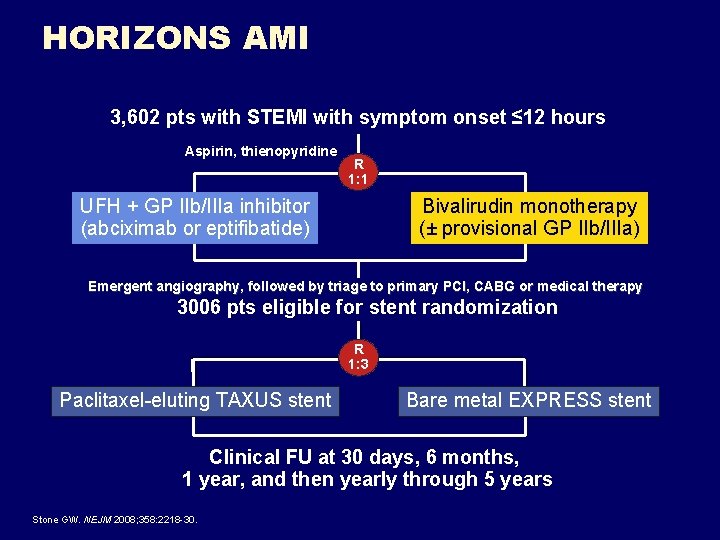
HORIZONS AMI 3, 602 pts with STEMI with symptom onset ≤ 12 hours Aspirin, thienopyridine R 1: 1 UFH + GP IIb/IIIa inhibitor (abciximab or eptifibatide) Bivalirudin monotherapy (± provisional GP IIb/IIIa) Emergent angiography, followed by triage to primary PCI, CABG or medical therapy 3006 pts eligible for stent randomization R 1: 3 Paclitaxel-eluting TAXUS stent Bare metal EXPRESS stent Clinical FU at 30 days, 6 months, 1 year, and then yearly through 5 years Stone GW. NEJM 2008; 358: 2218 -30.
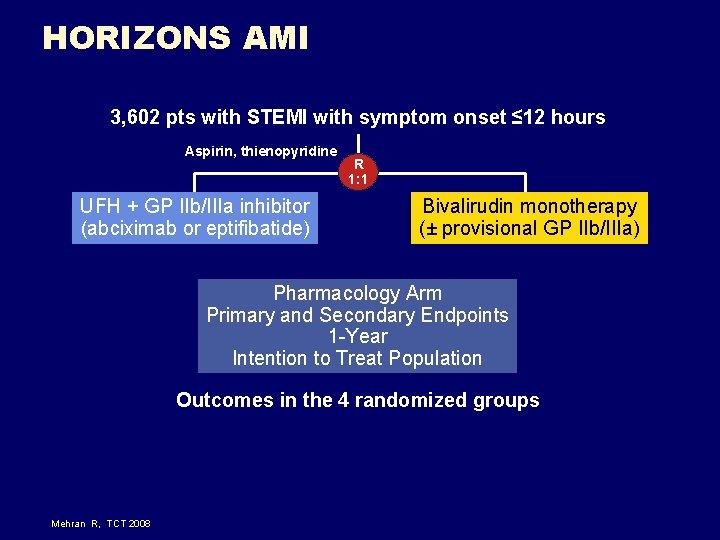
HORIZONS AMI 3, 602 pts with STEMI with symptom onset ≤ 12 hours Aspirin, thienopyridine UFH + GP IIb/IIIa inhibitor (abciximab or eptifibatide) R 1: 1 Bivalirudin monotherapy (± provisional GP IIb/IIIa) Pharmacology Arm Primary and Secondary Endpoints 1 -Year Intention to Treat Population Outcomes in the 4 randomized groups Mehran R, TCT 2008
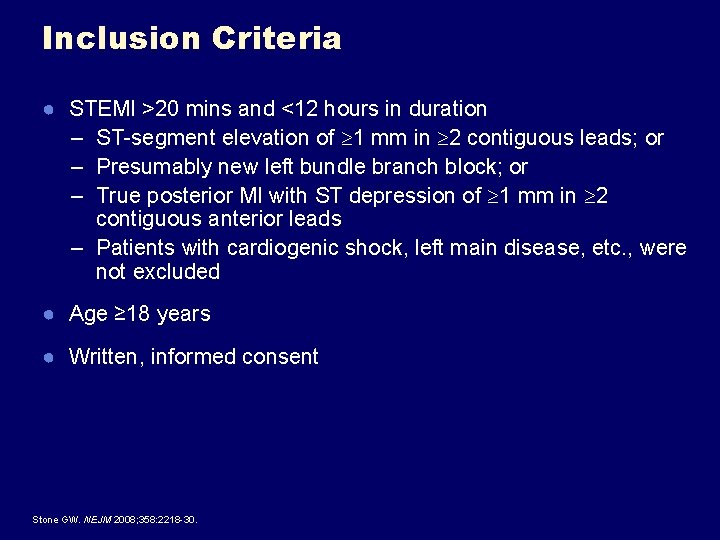
Inclusion Criteria ● STEMI >20 mins and <12 hours in duration – ST-segment elevation of 1 mm in 2 contiguous leads; or – Presumably new left bundle branch block; or – True posterior MI with ST depression of 1 mm in 2 contiguous anterior leads – Patients with cardiogenic shock, left main disease, etc. , were not excluded ● Age ≥ 18 years ● Written, informed consent Stone GW. NEJM 2008; 358: 2218 -30.
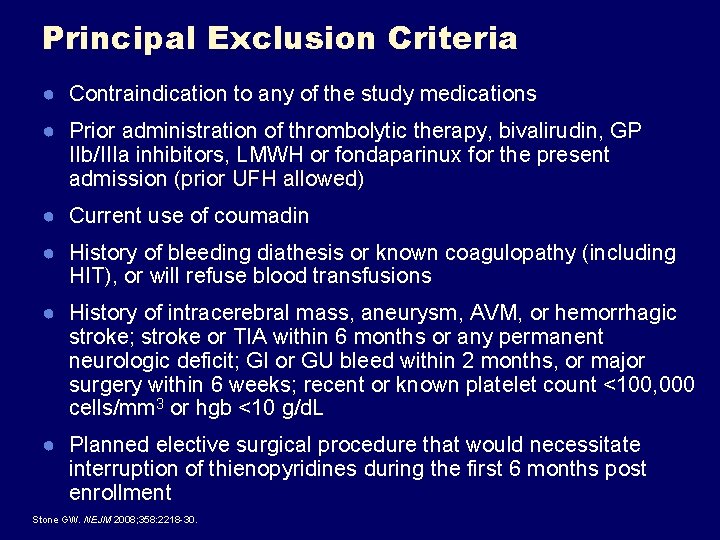
Principal Exclusion Criteria ● Contraindication to any of the study medications ● Prior administration of thrombolytic therapy, bivalirudin, GP IIb/IIIa inhibitors, LMWH or fondaparinux for the present admission (prior UFH allowed) ● Current use of coumadin ● History of bleeding diathesis or known coagulopathy (including HIT), or will refuse blood transfusions ● History of intracerebral mass, aneurysm, AVM, or hemorrhagic stroke; stroke or TIA within 6 months or any permanent neurologic deficit; GI or GU bleed within 2 months, or major surgery within 6 weeks; recent or known platelet count <100, 000 cells/mm 3 or hgb <10 g/d. L ● Planned elective surgical procedure that would necessitate interruption of thienopyridines during the first 6 months post enrollment Stone GW. NEJM 2008; 358: 2218 -30.
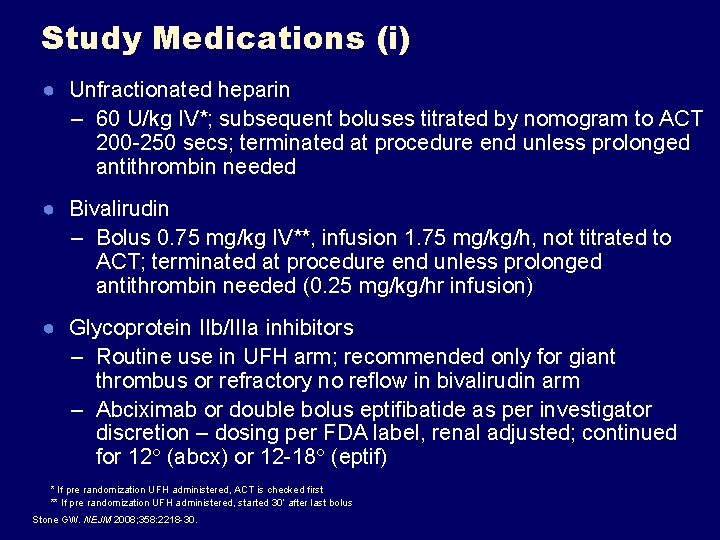
Study Medications (i) ● Unfractionated heparin – 60 U/kg IV*; subsequent boluses titrated by nomogram to ACT 200 -250 secs; terminated at procedure end unless prolonged antithrombin needed ● Bivalirudin – Bolus 0. 75 mg/kg IV**, infusion 1. 75 mg/kg/h, not titrated to ACT; terminated at procedure end unless prolonged antithrombin needed (0. 25 mg/kg/hr infusion) ● Glycoprotein IIb/IIIa inhibitors – Routine use in UFH arm; recommended only for giant thrombus or refractory no reflow in bivalirudin arm – Abciximab or double bolus eptifibatide as per investigator discretion – dosing per FDA label, renal adjusted; continued for 12 (abcx) or 12 -18 (eptif) * If pre randomization UFH administered, ACT is checked first ** If pre randomization UFH administered, started 30’ after last bolus Stone GW. NEJM 2008; 358: 2218 -30.
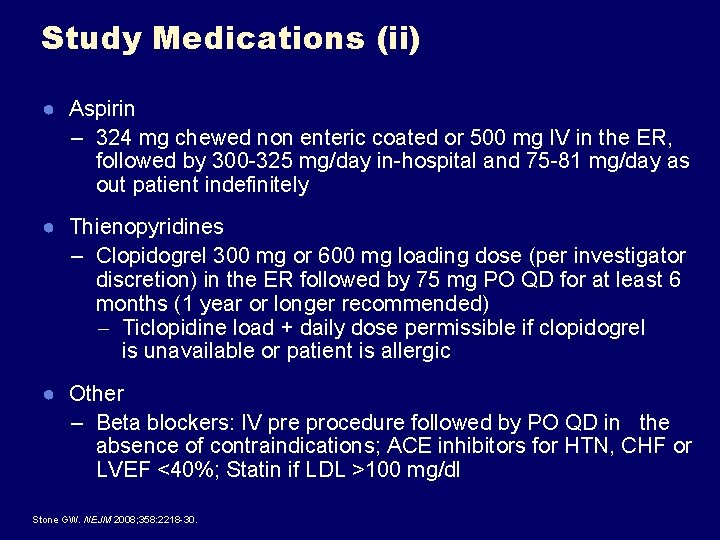
Study Medications (ii) ● Aspirin – 324 mg chewed non enteric coated or 500 mg IV in the ER, followed by 300 -325 mg/day in-hospital and 75 -81 mg/day as out patient indefinitely ● Thienopyridines – Clopidogrel 300 mg or 600 mg loading dose (per investigator discretion) in the ER followed by 75 mg PO QD for at least 6 months (1 year or longer recommended) – Ticlopidine load + daily dose permissible if clopidogrel is unavailable or patient is allergic ● Other – Beta blockers: IV pre procedure followed by PO QD in the absence of contraindications; ACE inhibitors for HTN, CHF or LVEF <40%; Statin if LDL >100 mg/dl Stone GW. NEJM 2008; 358: 2218 -30.
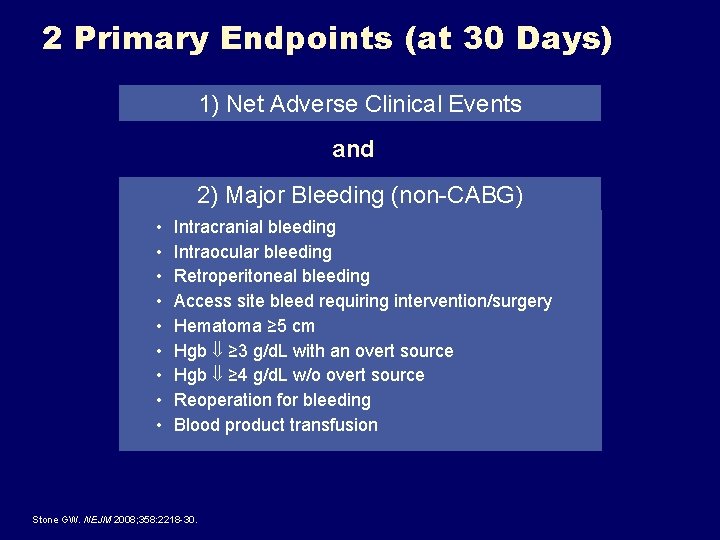
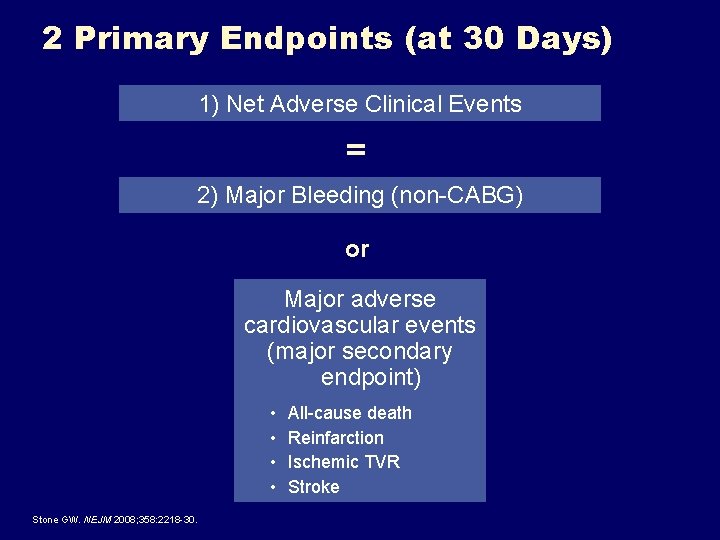
2 Primary Endpoints (at 30 Days) 1) Net Adverse Clinical Events and 2) Major Bleeding (non-CABG) • • • Intracranial bleeding Intraocular bleeding Retroperitoneal bleeding Access site bleed requiring intervention/surgery Hematoma ≥ 5 cm Hgb ≥ 3 g/d. L with an overt source Hgb ≥ 4 g/d. L w/o overt source Reoperation for bleeding Blood product transfusion Stone GW. NEJM 2008; 358: 2218 -30.
2 Primary Endpoints (at 30 Days) 1) Net Adverse Clinical Events = 2) Major Bleeding (non-CABG) or Major adverse cardiovascular events (major secondary endpoint) • • Stone GW. NEJM 2008; 358: 2218 -30. All-cause death Reinfarction Ischemic TVR Stroke
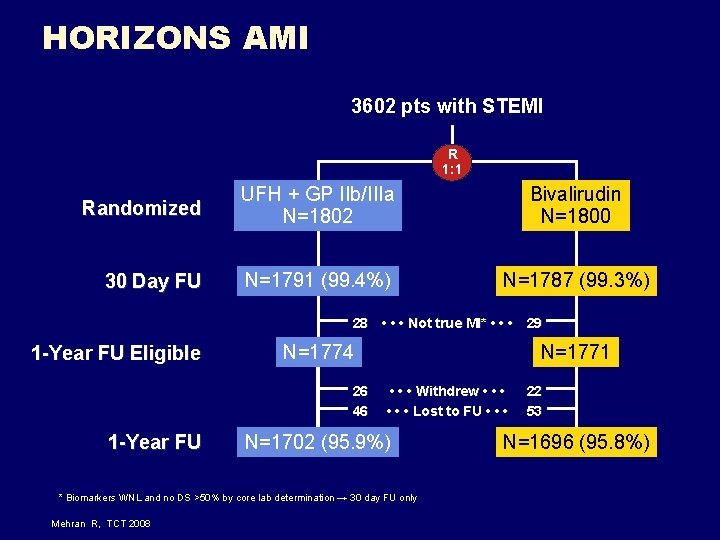
HORIZONS AMI 3602 pts with STEMI R 1: 1 Randomized UFH + GP IIb/IIIa N=1802 Bivalirudin N=1800 30 Day FU N=1791 (99. 4%) N=1787 (99. 3%) 28 • • • Not true MI* • • • 29 1 -Year FU Eligible N=1774 26 46 1 -Year FU N=1771 • • • Withdrew • • • Lost to FU • • • N=1702 (95. 9%) * Biomarkers WNL and no DS >50% by core lab determination → 30 day FU only Mehran R, TCT 2008 22 53 N=1696 (95. 8%)
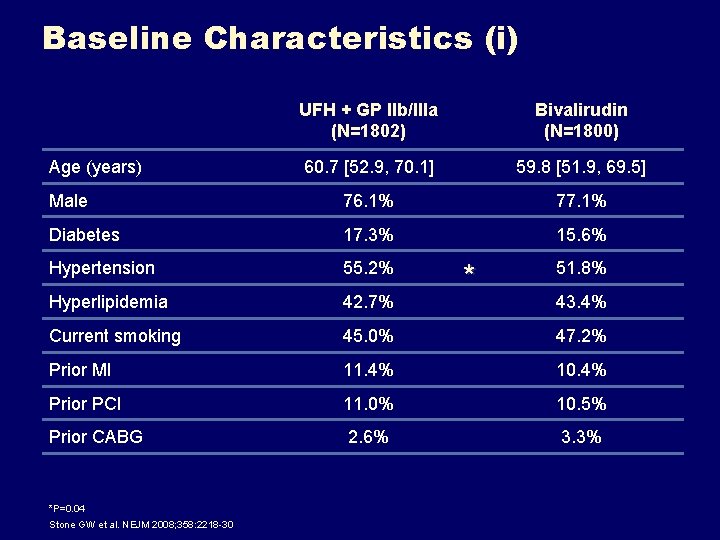
Baseline Characteristics (i) UFH + GP IIb/IIIa (N=1802) Bivalirudin (N=1800) 60. 7 [52. 9, 70. 1] 59. 8 [51. 9, 69. 5] Male 76. 1% 77. 1% Diabetes 17. 3% 15. 6% Hypertension 55. 2% Hyperlipidemia 42. 7% Current smoking 45. 0% 47. 2% Prior MI 11. 4% 10. 4% Prior PCI 11. 0% 10. 5% Prior CABG 2. 6% 3. 3% Age (years) *P=0. 04 Stone GW et al. NEJM 2008; 358: 2218 -30 * 51. 8% 43. 4%
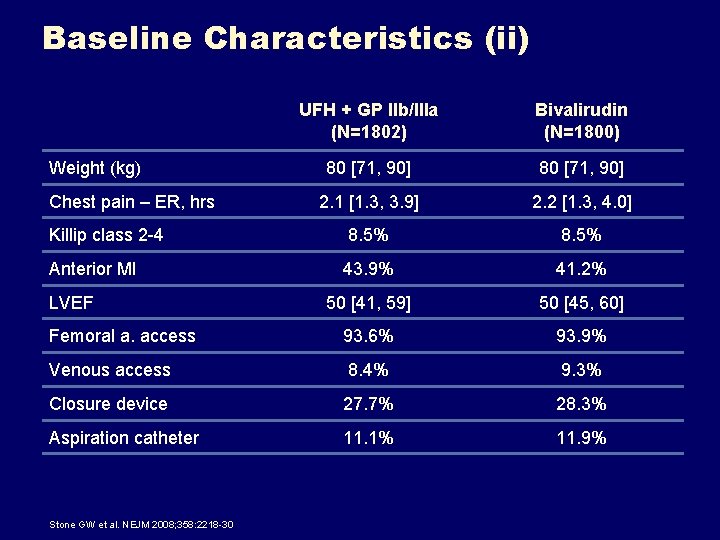
Baseline Characteristics (ii) UFH + GP IIb/IIIa (N=1802) Bivalirudin (N=1800) 80 [71, 90] 2. 1 [1. 3, 3. 9] 2. 2 [1. 3, 4. 0] Killip class 2 -4 8. 5% Anterior MI 43. 9% 41. 2% 50 [41, 59] 50 [45, 60] Femoral a. access 93. 6% 93. 9% Venous access 8. 4% 9. 3% Closure device 27. 7% 28. 3% Aspiration catheter 11. 1% 11. 9% Weight (kg) Chest pain – ER, hrs LVEF Stone GW et al. NEJM 2008; 358: 2218 -30
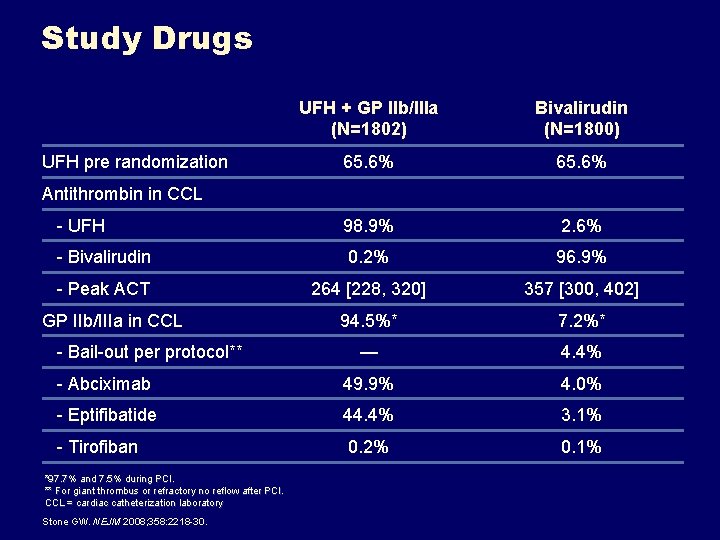
Study Drugs UFH + GP IIb/IIIa (N=1802) Bivalirudin (N=1800) 65. 6% - UFH 98. 9% 2. 6% - Bivalirudin 0. 2% 96. 9% - Peak ACT 264 [228, 320] 357 [300, 402] 94. 5%* 7. 2%* — 4. 4% - Abciximab 49. 9% 4. 0% - Eptifibatide 44. 4% 3. 1% - Tirofiban 0. 2% 0. 1% UFH pre randomization Antithrombin in CCL GP IIb/IIIa in CCL - Bail-out per protocol** *97. 7% and 7. 5% during PCI. ** For giant thrombus or refractory no reflow after PCI. CCL = cardiac catheterization laboratory Stone GW. NEJM 2008; 358: 2218 -30.
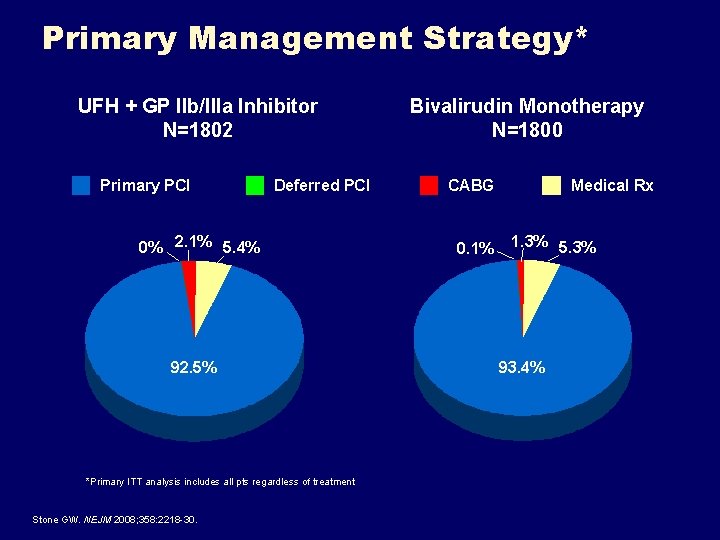
Primary Management Strategy* UFH + GP IIb/IIIa Inhibitor N=1802 Primary PCI Deferred PCI 0% 2. 1% 5. 4% 92. 5% *Primary ITT analysis includes all pts regardless of treatment Stone GW. NEJM 2008; 358: 2218 -30. Bivalirudin Monotherapy N=1800 CABG 0. 1% Medical Rx 1. 3% 5. 3% 93. 4%
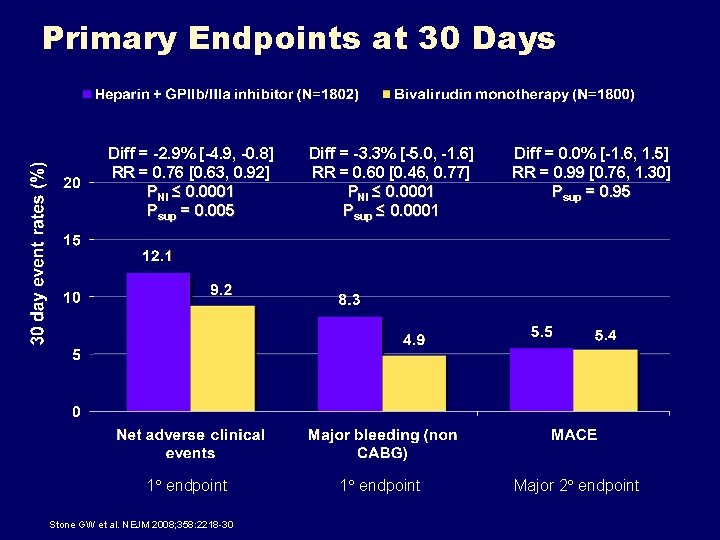
Primary Endpoints at 30 Days Diff = -2. 9% [-4. 9, -0. 8] RR = 0. 76 [0. 63, 0. 92] PNI ≤ 0. 0001 Psup = 0. 005 1 endpoint Stone GW et al. NEJM 2008; 358: 2218 -30 Diff = -3. 3% [-5. 0, -1. 6] RR = 0. 60 [0. 46, 0. 77] PNI ≤ 0. 0001 Psup ≤ 0. 0001 1 endpoint Diff = 0. 0% [-1. 6, 1. 5] RR = 0. 99 [0. 76, 1. 30] Psup = 0. 95 Major 2 endpoint
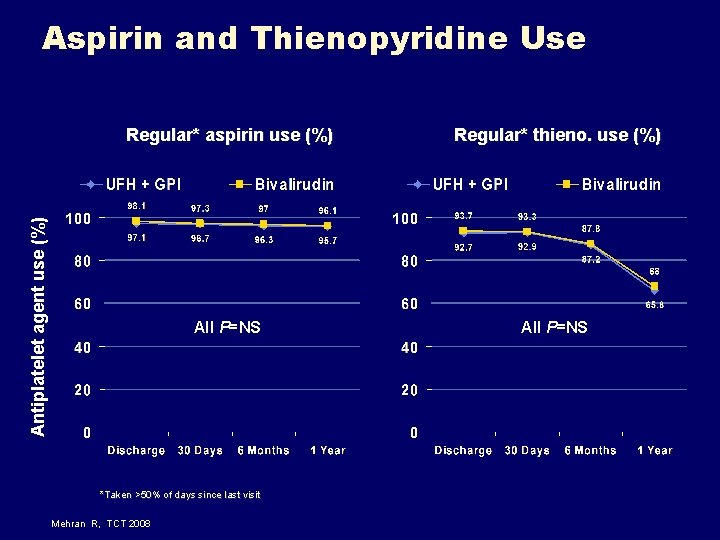
Aspirin and Thienopyridine Use Regular* thieno. use (%) All P=NS Antiplatelet agent use (%) Regular* aspirin use (%) *Taken >50% of days since last visit Mehran R, TCT 2008
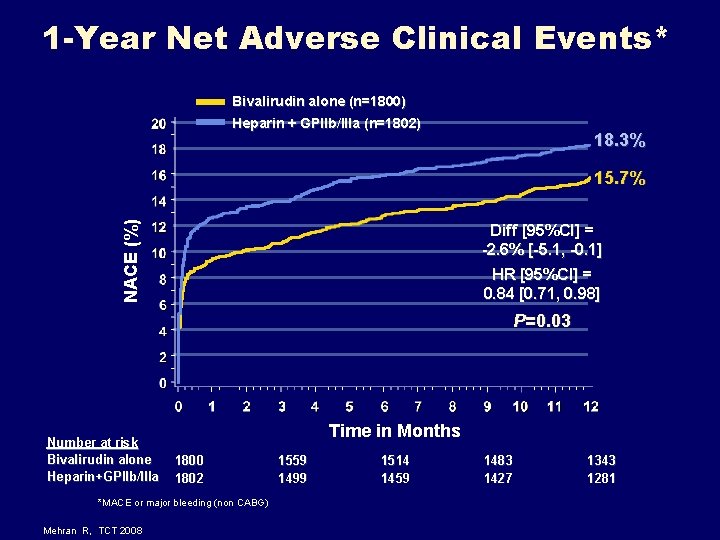
1 -Year Net Adverse Clinical Events* Bivalirudin alone (n=1800) Heparin + GPIIb/IIIa (n=1802) 18. 3% NACE (%) 15. 7% Diff [95%CI] = -2. 6% [-5. 1, -0. 1] HR [95%CI] = 0. 84 [0. 71, 0. 98] P=0. 03 Number at risk Bivalirudin alone Heparin+GPIIb/IIIa Time in Months 1800 1802 *MACE or major bleeding (non CABG) Mehran R, TCT 2008 1559 1499 1514 1459 1483 1427 1343 1281
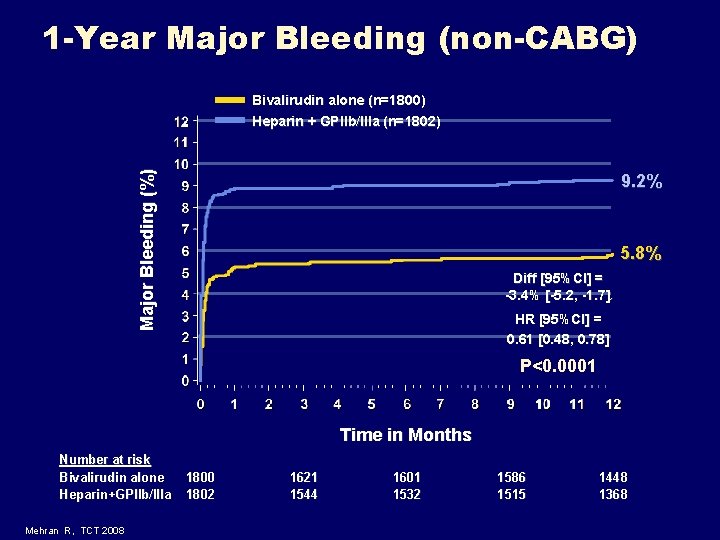
1 -Year Major Bleeding (non-CABG) Bivalirudin alone (n=1800) Major Bleeding (%) Heparin + GPIIb/IIIa (n=1802) 9. 2% 5. 8% Diff [95%CI] = -3. 4% [-5. 2, -1. 7] 2 HR [95%CI] = 0. 61 [0. 48, 0. 78] P<0. 0001 Time in Months Number at risk Bivalirudin alone Heparin+GPIIb/IIIa Mehran R, TCT 2008 1800 1802 1621 1544 1601 1532 1586 1515 1448 1368
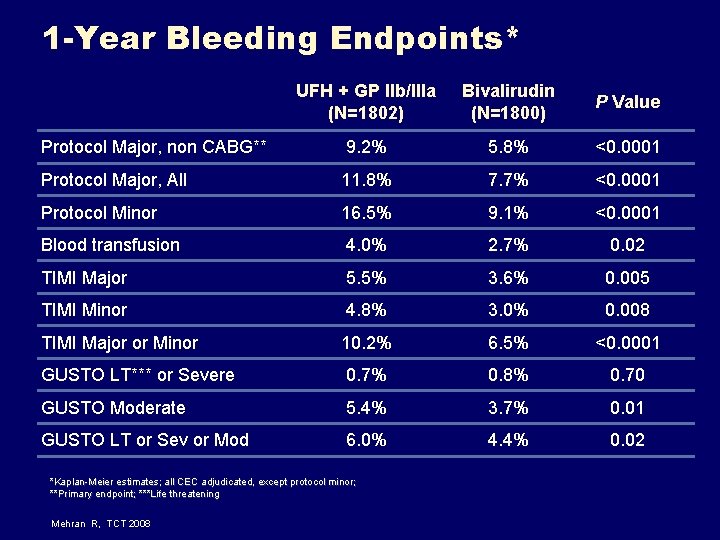
1 -Year Bleeding Endpoints* UFH + GP IIb/IIIa (N=1802) Bivalirudin (N=1800) P Value Protocol Major, non CABG** 9. 2% 5. 8% <0. 0001 Protocol Major, All 11. 8% 7. 7% <0. 0001 Protocol Minor 16. 5% 9. 1% <0. 0001 Blood transfusion 4. 0% 2. 7% 0. 02 TIMI Major 5. 5% 3. 6% 0. 005 TIMI Minor 4. 8% 3. 0% 0. 008 TIMI Major or Minor 10. 2% 6. 5% <0. 0001 GUSTO LT*** or Severe 0. 7% 0. 8% 0. 70 GUSTO Moderate 5. 4% 3. 7% 0. 01 GUSTO LT or Sev or Mod 6. 0% 4. 4% 0. 02 *Kaplan-Meier estimates; all CEC adjudicated, except protocol minor; **Primary endpoint; ***Life threatening Mehran R, TCT 2008
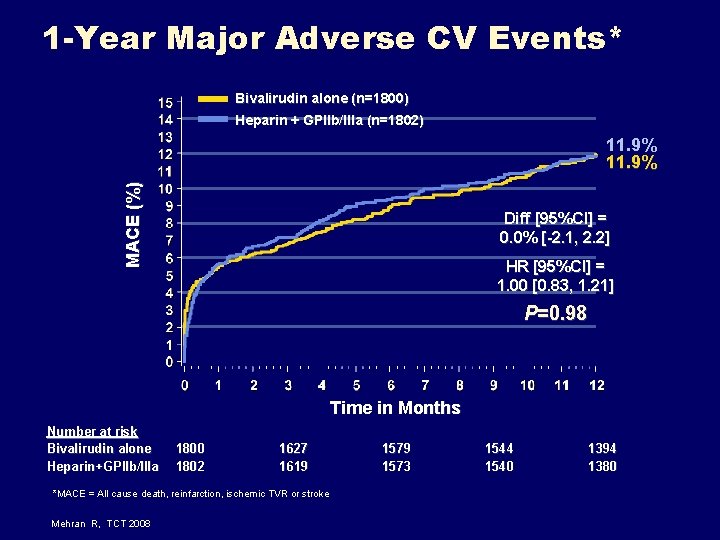
1 -Year Major Adverse CV Events* Bivalirudin alone (n=1800) Heparin + GPIIb/IIIa (n=1802) MACE (%) 11. 9% Diff [95%CI] = 0. 0% [-2. 1, 2. 2] HR [95%CI] = 1. 00 [0. 83, 1. 21] P=0. 98 Time in Months Number at risk Bivalirudin alone Heparin+GPIIb/IIIa 1800 1802 1627 1619 *MACE = All cause death, reinfarction, ischemic TVR or stroke Mehran R, TCT 2008 1579 1573 1544 1540 1394 1380
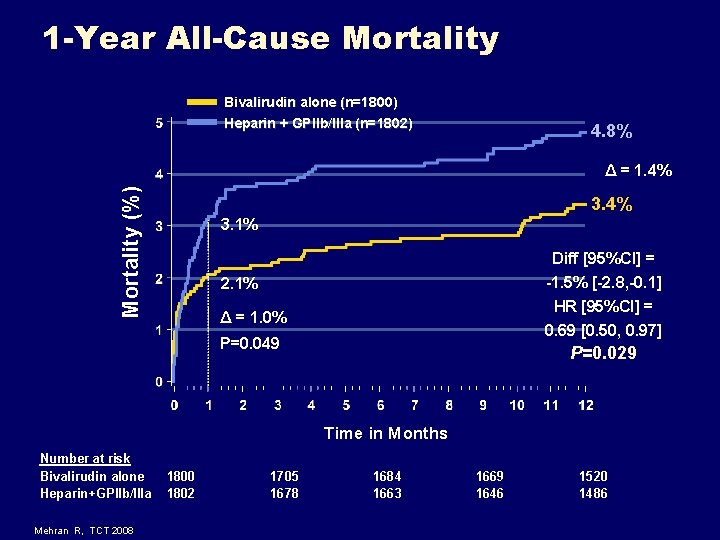
1 -Year All-Cause Mortality Bivalirudin alone (n=1800) Heparin + GPIIb/IIIa (n=1802) 4. 8% Mortality (%) Δ = 1. 4% 3. 1% Diff [95%CI] = -1. 5% [-2. 8, -0. 1] 2. 1% HR [95%CI] = Δ = 1. 0% 0. 69 [0. 50, 0. 97] P=0. 049 P=0. 029 Time in Months Number at risk Bivalirudin alone Heparin+GPIIb/IIIa Mehran R, TCT 2008 1800 1802 1705 1678 1684 1663 1669 1646 1520 1486
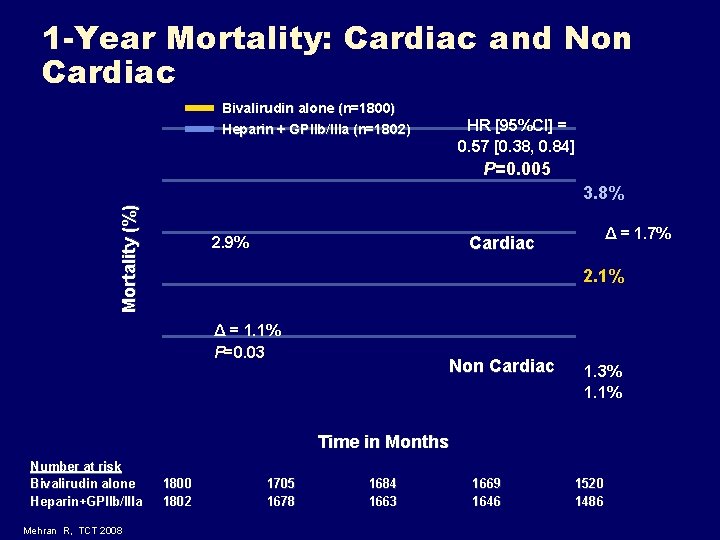
1 -Year Mortality: Cardiac and Non Cardiac Bivalirudin alone (n=1800) HR [95%CI] = 0. 57 [0. 38, 0. 84] Heparin + GPIIb/IIIa (n=1802) P=0. 005 Mortality (%) 3. 8% Δ = 1. 7% Cardiac 2. 9% 2. 1% Δ = 1. 1% P=0. 03 Non Cardiac 1. 3% 1. 1% Time in Months Number at risk Bivalirudin alone Heparin+GPIIb/IIIa Mehran R, TCT 2008 1800 1802 1705 1678 1684 1663 1669 1646 1520 1486
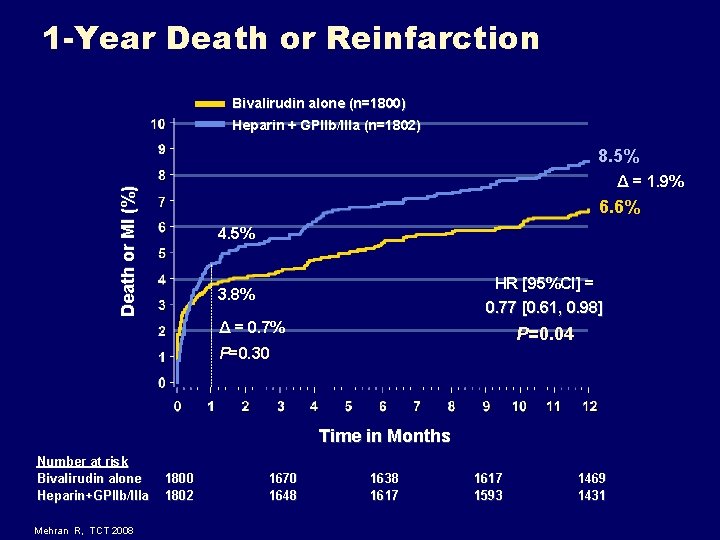
1 -Year Death or Reinfarction Bivalirudin alone (n=1800) Heparin + GPIIb/IIIa (n=1802) 8. 5% Death or MI (%) Δ = 1. 9% 6. 6% 4. 5% HR [95%CI] = 3. 8% 0. 77 [0. 61, 0. 98] Δ = 0. 7% P=0. 04 P=0. 30 Time in Months Number at risk Bivalirudin alone Heparin+GPIIb/IIIa Mehran R, TCT 2008 1800 1802 1670 1648 1638 1617 1593 1469 1431
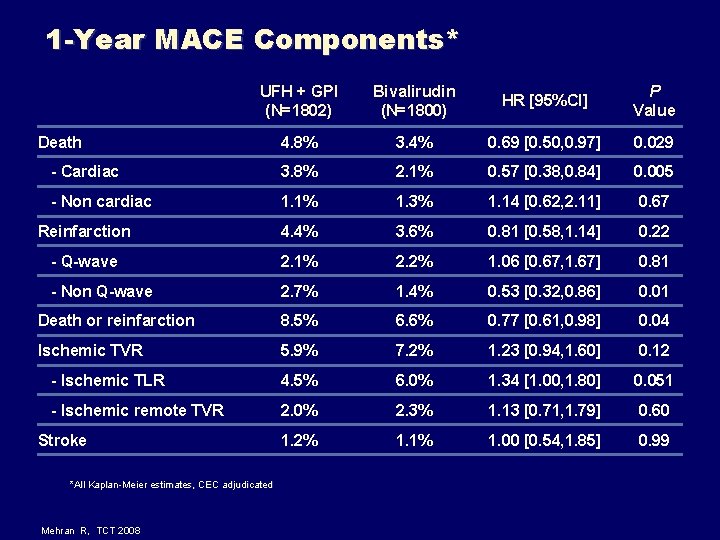
1 -Year MACE Components* UFH + GPI (N=1802) Bivalirudin (N=1800) HR [95%CI] P Value 4. 8% 3. 4% 0. 69 [0. 50, 0. 97] 0. 029 - Cardiac 3. 8% 2. 1% 0. 57 [0. 38, 0. 84] 0. 005 - Non cardiac 1. 1% 1. 3% 1. 14 [0. 62, 2. 11] 0. 67 Reinfarction 4. 4% 3. 6% 0. 81 [0. 58, 1. 14] 0. 22 - Q-wave 2. 1% 2. 2% 1. 06 [0. 67, 1. 67] 0. 81 - Non Q-wave 2. 7% 1. 4% 0. 53 [0. 32, 0. 86] 0. 01 Death or reinfarction 8. 5% 6. 6% 0. 77 [0. 61, 0. 98] 0. 04 Ischemic TVR 5. 9% 7. 2% 1. 23 [0. 94, 1. 60] 0. 12 - Ischemic TLR 4. 5% 6. 0% 1. 34 [1. 00, 1. 80] 0. 051 - Ischemic remote TVR 2. 0% 2. 3% 1. 13 [0. 71, 1. 79] 0. 60 1. 2% 1. 1% 1. 00 [0. 54, 1. 85] 0. 99 Death Stroke *All Kaplan-Meier estimates, CEC adjudicated Mehran R, TCT 2008
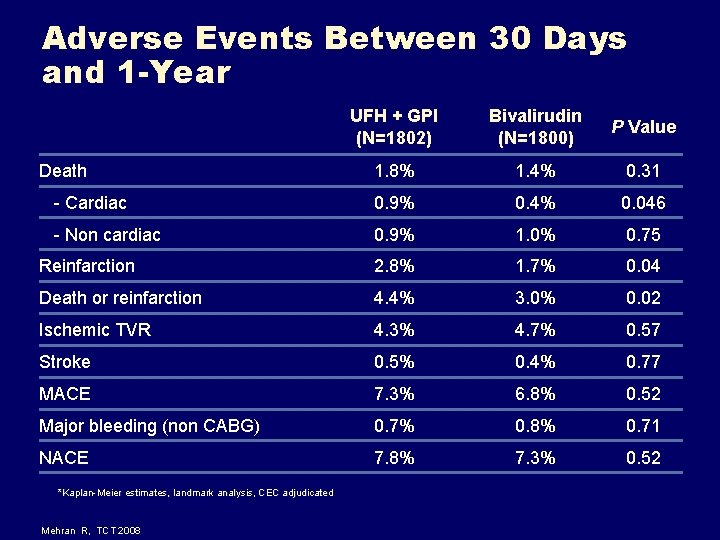
Adverse Events Between 30 Days and 1 -Year UFH + GPI (N=1802) Bivalirudin (N=1800) P Value 1. 8% 1. 4% 0. 31 - Cardiac 0. 9% 0. 4% 0. 046 - Non cardiac 0. 9% 1. 0% 0. 75 Reinfarction 2. 8% 1. 7% 0. 04 Death or reinfarction 4. 4% 3. 0% 0. 02 Ischemic TVR 4. 3% 4. 7% 0. 57 Stroke 0. 5% 0. 4% 0. 77 MACE 7. 3% 6. 8% 0. 52 Major bleeding (non CABG) 0. 7% 0. 8% 0. 71 NACE 7. 8% 7. 3% 0. 52 Death *Kaplan-Meier estimates, landmark analysis, CEC adjudicated Mehran R, TCT 2008
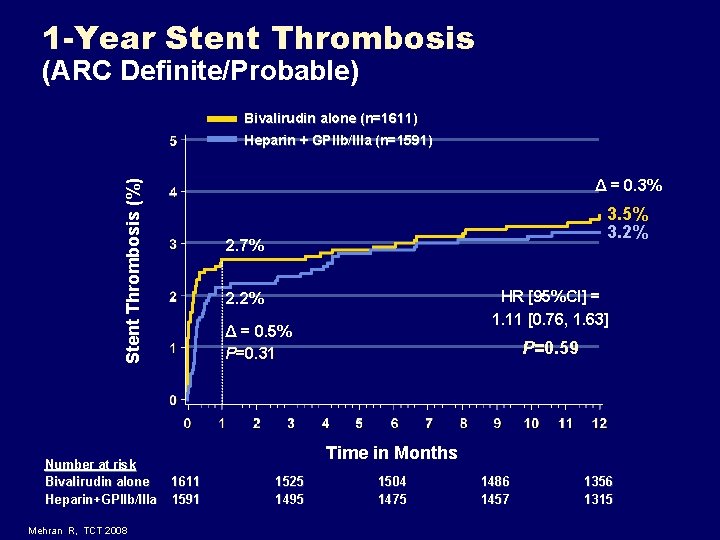
1 -Year Stent Thrombosis (ARC Definite/Probable) Bivalirudin alone (n=1611) Heparin + GPIIb/IIIa (n=1591) Stent Thrombosis (%) Δ = 0. 3% Number at risk Bivalirudin alone Heparin+GPIIb/IIIa Mehran R, TCT 2008 3. 5% 3. 2% 2. 7% HR [95%CI] = 1. 11 [0. 76, 1. 63] 2. 2% Δ = 0. 5% P=0. 31 P=0. 59 Time in Months 1611 1591 1525 1495 1504 1475 1486 1457 1356 1315
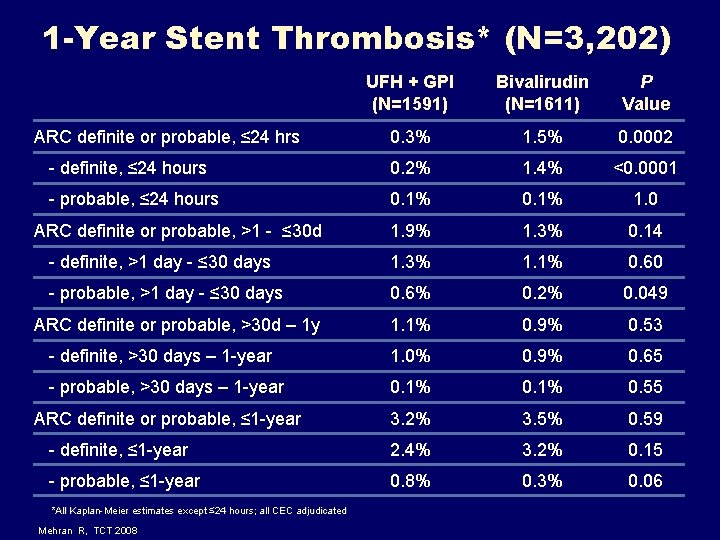
1 -Year Stent Thrombosis* (N=3, 202) UFH + GPI (N=1591) Bivalirudin (N=1611) P Value 0. 3% 1. 5% 0. 0002 - definite, ≤ 24 hours 0. 2% 1. 4% <0. 0001 - probable, ≤ 24 hours 0. 1% 1. 0 1. 9% 1. 3% 0. 14 - definite, >1 day - ≤ 30 days 1. 3% 1. 1% 0. 60 - probable, >1 day - ≤ 30 days 0. 6% 0. 2% 0. 049 1. 1% 0. 9% 0. 53 - definite, >30 days – 1 -year 1. 0% 0. 9% 0. 65 - probable, >30 days – 1 -year 0. 1% 0. 55 ARC definite or probable, ≤ 1 -year 3. 2% 3. 5% 0. 59 - definite, ≤ 1 -year 2. 4% 3. 2% 0. 15 - probable, ≤ 1 -year 0. 8% 0. 3% 0. 06 ARC definite or probable, ≤ 24 hrs ARC definite or probable, >1 - ≤ 30 d ARC definite or probable, >30 d – 1 y *All Kaplan-Meier estimates except ≤ 24 hours; all CEC adjudicated Mehran R, TCT 2008
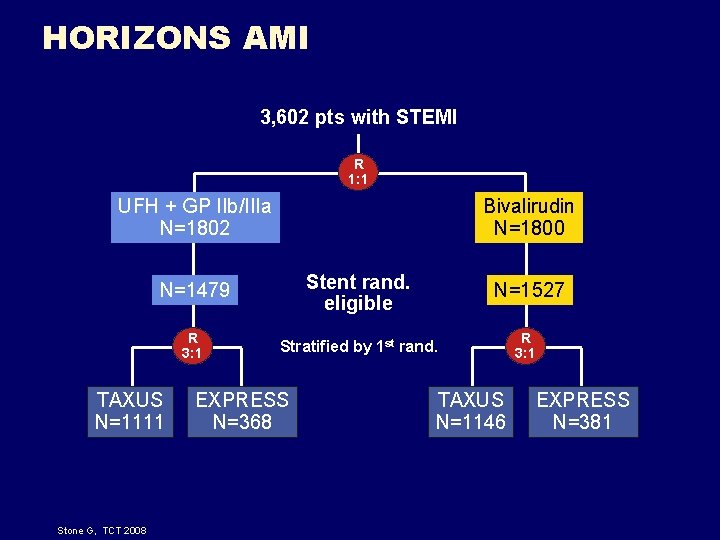
HORIZONS AMI 3, 602 pts with STEMI R 1: 1 UFH + GP IIb/IIIa N=1802 N=1479 Stent rand. eligible R 3: 1 Stratified by 1 st rand. TAXUS N=1111 Stone G, TCT 2008 Bivalirudin N=1800 EXPRESS N=368 N=1527 TAXUS N=1146 R 3: 1 EXPRESS N=381
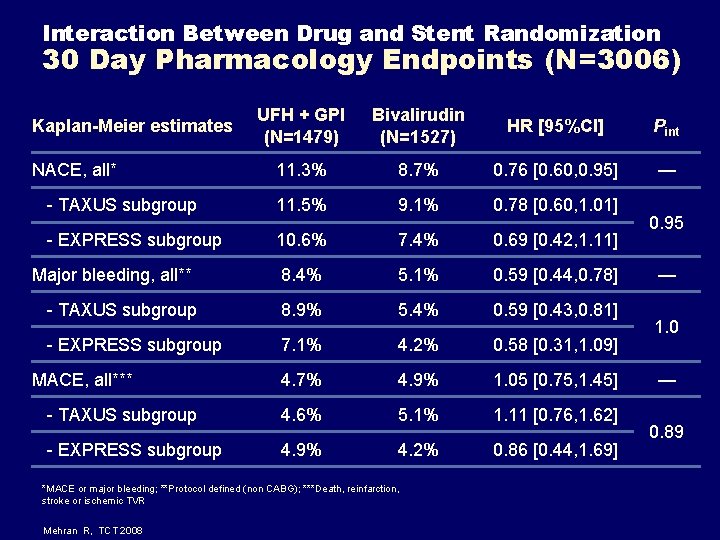
Interaction Between Drug and Stent Randomization 30 Day Pharmacology Endpoints (N=3006) UFH + GPI (N=1479) Bivalirudin (N=1527) HR [95%CI] Pint 11. 3% 8. 7% 0. 76 [0. 60, 0. 95] — - TAXUS subgroup 11. 5% 9. 1% 0. 78 [0. 60, 1. 01] - EXPRESS subgroup 10. 6% 7. 4% 0. 69 [0. 42, 1. 11] 8. 4% 5. 1% 0. 59 [0. 44, 0. 78] - TAXUS subgroup 8. 9% 5. 4% 0. 59 [0. 43, 0. 81] - EXPRESS subgroup 7. 1% 4. 2% 0. 58 [0. 31, 1. 09] 4. 7% 4. 9% 1. 05 [0. 75, 1. 45] - TAXUS subgroup 4. 6% 5. 1% 1. 11 [0. 76, 1. 62] - EXPRESS subgroup 4. 9% 4. 2% 0. 86 [0. 44, 1. 69] Kaplan-Meier estimates NACE, all* Major bleeding, all** MACE, all*** *MACE or major bleeding; **Protocol defined (non CABG); ***Death, reinfarction, stroke or ischemic TVR Mehran R, TCT 2008 0. 95 — 1. 0 — 0. 89
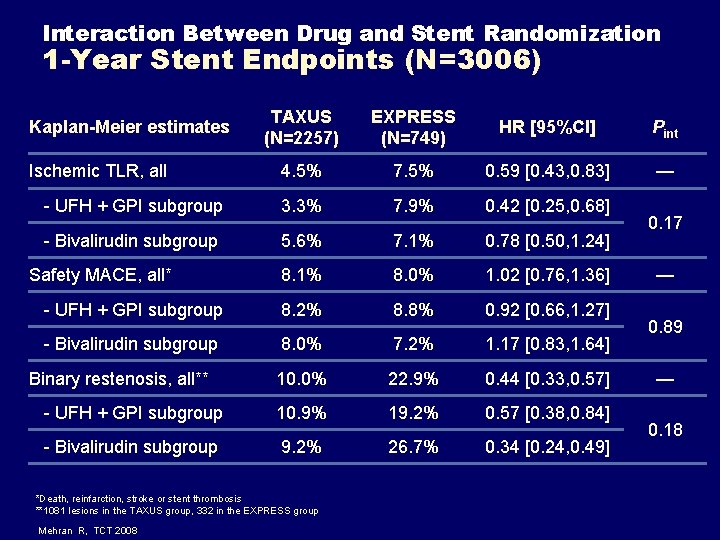
Interaction Between Drug and Stent Randomization 1 -Year Stent Endpoints (N=3006) TAXUS (N=2257) EXPRESS (N=749) HR [95%CI] Pint 4. 5% 7. 5% 0. 59 [0. 43, 0. 83] — - UFH + GPI subgroup 3. 3% 7. 9% 0. 42 [0. 25, 0. 68] - Bivalirudin subgroup 5. 6% 7. 1% 0. 78 [0. 50, 1. 24] 8. 1% 8. 0% 1. 02 [0. 76, 1. 36] - UFH + GPI subgroup 8. 2% 8. 8% 0. 92 [0. 66, 1. 27] - Bivalirudin subgroup 8. 0% 7. 2% 1. 17 [0. 83, 1. 64] 10. 0% 22. 9% 0. 44 [0. 33, 0. 57] - UFH + GPI subgroup 10. 9% 19. 2% 0. 57 [0. 38, 0. 84] - Bivalirudin subgroup 9. 2% 26. 7% 0. 34 [0. 24, 0. 49] Kaplan-Meier estimates Ischemic TLR, all Safety MACE, all* Binary restenosis, all** *Death, reinfarction, stroke or stent thrombosis **1081 lesions in the TAXUS group, 332 in the EXPRESS group Mehran R, TCT 2008 0. 17 — 0. 89 — 0. 18
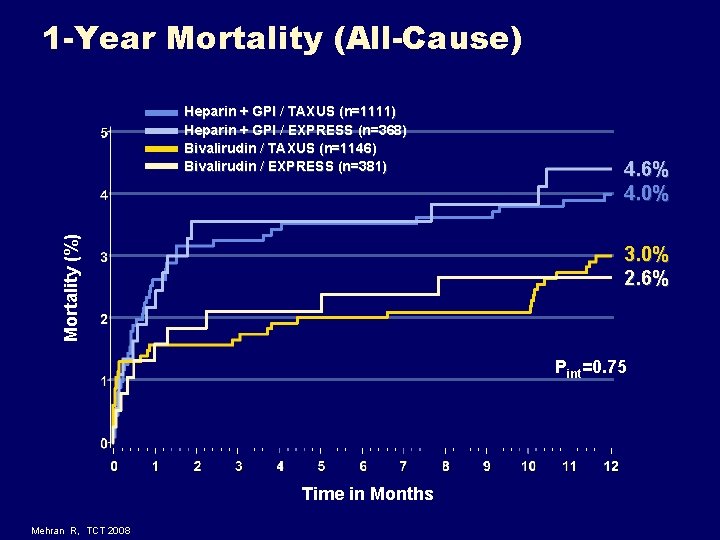
1 -Year Mortality (All-Cause) Mortality (%) Heparin + GPI / TAXUS (n=1111) Heparin + GPI / EXPRESS (n=368) Bivalirudin / TAXUS (n=1146) Bivalirudin / EXPRESS (n=381) 4. 6% 4. 0% 3. 0% 2. 6% Pint=0. 75 Time in Months Mehran R, TCT 2008
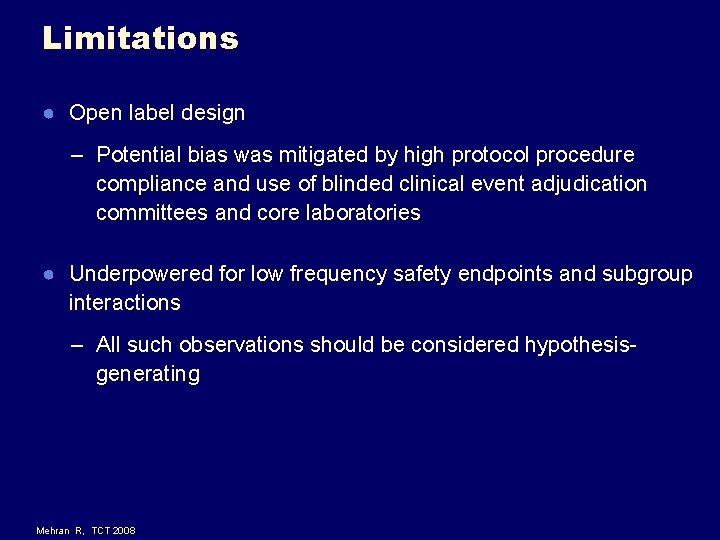
Limitations ● Open label design – Potential bias was mitigated by high protocol procedure compliance and use of blinded clinical event adjudication committees and core laboratories ● Underpowered for low frequency safety endpoints and subgroup interactions – All such observations should be considered hypothesisgenerating Mehran R, TCT 2008
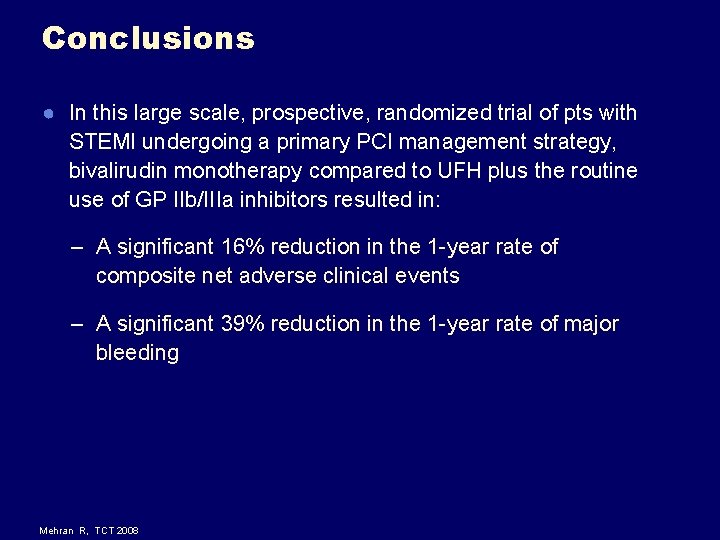
Conclusions ● In this large scale, prospective, randomized trial of pts with STEMI undergoing a primary PCI management strategy, bivalirudin monotherapy compared to UFH plus the routine use of GP IIb/IIIa inhibitors resulted in: – A significant 16% reduction in the 1 -year rate of composite net adverse clinical events – A significant 39% reduction in the 1 -year rate of major bleeding Mehran R, TCT 2008
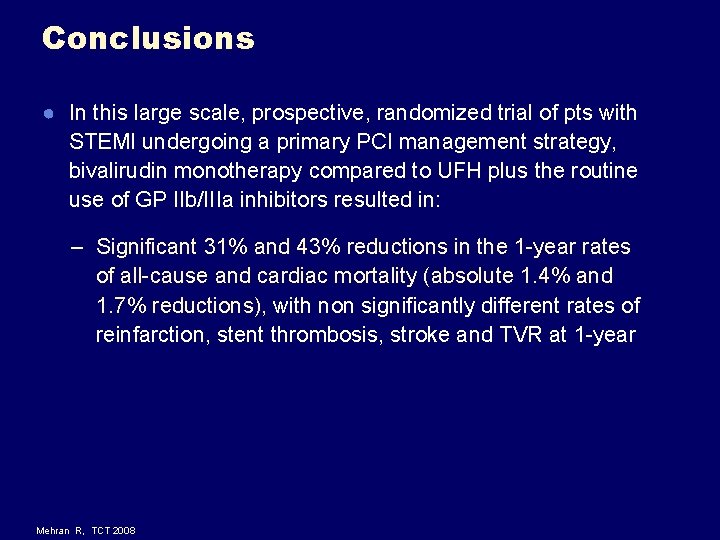
Conclusions ● In this large scale, prospective, randomized trial of pts with STEMI undergoing a primary PCI management strategy, bivalirudin monotherapy compared to UFH plus the routine use of GP IIb/IIIa inhibitors resulted in: – Significant 31% and 43% reductions in the 1 -year rates of all-cause and cardiac mortality (absolute 1. 4% and 1. 7% reductions), with non significantly different rates of reinfarction, stent thrombosis, stroke and TVR at 1 -year Mehran R, TCT 2008
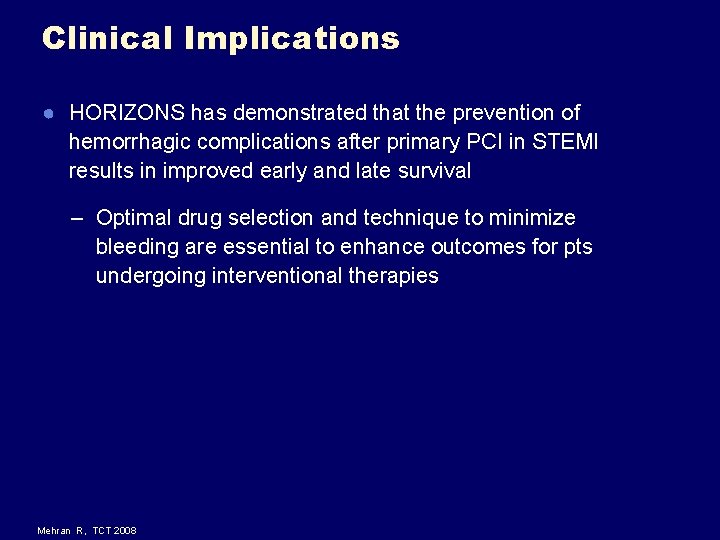
Clinical Implications ● HORIZONS has demonstrated that the prevention of hemorrhagic complications after primary PCI in STEMI results in improved early and late survival – Optimal drug selection and technique to minimize bleeding are essential to enhance outcomes for pts undergoing interventional therapies Mehran R, TCT 2008