High Redshift Relativistic Jets C C Teddy Cheung

- Slides: 52
High Redshift Relativistic Jets C. C. Teddy Cheung NASA Goddard Space Flight Center and Eureka Scientific Inc. * Teddy. Cheung@nasa. gov Radio Galaxies in the Chandra Era 8 July 2008 *Chandra GO 7 -8114 C
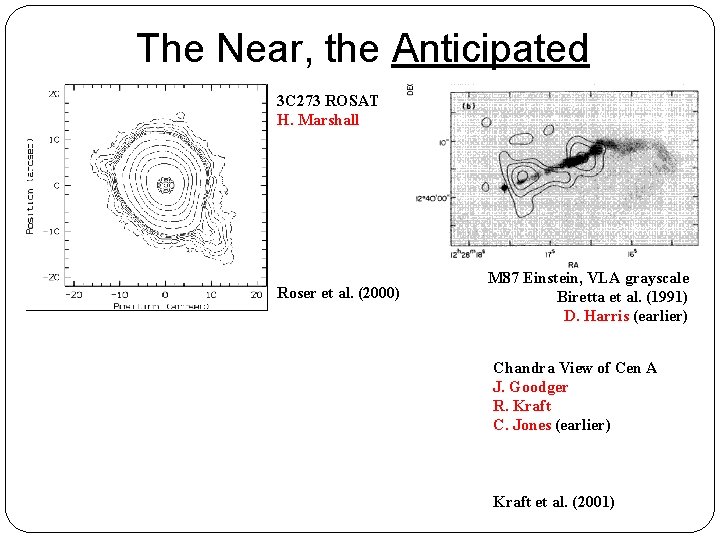
The Near, the Anticipated 3 C 273 ROSAT H. Marshall Roser et al. (2000) M 87 Einstein, VLA grayscale Biretta et al. (1991) D. Harris (earlier) Chandra View of Cen A J. Goodger R. Kraft C. Jones (earlier) Kraft et al. (2001)
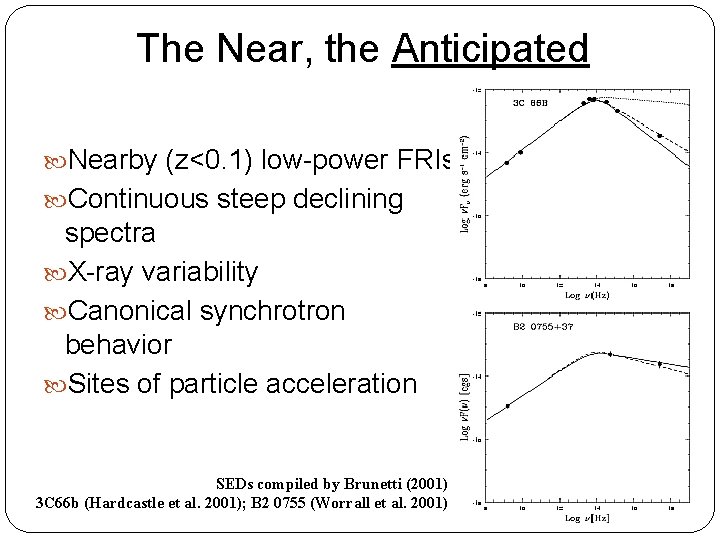
The Near, the Anticipated Nearby (z<0. 1) low-power FRIs Continuous steep declining spectra X-ray variability Canonical synchrotron behavior Sites of particle acceleration SEDs compiled by Brunetti (2001) 3 C 66 b (Hardcastle et al. 2001); B 2 0755 (Worrall et al. 2001)
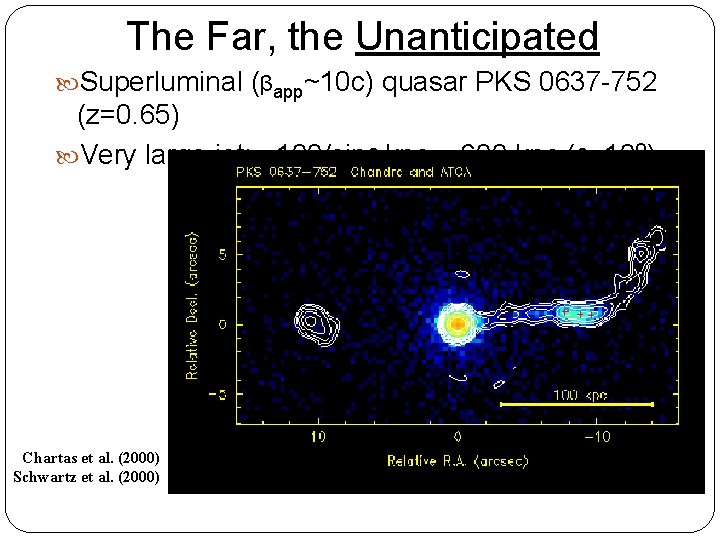
The Far, the Unanticipated Superluminal (βapp~10 c) quasar PKS 0637 -752 (z=0. 65) Very large jet: ~100/sinθ kpc = 600 kpc (θ=10 o) Chartas et al. (2000) Schwartz et al. (2000)
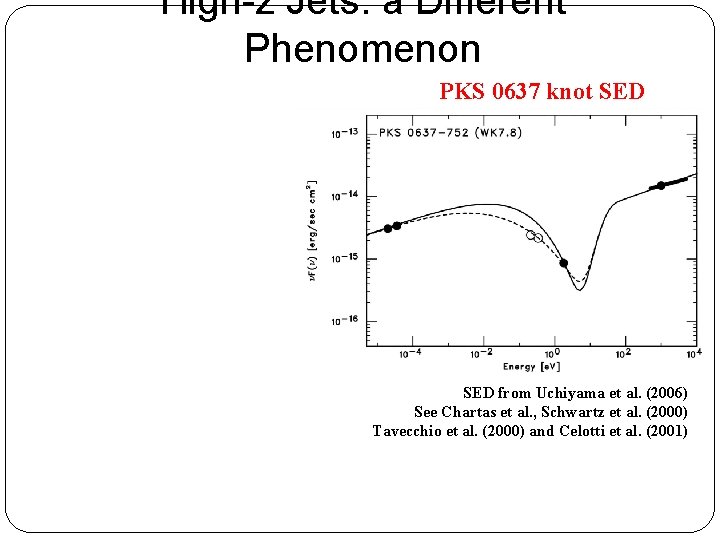
High-z Jets: a Different Phenomenon PKS 0637 knot SED from Uchiyama et al. (2006) See Chartas et al. , Schwartz et al. (2000) Tavecchio et al. (2000) and Celotti et al. (2001)
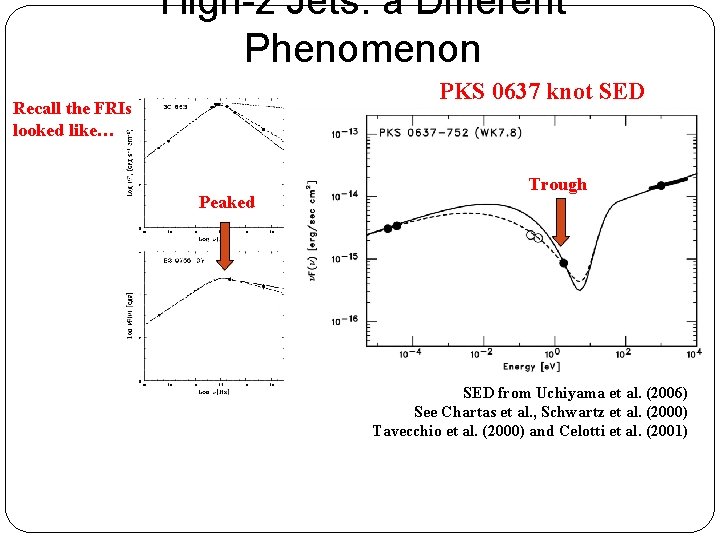
High-z Jets: a Different Phenomenon PKS 0637 knot SED Recall the FRIs looked like… Peaked Trough SED from Uchiyama et al. (2006) See Chartas et al. , Schwartz et al. (2000) Tavecchio et al. (2000) and Celotti et al. (2001)
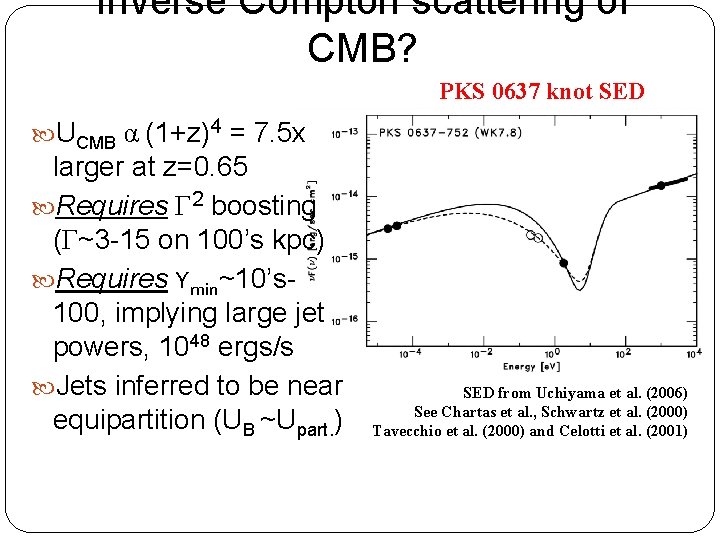
Inverse Compton scattering of CMB? PKS 0637 knot SED UCMB α (1+z)4 = 7. 5 x larger at z=0. 65 Requires Γ 2 boosting (Γ~3 -15 on 100’s kpc) Requires Υmin~10’s 100, implying large jet powers, 1048 ergs/s Jets inferred to be near equipartition (UB ~Upart. ) SED from Uchiyama et al. (2006) See Chartas et al. , Schwartz et al. (2000) Tavecchio et al. (2000) and Celotti et al. (2001)
The Far and Very Far
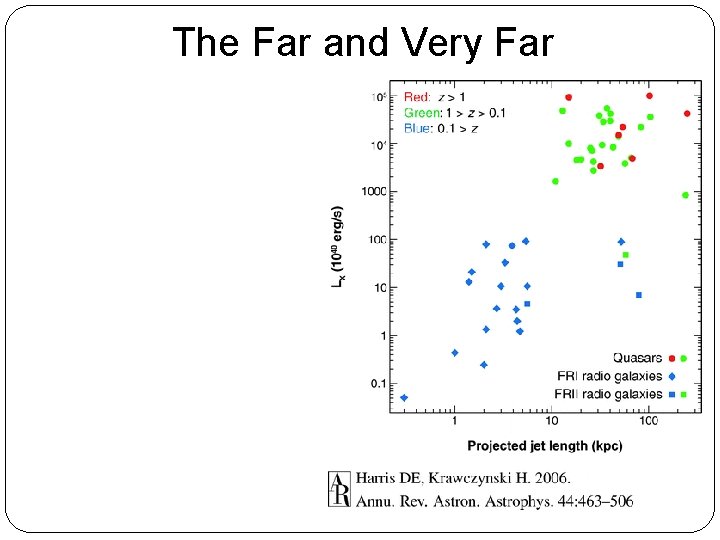
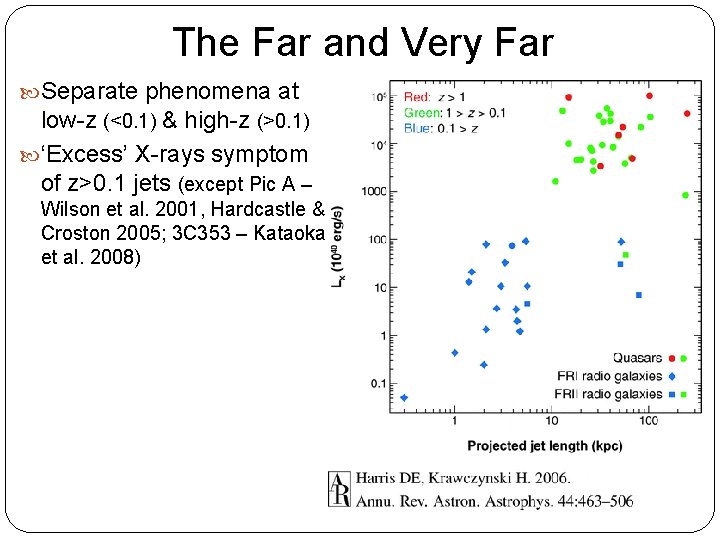
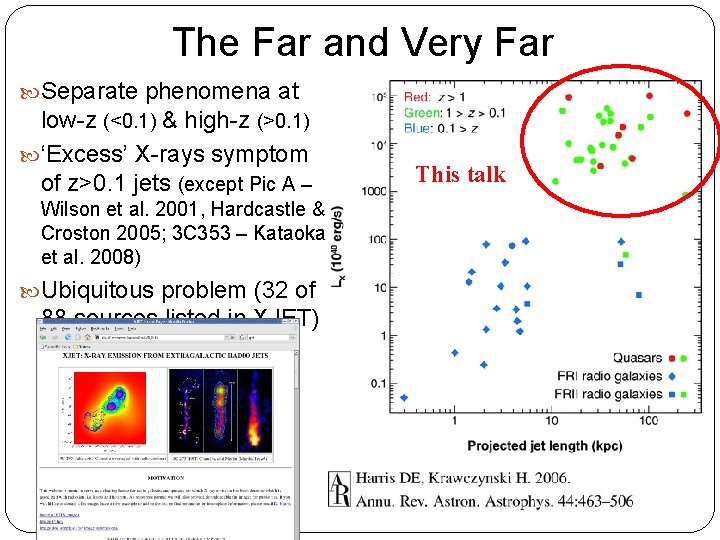
The Far and Very Far Separate phenomena at low-z (<0. 1) & high-z (>0. 1) ‘Excess’ X-rays symptom of z>0. 1 jets (except Pic A – Wilson et al. 2001, Hardcastle & Croston 2005; 3 C 353 – Kataoka et al. 2008)
The Far and Very Far Separate phenomena at low-z (<0. 1) & high-z (>0. 1) ‘Excess’ X-rays symptom of z>0. 1 jets (except Pic A – Wilson et al. 2001, Hardcastle & Croston 2005; 3 C 353 – Kataoka et al. 2008) Ubiquitous problem (32 of 88 sources listed in XJET) This talk
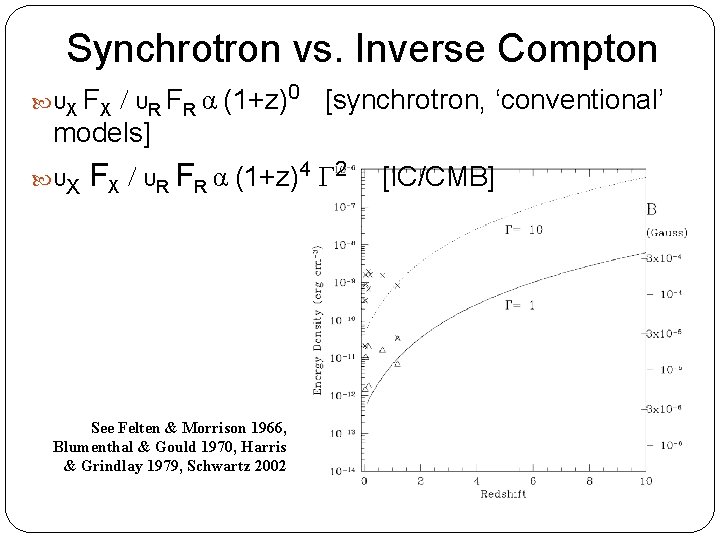
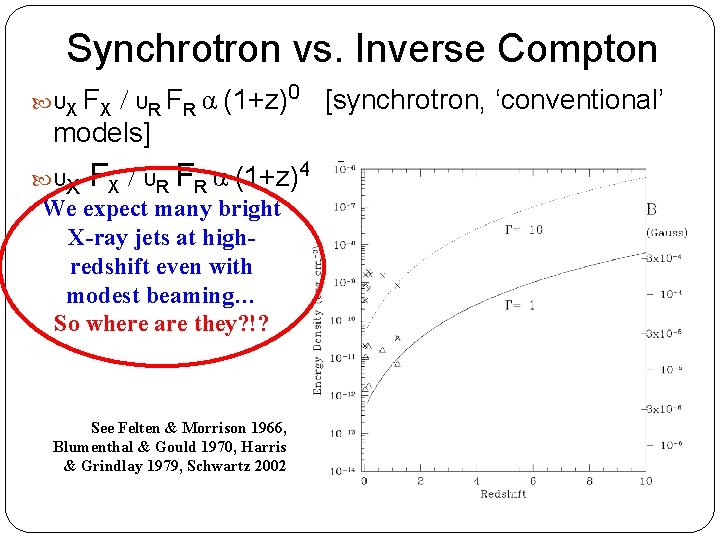
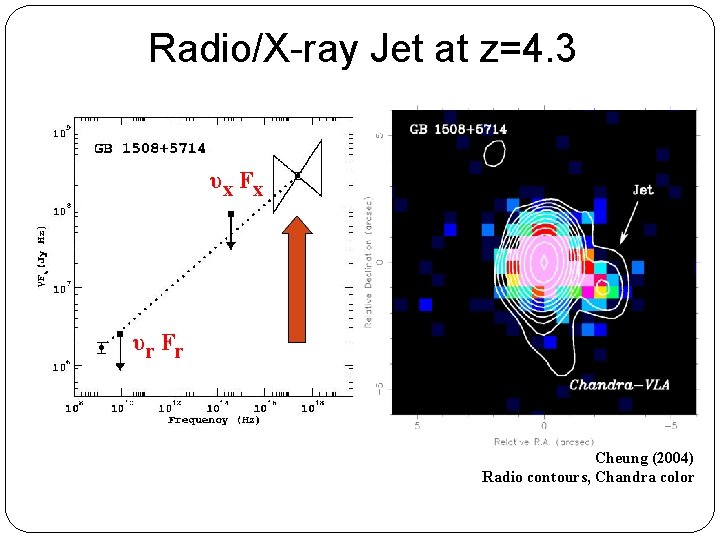
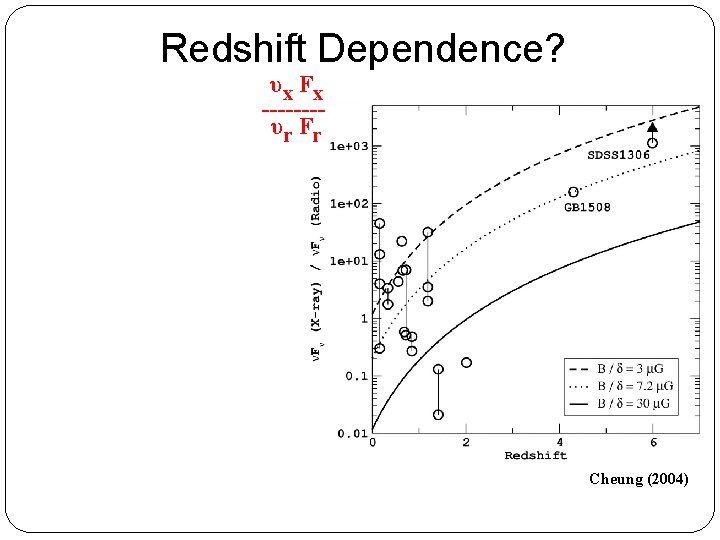
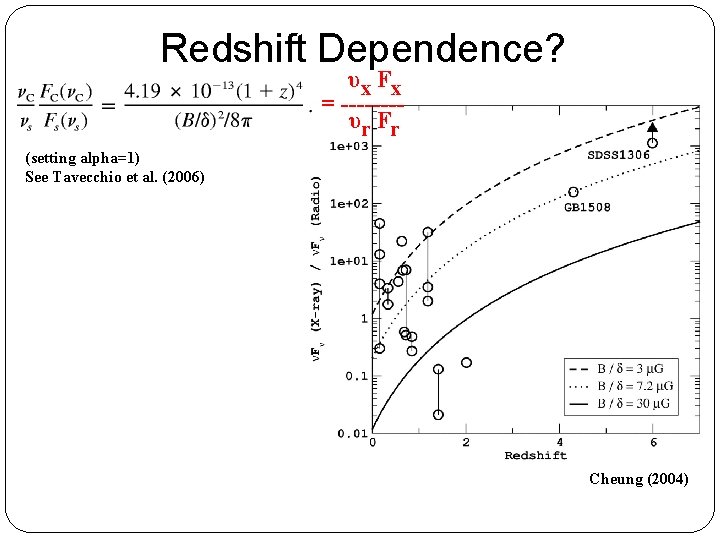
Synchrotron vs. Inverse Compton / υR FR α (1+z)0 [synchrotron, ‘conventional’ models] υX FX / υR FR α (1+z)4 Γ 2 See Felten & Morrison 1966, Blumenthal & Gould 1970, Harris & Grindlay 1979, Schwartz 2002 [IC/CMB]
Synchrotron vs. Inverse Compton / υR FR α (1+z)0 [synchrotron, ‘conventional’ models] υX FX / υR FR α (1+z)4 Γ 2 We expect many bright X-ray jets at highredshift even with modest beaming… So where are they? !? See Felten & Morrison 1966, Blumenthal & Gould 1970, Harris & Grindlay 1979, Schwartz 2002 [IC/CMB]
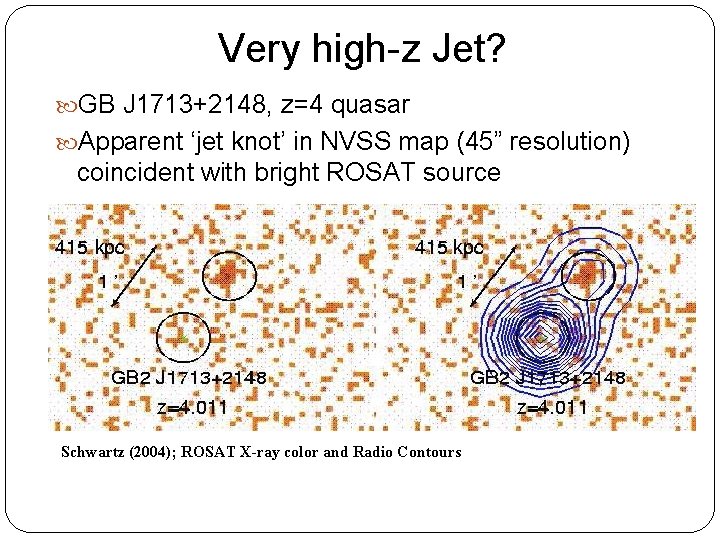
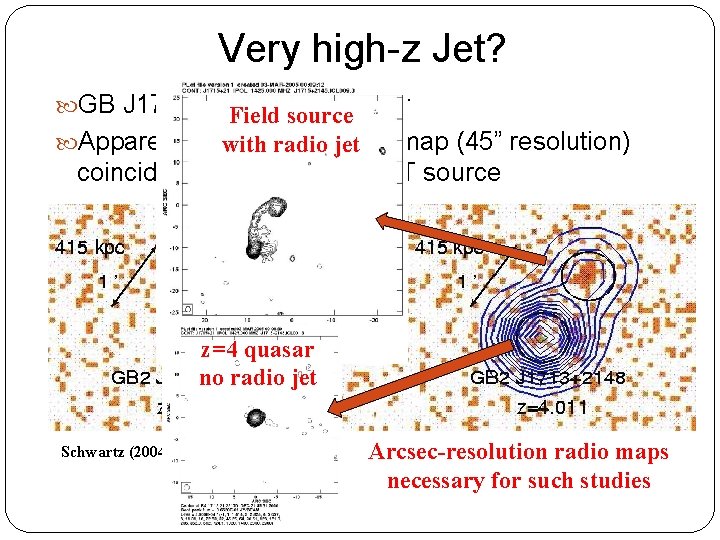
Very high-z Jet? GB J 1713+2148, z=4 quasar Apparent ‘jet knot’ in NVSS map (45” resolution) coincident with bright ROSAT source Schwartz (2004); ROSAT X-ray color and Radio Contours
Very high-z Jet? GB J 1713+2148, quasar Fieldz=4 source Apparent ‘jetwith knot’radio in NVSS map (45” resolution) jet coincident with bright ROSAT source z=4 quasar no radio jet Schwartz (2004) Arcsec-resolution radio maps necessary for such studies
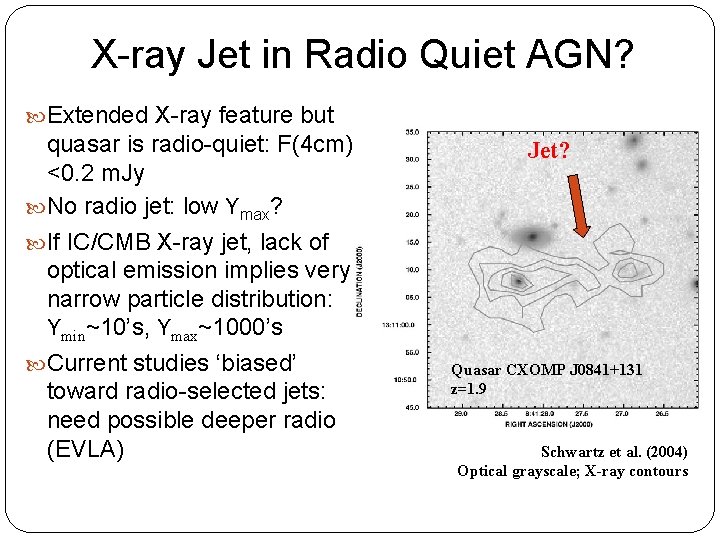
X-ray Jet in Radio Quiet AGN? Extended X-ray feature but quasar is radio-quiet: F(4 cm) <0. 2 m. Jy No radio jet: low Υmax? If IC/CMB X-ray jet, lack of optical emission implies very narrow particle distribution: Υmin~10’s, Υmax~1000’s Current studies ‘biased’ toward radio-selected jets: need possible deeper radio (EVLA) Jet? Quasar CXOMP J 0841+131 z=1. 9 Schwartz et al. (2004) Optical grayscale; X-ray contours
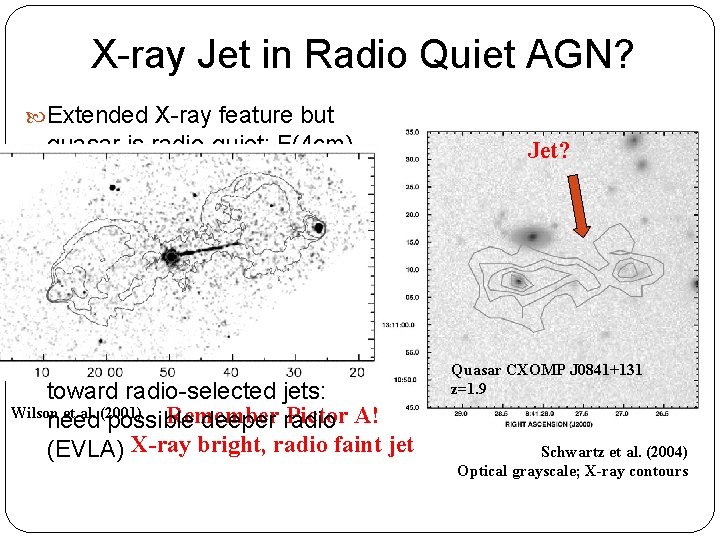
X-ray Jet in Radio Quiet AGN? Extended X-ray feature but quasar is radio-quiet: F(4 cm) <0. 2 m. Jy No radio jet: low Υmax? If IC/CMB X-ray jet, lack of optical emission implies very narrow particle distribution: Υmin~10’s, Υmax~1000’s Current studies ‘biased’ toward radio-selected jets: Wilson et al. (2001) Remember Pictor A! need possible deeper radio (EVLA) X-ray bright, radio faint jet Jet? Quasar CXOMP J 0841+131 z=1. 9 Schwartz et al. (2004) Optical grayscale; X-ray contours
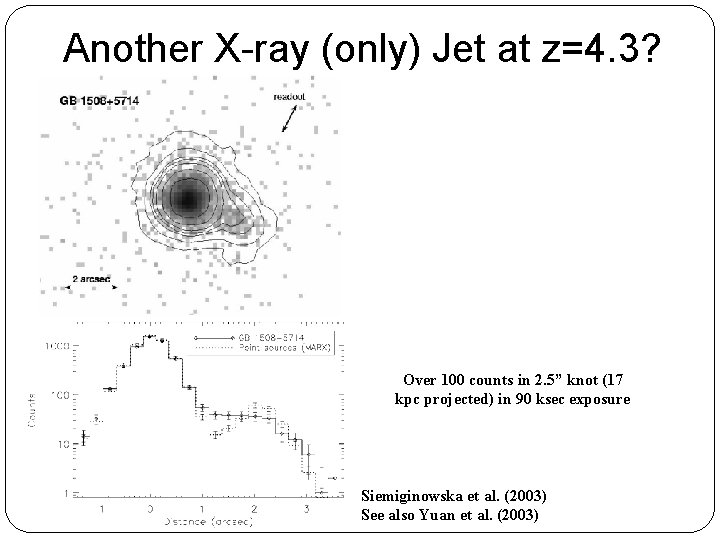
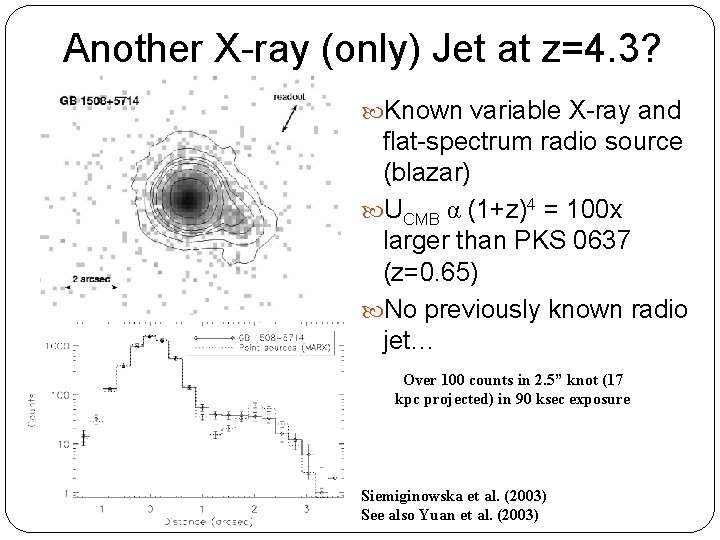
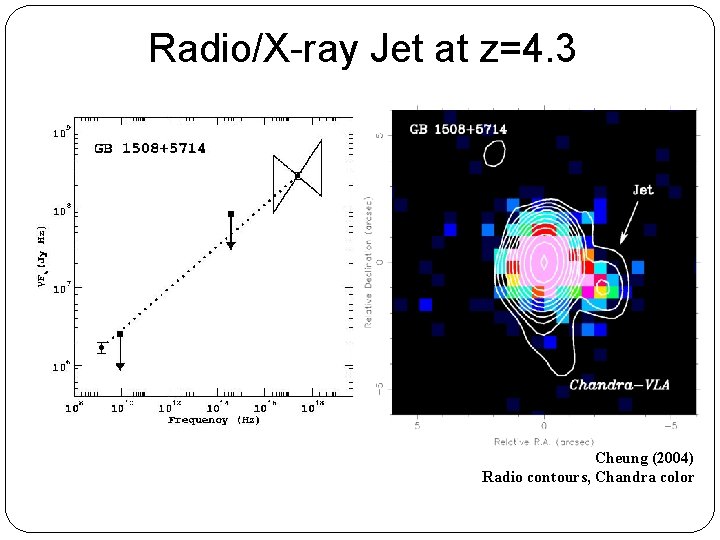
Another X-ray (only) Jet at z=4. 3? Over 100 counts in 2. 5” knot (17 kpc projected) in 90 ksec exposure Siemiginowska et al. (2003) See also Yuan et al. (2003)
Another X-ray (only) Jet at z=4. 3? Known variable X-ray and flat-spectrum radio source (blazar) UCMB α (1+z)4 = 100 x larger than PKS 0637 (z=0. 65) No previously known radio jet… Over 100 counts in 2. 5” knot (17 kpc projected) in 90 ksec exposure Siemiginowska et al. (2003) See also Yuan et al. (2003)
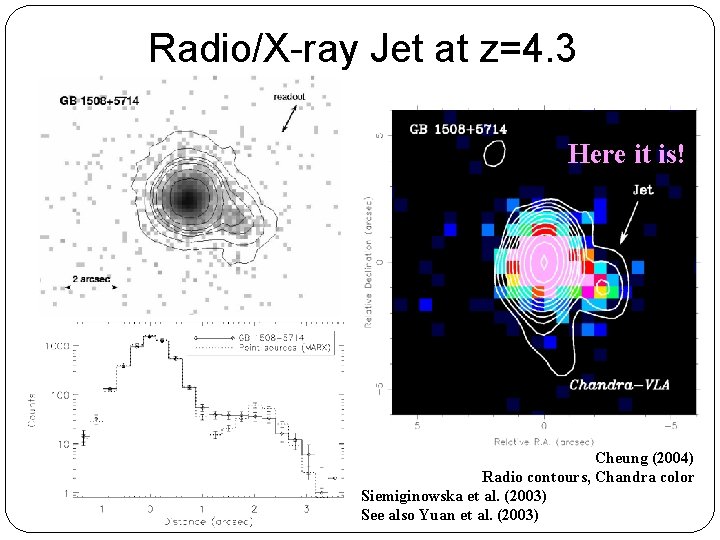
Radio/X-ray Jet at z=4. 3 Here it is! Cheung (2004) Radio contours, Chandra color Siemiginowska et al. (2003) See also Yuan et al. (2003)
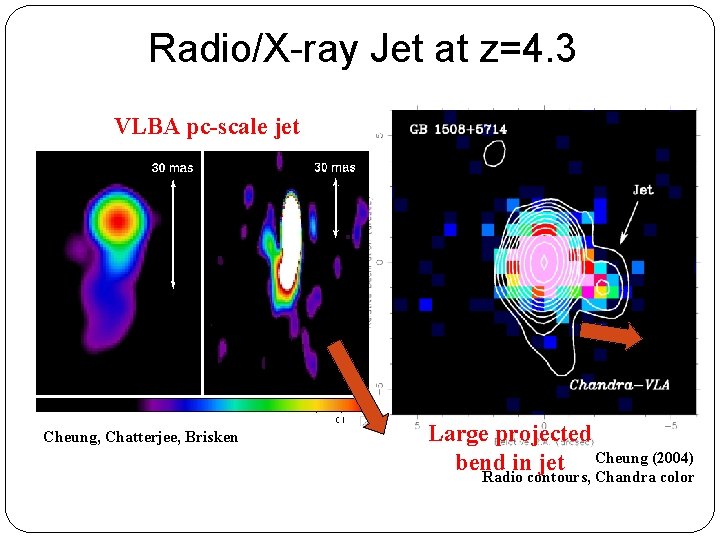
Radio/X-ray Jet at z=4. 3 VLBA pc-scale jet Cheung, Chatterjee, Brisken Large projected bend in jet Cheung (2004) Radio contours, Chandra color
Radio/X-ray Jet at z=4. 3 Cheung (2004) Radio contours, Chandra color
Radio/X-ray Jet at z=4. 3 υx F x υr F r Cheung (2004) Radio contours, Chandra color
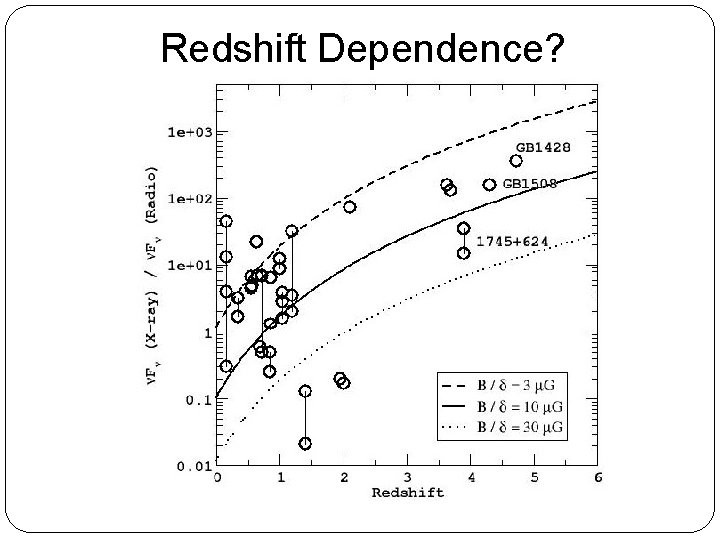
Redshift Dependence? υx F x -------υr F r Cheung (2004)
Redshift Dependence? υx F x = -------υr F r (setting alpha=1) See Tavecchio et al. (2006) Cheung (2004)
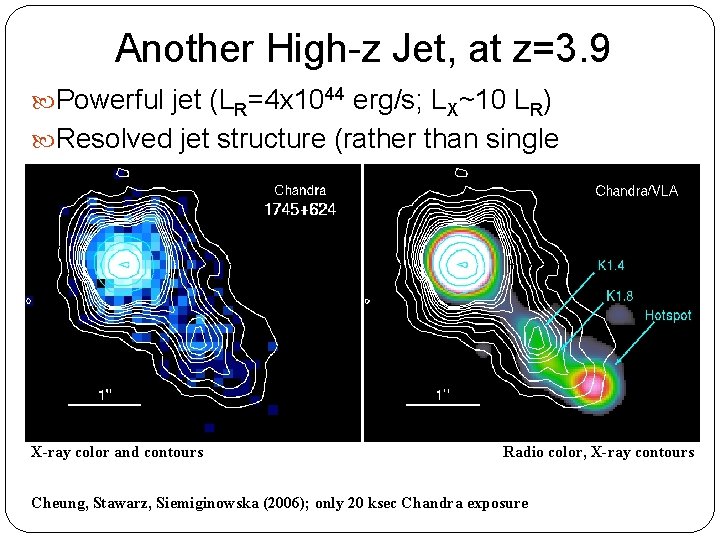
Another High-z Jet, at z=3. 9 Powerful jet (LR=4 x 1044 erg/s; LX~10 LR) Resolved jet structure (rather than single feature) B=… T_electron T_lightcross X-ray color and contours Radio color, X-ray contours Cheung, Stawarz, Siemiginowska (2006); only 20 ksec Chandra exposure
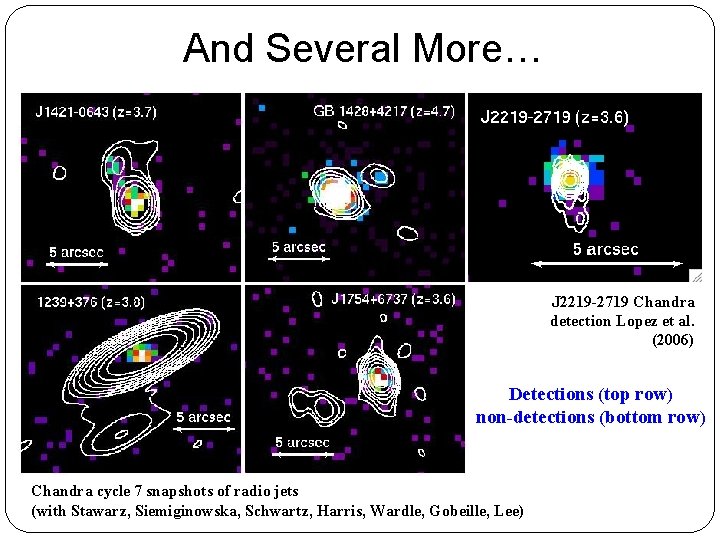
And Several More… J 2219 -2719 Chandra detection Lopez et al. (2006) Detections (top row) non-detections (bottom row) Chandra cycle 7 snapshots of radio jets (with Stawarz, Siemiginowska, Schwartz, Harris, Wardle, Gobeille, Lee)
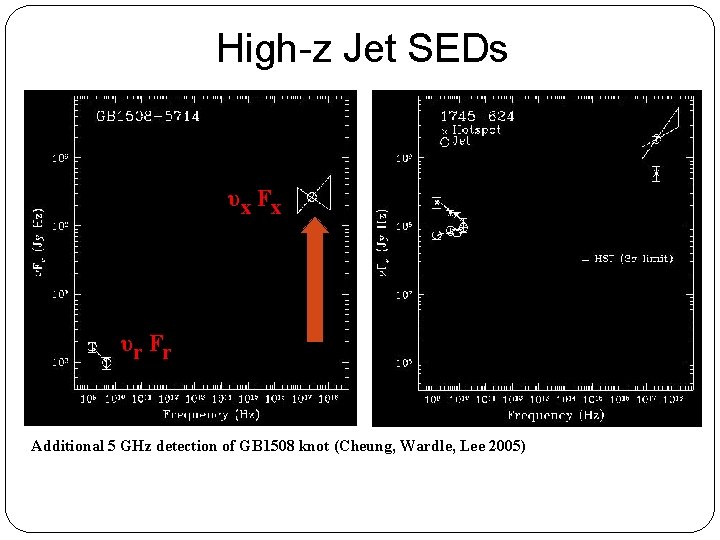
High-z Jet SEDs υx F x υr F r Additional 5 GHz detection of GB 1508 knot (Cheung, Wardle, Lee 2005)
Redshift Dependence?
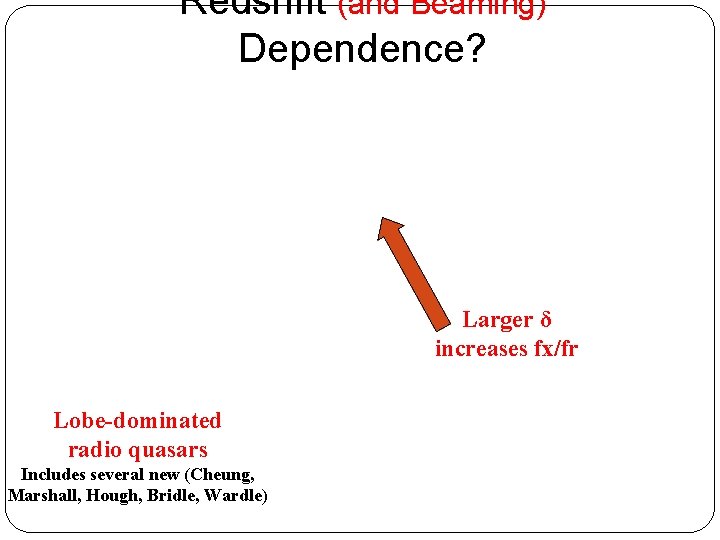
Redshift (and Beaming) Dependence? Lobe-dominated radio quasars Includes several new (Cheung, Marshall, Hough, Bridle, Wardle)
Redshift (and Beaming) Dependence? Larger δ increases fx/fr Lobe-dominated radio quasars Includes several new (Cheung, Marshall, Hough, Bridle, Wardle)
Four Challenges • X-ray emission mechanism and physics through high-redshift jets [Radio imaging needs to catch up]
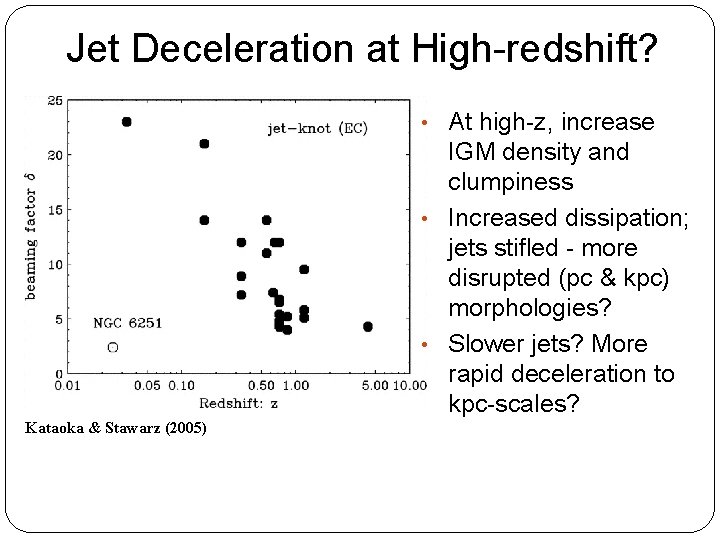
Jet Deceleration at High-redshift? • At high-z, increase IGM density and clumpiness • Increased dissipation; jets stifled - more disrupted (pc & kpc) morphologies? • Slower jets? More rapid deceleration to kpc-scales? Kataoka & Stawarz (2005)
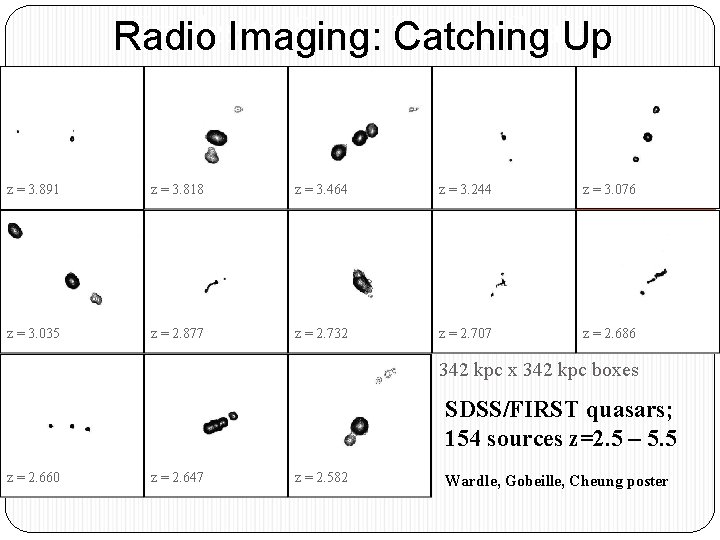
Triples. Imaging: to Same Linear Scale Radio Catching Up z = 3. 891 z = 3. 818 z = 3. 464 z = 3. 244 z = 3. 076 z = 3. 035 z = 2. 877 z = 2. 732 z = 2. 707 z = 2. 686 342 kpc x 342 kpc boxes SDSS/FIRST quasars; 154 sources z=2. 5 – 5. 5 z = 2. 660 z = 2. 647 z = 2. 582 Wardle, Gobeille, Cheung poster
Four Challenges • X-ray emission mechanism and physics through high-redshift jets [Radio imaging needs to catch up] • Synergy with gamma-ray (GLAST) observations [Chandra imaging of GLAST-LAT blazars]
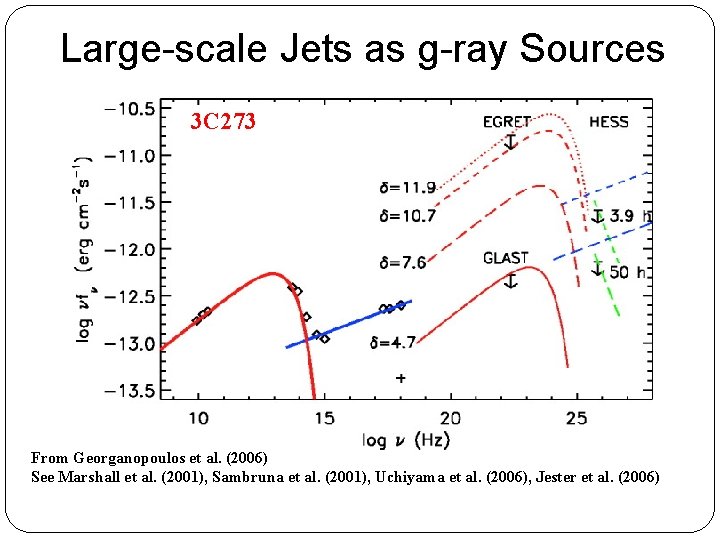
Large-scale Jets as g-ray Sources 3 C 273 From Georganopoulos et al. (2006) See Marshall et al. (2001), Sambruna et al. (2001), Uchiyama et al. (2006), Jester et al. (2006)
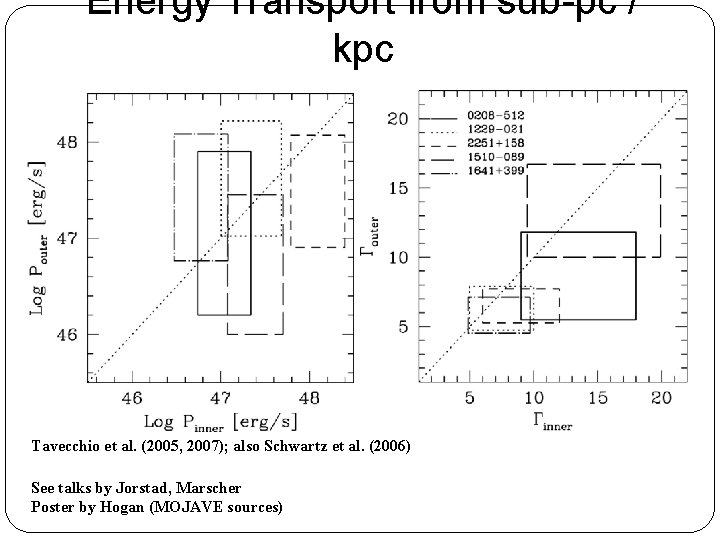
Energy Transport from sub-pc / kpc Tavecchio et al. (2005, 2007); also Schwartz et al. (2006) See talks by Jorstad, Marscher Poster by Hogan (MOJAVE sources)
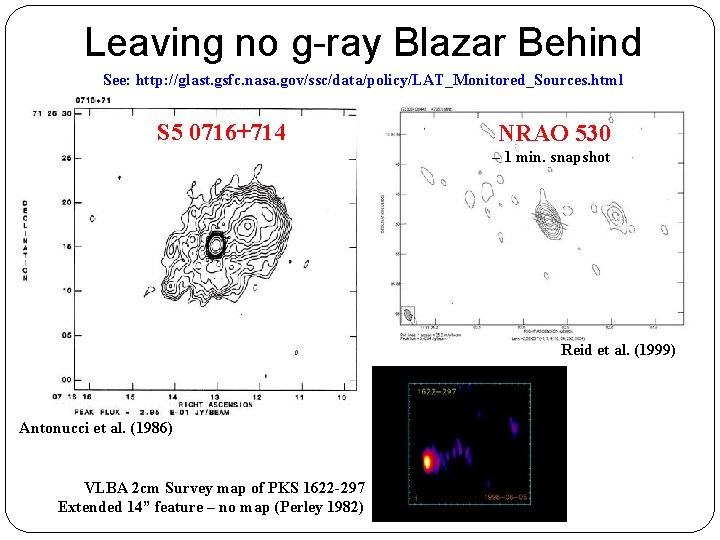
Leaving no g-ray Blazar Behind See: http: //glast. gsfc. nasa. gov/ssc/data/policy/LAT_Monitored_Sources. html S 5 0716+714 NRAO 530 – 1 min. snapshot Reid et al. (1999) Antonucci et al. (1986) VLBA 2 cm Survey map of PKS 1622 -297 Extended 14” feature – no map (Perley 1982)
Four Challenges • X-ray emission mechanism and physics through high-redshift jets [Radio imaging needs to catch up] • Synergy with gamma-ray (GLAST) observations [Chandra imaging of GLAST-LAT blazars] • The low-energy spectra [Anticipate Chandra data necessary when LWA, LOFAR come online]
Where are the Low-E electrons? In my opinion, if the LWA does nothing more than tell us something new about the low end of relativistic electron spectra, it would have been worth the effort! -D. E. Harris (2005), Clark Lake to Long Wavelength Array Meeting
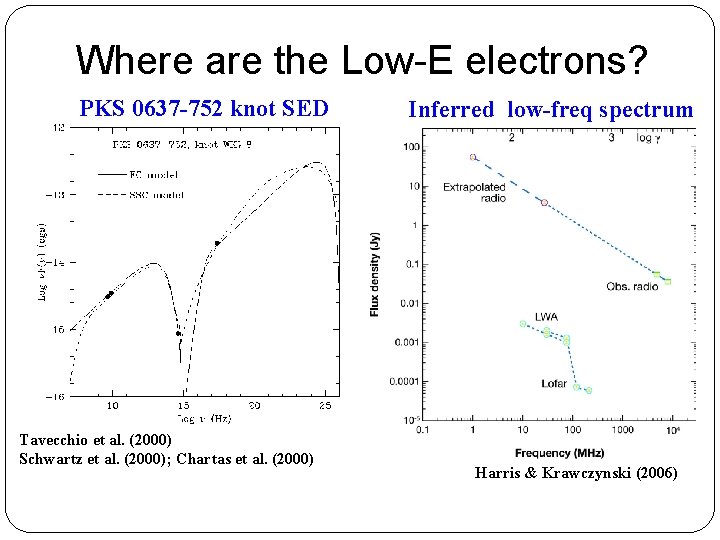
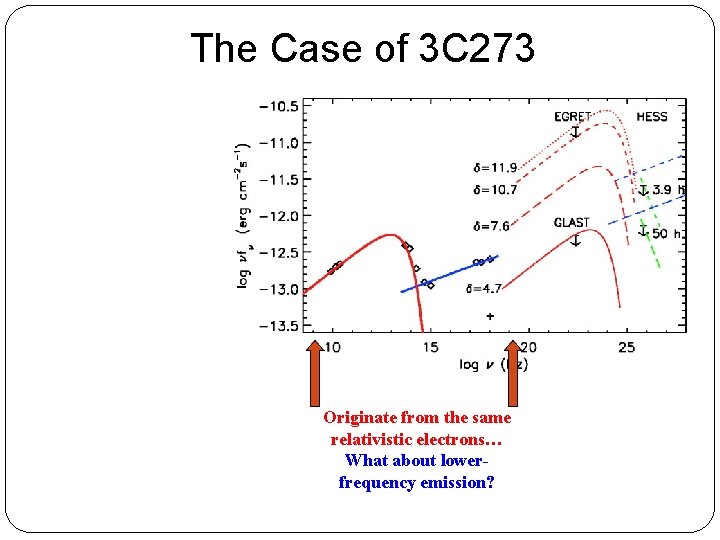
Where are the Low-E electrons? PKS 0637 -752 knot SED Tavecchio et al. (2000) Schwartz et al. (2000); Chartas et al. (2000) Inferred low-freq spectrum Harris & Krawczynski (2006)
The Case of 3 C 273 Originate from the same relativistic electrons… What about lowerfrequency emission?
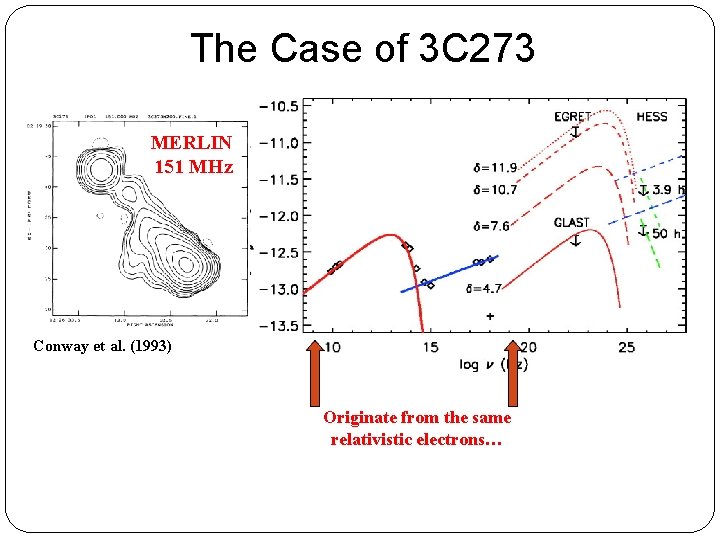
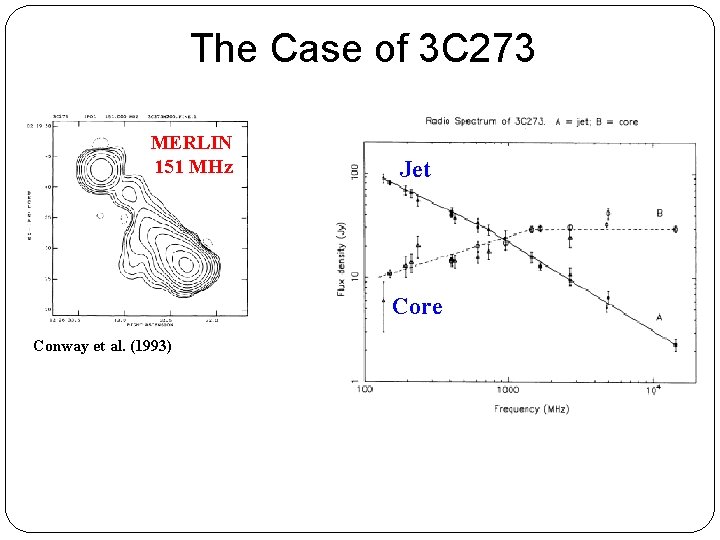
The Case of 3 C 273 MERLIN 151 MHz Conway et al. (1993) Originate from the same relativistic electrons…
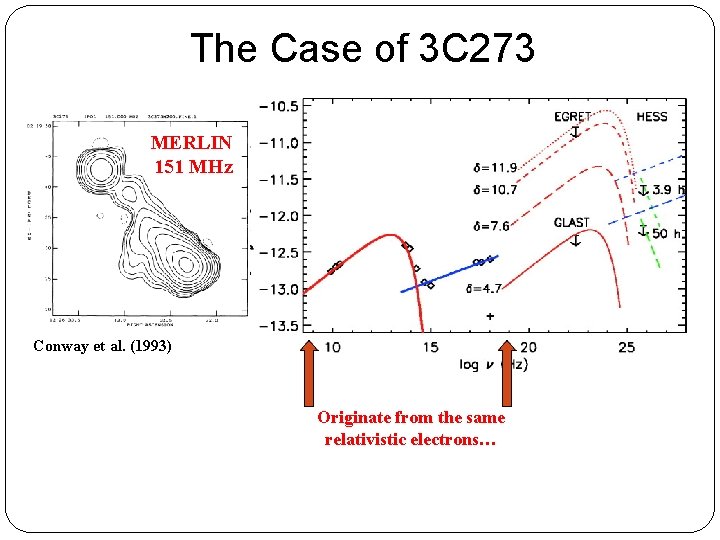
The Case of 3 C 273 MERLIN 151 MHz Conway et al. (1993) Originate from the same relativistic electrons…
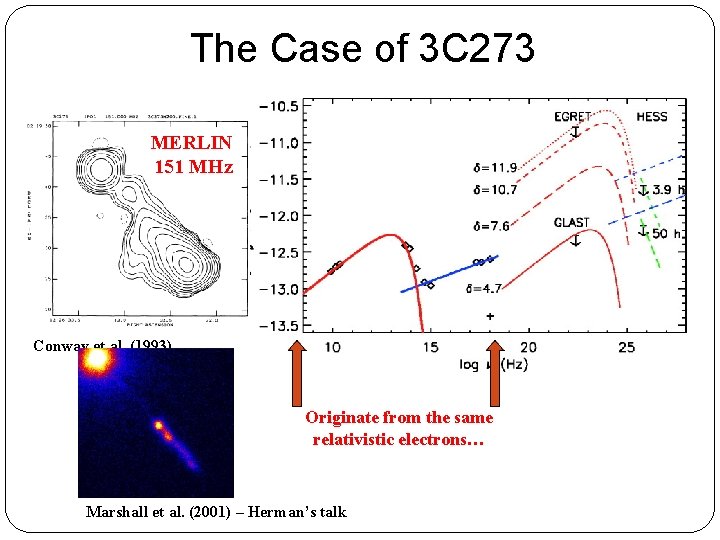
The Case of 3 C 273 MERLIN 151 MHz Conway et al. (1993) Originate from the same relativistic electrons… Marshall et al. (2001) – Herman’s talk
The Case of 3 C 273 MERLIN 151 MHz Jet Core Conway et al. (1993)
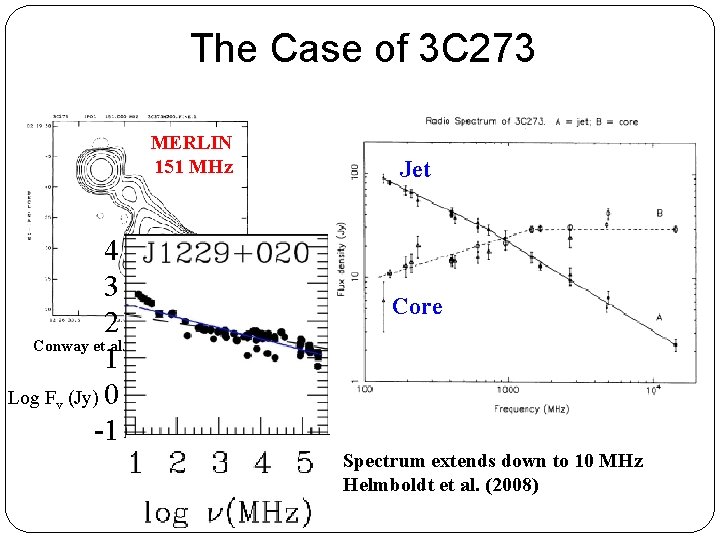
The Case of 3 C 273 MERLIN 151 MHz 4 3 2 Conway et al. (1993) 1 Log Fv (Jy) 0 -1 Jet Core Spectrum extends down to 10 MHz Helmboldt et al. (2008)
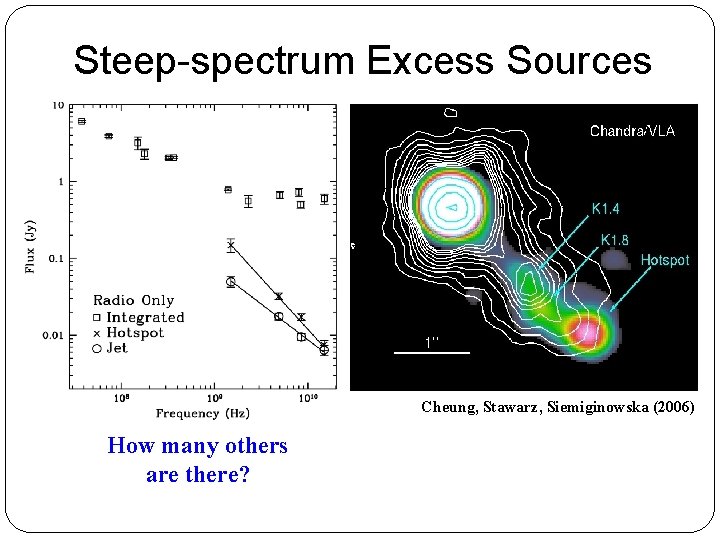
Steep-spectrum Excess Sources Cheung, Stawarz, Siemiginowska (2006) How many others are there?
Low-frequency Spectral Curvature
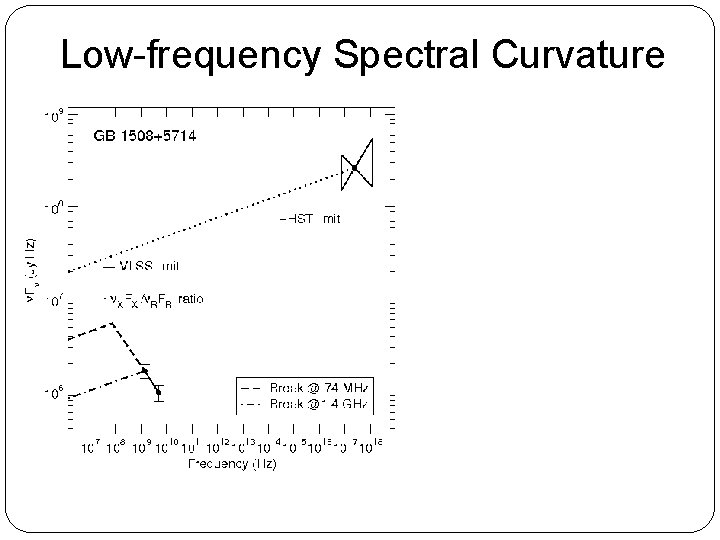
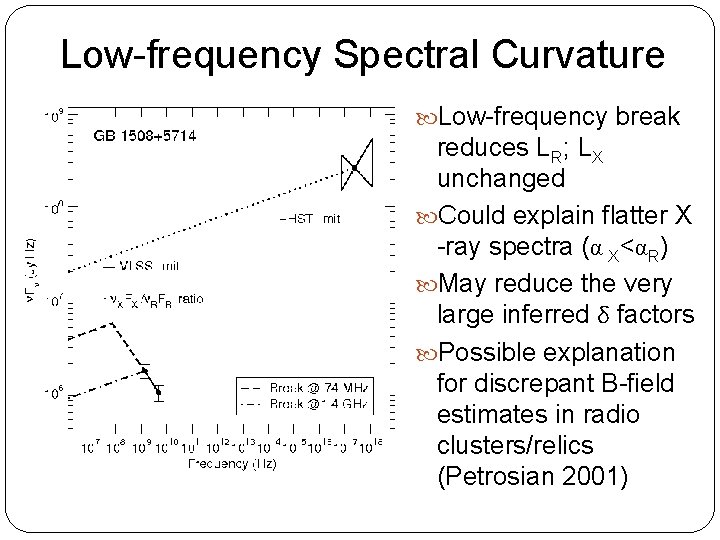
Low-frequency Spectral Curvature Low-frequency break reduces LR; LX unchanged Could explain flatter X -ray spectra (α X<αR) May reduce the very large inferred δ factors Possible explanation for discrepant B-field estimates in radio clusters/relics (Petrosian 2001)
Four Challenges • X-ray emission mechanism and physics through high-redshift jets [Radio imaging needs to catch up] • Synergy with gamma-ray (GLAST) observations [Chandra imaging of GLAST-LAT blazars] • The low-energy spectra [Anticipate Chandra data necessary when LWA, LOFAR come online] • Hybrid synchrotron + IC models? [Detailed modeling of 3 C 273, PKS 0637 -
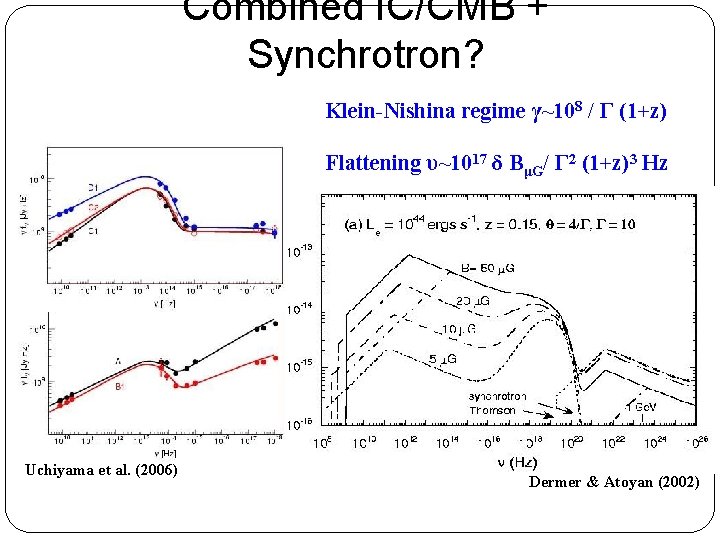
Combined IC/CMB + Synchrotron? Klein-Nishina regime γ~108 / Γ (1+z) Flattening υ~1017 δ BμG/ Γ 2 (1+z)3 Hz Uchiyama et al. (2006) Dermer & Atoyan (2002)
Thanks! • Especially to Aneta, Ralph, the LOC, SOC & CXC