Tax Reform Prof Stephen Cheung Professor Chair of

- Slides: 25
Tax Reform? Prof. Stephen Cheung Professor (Chair) of Finance City University of Hong Kong
Contents l Do we need a tax reform? l How we can broaden the tax base? l GST or other alternatives?
Concerns of Hong Kong Future Development l Narrow tax base l Aging population l Economic growth is not sustainable l Increase the public expenditure
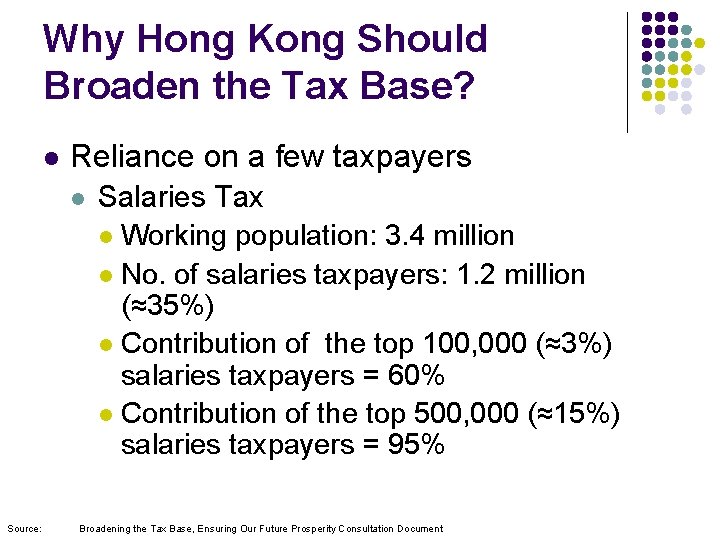
Why Hong Kong Should Broaden the Tax Base? l Reliance on a few taxpayers l Source: Salaries Tax l Working population: 3. 4 million l No. of salaries taxpayers: 1. 2 million (≈35%) l Contribution of the top 100, 000 (≈3%) salaries taxpayers = 60% l Contribution of the top 500, 000 (≈15%) salaries taxpayers = 95% Broadening the Tax Base, Ensuring Our Future Prosperity Consultation Document
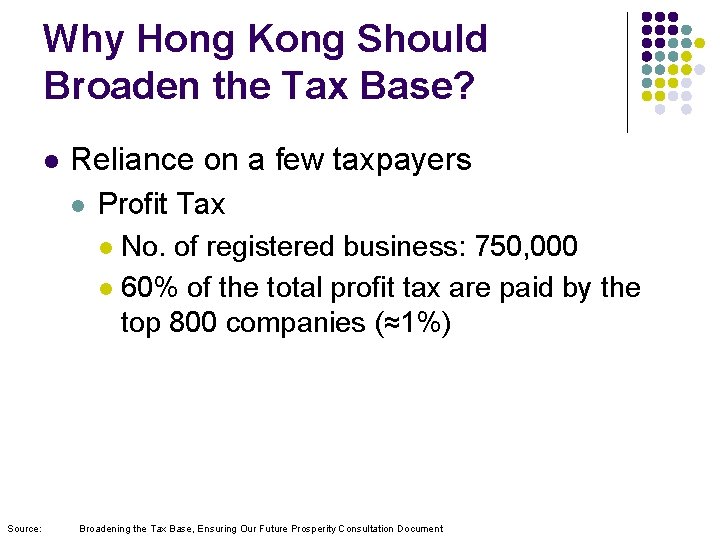
Why Hong Kong Should Broaden the Tax Base? l Reliance on a few taxpayers l Source: Profit Tax l No. of registered business: 750, 000 l 60% of the total profit tax are paid by the top 800 companies (≈1%) Broadening the Tax Base, Ensuring Our Future Prosperity Consultation Document
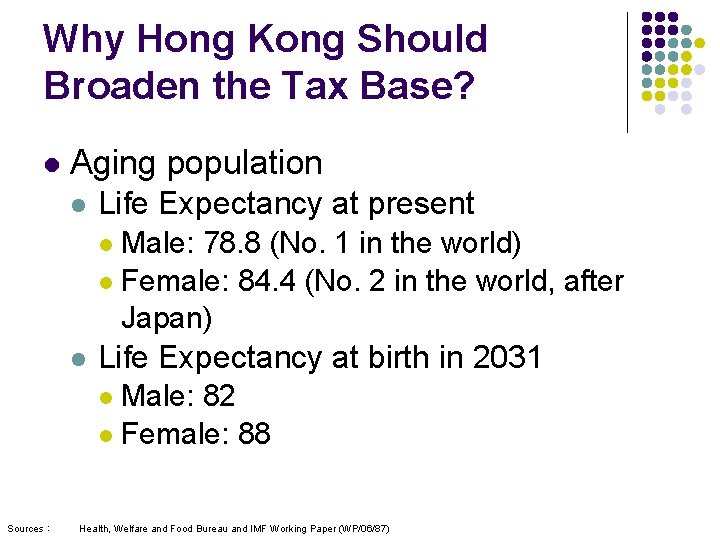
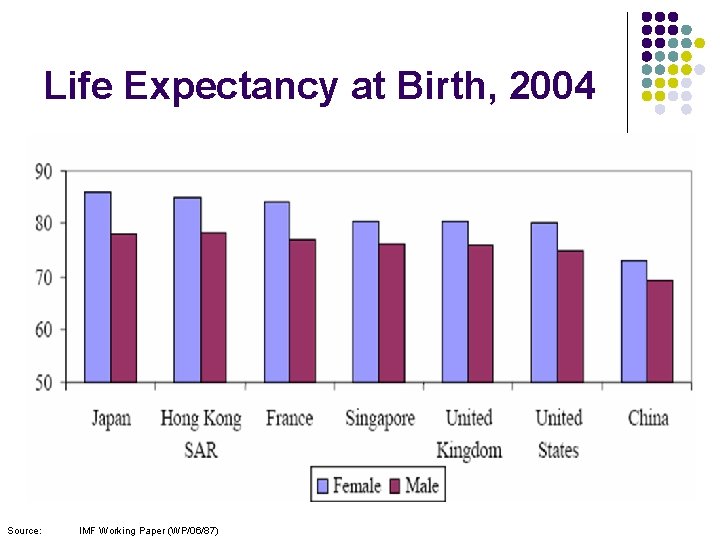
Why Hong Kong Should Broaden the Tax Base? l Aging population l Life Expectancy at present Male: 78. 8 (No. 1 in the world) l Female: 84. 4 (No. 2 in the world, after Japan) l l Life Expectancy at birth in 2031 Male: 82 l Female: 88 l Sources: Health, Welfare and Food Bureau and IMF Working Paper (WP/06/87)
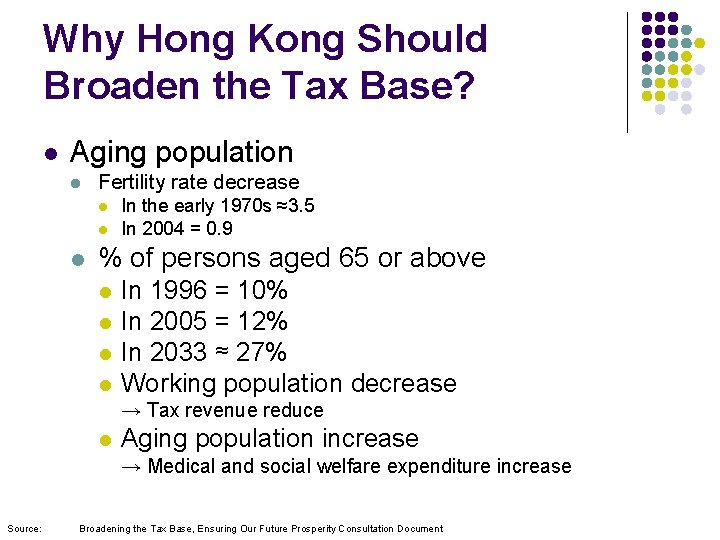
Why Hong Kong Should Broaden the Tax Base? l Aging population l Fertility rate decrease l l l In the early 1970 s ≈3. 5 In 2004 = 0. 9 % of persons aged 65 or above l l In 1996 = 10% In 2005 = 12% In 2033 ≈ 27% Working population decrease → Tax revenue reduce l Aging population increase → Medical and social welfare expenditure increase Source: Broadening the Tax Base, Ensuring Our Future Prosperity Consultation Document
Life Expectancy at Birth, 2004 Source: IMF Working Paper (WP/06/87)
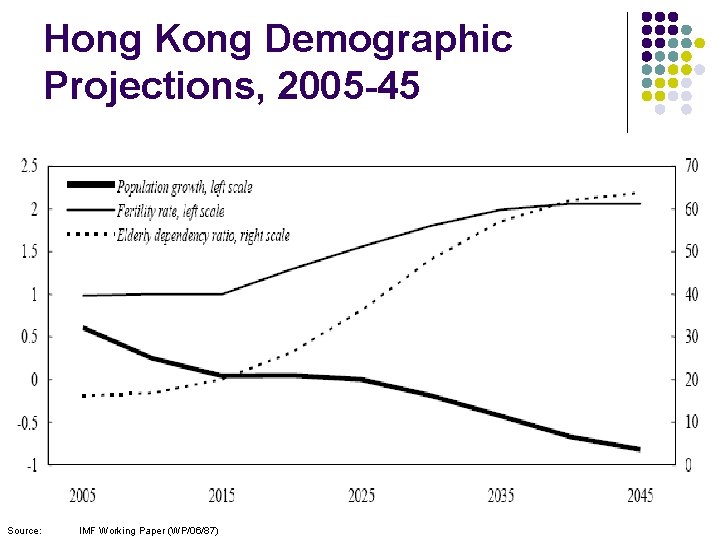
Hong Kong Demographic Projections, 2005 -45 Source: IMF Working Paper (WP/06/87)
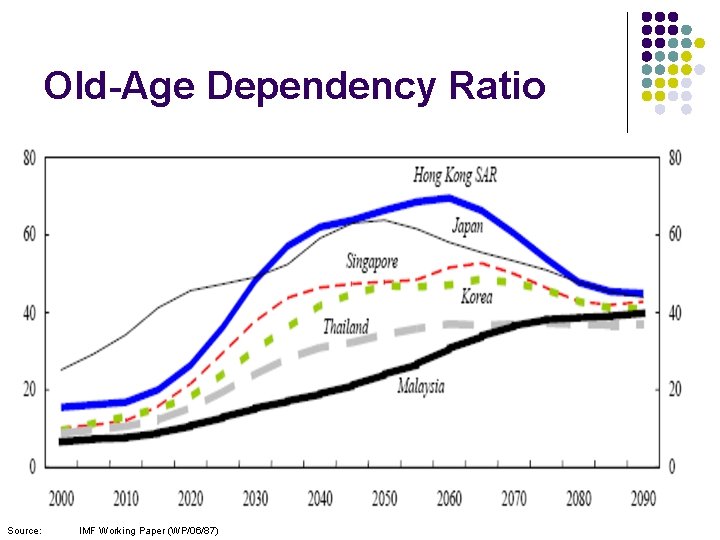
Old-Age Dependency Ratio Source: IMF Working Paper (WP/06/87)
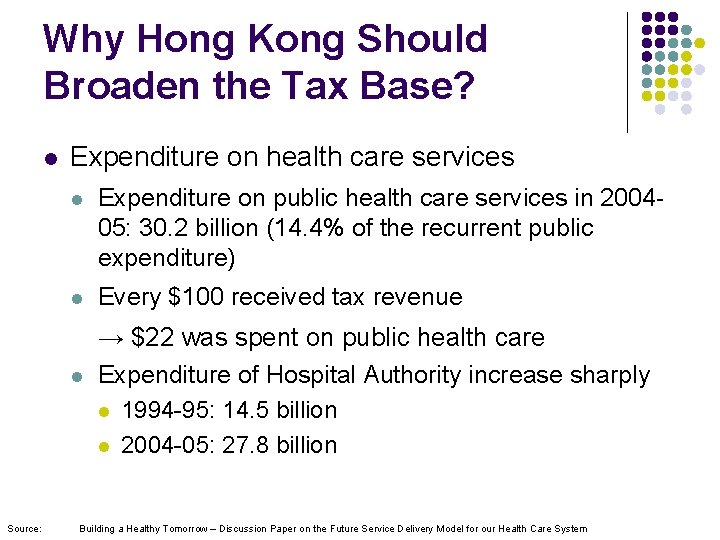
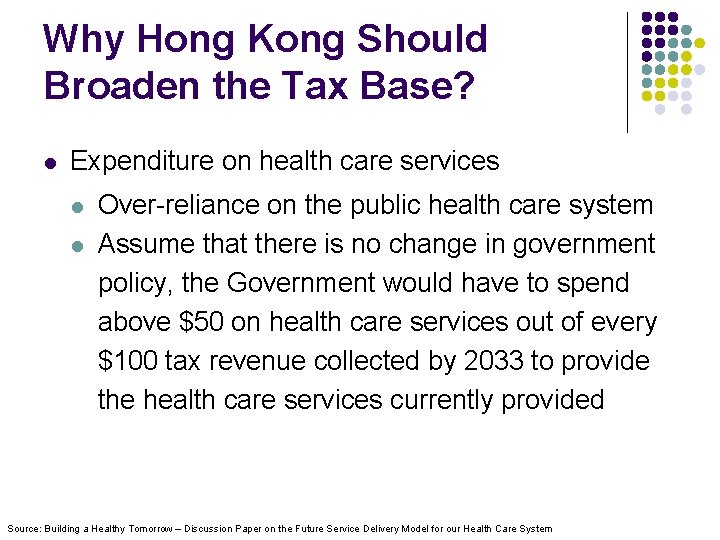
Why Hong Kong Should Broaden the Tax Base? l Expenditure on health care services l Expenditure on public health care services in 200405: 30. 2 billion (14. 4% of the recurrent public expenditure) l Every $100 received tax revenue l → $22 was spent on public health care Expenditure of Hospital Authority increase sharply l l Source: 1994 -95: 14. 5 billion 2004 -05: 27. 8 billion Building a Healthy Tomorrow – Discussion Paper on the Future Service Delivery Model for our Health Care System
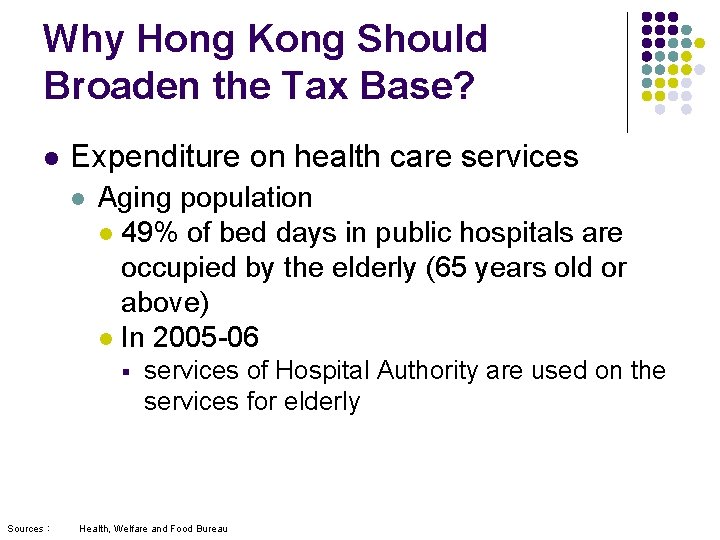
Why Hong Kong Should Broaden the Tax Base? l Expenditure on health care services l Aging population l 49% of bed days in public hospitals are occupied by the elderly (65 years old or above) l In 2005 -06 § Sources: services of Hospital Authority are used on the services for elderly Health, Welfare and Food Bureau
Why Hong Kong Should Broaden the Tax Base? l Expenditure on health care services l l Over-reliance on the public health care system Assume that there is no change in government policy, the Government would have to spend above $50 on health care services out of every $100 tax revenue collected by 2033 to provide the health care services currently provided Source: Building a Healthy Tomorrow – Discussion Paper on the Future Service Delivery Model for our Health Care System
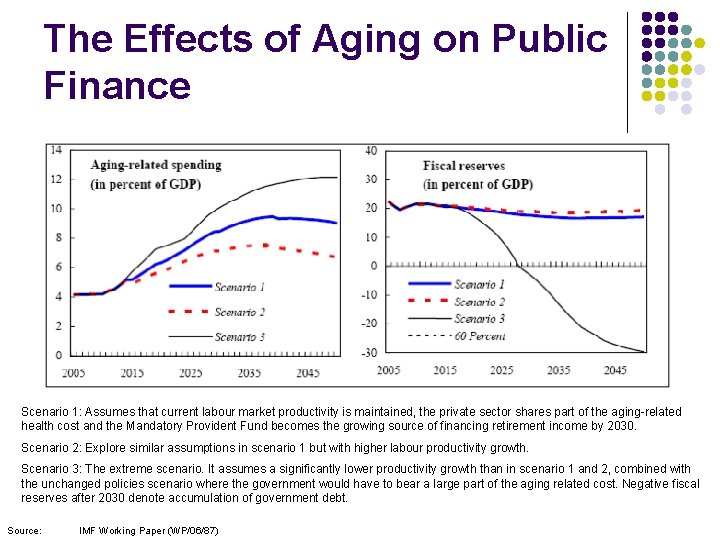
The Effects of Aging on Public Finance Scenario 1: Assumes that current labour market productivity is maintained, the private sector shares part of the aging-related health cost and the Mandatory Provident Fund becomes the growing source of financing retirement income by 2030. Scenario 2: Explore similar assumptions in scenario 1 but with higher labour productivity growth. Scenario 3: The extreme scenario. It assumes a significantly lower productivity growth than in scenario 1 and 2, combined with the unchanged policies scenario where the government would have to bear a large part of the aging related cost. Negative fiscal reserves after 2030 denote accumulation of government debt. Source: IMF Working Paper (WP/06/87)
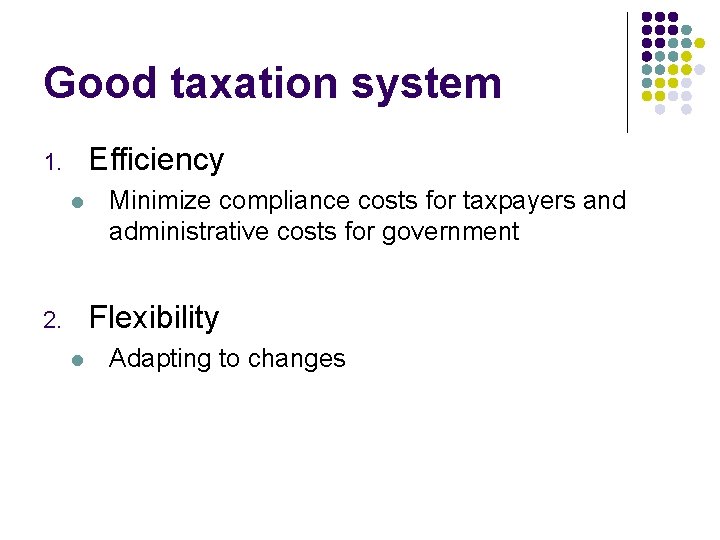
Good taxation system Efficiency 1. l Minimize compliance costs for taxpayers and administrative costs for government Flexibility 2. l Adapting to changes
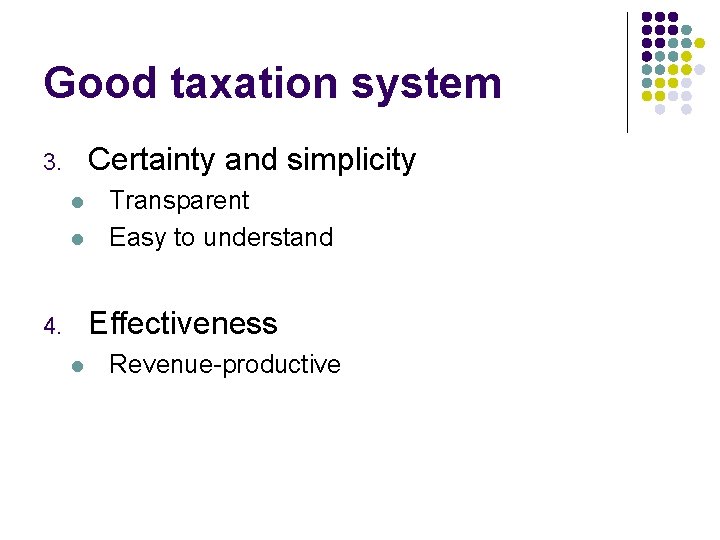
Good taxation system Certainty and simplicity 3. l l Transparent Easy to understand Effectiveness 4. l Revenue-productive
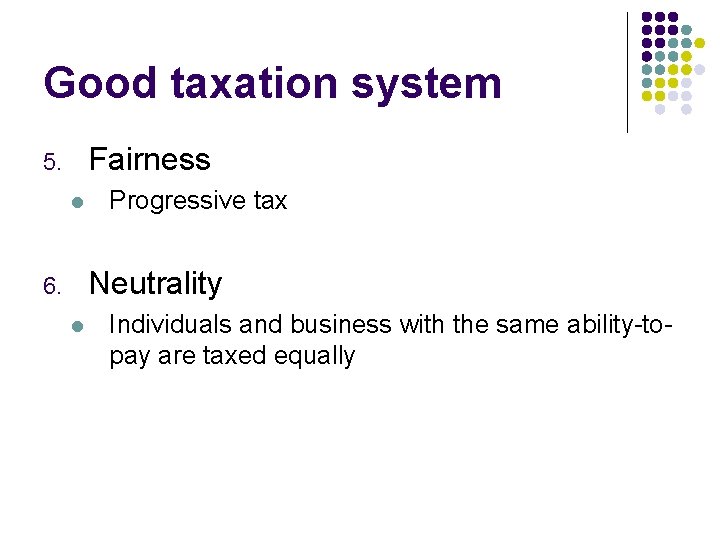
Good taxation system Fairness 5. l Progressive tax Neutrality 6. l Individuals and business with the same ability-topay are taxed equally
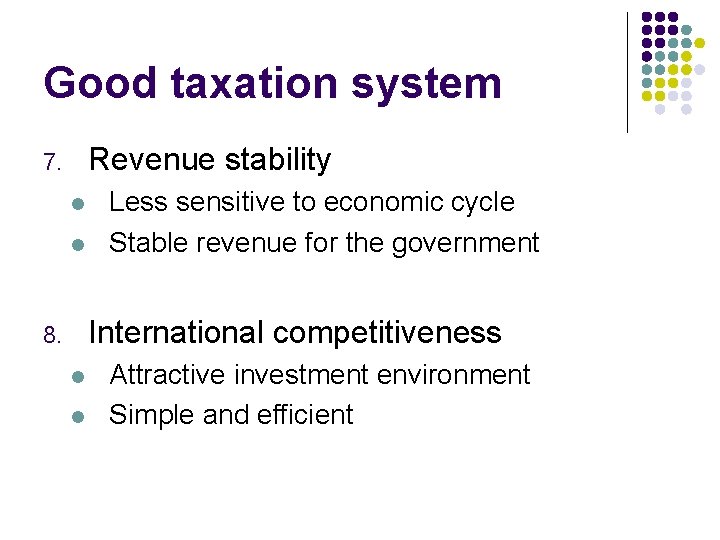
Good taxation system Revenue stability 7. l l Less sensitive to economic cycle Stable revenue for the government International competitiveness 8. l l Attractive investment environment Simple and efficient
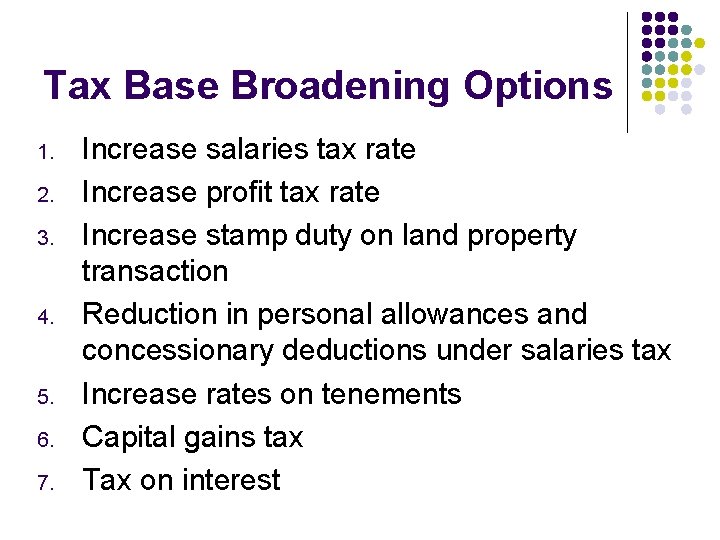
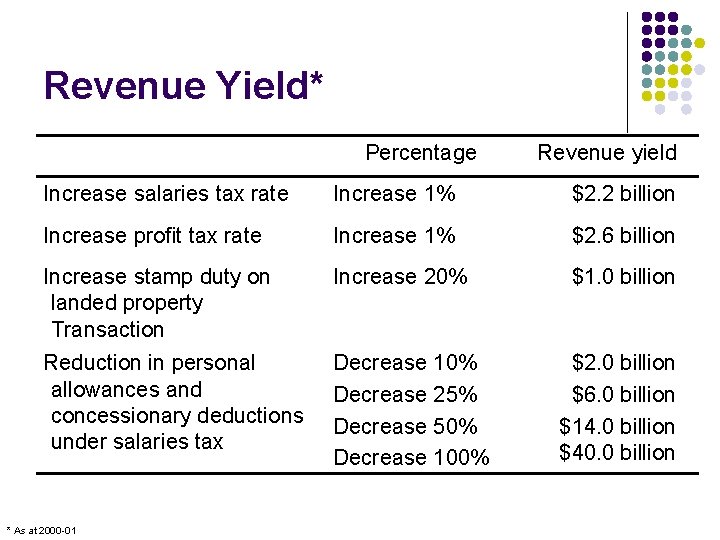
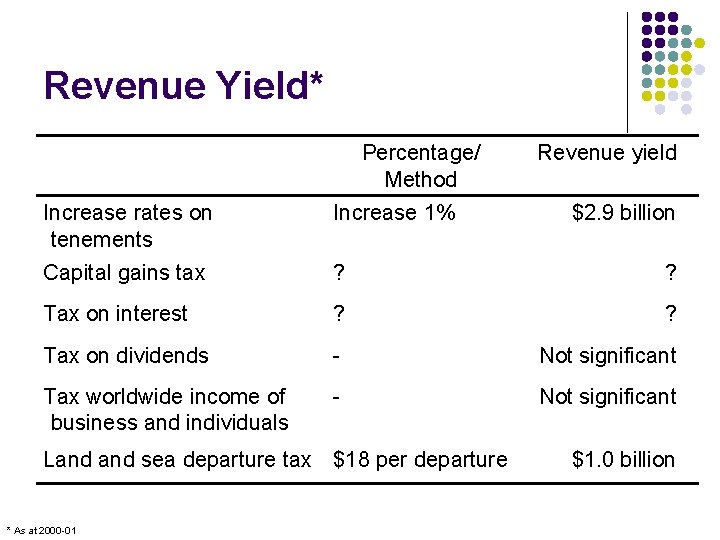
Tax Base Broadening Options 1. 2. 3. 4. 5. 6. 7. Increase salaries tax rate Increase profit tax rate Increase stamp duty on land property transaction Reduction in personal allowances and concessionary deductions under salaries tax Increase rates on tenements Capital gains tax Tax on interest
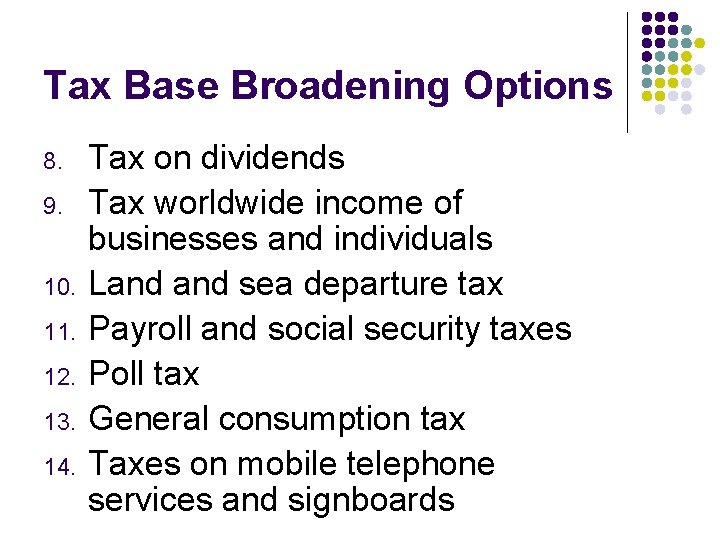
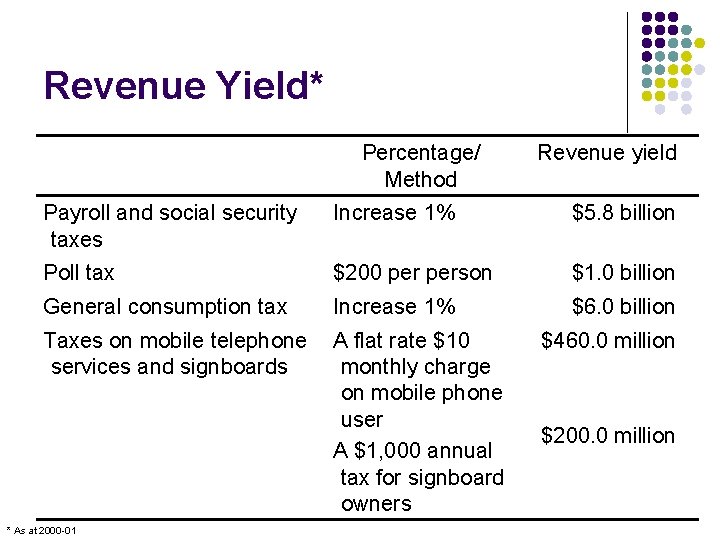
Tax Base Broadening Options 8. 9. 10. 11. 12. 13. 14. Tax on dividends Tax worldwide income of businesses and individuals Land sea departure tax Payroll and social security taxes Poll tax General consumption tax Taxes on mobile telephone services and signboards
Revenue Yield* Percentage Revenue yield Increase salaries tax rate Increase 1% $2. 2 billion Increase profit tax rate Increase 1% $2. 6 billion Increase stamp duty on landed property Transaction Increase 20% $1. 0 billion Reduction in personal allowances and concessionary deductions under salaries tax Decrease 10% Decrease 25% Decrease 50% Decrease 100% * As at 2000 -01 $2. 0 billion $6. 0 billion $14. 0 billion $40. 0 billion
Revenue Yield* Percentage/ Method Revenue yield Increase rates on tenements Increase 1% Capital gains tax ? ? Tax on interest ? ? Tax on dividends - Not significant Tax worldwide income of business and individuals - Not significant Land sea departure tax $18 per departure * As at 2000 -01 $2. 9 billion $1. 0 billion
Revenue Yield* Percentage/ Method Revenue yield Payroll and social security taxes Increase 1% $5. 8 billion Poll tax $200 person $1. 0 billion General consumption tax Increase 1% $6. 0 billion Taxes on mobile telephone services and signboards A flat rate $10 monthly charge on mobile phone user A $1, 000 annual tax for signboard owners * As at 2000 -01 $460. 0 million $200. 0 million
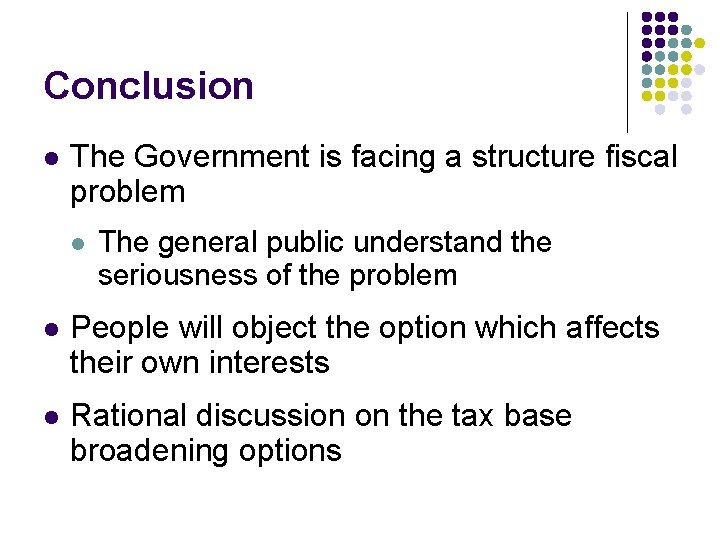
Conclusion l The Government is facing a structure fiscal problem l The general public understand the seriousness of the problem l People will object the option which affects their own interests l Rational discussion on the tax base broadening options
~ END ~