Unit 1 Magnets for circular accelerators the arc


- Slides: 55
Unit 1 Magnets for circular accelerators: the arc Ezio Todesco European Organization for Nuclear Research (CERN) Lectures based on USPAS courses in 2009 -2015 with P. Ferracin, H. Felice, S. Prestemon and on University of Milano Bicocca courses in 2016 -2018 Thanks to L. Bottura and G. de Rijk for proposing and supporting this initiative All the units will use International System (meter, kilo, second, ampere) unless specified E. Todesco, CERN – May 2020
FOREWORD The science (or the art …) of superconducting magnets is a exciting, fancy and dirty mixture of physics, engineering, and chemistry Chemistry and material science: the quest for superconducting materials with better performances Quantum physics: the key mechanisms of superconductivity and superfluidity Classical electrodynamics: magnet design Mechanical engineering: support structures Electrical engineering: powering of the magnets and their protection Cryogenics: keep them cool … The cost optimization is a key element Keep them cheap … E. Todesco, CERN – May 2020 Unit 1 - 2
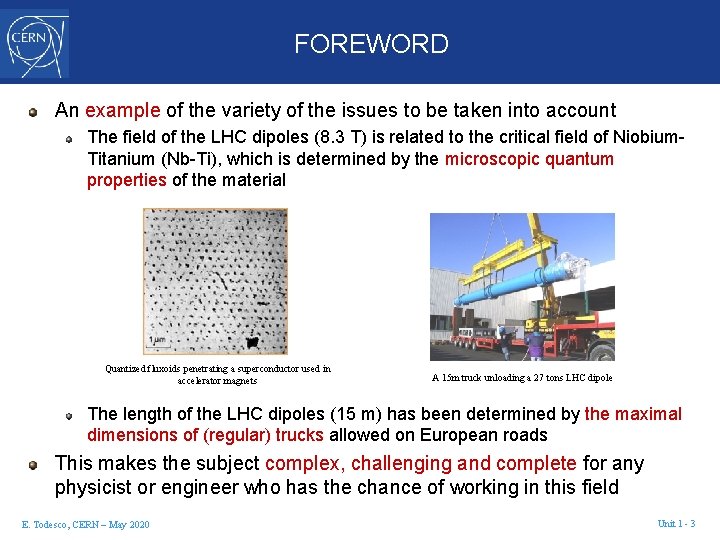
FOREWORD An example of the variety of the issues to be taken into account The field of the LHC dipoles (8. 3 T) is related to the critical field of Niobium. Titanium (Nb-Ti), which is determined by the microscopic quantum properties of the material Quantized fluxoids penetrating a superconductor used in accelerator magnets A 15 m truck unloading a 27 tons LHC dipole The length of the LHC dipoles (15 m) has been determined by the maximal dimensions of (regular) trucks allowed on European roads This makes the subject complex, challenging and complete for any physicist or engineer who has the chance of working in this field E. Todesco, CERN – May 2020 Unit 1 - 3
AIM OF THE LECTURES Superconducting magnets for particle accelerators are a vaste domain These lectures will be especially focused on magnets for colliders, with a special eye on the CERN high energy infrastructures The Large Hadron Collider, 27 km tunnel with 8 T magnets based on Nb-Ti (CERN-2004 -0039, the blue book) The HL-LHC, upgrade in luminosity of the LHC – ongoing project with installation foreseen in 2025 (CERN-2017 -007) We will give some examples for the studies related to FCC (Future Circular Colliders) A 100 Te. V collider based on a 16 T Nb 3 Sn dipole in a 100 km tunnel (CERN-ACC-2018 -058) A 30 Te. V collider based on 16 T Nb 3 Sn dipole in the LHC tunnel (also known as HE-LHC) (CERN-ACC-2018 -059) E. Todesco, CERN – May 2020 Unit 1 - 4
A SUMMARY OF THE TOOLS Estimating order of magnitudes Can be done just thinking, no need of paper Back-of-the-envelope Based on simple analytical formulas, can be done on a sheet of paper and with a pocket calculator Analytical tools More complex formulas, but still analytical, that can be implemented on a worksheet (Excel type) Allow a fast sensitive analysis Simple self-made codes (100 -1000 lines) Equations need integration, or optimization problem needs iterative procedures, that can be coded Difficulty: you have to write the code Complex codes (10 k lines) Finite elements codes (ROXIE ANSYS) or multiphysics (COMSOL, …) Difficulty: you have to write the input and understand the output E. Todesco, CERN – May 2020 Unit 1 - 5
AIM OF THE LECTURES A good physicist/engineer should have a toolbox available to solve the challenges According to the type of problem, be sure to use the right tool Don’t spend hours with a screwdriver if you need a hammer … Don’t be afraid of be imprecise, if you are aware of the level of your imprecision – go in successuve steps of approximation Aim of the lectures Cover the main physics and the main equations of magnet design, bringing the partecipants up to the « aware » use of complex codes like ANSYS, ROXIE or COMSOL We will not deal with complex codes Many things can be done analytically! The analytical approach has the advantage of allowing a fast sensitive analysis Not easy to find in the literature E. Todesco, CERN – May 2020 Unit 1 - 6
AIM OF THE LECTURES Estimating order of magnitudes Can be done just thinking, no need of paper Back-of-the-envelope Based on simple analytical formulas, can be done on a sheet of paper and with a pocket calculator Analytical tools More complex formulas, but still analytical, that can be implemented on a worksheet (Excel type) We will focus on these tools Allow a fast sensitive analysis Simple self-made codes (100 -1000 lines) Equations need integration, or optimization problem needs iterative procedures, that can be coded Difficulty: you have to write the code Complex codes (10 k lines) Finite elements codes (ROXIE ANSYS) or multiphysics (COMSOL, …) Difficulty: you have to write the input and understand the output E. Todesco, CERN – May 2020 Unit 1 - 7
PLAN OF THE LECTURES Part 1 – From beam dynamics to magnet specifications Unit 1: the energy of a synchrotron and the magnets in the arcs Unit 1. 2: the luminosity in a collider and the interaction region magnets Part 2 – Principles of electromagnets Part 3 – Basics of superconductivity Part 4 – Magnet design Each unit lasting approximately 90 minutes Additional units with exercises could be envisaged E. Todesco, CERN – May 2020 Unit 1 - 8
RULE OF THE LECTURES Lectures are carried out in the early European morning to allow participation from Eurasia Please register for each unit, so we have an idea of the attendance Put also your institute When entering vidyo, please use your name and surname Please, not email of initials … During the lecture mute the microphone Questions I will stop from time to open for questions When you make questions, please switch camera on Lectures will be registered, but this should not limit the possibility to put questions (even naïve, wrong, or stupid) – we are here to learn E. Todesco, CERN – May 2020 Unit 1 - 9
Unit 1 Magnets for circular accelerators: the arc Ezio Todesco European Organization for Nuclear Research (CERN) Lectures based on USPAS courses in 2009 -2015 with P. Ferracin, H. Felice, S. Prestemon and on University of Milano Bicocca courses in 2016 -2018 Thanks to L. Bottura and G. de Rijk for proposing and supporting this initiative All the units will use International System (meter, kilo, second, ampere) unless specified E. Todesco, CERN – May 2020
CONTENTS Principles of synchrotron How to keep particles on a circular orbit Relation between energy, dipolar field, machine length The beam size and principles of focusing Aperture requirements for arc dipoles and arc quadrupoles Gradient requirements for arc quadrupoles Some examples Conclusions E. Todesco, CERN – May 2020 Unit 1 - 11
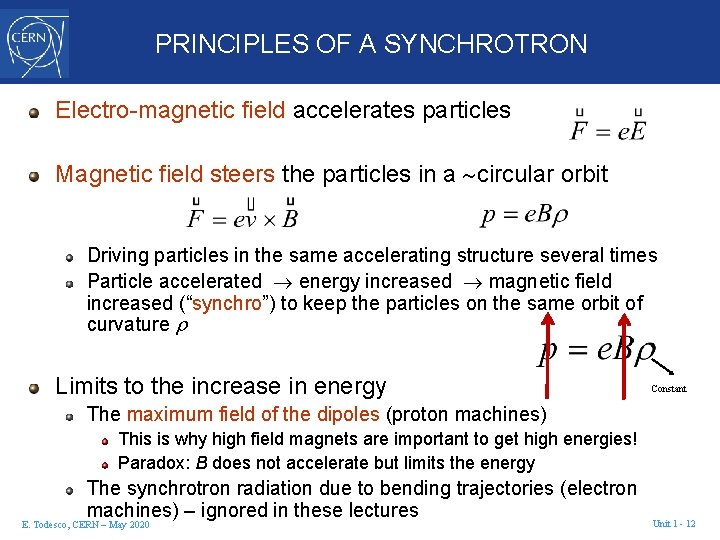
PRINCIPLES OF A SYNCHROTRON Electro-magnetic field accelerates particles Magnetic field steers the particles in a circular orbit Driving particles in the same accelerating structure several times Particle accelerated energy increased magnetic field increased (“synchro”) to keep the particles on the same orbit of curvature r Limits to the increase in energy Constant The maximum field of the dipoles (proton machines) This is why high field magnets are important to get high energies! Paradox: B does not accelerate but limits the energy The synchrotron radiation due to bending trajectories (electron machines) – ignored in these lectures E. Todesco, CERN – May 2020 Unit 1 - 12
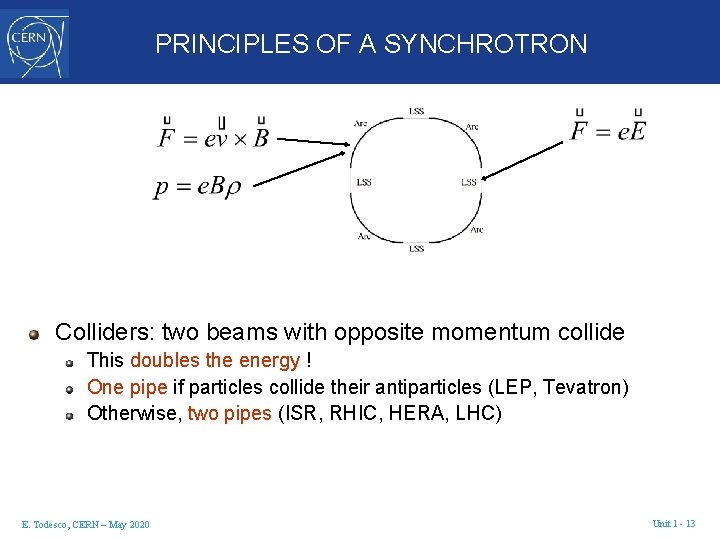
PRINCIPLES OF A SYNCHROTRON Colliders: two beams with opposite momentum collide This doubles the energy ! One pipe if particles collide their antiparticles (LEP, Tevatron) Otherwise, two pipes (ISR, RHIC, HERA, LHC) E. Todesco, CERN – May 2020 Unit 1 - 13
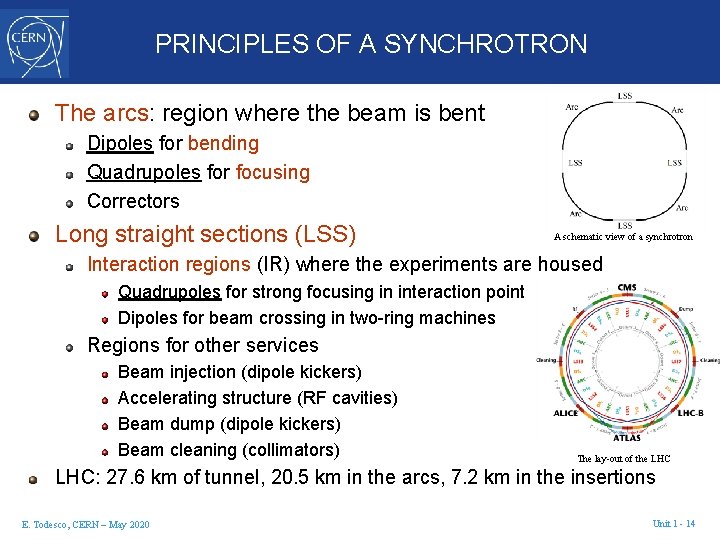
PRINCIPLES OF A SYNCHROTRON The arcs: region where the beam is bent Dipoles for bending Quadrupoles for focusing Correctors Long straight sections (LSS) A schematic view of a synchrotron Interaction regions (IR) where the experiments are housed Quadrupoles for strong focusing in interaction point Dipoles for beam crossing in two-ring machines Regions for other services Beam injection (dipole kickers) Accelerating structure (RF cavities) Beam dump (dipole kickers) Beam cleaning (collimators) The lay-out of the LHC: 27. 6 km of tunnel, 20. 5 km in the arcs, 7. 2 km in the insertions E. Todesco, CERN – May 2020 Unit 1 - 14
CONTENTS Principles of synchrotron How to keep particles on a circular orbit Relation between energy, dipolar field, machine length The beam size and principles of focusing Aperture requirements for arc dipoles and arc quadrupoles Gradient requirements for arc quadrupoles Some examples Conclusions E. Todesco, CERN – May 2020 Unit 1 - 15
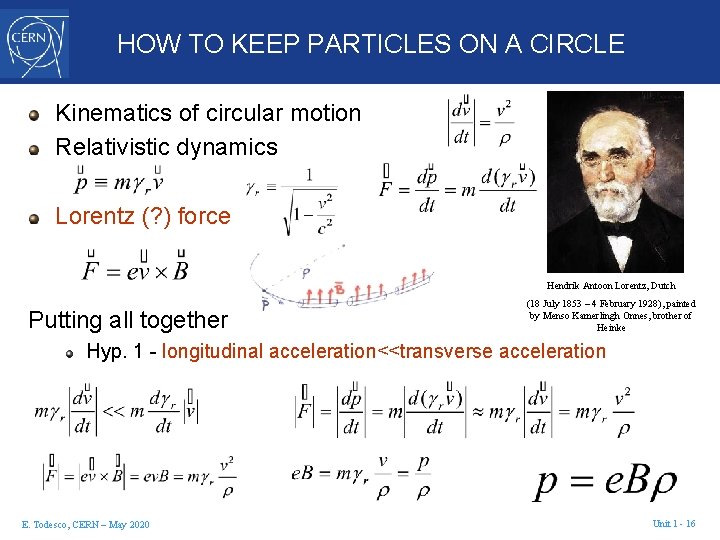
HOW TO KEEP PARTICLES ON A CIRCLE Kinematics of circular motion Relativistic dynamics Lorentz (? ) force Hendrik Antoon Lorentz, Dutch Putting all together (18 July 1853 – 4 February 1928), painted by Menso Kamerlingh Onnes, brother of Heinke Hyp. 1 - longitudinal acceleration<<transverse acceleration E. Todesco, CERN – May 2020 Unit 1 - 16
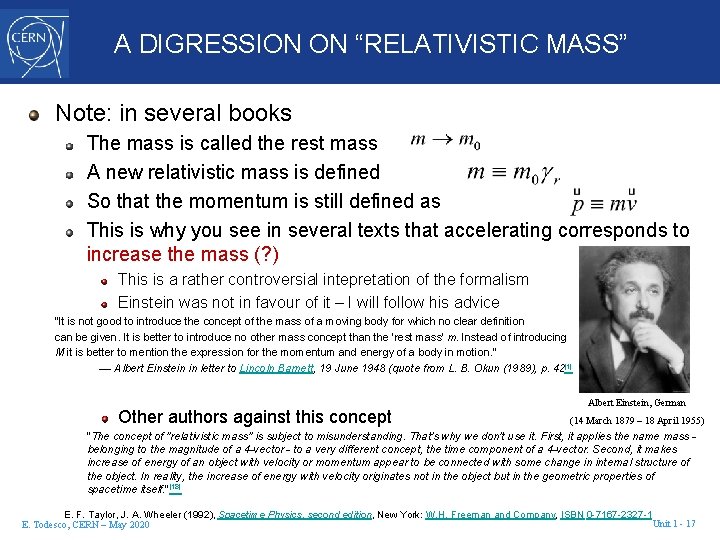
A DIGRESSION ON “RELATIVISTIC MASS” Note: in several books The mass is called the rest mass A new relativistic mass is defined So that the momentum is still defined as This is why you see in several texts that accelerating corresponds to increase the mass (? ) This is a rather controversial intepretation of the formalism Einstein was not in favour of it – I will follow his advice “It is not good to introduce the concept of the mass of a moving body for which no clear definition can be given. It is better to introduce no other mass concept than the ’rest mass’ m. Instead of introducing M it is better to mention the expression for the momentum and energy of a body in motion. ” — Albert Einstein in letter to Lincoln Barnett, 19 June 1948 (quote from L. B. Okun (1989), p. 42[1] Other authors against this concept Albert Einstein, German (14 March 1879 – 18 April 1955) "The concept of "relativistic mass" is subject to misunderstanding. That's why we don't use it. First, it applies the name mass - belonging to the magnitude of a 4 -vector - to a very different concept, the time component of a 4 -vector. Second, it makes increase of energy of an object with velocity or momentum appear to be connected with some change in internal structure of the object. In reality, the increase of energy with velocity originates not in the object but in the geometric properties of spacetime itself. "[18] E. F. Taylor, J. A. Wheeler (1992), Spacetime Physics, second edition, New York: W. H. Freeman and Company, ISBN 0 -7167 -2327 -1 Unit 1 - 17 E. Todesco, CERN – May 2020
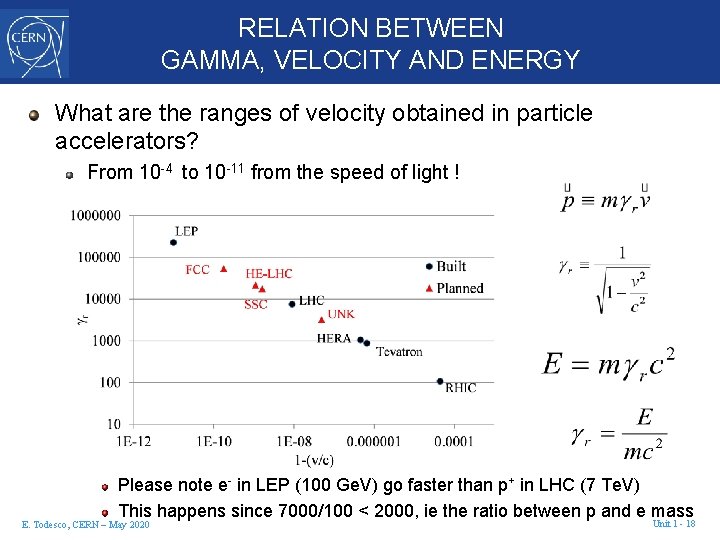
RELATION BETWEEN GAMMA, VELOCITY AND ENERGY What are the ranges of velocity obtained in particle accelerators? From 10 -4 to 10 -11 from the speed of light ! Please note e- in LEP (100 Ge. V) go faster than p+ in LHC (7 Te. V) This happens since 7000/100 < 2000, ie the ratio between p and e mass E. Todesco, CERN – May 2020 Unit 1 - 18
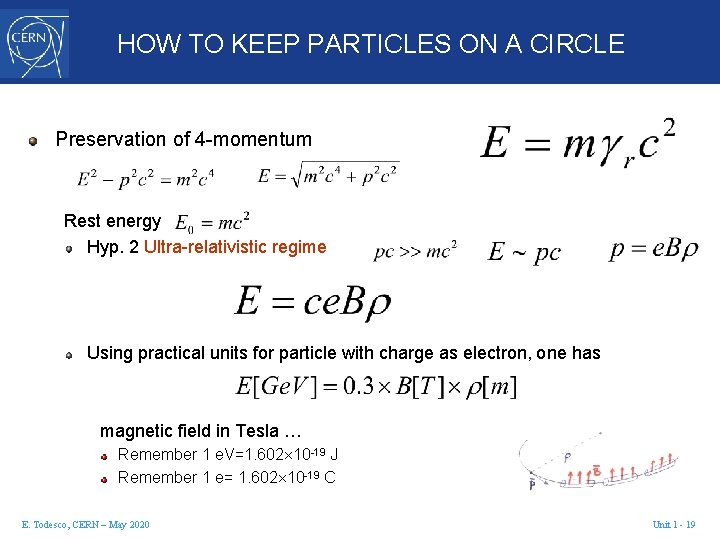
HOW TO KEEP PARTICLES ON A CIRCLE Preservation of 4 -momentum Rest energy Hyp. 2 Ultra-relativistic regime Using practical units for particle with charge as electron, one has magnetic field in Tesla … Remember 1 e. V=1. 602 10 -19 J Remember 1 e= 1. 602 10 -19 C E. Todesco, CERN – May 2020 Unit 1 - 19
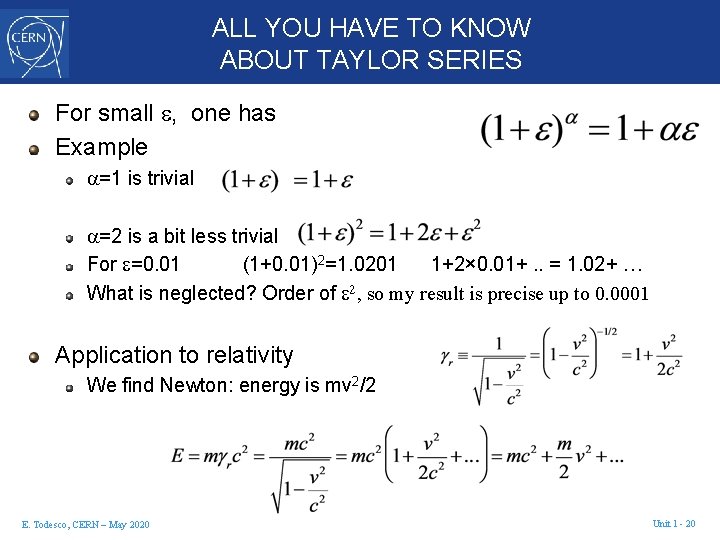
ALL YOU HAVE TO KNOW ABOUT TAYLOR SERIES For small e, one has Example a=1 is trivial a=2 is a bit less trivial For e=0. 01 (1+0. 01)2=1. 0201 1+2× 0. 01+. . = 1. 02+ … What is neglected? Order of e 2, so my result is precise up to 0. 0001 Application to relativity We find Newton: energy is mv 2/2 E. Todesco, CERN – May 2020 Unit 1 - 20
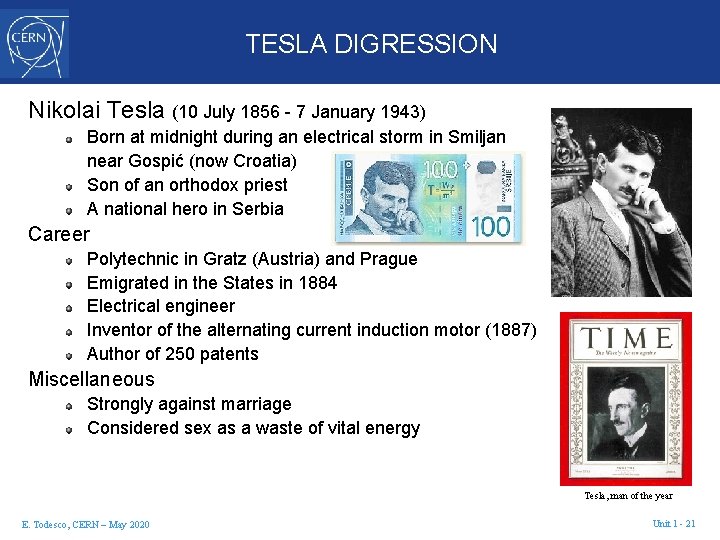
TESLA DIGRESSION Nikolai Tesla (10 July 1856 - 7 January 1943) Born at midnight during an electrical storm in Smiljan near Gospić (now Croatia) Son of an orthodox priest A national hero in Serbia Career Polytechnic in Gratz (Austria) and Prague Emigrated in the States in 1884 Electrical engineer Inventor of the alternating current induction motor (1887) Author of 250 patents Miscellaneous Strongly against marriage Considered sex as a waste of vital energy Tesla, man of the year E. Todesco, CERN – May 2020 Unit 1 - 21
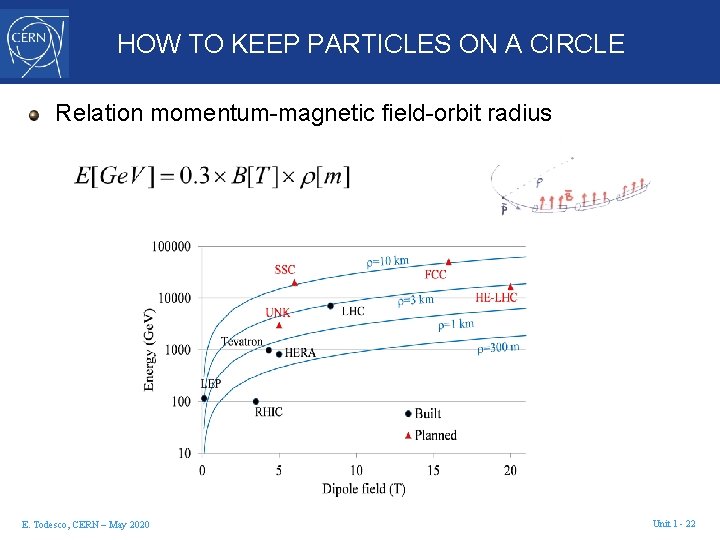
HOW TO KEEP PARTICLES ON A CIRCLE Relation momentum-magnetic field-orbit radius E. Todesco, CERN – May 2020 Unit 1 - 22
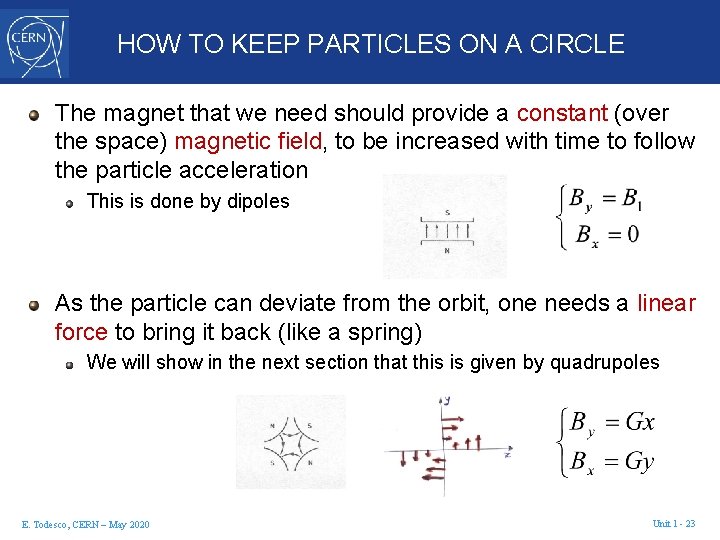
HOW TO KEEP PARTICLES ON A CIRCLE The magnet that we need should provide a constant (over the space) magnetic field, to be increased with time to follow the particle acceleration This is done by dipoles As the particle can deviate from the orbit, one needs a linear force to bring it back (like a spring) We will show in the next section that this is given by quadrupoles E. Todesco, CERN – May 2020 Unit 1 - 23
CONTENTS Principles of synchrotron How to keep particles on a circular orbit Relation between energy, dipolar field, machine length The beam size and principles of focusing Aperture requirements for arc dipoles and arc quadrupoles Gradient requirements for arc quadrupoles Some examples Conclusions E. Todesco, CERN – May 2020 Unit 1 - 24
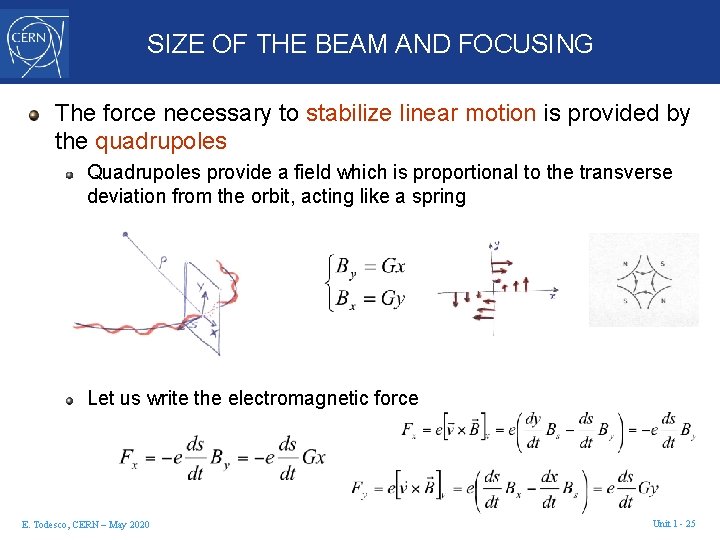
SIZE OF THE BEAM AND FOCUSING The force necessary to stabilize linear motion is provided by the quadrupoles Quadrupoles provide a field which is proportional to the transverse deviation from the orbit, acting like a spring Let us write the electromagnetic force E. Todesco, CERN – May 2020 Unit 1 - 25
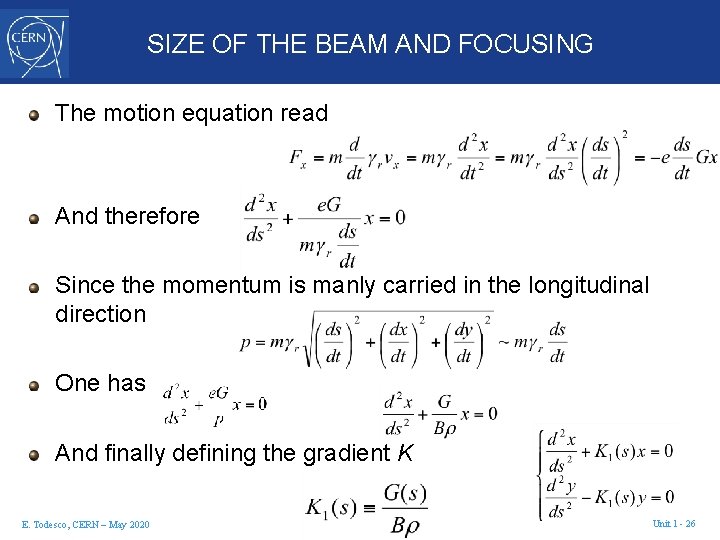
SIZE OF THE BEAM AND FOCUSING The motion equation read And therefore Since the momentum is manly carried in the longitudinal direction One has And finally defining the gradient K E. Todesco, CERN – May 2020 Unit 1 - 26
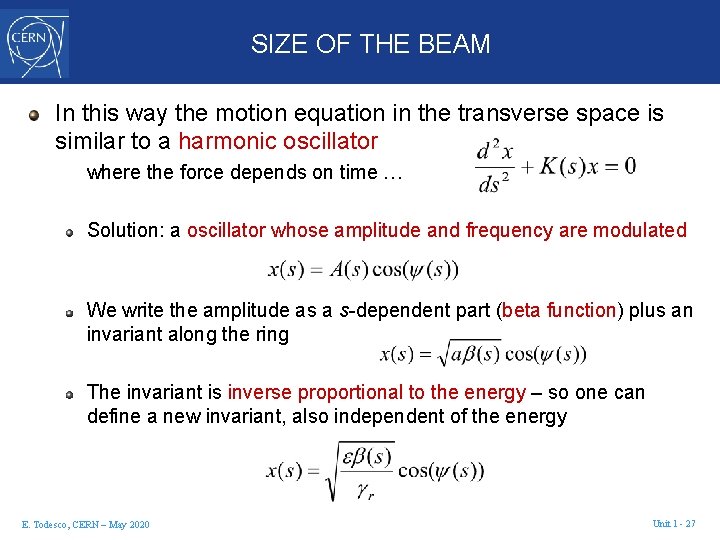
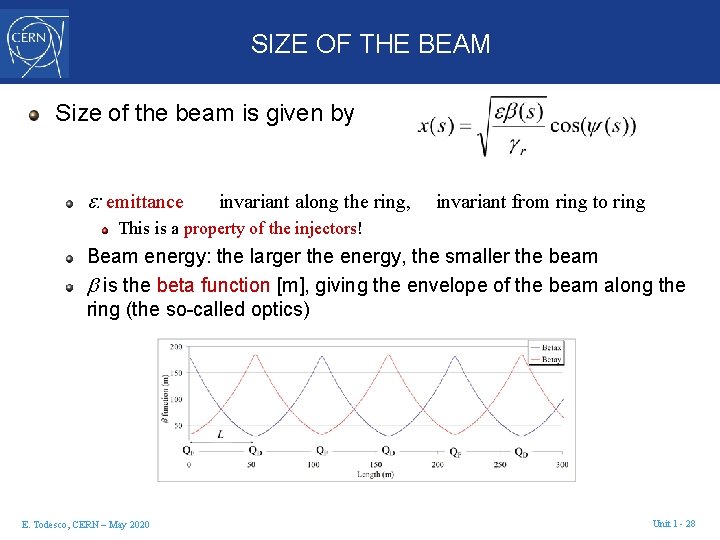
SIZE OF THE BEAM In this way the motion equation in the transverse space is similar to a harmonic oscillator where the force depends on time … Solution: a oscillator whose amplitude and frequency are modulated We write the amplitude as a s-dependent part (beta function) plus an invariant along the ring The invariant is inverse proportional to the energy – so one can define a new invariant, also independent of the energy E. Todesco, CERN – May 2020 Unit 1 - 27
SIZE OF THE BEAM Size of the beam is given by : emittance invariant along the ring, invariant from ring to ring This is a property of the injectors! Beam energy: the larger the energy, the smaller the beam is the beta function [m], giving the envelope of the beam along the ring (the so-called optics) E. Todesco, CERN – May 2020 Unit 1 - 28
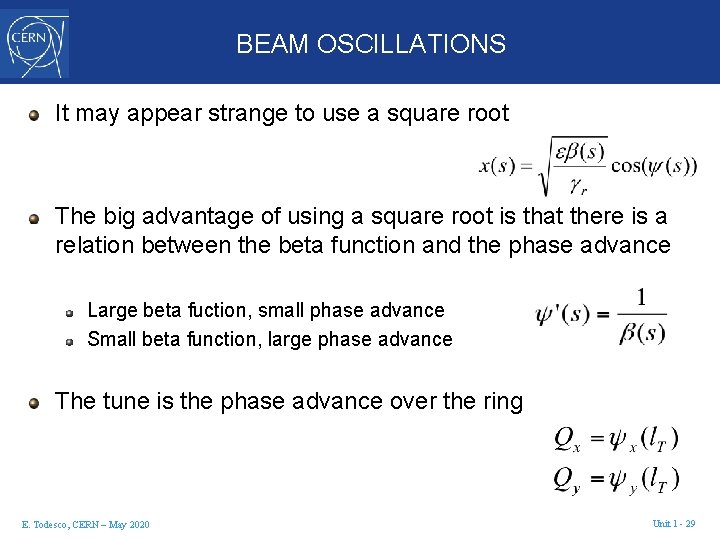
BEAM OSCILLATIONS It may appear strange to use a square root The big advantage of using a square root is that there is a relation between the beta function and the phase advance Large beta fuction, small phase advance Small beta function, large phase advance The tune is the phase advance over the ring E. Todesco, CERN – May 2020 Unit 1 - 29
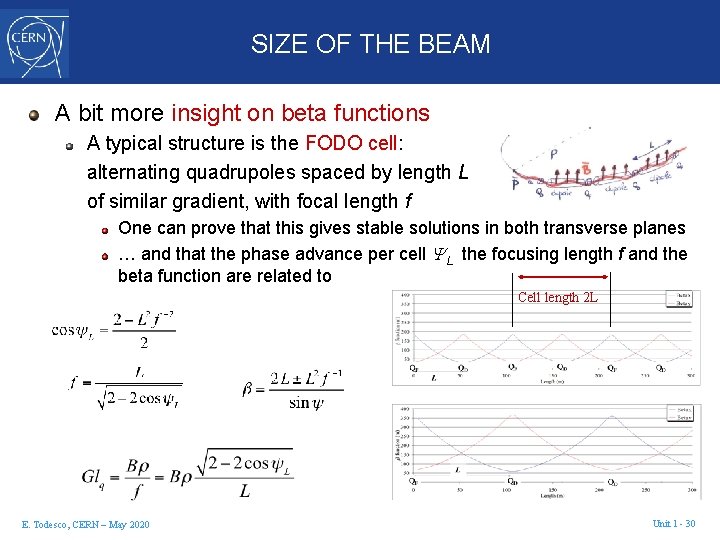
SIZE OF THE BEAM A bit more insight on beta functions A typical structure is the FODO cell: alternating quadrupoles spaced by length L of similar gradient, with focal length f One can prove that this gives stable solutions in both transverse planes … and that the phase advance per cell YL the focusing length f and the beta function are related to Cell length 2 L E. Todesco, CERN – May 2020 Unit 1 - 30
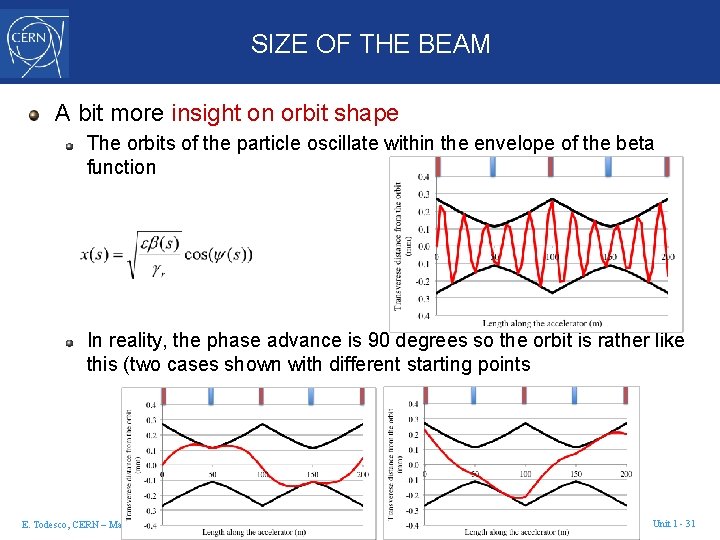
SIZE OF THE BEAM A bit more insight on orbit shape The orbits of the particle oscillate within the envelope of the beta function In reality, the phase advance is 90 degrees so the orbit is rather like this (two cases shown with different starting points E. Todesco, CERN – May 2020 Unit 1 - 31
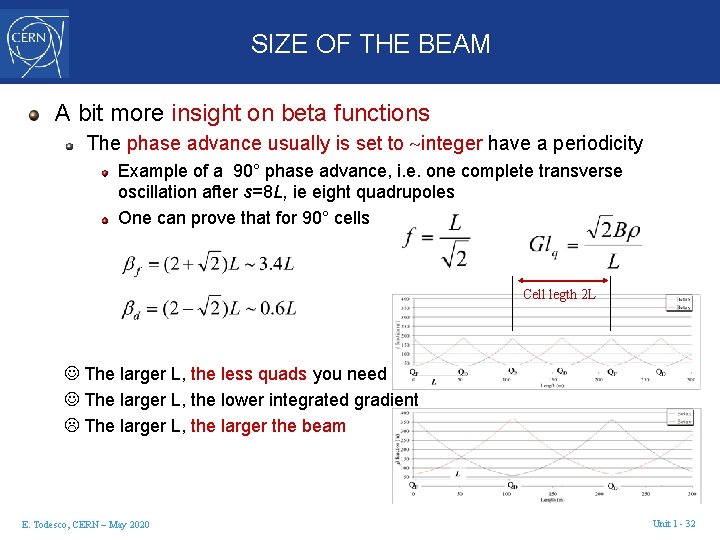
SIZE OF THE BEAM A bit more insight on beta functions The phase advance usually is set to integer have a periodicity Example of a 90° phase advance, i. e. one complete transverse oscillation after s=8 L, ie eight quadrupoles One can prove that for 90° cells Cell legth 2 L The larger L, the less quads you need The larger L, the lower integrated gradient The larger L, the larger the beam E. Todesco, CERN – May 2020 Unit 1 - 32
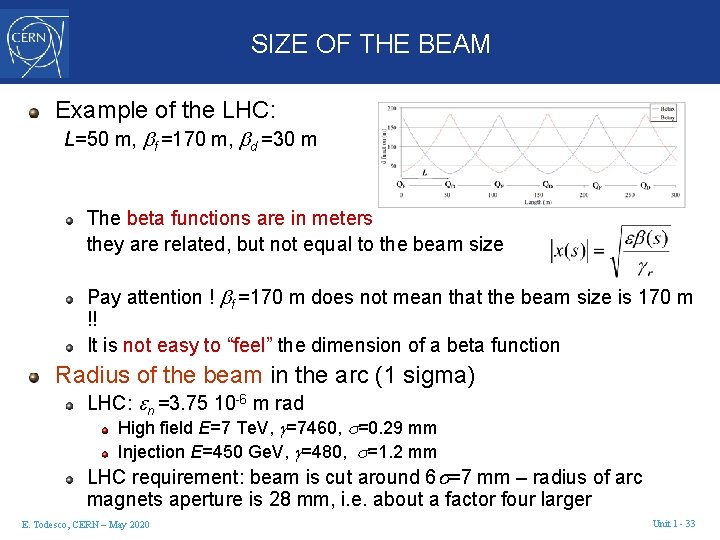
SIZE OF THE BEAM Example of the LHC: L=50 m, f =170 m, d =30 m The beta functions are in meters they are related, but not equal to the beam size Pay attention ! f =170 m does not mean that the beam size is 170 m !! It is not easy to “feel” the dimension of a beta function Radius of the beam in the arc (1 sigma) LHC: n =3. 75 10 -6 m rad High field E=7 Te. V, =7460, =0. 29 mm Injection E=450 Ge. V, =480, =1. 2 mm LHC requirement: beam is cut around 6 =7 mm – radius of arc magnets aperture is 28 mm, i. e. about a factor four larger E. Todesco, CERN – May 2020 Unit 1 - 33
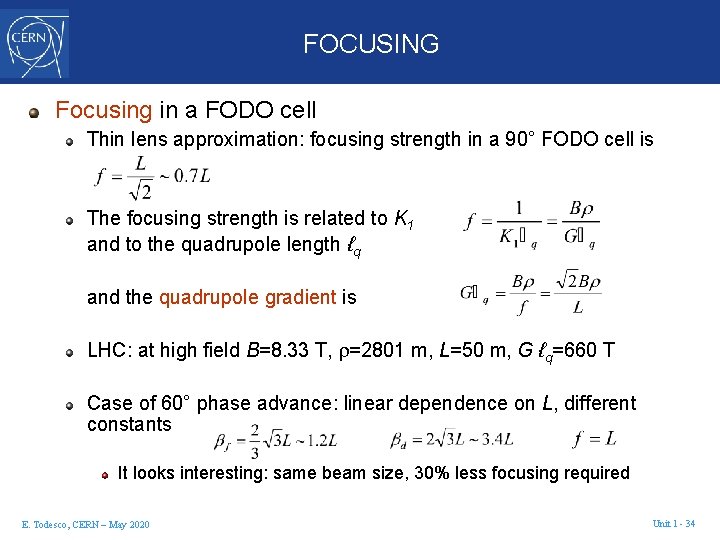
FOCUSING Focusing in a FODO cell Thin lens approximation: focusing strength in a 90° FODO cell is The focusing strength is related to K 1 and to the quadrupole length ℓq and the quadrupole gradient is LHC: at high field B=8. 33 T, =2801 m, L=50 m, G ℓq=660 T Case of 60° phase advance: linear dependence on L, different constants It looks interesting: same beam size, 30% less focusing required E. Todesco, CERN – May 2020 Unit 1 - 34
CONTENTS Principles of synchrotron How to keep particles on a circular orbit Relation between energy, dipolar field, machine length The beam size and principles of focusing Aperture requirements for arc dipoles and arc quadrupoles Gradient requirements for arc quadrupoles Some examples Conclusions E. Todesco, CERN – May 2020 Unit 1 - 35
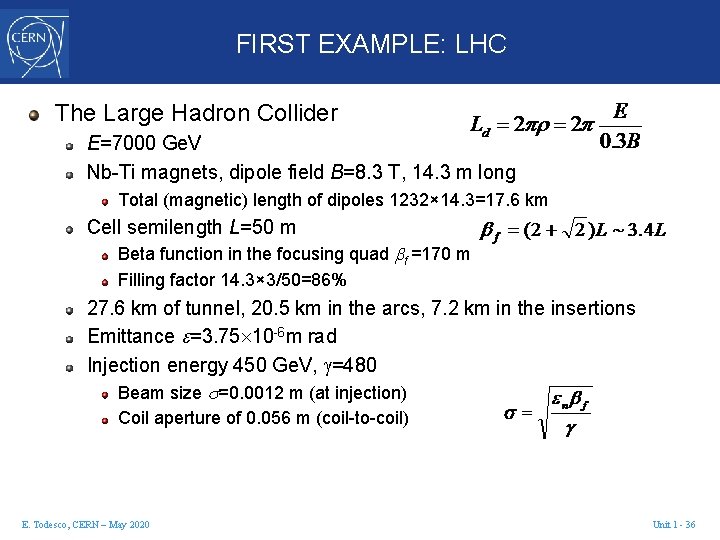
FIRST EXAMPLE: LHC The Large Hadron Collider E=7000 Ge. V Nb-Ti magnets, dipole field B=8. 3 T, 14. 3 m long Total (magnetic) length of dipoles 1232× 14. 3=17. 6 km Cell semilength L=50 m Beta function in the focusing quad f =170 m Filling factor 14. 3× 3/50=86% 27. 6 km of tunnel, 20. 5 km in the arcs, 7. 2 km in the insertions Emittance =3. 75 10 -6 m rad Injection energy 450 Ge. V, =480 Beam size =0. 0012 m (at injection) Coil aperture of 0. 056 m (coil-to-coil) E. Todesco, CERN – May 2020 Unit 1 - 36
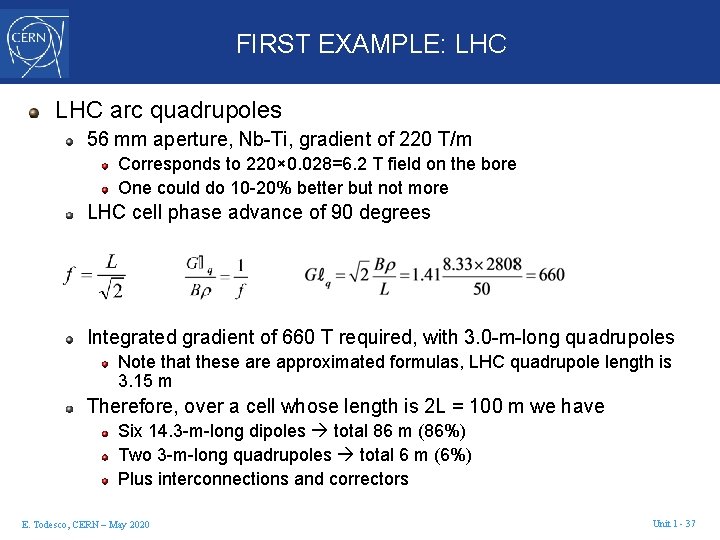
FIRST EXAMPLE: LHC arc quadrupoles 56 mm aperture, Nb-Ti, gradient of 220 T/m Corresponds to 220× 0. 028=6. 2 T field on the bore One could do 10 -20% better but not more LHC cell phase advance of 90 degrees Integrated gradient of 660 T required, with 3. 0 -m-long quadrupoles Note that these are approximated formulas, LHC quadrupole length is 3. 15 m Therefore, over a cell whose length is 2 L = 100 m we have Six 14. 3 -m-long dipoles total 86 m (86%) Two 3 -m-long quadrupoles total 6 m (6%) Plus interconnections and correctors E. Todesco, CERN – May 2020 Unit 1 - 37
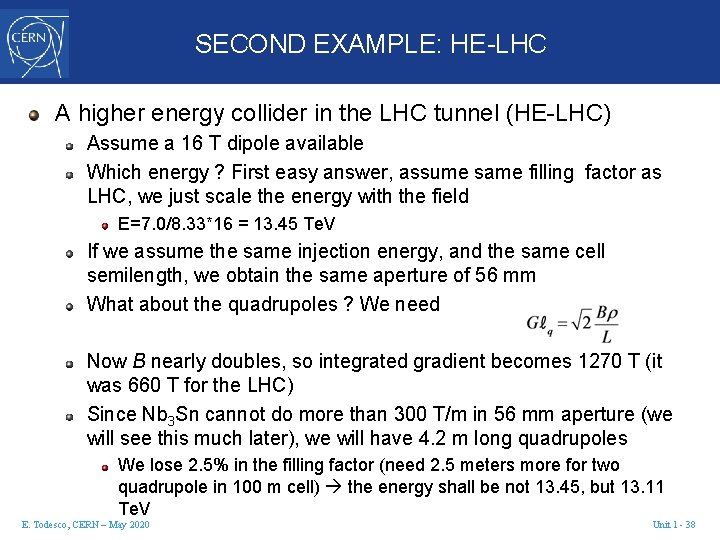
SECOND EXAMPLE: HE-LHC A higher energy collider in the LHC tunnel (HE-LHC) Assume a 16 T dipole available Which energy ? First easy answer, assume same filling factor as LHC, we just scale the energy with the field E=7. 0/8. 33*16 = 13. 45 Te. V If we assume the same injection energy, and the same cell semilength, we obtain the same aperture of 56 mm What about the quadrupoles ? We need Now B nearly doubles, so integrated gradient becomes 1270 T (it was 660 T for the LHC) Since Nb 3 Sn cannot do more than 300 T/m in 56 mm aperture (we will see this much later), we will have 4. 2 m long quadrupoles We lose 2. 5% in the filling factor (need 2. 5 meters more for two quadrupole in 100 m cell) the energy shall be not 13. 45, but 13. 11 Te. V E. Todesco, CERN – May 2020 Unit 1 - 38
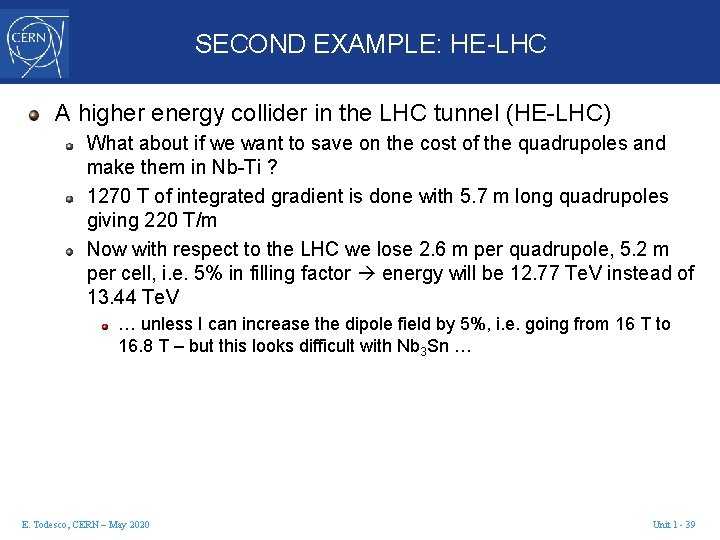
SECOND EXAMPLE: HE-LHC A higher energy collider in the LHC tunnel (HE-LHC) What about if we want to save on the cost of the quadrupoles and make them in Nb-Ti ? 1270 T of integrated gradient is done with 5. 7 m long quadrupoles giving 220 T/m Now with respect to the LHC we lose 2. 6 m per quadrupole, 5. 2 m per cell, i. e. 5% in filling factor energy will be 12. 77 Te. V instead of 13. 44 Te. V … unless I can increase the dipole field by 5%, i. e. going from 16 T to 16. 8 T – but this looks difficult with Nb 3 Sn … E. Todesco, CERN – May 2020 Unit 1 - 39
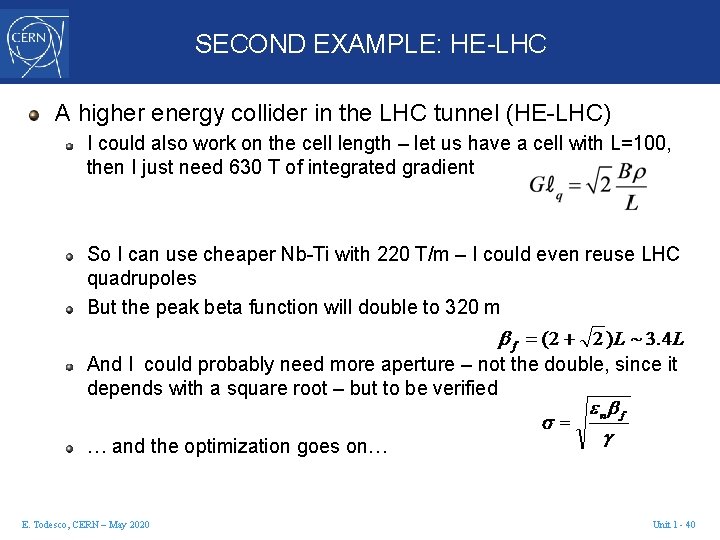
SECOND EXAMPLE: HE-LHC A higher energy collider in the LHC tunnel (HE-LHC) I could also work on the cell length – let us have a cell with L=100, then I just need 630 T of integrated gradient So I can use cheaper Nb-Ti with 220 T/m – I could even reuse LHC quadrupoles But the peak beta function will double to 320 m And I could probably need more aperture – not the double, since it depends with a square root – but to be verified … and the optimization goes on… E. Todesco, CERN – May 2020 Unit 1 - 40
THIRD EXAMPLE: FCC A 100 km, 100 Te. V collider with 16 T magnets (FCC) E=50, 000 Ge. V Nb-Ti magnets, dipole field B=16 T Curvature radius 10. 4 km Total length of dipoles Ld=65. 4 km – looks reasonable for 100 km tunnel Cell semilength L=100 m Better to increase the. LHC value otherwise quadrupole needs will become huge Beta function in the focusing quad f =340 m Emittance =3. 75 10 -6 m rad Injection energy 1 Te. V Ge. V Beta has doubled, but I also double gamma so the aperture is the same as in the LHC E. Todesco, CERN – May 2020 Unit 1 - 41
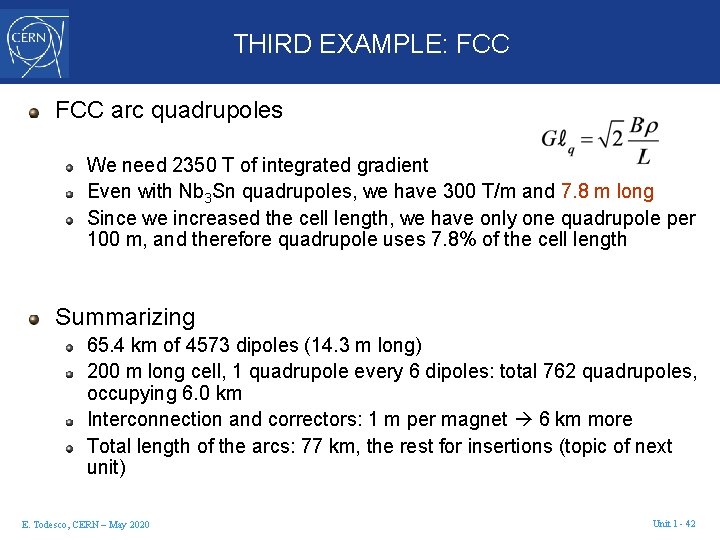
THIRD EXAMPLE: FCC arc quadrupoles We need 2350 T of integrated gradient Even with Nb 3 Sn quadrupoles, we have 300 T/m and 7. 8 m long Since we increased the cell length, we have only one quadrupole per 100 m, and therefore quadrupole uses 7. 8% of the cell length Summarizing 65. 4 km of 4573 dipoles (14. 3 m long) 200 m long cell, 1 quadrupole every 6 dipoles: total 762 quadrupoles, occupying 6. 0 km Interconnection and correctors: 1 m per magnet 6 km more Total length of the arcs: 77 km, the rest for insertions (topic of next unit) E. Todesco, CERN – May 2020 Unit 1 - 42
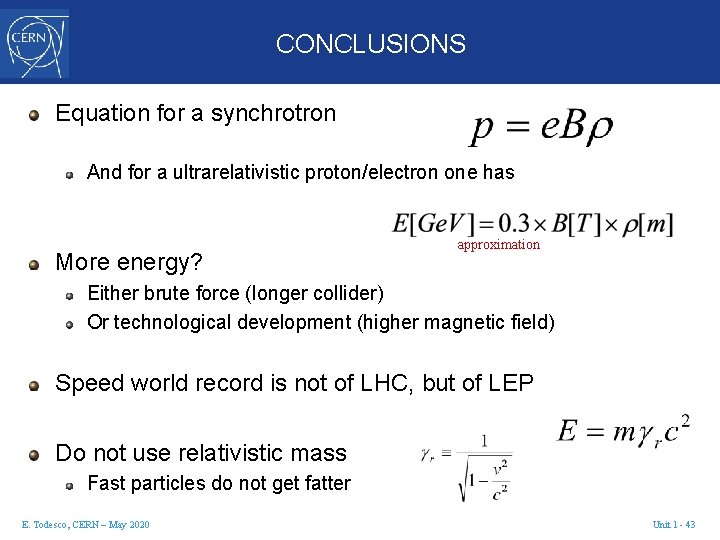
CONCLUSIONS Equation for a synchrotron And for a ultrarelativistic proton/electron one has More energy? approximation Either brute force (longer collider) Or technological development (higher magnetic field) Speed world record is not of LHC, but of LEP Do not use relativistic mass Fast particles do not get fatter E. Todesco, CERN – May 2020 Unit 1 - 43
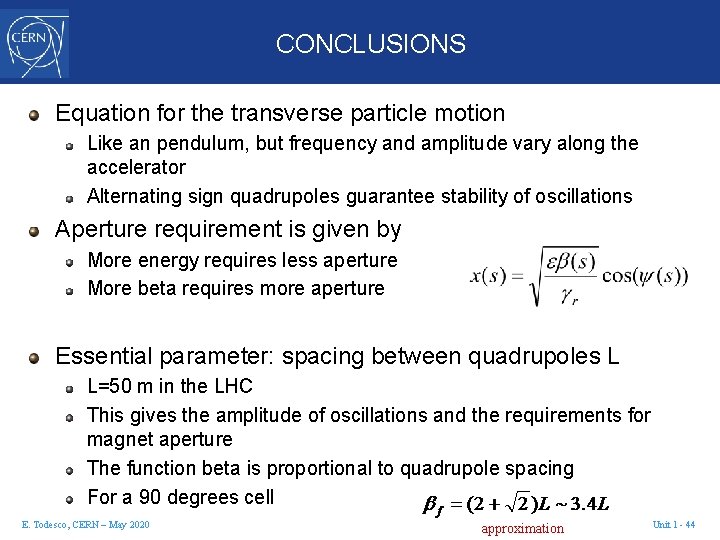
CONCLUSIONS Equation for the transverse particle motion Like an pendulum, but frequency and amplitude vary along the accelerator Alternating sign quadrupoles guarantee stability of oscillations Aperture requirement is given by More energy requires less aperture More beta requires more aperture Essential parameter: spacing between quadrupoles L L=50 m in the LHC This gives the amplitude of oscillations and the requirements for magnet aperture The function beta is proportional to quadrupole spacing For a 90 degrees cell E. Todesco, CERN – May 2020 approximation Unit 1 - 44
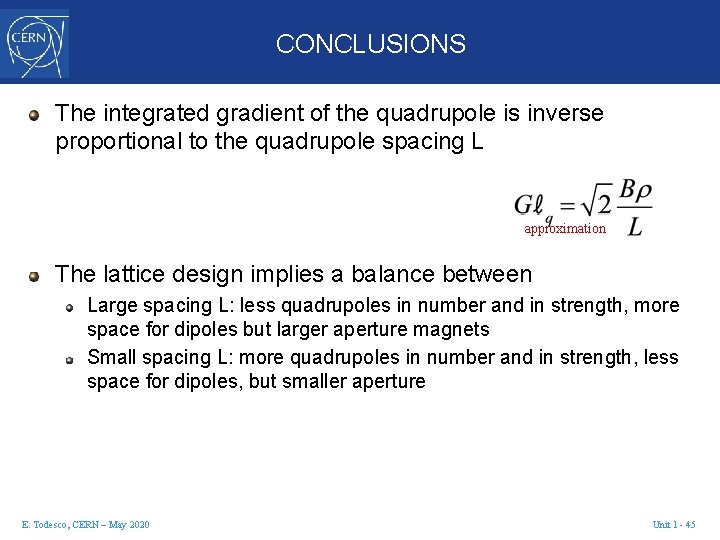
CONCLUSIONS The integrated gradient of the quadrupole is inverse proportional to the quadrupole spacing L approximation The lattice design implies a balance between Large spacing L: less quadrupoles in number and in strength, more space for dipoles but larger aperture magnets Small spacing L: more quadrupoles in number and in strength, less space for dipoles, but smaller aperture E. Todesco, CERN – May 2020 Unit 1 - 45
REFERENCES Beam dynamics - arcs P. Schmuser, et al, Ch. 9. F. Asner, Ch. 8. K. Steffen, “Basic course of accelerator optics”, CERN 85 -19, pg 25 -63. J. Rossbach, P. Schmuser, “Basic course of accelerator optics”, CERN 94 -01, pg 17 -79. E. Todesco, CERN – May 2020 Unit 1 - 46
ACKNOWLEDGEMENTS J. P. Kouthcouk, M. Giovannozzi, W. Scandale for discussions on beam dynamics and optics www. wikipedia. org for most of the pictures E. Todesco, CERN – May 2020 Unit 1 - 47
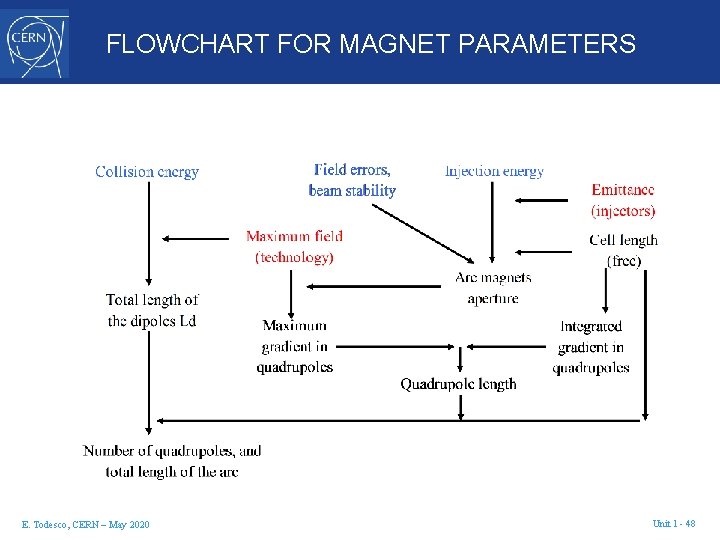
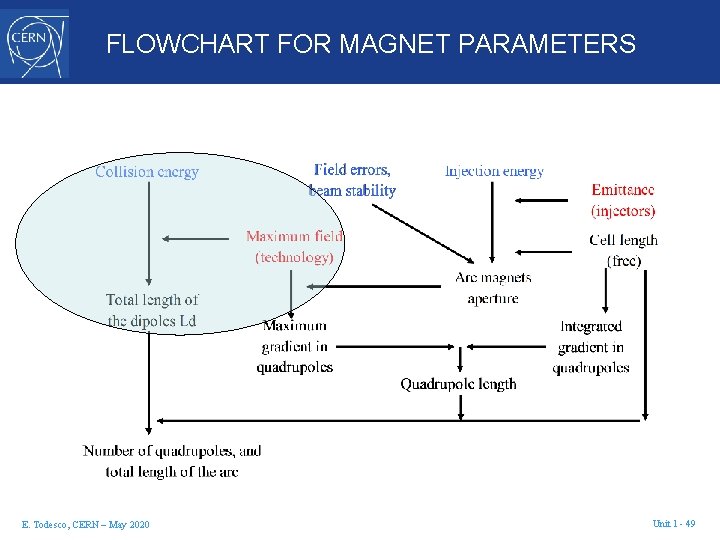
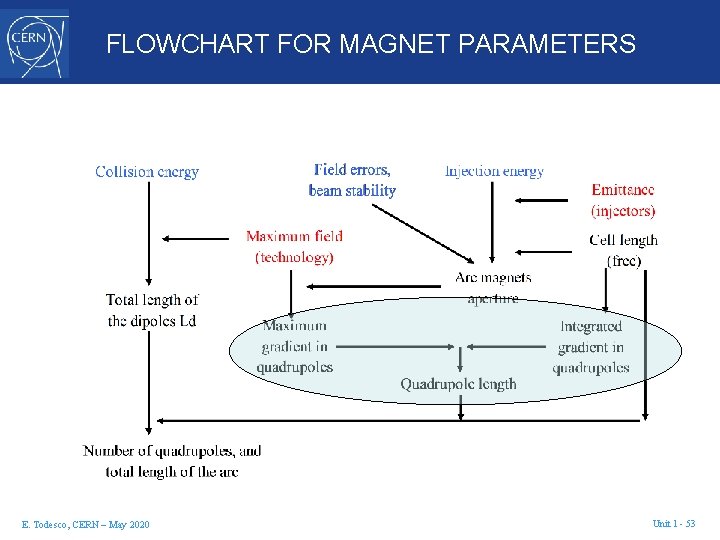
FLOWCHART FOR MAGNET PARAMETERS E. Todesco, CERN – May 2020 Unit 1 - 48
FLOWCHART FOR MAGNET PARAMETERS E. Todesco, CERN – May 2020 Unit 1 - 49
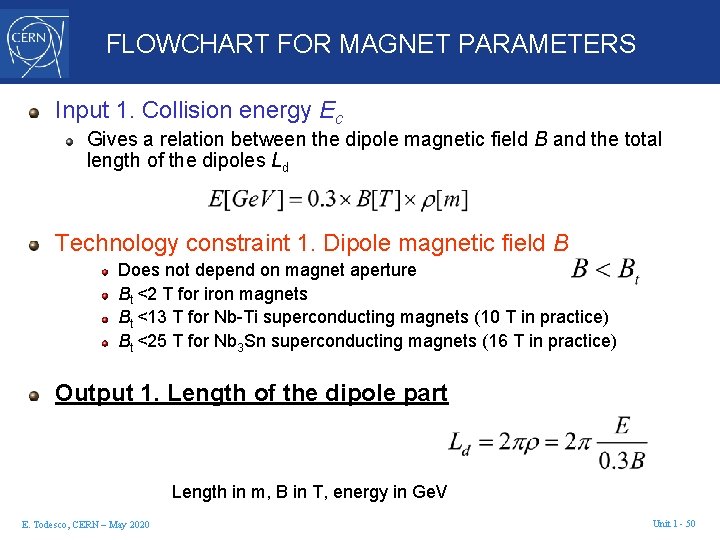
FLOWCHART FOR MAGNET PARAMETERS Input 1. Collision energy Ec Gives a relation between the dipole magnetic field B and the total length of the dipoles Ld Technology constraint 1. Dipole magnetic field B Does not depend on magnet aperture Bt <2 T for iron magnets Bt <13 T for Nb-Ti superconducting magnets (10 T in practice) Bt <25 T for Nb 3 Sn superconducting magnets (16 T in practice) Output 1. Length of the dipole part Length in m, B in T, energy in Ge. V E. Todesco, CERN – May 2020 Unit 1 - 50
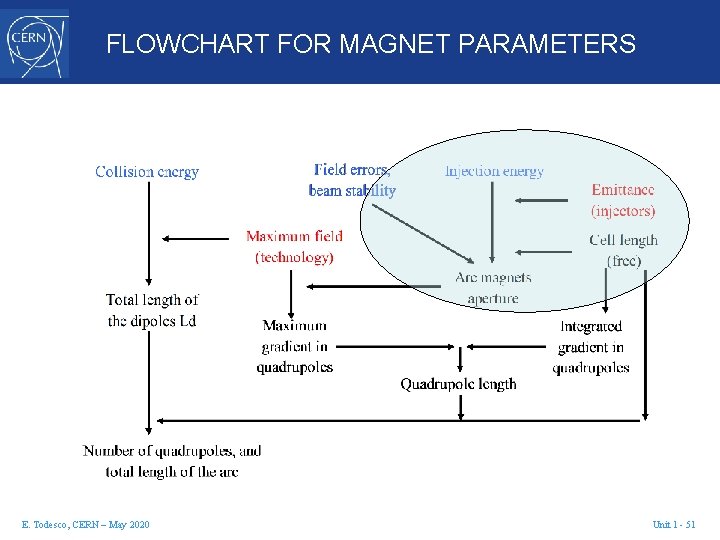
FLOWCHART FOR MAGNET PARAMETERS E. Todesco, CERN – May 2020 Unit 1 - 51
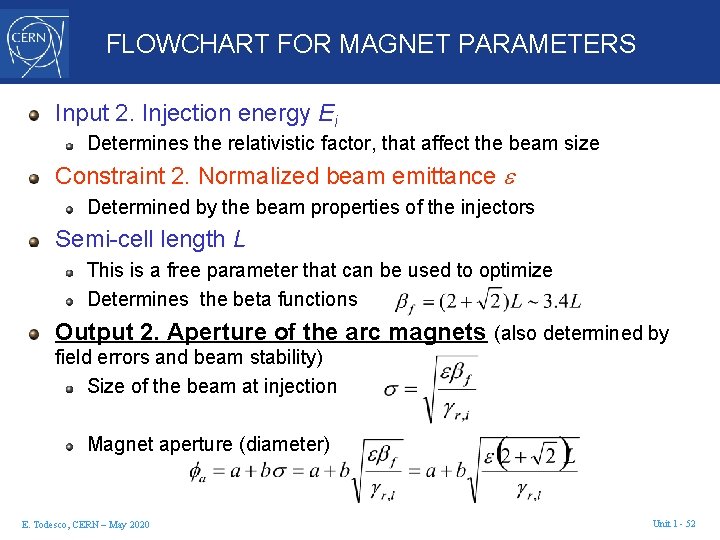
FLOWCHART FOR MAGNET PARAMETERS Input 2. Injection energy Ei Determines the relativistic factor, that affect the beam size Constraint 2. Normalized beam emittance Determined by the beam properties of the injectors Semi-cell length L This is a free parameter that can be used to optimize Determines the beta functions Output 2. Aperture of the arc magnets (also determined by field errors and beam stability) Size of the beam at injection Magnet aperture (diameter) E. Todesco, CERN – May 2020 Unit 1 - 52
FLOWCHART FOR MAGNET PARAMETERS E. Todesco, CERN – May 2020 Unit 1 - 53
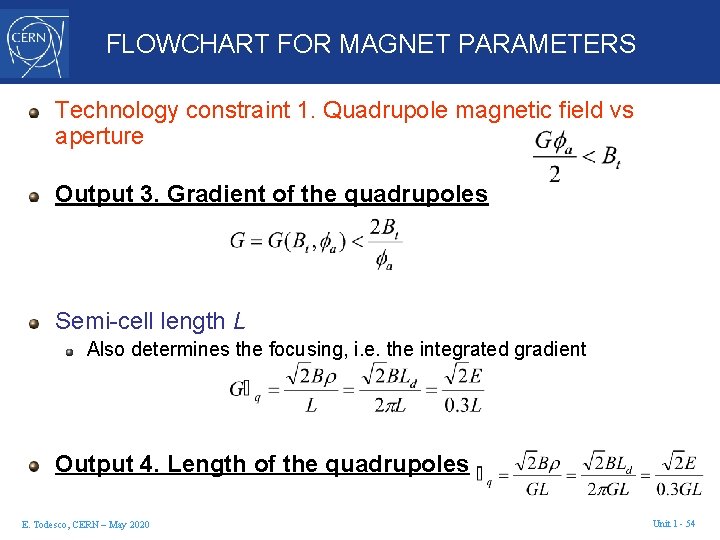
FLOWCHART FOR MAGNET PARAMETERS Technology constraint 1. Quadrupole magnetic field vs aperture Output 3. Gradient of the quadrupoles Semi-cell length L Also determines the focusing, i. e. the integrated gradient Output 4. Length of the quadrupoles E. Todesco, CERN – May 2020 Unit 1 - 54
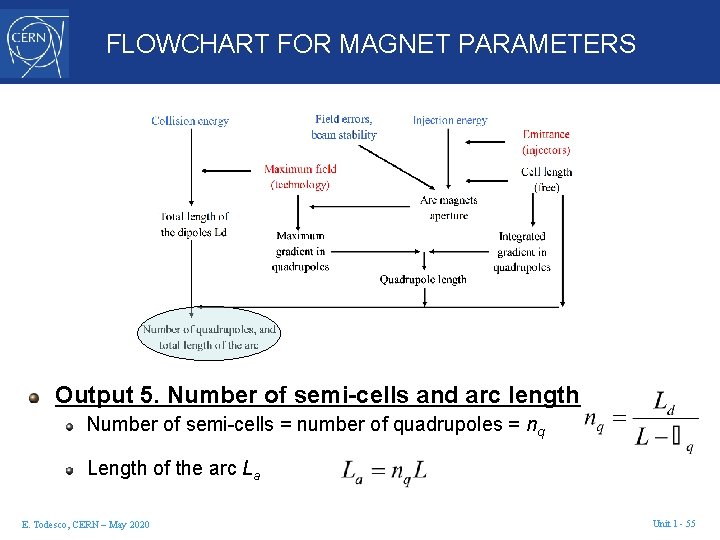
FLOWCHART FOR MAGNET PARAMETERS Output 5. Number of semi-cells and arc length Number of semi-cells = number of quadrupoles = nq Length of the arc La E. Todesco, CERN – May 2020 Unit 1 - 55