Essential Questions How do magnetic poles interact Why


- Slides: 17
Essential Questions • How do magnetic poles interact? • Why does a magnet exert a force on distant magnetic materials? • Why are some materials magnetic but others are not? • How do magnetic domains model magnetic behavior? Copyright © Mc. Graw-Hill Education Magnetism
Magnets • • More than 2, 000 years ago Greeks discovered deposits of a mineral that was a natural magnet. The mineral is now called magnetite. In the twelfth century Chinese sailors used magnetite to make compasses that improved navigation. Today, the word magnetism refers to the properties and interactions of magnets. Copyright © Mc. Graw-Hill Education Magnetism
Magnetic Force Depending on which ends of the magnets are close together, the magnets either repel or attract each other. • The strength of the force between two magnets increases as magnets move closer together and decreases as the magnets move farther apart. Copyright © Mc. Graw-Hill Education Magnetism
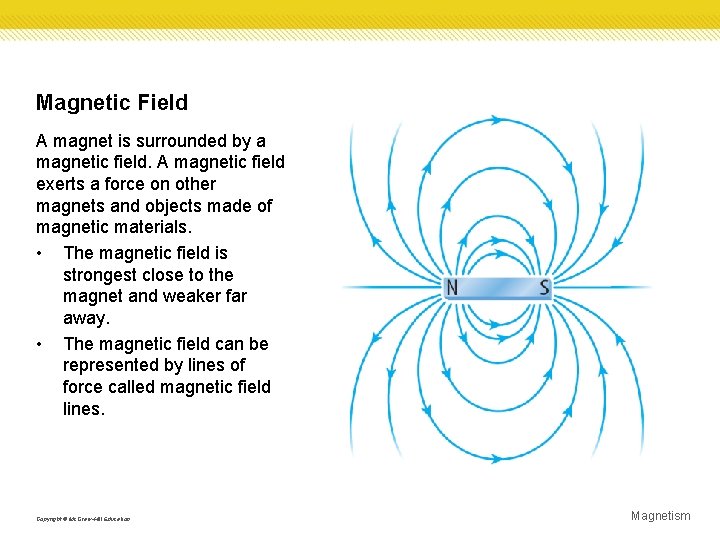
Magnetic Field A magnet is surrounded by a magnetic field. A magnetic field exerts a force on other magnets and objects made of magnetic materials. • The magnetic field is strongest close to the magnet and weaker far away. • The magnetic field can be represented by lines of force called magnetic field lines. Copyright © Mc. Graw-Hill Education Magnetism
Magnetic Poles Magnetic poles are where the magnetic force exerted by the magnet is strongest. • All magnets have a north pole and a south pole. • For a bar magnet, the north and south poles are at the opposite ends. Copyright © Mc. Graw-Hill Education Magnetism
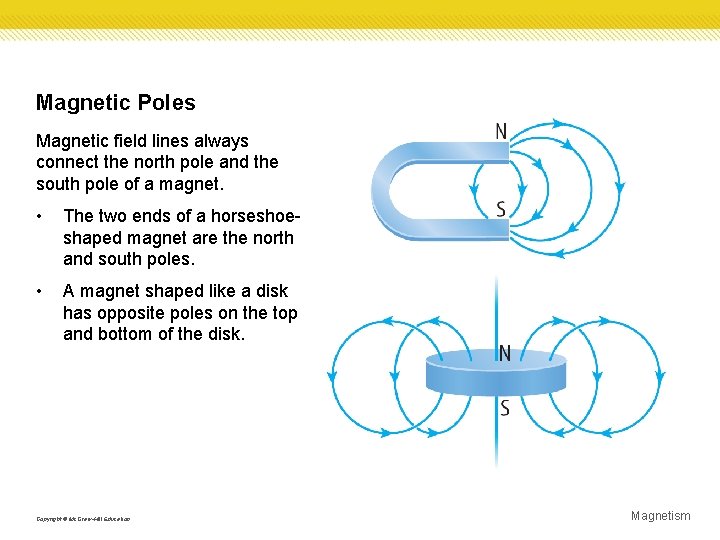
Magnetic Poles Magnetic field lines always connect the north pole and the south pole of a magnet. • The two ends of a horseshoeshaped magnet are the north and south poles. • A magnet shaped like a disk has opposite poles on the top and bottom of the disk. Copyright © Mc. Graw-Hill Education Magnetism
How Magnets Interact Two magnets can either attract or repel each other. • Two north poles or two south poles of two magnets repel each other. However, north poles and south poles always attract each other. • When two magnets are brought close to each other, their magnetic fields combine to produce a new magnetic field. Copyright © Mc. Graw-Hill Education Magnetism
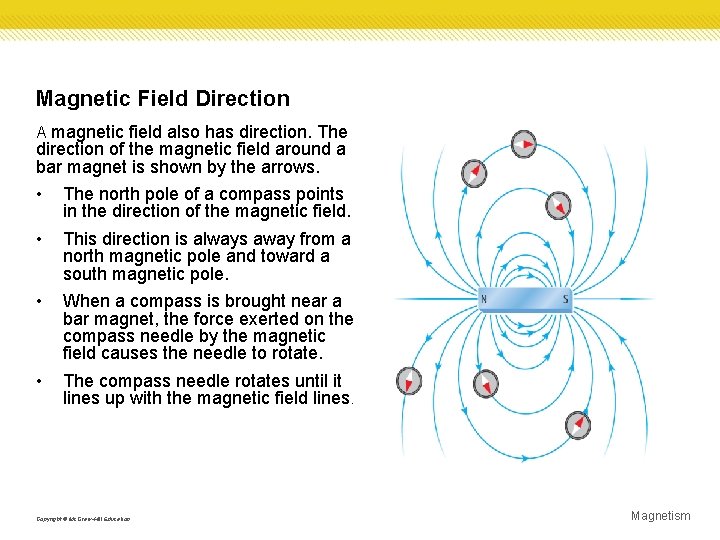
Magnetic Field Direction A magnetic field also has direction. The direction of the magnetic field around a bar magnet is shown by the arrows. • The north pole of a compass points in the direction of the magnetic field. • This direction is always away from a north magnetic pole and toward a south magnetic pole. • When a compass is brought near a bar magnet, the force exerted on the compass needle by the magnetic field causes the needle to rotate. • The compass needle rotates until it lines up with the magnetic field lines. Copyright © Mc. Graw-Hill Education Magnetism
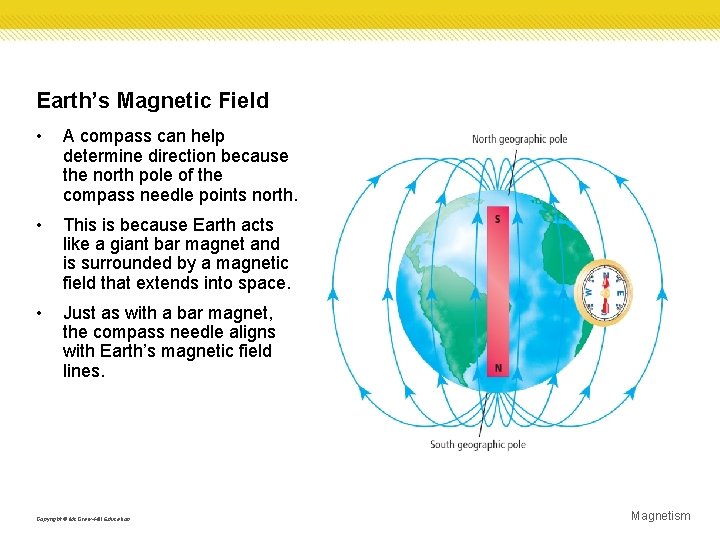
Earth’s Magnetic Field • A compass can help determine direction because the north pole of the compass needle points north. • This is because Earth acts like a giant bar magnet and is surrounded by a magnetic field that extends into space. • Just as with a bar magnet, the compass needle aligns with Earth’s magnetic field lines. Copyright © Mc. Graw-Hill Education Magnetism
Earth’s Magnetic Poles Earth’s magnetic poles move slowly with time. • Currently, Earth’s south magnetic pole is located north of Canada, about 1, 000 km from the geographic north pole. • Sometimes Earth’s magnetic poles switch places so that Earth’s south magnetic pole is the southern hemisphere near the geographic south pole. Copyright © Mc. Graw-Hill Education Magnetism
Magnetic Materials You might have noticed that a magnet will not attract all metal objects. • Only a few metals, such as iron, cobalt, and nickel, are attracted to magnets or can be made into permanent magnets. • What makes these elements magnetic? Remember that every atom contains electrons. Electrons have magnetic properties. • In the atoms of most elements, the magnetic properties of the electrons cancel out. • But in the atoms of iron, cobalt, and nickel, these magnetic properties don’t cancel out. • Even though these atoms have their own magnetic fields, objects made from these metals are not always magnets. Copyright © Mc. Graw-Hill Education Magnetism
Magnetic Domains—A Model for Magnetism Groups of atoms with aligned magnetic poles are called magnetic domains. • Each domain contains an enormous number of atoms, yet the domains are too small to be seen with the unaided eye. • Because the magnetic poles of the individual atoms in a domain are aligned, the domain itself behaves like a magnet with a north pole and a south pole. Copyright © Mc. Graw-Hill Education Magnetism
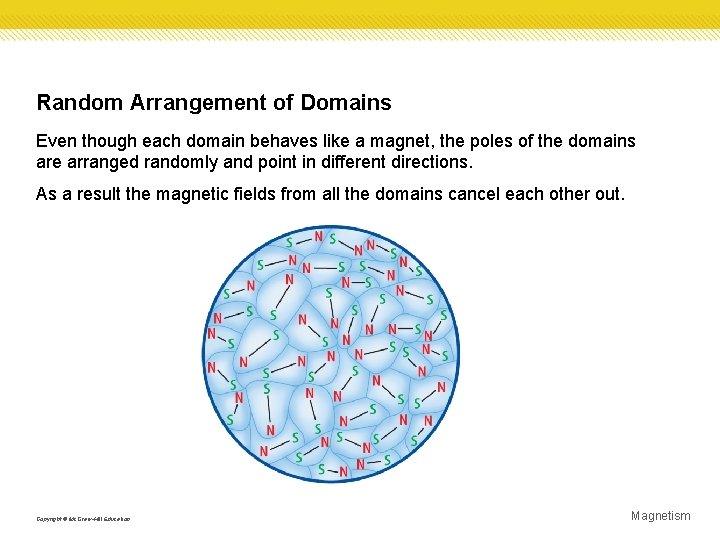
Random Arrangement of Domains Even though each domain behaves like a magnet, the poles of the domains are arranged randomly and point in different directions. As a result the magnetic fields from all the domains cancel each other out. Copyright © Mc. Graw-Hill Education Magnetism
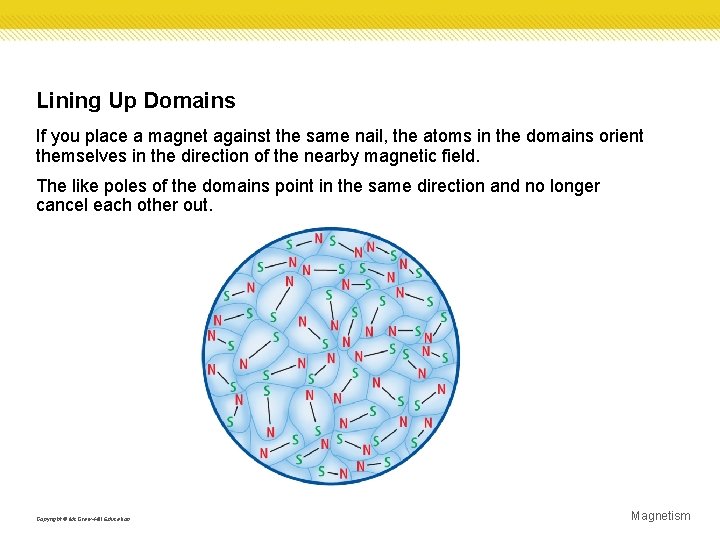
Lining Up Domains If you place a magnet against the same nail, the atoms in the domains orient themselves in the direction of the nearby magnetic field. The like poles of the domains point in the same direction and no longer cancel each other out. Copyright © Mc. Graw-Hill Education Magnetism
Permanent Magnets A permanent magnet can be made by placing a magnetic material, such as iron, in a strong magnetic field. • The strong magnetic field causes the magnetic domains in the material to line up. • The magnetic fields of these aligned domains add together and create a strong magnetic field inside the material. • This field prevents the constant motion of the atoms from bumping the • • domains out of alignment. The material is then a permanent magnet. If the permanent magnet is heated enough, its atoms may be moving fast enough to jostle the domains out of alignment. Then the permanent magnet loses its magnetic field and is no longer a magnet. Copyright © Mc. Graw-Hill Education Magnetism
Can a pole be isolated? Recall that even individual atoms of magnetic materials act as tiny magnets. • Because every magnet is made of many aligned smaller magnets, even the smallest pieces have both a north pole and a south pole. Copyright © Mc. Graw-Hill Education Magnetism
Review Essential Questions • • How do magnetic poles interact? Why does a magnet exert a force on distant magnetic materials? Why are some materials magnetic but others are not? How do magnetic domains model magnetic behavior? Vocabulary • magnetism • magnetic field Copyright © Mc. Graw-Hill Education • magnetic pole • magnetic domain Magnetism