HAPPY HOMECOMING WEEK HR 9 12 PLEASE SIGN







- Slides: 35
HAPPY HOMECOMING WEEK, HR 9 -12! PLEASE SIGN THE ROLL.
ESPAÑOL 2 -4 HONORES
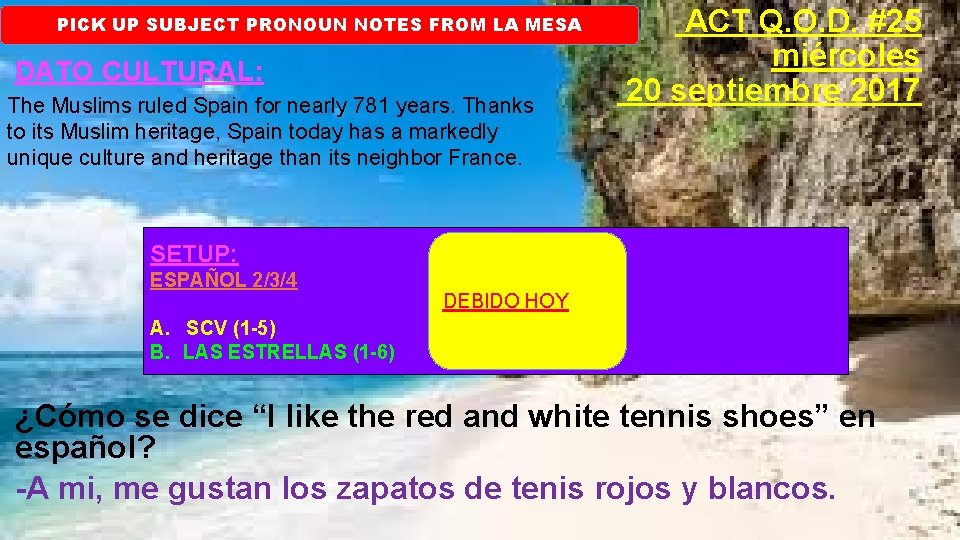
PICK UP SUBJECT PRONOUN NOTES FROM LA MESA DATO CULTURAL: The Muslims ruled Spain for nearly 781 years. Thanks to its Muslim heritage, Spain today has a markedly unique culture and heritage than its neighbor France. ACT Q. O. D. #25 miércoles 20 septiembre 2017 SETUP: ESPAÑOL 2/3/4 DEBIDO HOY A. SCV (1 -5) B. LAS ESTRELLAS (1 -6) ¿Cómo se dice “I like the red and white tennis shoes” en español? -A mi, me gustan los zapatos de tenis rojos y blancos.
20 septiembre 2017 TODAY’S OBJECTIVES: 1. TLW- Answer questions in the target language using basic biographical information. 2. TLW- Examine and analyze Stem-Changing verbs and use them to form short sentences in the target language. 3. TLW- Describe a celebrity in specific detail in the target language.
Why should you be bilingual? 1. Being bilingual improves your memory. 2. Being bilingual makes one smarter. 3. Learning a second language makes it easier to learn other languages. 4. Knowing another language can open doors for you in the job market. 5. Studying a foreign language will improve your skills in your native language.
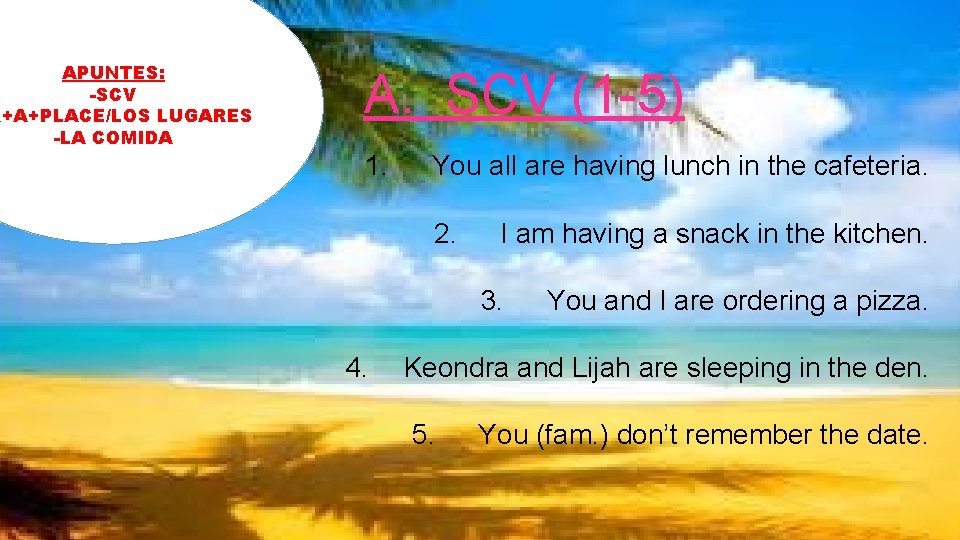
APUNTES: -SCV R+A+PLACE/LOS LUGARES -LA COMIDA A. SCV (1 -5) 1. You all are having lunch in the cafeteria. 2. I am having a snack in the kitchen. 3. 4. You and I are ordering a pizza. Keondra and Lijah are sleeping in the den. 5. You (fam. ) don’t remember the date.
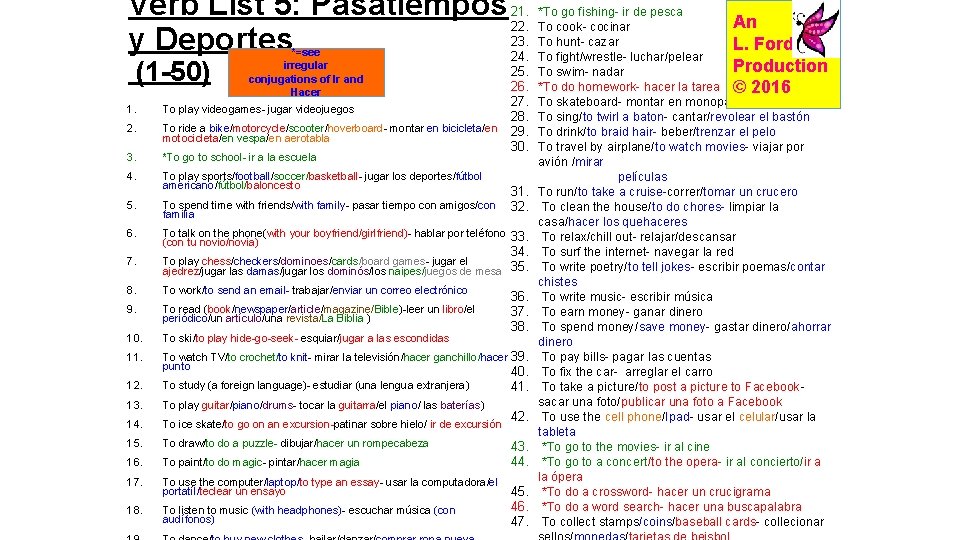
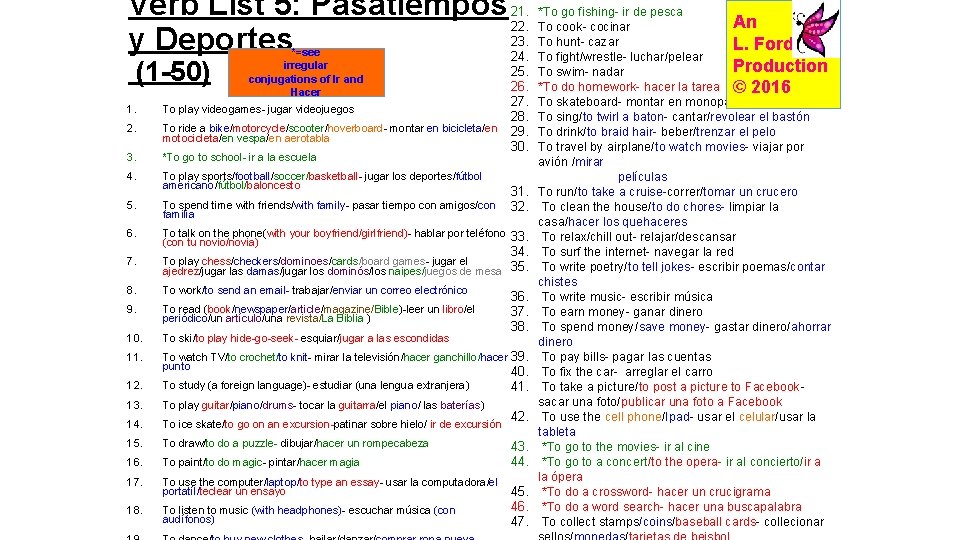
Verb List 5: Pasatiempos 21. 22. 23. y Deportes 24. (1 -50) *=see irregular conjugations of Ir and Hacer 1. To play videogames- jugar videojuegos 2. To ride a bike/motorcycle/scooter/hoverboard- montar en bicicleta/en motocicleta/en vespa/en aerotabla 3. *To go to school- ir a la escuela 4. To play sports/football/soccer/basketball- jugar los deportes/fútbol americano/fútbol/baloncesto 25. 26. 27. 28. 29. 30. 31. 32. 5. To spend time with friends/with family- pasar tiempo con amigos/con familia 6. To talk on the phone(with your boyfriend/girlfriend)- hablar por teléfono 33. (con tu novio/novia) 7. To play chess/checkers/dominoes/cards/board games- jugar el ajedrez/jugar las damas/jugar los dominós/los naipes/juegos de mesa 35. 8. To work/to send an email- trabajar/enviar un correo electrónico 9. To read (book/newspaper/article/magazine/Bible)-leer un libro/el periódico/un artículo/una revista/La Biblia ) 10. To ski/to play hide-go-seek- esquiar/jugar a las escondidas 11. To watch TV/to crochet/to knit- mirar la televisión/hacer ganchillo/hacer 39. punto 34. 12. To study (a foreign language)- estudiar (una lengua extranjera) 13. To play guitar/piano/drums- tocar la guitarra/el piano/ las baterías) 14. To ice skate/to go on an excursion-patinar sobre hielo/ ir de excursión 15. To draw/to do a puzzle- dibujar/hacer un rompecabeza 16. To paint/to do magic- pintar/hacer magia 17. To use the computer/laptop/to type an essay- usar la computadora/el portatíl/teclear un ensayo 18. To listen to music (with headphones)- escuchar música (con audífonos) 36. 37. 38. 40. 41. 42. 43. 44. 45. 46. 47. *To go fishing- ir de pesca An To cook- cocinar To hunt- cazar L. Ford To fight/wrestle- luchar/pelear Production To swim- nadar *To do homework- hacer la tarea © 2016 To skateboard- montar en monopatín To sing/to twirl a baton- cantar/revolear el bastón To drink/to braid hair- beber/trenzar el pelo To travel by airplane/to watch movies- viajar por avión /mirar películas To run/to take a cruise-correr/tomar un crucero To clean the house/to do chores- limpiar la casa/hacer los quehaceres To relax/chill out- relajar/descansar To surf the internet- navegar la red To write poetry/to tell jokes- escribir poemas/contar chistes To write music- escribir música To earn money- ganar dinero To spend money/save money- gastar dinero/ahorrar dinero To pay bills- pagar las cuentas To fix the car- arreglar el carro To take a picture/to post a picture to Facebooksacar una foto/publicar una foto a Facebook To use the cell phone/Ipad- usar el celular/usar la tableta *To go to the movies- ir al cine *To go to a concert/to the opera- ir al concierto/ir a la ópera *To do a crossword- hacer un crucigrama *To do a word search- hacer una buscapalabra To collect stamps/coins/baseball cards- collecionar
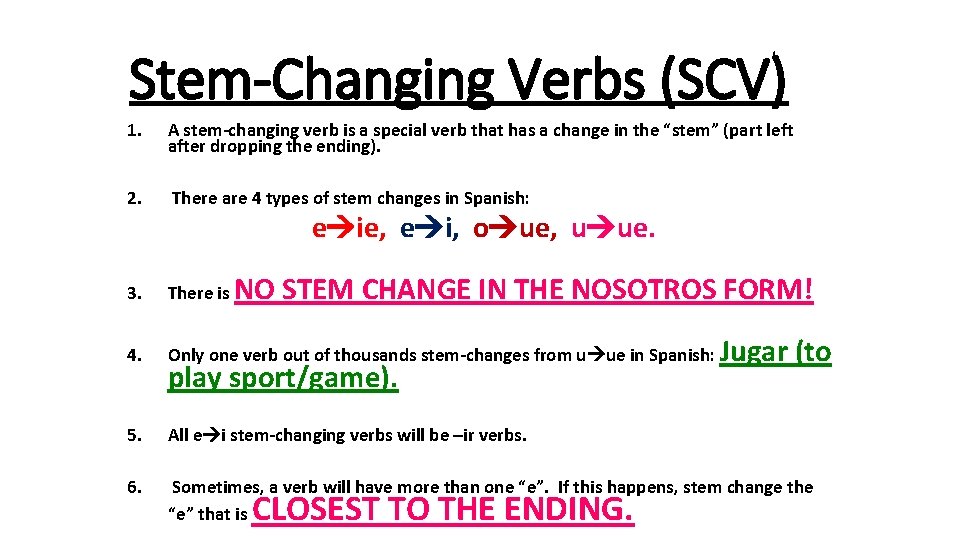
Stem-Changing Verbs (SCV) 1. A stem-changing verb is a special verb that has a change in the “stem” (part left after dropping the ending). 2. There are 4 types of stem changes in Spanish: 3. There is 4. Only one verb out of thousands stem-changes from u ue in Spanish: 5. All e i stem-changing verbs will be –ir verbs. 6. Sometimes, a verb will have more than one “e”. If this happens, stem change the “e” that is e ie, e i, o ue, u ue. NO STEM CHANGE IN THE NOSOTROS FORM! play sport/game). CLOSEST TO THE ENDING. Jugar (to
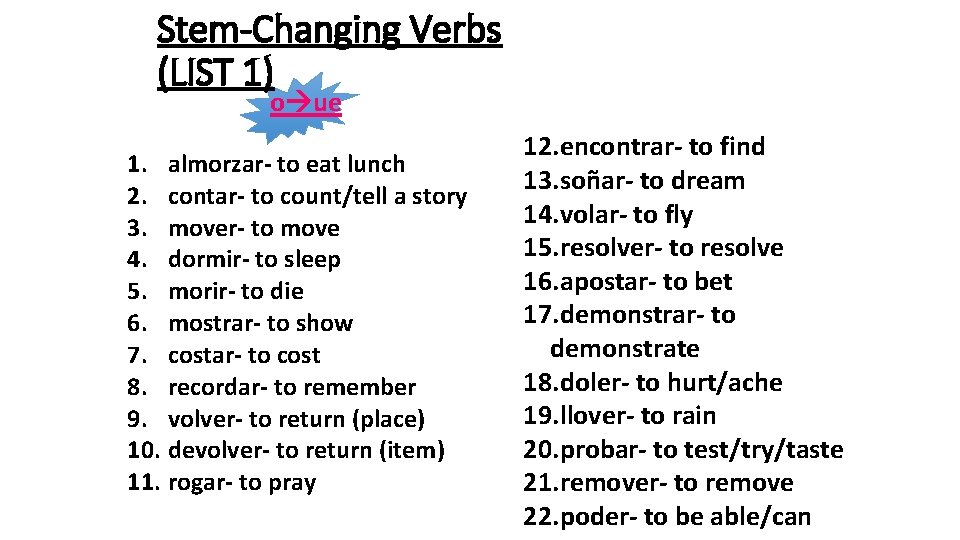
Stem-Changing Verbs (LIST 1) o ue 1. almorzar- to eat lunch 2. contar- to count/tell a story 3. mover- to move 4. dormir- to sleep 5. morir- to die 6. mostrar- to show 7. costar- to cost 8. recordar- to remember 9. volver- to return (place) 10. devolver- to return (item) 11. rogar- to pray 12. encontrar- to find 13. soñar- to dream 14. volar- to fly 15. resolver- to resolve 16. apostar- to bet 17. demonstrar- to demonstrate 18. doler- to hurt/ache 19. llover- to rain 20. probar- to test/try/taste 21. remover- to remove 22. poder- to be able/can
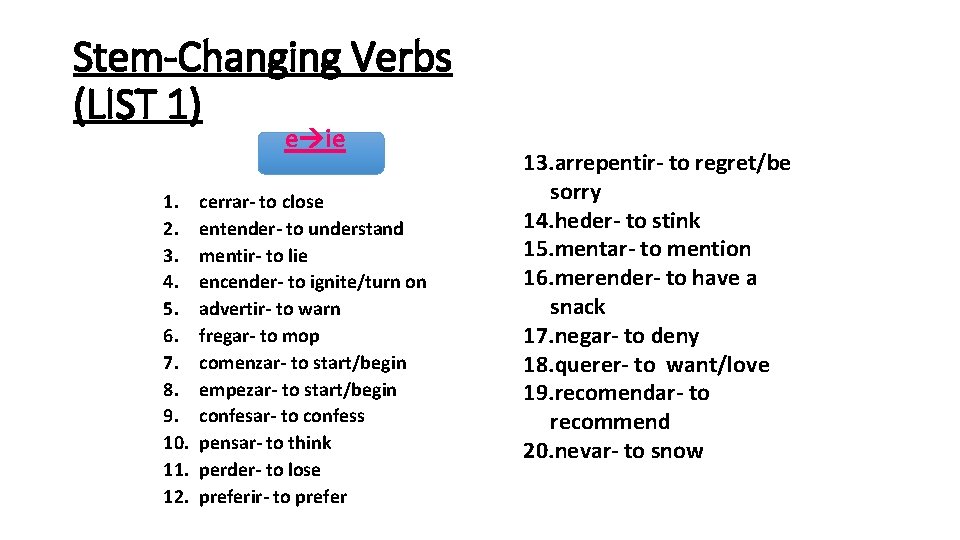
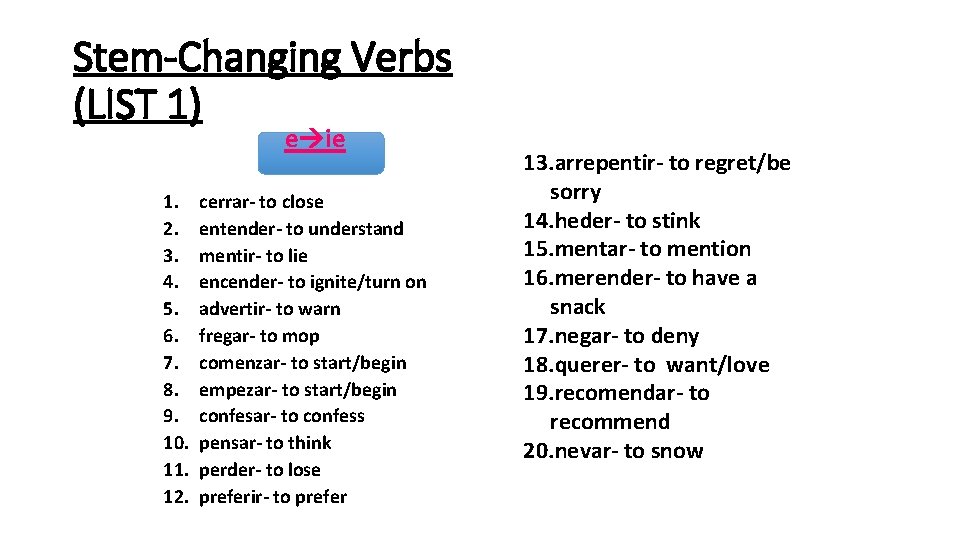
Stem-Changing Verbs (LIST 1) e ie 1. 2. 3. 4. 5. 6. 7. 8. 9. 10. 11. 12. cerrar- to close entender- to understand mentir- to lie encender- to ignite/turn on advertir- to warn fregar- to mop comenzar- to start/begin empezar- to start/begin confesar- to confess pensar- to think perder- to lose preferir- to prefer 13. arrepentir- to regret/be sorry 14. heder- to stink 15. mentar- to mention 16. merender- to have a snack 17. negar- to deny 18. querer- to want/love 19. recomendar- to recommend 20. nevar- to snow
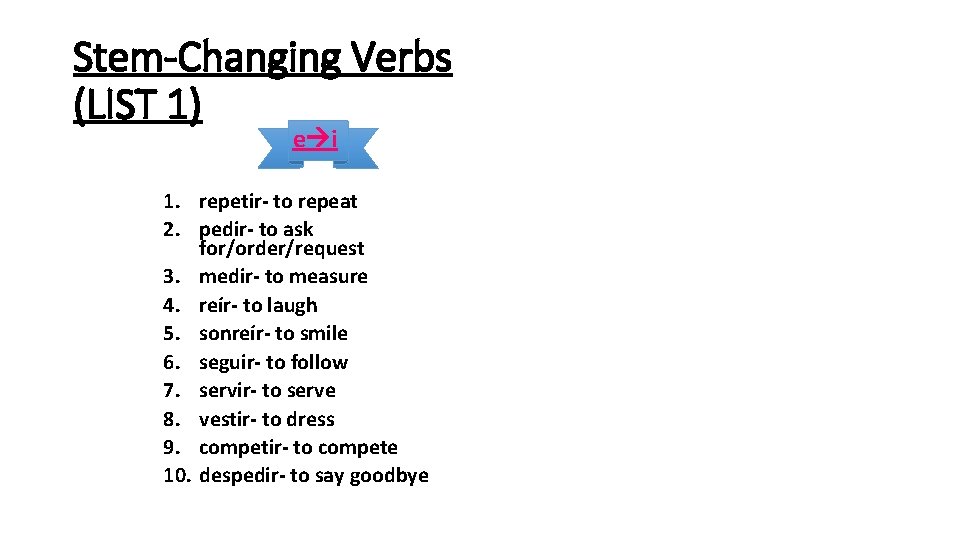
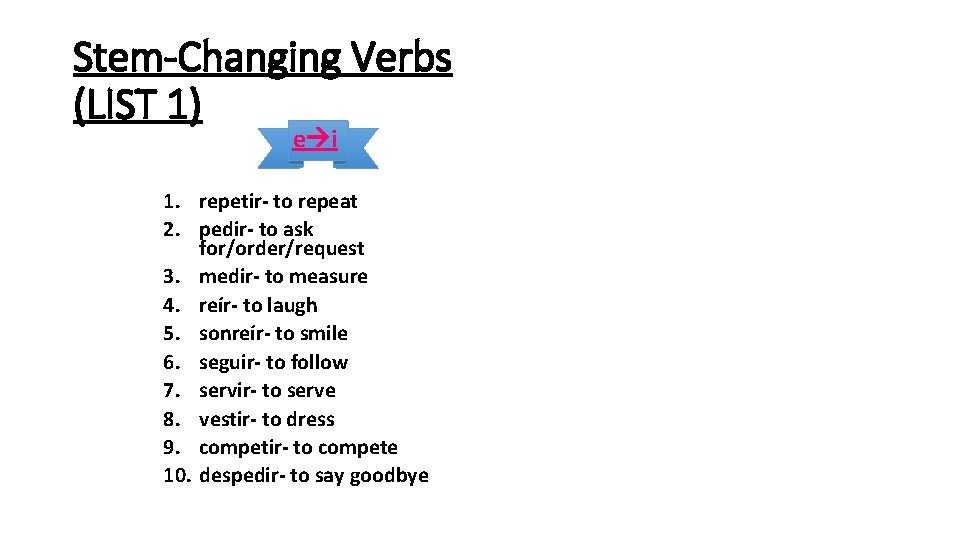
Stem-Changing Verbs (LIST 1) e i 1. repetir- to repeat 2. pedir- to ask for/order/request 3. medir- to measure 4. reír- to laugh 5. sonreír- to smile 6. seguir- to follow 7. servir- to serve 8. vestir- to dress 9. competir- to compete 10. despedir- to say goodbye
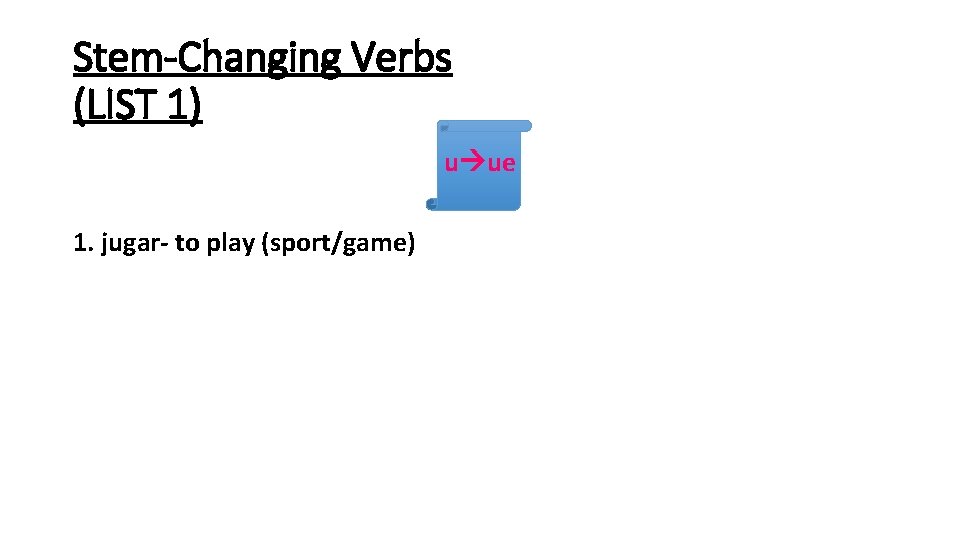
Stem-Changing Verbs (LIST 1) u ue 1. jugar- to play (sport/game)
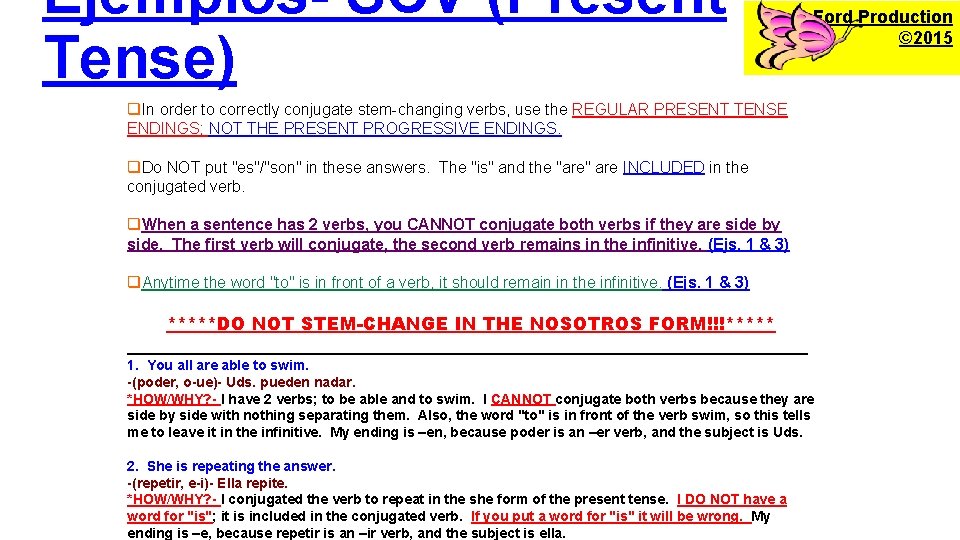
Ejemplos- SCV (Present Tense) An L. Ford Production © 2015 q. In order to correctly conjugate stem-changing verbs, use the REGULAR PRESENT TENSE ENDINGS; NOT THE PRESENT PROGRESSIVE ENDINGS. q. Do NOT put "es"/"son" in these answers. The "is" and the "are" are INCLUDED in the conjugated verb. q. When a sentence has 2 verbs, you CANNOT conjugate both verbs if they are side by side. The first verb will conjugate, the second verb remains in the infinitive. (Ejs. 1 & 3) q. Anytime the word "to" is in front of a verb, it should remain in the infinitive. (Ejs. 1 & 3) *****DO NOT STEM-CHANGE IN THE NOSOTROS FORM!!!***** ______________________________________ 1. You all are able to swim. -(poder, o-ue)- Uds. pueden nadar. *HOW/WHY? - I have 2 verbs; to be able and to swim. I CANNOT conjugate both verbs because they are side by side with nothing separating them. Also, the word "to" is in front of the verb swim, so this tells me to leave it in the infinitive. My ending is –en, because poder is an –er verb, and the subject is Uds. 2. She is repeating the answer. -(repetir, e-i)- Ella repite. *HOW/WHY? - I conjugated the verb to repeat in the she form of the present tense. I DO NOT have a word for "is"; it is included in the conjugated verb. If you put a word for "is" it will be wrong. My ending is –e, because repetir is an –ir verb, and the subject is ella.
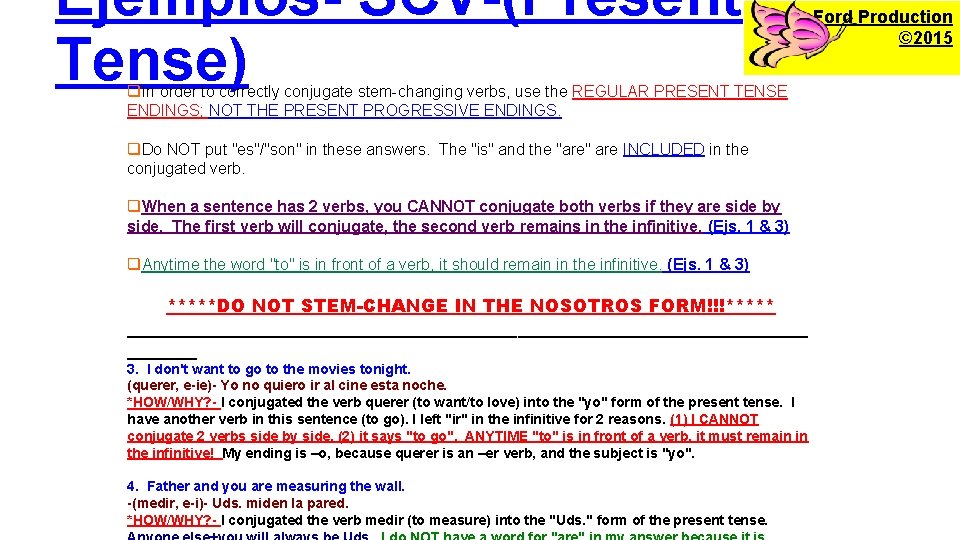
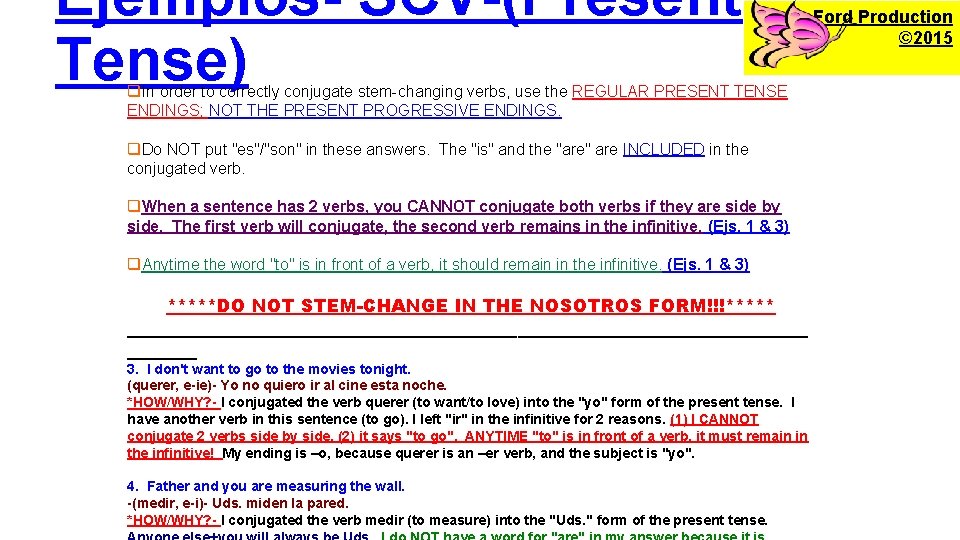
Ejemplos- SCV-(Present Tense) An L. Ford Production © 2015 q. In order to correctly conjugate stem-changing verbs, use the REGULAR PRESENT TENSE ENDINGS; NOT THE PRESENT PROGRESSIVE ENDINGS. q. Do NOT put "es"/"son" in these answers. The "is" and the "are" are INCLUDED in the conjugated verb. q. When a sentence has 2 verbs, you CANNOT conjugate both verbs if they are side by side. The first verb will conjugate, the second verb remains in the infinitive. (Ejs. 1 & 3) q. Anytime the word "to" is in front of a verb, it should remain in the infinitive. (Ejs. 1 & 3) *****DO NOT STEM-CHANGE IN THE NOSOTROS FORM!!!***** __________________________________ 3. I don't want to go to the movies tonight. (querer, e-ie)- Yo no quiero ir al cine esta noche. *HOW/WHY? - I conjugated the verb querer (to want/to love) into the "yo" form of the present tense. I have another verb in this sentence (to go). I left "ir" in the infinitive for 2 reasons. (1) I CANNOT conjugate 2 verbs side by side, (2) it says "to go". ANYTIME "to" is in front of a verb, it must remain in the infinitive! My ending is –o, because querer is an –er verb, and the subject is "yo". 4. Father and you are measuring the wall. -(medir, e-i)- Uds. miden la pared. *HOW/WHY? - I conjugated the verb medir (to measure) into the "Uds. " form of the present tense.
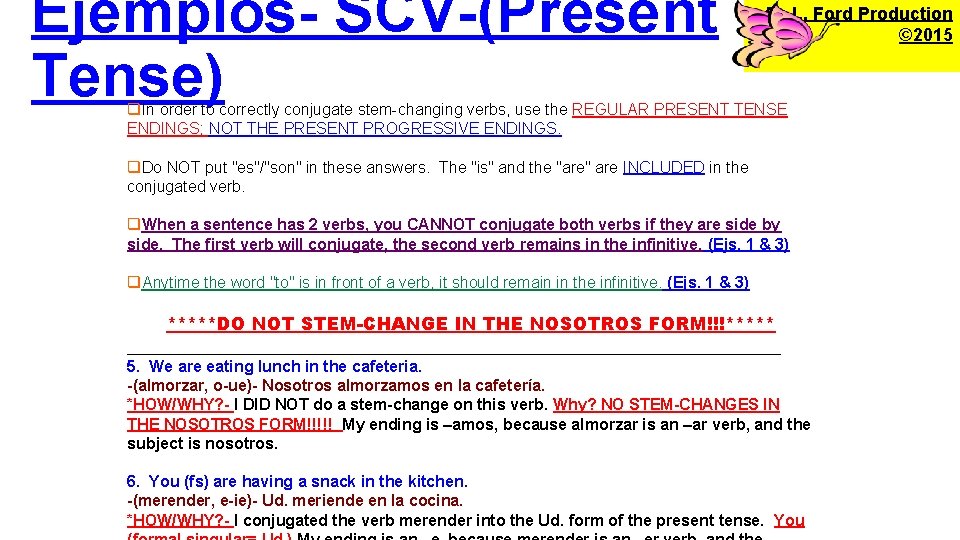
Ejemplos- SCV-(Present Tense) An L. Ford Production © 2015 q. In order to correctly conjugate stem-changing verbs, use the REGULAR PRESENT TENSE ENDINGS; NOT THE PRESENT PROGRESSIVE ENDINGS. q. Do NOT put "es"/"son" in these answers. The "is" and the "are" are INCLUDED in the conjugated verb. q. When a sentence has 2 verbs, you CANNOT conjugate both verbs if they are side by side. The first verb will conjugate, the second verb remains in the infinitive. (Ejs. 1 & 3) q. Anytime the word "to" is in front of a verb, it should remain in the infinitive. (Ejs. 1 & 3) *****DO NOT STEM-CHANGE IN THE NOSOTROS FORM!!!***** _____________________________________ 5. We are eating lunch in the cafeteria. -(almorzar, o-ue)- Nosotros almorzamos en la cafetería. *HOW/WHY? - I DID NOT do a stem-change on this verb. Why? NO STEM-CHANGES IN THE NOSOTROS FORM!!!!! My ending is –amos, because almorzar is an –ar verb, and the subject is nosotros. 6. You (fs) are having a snack in the kitchen. -(merender, e-ie)- Ud. meriende en la cocina. *HOW/WHY? - I conjugated the verb merender into the Ud. form of the present tense. You
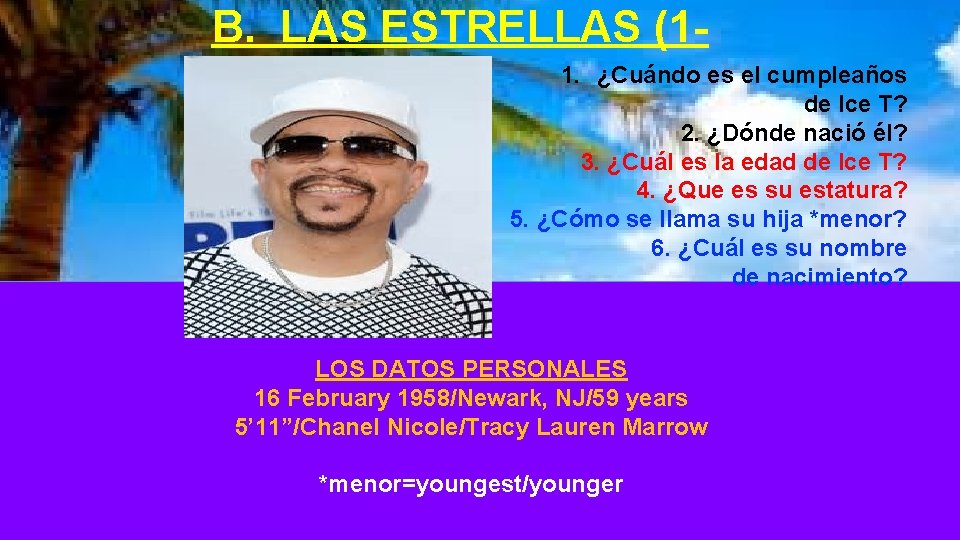
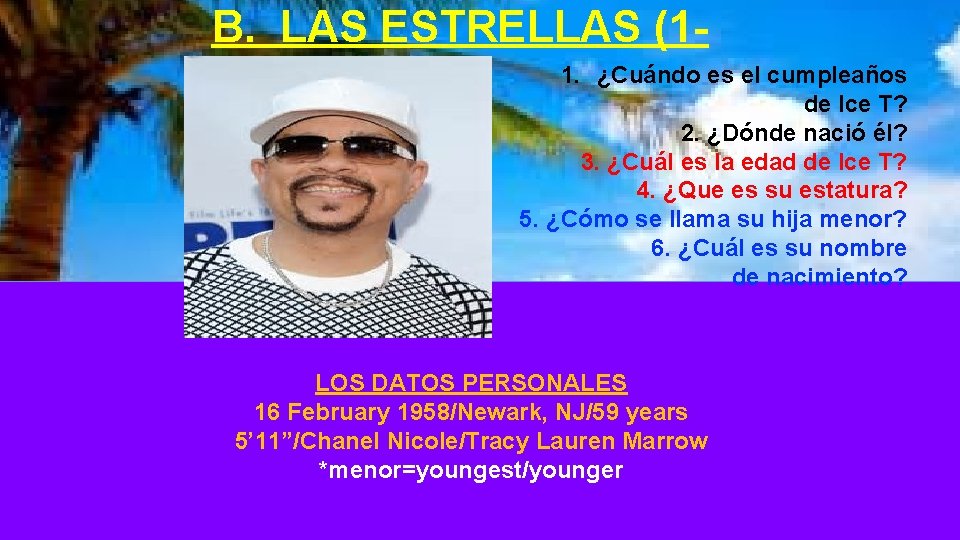
B. LAS ESTRELLAS (11. ¿Cuándo es el cumpleaños 6) de Ice T? 2. ¿Dónde nació él? 3. ¿Cuál es la edad de Ice T? 4. ¿Que es su estatura? 5. ¿Cómo se llama su hija *menor? 6. ¿Cuál es su nombre de nacimiento? LOS DATOS PERSONALES 16 February 1958/Newark, NJ/59 years 5’ 11”/Chanel Nicole/Tracy Lauren Marrow *menor=youngest/younger
ESPAÑOL 1 HONORES
DATO CULTURAL: The Muslims ruled Spain for nearly 781 years. Thanks to its Muslim heritage, Spain today has a markedly unique culture and heritage than its neighbor France. ACT Q. O. D. #25 miércoles 20 septiembre 2017 SETUP: ESPAÑOL 1 DEBIDO HOY A. GUSTAR VS. ENCANTAR (1 -5) B. LAS ESTRELLAS (1 -6) ¿Cómo se dice “I like the red and white tennis shoes” en español? -A mi, me gustan los zapatos de tenis rojos y blancos.
A. GUSTAR VS. ENCANTAR (1 -5) APUNTES: -VL 1 -5 B -LA ROPA 1. We love to cook, sing, and dance (d). 2. I don’t like the green and black coat. 3. She likes the orange and white vest. 4. 5. You all love to read and write. Ms. Ford likes to eat and swim. -A ella, le gusta comer y nadar.
B. LAS ESTRELLAS (11. ¿Cuándo es el cumpleaños 6) de Ice T? 2. ¿Dónde nació él? 3. ¿Cuál es la edad de Ice T? 4. ¿Que es su estatura? 5. ¿Cómo se llama su hija menor? 6. ¿Cuál es su nombre de nacimiento? LOS DATOS PERSONALES 16 February 1958/Newark, NJ/59 years 5’ 11”/Chanel Nicole/Tracy Lauren Marrow *menor=youngest/younger
Verb List 5: Pasatiempos 21. 22. 23. y Deportes 24. (1 -50) *=see irregular conjugations of Ir and Hacer 1. To play videogames- jugar videojuegos 2. To ride a bike/motorcycle/scooter/hoverboard- montar en bicicleta/en motocicleta/en vespa/en aerotabla 3. *To go to school- ir a la escuela 4. To play sports/football/soccer/basketball- jugar los deportes/fútbol americano/fútbol/baloncesto 25. 26. 27. 28. 29. 30. 31. 32. 5. To spend time with friends/with family- pasar tiempo con amigos/con familia 6. To talk on the phone(with your boyfriend/girlfriend)- hablar por teléfono 33. (con tu novio/novia) 7. To play chess/checkers/dominoes/cards/board games- jugar el ajedrez/jugar las damas/jugar los dominós/los naipes/juegos de mesa 35. 8. To work/to send an email- trabajar/enviar un correo electrónico 9. To read (book/newspaper/article/magazine/Bible)-leer un libro/el periódico/un artículo/una revista/La Biblia ) 10. To ski/to play hide-go-seek- esquiar/jugar a las escondidas 11. To watch TV/to crochet/to knit- mirar la televisión/hacer ganchillo/hacer 39. punto 34. 12. To study (a foreign language)- estudiar (una lengua extranjera) 13. To play guitar/piano/drums- tocar la guitarra/el piano/ las baterías) 14. To ice skate/to go on an excursion-patinar sobre hielo/ ir de excursión 15. To draw/to do a puzzle- dibujar/hacer un rompecabeza 16. To paint/to do magic- pintar/hacer magia 17. To use the computer/laptop/to type an essay- usar la computadora/el portatíl/teclear un ensayo 18. To listen to music (with headphones)- escuchar música (con audífonos) 36. 37. 38. 40. 41. 42. 43. 44. 45. 46. 47. *To go fishing- ir de pesca An To cook- cocinar To hunt- cazar L. Ford To fight/wrestle- luchar/pelear Production To swim- nadar *To do homework- hacer la tarea © 2016 To skateboard- montar en monopatín To sing/to twirl a baton- cantar/revolear el bastón To drink/to braid hair- beber/trenzar el pelo To travel by airplane/to watch movies- viajar por avión /mirar películas To run/to take a cruise-correr/tomar un crucero To clean the house/to do chores- limpiar la casa/hacer los quehaceres To relax/chill out- relajar/descansar To surf the internet- navegar la red To write poetry/to tell jokes- escribir poemas/contar chistes To write music- escribir música To earn money- ganar dinero To spend money/save money- gastar dinero/ahorrar dinero To pay bills- pagar las cuentas To fix the car- arreglar el carro To take a picture/to post a picture to Facebooksacar una foto/publicar una foto a Facebook To use the cell phone/Ipad- usar el celular/usar la tableta *To go to the movies- ir al cine *To go to a concert/to the opera- ir al concierto/ir a la ópera *To do a crossword- hacer un crucigrama *To do a word search- hacer una buscapalabra To collect stamps/coins/baseball cards- collecionar
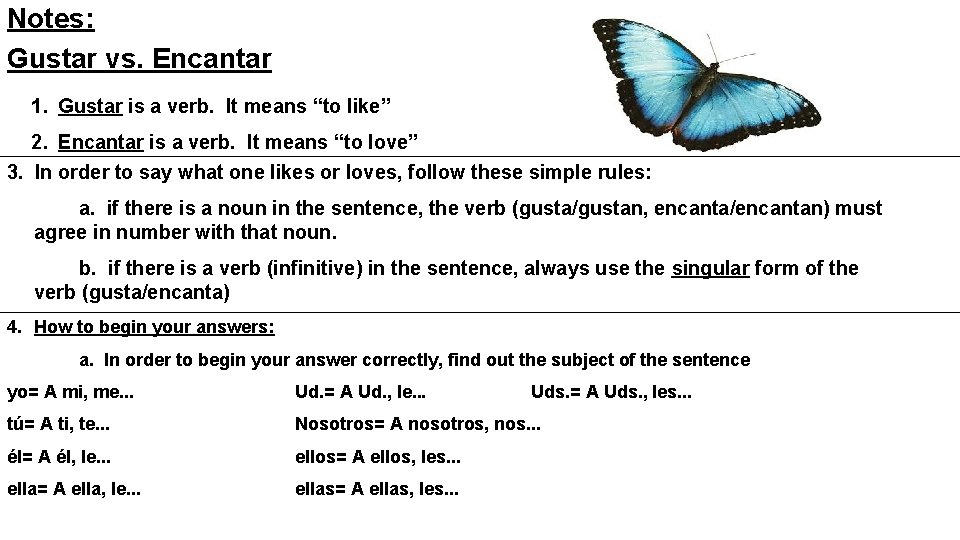
Notes: Gustar vs. Encantar 1. Gustar is a verb. It means “to like” 2. Encantar is a verb. It means “to love” 3. In order to say what one likes or loves, follow these simple rules: a. if there is a noun in the sentence, the verb (gusta/gustan, encanta/encantan) must agree in number with that noun. b. if there is a verb (infinitive) in the sentence, always use the singular form of the verb (gusta/encanta) 4. How to begin your answers: a. In order to begin your answer correctly, find out the subject of the sentence yo= A mi, me. . . Ud. = A Ud. , le. . . Uds. = A Uds. , les. . . tú= A ti, te. . . Nosotros= A nosotros, nos. . . él= A él, le. . . ellos= A ellos, les. . . ella= A ella, le. . . ellas= A ellas, les. . .
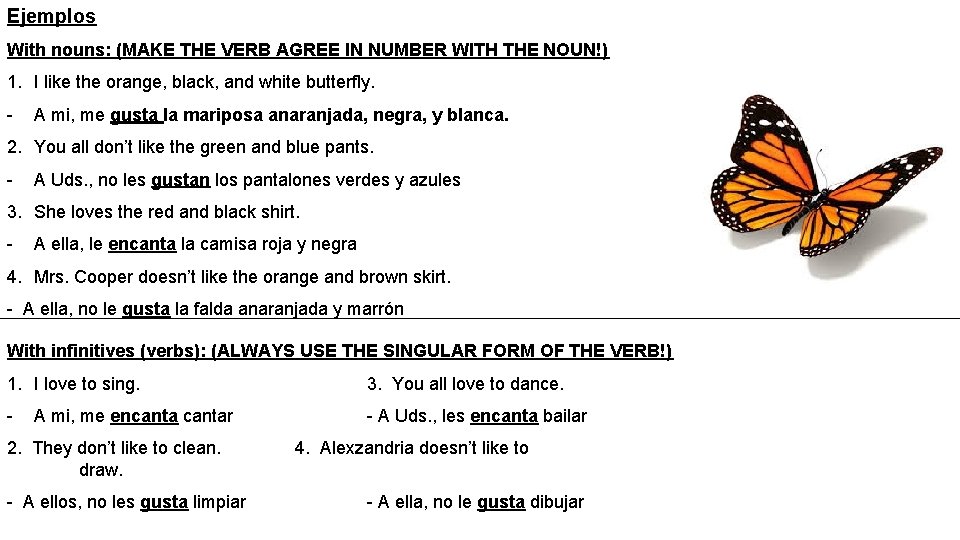
Ejemplos With nouns: (MAKE THE VERB AGREE IN NUMBER WITH THE NOUN!) 1. I like the orange, black, and white butterfly. - A mi, me gusta la mariposa anaranjada, negra, y blanca. 2. You all don’t like the green and blue pants. - A Uds. , no les gustan los pantalones verdes y azules 3. She loves the red and black shirt. - A ella, le encanta la camisa roja y negra 4. Mrs. Cooper doesn’t like the orange and brown skirt. - A ella, no le gusta la falda anaranjada y marrón With infinitives (verbs): (ALWAYS USE THE SINGULAR FORM OF THE VERB!) 1. I love to sing. 3. You all love to dance. - - A Uds. , les encanta bailar A mi, me encantar 2. They don’t like to clean. draw. - A ellos, no les gusta limpiar 4. Alexzandria doesn’t like to - A ella, no le gusta dibujar
ESPAÑOL 2 HORA 6
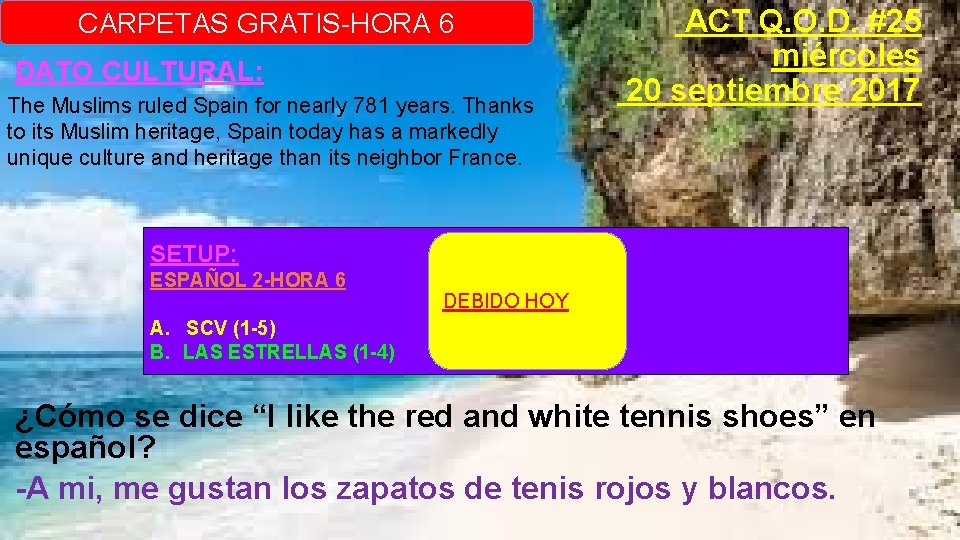
CARPETAS GRATIS-HORA 6 DATO CULTURAL: The Muslims ruled Spain for nearly 781 years. Thanks to its Muslim heritage, Spain today has a markedly unique culture and heritage than its neighbor France. ACT Q. O. D. #25 miércoles 20 septiembre 2017 SETUP: ESPAÑOL 2 -HORA 6 DEBIDO HOY A. SCV (1 -5) B. LAS ESTRELLAS (1 -4) ¿Cómo se dice “I like the red and white tennis shoes” en español? -A mi, me gustan los zapatos de tenis rojos y blancos.
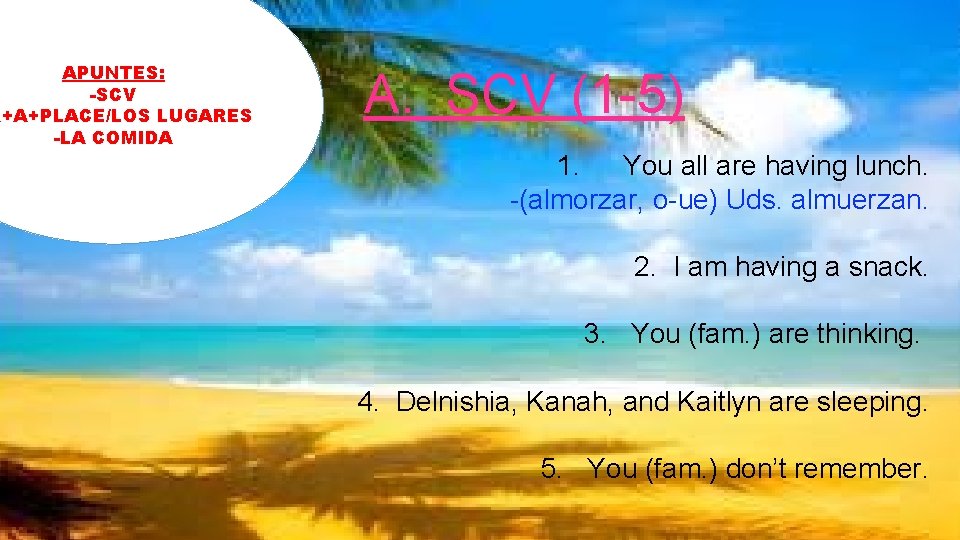
APUNTES: -SCV R+A+PLACE/LOS LUGARES -LA COMIDA A. SCV (1 -5) 1. You all are having lunch. -(almorzar, o-ue) Uds. almuerzan. 2. I am having a snack. 3. You (fam. ) are thinking. 4. Delnishia, Kanah, and Kaitlyn are sleeping. 5. You (fam. ) don’t remember.
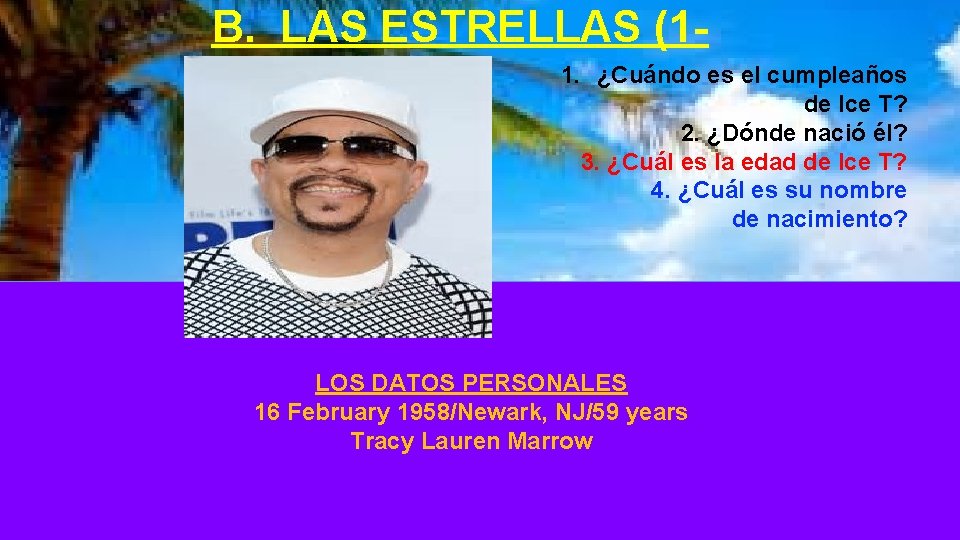
B. LAS ESTRELLAS (11. ¿Cuándo es el cumpleaños 4) de Ice T? 2. ¿Dónde nació él? 3. ¿Cuál es la edad de Ice T? 4. ¿Cuál es su nombre de nacimiento? LOS DATOS PERSONALES 16 February 1958/Newark, NJ/59 years Tracy Lauren Marrow
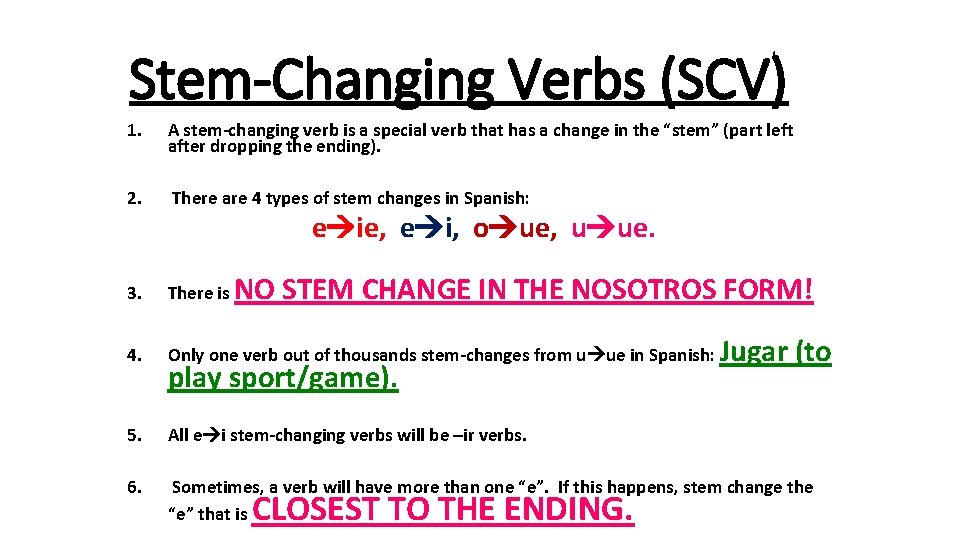
Stem-Changing Verbs (SCV) 1. A stem-changing verb is a special verb that has a change in the “stem” (part left after dropping the ending). 2. There are 4 types of stem changes in Spanish: 3. There is 4. Only one verb out of thousands stem-changes from u ue in Spanish: 5. All e i stem-changing verbs will be –ir verbs. 6. Sometimes, a verb will have more than one “e”. If this happens, stem change the “e” that is e ie, e i, o ue, u ue. NO STEM CHANGE IN THE NOSOTROS FORM! play sport/game). CLOSEST TO THE ENDING. Jugar (to
Stem-Changing Verbs (LIST 1) o ue 1. almorzar- to eat lunch 2. contar- to count/tell a story 3. mover- to move 4. dormir- to sleep 5. morir- to die 6. mostrar- to show 7. costar- to cost 8. recordar- to remember 9. volver- to return (place) 10. devolver- to return (item) 11. rogar- to pray 12. encontrar- to find 13. soñar- to dream 14. volar- to fly 15. resolver- to resolve 16. apostar- to bet 17. demonstrar- to demonstrate 18. doler- to hurt/ache 19. llover- to rain 20. probar- to test/try/taste 21. remover- to remove 22. poder- to be able/can
Stem-Changing Verbs (LIST 1) e ie 1. 2. 3. 4. 5. 6. 7. 8. 9. 10. 11. 12. cerrar- to close entender- to understand mentir- to lie encender- to ignite/turn on advertir- to warn fregar- to mop comenzar- to start/begin empezar- to start/begin confesar- to confess pensar- to think perder- to lose preferir- to prefer 13. arrepentir- to regret/be sorry 14. heder- to stink 15. mentar- to mention 16. merender- to have a snack 17. negar- to deny 18. querer- to want/love 19. recomendar- to recommend 20. nevar- to snow
Stem-Changing Verbs (LIST 1) e i 1. repetir- to repeat 2. pedir- to ask for/order/request 3. medir- to measure 4. reír- to laugh 5. sonreír- to smile 6. seguir- to follow 7. servir- to serve 8. vestir- to dress 9. competir- to compete 10. despedir- to say goodbye
Stem-Changing Verbs (LIST 1) u ue 1. jugar- to play (sport/game)
Ejemplos- SCV (Present Tense) An L. Ford Production © 2015 q. In order to correctly conjugate stem-changing verbs, use the REGULAR PRESENT TENSE ENDINGS; NOT THE PRESENT PROGRESSIVE ENDINGS. q. Do NOT put "es"/"son" in these answers. The "is" and the "are" are INCLUDED in the conjugated verb. q. When a sentence has 2 verbs, you CANNOT conjugate both verbs if they are side by side. The first verb will conjugate, the second verb remains in the infinitive. (Ejs. 1 & 3) q. Anytime the word "to" is in front of a verb, it should remain in the infinitive. (Ejs. 1 & 3) *****DO NOT STEM-CHANGE IN THE NOSOTROS FORM!!!***** ______________________________________ 1. You all are able to swim. -(poder, o-ue)- Uds. pueden nadar. *HOW/WHY? - I have 2 verbs; to be able and to swim. I CANNOT conjugate both verbs because they are side by side with nothing separating them. Also, the word "to" is in front of the verb swim, so this tells me to leave it in the infinitive. My ending is –en, because poder is an –er verb, and the subject is Uds. 2. She is repeating the answer. -(repetir, e-i)- Ella repite. *HOW/WHY? - I conjugated the verb to repeat in the she form of the present tense. I DO NOT have a word for "is"; it is included in the conjugated verb. If you put a word for "is" it will be wrong. My ending is –e, because repetir is an –ir verb, and the subject is ella.
Ejemplos- SCV-(Present Tense) An L. Ford Production © 2015 q. In order to correctly conjugate stem-changing verbs, use the REGULAR PRESENT TENSE ENDINGS; NOT THE PRESENT PROGRESSIVE ENDINGS. q. Do NOT put "es"/"son" in these answers. The "is" and the "are" are INCLUDED in the conjugated verb. q. When a sentence has 2 verbs, you CANNOT conjugate both verbs if they are side by side. The first verb will conjugate, the second verb remains in the infinitive. (Ejs. 1 & 3) q. Anytime the word "to" is in front of a verb, it should remain in the infinitive. (Ejs. 1 & 3) *****DO NOT STEM-CHANGE IN THE NOSOTROS FORM!!!***** __________________________________ 3. I don't want to go to the movies tonight. (querer, e-ie)- Yo no quiero ir al cine esta noche. *HOW/WHY? - I conjugated the verb querer (to want/to love) into the "yo" form of the present tense. I have another verb in this sentence (to go). I left "ir" in the infinitive for 2 reasons. (1) I CANNOT conjugate 2 verbs side by side, (2) it says "to go". ANYTIME "to" is in front of a verb, it must remain in the infinitive! My ending is –o, because querer is an –er verb, and the subject is "yo". 4. Father and you are measuring the wall. -(medir, e-i)- Uds. miden la pared. *HOW/WHY? - I conjugated the verb medir (to measure) into the "Uds. " form of the present tense.
Ejemplos- SCV-(Present Tense) An L. Ford Production © 2015 q. In order to correctly conjugate stem-changing verbs, use the REGULAR PRESENT TENSE ENDINGS; NOT THE PRESENT PROGRESSIVE ENDINGS. q. Do NOT put "es"/"son" in these answers. The "is" and the "are" are INCLUDED in the conjugated verb. q. When a sentence has 2 verbs, you CANNOT conjugate both verbs if they are side by side. The first verb will conjugate, the second verb remains in the infinitive. (Ejs. 1 & 3) q. Anytime the word "to" is in front of a verb, it should remain in the infinitive. (Ejs. 1 & 3) *****DO NOT STEM-CHANGE IN THE NOSOTROS FORM!!!***** _____________________________________ 5. We are eating lunch in the cafeteria. -(almorzar, o-ue)- Nosotros almorzamos en la cafetería. *HOW/WHY? - I DID NOT do a stem-change on this verb. Why? NO STEM-CHANGES IN THE NOSOTROS FORM!!!!! My ending is –amos, because almorzar is an –ar verb, and the subject is nosotros. 6. You (fs) are having a snack in the kitchen. -(merender, e-ie)- Ud. meriende en la cocina. *HOW/WHY? - I conjugated the verb merender into the Ud. form of the present tense. You