
Homecoming Bruce Dawe About the Poem It is
Homecoming Bruce Dawe

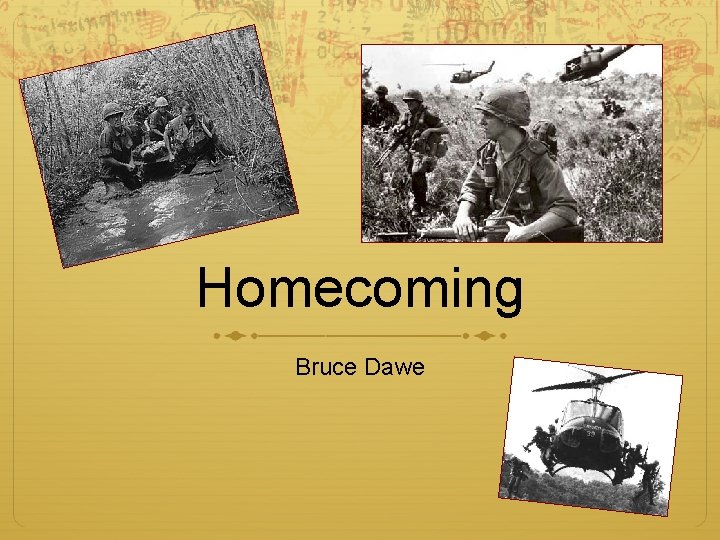
About the Poem It is an anti-war poem written about the Vietnam War. The poem describes the process of collecting and processing the dead from a war and shipping them home. It tells the story of soldiers coming home from war dead.
Dawe’s Stance on War Based on his own reading and reflection, Dawe was opposed to the Vietnam war, believing it to be lacking sense historically. He thought it was futile and the many deaths were pointless.
‘Homecoming’ as an Anti. War Poem Although "Homecoming" makes reference to Vietnam numerous times, it is not an ‘anti-Vietnam’ poem, but an opposition to the whole business of war generally, to the dangers of beliefs and views presented by war reporting.
Structure Despite being created in the form of a single sentence, the poem can be easily divided into three parts: The collection of bodies in Vietnam. (lines 1 -8) The flight home. (lines 9 -16) The arrival in Australia. (lines 17 -26)
Elegy In literature, an elegy is a mournful, melancholic or sorrowful poem. ‘Homecoming’ is in the form of an elegy, and its tone also follows this form.
About the Title The title is an example of irony in this text, as what is being spoken about is the return of dead soldiers to their families. Homecoming traditionally has connotations of happiness and a heroes welcome, neither of which are present here.
Activities 1. Underline all of the examples of repetition in the poem (remember repetition could be a repeated word, phrase or ideas) 2. Circle the examples of similes 3. Highlight or colour the examples of visual imagery 4. Explain the meaning of the last line “they’re bringing them home, now, too late, too early”
Key Vocab Notes Techniques
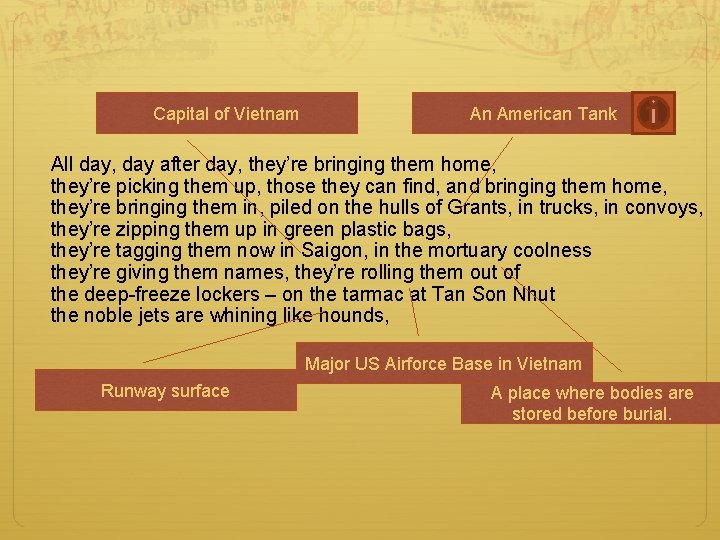
Capital of Vietnam An American Tank All day, day after day, they’re bringing them home, they’re picking them up, those they can find, and bringing them home, they’re bringing them in, piled on the hulls of Grants, in trucks, in convoys, they’re zipping them up in green plastic bags, they’re tagging them now in Saigon, in the mortuary coolness they’re giving them names, they’re rolling them out of the deep-freeze lockers – on the tarmac at Tan Son Nhut the noble jets are whining like hounds, Major US Airforce Base in Vietnam Runway surface A place where bodies are stored before burial.
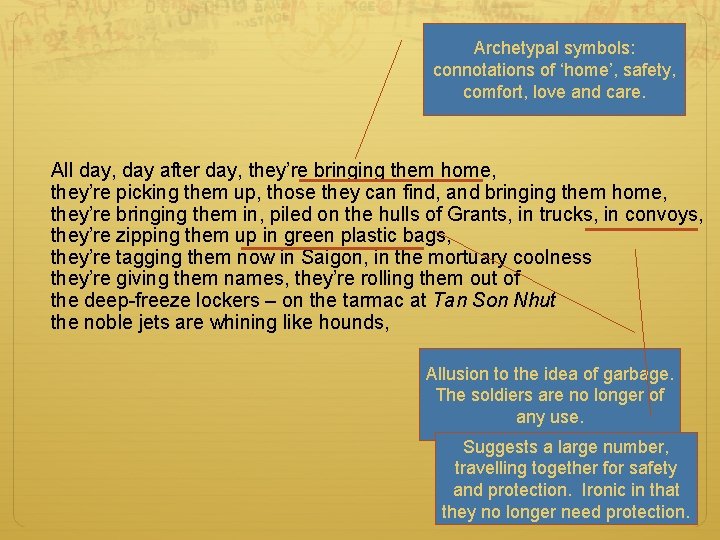
Archetypal symbols: connotations of ‘home’, safety, comfort, love and care. All day, day after day, they’re bringing them home, they’re picking them up, those they can find, and bringing them home, they’re bringing them in, piled on the hulls of Grants, in trucks, in convoys, they’re zipping them up in green plastic bags, they’re tagging them now in Saigon, in the mortuary coolness they’re giving them names, they’re rolling them out of the deep-freeze lockers – on the tarmac at Tan Son Nhut the noble jets are whining like hounds, Allusion to the idea of garbage. The soldiers are no longer of any use. Suggests a large number, travelling together for safety and protection. Ironic in that they no longer need protection.
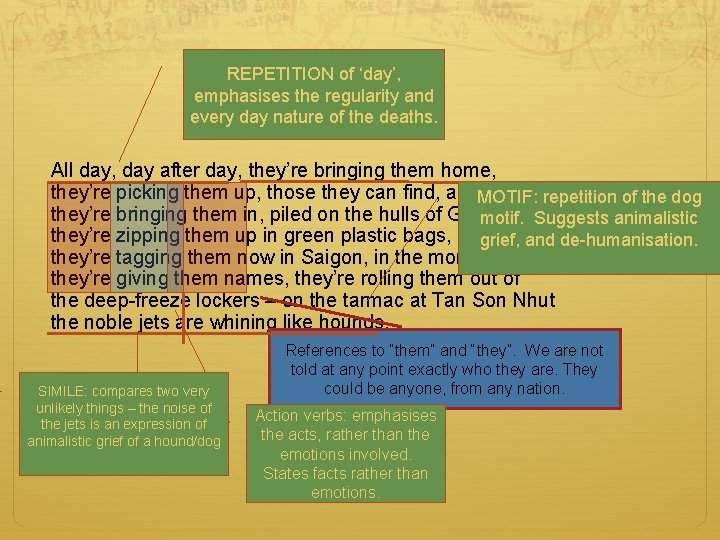
REPETITION of ‘day’, emphasises the regularity and every day nature of the deaths. All day, day after day, they’re bringing them home, they’re picking them up, those they can find, and bringing them home, MOTIF: repetition of the dog they’re bringing them in, piled on the hulls of Grants, in trucks, in convoys, motif. Suggests animalistic they’re zipping them up in green plastic bags, grief, and de-humanisation. they’re tagging them now in Saigon, in the mortuary coolness they’re giving them names, they’re rolling them out of the deep-freeze lockers – on the tarmac at Tan Son Nhut the noble jets are whining like hounds, SIMILE: compares two very unlikely things – the noise of the jets is an expression of animalistic grief of a hound/dog References to “them” and “they”. We are not told at any point exactly who they are. They could be anyone, from any nation. Action verbs: emphasises the acts, rather than the emotions involved. States facts rather than emotions.
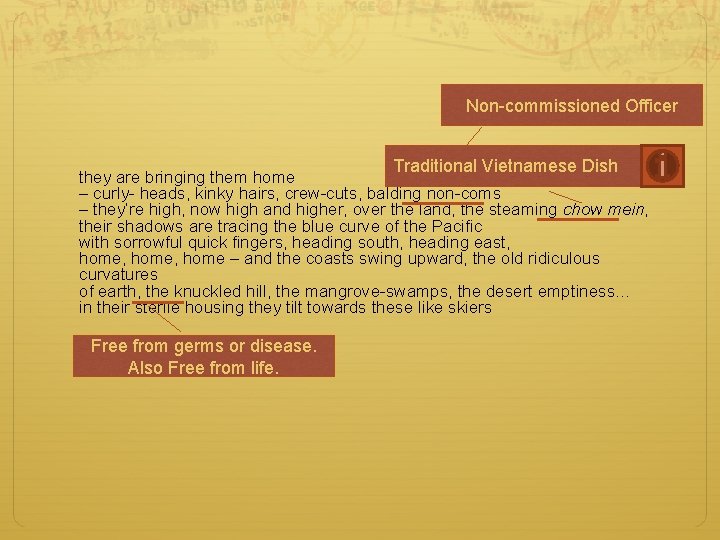
Non-commissioned Officer Traditional Vietnamese Dish they are bringing them home – curly- heads, kinky hairs, crew-cuts, balding non-coms – they’re high, now high and higher, over the land, the steaming chow mein, their shadows are tracing the blue curve of the Pacific with sorrowful quick fingers, heading south, heading east, home, home – and the coasts swing upward, the old ridiculous curvatures of earth, the knuckled hill, the mangrove-swamps, the desert emptiness… in their sterile housing they tilt towards these like skiers Free from germs or disease. Also Free from life.

Listing shows the never-ending nature of death during war. The different types of soldiers are also addressed here, the conscripts, the paid soldiers, and the officers – no one is immune. They’re rising in the planes that are carrying their bodies home, however, they can also be seen to be rising to heaven. they are bringing them home – curly- heads, kinky hairs, crew-cuts, balding non-coms – they’re high, now high and higher, over the land, the steaming chow mein, their shadows are tracing the blue curve of the Pacific with sorrowful quick fingers, heading south, heading east, home, home – and the coasts swing upward, the old ridiculous curvatures of earth, the knuckled hill, the mangrove-swamps, the desert emptiness… in their sterile housing they tilt towards these like skiers Listing again, this time of what could be seen out the window of the plane. Dawe tries to emulate the excitement of men returning home, however this is not an experience had by these men, who can never see their homeland again.
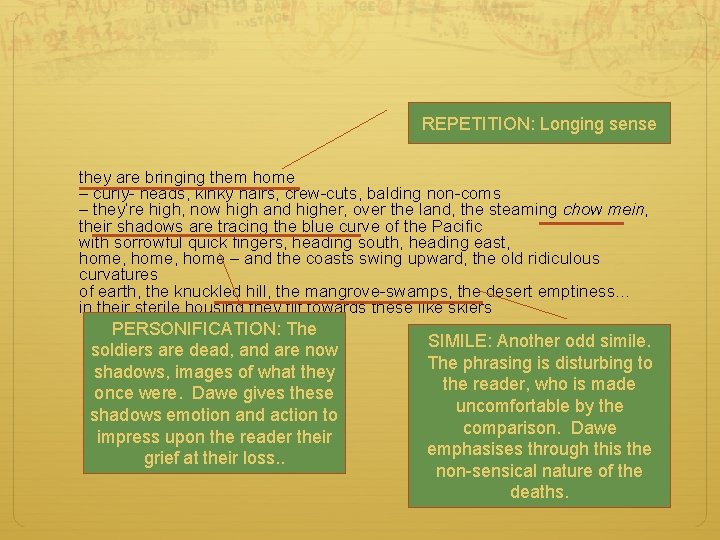
REPETITION: Longing sense they are bringing them home – curly- heads, kinky hairs, crew-cuts, balding non-coms – they’re high, now high and higher, over the land, the steaming chow mein, their shadows are tracing the blue curve of the Pacific with sorrowful quick fingers, heading south, heading east, home, home – and the coasts swing upward, the old ridiculous curvatures of earth, the knuckled hill, the mangrove-swamps, the desert emptiness… in their sterile housing they tilt towards these like skiers PERSONIFICATION: The soldiers are dead, and are now shadows, images of what they once were. Dawe gives these shadows emotion and action to impress upon the reader their grief at their loss. . SIMILE: Another odd simile. The phrasing is disturbing to the reader, who is made uncomfortable by the comparison. Dawe emphasises through this the non-sensical nature of the deaths.

Magnificence – taxiing in, on the long runways, the howl of their homecoming rises surrounding them like their last moments (the mash, the splendour) then fading at length as they move on to small towns where dogs in the frozen sunset raise muzzles in mute salute, and on to cities in whose wide web of suburbs telegrams tremble like leaves from a wintering tree and the spider grief swings in his bitter geometry – they’re bringing them home, now, too late, too early. The forward, projecting part of a dog’s head. Silent.

Solemnity of the occasion is Traditionally this would be a howl of emphasised. Usually dogs would bark delight, a celebration of their return in a or howl, but they, like the rest of the tickertape parade, but here it is one of world, are solemn and silent due to grief. these events. – taxiing in, on the long runways, the howl of their homecoming rises surrounding them like their last moments (the mash, the splendour) then fading at length as they move on to small towns where dogs in the frozen sunset raise muzzles in mute salute, and on to cities in whose wide web of suburbs telegrams tremble like leaves from a wintering tree and the spider grief swings in his bitter geometry – they’re bringing them home, now, too late, too early. Very visual description of the connections between the deaths and their effects on the people left behind. The concept of a spiders web is mentioned twice: References the spider-web, the tangle and the impact upon everyone. Draws images of a map, and connections between all those who have lost someone.
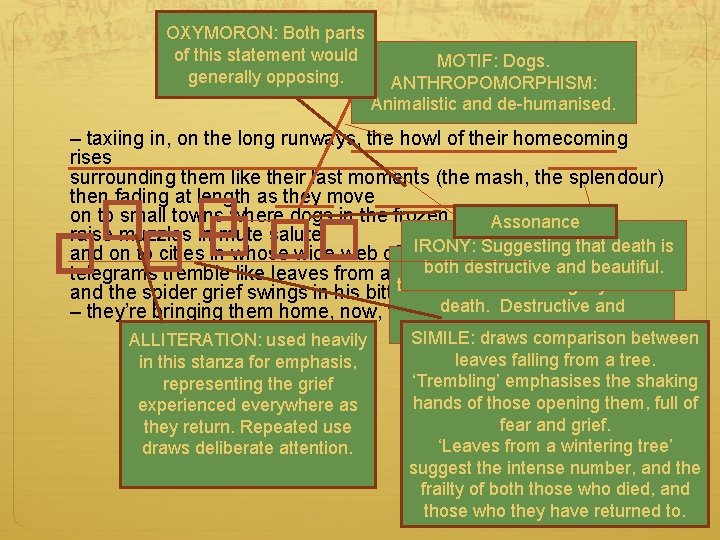
OXYMORON: Both parts of this statement would generally opposing. MOTIF: Dogs. ANTHROPOMORPHISM: Animalistic and de-humanised. – taxiing in, on the long runways, the howl of their homecoming rises surrounding them like their last moments (the mash, the splendour) then fading at length as they move on to small towns where dogs in the frozen sunset Assonance raise muzzles in mute salute, IRONY: Suggesting that death is and on to cities in whose wide web of suburbs SIMILE: compares the agony at both destructive and beautiful. telegrams tremble like leaves from a wintering tree their arrival with the agony at their and the spider grief swings in his bitter geometry death. Destructive and – they’re bringing them home, now, too late, too early. ALLITERATION: used heavily in this stanza for emphasis, representing the grief experienced everywhere as they return. Repeated use draws deliberate attention. inescapable. SIMILE: draws comparison between leaves falling from a tree. ‘Trembling’ emphasises the shaking hands of those opening them, full of fear and grief. ‘Leaves from a wintering tree’ suggest the intense number, and the frailty of both those who died, and those who they have returned to.
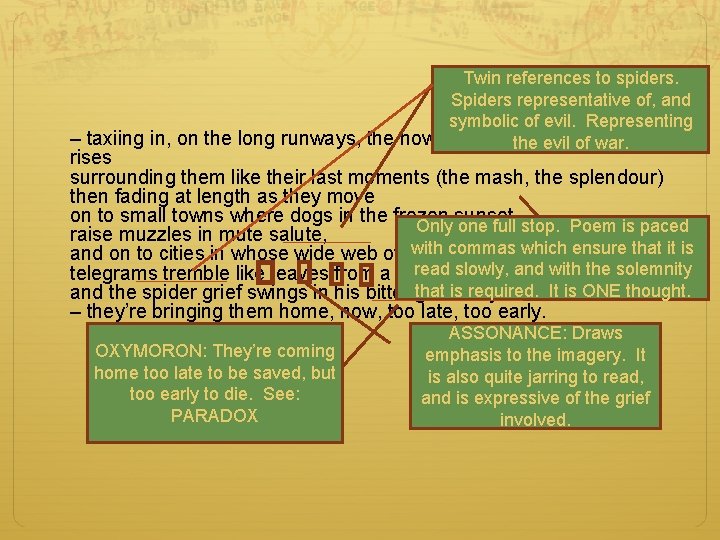
Twin references to spiders. Spiders representative of, and symbolic of evil. Representing – taxiing in, on the long runways, the howl of their homecoming the evil of war. rises surrounding them like their last moments (the mash, the splendour) then fading at length as they move on to small towns where dogs in the frozen sunset Only one full stop. Poem is paced raise muzzles in mute salute, with commas which ensure that it is and on to cities in whose wide web of suburbs read slowly, and with the solemnity telegrams tremble like leaves from a wintering tree that is required. It is ONE thought. and the spider grief swings in his bitter geometry – they’re bringing them home, now, too late, too early. OXYMORON: They’re coming home too late to be saved, but too early to die. See: PARADOX ASSONANCE: Draws emphasis to the imagery. It is also quite jarring to read, and is expressive of the grief involved.
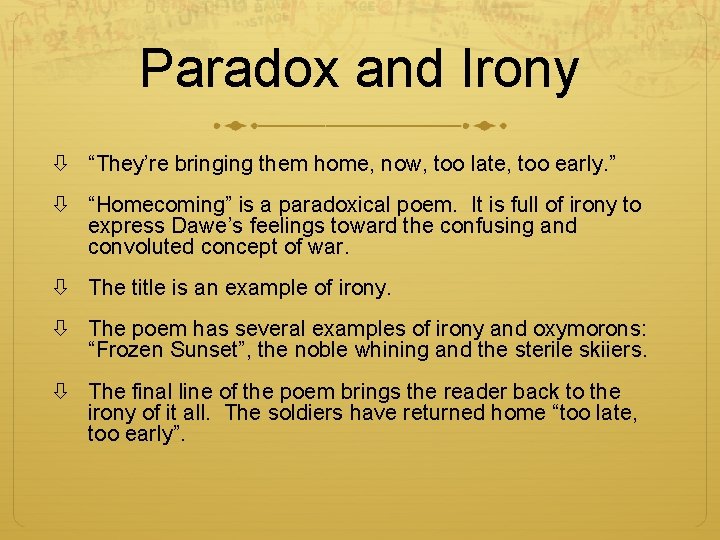
Paradox and Irony “They’re bringing them home, now, too late, too early. ” “Homecoming” is a paradoxical poem. It is full of irony to express Dawe’s feelings toward the confusing and convoluted concept of war. The title is an example of irony. The poem has several examples of irony and oxymorons: “Frozen Sunset”, the noble whining and the sterile skiiers. The final line of the poem brings the reader back to the irony of it all. The soldiers have returned home “too late, too early”.
Themes What are they?
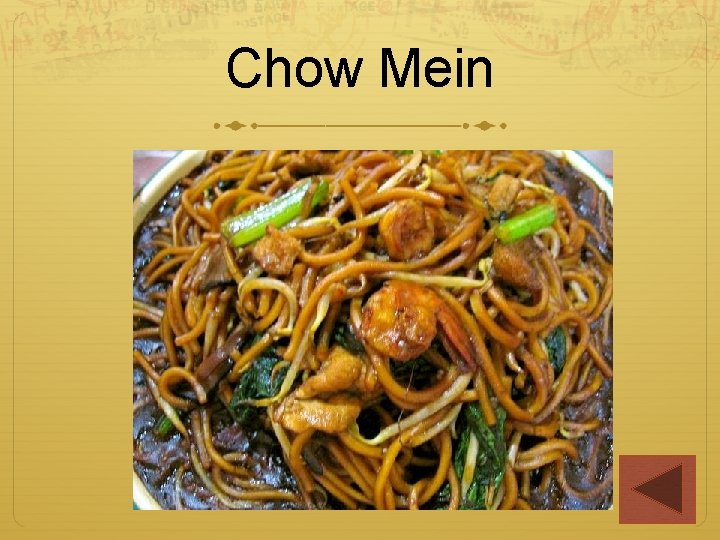
Chow Mein
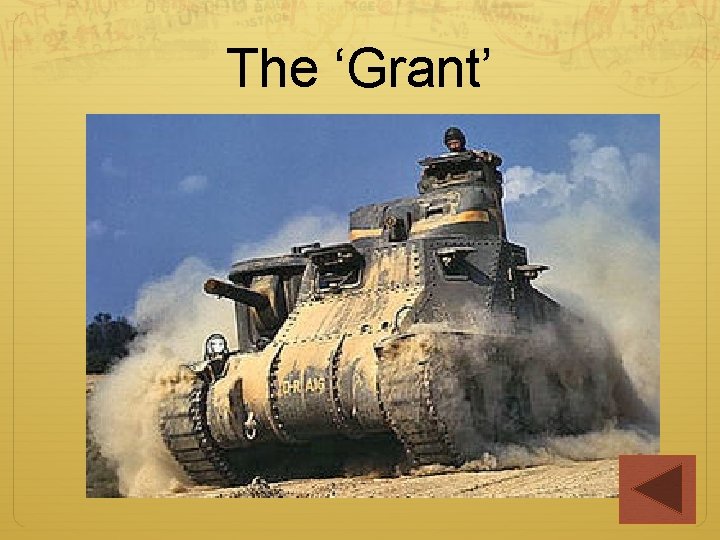
The ‘Grant’
- Slides: 23