Gene Interactions Marie ern Lecture No 406 H




- Slides: 39
Gene Interactions Marie Černá Lecture No 406 -H
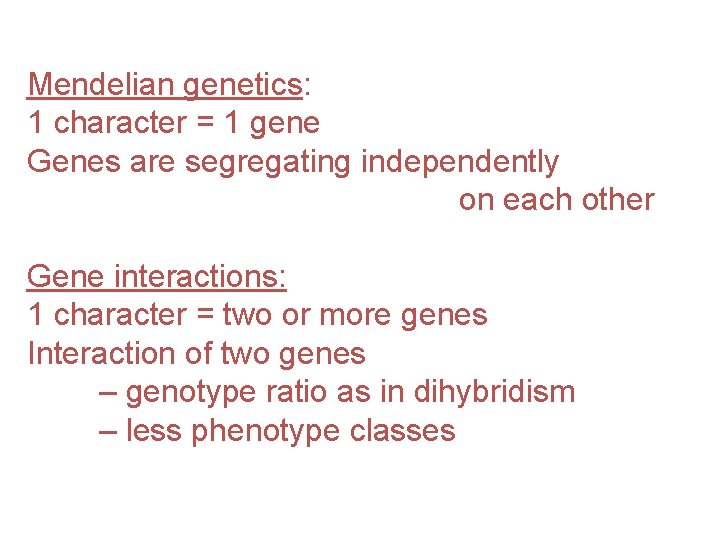
Mendelian genetics: 1 character = 1 gene Genes are segregating independently on each other Gene interactions: 1 character = two or more genes Interaction of two genes – genotype ratio as in dihybridism – less phenotype classes
Gene Interactions • • • Reciprocal interactions Epistasis - dominant and recessive Inhibition Complementarity Multiplicity
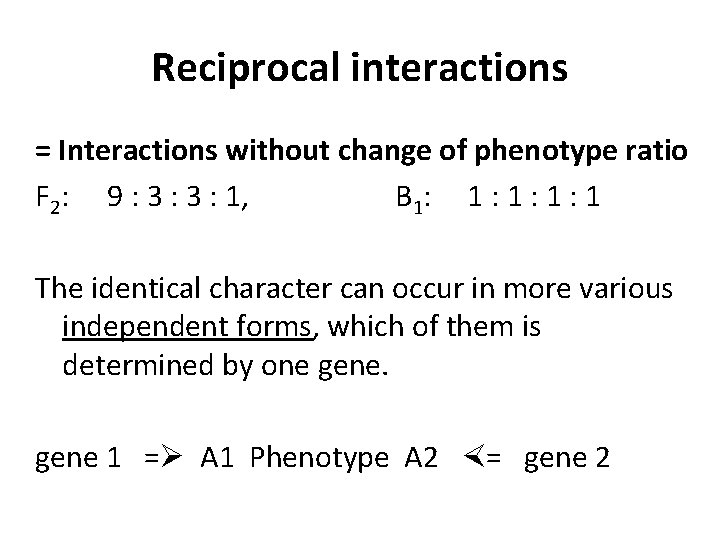
Reciprocal interactions = Interactions without change of phenotype ratio F 2: 9 : 3 : 1, B 1: 1 : 1 The identical character can occur in more various independent forms, which of them is determined by one gene 1 = A 1 Phenotype A 2 = gene 2
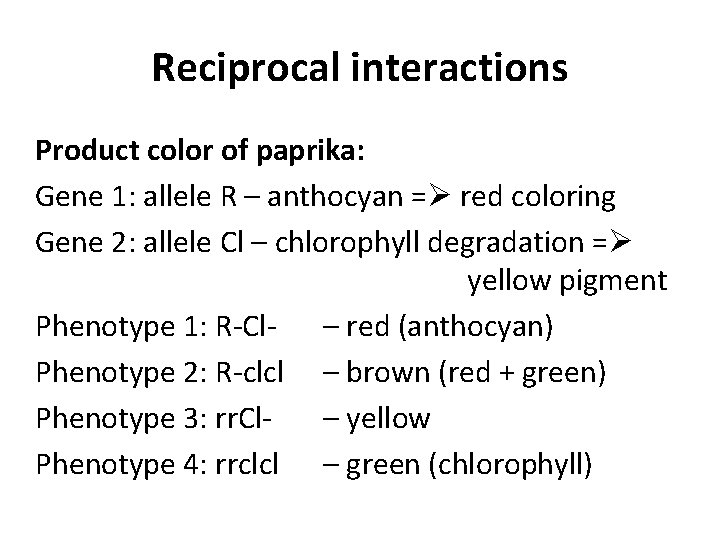
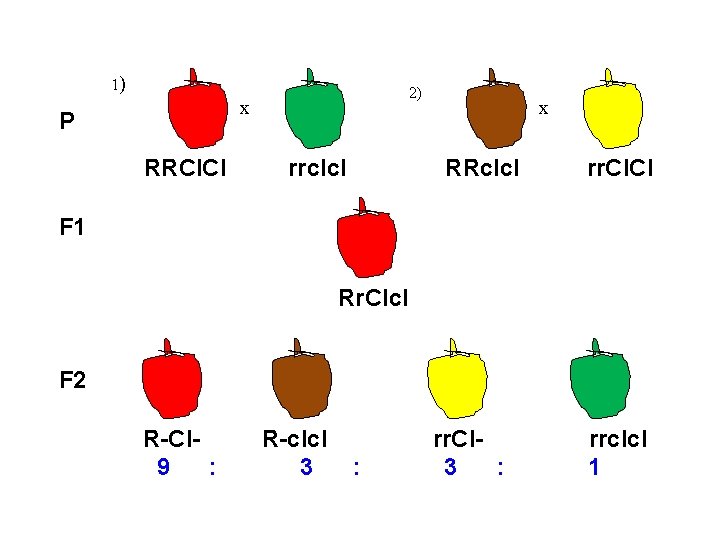
Reciprocal interactions Product color of paprika: Gene 1: allele R – anthocyan = red coloring Gene 2: allele Cl – chlorophyll degradation = yellow pigment Phenotype 1: R-Cl- – red (anthocyan) Phenotype 2: R-clcl – brown (red + green) Phenotype 3: rr. Cl– yellow Phenotype 4: rrclcl – green (chlorophyll)
1) 2) x P RRCl. Cl rrclcl x RRclcl rr. Cl F 1 Rr. Clcl F 2 R-Cl 9 : R-clcl 3 : rr. Cl 3 : rrclcl 1
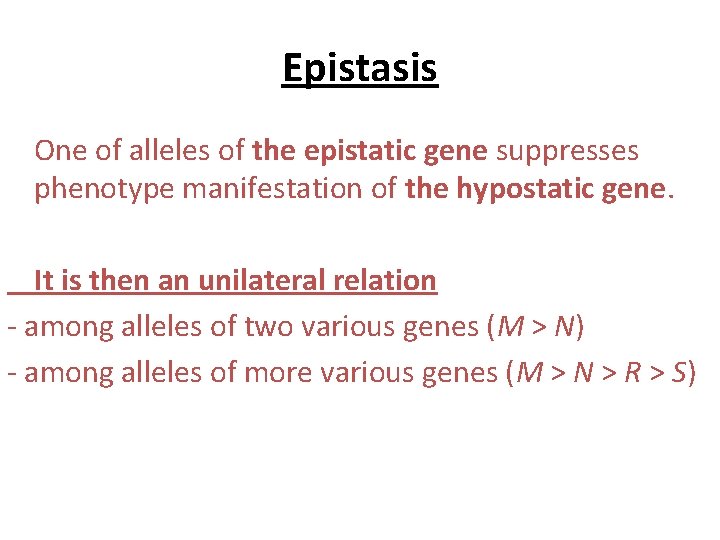
Epistasis One of alleles of the epistatic gene suppresses phenotype manifestation of the hypostatic gene. It is then an unilateral relation - among alleles of two various genes (M > N) - among alleles of more various genes (M > N > R > S)
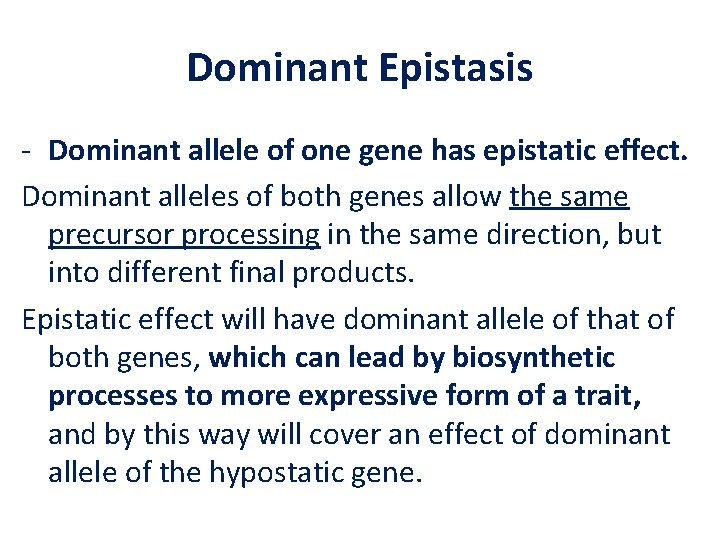
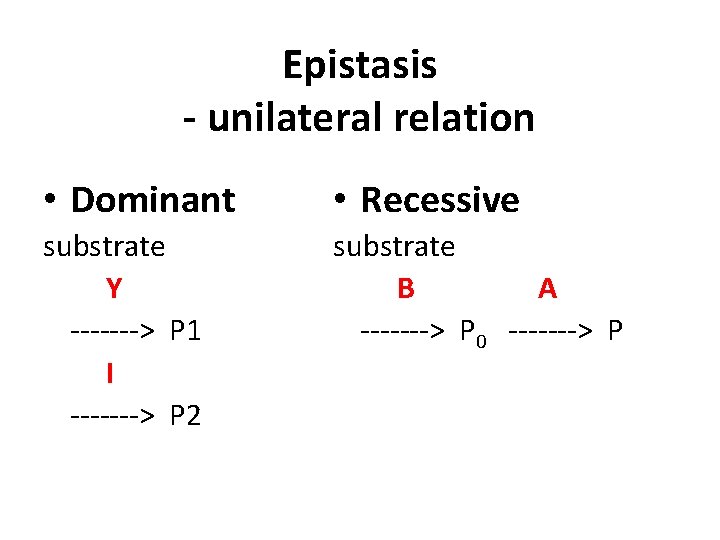
Dominant Epistasis - Dominant allele of one gene has epistatic effect. Dominant alleles of both genes allow the same precursor processing in the same direction, but into different final products. Epistatic effect will have dominant allele of that of both genes, which can lead by biosynthetic processes to more expressive form of a trait, and by this way will cover an effect of dominant allele of the hypostatic gene.
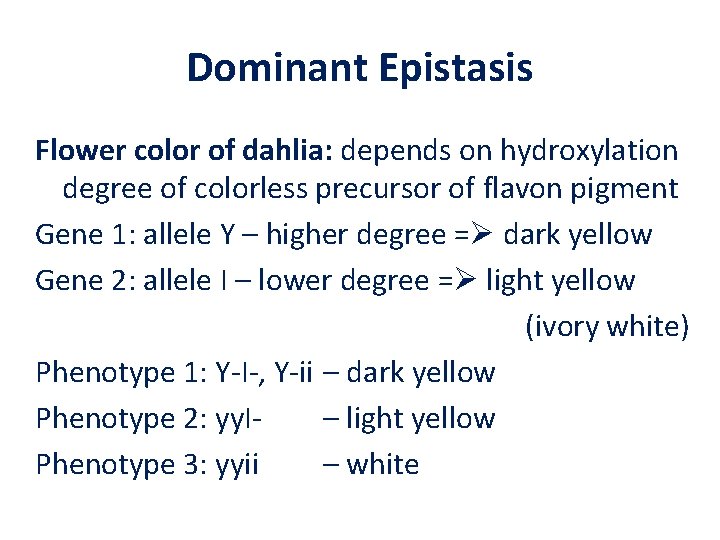
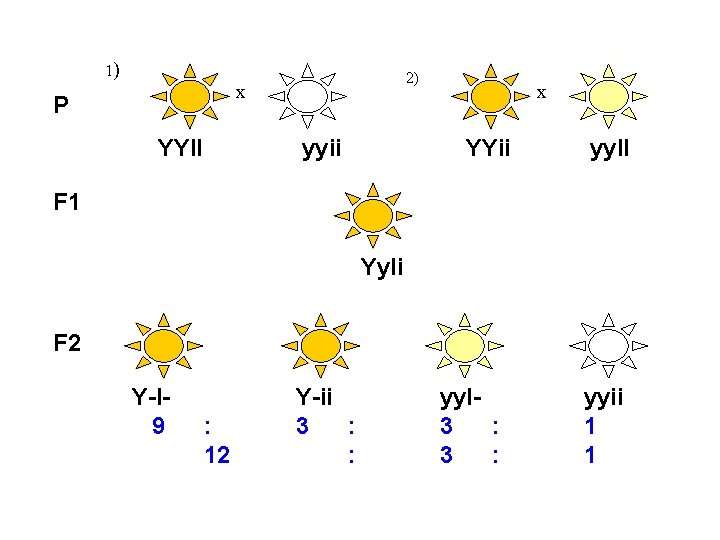
Dominant Epistasis Flower color of dahlia: depends on hydroxylation degree of colorless precursor of flavon pigment Gene 1: allele Y – higher degree = dark yellow Gene 2: allele I – lower degree = light yellow (ivory white) Phenotype 1: Y-I-, Y-ii – dark yellow Phenotype 2: yy. I– light yellow Phenotype 3: yyii – white
1) 2) x P YYII yyii x YYii yy. II F 1 Yy. Ii F 2 Y-I 9 : 12 Y-ii 3 : : yy. I 3 : yyii 1 1
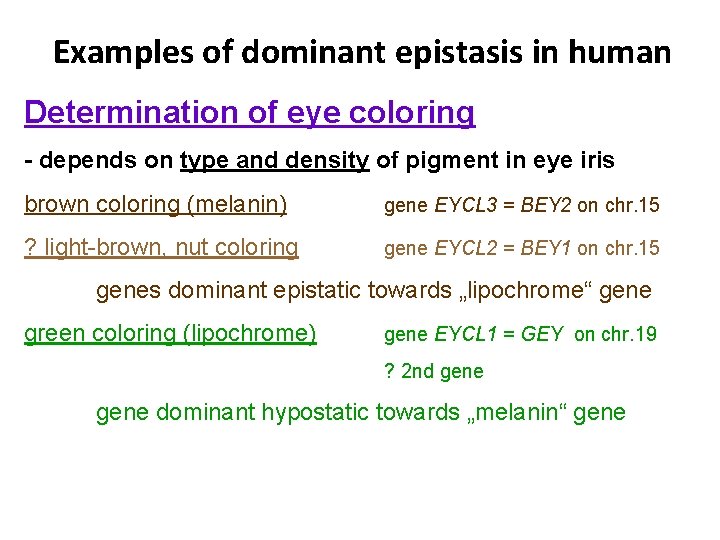
Examples of dominant epistasis in human Determination of eye coloring - depends on type and density of pigment in eye iris brown coloring (melanin) gene EYCL 3 = BEY 2 on chr. 15 ? light-brown, nut coloring gene EYCL 2 = BEY 1 on chr. 15 genes dominant epistatic towards „lipochrome“ gene green coloring (lipochrome) gene EYCL 1 = GEY on chr. 19 ? 2 nd gene dominant hypostatic towards „melanin“ gene
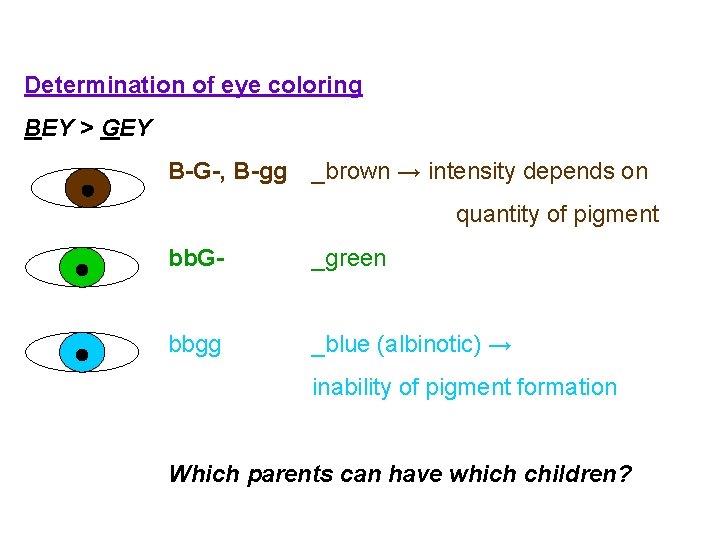
Determination of eye coloring BEY > GEY B-G-, B-gg _brown → intensity depends on quantity of pigment bb. G- _green bbgg _blue (albinotic) → inability of pigment formation Which parents can have which children?
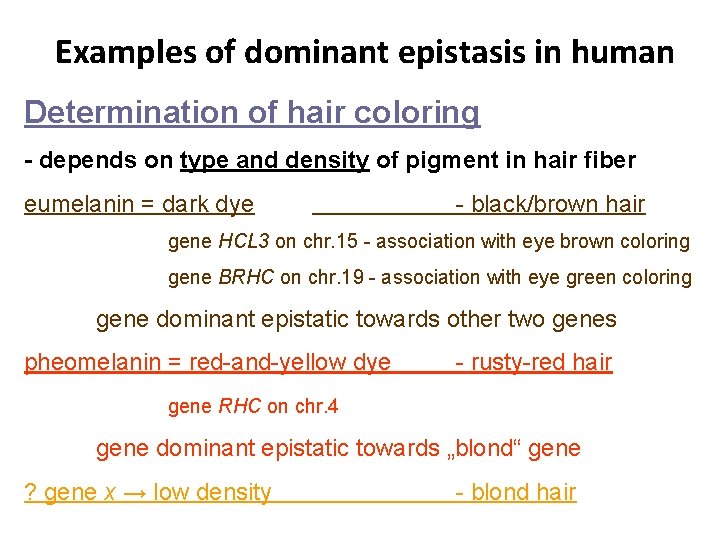
Examples of dominant epistasis in human Determination of hair coloring - depends on type and density of pigment in hair fiber eumelanin = dark dye - black/brown hair gene HCL 3 on chr. 15 - association with eye brown coloring gene BRHC on chr. 19 - association with eye green coloring gene dominant epistatic towards other two genes pheomelanin = red-and-yellow dye - rusty-red hair gene RHC on chr. 4 gene dominant epistatic towards „blond“ gene ? gene x → low density - blond hair
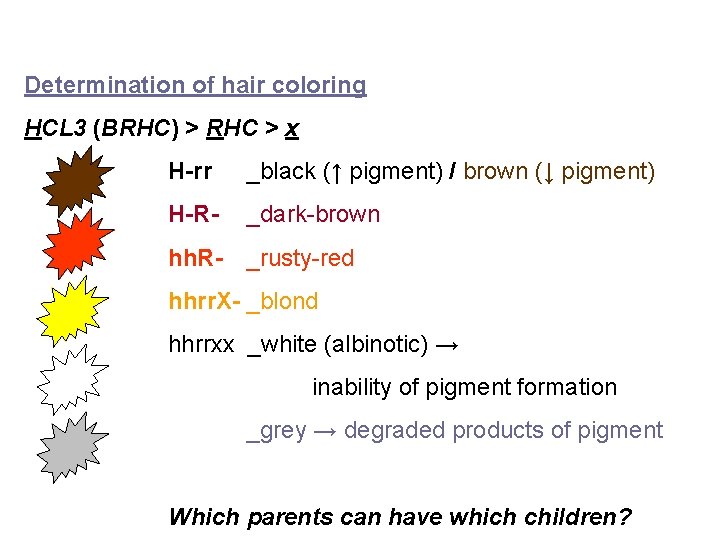
Determination of hair coloring HCL 3 (BRHC) > RHC > x H-rr _black (↑ pigment) / brown (↓ pigment) H-R- _dark-brown hh. R- _rusty-red hhrr. X- _blond hhrrxx _white (albinotic) → inability of pigment formation _grey → degraded products of pigment Which parents can have which children?
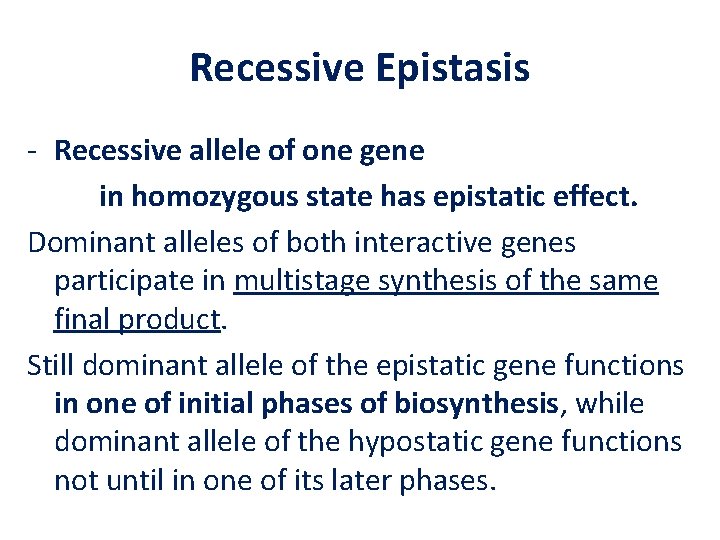
Recessive Epistasis - Recessive allele of one gene in homozygous state has epistatic effect. Dominant alleles of both interactive genes participate in multistage synthesis of the same final product. Still dominant allele of the epistatic gene functions in one of initial phases of biosynthesis, while dominant allele of the hypostatic gene functions not until in one of its later phases.
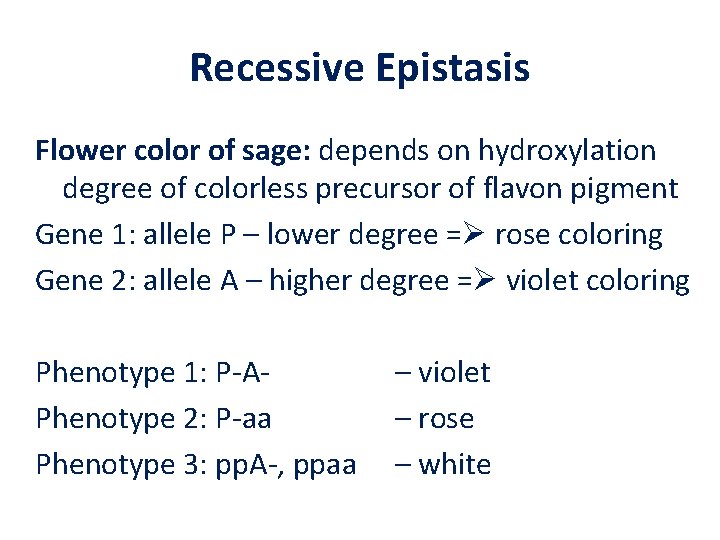
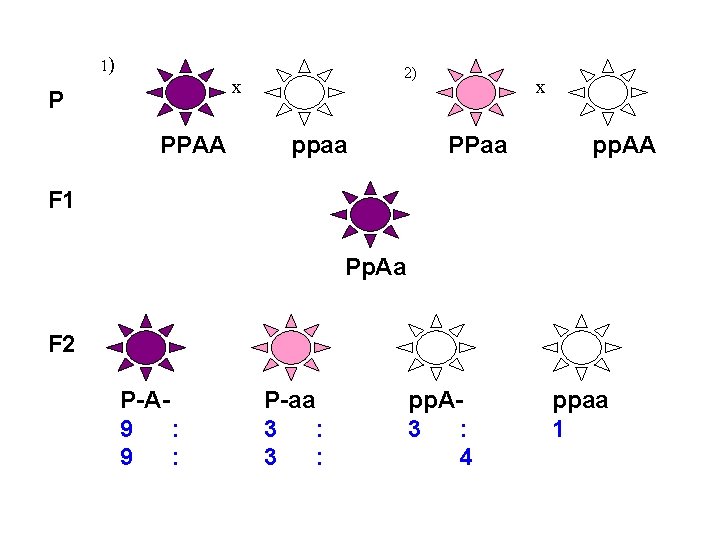
Recessive Epistasis Flower color of sage: depends on hydroxylation degree of colorless precursor of flavon pigment Gene 1: allele P – lower degree = rose coloring Gene 2: allele A – higher degree = violet coloring Phenotype 1: P-APhenotype 2: P-aa Phenotype 3: pp. A-, ppaa – violet – rose – white
1) 2) x P PPAA ppaa x PPaa pp. AA F 1 Pp. Aa F 2 P-A 9 : P-aa 3 : pp. A 3 : 4 ppaa 1
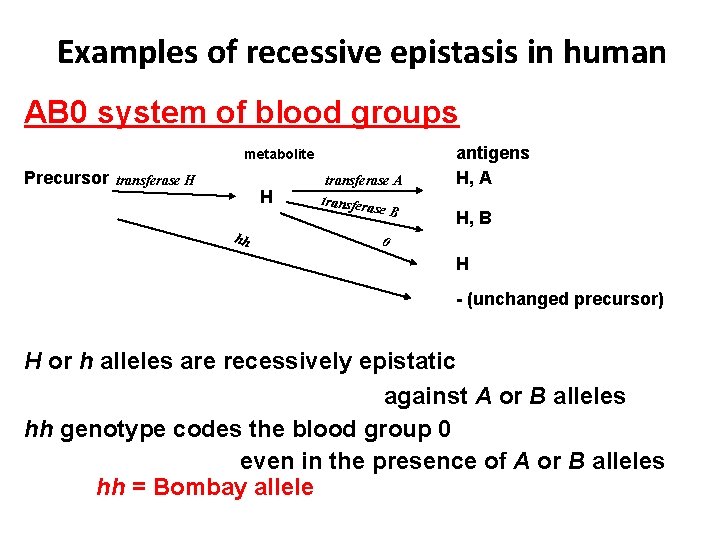
Examples of recessive epistasis in human AB 0 system of blood groups metabolite Precursor transferase H H hh transferase A transfer ase B antigens H, A H, B 0 H - (unchanged precursor) H or h alleles are recessively epistatic against A or B alleles hh genotype codes the blood group 0 even in the presence of A or B alleles hh = Bombay allele
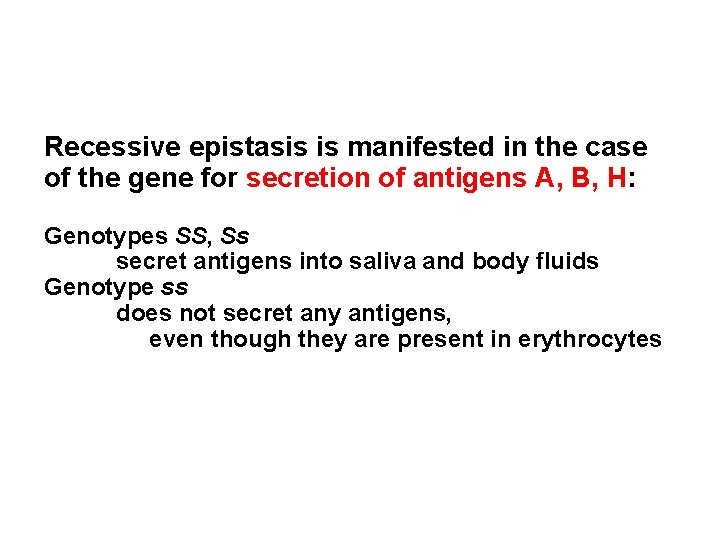
Recessive epistasis is manifested in the case of the gene for secretion of antigens A, B, H: Genotypes SS, Ss secret antigens into saliva and body fluids Genotype ss does not secret any antigens, even though they are present in erythrocytes
Epistasis - unilateral relation • Dominant • Recessive substrate Y -------> P 1 I -------> P 2 substrate B A -------> P 0 -------> P
Inhibition It is certain analogy of dominant epistasis. But, in comparison with it, inhibitive allele I has not another effect on phenotype than ability to suppress an effect of allele A. Feathers color of domestic fowl: Gene 1: allele C = red coloring Gene 2: allele I = inhibits an effect of allele C Phenotype 1: C-I-, ccii – colorless Phenotype 2: C-ii – colored
1) 2) x P CCII ccii x CCii cc. II cc. I 3 : ccii 1 F 1 Cc. Ii F 2 C-I 9 13 : : C-ii 3 3 :
Complementarity and Multiplicity • genes are equal – no subordination • bilateral relation of alleles of interactive genes
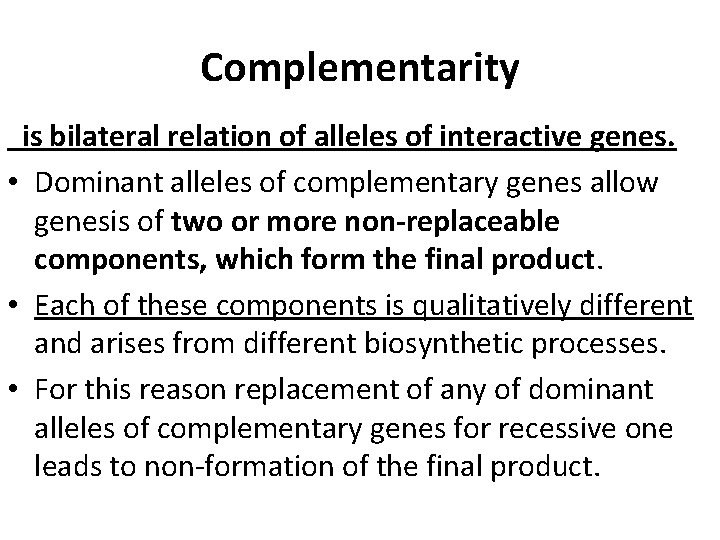
Complementarity is bilateral relation of alleles of interactive genes. • Dominant alleles of complementary genes allow genesis of two or more non-replaceable components, which form the final product. • Each of these components is qualitatively different and arises from different biosynthetic processes. • For this reason replacement of any of dominant alleles of complementary genes for recessive one leads to non-formation of the final product.
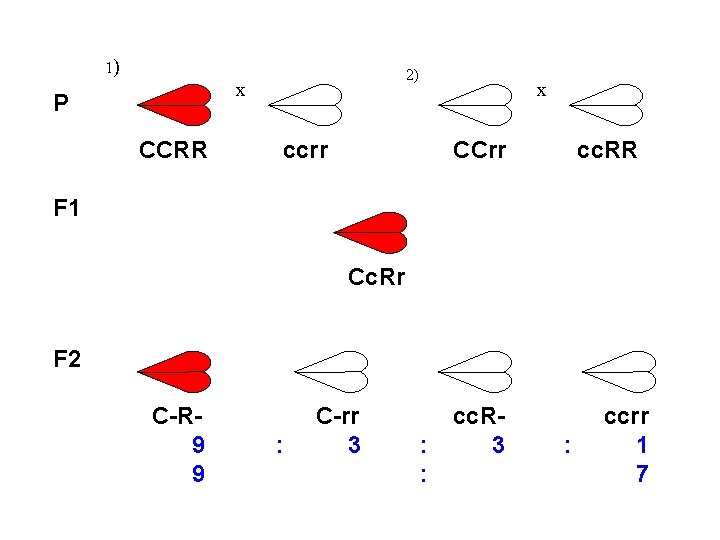
Complementarity Flower color of earthnut pea: Gene 1: allele C – formation of colorless precursor Gene 2: allele R – formation of activation enzyme, which changes the precursor into colored compound Phenotype 1: C-RPhenotype 2: C-rr, cc. R-, ccrr – red (anthocyan) – colorless
1) 2) x P CCRR ccrr x CCrr cc. RR F 1 Cc. Rr F 2 C-R 9 9 : C-rr 3 : : cc. R 3 : ccrr 1 7
Multiplicity is bilateral relation of alleles of interactive genes, but in comparison with complementarity, each single dominant allele of any of these genes, even in itself, is sufficient for expression of a corresponding trait. To this effect these single dominant alleles are identical. These alleles are responsible for biosynthesis of identical final products, but by qualitatively different ways.
Multiplicity • Noncumulative – full expression of a corresponding trait is caused by single dominant allele of given multiplicative rank and presence of next members of the rank no more changes intensity of phenotype. • Cumulative – intensity of phenotype expression is direct proportionally dependent on number of present dominant members of multiplicative rank.
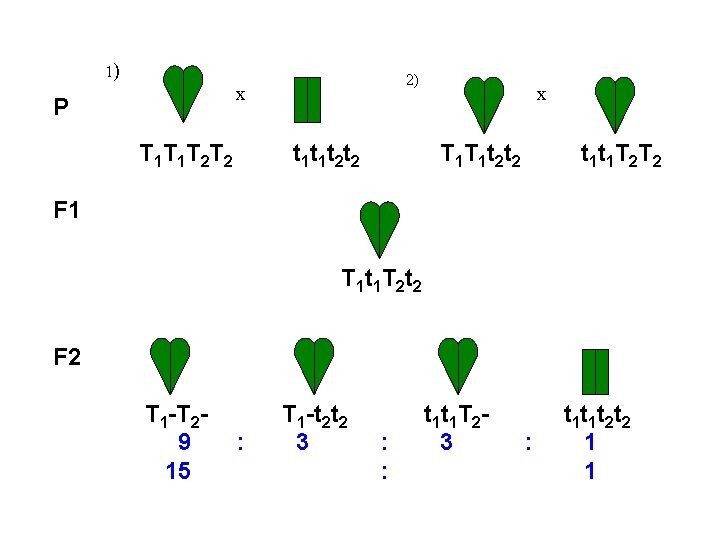
Duplicity noncumulative Siliqua shape of shepherd’s purse: Gene 1: allele T 1 – normal (heart-shaped) Gene 2: allele T 2 – normal (heart-shaped) T 1+T 2 – normal (heart-shaped) Phenotype 1: T 1 -T 2 -, T 1 -t 2 t 2, t 1 t 1 T 2 - – normal Phenotype 2: t 1 t 1 t 2 t 2 – cylindrical
1) 2) x P T 1 T 1 T 2 T 2 t 1 t 2 x T 1 t 2 t 1 T 2 F 1 T 1 t 1 T 2 t 2 F 2 T 1 -T 29 15 : T 1 -t 2 t 2 3 : : t 1 T 2 3 : t 1 t 2 1 1
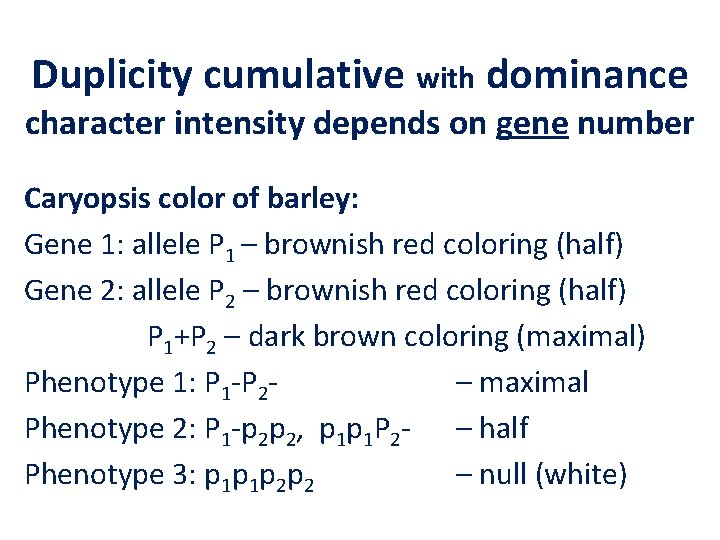
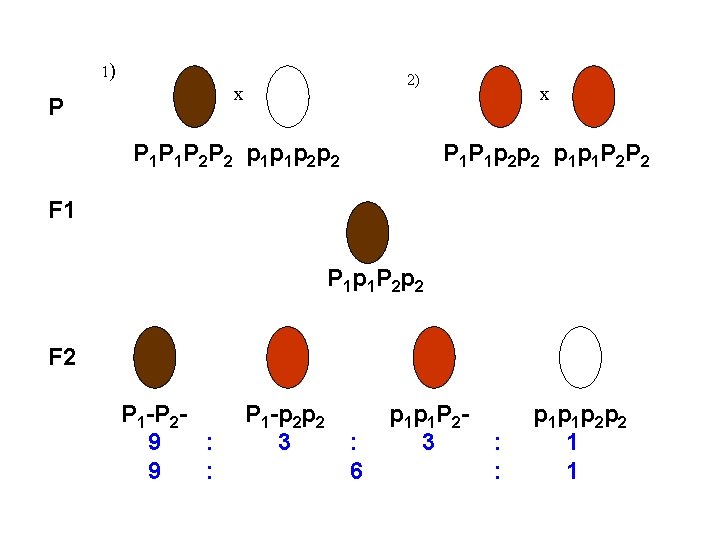
Duplicity cumulative with dominance character intensity depends on gene number Caryopsis color of barley: Gene 1: allele P 1 – brownish red coloring (half) Gene 2: allele P 2 – brownish red coloring (half) P 1+P 2 – dark brown coloring (maximal) Phenotype 1: P 1 -P 2– maximal Phenotype 2: P 1 -p 2 p 2, p 1 p 1 P 2 - – half Phenotype 3: p 1 p 1 p 2 p 2 – null (white)
1) 2) x P P 1 P 1 P 2 P 2 p 1 p 1 p 2 p 2 x P 1 P 1 p 2 p 2 p 1 p 1 P 2 P 2 F 1 P 1 p 1 P 2 p 2 F 2 P 1 -P 29 : P 1 -p 2 p 2 3 : 6 p 1 p 1 P 23 : : p 1 p 1 p 2 p 2 1 1
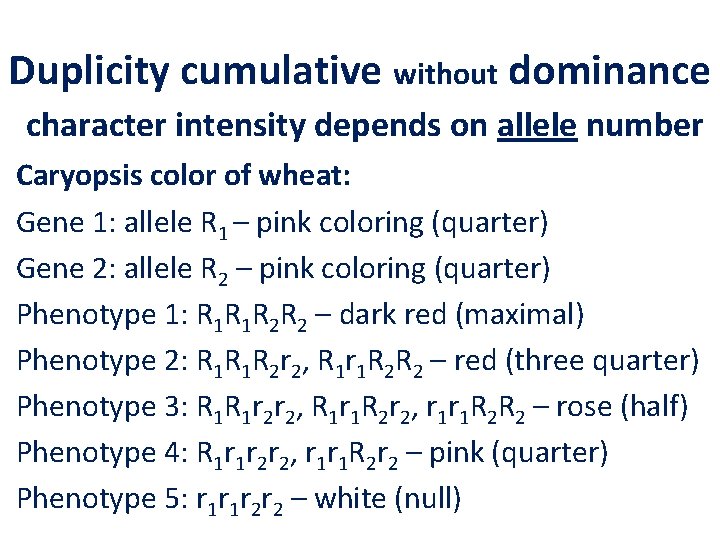
Duplicity cumulative without dominance character intensity depends on allele number Caryopsis color of wheat: Gene 1: allele R 1 – pink coloring (quarter) Gene 2: allele R 2 – pink coloring (quarter) Phenotype 1: R 1 R 1 R 2 R 2 – dark red (maximal) Phenotype 2: R 1 R 1 R 2 r 2, R 1 r 1 R 2 R 2 – red (three quarter) Phenotype 3: R 1 R 1 r 2 r 2, R 1 r 1 R 2 r 2, r 1 r 1 R 2 R 2 – rose (half) Phenotype 4: R 1 r 1 r 2 r 2, r 1 r 1 R 2 r 2 – pink (quarter) Phenotype 5: r 1 r 1 r 2 r 2 – white (null)
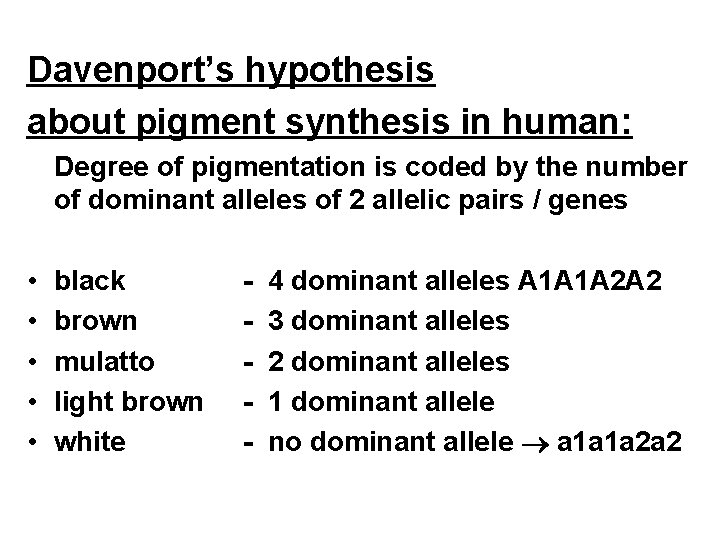
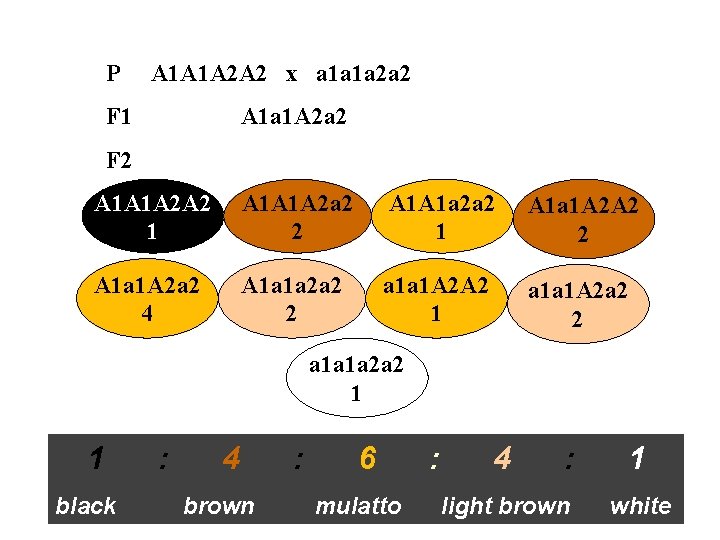
Davenport’s hypothesis about pigment synthesis in human: Degree of pigmentation is coded by the number of dominant alleles of 2 allelic pairs / genes • • • black brown mulatto light brown white - 4 dominant alleles A 1 A 1 A 2 A 2 3 dominant alleles 2 dominant alleles 1 dominant allele no dominant allele a 1 a 1 a 2 a 2
P A 1 A 1 A 2 A 2 x a 1 a 1 a 2 a 2 F 1 A 1 a 1 A 2 a 2 F 2 A 1 A 1 A 2 A 2 1 A 1 A 1 A 2 a 2 2 A 1 A 1 a 2 a 2 1 A 1 a 1 A 2 A 2 2 A 1 a 1 A 2 a 2 4 A 1 a 1 a 2 a 2 2 a 1 a 1 A 2 A 2 1 a 1 a 1 A 2 a 2 2 a 1 a 1 a 2 a 2 1 1 black : 4 brown : 6 mulatto : 4 : light brown 1 white
Bilateral allele relation of cooperated genes Complementarity Multiplicity alleles ≥ 2 genes R ∩ S ↓ ↓ A 1 A 2 ↘ ↙ A phenotype alleles ≥ 2 genes T 1 ∪ T 2 ↘ ↙ A phenotype
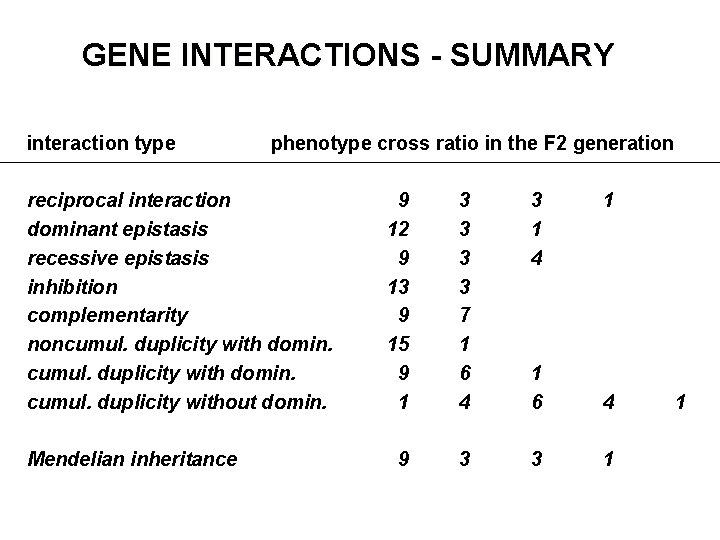
GENE INTERACTIONS - SUMMARY interaction type phenotype cross ratio in the F 2 generation reciprocal interaction dominant epistasis recessive epistasis inhibition complementarity noncumul. duplicity with domin. cumul. duplicity without domin. Mendelian inheritance 9 12 9 13 9 15 9 1 3 3 7 1 6 4 3 1 4 1 1 6 4 9 3 3 1 1
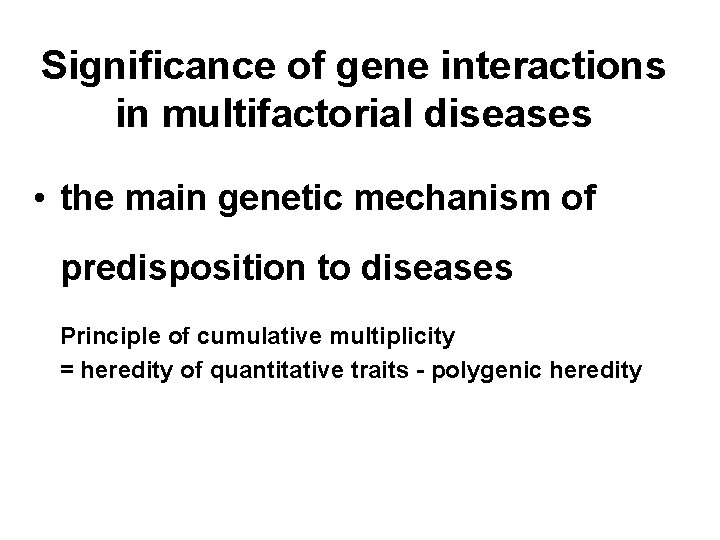
Significance of gene interactions in multifactorial diseases • the main genetic mechanism of predisposition to diseases Principle of cumulative multiplicity = heredity of quantitative traits - polygenic heredity
Significance of gene interactions in monogenic diseases • low penetrance = probability of expression of dominant allele in phenotype - sick or healthy persons • different expressivity = intensity of phenotype manifestation - severe or minor clinical signs