
BIOL 710 Molecular Biology Mondays and Wednesdays 5
BIOL 710: Molecular Biology Mondays and Wednesdays, 5: 30 PM LECTURERS Mitchell Goldfarb HN 834 772 -5289 Goldfarb@genectr. hunter. cuny. edu Thomas Schmidt-Glenewinkel HN 841 772 -5027 Thomas@genectr. hunter. cuny. edu SUGGESTED TEXT Biochemistry, 6 th edition Berg, Tymockzo, & Stryer ISBN: 0716787245 OR Biochemistry, 4 th edition Stryer ISBN: 0716720094 Available online from www. barnesandnoble. com www. amazon. com COURSE WEBSITE (for Goldfarb lectures) http: //biology. hunter. cuny. edu/Goldfarb/ Then click link to course at bottom of the web page
Scope of the Course How are biological macromolecules synthesized and assembled? How do different macromolecules generate the structure of cells? How do proteins fold to acquire functionality? How do enzymes catalyze reactions? How is energy harvested and stored in the cell? How do pumps and channels store energy and control the chemical composition of cellular compartments? Intracellular biochemical signaling by proteins and lipids. DNA structure and replication. Transcription and post-transcriptional RNA modification. Regulation of transcription. The genetic code and protein translation. Similarities and differences in processing of genetic information in prokaryotes vs. eukaryotes
Exams and Studying Midterm on Oct. 22 nd (tentative) Covers Lectures 1 -12 on Proteins (Goldfarb and Schmidt-Glnewinkel) Final in December Covers Lectures 13 -26 on DNA/RNA & Information Flow (Schmidt-Glenewinkel) Study Tips Read suggested readings before and/or soon after each lecture Distribute your studying throughout semester; do not cram
LECTURE 1: p. H, p. K, Amino Acids, Peptide Properties, p. I Reading: Berg Chapters 1, 2 Before being able to discuss the properties of biological macromolecules, we must first review: 1) Covalent and noncovalent bonding 2) Oxidation and reduction 3) Acid/base chemistry
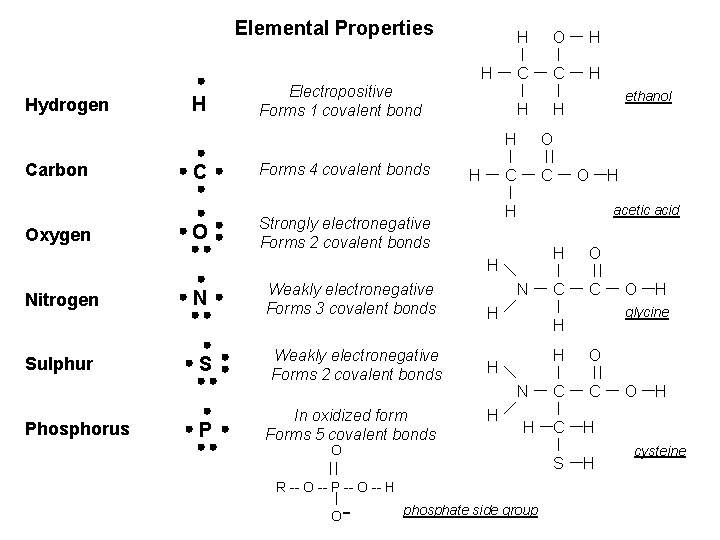
Elemental Properties H Hydrogen Carbon Oxygen H C O Electropositive Forms 1 covalent bond Forms 4 covalent bonds H H O H C C H H O C C Sulphur Phosphorus N Strongly electronegative Forms 2 covalent bonds S P Weakly electronegative Forms 3 covalent bonds Weakly electronegative Forms 2 covalent bonds In oxidized form Forms 5 covalent bonds N H H O C C H phosphate side group O H glycine H R -- O -- P -- O -- H acetic acid O O O H H Nitrogen ethanol H O C C C H S H O H cysteine
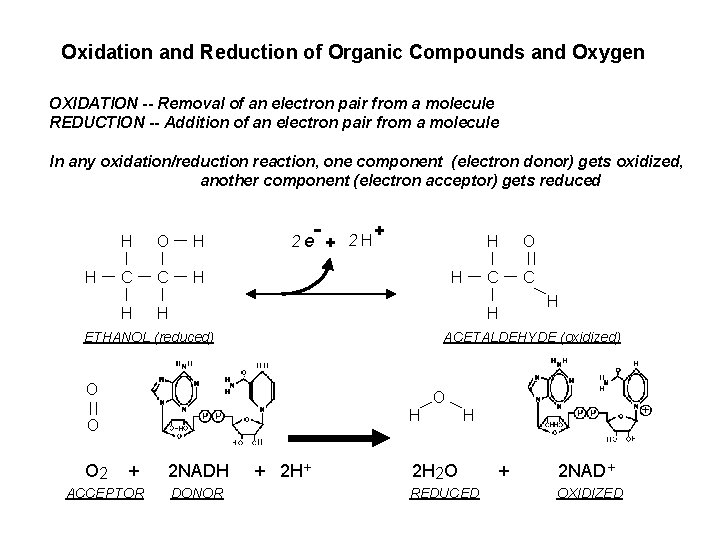
Oxidation and Reduction of Organic Compounds and Oxygen OXIDATION -- Removal of an electron pair from a molecule REDUCTION -- Addition of an electron pair from a molecule In any oxidation/reduction reaction, one component (electron donor) gets oxidized, another component (electron acceptor) gets reduced H H O H C C H H H - 2 e + 2 H + H O C C H ETHANOL (reduced) H ACETALDEHYDE (oxidized) O O H O O 2 H + ACCEPTOR 2 NADH DONOR + 2 H+ H 2 H 2 O REDUCED + 2 NAD+ OXIDIZED
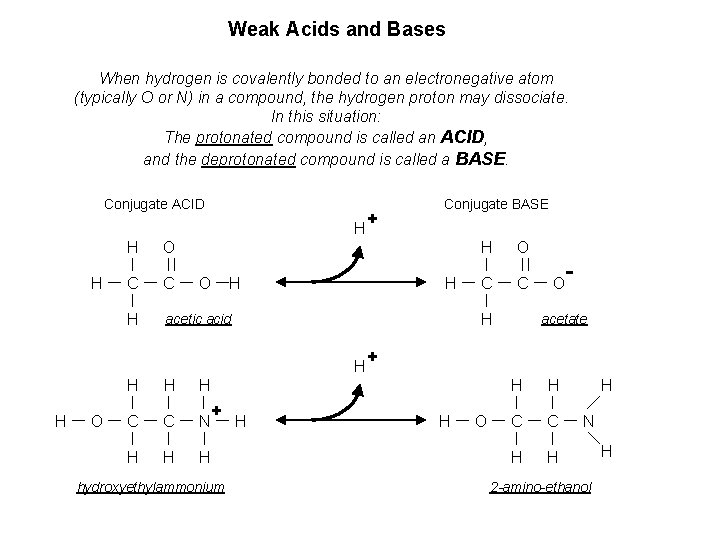
Weak Acids and Bases When hydrogen is covalently bonded to an electronegative atom (typically O or N) in a compound, the hydrogen proton may dissociate. In this situation: The protonated compound is called an ACID, and the deprotonated compound is called a BASE. Conjugate ACID H H H O C C H acetic acid O H H H O H H C C N H H H + hydroxyethylammonium H O C C H H H + Conjugate BASE H O - acetate + H O H H C C H H H N 2 -amino-ethanol H
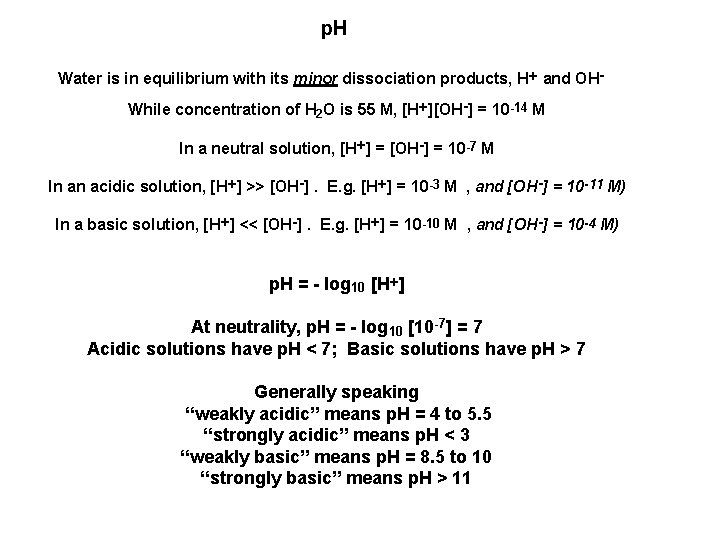
p. H Water is in equilibrium with its minor dissociation products, H+ and OHWhile concentration of H 2 O is 55 M, [H+][OH-] = 10 -14 M In a neutral solution, [H+] = [OH-] = 10 -7 M In an acidic solution, [H+] >> [OH-]. E. g. [H+] = 10 -3 M , and [OH-] = 10 -11 M) In a basic solution, [H+] << [OH-]. E. g. [H+] = 10 -10 M , and [OH-] = 10 -4 M) p. H = - log 10 [H+] At neutrality, p. H = - log 10 [10 -7] = 7 Acidic solutions have p. H < 7; Basic solutions have p. H > 7 Generally speaking “weakly acidic” means p. H = 4 to 5. 5 “strongly acidic” means p. H < 3 “weakly basic” means p. H = 8. 5 to 10 “strongly basic” means p. H > 11
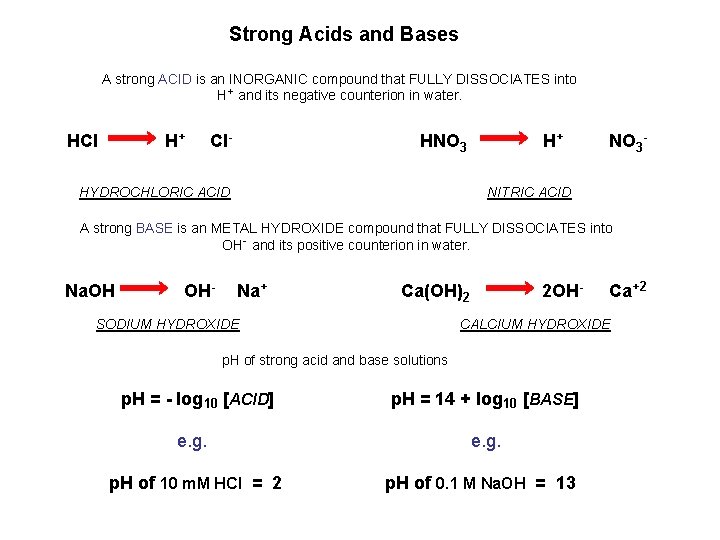
Strong Acids and Bases A strong ACID is an INORGANIC compound that FULLY DISSOCIATES into H+ and its negative counterion in water. H+ HCl Cl- H+ HNO 3 HYDROCHLORIC ACID NO 3 - NITRIC ACID A strong BASE is an METAL HYDROXIDE compound that FULLY DISSOCIATES into OH- and its positive counterion in water. Na. OH OH- Na+ 2 OH- Ca(OH)2 SODIUM HYDROXIDE CALCIUM HYDROXIDE p. H of strong acid and base solutions p. H = - log 10 [ACID] Ca+2 p. H = 14 + log 10 [BASE] e. g. p. H of 10 m. M HCl = 2 p. H of 0. 1 M Na. OH = 13
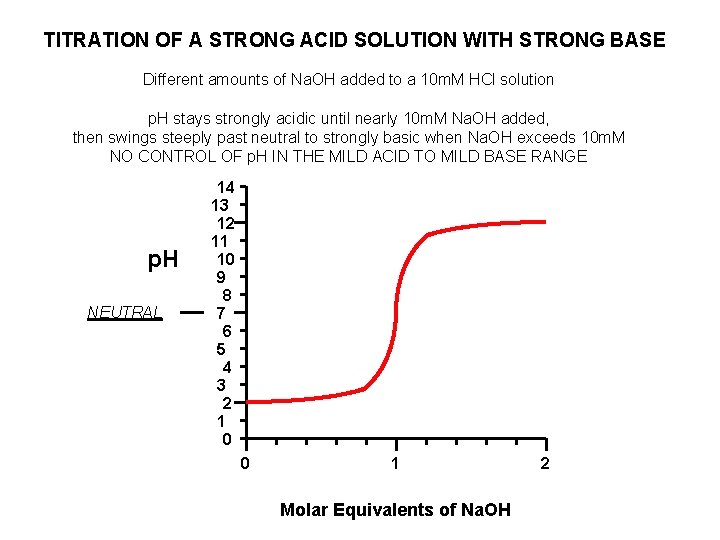
TITRATION OF A STRONG ACID SOLUTION WITH STRONG BASE Different amounts of Na. OH added to a 10 m. M HCl solution p. H stays strongly acidic until nearly 10 m. M Na. OH added, then swings steeply past neutral to strongly basic when Na. OH exceeds 10 m. M NO CONTROL OF p. H IN THE MILD ACID TO MILD BASE RANGE p. H NEUTRAL 14 13 12 11 10 9 8 7 6 5 4 3 2 1 0 0 1 Molar Equivalents of Na. OH 2
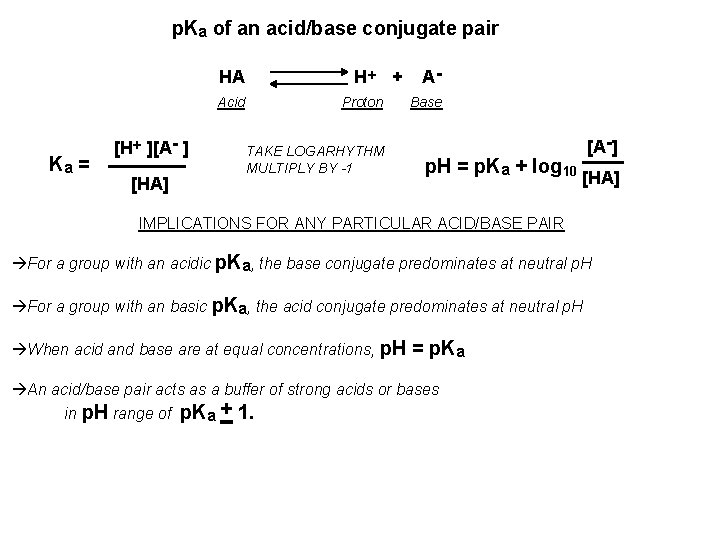
p. Ka of an acid/base conjugate pair HA Acid Ka = [H+ ][A- ] [HA] H+ + Proton TAKE LOGARHYTHM MULTIPLY BY -1 ABase p. H = p. Ka + log 10 [A-] [HA] IMPLICATIONS FOR ANY PARTICULAR ACID/BASE PAIR àFor a group with an acidic p. Ka, the base conjugate predominates at neutral p. H àFor a group with an basic p. Ka, the acid conjugate predominates at neutral p. H àWhen acid and base are at equal concentrations, p. H = p. Ka àAn acid/base pair acts as a buffer of strong acids or bases in p. H range of p. Ka + 1.
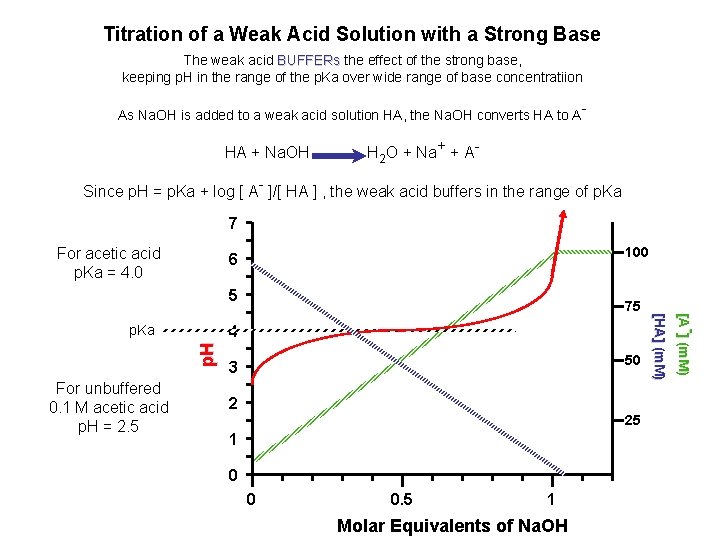
Titration of a Weak Acid Solution with a Strong Base The weak acid BUFFERs the effect of the strong base, keeping p. H in the range of the p. Ka over wide range of base concentratiion As Na. OH is added to a weak acid solution HA, the Na. OH converts HA to A HA + Na. OH - H 2 O + Na+ + A- Since p. H = p. Ka + log [ A- ]/[ HA ] , the weak acid buffers in the range of p. Ka 7 For acetic acid p. Ka = 4. 0 100 6 5 2 25 1 0 0 0. 5 1 Molar Equivalents of Na. OH p. H - For unbuffered 0. 1 M acetic acid p. H = 2. 5 50 3 [A -] (m. M) 4 [HA] (m. M) p. Ka 75
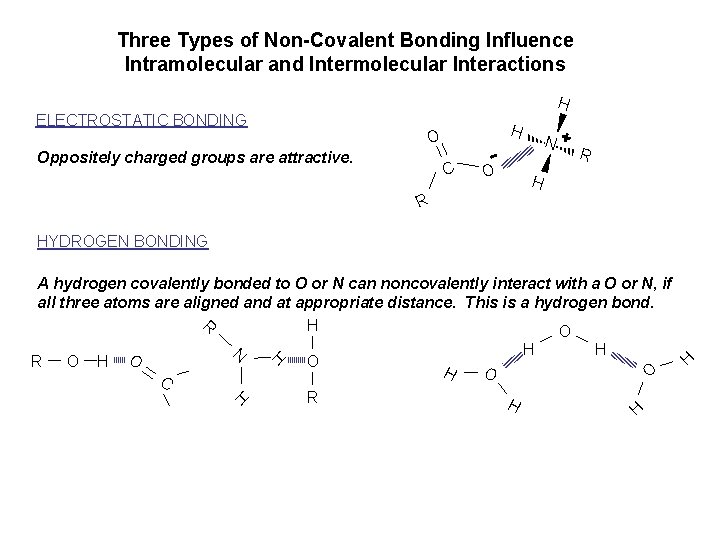
Three Types of Non-Covalent Bonding Influence Intramolecular and Intermolecular Interactions H ELECTROSTATIC BONDING H O Oppositely charged groups are attractive. C N+ - O R HYDROGEN BONDING A hydrogen covalently bonded to O or N can noncovalently interact with a O or N, if all three atoms are aligned and at appropriate distance. This is a hydrogen bond. R H O H H N H H R O H O O C H R H H
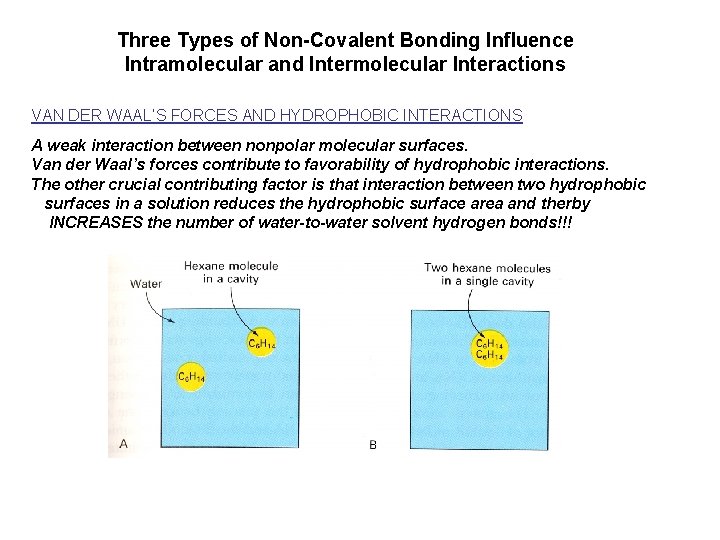
Three Types of Non-Covalent Bonding Influence Intramolecular and Intermolecular Interactions VAN DER WAAL’S FORCES AND HYDROPHOBIC INTERACTIONS A weak interaction between nonpolar molecular surfaces. Van der Waal’s forces contribute to favorability of hydrophobic interactions. The other crucial contributing factor is that interaction between two hydrophobic surfaces in a solution reduces the hydrophobic surface area and therby INCREASES the number of water-to-water solvent hydrogen bonds!!!
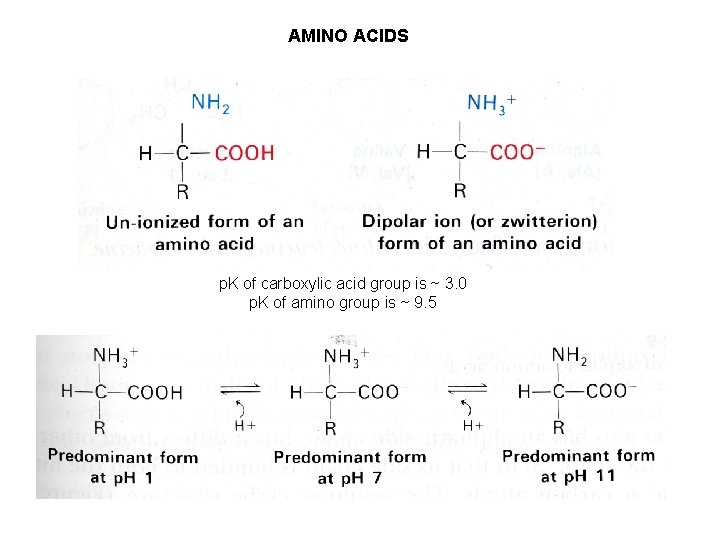
AMINO ACIDS p. K of carboxylic acid group is ~ 3. 0 p. K of amino group is ~ 9. 5
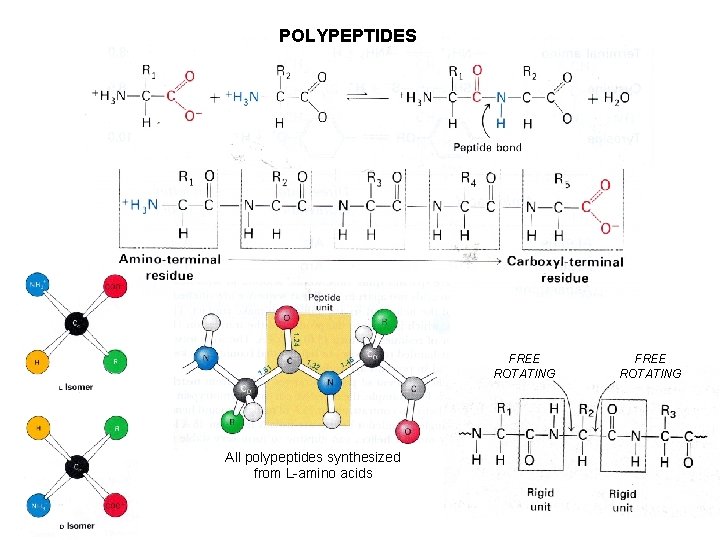
POLYPEPTIDES FREE ROTATING All polypeptides synthesized from L-amino acids FREE ROTATING
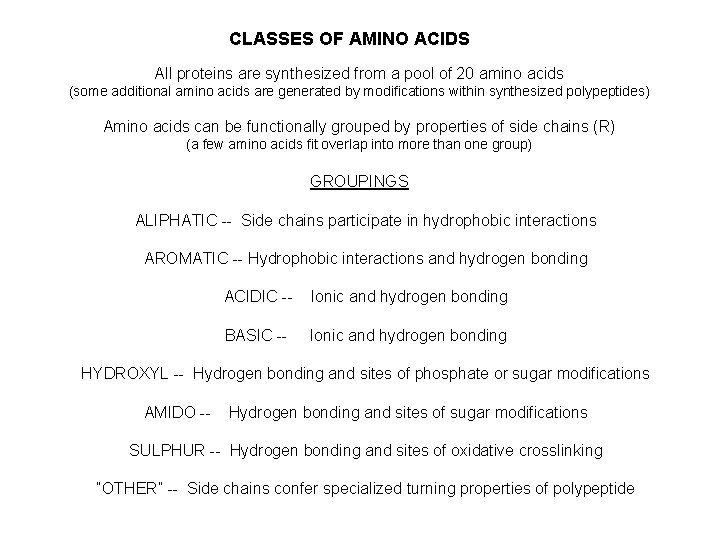
CLASSES OF AMINO ACIDS All proteins are synthesized from a pool of 20 amino acids (some additional amino acids are generated by modifications within synthesized polypeptides) Amino acids can be functionally grouped by properties of side chains (R) (a few amino acids fit overlap into more than one group) GROUPINGS ALIPHATIC -- Side chains participate in hydrophobic interactions AROMATIC -- Hydrophobic interactions and hydrogen bonding ACIDIC -- Ionic and hydrogen bonding BASIC -- Ionic and hydrogen bonding HYDROXYL -- Hydrogen bonding and sites of phosphate or sugar modifications AMIDO -- Hydrogen bonding and sites of sugar modifications SULPHUR -- Hydrogen bonding and sites of oxidative crosslinking “OTHER” -- Side chains confer specialized turning properties of polypeptide
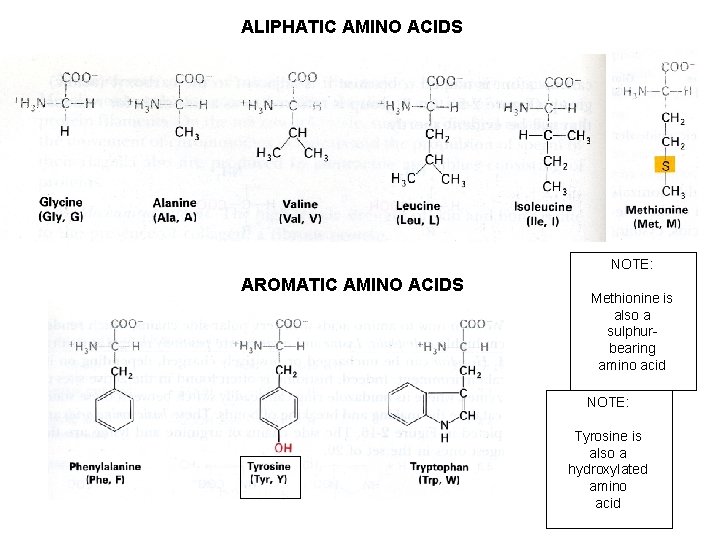
ALIPHATIC AMINO ACIDS NOTE: AROMATIC AMINO ACIDS Methionine is also a sulphurbearing amino acid NOTE: Tyrosine is also a hydroxylated amino acid
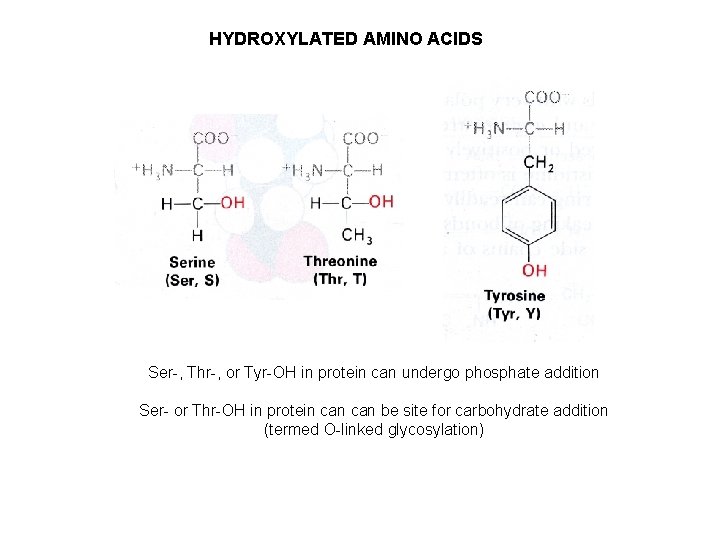
HYDROXYLATED AMINO ACIDS Ser-, Thr-, or Tyr-OH in protein can undergo phosphate addition Ser- or Thr-OH in protein can be site for carbohydrate addition (termed O-linked glycosylation)
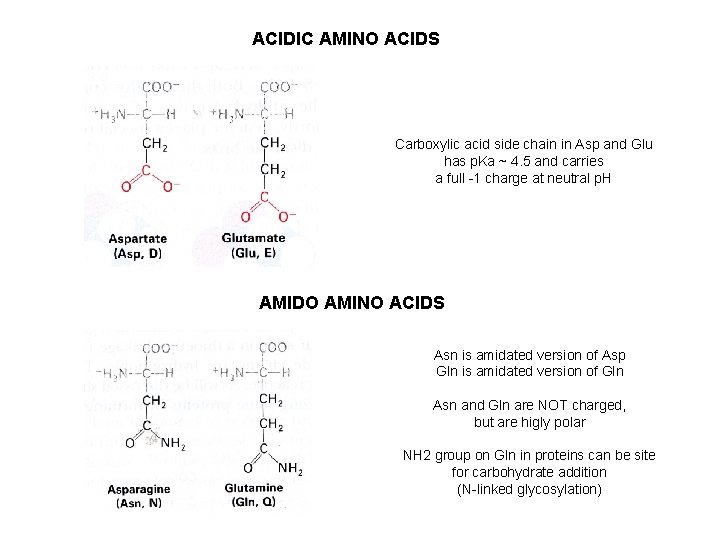
ACIDIC AMINO ACIDS Carboxylic acid side chain in Asp and Glu has p. Ka ~ 4. 5 and carries a full -1 charge at neutral p. H AMIDO AMINO ACIDS Asn is amidated version of Asp Gln is amidated version of Gln Asn and Gln are NOT charged, but are higly polar NH 2 group on Gln in proteins can be site for carbohydrate addition (N-linked glycosylation)
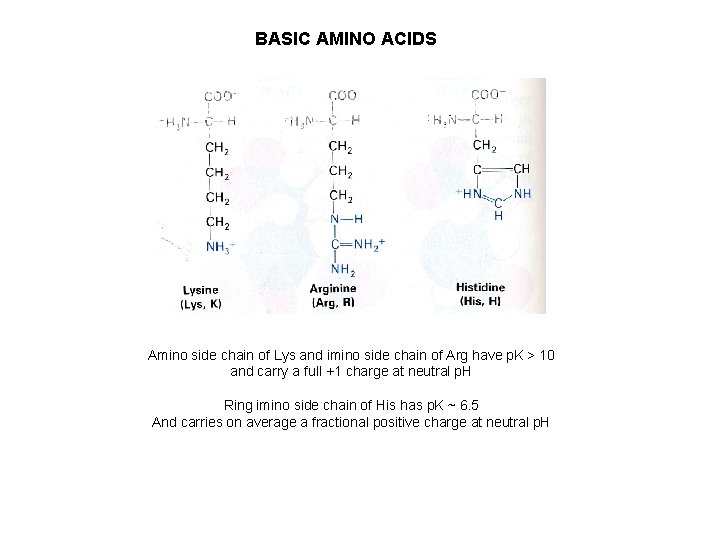
BASIC AMINO ACIDS Amino side chain of Lys and imino side chain of Arg have p. K > 10 and carry a full +1 charge at neutral p. H Ring imino side chain of His has p. K ~ 6. 5 And carries on average a fractional positive charge at neutral p. H
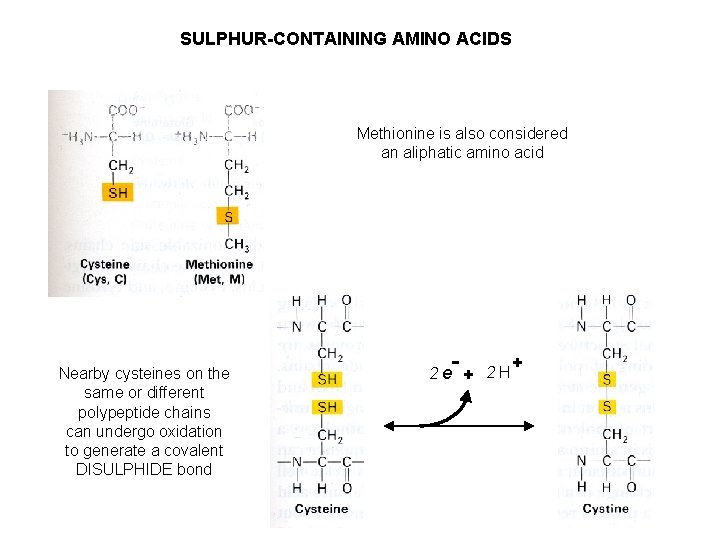
SULPHUR-CONTAINING AMINO ACIDS Methionine is also considered an aliphatic amino acid Nearby cysteines on the same or different polypeptide chains can undergo oxidation to generate a covalent DISULPHIDE bond - 2 e + 2 H +
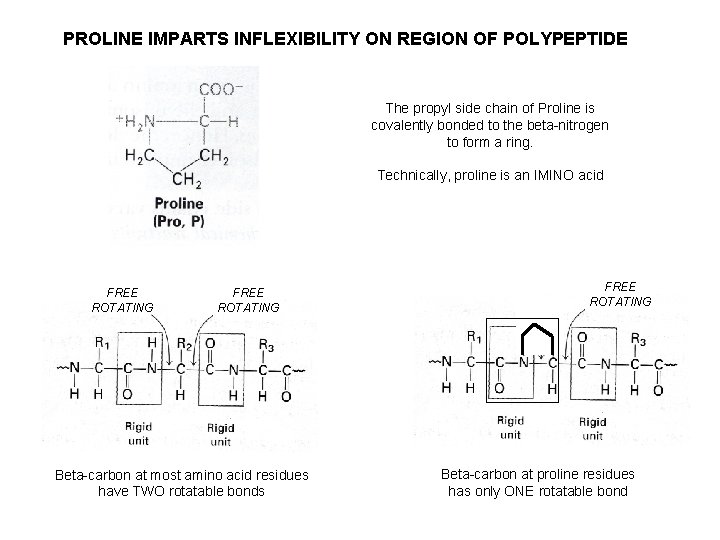
PROLINE IMPARTS INFLEXIBILITY ON REGION OF POLYPEPTIDE The propyl side chain of Proline is covalently bonded to the beta-nitrogen to form a ring. Technically, proline is an IMINO acid FREE ROTATING Beta-carbon at most amino acid residues have TWO rotatable bonds FREE ROTATING Beta-carbon at proline residues has only ONE rotatable bond
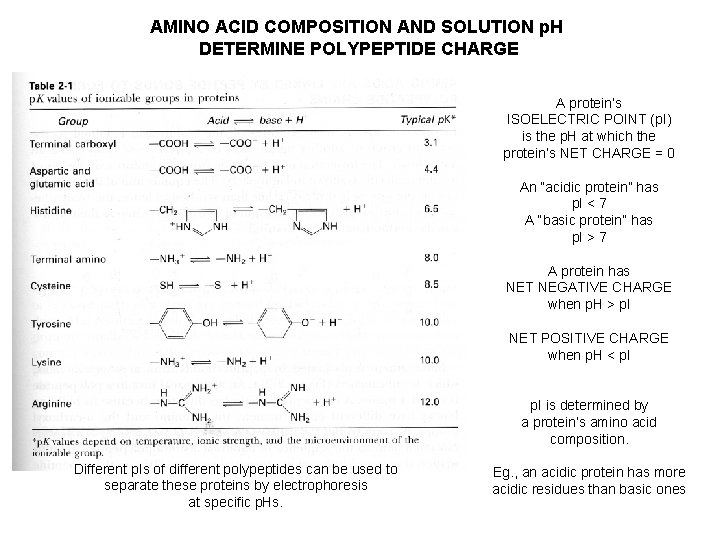
AMINO ACID COMPOSITION AND SOLUTION p. H DETERMINE POLYPEPTIDE CHARGE A protein’s ISOELECTRIC POINT (p. I) is the p. H at which the protein’s NET CHARGE = 0 An “acidic protein” has p. I < 7 A “basic protein” has p. I > 7 A protein has NET NEGATIVE CHARGE when p. H > p. I NET POSITIVE CHARGE when p. H < p. I is determined by a protein’s amino acid composition. Different p. Is of different polypeptides can be used to separate these proteins by electrophoresis at specific p. Hs. Eg. , an acidic protein has more acidic residues than basic ones
NEXT LECTURE: PROTEIN STRUCTURE 1 Reading: Berg, Chapter 2
- Slides: 25