Fundamentals of Memory Consistency Smruti R Sarangi Prereq

- Slides: 29
Fundamentals of Memory Consistency Smruti R. Sarangi Prereq: Slides for Chapter 11 (Multiprocessor Systems), Computer Organisation and Architecture, Smruti R. Sarangi, Mc. Graw. Hill, 2015 1
Contents • Basic Terminology • Program Order Relaxations • Healthiness Conditions 2
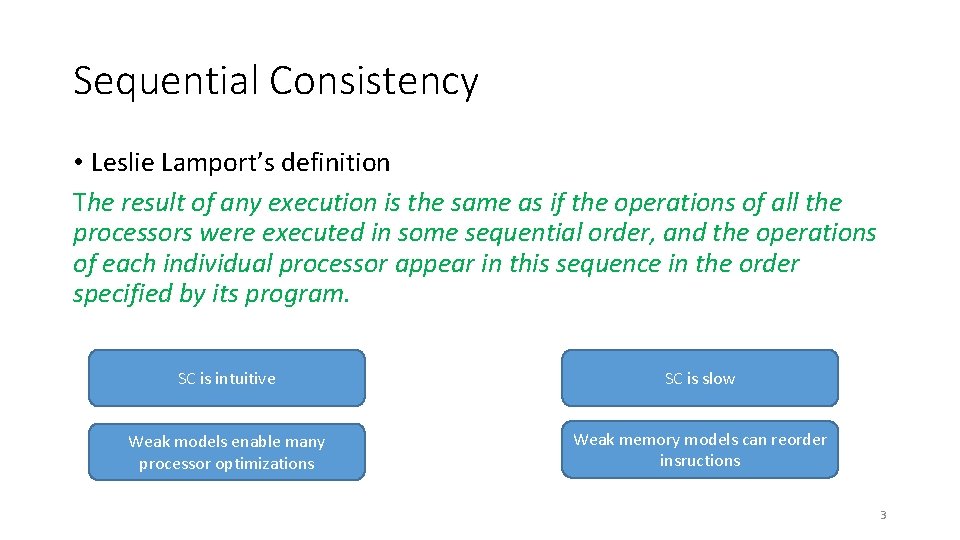
Sequential Consistency • Leslie Lamport’s definition The result of any execution is the same as if the operations of all the processors were executed in some sequential order, and the operations of each individual processor appear in this sequence in the order specified by its program. SC is intuitive SC is slow Weak models enable many processor optimizations Weak memory models can reorder insructions 3
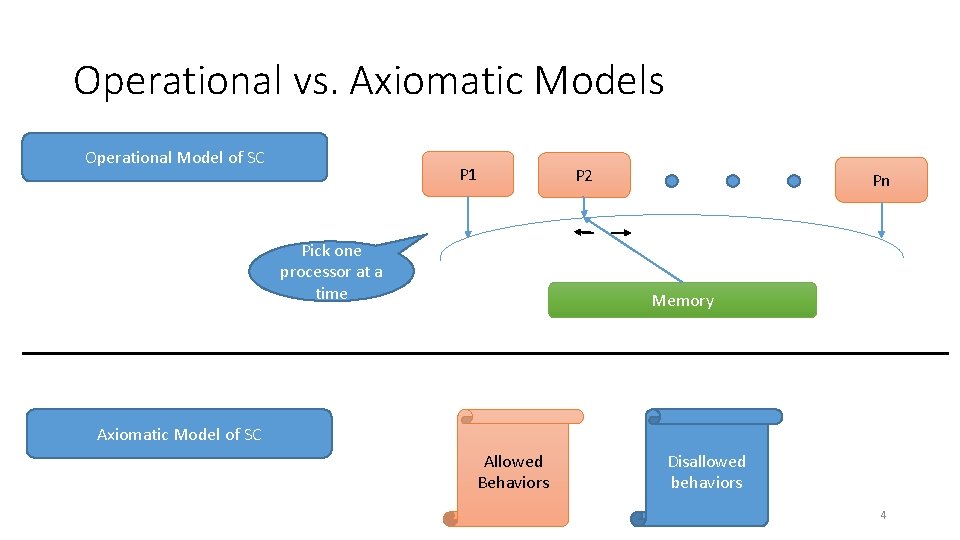
Operational vs. Axiomatic Models Operational Model of SC P 1 P 2 Pick one processor at a time Pn Memory Axiomatic Model of SC Allowed Behaviors Disallowed behaviors 4
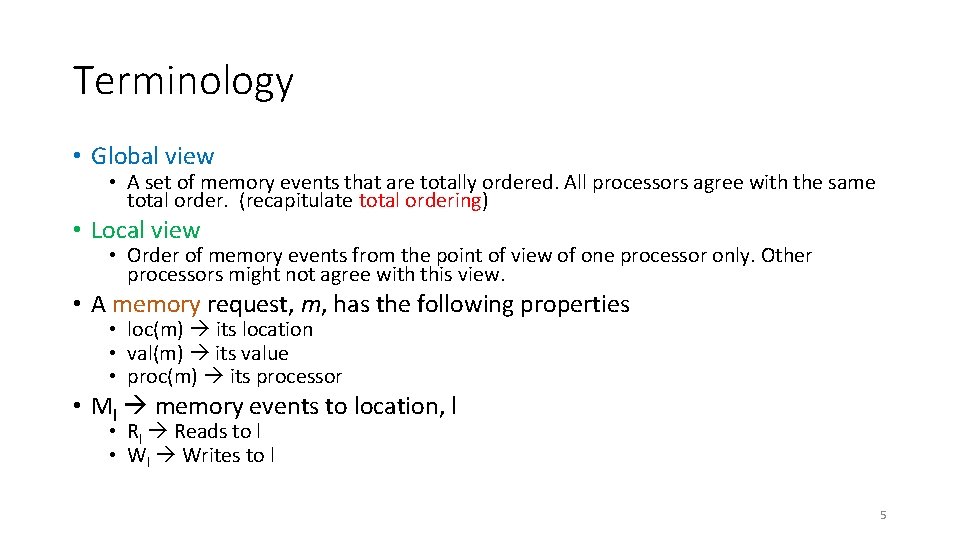
Terminology • Global view • A set of memory events that are totally ordered. All processors agree with the same total order. (recapitulate total ordering) • Local view • Order of memory events from the point of view of one processor only. Other processors might not agree with this view. • A memory request, m, has the following properties • loc(m) its location • val(m) its value • proc(m) its processor • Ml memory events to location, l • Rl Reads to l • Wl Writes to l 5
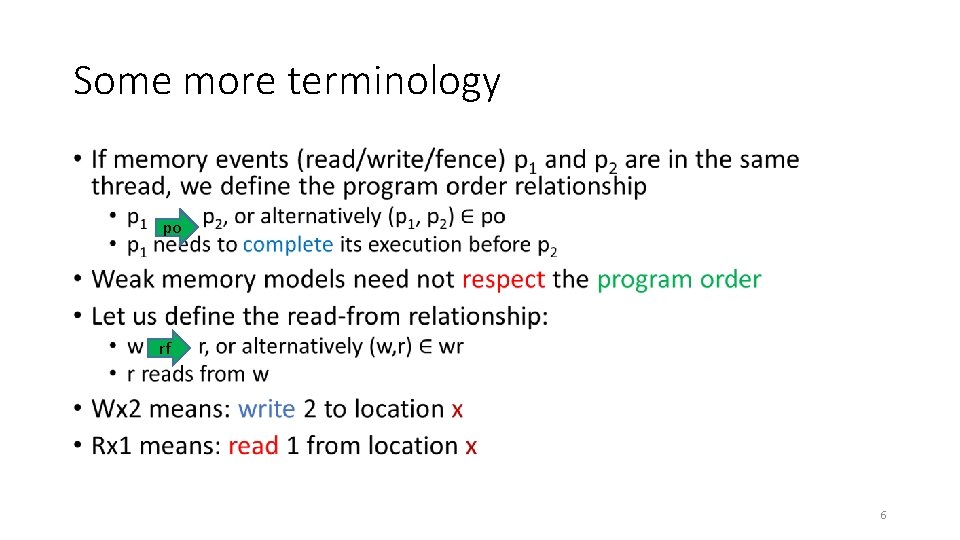
Some more terminology • po rf 6
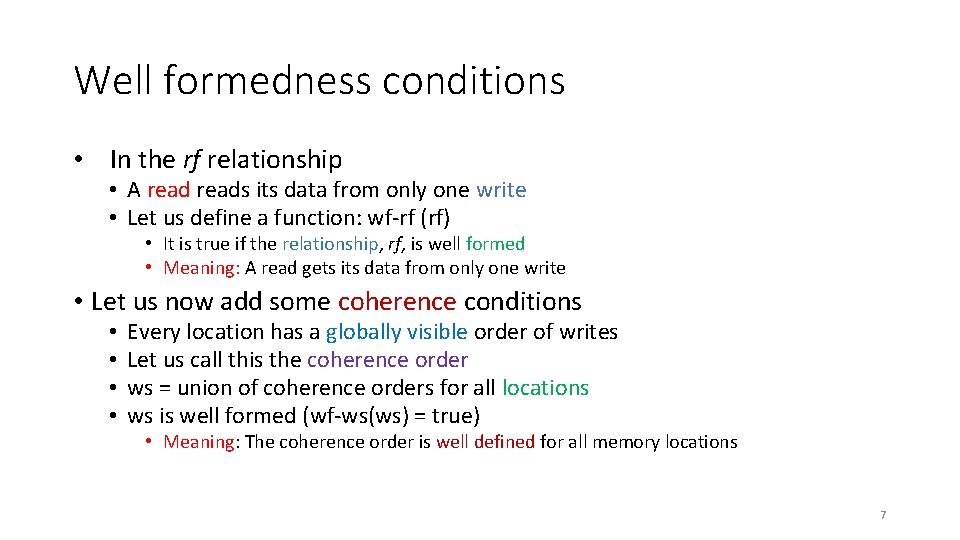
Well formedness conditions • In the rf relationship • A reads its data from only one write • Let us define a function: wf-rf (rf) • It is true if the relationship, rf, is well formed • Meaning: A read gets its data from only one write • Let us now add some coherence conditions • • Every location has a globally visible order of writes Let us call this the coherence order ws = union of coherence orders for all locations ws is well formed (wf-ws(ws) = true) • Meaning: The coherence order is well defined for all memory locations 7
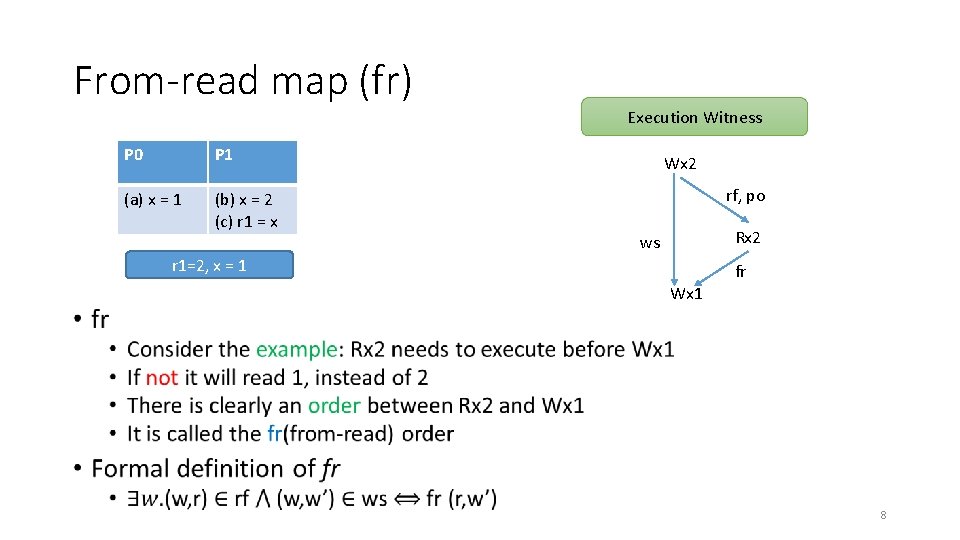
From-read map (fr) P 0 P 1 (a) x = 1 (b) x = 2 (c) r 1 = x Execution Witness Wx 2 rf, po Rx 2 ws r 1=2, x = 1 Wx 1 fr 8
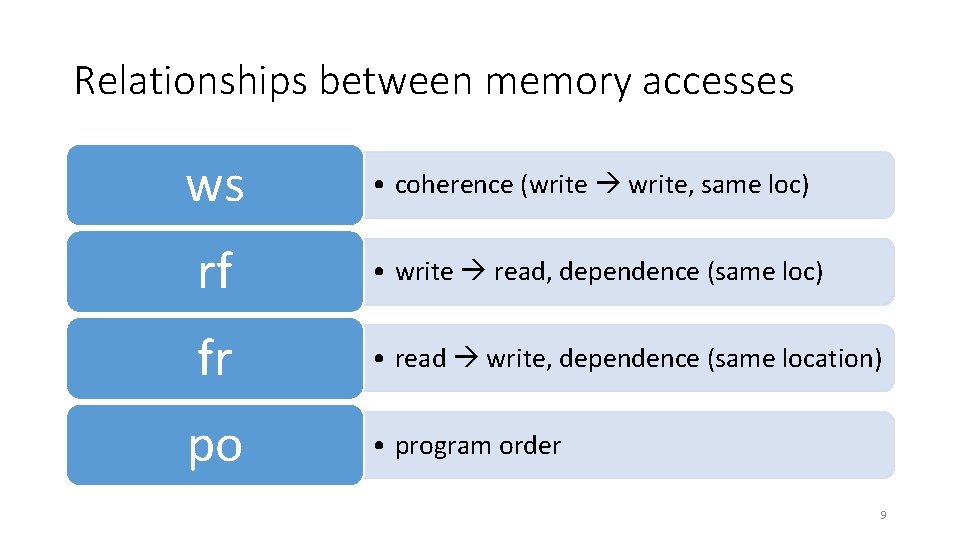
Relationships between memory accesses ws • coherence (write write, same loc) rf • write read, dependence (same loc) fr • read write, dependence (same location) po • program order 9
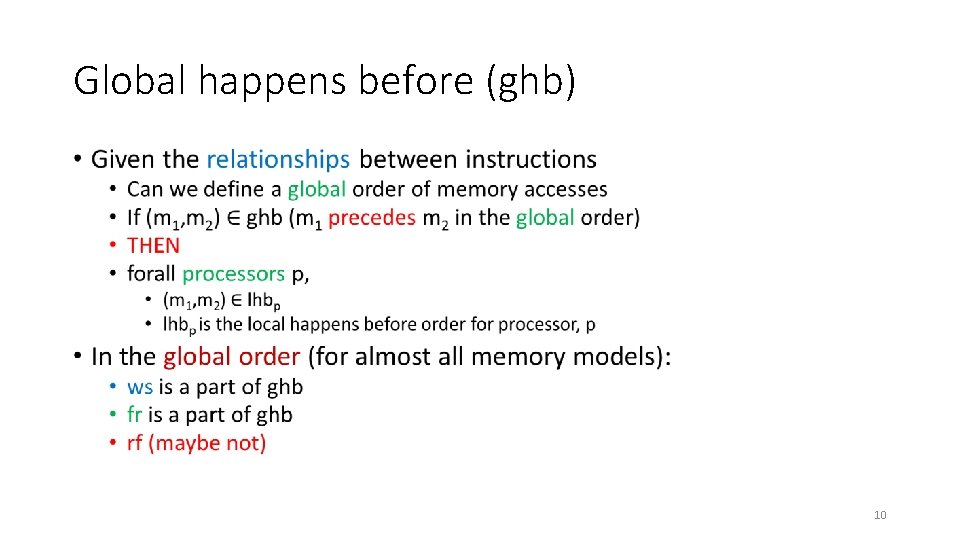
Global happens before (ghb) • 10
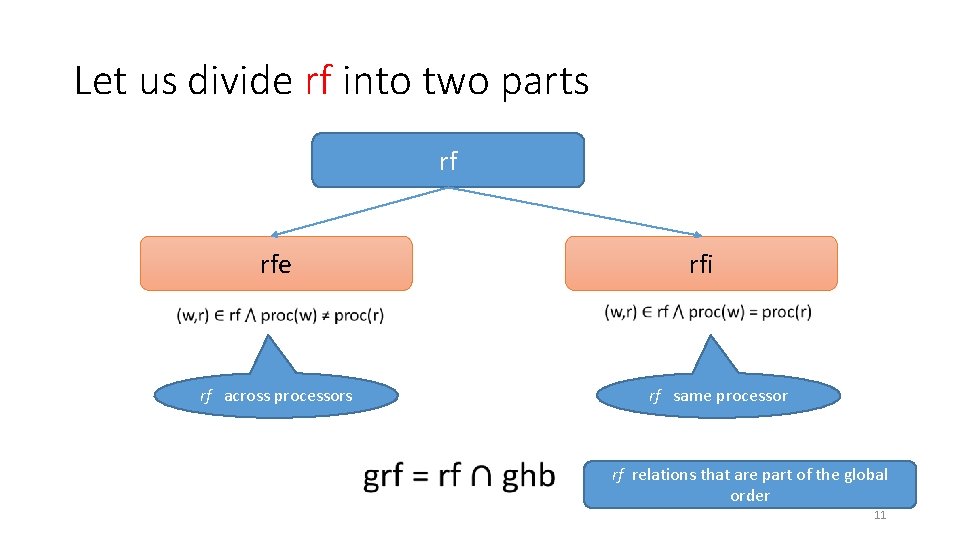
Let us divide rf into two parts rf rfi rfe rf across processors rf same processor rf relations that are part of the global order 11
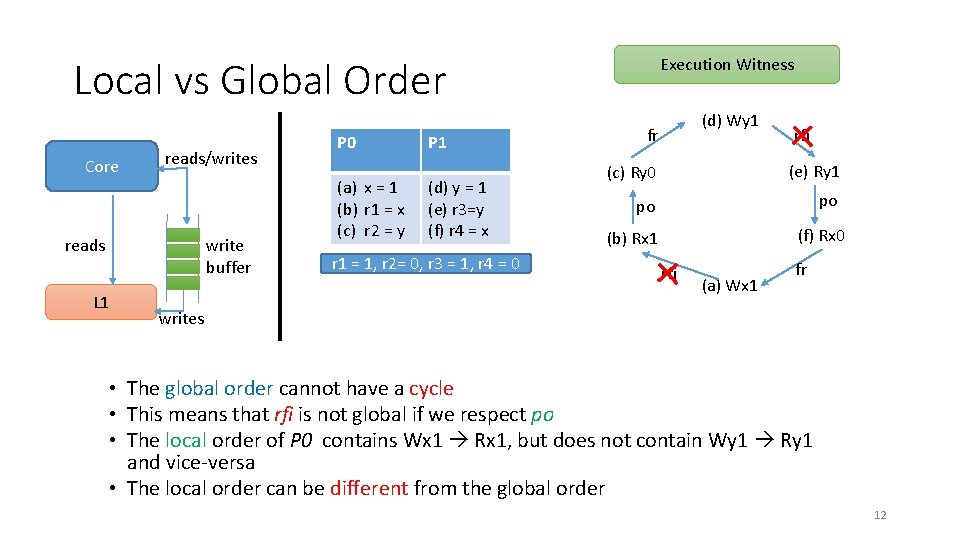
Local vs Global Order Core reads/writes reads write buffer L 1 P 0 (a) x = 1 (b) r 1 = x (c) r 2 = y P 1 (d) y = 1 (e) r 3=y (f) r 4 = x r 1 = 1, r 2= 0, r 3 = 1, r 4 = 0 Execution Witness (d) Wy 1 fr rfi (c) Ry 0 (e) Ry 1 po po (f) Rx 0 (b) Rx 1 rfi (a) Wx 1 fr writes • The global order cannot have a cycle • This means that rfi is not global if we respect po • The local order of P 0 contains Wx 1 Rx 1, but does not contain Wy 1 Ry 1 and vice-versa • The local order can be different from the global order 12
Contents • Basic Terminology • Program Order Relaxations • Healthiness Conditions 13
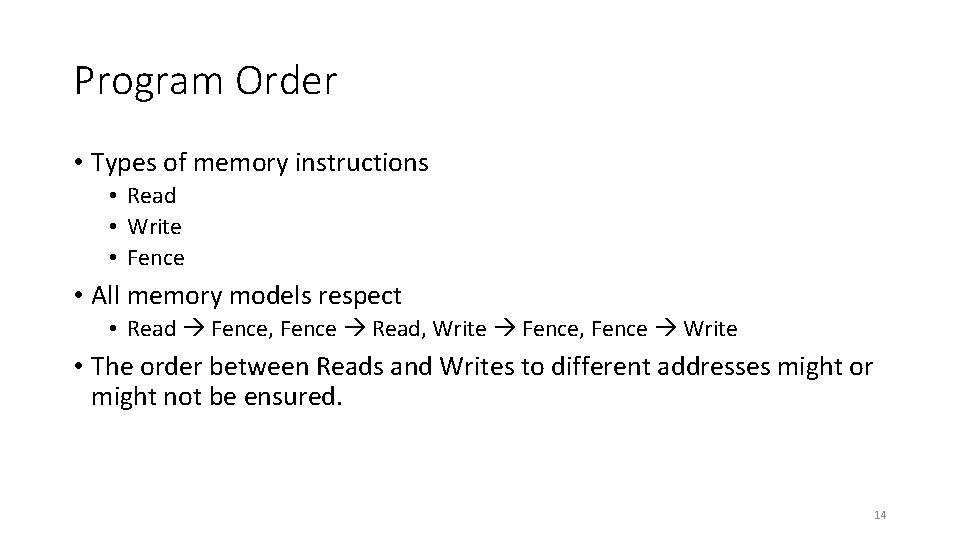
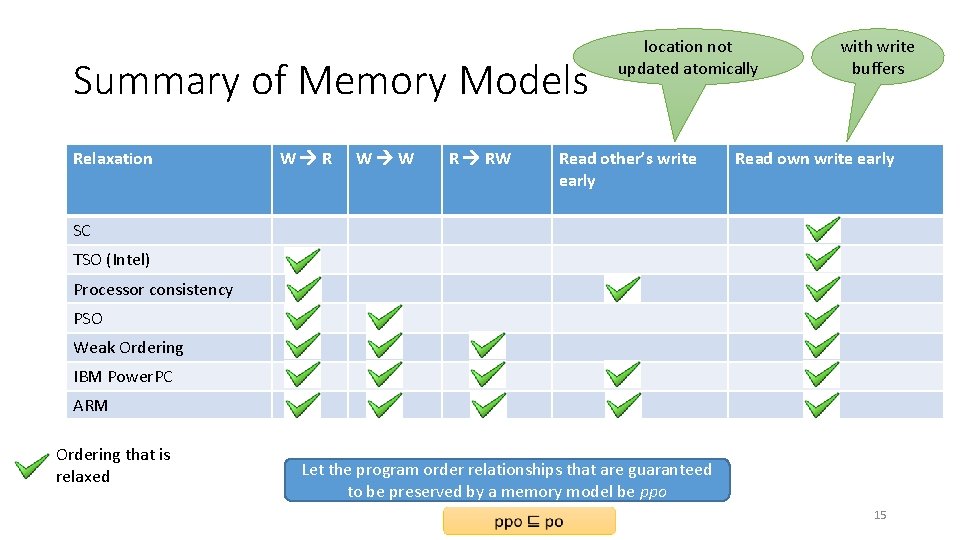
Program Order • Types of memory instructions • Read • Write • Fence • All memory models respect • Read Fence, Fence Read, Write Fence, Fence Write • The order between Reads and Writes to different addresses might or might not be ensured. 14
Summary of Memory Models Relaxation W R W W R RW location not updated atomically Read other’s write early with write buffers Read own write early SC TSO (Intel) Processor consistency PSO Weak Ordering IBM Power. PC ARM Ordering that is relaxed Let the program order relationships that are guaranteed to be preserved by a memory model be ppo 15
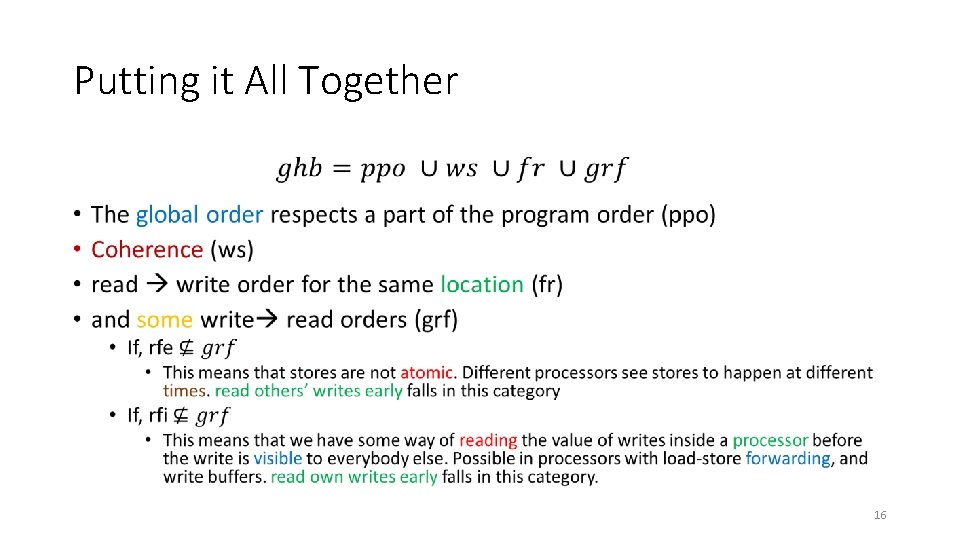
Putting it All Together • 16
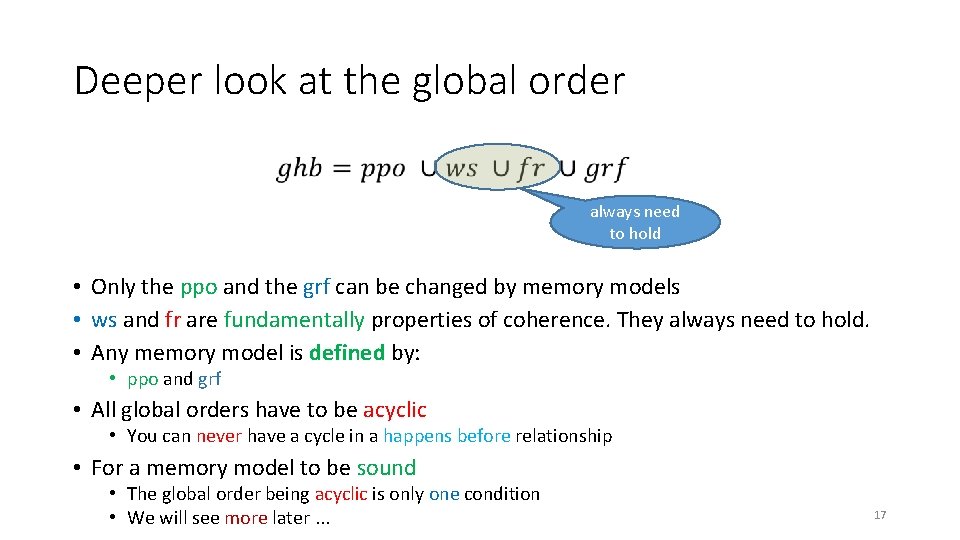
Deeper look at the global order always need to hold • Only the ppo and the grf can be changed by memory models • ws and fr are fundamentally properties of coherence. They always need to hold. • Any memory model is defined by: • ppo and grf • All global orders have to be acyclic • You can never have a cycle in a happens before relationship • For a memory model to be sound • The global order being acyclic is only one condition • We will see more later. . . 17
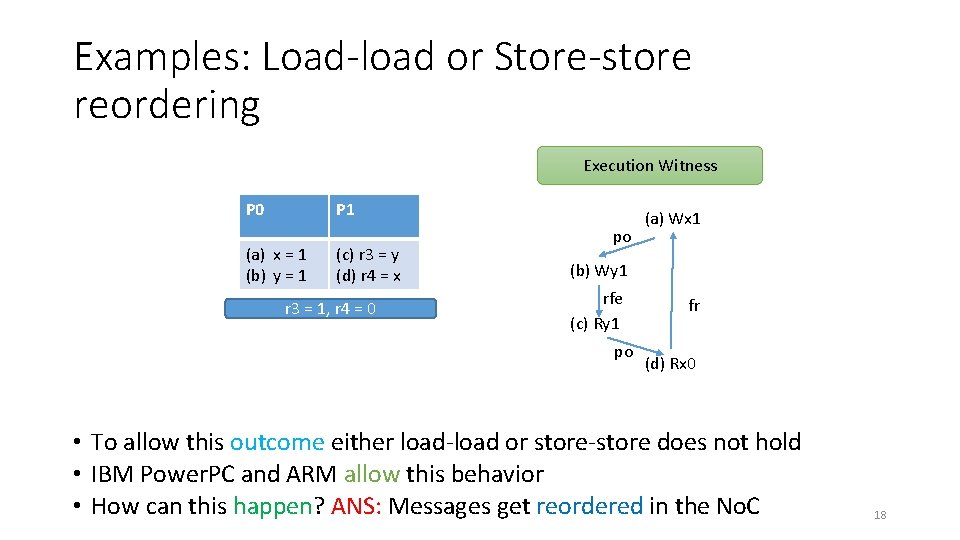
Examples: Load-load or Store-store reordering Execution Witness P 0 P 1 (a) x = 1 (b) y = 1 (c) r 3 = y (d) r 4 = x r 3 = 1, r 4 = 0 po (a) Wx 1 (b) Wy 1 rfe (c) Ry 1 po fr (d) Rx 0 • To allow this outcome either load-load or store-store does not hold • IBM Power. PC and ARM allow this behavior • How can this happen? ANS: Messages get reordered in the No. C 18
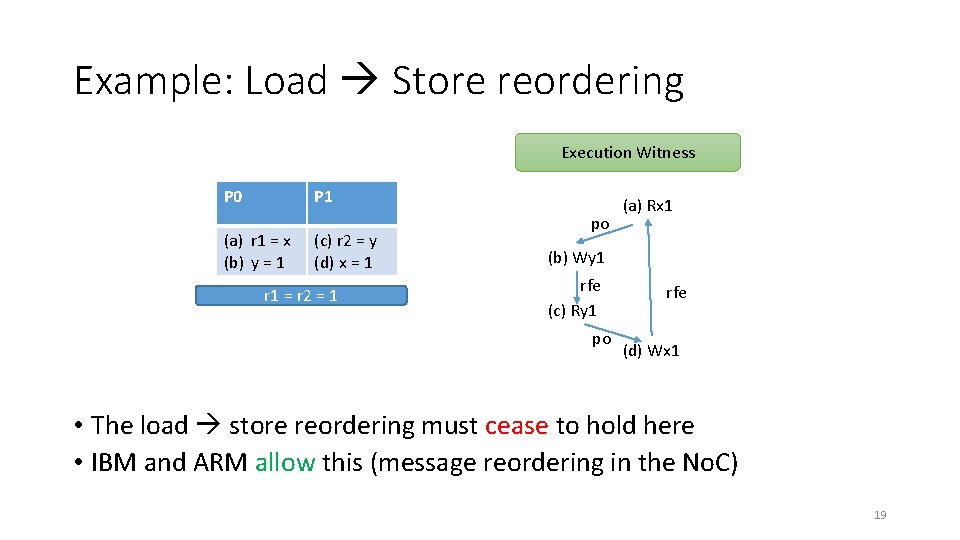
Example: Load Store reordering Execution Witness P 0 P 1 (a) r 1 = x (b) y = 1 (c) r 2 = y (d) x = 1 r 1 = r 2 = 1 po (a) Rx 1 (b) Wy 1 rfe (c) Ry 1 po rfe (d) Wx 1 • The load store reordering must cease to hold here • IBM and ARM allow this (message reordering in the No. C) 19
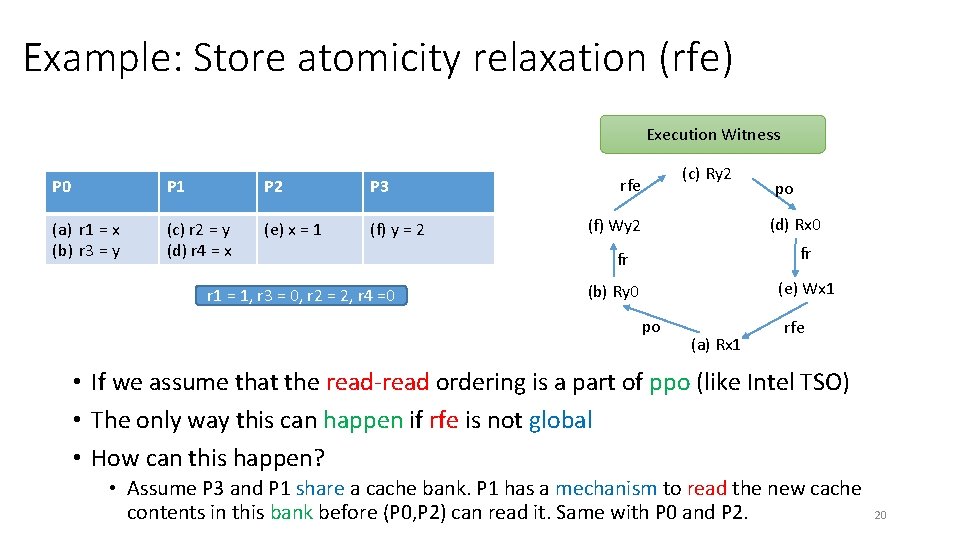
Example: Store atomicity relaxation (rfe) Execution Witness P 0 P 1 P 2 P 3 (a) r 1 = x (b) r 3 = y (c) r 2 = y (d) r 4 = x (e) x = 1 (f) y = 2 r 1 = 1, r 3 = 0, r 2 = 2, r 4 =0 (c) Ry 2 rfe po (d) Rx 0 (f) Wy 2 fr fr (e) Wx 1 (b) Ry 0 po (a) Rx 1 rfe • If we assume that the read-read ordering is a part of ppo (like Intel TSO) • The only way this can happen if rfe is not global • How can this happen? • Assume P 3 and P 1 share a cache bank. P 1 has a mechanism to read the new cache contents in this bank before (P 0, P 2) can read it. Same with P 0 and P 2. 20
Contents • Basic Terminology • Program Order Relaxations • Healthiness Conditions 21
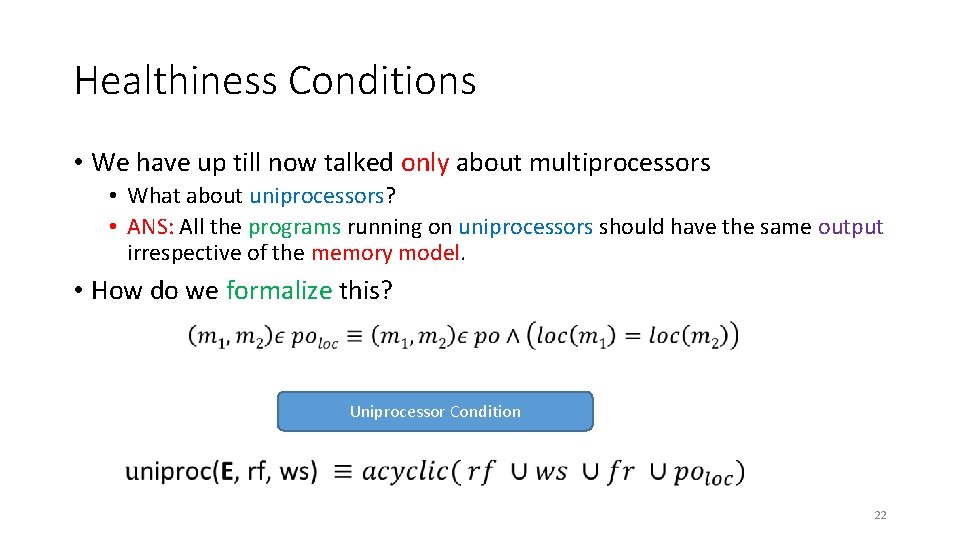
Healthiness Conditions • We have up till now talked only about multiprocessors • What about uniprocessors? • ANS: All the programs running on uniprocessors should have the same output irrespective of the memory model. • How do we formalize this? Uniprocessor Condition 22
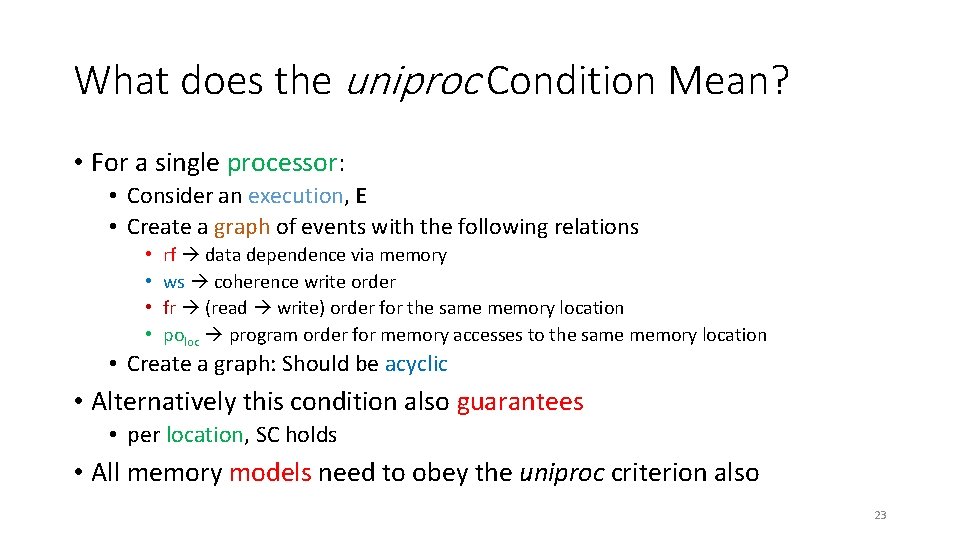
What does the uniproc Condition Mean? • For a single processor: • Consider an execution, E • Create a graph of events with the following relations • • rf data dependence via memory ws coherence write order fr (read write) order for the same memory location poloc program order for memory accesses to the same memory location • Create a graph: Should be acyclic • Alternatively this condition also guarantees • per location, SC holds • All memory models need to obey the uniproc criterion also 23
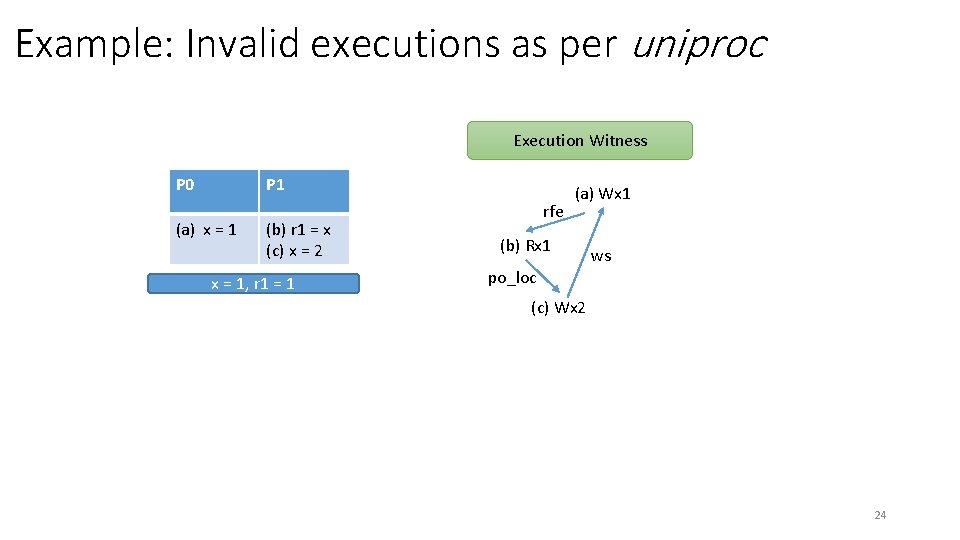
Example: Invalid executions as per uniproc Execution Witness P 0 P 1 (a) x = 1 (b) r 1 = x (c) x = 2 x = 1, r 1 = 1 rfe (a) Wx 1 (b) Rx 1 ws po_loc (c) Wx 2 24
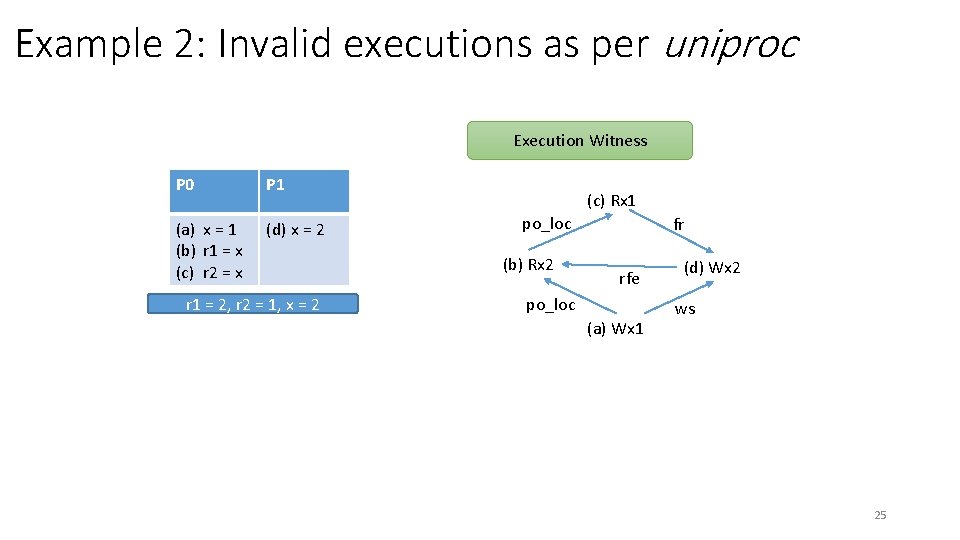
Example 2: Invalid executions as per uniproc Execution Witness P 0 P 1 (a) x = 1 (b) r 1 = x (c) r 2 = x (d) x = 2 r 1 = 2, r 2 = 1, x = 2 (c) Rx 1 po_loc (b) Rx 2 fr rfe po_loc (a) Wx 1 (d) Wx 2 ws 25
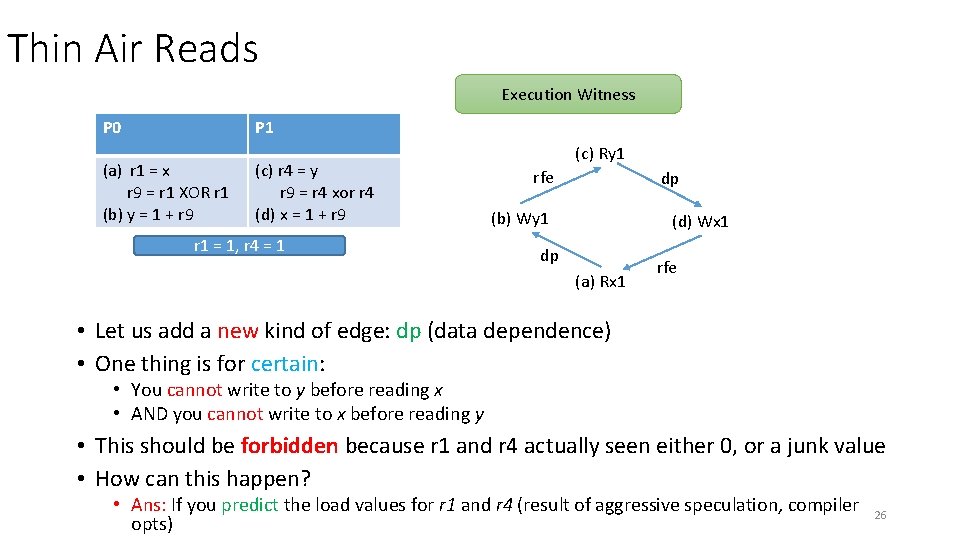
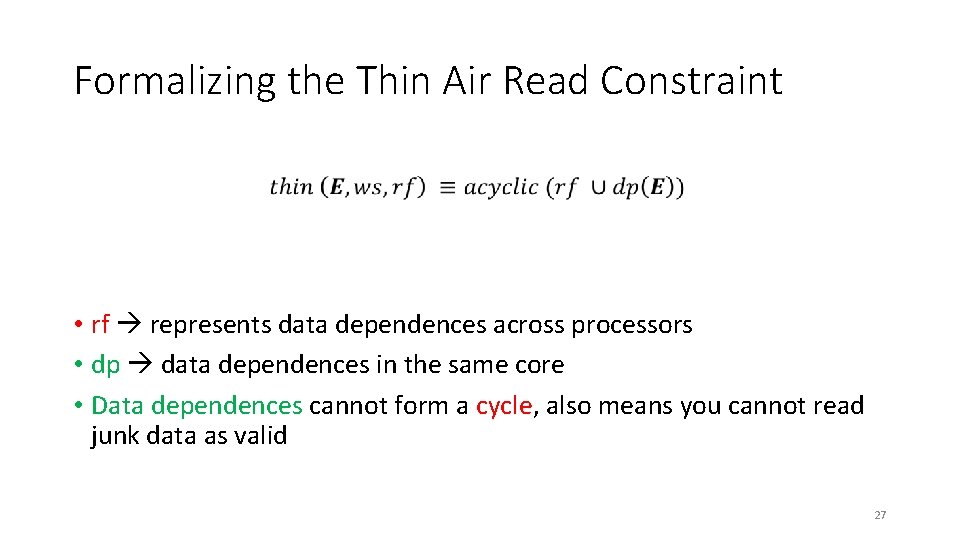
Thin Air Reads Execution Witness P 0 P 1 (a) r 1 = x r 9 = r 1 XOR r 1 (b) y = 1 + r 9 (c) r 4 = y r 9 = r 4 xor r 4 (d) x = 1 + r 9 r 1 = 1, r 4 = 1 (c) Ry 1 rfe dp (b) Wy 1 (d) Wx 1 dp (a) Rx 1 rfe • Let us add a new kind of edge: dp (data dependence) • One thing is for certain: • You cannot write to y before reading x • AND you cannot write to x before reading y • This should be forbidden because r 1 and r 4 actually seen either 0, or a junk value • How can this happen? • Ans: If you predict the load values for r 1 and r 4 (result of aggressive speculation, compiler opts) 26
Formalizing the Thin Air Read Constraint • rf represents data dependences across processors • dp data dependences in the same core • Data dependences cannot form a cycle, also means you cannot read junk data as valid 27
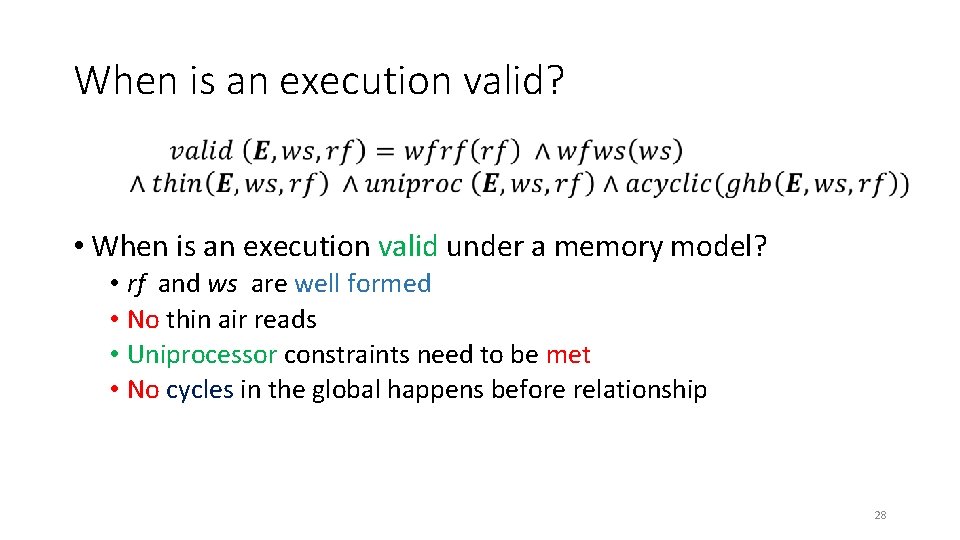
When is an execution valid? • When is an execution valid under a memory model? • rf and ws are well formed • No thin air reads • Uniprocessor constraints need to be met • No cycles in the global happens before relationship 28
29