
Dysphagia Inservice for Certified Nursing AssistantsCNAs and Cafeteria
- Slides: 24
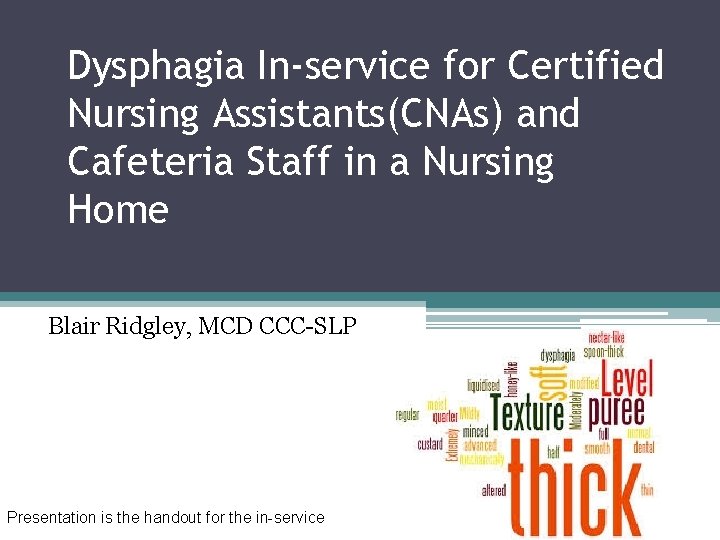
Dysphagia In-service for Certified Nursing Assistants(CNAs) and Cafeteria Staff in a Nursing Home Blair Ridgley, MCD CCC-SLP Presentation is the handout for the in-service
What is Dysphagia? • Dysphagia means difficulty eating or swallowing ▫ Dys: Difficult ▫ Phagein: To eat • A person can have difficulty with eating or swallowing, classified as dysphagia, relating to any of these three stages: ▫ Oral ▫ Pharyngeal ▫ Esophageal (Nazarko, 2008)
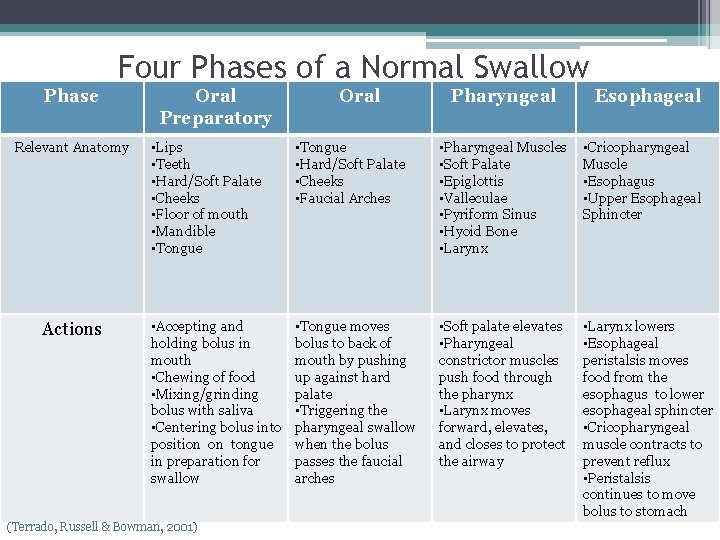
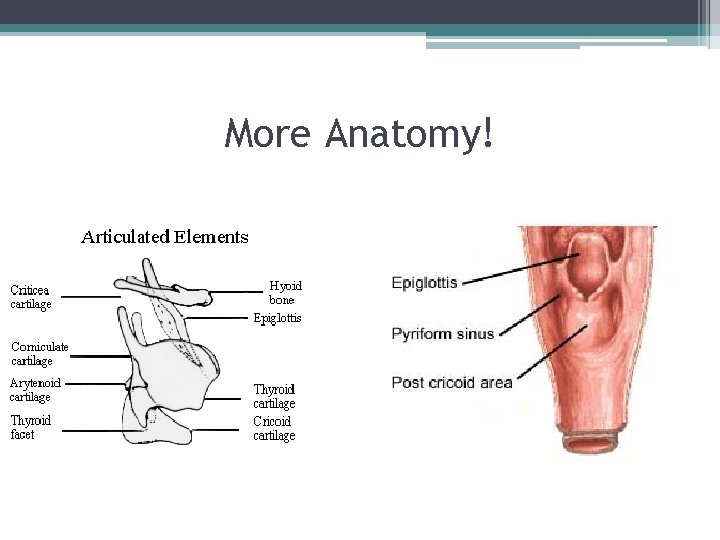
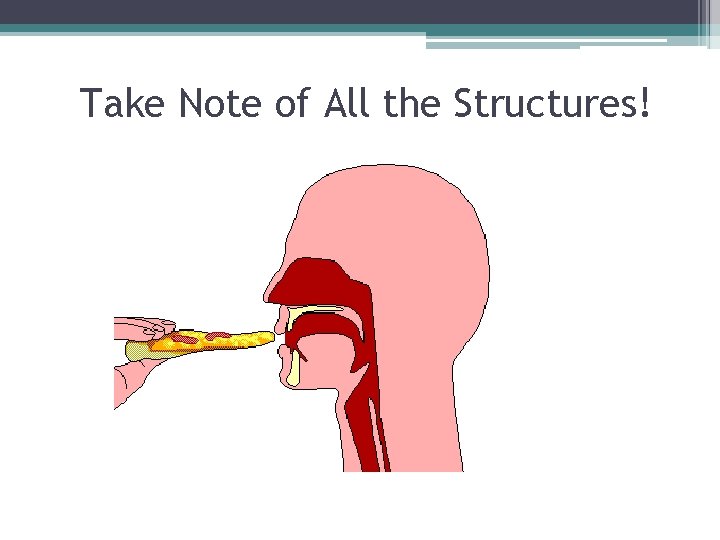
Four Phases of a Normal Swallow Phase Relevant Anatomy Actions Oral Preparatory Oral Pharyngeal Esophageal • Lips • Teeth • Hard/Soft Palate • Cheeks • Floor of mouth • Mandible • Tongue • Hard/Soft Palate • Cheeks • Faucial Arches • Pharyngeal Muscles • Soft Palate • Epiglottis • Valleculae • Pyriform Sinus • Hyoid Bone • Larynx • Cricopharyngeal Muscle • Esophagus • Upper Esophageal Sphincter • Accepting and holding bolus in mouth • Chewing of food • Mixing/grinding bolus with saliva • Centering bolus into position on tongue in preparation for swallow • Tongue moves bolus to back of mouth by pushing up against hard palate • Triggering the pharyngeal swallow when the bolus passes the faucial arches • Soft palate elevates • Pharyngeal constrictor muscles push food through the pharynx • Larynx moves forward, elevates, and closes to protect the airway • Larynx lowers • Esophageal peristalsis moves food from the esophagus to lower esophageal sphincter • Cricopharyngeal muscle contracts to prevent reflux • Peristalsis continues to move bolus to stomach (Terrado, Russell & Bowman, 2001)
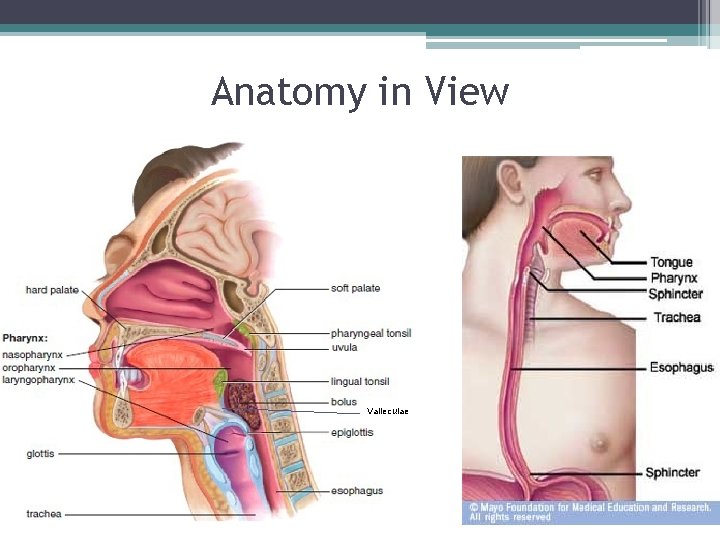
Anatomy in View Valleculae
More Anatomy!
Take Note of All the Structures!
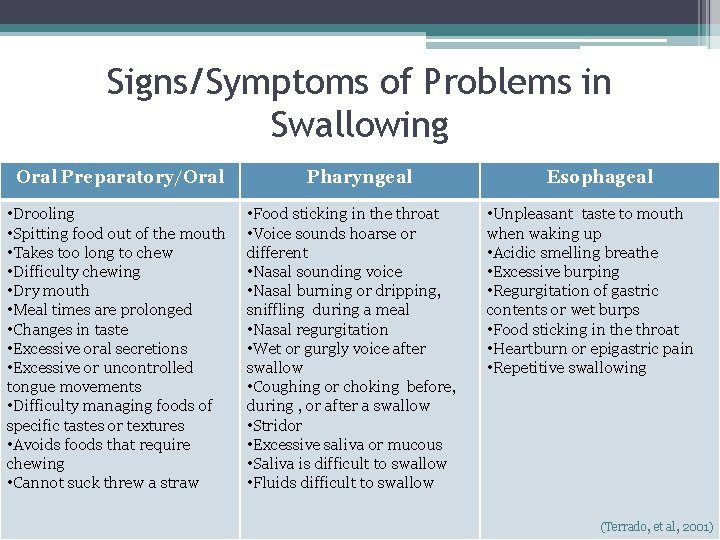
Signs/Symptoms of Problems in Swallowing Oral Preparatory/Oral • Drooling • Spitting food out of the mouth • Takes too long to chew • Difficulty chewing • Dry mouth • Meal times are prolonged • Changes in taste • Excessive oral secretions • Excessive or uncontrolled tongue movements • Difficulty managing foods of specific tastes or textures • Avoids foods that require chewing • Cannot suck threw a straw Pharyngeal • Food sticking in the throat • Voice sounds hoarse or different • Nasal sounding voice • Nasal burning or dripping, sniffling during a meal • Nasal regurgitation • Wet or gurgly voice after swallow • Coughing or choking before, during , or after a swallow • Stridor • Excessive saliva or mucous • Saliva is difficult to swallow • Fluids difficult to swallow Esophageal • Unpleasant taste to mouth when waking up • Acidic smelling breathe • Excessive burping • Regurgitation of gastric contents or wet burps • Food sticking in the throat • Heartburn or epigastric pain • Repetitive swallowing (Terrado, et al, 2001)
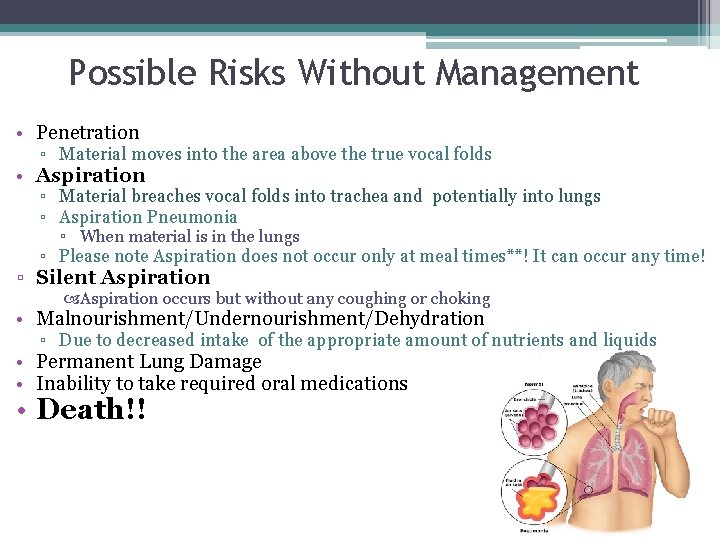
Possible Risks Without Management • Penetration ▫ Material moves into the area above the true vocal folds • Aspiration ▫ Material breaches vocal folds into trachea and potentially into lungs ▫ Aspiration Pneumonia ▫ When material is in the lungs ▫ Please note Aspiration does not occur only at meal times**! It can occur any time! ▫ Silent Aspiration occurs but without any coughing or choking • Malnourishment/Undernourishment/Dehydration ▫ Due to decreased intake of the appropriate amount of nutrients and liquids • Permanent Lung Damage • Inability to take required oral medications • Death!!
Signs and Symptoms of Silent Aspiration • Just because a patient is not coughing or choking after a swallow does not mean that they have not ASPIRATED!! • This may occur due to the patient losing the ability to feel that something is in their mouth or has entered their airway. • Around 50% of patients who aspirate are silent (Logemann, 1998) aspirators • Some signs to recognize silent aspiration: ▫ Eyes watering ▫ Nose running ▫ Patient turning a different color
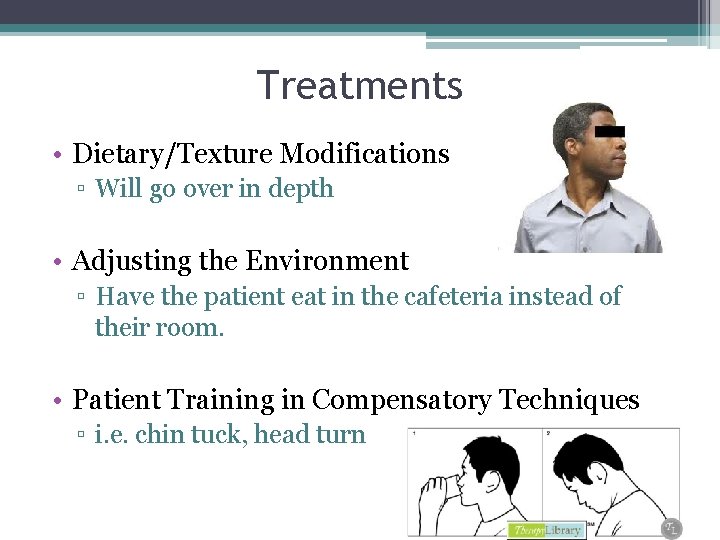
Treatments • Dietary/Texture Modifications ▫ Will go over in depth • Adjusting the Environment ▫ Have the patient eat in the cafeteria instead of their room. • Patient Training in Compensatory Techniques ▫ i. e. chin tuck, head turn
How Can We Modify the Patient’s Diet? • No Set Standard ▫ The American Speech-Language Hearing Association (ASHA) has no set standard for textures or modified foods and thickened liquids. (American Speech-Language Hearing Association, 1997 -2014) • ASHA does not have guidelines currently about food types that should be included on different diet texture levels. (American Speech-Language Hearing Association, 1997 -2014) • The National Dysphagia Diet (NDD) ▫ Published in 2002 by the National Dietetic Association ▫ It outlines 3 modified solid textures and 3 thickened liquid levels (Mc. Cullough, Pelletier, & Steele, 2003)
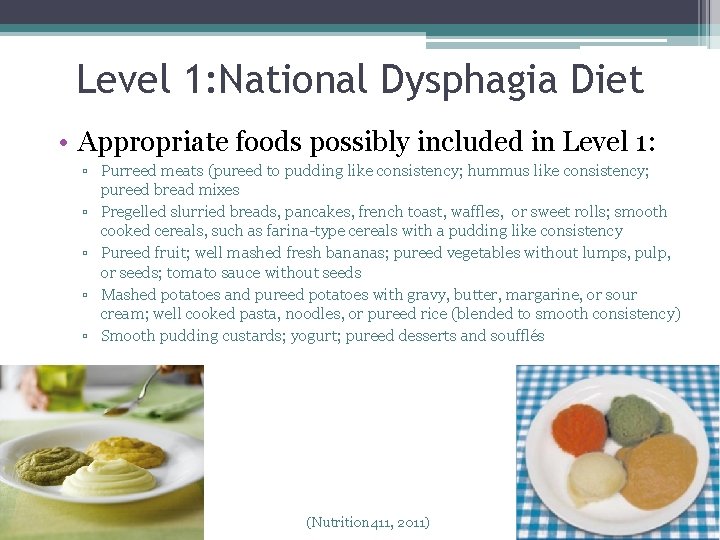
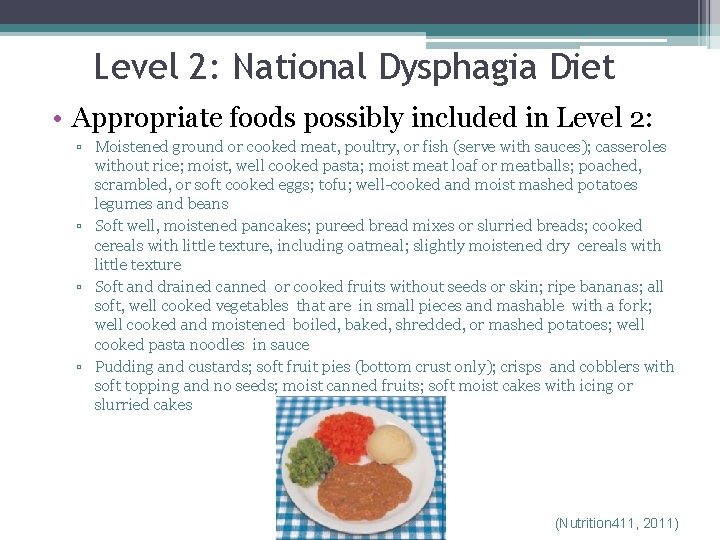
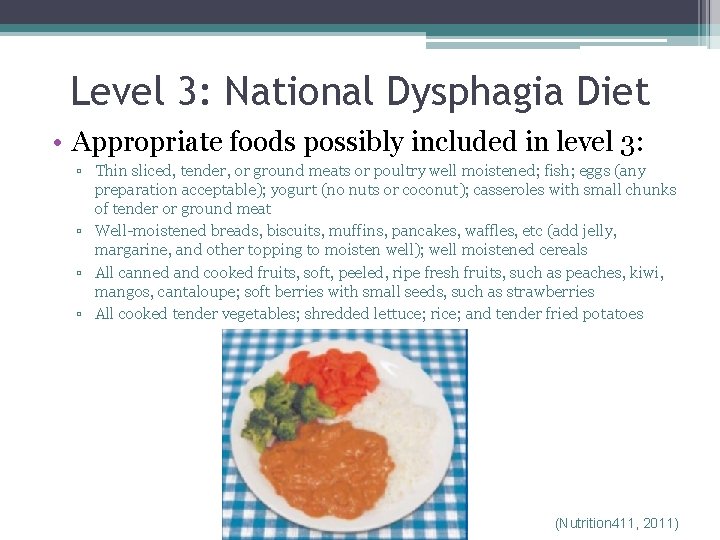
National Dyphagia Diet: 3 Solids • NDD Level 1: Dysphagia-Pureed (homogenous, very cohesive, pudding-like, requiring very little chewing ability). • NDD Level 2: Dysphagia-Mechanical Altered (cohesive, moist, semisolid foods, requiring some chewing). • NDD Level 3: Dysphagia-Advanced (soft foods that require more chewing ability). • Regular Diet: all foods allowed (Mc. Cullough, et al, 2003)
Level 1: National Dysphagia Diet • Appropriate foods possibly included in Level 1: ▫ Purreed meats (pureed to pudding like consistency; hummus like consistency; pureed bread mixes ▫ Pregelled slurried breads, pancakes, french toast, waffles, or sweet rolls; smooth cooked cereals, such as farina-type cereals with a pudding like consistency ▫ Pureed fruit; well mashed fresh bananas; pureed vegetables without lumps, pulp, or seeds; tomato sauce without seeds ▫ Mashed potatoes and pureed potatoes with gravy, butter, margarine, or sour cream; well cooked pasta, noodles, or pureed rice (blended to smooth consistency) ▫ Smooth pudding custards; yogurt; pureed desserts and soufflés (Nutrition 411, 2011)
Level 2: National Dysphagia Diet • Appropriate foods possibly included in Level 2: ▫ Moistened ground or cooked meat, poultry, or fish (serve with sauces); casseroles without rice; moist, well cooked pasta; moist meat loaf or meatballs; poached, scrambled, or soft cooked eggs; tofu; well-cooked and moist mashed potatoes legumes and beans ▫ Soft well, moistened pancakes; pureed bread mixes or slurried breads; cooked cereals with little texture, including oatmeal; slightly moistened dry cereals with little texture ▫ Soft and drained canned or cooked fruits without seeds or skin; ripe bananas; all soft, well cooked vegetables that are in small pieces and mashable with a fork; well cooked and moistened boiled, baked, shredded, or mashed potatoes; well cooked pasta noodles in sauce ▫ Pudding and custards; soft fruit pies (bottom crust only); crisps and cobblers with soft topping and no seeds; moist canned fruits; soft moist cakes with icing or slurried cakes (Nutrition 411, 2011)
Level 3: National Dysphagia Diet • Appropriate foods possibly included in level 3: ▫ Thin sliced, tender, or ground meats or poultry well moistened; fish; eggs (any preparation acceptable); yogurt (no nuts or coconut); casseroles with small chunks of tender or ground meat ▫ Well-moistened breads, biscuits, muffins, pancakes, waffles, etc (add jelly, margarine, and other topping to moisten well); well moistened cereals ▫ All canned and cooked fruits, soft, peeled, ripe fresh fruits, such as peaches, kiwi, mangos, cantaloupe; soft berries with small seeds, such as strawberries ▫ All cooked tender vegetables; shredded lettuce; rice; and tender fried potatoes (Nutrition 411, 2011)
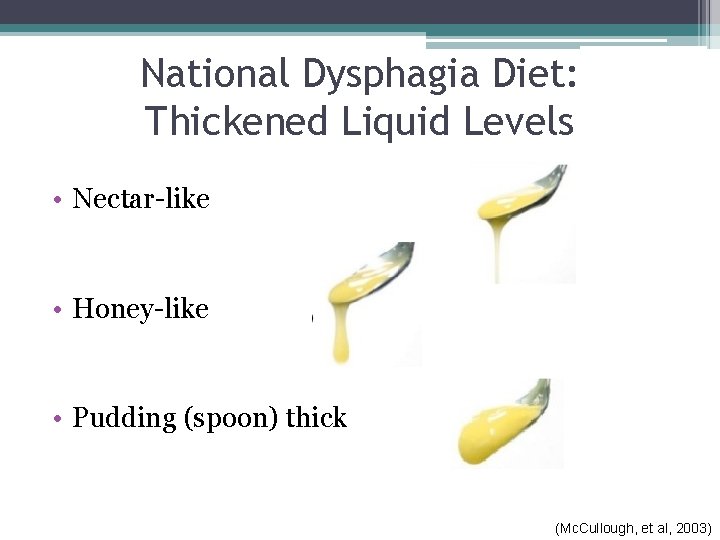
National Dysphagia Diet: Thickened Liquid Levels • Nectar-like • Honey-like • Pudding (spoon) thick (Mc. Cullough, et al, 2003)
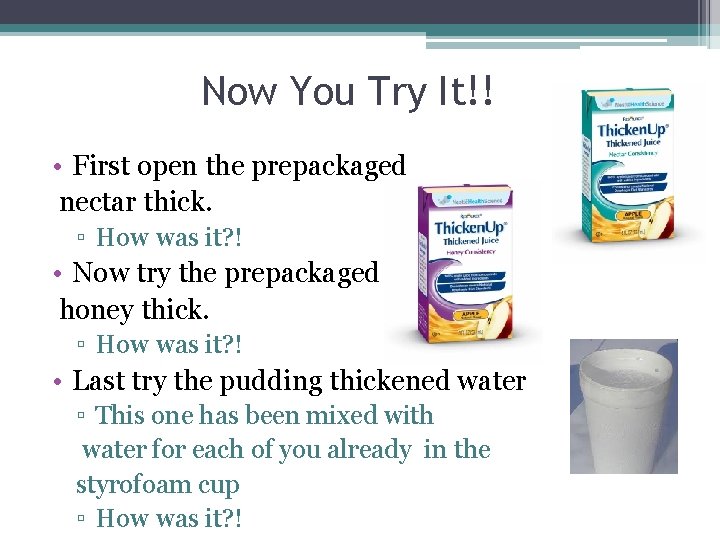
Now You Try It!! • First open the prepackaged nectar thick. ▫ How was it? ! • Now try the prepackaged honey thick. ▫ How was it? ! • Last try the pudding thickened water ▫ This one has been mixed with water for each of you already in the styrofoam cup ▫ How was it? !
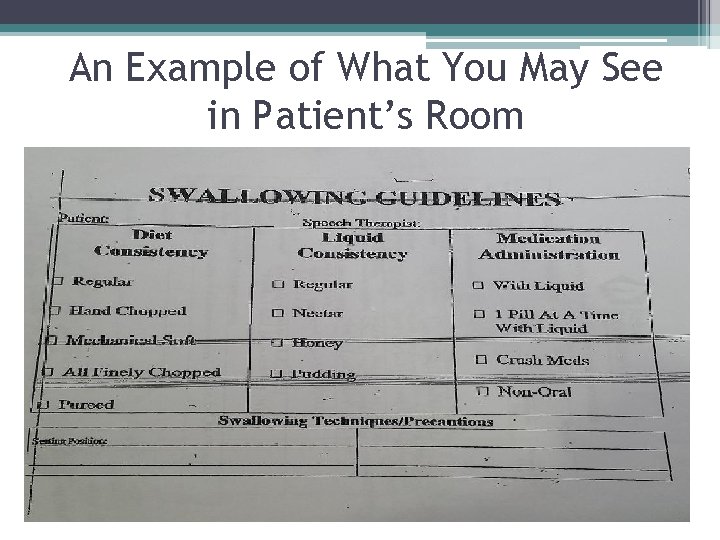
What should you do while feeding the patient? • When feeding the patient be on the look out for those signs and symptoms we talked about earlier. ▫ Choking, coughing, wet or gurgly voice quality, eyes watering, nose running, etc. • If the patient is known to have weakness on one side make sure to place the food on the strong side of the mouth, so chewing can be done appropriately. • Give verbal and visual cues if necessary for the patient ▫ “alright now let’s clear the side of your mouth, so take your finger and move that food onto your tongue” ▫ Say this while showing the patient what to do with your finger in your mouth • Make sure the patient is using compensatory strategies while eating ▫ Chin tucks, head turns, etc. ▫ If the patient has a delayed swallow a functional way to help the problem is to give them a bite of food then give them a bite of sherbet to wake up the swallowing system and initiate a swallow reflex • Look for any signs above or near the patient’s bed for specific diets! • Position the patient appropriately!
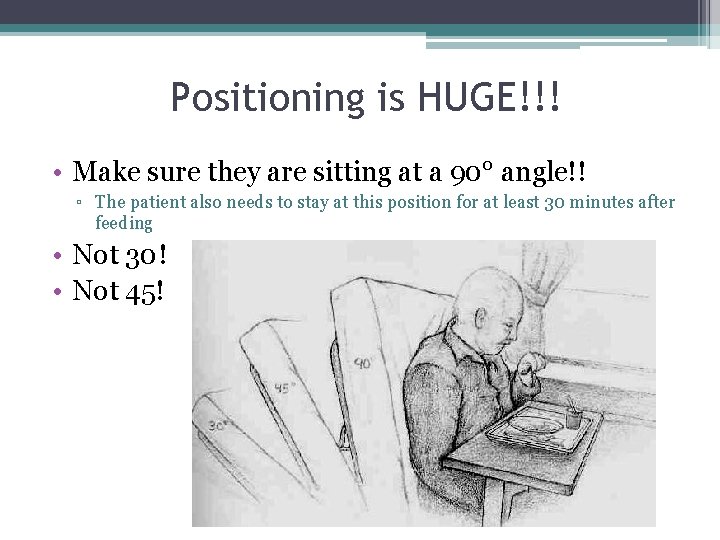
Positioning is HUGE!!! • Make sure they are sitting at a 90° angle!! ▫ The patient also needs to stay at this position for at least 30 minutes after feeding • Not 30! • Not 45!
An Example of What You May See in Patient’s Room
What should you NOT do while feeding a patient? • DO NOT: ▫ Add ice or water to already thickened liquids This makes the liquid thin again which can cause the patient to possibly aspirate We want to follow the diets given strictly!!! ▫ Feed the patient when they are lethargic or sleeping ▫ Use straws when giving the patient thickened liquids Instruct them to take small sips of their liquid ▫ Let the thickened liquid sit for a long time It will get thicker as it sits and may cause problems for the patient
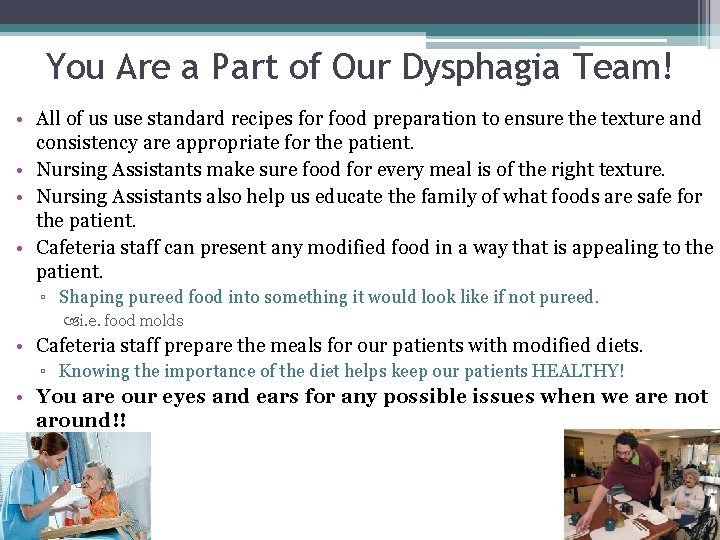
You Are a Part of Our Dysphagia Team! • All of us use standard recipes for food preparation to ensure the texture and consistency are appropriate for the patient. • Nursing Assistants make sure food for every meal is of the right texture. • Nursing Assistants also help us educate the family of what foods are safe for the patient. • Cafeteria staff can present any modified food in a way that is appealing to the patient. ▫ Shaping pureed food into something it would look like if not pureed. i. e. food molds • Cafeteria staff prepare the meals for our patients with modified diets. ▫ Knowing the importance of the diet helps keep our patients HEALTHY! • You are our eyes and ears for any possible issues when we are not around!!
Let’s Test What You’ve Learned!! • If the patient complains their thickened water isn’t cold enough, you can put ice chips in it to make it cold. ▫ True or False? • What angle should a patient be sitting at when eating? ▫ 30°, 40°, 90° • You shouldn’t worry about aspiration if the patient isn’t coughing or choking, but their eyes are watering. ▫ True or False? • What are some examples of signs and symptoms involved with issues in swallowing? • If a patient is recommended a Level 1 diet, they are able to eat foods that need a large amount of chewing. ▫ True or False?
Questions? ? ?