Functional Family Therapy Overview Implementation Planning Todd Sosna

- Slides: 42
Functional Family Therapy Overview & Implementation Planning Todd Sosna. Ph. D. , CIMH Senior Associate Pam Hawkins, CIMH Associate *Slides on FFT model and outcomes courtesy of FFT National Training Center FFT Introduction & Planning
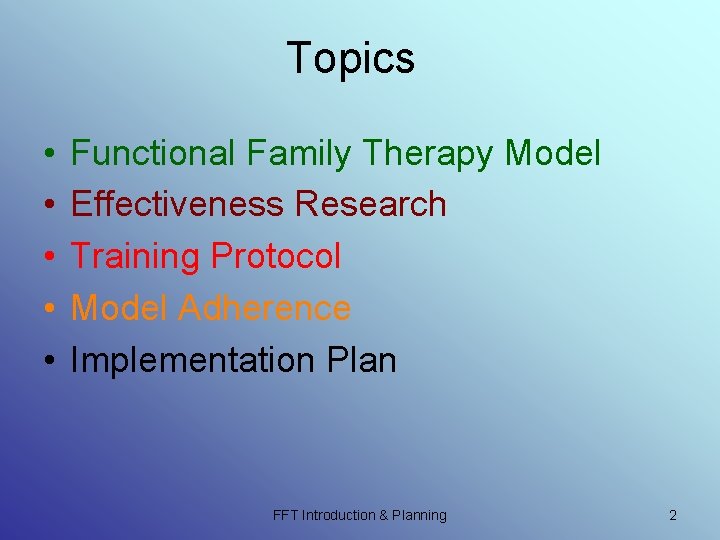
Topics • • • Functional Family Therapy Model Effectiveness Research Training Protocol Model Adherence Implementation Plan FFT Introduction & Planning 2
Functional Family Therapy-FFT • Research-based prevention and intervention program for at-risk adolescents and their families • Developed by James Alexander, University of Utah • FFT Inc. www. fftinc. com FFT Introduction & Planning 3
FFT Target Population • Youth (11 -18) • Appropriate for the full recidivism risk continuum • Presenting serious delinquency, violence and/or substance use • Diversion • Probation or child welfare involved • Family conflict FFT Introduction & Planning 4
FFT Model • Provided by a team of practitioners • 3 -8 practitioners per team • Masters level clinician is preferred; however, bachelors level practitioner is acceptable • Home, clinic or community settings • Typically 3 sessions in the first 10 days, and then 1 session per week, but may vary • Typical duration of therapy is 8 -30 sessions, depending on severity • Sessions lengths vary (60 -120 minutes) • Each therapist works with 10 -12 families at one time FFT Introduction & Planning 5
FFT Model • Builds protective factors, reduces risk factors • Therapist assumes responsibility for – Engagement – Develops interventions that give family members hope even before behavior change occurs – Work with families to develop a “roadmap” for change – Provide them tools to be successful in the context of their own values and culture FFT Introduction & Planning 6
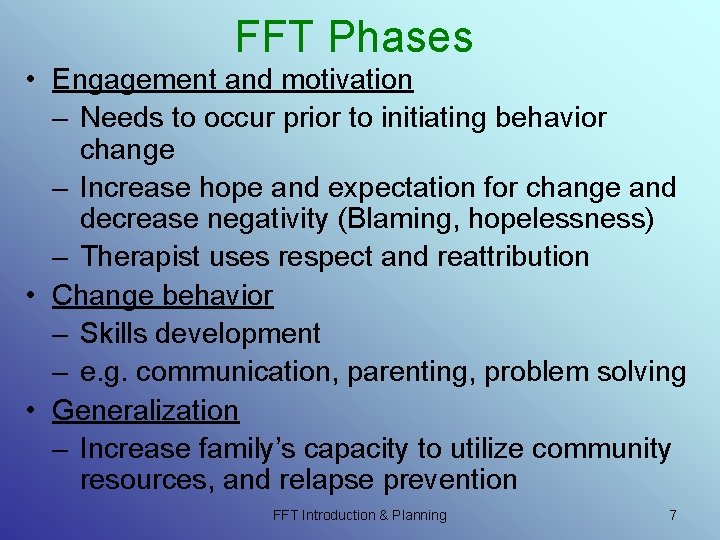
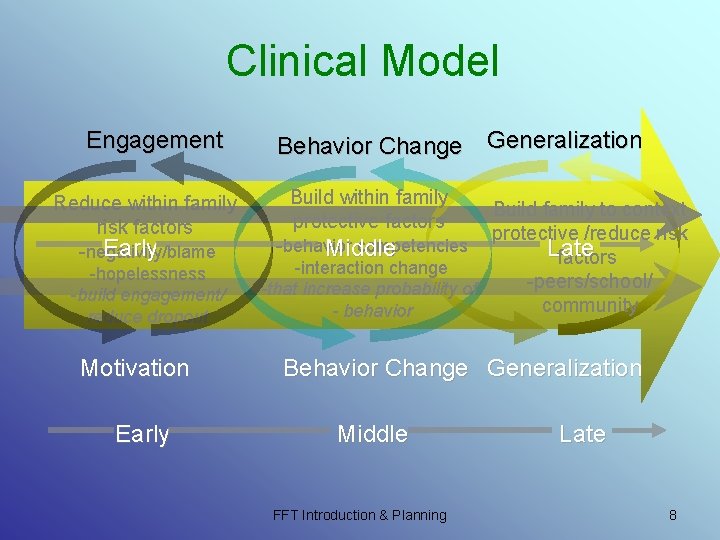
FFT Phases • Engagement and motivation – Needs to occur prior to initiating behavior change – Increase hope and expectation for change and decrease negativity (Blaming, hopelessness) – Therapist uses respect and reattribution • Change behavior – Skills development – e. g. communication, parenting, problem solving • Generalization – Increase family’s capacity to utilize community resources, and relapse prevention FFT Introduction & Planning 7
Clinical Model Engagement Reduce within family risk factors Early -negativity/blame -hopelessness -build engagement/ reduce dropout Motivation Early Behavior Change Generalization Build within family protective factors Build family to context protective /reduce risk -behavior competencies Middle Late factors -interaction change -peers/school/ -that increase probability of community - behavior Behavior Change Generalization Middle FFT Introduction & Planning Late 8
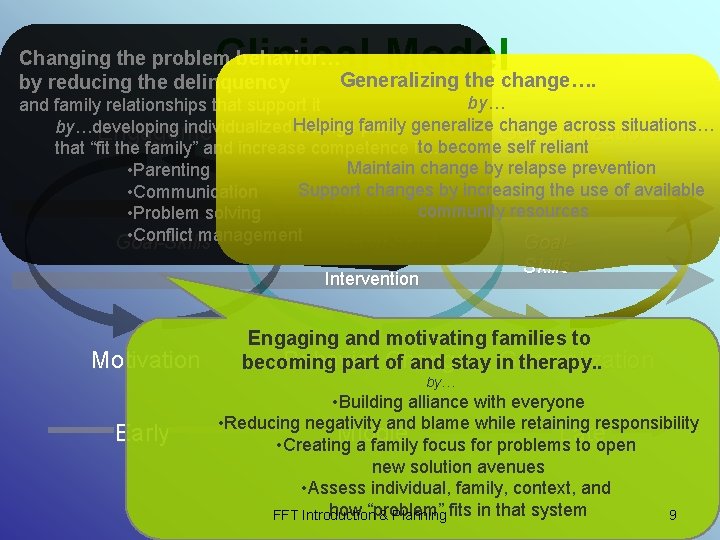
Clinical Model Changing the problem behavior… Generalizing the change…. by reducing the delinquency by… and family relationships that support it Helping generalize change across situations… by…developing individualized. Behavior change family plans Engagement Change Generalization to become self reliant that “fit the family” and increase competence in. . Maintain change by relapse prevention • Parenting Support changes by increasing the use of available • Communication Assessment community resources • Problem solving • Conflict management Goal-Skills Goal-Skills Intervention Motivation Early Goal. Skills Engaging and motivating families to Behavior Generalization becoming part Change of and stay in therapy. . by… • Building alliance with everyone • Reducing negativity and blame while retaining responsibility Middle Late • Creating a family focus for problems to open new solution avenues • Assess individual, family, context, and how “problem” FFT Introduction & Planning fits in that system 9
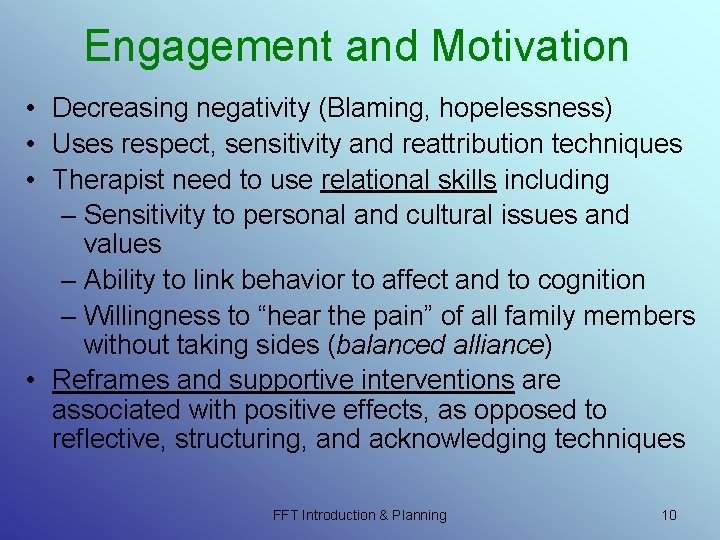
Engagement and Motivation • Decreasing negativity (Blaming, hopelessness) • Uses respect, sensitivity and reattribution techniques • Therapist need to use relational skills including – Sensitivity to personal and cultural issues and values – Ability to link behavior to affect and to cognition – Willingness to “hear the pain” of all family members without taking sides (balanced alliance) • Reframes and supportive interventions are associated with positive effects, as opposed to reflective, structuring, and acknowledging techniques FFT Introduction & Planning 10
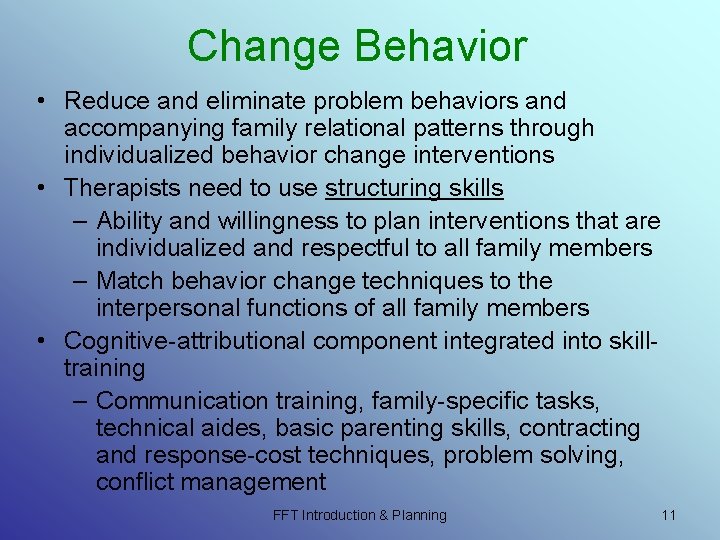
Change Behavior • Reduce and eliminate problem behaviors and accompanying family relational patterns through individualized behavior change interventions • Therapists need to use structuring skills – Ability and willingness to plan interventions that are individualized and respectful to all family members – Match behavior change techniques to the interpersonal functions of all family members • Cognitive-attributional component integrated into skilltraining – Communication training, family-specific tasks, technical aides, basic parenting skills, contracting and response-cost techniques, problem solving, conflict management FFT Introduction & Planning 11
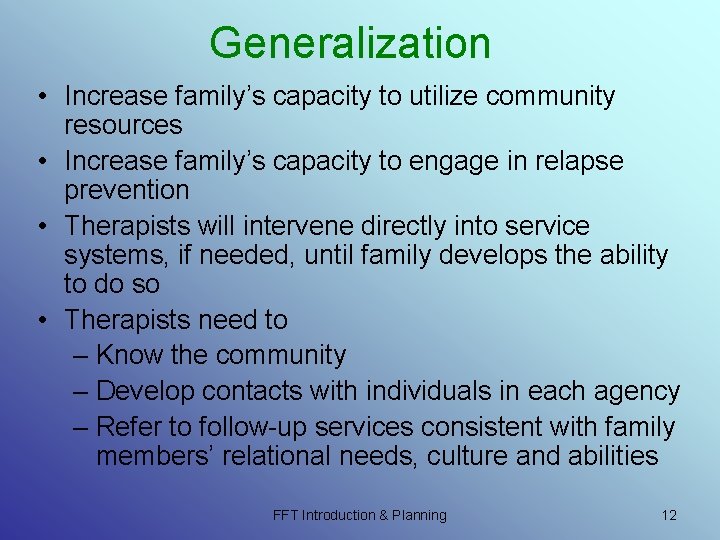
Generalization • Increase family’s capacity to utilize community resources • Increase family’s capacity to engage in relapse prevention • Therapists will intervene directly into service systems, if needed, until family develops the ability to do so • Therapists need to – Know the community – Develop contacts with individuals in each agency – Refer to follow-up services consistent with family members’ relational needs, culture and abilities FFT Introduction & Planning 12
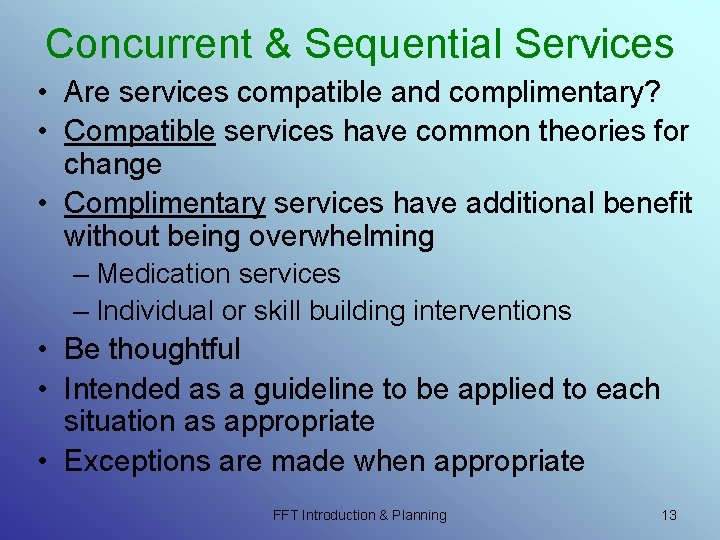
Concurrent & Sequential Services • Are services compatible and complimentary? • Compatible services have common theories for change • Complimentary services have additional benefit without being overwhelming – Medication services – Individual or skill building interventions • Be thoughtful • Intended as a guideline to be applied to each situation as appropriate • Exceptions are made when appropriate FFT Introduction & Planning 13
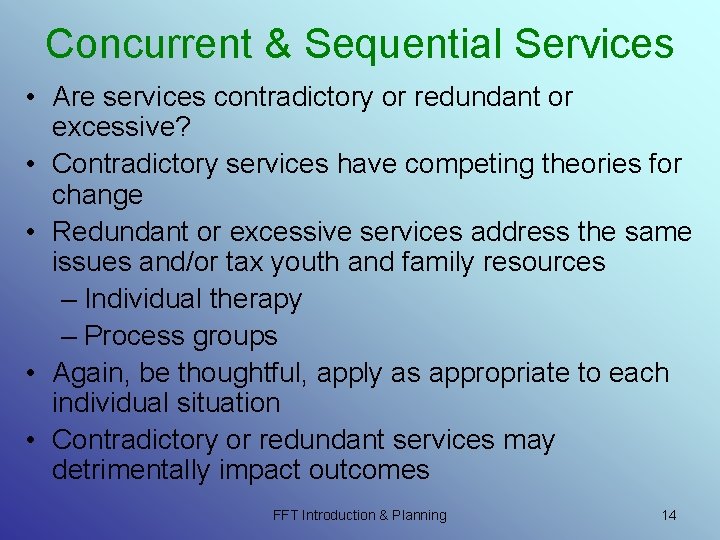
Concurrent & Sequential Services • Are services contradictory or redundant or excessive? • Contradictory services have competing theories for change • Redundant or excessive services address the same issues and/or tax youth and family resources – Individual therapy – Process groups • Again, be thoughtful, apply as appropriate to each individual situation • Contradictory or redundant services may detrimentally impact outcomes FFT Introduction & Planning 14
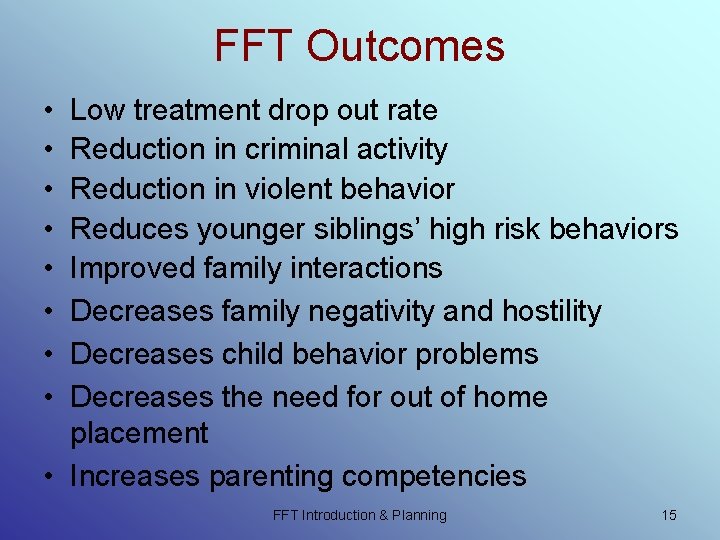
FFT Outcomes • • Low treatment drop out rate Reduction in criminal activity Reduction in violent behavior Reduces younger siblings’ high risk behaviors Improved family interactions Decreases family negativity and hostility Decreases child behavior problems Decreases the need for out of home placement • Increases parenting competencies FFT Introduction & Planning 15
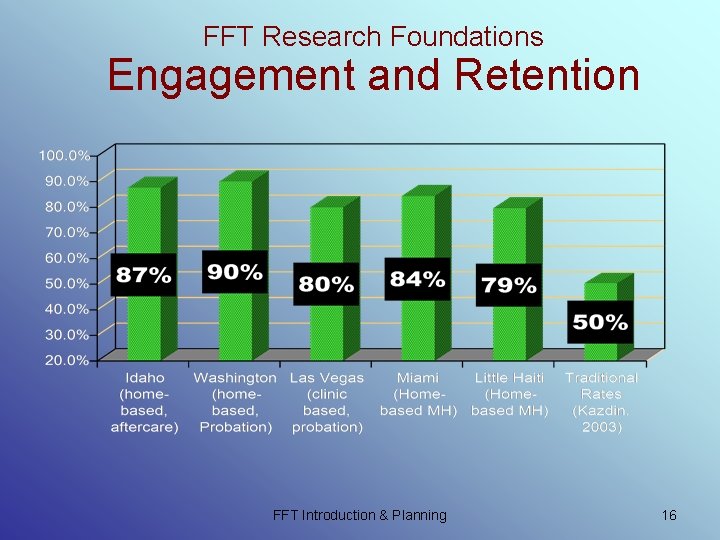
FFT Research Foundations Engagement and Retention FFT Introduction & Planning 16
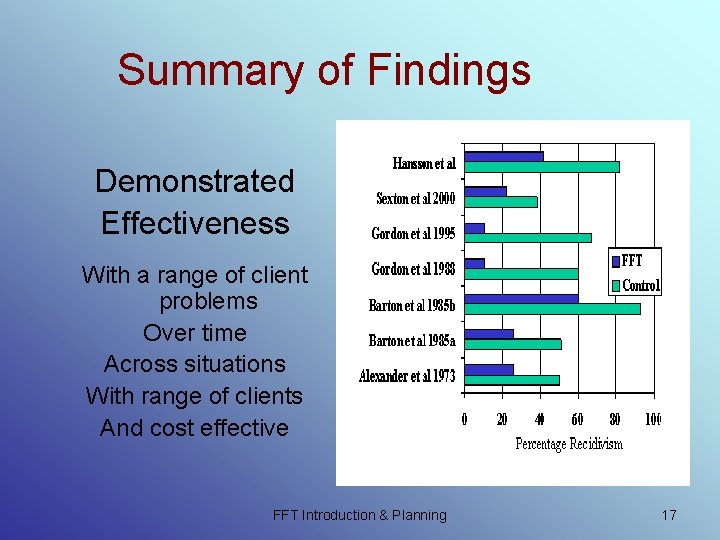
Summary of Findings Demonstrated Effectiveness With a range of client problems Over time Across situations With range of clients And cost effective FFT Introduction & Planning 17
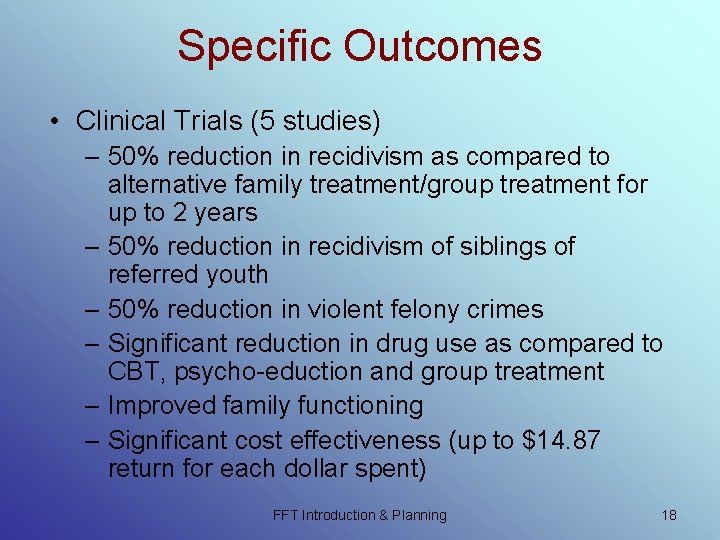
Specific Outcomes • Clinical Trials (5 studies) – 50% reduction in recidivism as compared to alternative family treatment/group treatment for up to 2 years – 50% reduction in recidivism of siblings of referred youth – 50% reduction in violent felony crimes – Significant reduction in drug use as compared to CBT, psycho-eduction and group treatment – Improved family functioning – Significant cost effectiveness (up to $14. 87 return for each dollar spent) FFT Introduction & Planning 18
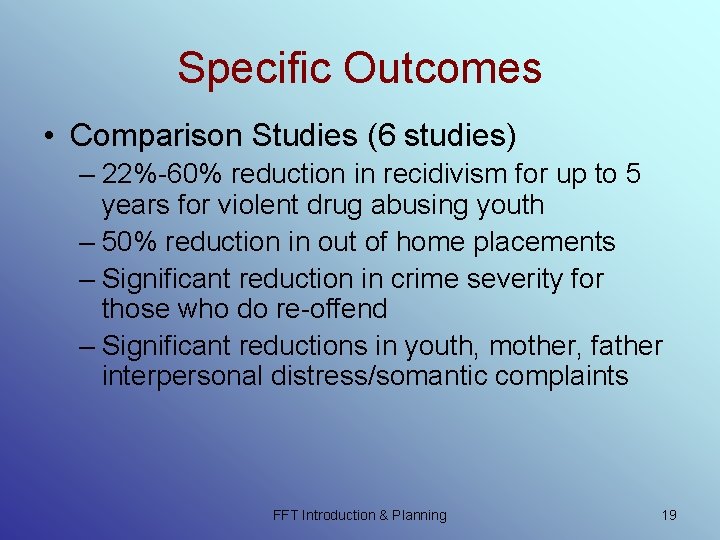
Specific Outcomes • Comparison Studies (6 studies) – 22%-60% reduction in recidivism for up to 5 years for violent drug abusing youth – 50% reduction in out of home placements – Significant reduction in crime severity for those who do re-offend – Significant reductions in youth, mother, father interpersonal distress/somantic complaints FFT Introduction & Planning 19
FFT Randomized Trials (Recidivism 6 – 12 months, 30 – 42 months, 24 months respectively) Absolute Effectiveness FFT Introduction & Planning Relative Effectiveness 20
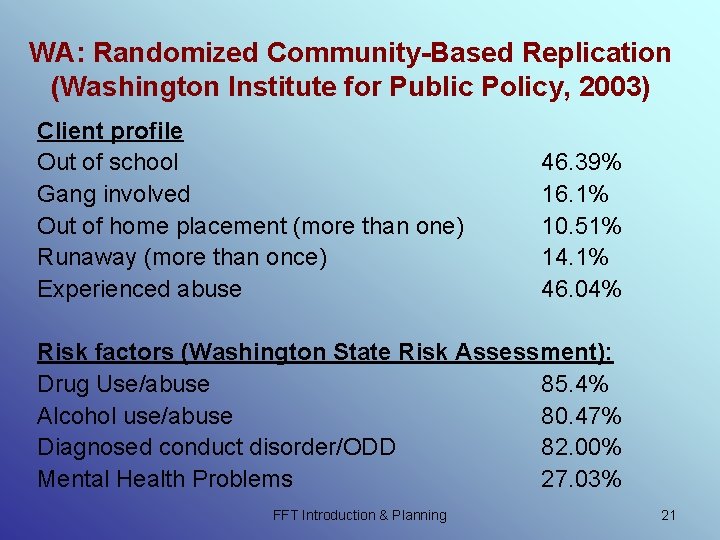
WA: Randomized Community-Based Replication (Washington Institute for Public Policy, 2003) Client profile Out of school Gang involved Out of home placement (more than one) Runaway (more than once) Experienced abuse 46. 39% 16. 1% 10. 51% 14. 1% 46. 04% Risk factors (Washington State Risk Assessment): Drug Use/abuse 85. 4% Alcohol use/abuse 80. 47% Diagnosed conduct disorder/ODD 82. 00% Mental Health Problems 27. 03% FFT Introduction & Planning 21
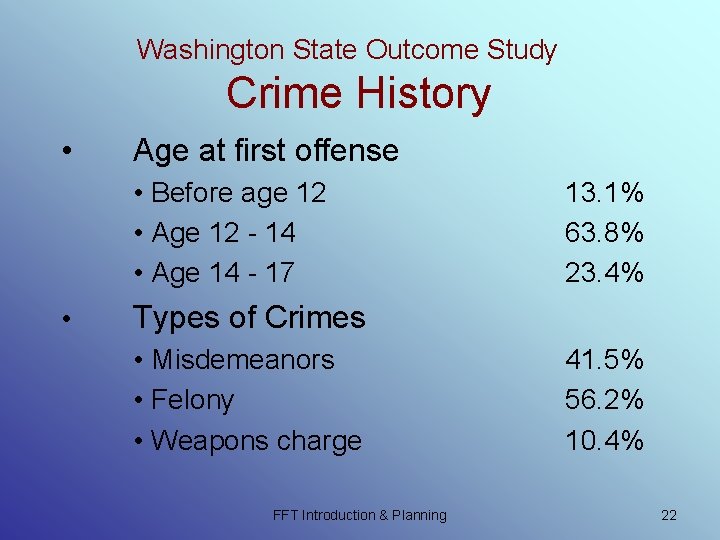
Washington State Outcome Study Crime History • Age at first offense • Before age 12 • Age 12 - 14 • Age 14 - 17 • 13. 1% 63. 8% 23. 4% Types of Crimes • Misdemeanors • Felony • Weapons charge FFT Introduction & Planning 41. 5% 56. 2% 10. 4% 22
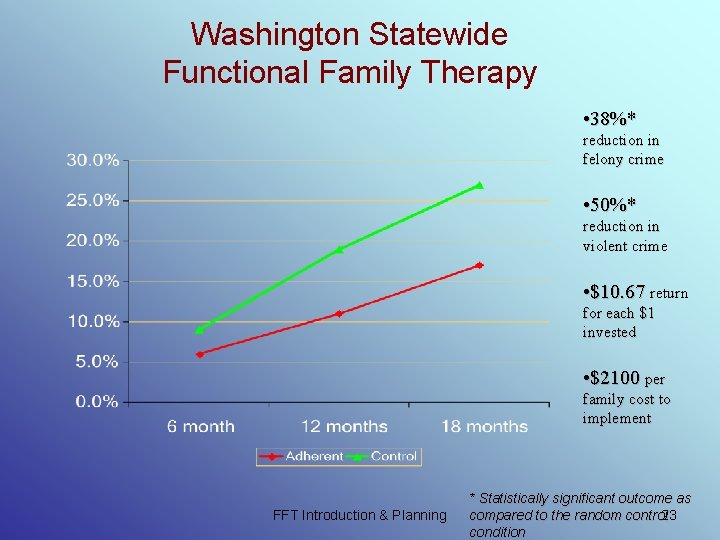
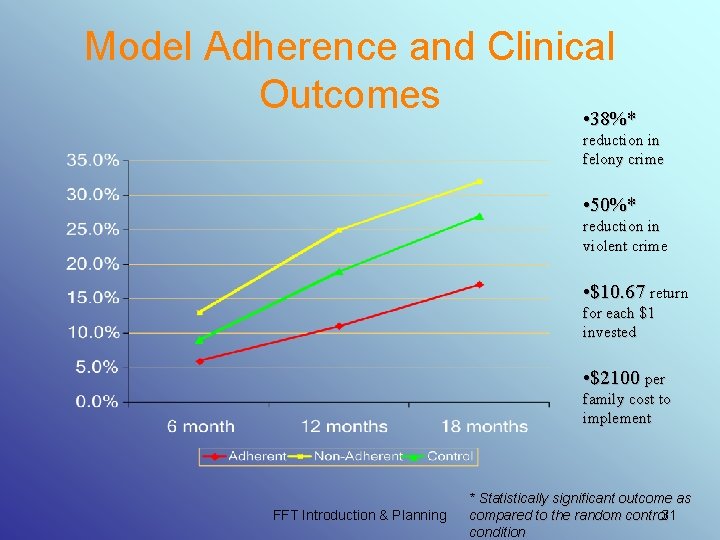
Washington Statewide Functional Family Therapy • 38%* reduction in felony crime • 50%* reduction in violent crime • $10. 67 return for each $1 invested • $2100 per family cost to implement FFT Introduction & Planning * Statistically significant outcome as compared to the random control 23 condition
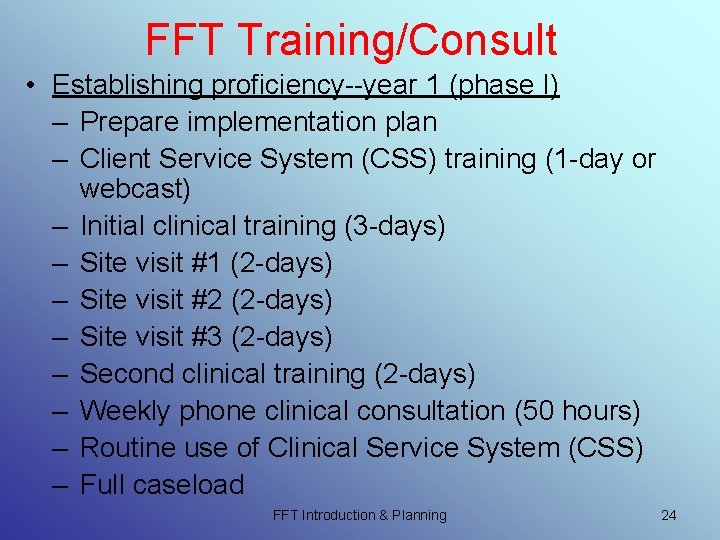
FFT Training/Consult • Establishing proficiency--year 1 (phase I) – Prepare implementation plan – Client Service System (CSS) training (1 -day or webcast) – Initial clinical training (3 -days) – Site visit #1 (2 -days) – Site visit #2 (2 -days) – Site visit #3 (2 -days) – Second clinical training (2 -days) – Weekly phone clinical consultation (50 hours) – Routine use of Clinical Service System (CSS) – Full caseload FFT Introduction & Planning 24
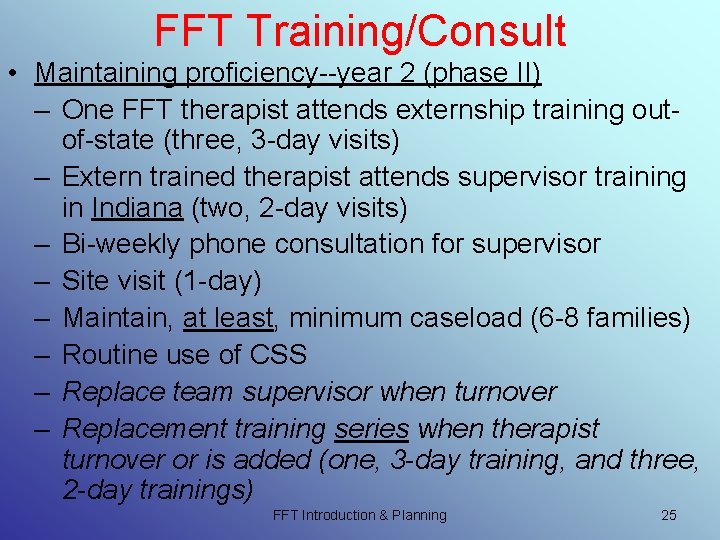
FFT Training/Consult • Maintaining proficiency--year 2 (phase II) – One FFT therapist attends externship training outof-state (three, 3 -day visits) – Extern trained therapist attends supervisor training in Indiana (two, 2 -day visits) – Bi-weekly phone consultation for supervisor – Site visit (1 -day) – Maintain, at least, minimum caseload (6 -8 families) – Routine use of CSS – Replace team supervisor when turnover – Replacement training series when therapist turnover or is added (one, 3 -day training, and three, 2 -day trainings) FFT Introduction & Planning 25
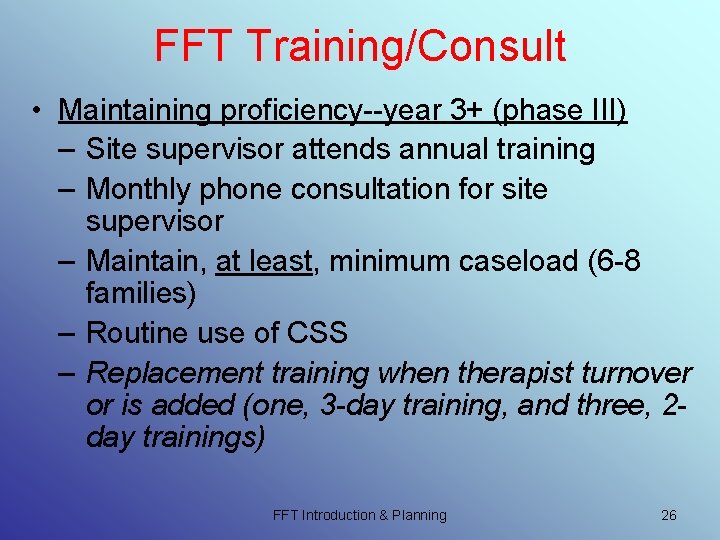
FFT Training/Consult • Maintaining proficiency--year 3+ (phase III) – Site supervisor attends annual training – Monthly phone consultation for site supervisor – Maintain, at least, minimum caseload (6 -8 families) – Routine use of CSS – Replacement training when therapist turnover or is added (one, 3 -day training, and three, 2 day trainings) FFT Introduction & Planning 26
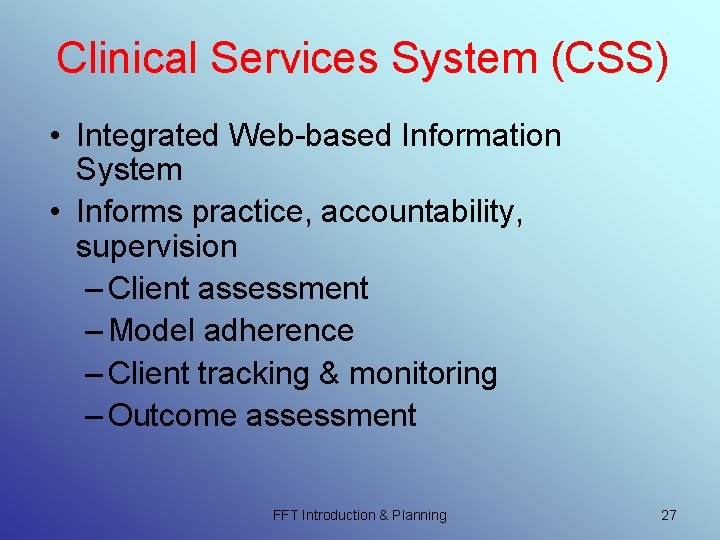
Clinical Services System (CSS) • Integrated Web-based Information System • Informs practice, accountability, supervision – Client assessment – Model adherence – Client tracking & monitoring – Outcome assessment FFT Introduction & Planning 27
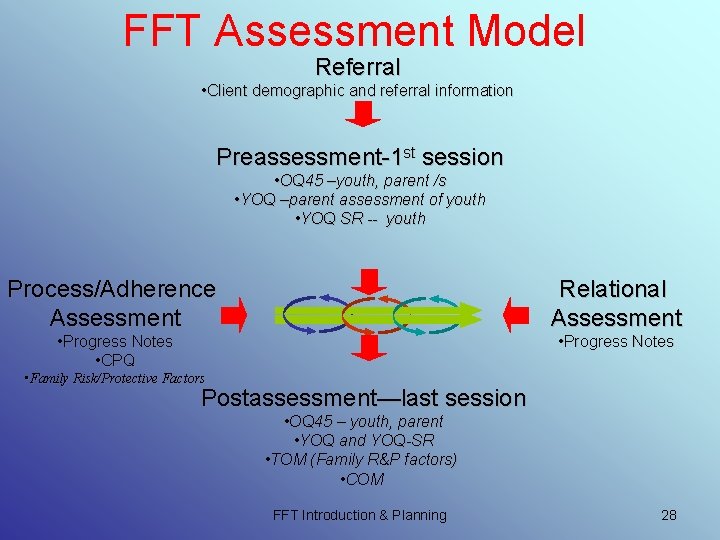
FFT Assessment Model Referral • Client demographic and referral information Preassessment-1 st session • OQ 45 –youth, parent /s • YOQ –parent assessment of youth • YOQ SR -- youth Process/Adherence Assessment Relational Assessment • Progress Notes • CPQ • Progress Notes • Family Risk/Protective Factors Postassessment—last session • OQ 45 – youth, parent • YOQ and YOQ-SR • TOM (Family R&P factors) • COM FFT Introduction & Planning 28
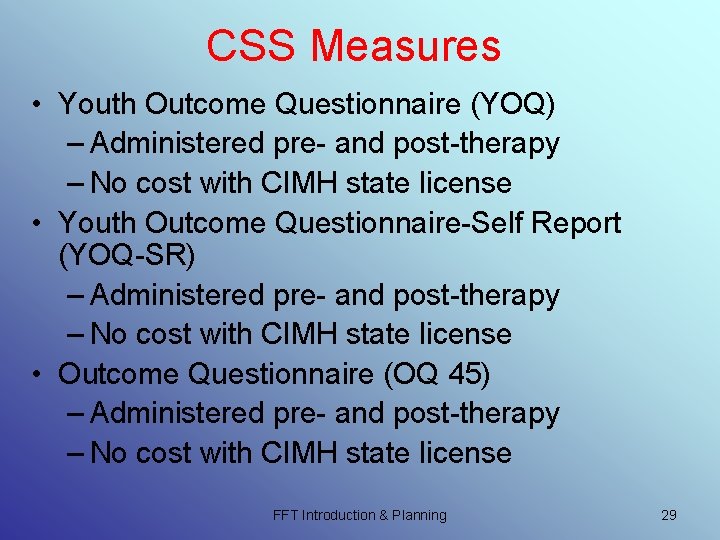
CSS Measures • Youth Outcome Questionnaire (YOQ) – Administered pre- and post-therapy – No cost with CIMH state license • Youth Outcome Questionnaire-Self Report (YOQ-SR) – Administered pre- and post-therapy – No cost with CIMH state license • Outcome Questionnaire (OQ 45) – Administered pre- and post-therapy – No cost with CIMH state license FFT Introduction & Planning 29
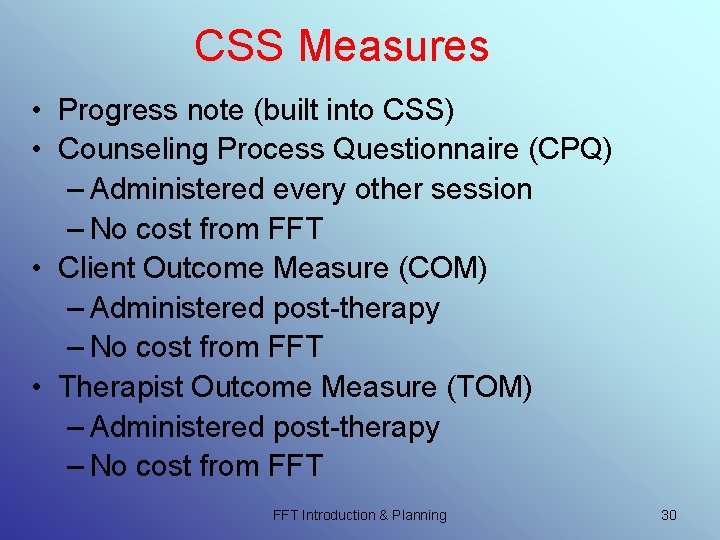
CSS Measures • Progress note (built into CSS) • Counseling Process Questionnaire (CPQ) – Administered every other session – No cost from FFT • Client Outcome Measure (COM) – Administered post-therapy – No cost from FFT • Therapist Outcome Measure (TOM) – Administered post-therapy – No cost from FFT Introduction & Planning 30
Model Adherence and Clinical Outcomes • 38%* reduction in felony crime • 50%* reduction in violent crime • $10. 67 return for each $1 invested • $2100 per family cost to implement FFT Introduction & Planning * Statistically significant outcome as compared to the random control 31 condition
Development Team Goals • High quality, model adherent (high fidelity) and sustainable implementation of FFT – Prepare practitioners to be proficient in the use of FFT – Prepare agencies to support and sustain FFT teams FFT Introduction & Planning 32
Development Team Features • Development Teams are a training and technical assistance process to promote adoption of a practice • Consisting of a team of agencies committed to adopting a practice in common • Combines four features – Clinical training – Administrative supports – Site specific planning – Peer-to-peer assistance FFT Introduction & Planning 33
Development Team Features • Clinical training and consultation provided by the FFT national training center • Implementation planning and administrative supports provided by CIMH Planning meetings – Monthly Administrator conference calls – Outcome evaluation support (analysis and reporting) • Channels of communication to support peerto-peer assistance – Web bulletin board FFT Introduction & Planning 34
Expectations • Agencies are committed to participating fully in all training and consultation activities • Agencies are committed to implementing FFT with fidelity • Agencies will diligently use the CSS and evaluate outcomes • Agencies will establish HIPPA agreements to support sharing of information for clinical consultations and outcome evaluation FFT Introduction & Planning 35
Expectations • Agencies are responsible for the cost of training and consultation • Agencies will be responsible for their own travel expenses • One manager, per team, who will not be providing FFT is welcome to “audit” the clinical trainings • Agencies will have ongoing training and consultation costs associated with replacing/adding therapists, replacing team supervisors, and maintaining model adherence FFT Introduction & Planning 36
Implementation Plans • • • Clients Integration into agency services Staffing Funding Administrative oversight FFT Introduction & Planning 37
Integrating Into Agency Services • Where will the practice fit into the service system? • Who will be referred? Inclusion or exclusion criteria? • Who will be responsible for making referrals, and under what circumstances? • Will the service be provided independently of, in addition to, or instead of other services? FFT Introduction & Planning 38
Staffing • Who will be the practitioners? • How will they be selected? • Will they be full time dedicated to FFT? • What other duties will they have? FFT Introduction & Planning 39
Funding • How will FFT be funded? • Are billing or other requirements compatible? • Are the individuals responsible for billing involved in the planning? • Is there coordination with the County Mental Health Plan? FFT Introduction & Planning 40
Administrative Oversight • Who at the administrative level participated in implementation planning? • Who at the administrative level will be responsible to make sure that FFT is implemented? • How will staff attrition be managed? FFT Introduction & Planning 41
www. cimh. org • Todd Sosna – tmq@verizon. net – (916) 549 -5506 • Pam Hawkins – Phawkins@cimh. org – (916) 556 -3480 ext. 135 FFT Introduction & Planning 42