
Functional Family Parole Services Washington State Juvenile Justice
- Slides: 60
Functional Family Parole Services Washington State Juvenile Justice & Rehabilitation Administration, Juvenile Rehabilitation An integrative model for: Engaging, Motivating, Assessing, and Working Successfully. . . with High Risk Youth and Families Laurie Hart, MS Kelsey Hawk, MA, LMHC FFT Content developed by: J Alexander, D Kopp, T Sexton for FFT Inc Transforming Lives - Juvenile Rehabilitation 1
Today’s Topics � � Project History FFP Principles and Philosophy Transition and Reentry FFP Model Engagement & Motivation Support & Monitor Generalization � Parole Information Transforming Lives - Juvenile Rehabilitation 2
Evidence Based Programs… How we got here? 1997 – The Washington State Legislature enacted the Community Juvenile Accountability Act (CJAA) to test the use of “research-based” programs to reduce recidivism. This established funding for evidence based practices: Functional Family Therapy (FFT) Aggression Replacement Training (ART) Multi Systemic Therapy (MST) Coordination of Services (COS) Transforming Lives - Juvenile Rehabilitation 3
1999 Juvenile Court Implementation CJAA Advisory Committee was formed Contracted with expert consultants Determined risk assessment eligibility criteria Developed a menu of interventions (FFT, ART, MST, COS) Transforming Lives - Juvenile Rehabilitation 4
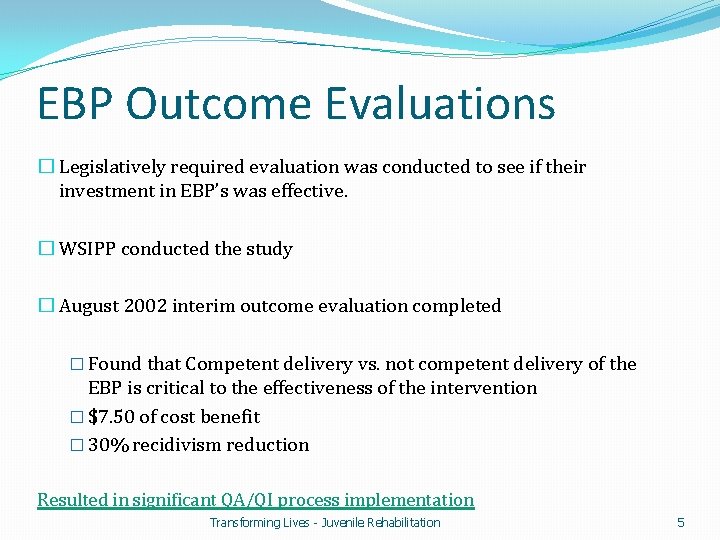
EBP Outcome Evaluations � Legislatively required evaluation was conducted to see if their investment in EBP’s was effective. � WSIPP conducted the study � August 2002 interim outcome evaluation completed � Found that Competent delivery vs. not competent delivery of the EBP is critical to the effectiveness of the intervention � $7. 50 of cost benefit � 30% recidivism reduction Resulted in significant QA/QI process implementation Transforming Lives - Juvenile Rehabilitation 5
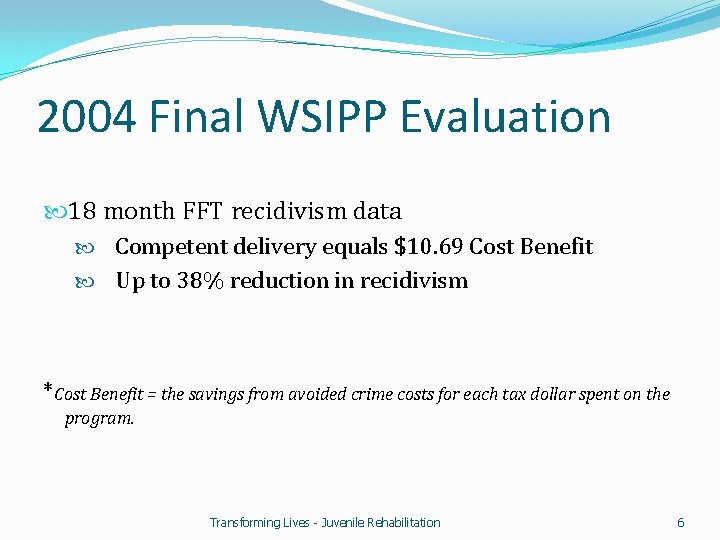
2004 Final WSIPP Evaluation 18 month FFT recidivism data Competent delivery equals $10. 69 Cost Benefit Up to 38% reduction in recidivism *Cost Benefit = the savings from avoided crime costs for each tax dollar spent on the program. Transforming Lives - Juvenile Rehabilitation 6
What does this mean for us in JR? At the same time that the Juvenile Court implementation of EBP’s occurred, the JR Integrated Treatment Model was being developed. In March 2001, WSIPP reported that parole was not effective and did not reduce recidivism. JR needed to define a parole program that would be considered “effective” and that would impact recidivism. Transforming Lives - Juvenile Rehabilitation 7
FFP Model Creation FFT Inc. contracted to develop model Based on core FFT principles Idea is to achieve same evidence based reduction for FFP with competent program delivery Transforming Lives - Juvenile Rehabilitation 8
Implementation � 2002 - all community staff trained in FFP �January 2003 statewide implementation �Interim Evaluation completed November 2006 �FFP Quality Assurance and Performance Improvement System released April 2009 Transforming Lives - Juvenile Rehabilitation 9
FFP Interim Evaluation – ’ 06 & ‘ 09 � 14. 6% reduction in felony crime rates for those youth who received the FFP intervention from a highly adherent parole counselor �Significantly fewer parole revocations (14. 7% reduction) as compared to traditional parole services �Highest risk youth received the most benefit from FFP �Parents and youth report improvements in their overall family functioning �Final evaluation completed in early 2009 �Interim findings sustained with final evaluation, not statistically significant Transforming Lives - Juvenile Rehabilitation 10
Research Results – FFT 2011 *Functional Family Therapy Programs in Washington State continue to produce high yields… FFT achieves a total benefit of $37, 739 per participant (2010 dollars) Benefits come from reduced juvenile crime, labor market and health care due to probability of high school graduation $8, 536 of the total benefit is to taxpayers $29, 203 accrues primarily for people not victimized by avoided crimes Cost benefit of $11. 86 99% likelihood of producing benefits that exceed costs *Steve Aos, et al. Return on Investment: Evidence-Based Options to Improve Statewide Outcomes – July 2011 Update. Washington State Institute for Public Policy, July 2011. Transforming Lives - Juvenile Rehabilitation 11
Research Results – FFP 2011 Functional Family Parole* in Washington State has been shown to: Significantly reduce the likelihood of youth re-arrest within nine months post release 21. 5% of FFP participants re-arrested as compared to 31. 9% for non-FFP youth (p<. 05) Significantly increase employment rates for youth participating in FFP 43. 9% of FFP participants working as compared to 29. 5 for non-FFP youth (p=. 005) *Barbara A. Lucenko, Ph. D, Lijian He, Ph. D, David Mancuso, Ph. D, and Barbara Felver, MES, MPA. Effects of Functional Family Parole on Re-Arrest and Employment for Youth in Washington State. October 2011 RDA Report 2. 24, Olympia, Washington. Transforming Lives - Juvenile Rehabilitation 12
Functional Family Parole January 2013: FFP designated as Evidence Based* with high fidelity implementation Research Based with average implementation $3. 24 cost benefit, from updated August 2014 WSIPP Cost Benefit Analysis *2012 Washington State Legislative House Bill 2536 Transforming Lives - Juvenile Rehabilitation 13
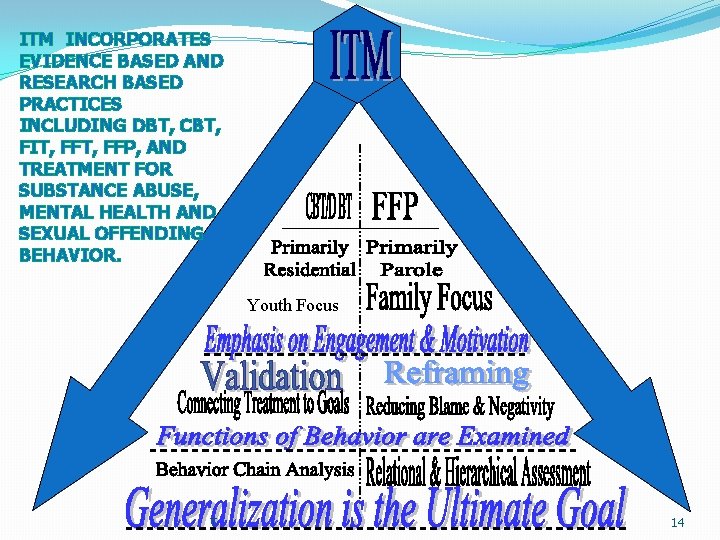
ITM INCORPORATES EVIDENCE BASED AND RESEARCH BASED PRACTICES INCLUDING DBT, CBT, FIT, FFP, AND TREATMENT FOR SUBSTANCE ABUSE, MENTAL HEALTH AND SEXUAL OFFENDING BEHAVIOR. Youth Focus T 14
Functional Family Parole Services Focuses on a relational and strength based way of thinking about change Targets more positive outcomes for youth and families Employs the family as the avenue for change Grounded in FFT principles and philosophy Transforming Lives - Juvenile Rehabilitation 15
FFP Philosophy… core principles �Balanced Alliance �Relational (Family) Focus �Strength Based �Respect �Matching Transforming Lives - Juvenile Rehabilitation 16
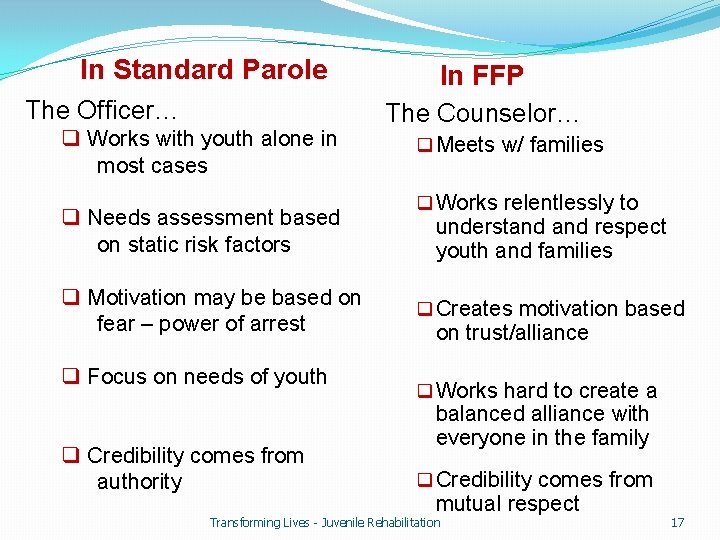
In Standard Parole The Officer… q Works with youth alone in most cases q Needs assessment based on static risk factors q Motivation may be based on fear – power of arrest q Focus on needs of youth q Credibility comes from authority In FFP The Counselor… q Meets w/ families q Works relentlessly to understand respect youth and families q Creates motivation based on trust/alliance q Works hard to create a balanced alliance with everyone in the family q Credibility comes from mutual respect Transforming Lives - Juvenile Rehabilitation 17
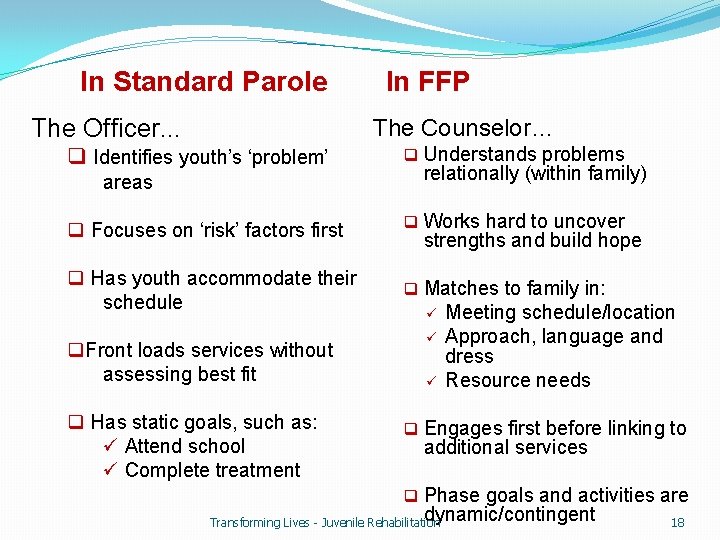
In Standard Parole The Officer… In FFP The Counselor… q Identifies youth’s ‘problem’ areas q Understands problems relationally (within family) q Focuses on ‘risk’ factors first q Works hard to uncover q Has youth accommodate their schedule q Matches to family in: q. Front loads services without assessing best fit q Has static goals, such as: ü Attend school ü Complete treatment strengths and build hope ü ü ü Meeting schedule/location Approach, language and dress Resource needs q Engages first before linking to additional services q Phase goals and activities are dynamic/contingent Transforming Lives - Juvenile Rehabilitation 18
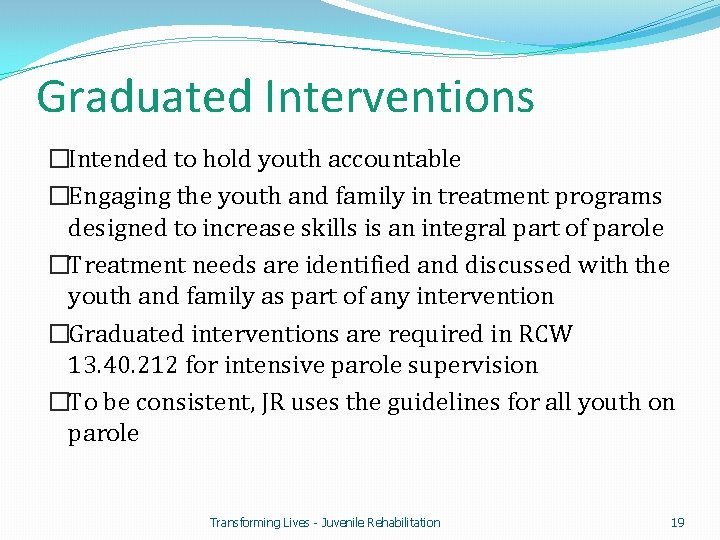
Graduated Interventions �Intended to hold youth accountable �Engaging the youth and family in treatment programs designed to increase skills is an integral part of parole �Treatment needs are identified and discussed with the youth and family as part of any intervention �Graduated interventions are required in RCW 13. 40. 212 for intensive parole supervision �To be consistent, JR uses the guidelines for all youth on parole Transforming Lives - Juvenile Rehabilitation 19
Transition is the process of moving through the JR continuum of care. Best Practice recommends family involvement from the very beginning. JR is committed to increasing family involvement in the planning for treatment , transitions through JR and reentry to the community, with or without parole. Transforming Lives - Juvenile Rehabilitation 20
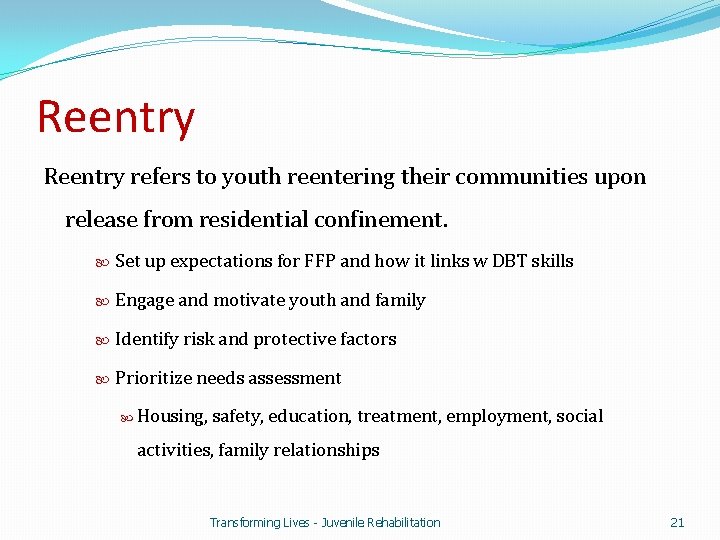
Reentry refers to youth reentering their communities upon release from residential confinement. Set up expectations for FFP and how it links w DBT skills Engage and motivate youth and family Identify risk and protective factors Prioritize needs assessment Housing, safety, education, treatment, employment, social activities, family relationships Transforming Lives - Juvenile Rehabilitation 21
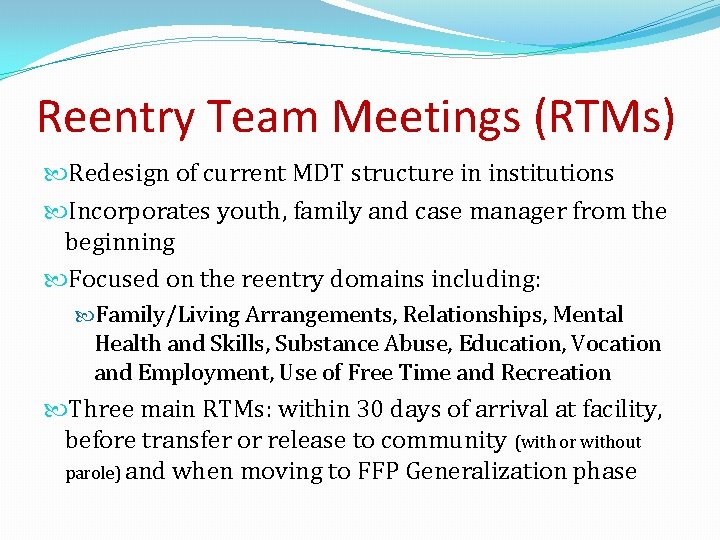
Reentry Team Meetings (RTMs) Redesign of current MDT structure in institutions Incorporates youth, family and case manager from the beginning Focused on the reentry domains including: Family/Living Arrangements, Relationships, Mental Health and Skills, Substance Abuse, Education, Vocation and Employment, Use of Free Time and Recreation Three main RTMs: within 30 days of arrival at facility, before transfer or release to community (with or without parole) and when moving to FFP Generalization phase
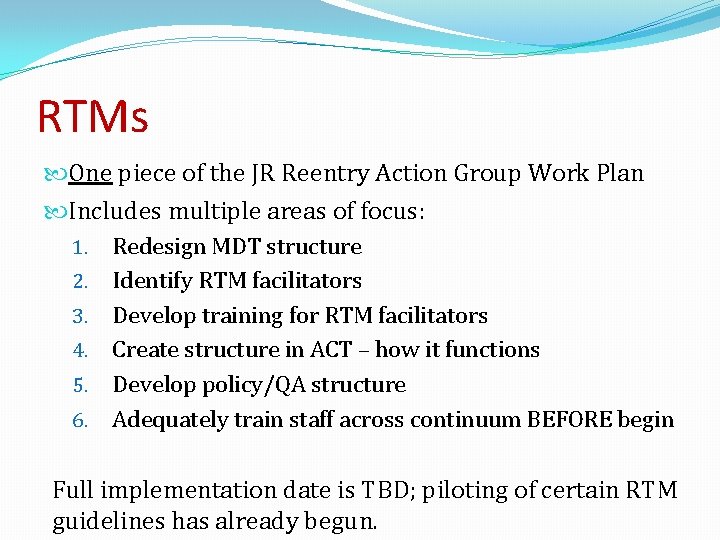
RTMs One piece of the JR Reentry Action Group Work Plan Includes multiple areas of focus: 1. Redesign MDT structure 2. Identify RTM facilitators 3. Develop training for RTM facilitators 4. Create structure in ACT – how it functions 5. Develop policy/QA structure 6. Adequately train staff across continuum BEFORE begin Full implementation date is TBD; piloting of certain RTM guidelines has already begun.
FFP - Family First Transforming Lives - Juvenile Rehabilitation 24
Advantages of family focus… Issues arise through family and can begin to be solved there With the family involved, changes can happen quicker. . . IF we can engage and motivate them Family can support youth more effectively than youth on his/her own Involvement is the first step toward persuasion… Transforming Lives - Juvenile Rehabilitation 25
MATCHING is a fundamental requisite for effectively engaging and changing families �Match to phase of your responsibility…Do the right thing at the right time �Match outcome goals to them: How can they become functional and positive within their own culture, communities, realities? �Match to clients do what it takes for them to feel you are working hard to respect and understand them, their language, norms, etc. mismatch results in “resistance” Transforming Lives - Juvenile Rehabilitation 26
What Good Case Management Should Do… �Engage and motivate youth and families to participate in services �Use Assessment to identify interventions and/or target change �Link youth and families to appropriate and effective interventions �Support youth and families throughout their participation in services �Monitor youth for parole compliance �When intervention ends, help maintain change � ensure youth and family finish parole in positive way Transforming Lives - Juvenile Rehabilitation 27
Contingent Case Management �Plan to Adapt with a Focus � � Adapt is the Match Focus is the FFP Principles – the ‘Lens’ �Make Decisions in the Moment that lead to: � � Progress on Phase Goals Maintenance of FFP Principles Desired Outcome in FFP �Consider Risk and Protective Factors �Be Creative, Respectful, Authentic Transforming Lives - Juvenile Rehabilitation 28
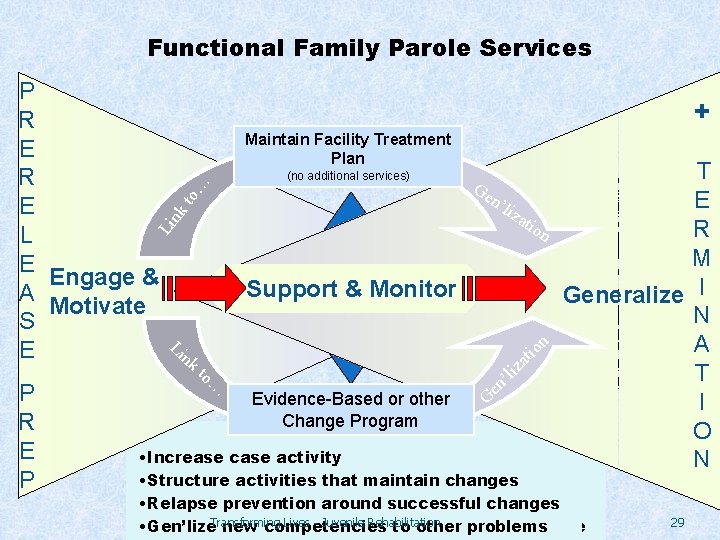
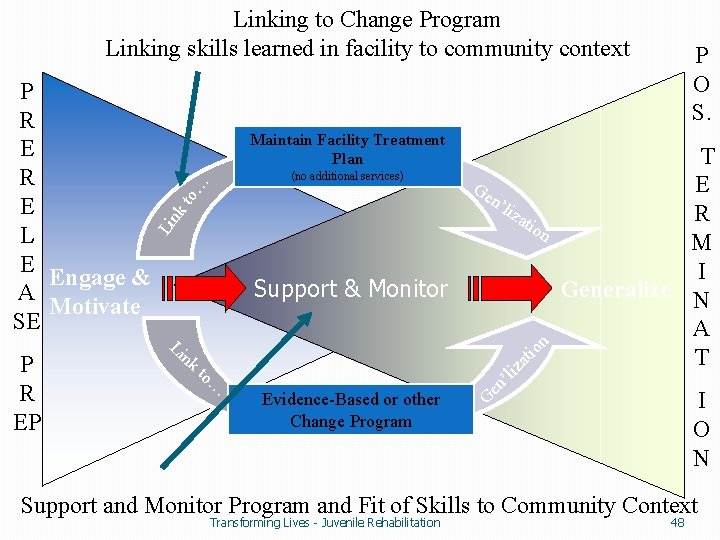
Functional Family Parole Services + nk to… Maintain Facility Treatment Plan Li P R E L E Engage & A Motivate S E P R E P Li nk to … T • Know • Set community individual and resources family G • e. Link family to appropriate n • ’Maintain/use Structuring Skills: expectations Provide family E community liprograms that fit family za tiodirection focused in initial family • Develop balanced contacts alliance R n learned in facility • Skills meetings • • matched Establish Locate community trust and credibility resources to family/community M that fit motivation risk/needs • Increase Interpersonal Skills: Validate; positive context 90 -95% retention; avg. I Support & meeting Monitor • Decrease hopelessness interpretation; reattribution; reframing; Generalize 8 contacts b/f and relational functions • • Understand family problem N Support family andcredibility. change • Eliminate barriers tosequence services agent n Skills: trust, Relationship warmth, A o i t tofamily • Move less active role • Understand relational a • Ensure program has effective trust, humor, individual iz non-blaming, functions l T ’ • Adaptn skills learned facility changeinprocess respect e G Evidence-Based or other to community/family context I (no additional services) Change Program • • Maintain generalize Increaseand case activity change • • Attribute to family Structurechange activities that maintain changes • • Use Community support Relapse prevention around successful changes Livesneeded - Juvenile Rehabilitation • • Identify resources toto maintain pos. change Gen’lize. Transforming new competencies other problems O N 29
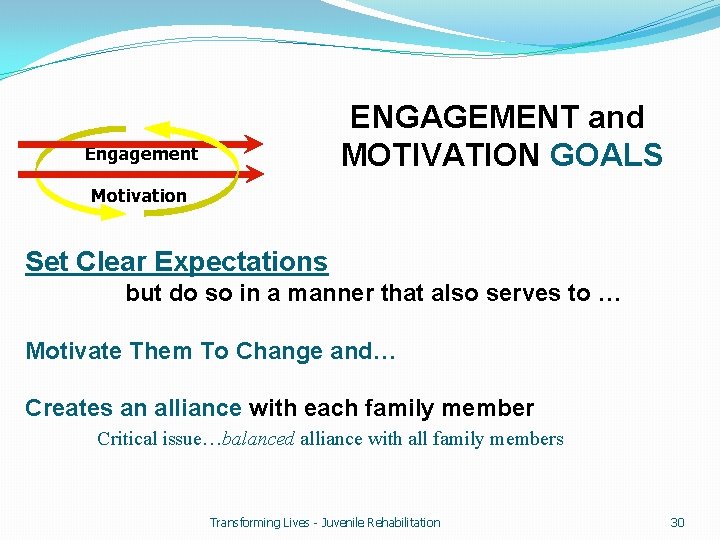
ENGAGEMENT and MOTIVATION GOALS Engagement Motivation Set Clear Expectations but do so in a manner that also serves to … Motivate Them To Change and… Creates an alliance with each family member Critical issue…balanced alliance with all family members Transforming Lives - Juvenile Rehabilitation 30
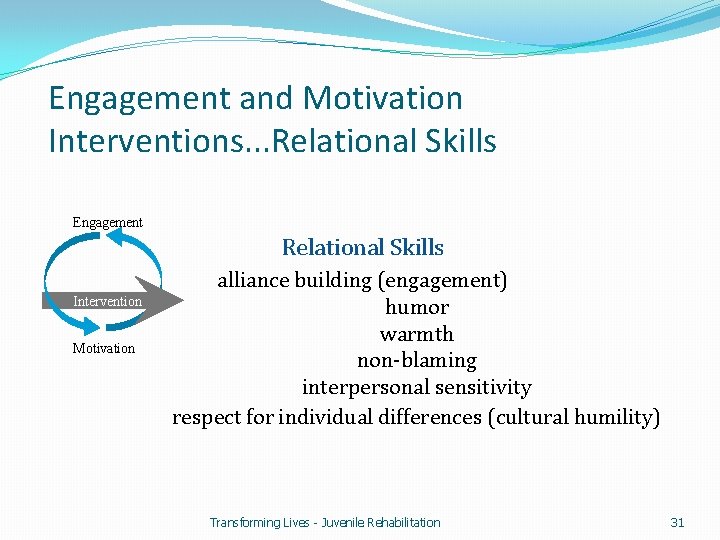
Engagement and Motivation Interventions. . . Relational Skills Engagement Relational Skills Intervention Motivation alliance building (engagement) humor warmth non-blaming interpersonal sensitivity respect for individual differences (cultural humility) Transforming Lives - Juvenile Rehabilitation 31
FFP Skills �Change Focus – from individual to relational � Relationship building – humor, curiosity, acknowledgement, strength based statements � Point processing � Sequencing � Interrupting/Diverting �Change Meaning – from blame and negativity to noble but misguided intent � Re-label � Reframe � Themes Transforming Lives - Juvenile Rehabilitation 32
Re-labels A re-label changes the “tone, ” description, or meaning of a behavior or feeling. It’s a quick switcheroo on words… “I can see how angry you are and wonder if you are a little sad too? ” “Could it be that the tears come from frustration and also a sense of loss? ” “When you yell at him, I wonder if you’re upset but also really scared? ” Transforming Lives - Juvenile Rehabilitation 33
REFRAMING Reframe to. . . reduce negativity and blame in immediate interactions refocus problem solutions develop organizing thread/problem definition By changing the causal attribution (meaning) of. . . emotions behaviors problem definitions focus (from individual to relational) So they will be willing to try something new with less negative emotions and fewer blaming interactions…thus increased motivation. Transforming Lives - Juvenile Rehabilitation 34
What is Reframing? Reframing is an Interpersonal Process in which the you take the lead in suggesting that a problem behavior may not necessarily only have a malevolent motive; instead it could also include a more positive (but very misguided) intent. Transforming Lives - Juvenile Rehabilitation 35
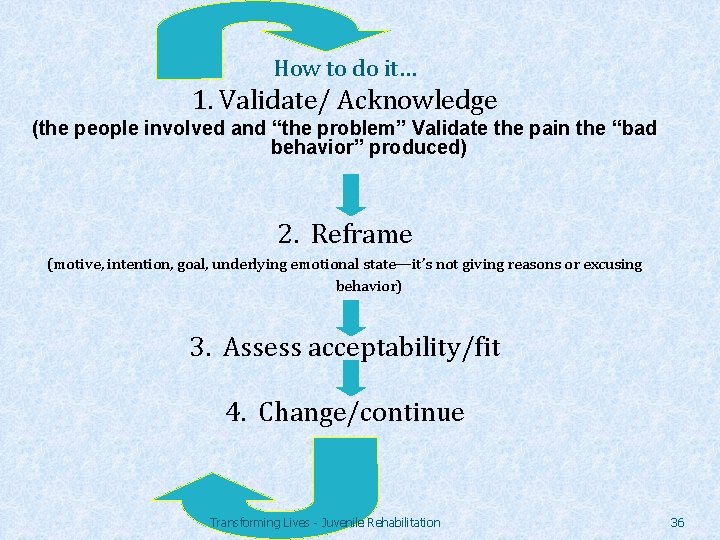
How to do it… 1. Validate/ Acknowledge (the people involved and “the problem” Validate the pain the “bad behavior” produced) 2. Reframe (motive, intention, goal, underlying emotional state—it’s not giving reasons or excusing behavior) 3. Assess acceptability/fit 4. Change/continue Transforming Lives - Juvenile Rehabilitation 36
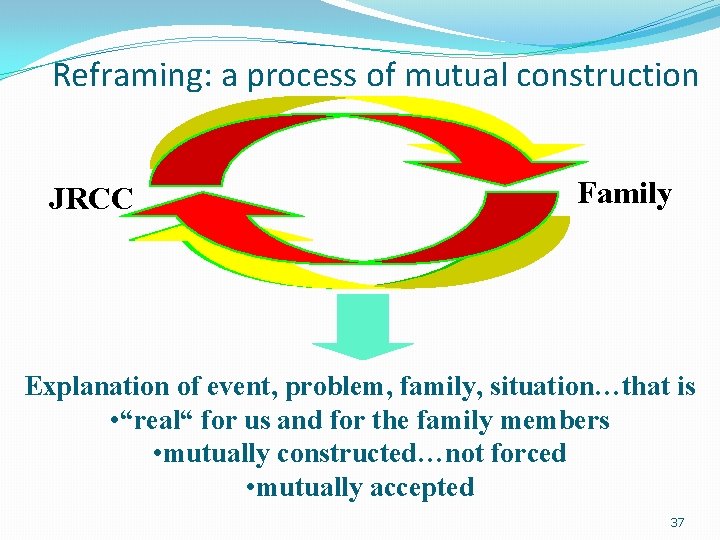
Reframing: a process of mutual construction JRCC Family Explanation of event, problem, family, situation…that is • “real“ for us and for the family members • mutually constructed…not forced • mutually accepted 37
What Are Themes? Themes describe problematic patterns of behavior, and/or relationships, in a way that suggests they may be motivated by positive (but very misguided) intent(s). Themes provide new “explanations” of problematic and painful experiences that provide hope for the future and give family members a reason to follow through or “stick with” a change process. Transforming Lives - Juvenile Rehabilitation 38
Themes Ø Because they are more global than reframes, themes are often easier to develop. Ø Compared to reframes, themes are broader, more inclusive, they link everyone together. Ø Themes offer a HOPEFUL WAY to experience the past and to set the stage for the future. Transforming Lives - Juvenile Rehabilitation 39
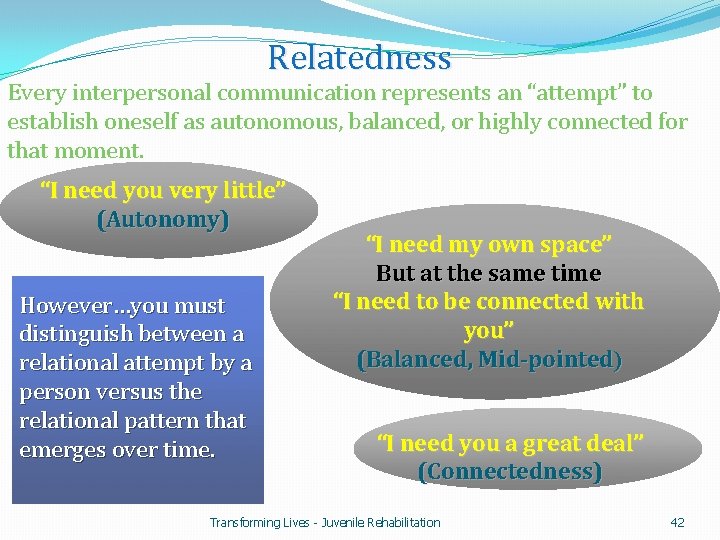
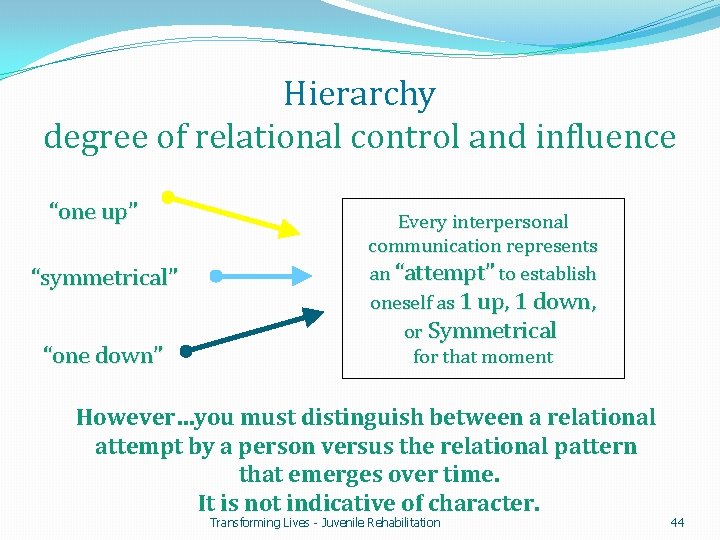
Relational “Functions” “Space between” people can best be explained by: When X relates to Y, the typical relational pattern (behavioral sequence within the relationship ) is characterized by degrees of: Relatedness…. contact vs. distance and Hierarchy…. relational control/influence Goal is to understand use the information. Attempting to change these basic motivational components of human behavior in just a few meetings is clinically impossible and unethical. Transforming Lives - Juvenile Rehabilitation 40
How relational assessments help… Relational thinking Effectively “match to” Identify treatment and service recommendations that are obtainable for the family Understand how family might: react to referrals, share or report info, follow-though with interventions Transforming Lives - Juvenile Rehabilitation 41
Relatedness Every interpersonal communication represents an “attempt” to establish oneself as autonomous, balanced, or highly connected for that moment. “I need you very little” (Autonomy) However…you must distinguish between a relational attempt by a person versus the relational pattern that emerges over time. “I need my own space” But at the same time “I need to be connected with you” (Balanced, Mid-pointed) “I need you a great deal” (Connectedness) Transforming Lives - Juvenile Rehabilitation 42
Relatedness Caveats Not quantifying how much they love each other Both healthy and unhealthy interactions can achieve all three relational functions No assumption that one relational function is healthiest…respect all functions Transforming Lives - Juvenile Rehabilitation 43
Hierarchy degree of relational control and influence “one up” “symmetrical” “one down” Every interpersonal communication represents an “attempt” to establish oneself as 1 up, 1 down, or Symmetrical for that moment However…you must distinguish between a relational attempt by a person versus the relational pattern that emerges over time. It is not indicative of character. Transforming Lives - Juvenile Rehabilitation 44
Hierarchy Caveats More than just compliance Assessment of who has influence over behavior What happens when a parent and child cannot agree on curfew? Does the child come home when they want to (one up) or do they follow the curfew set by parent (one down or at least symmetrical)? Must consider relational influence over family resources such as transportation, finances, food, etc. Does parent depend on youth to drive them back and forth to work and for youth to pay house bills? Transforming Lives - Juvenile Rehabilitation 45
Resistance indicates that one or more members do not experience that the current process will benefit them Transforming Lives - Juvenile Rehabilitation 46
Engagement and Motivation Outcomes of these goals… Family motivated to continue…because they… �Have a different “experience” � Not the same at home � Less negativity and blaming of each other � Increased hope � A relationally focused problem – a sense of ‘we all have a part in this’ �Worked with someone who � helped to overcome obstacles to community transition or therapy � was a credible helper � was available �Have an expectation for the “possibility” of change Transforming Lives - Juvenile Rehabilitation 47
Linking to Change Program Linking skills learned in facility to community context Maintain Facility Treatment Plan to… (no additional services) P R EP Ge nk n’l Li P R E L E Engage & A Motivate SE iza tio n Support & Monitor Li nk n tio a l’ iz to … Evidence-Based or other Change Program P O S. T E R M I Generalize N A T en G I O N Support and Monitor Program and Fit of Skills to Community Context Transforming Lives - Juvenile Rehabilitation 48
Linking… Identifying and Accessing Community Resources Parole counselors are ‘experts’ in their communities with knowing resources and how to access them Parole staff should have many contacts and relationships across numerous communities BUT… resources and community contacts don’t just appear Locating and securing resources takes conscious, concerted, on-going and organized effort At a minimum, it requires networking, relationships, research and outreach to identify services, programs, individuals, groups, resources and funding, etc. within a community Transforming Lives - Juvenile Rehabilitation 49
So how a service or referral begins… How helpful the JRCC is in making sure the intervention gets off on the right track can make all the difference… Anticipate logistical obstacles (transport, scheduling, etc. ) Anticipate programmatic barriers (culture, match to, etc. ) Remember: resistance indicates one or more members do not experience the current process will benefit them Transforming Lives - Juvenile Rehabilitation 50
To Consider when Linking to services: Match to family and core needs using relational assessments Don’t overwhelm with too many resources at once Consider history Consider ‘Gateway’ intervention Think several interventions out… Help with logistics - use relational assessments Drop out increases risk Consider risk and protective factors Consider individual/family/environmental risks Best Practice/Evidence Based approaches Transforming Lives - Juvenile Rehabilitation 51
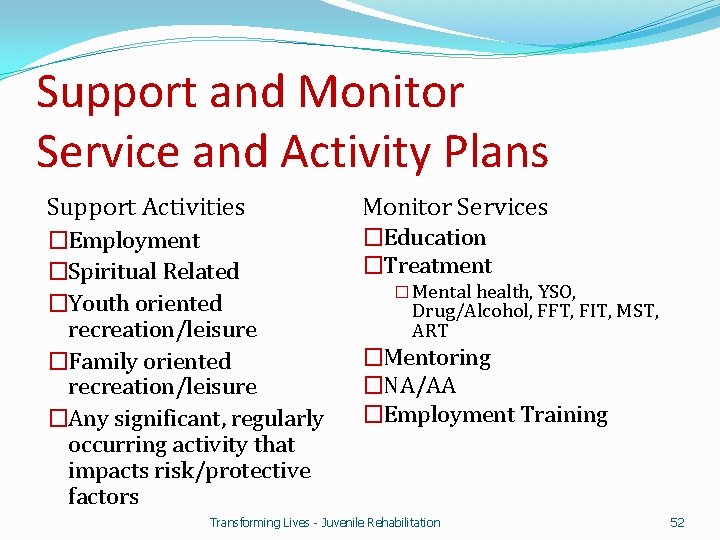
Support and Monitor Service and Activity Plans Support Activities Monitor Services �Employment �Spiritual Related �Youth oriented recreation/leisure �Family oriented recreation/leisure �Any significant, regularly occurring activity that impacts risk/protective factors �Education �Treatment � Mental health, YSO, Drug/Alcohol, FFT, FIT, MST, ART �Mentoring �NA/AA �Employment Training Transforming Lives - Juvenile Rehabilitation 52
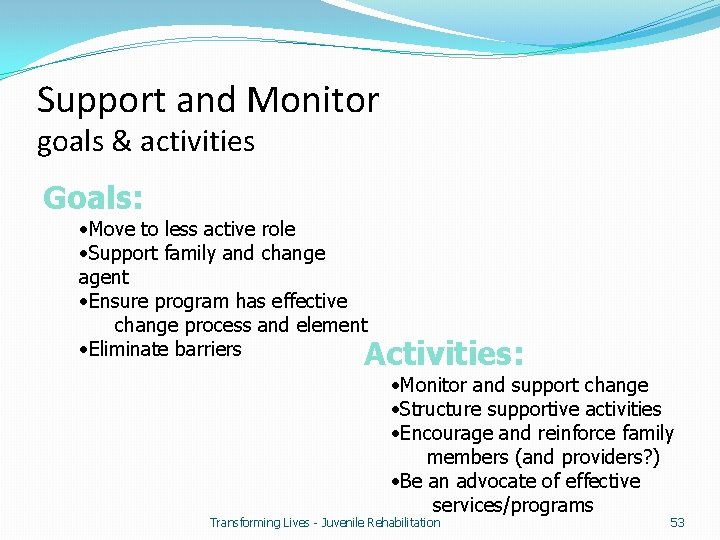
Support and Monitor goals & activities Goals: • Move to less active role • Support family and change agent • Ensure program has effective change process and element • Eliminate barriers Activities: • Monitor and support change • Structure supportive activities • Encourage and reinforce family members (and providers? ) • Be an advocate of effective services/programs Transforming Lives - Juvenile Rehabilitation 53
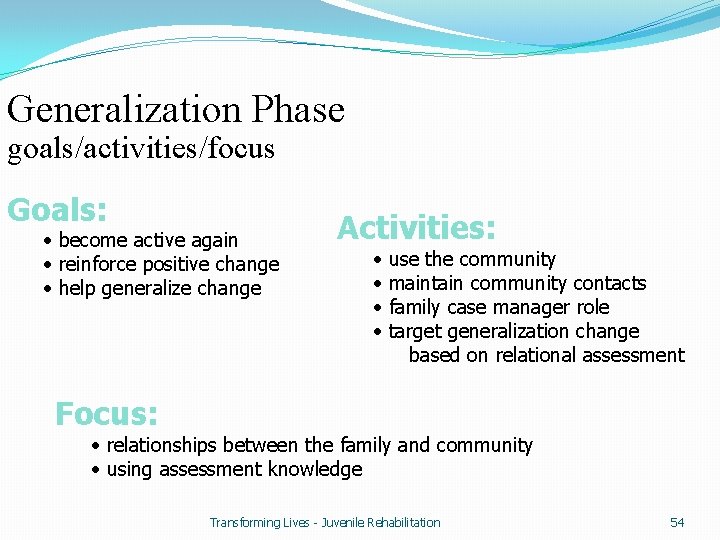
Generalization Phase goals/activities/focus Goals: • become active again • reinforce positive change • help generalize change Activities: • • use the community maintain community contacts family case manager role target generalization change based on relational assessment Focus: • relationships between the family and community • using assessment knowledge Transforming Lives - Juvenile Rehabilitation 54
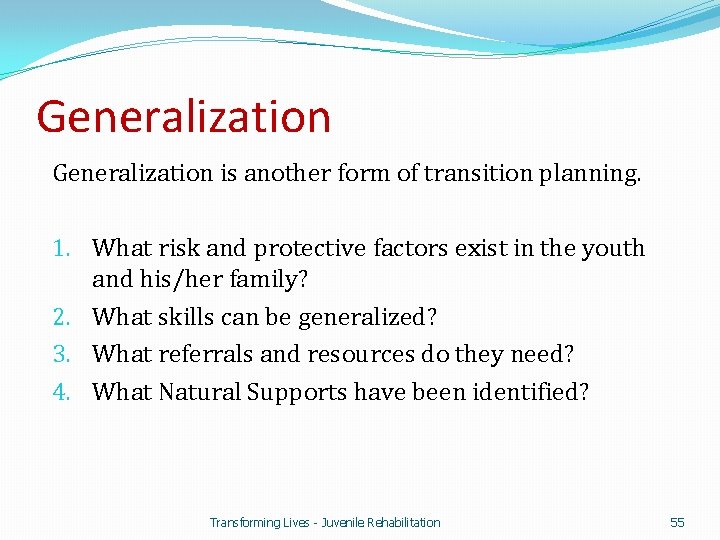
Generalization is another form of transition planning. 1. What risk and protective factors exist in the youth and his/her family? 2. What skills can be generalized? 3. What referrals and resources do they need? 4. What Natural Supports have been identified? Transforming Lives - Juvenile Rehabilitation 55
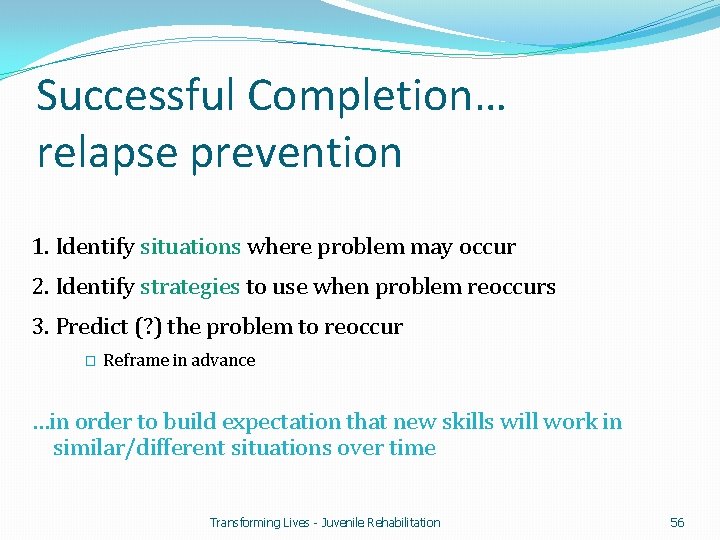
Successful Completion… relapse prevention 1. Identify situations where problem may occur 2. Identify strategies to use when problem reoccurs 3. Predict (? ) the problem to reoccur � Reframe in advance …in order to build expectation that new skills will work in similar/different situations over time Transforming Lives - Juvenile Rehabilitation 56
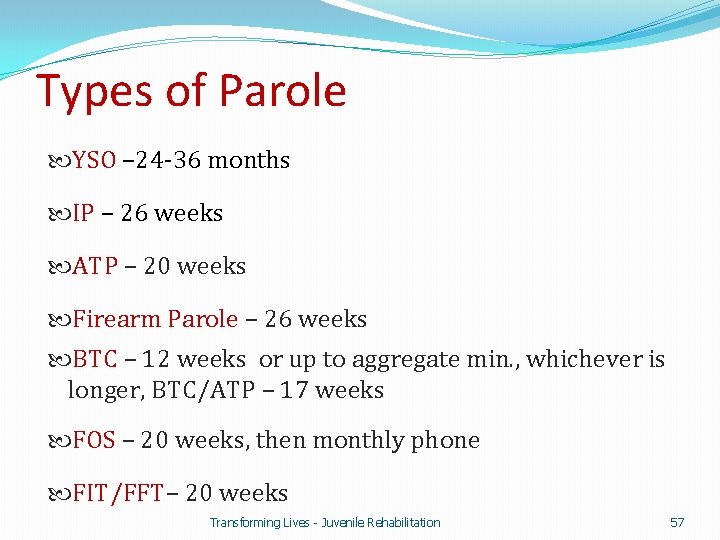
Types of Parole YSO – 24 -36 months IP – 26 weeks ATP – 20 weeks Firearm Parole – 26 weeks BTC – 12 weeks or up to aggregate min. , whichever is longer, BTC/ATP – 17 weeks FOS – 20 weeks, then monthly phone FIT/FFT– 20 weeks Transforming Lives - Juvenile Rehabilitation 57
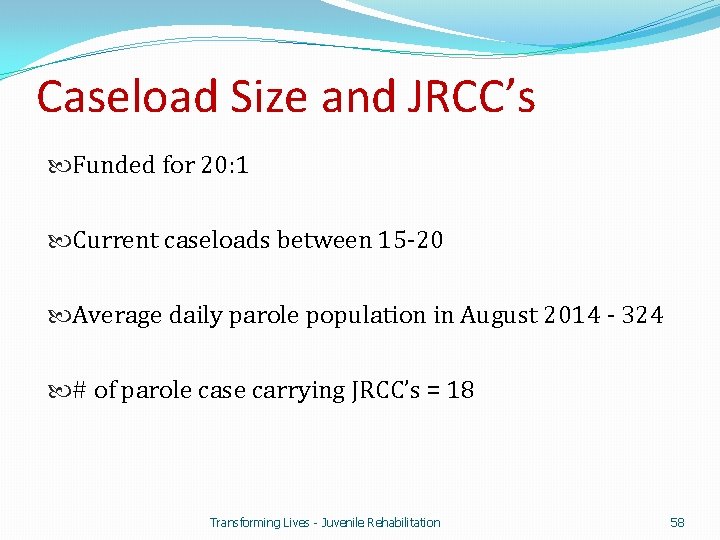
Caseload Size and JRCC’s Funded for 20: 1 Current caseloads between 15 -20 Average daily parole population in August 2014 - 324 # of parole case carrying JRCC’s = 18 Transforming Lives - Juvenile Rehabilitation 58
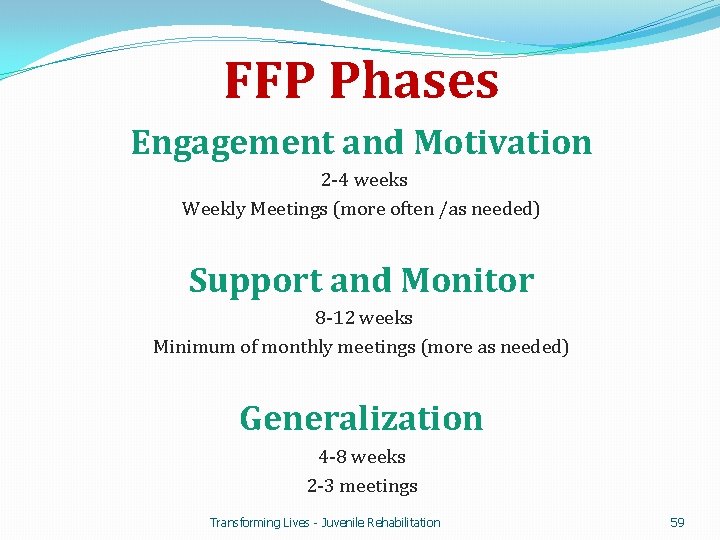
FFP Phases Engagement and Motivation 2 -4 weeks Weekly Meetings (more often /as needed) Support and Monitor 8 -12 weeks Minimum of monthly meetings (more as needed) Generalization 4 -8 weeks 2 -3 meetings Transforming Lives - Juvenile Rehabilitation 59
For More Information… Laurie Hart, FFP/FFT QA Program Administrator (509)225 -7925, hartla@dshs. wa. gov FFP Consultants: R 1 – Melisa Majnarich and Kelsey Hawk R 2 – Jeff Merritt and Melissa Wayman R 3 – Damon Vaden, Jeremy Kochrian and Megan Fiscus JR Home Page/Library/Parole Desk Manual Transforming Lives - Juvenile Rehabilitation 60